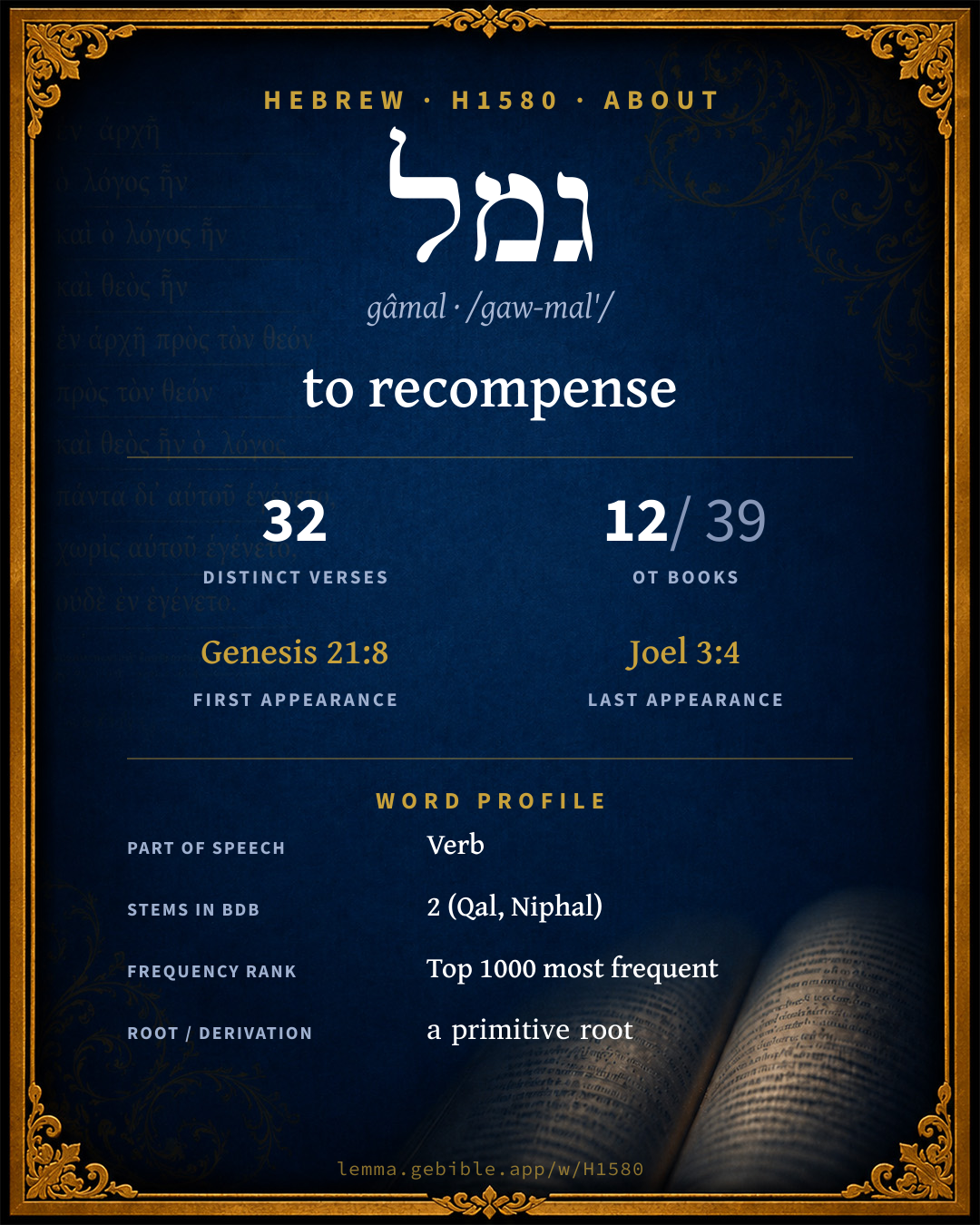
גָּמַל
to recompense
‘to recompense’ is one of 3 main senses fuller range ↓
Full lexicon entry — Brown-Driver-Briggs (BDB)
From Brown-Driver-Briggs (BDB)
Where this word appears
See every Qal verb in the Hebrew Bible →
Grammar key — what these labels mean
Part of speech
- Verb
- An action or state-of-being word.
Stem
- Qal
- The basic, simple active stem — the plain form of the verb (“he wrote”). Here: ‘deal out to’
- Niphal
- Usually the simple passive or reflexive of the Qal (“he was written”).
Form
- Imperfect
- An incomplete, ongoing, or future action (“he will / would write”).
- Perfect
- A completed action or state — Hebrew marks aspect (completeness) more than strict tense (“he wrote”).
- Participle Active
- A verbal adjective expressing ongoing or characteristic action (“writing / one who writes”).
- Sequential Imperfect
- An imperfect with prefixed waw — the standard past-narrative form (waw-consecutive imperfect).
- Participle Passive
- A verbal adjective expressing action received (“written”).
- Infinitive Construct
- A bound verbal noun, frequently with prepositions (“to write / in writing”).
- Imperative
- A direct command (“write!”).
State
- Absolute
- The independent form of a noun, not bound to a following word.
- Construct
- A noun bound to a following noun in a possessive / “of” relationship (the construct chain).
Person
- 3rd Person
- The one spoken about (“he / she / it / they”).
- 2nd Person
- The one addressed (“you”).
- 1st Person
- The speaker (“I / we”).
Gender
- Masculine
- Grammatically masculine.
- Feminine
- Grammatically feminine.
- Common
- Either gender — not distinguished for this form.
Number
- Singular
- One.
- Plural
- More than one (in Hebrew, generally three or more).
30 distinct verses where H1580 appears in the Qal stem, across 12 books. Filtered view — show all forms. Click any verse to open its interlinear word-by-word view. Verse text shown in the World English Bible for context — . Each verse’s Hebrew form is shown with its reference; the English is not keyword-highlighted, since the data carries no word-level English alignment. Use “Compare translations” on any verse to read it across multiple English versions. This concordance covers the Hebrew Bible; Septuagint (Greek Old Testament) occurrences are not indexed here.
Genesis 2 verses
- Genesis 50:15 גָּמַ֖לְנוּ Qal pf 1cp When Joseph's brothers saw that their father was dead, they said, "It may be that Joseph will hate us, and will fully pay us back for all of the evil which we did to him.
- Genesis 50:17 גְמָל֔וּ/ךָ Qal pf 3cp + sfx pers 2ms "So you shall tell Joseph, 'Now please forgive the disobedience of your brothers, and their sin, because they did evil to you.' Now, please forgive the disobedience of the servants of the God of your father." Joseph wept when they spoke to him.
Numbers 1 verse
Deuteronomy 1 verse
1 Samuel 3 verses
- 1 Samuel 1:23 גָּמְלֵ֣/ךְ גָּמְלָ֖/הּ Qal inf.cs + sfx pers 2fs Qal inf.cs + sfx pers 3fs Elkanah her husband said to her, Do what seems you good; wait until you have weaned him; only Yahweh establish his word. So the woman waited and nursed her son, until she weaned him.
- 1 Samuel 1:24 גְּמָלַ֗תּ/וּ Qal pf 3fs + sfx pers 3ms When she had weaned him, she took him up with her, with three bulls, and one ephah of meal, and a bottle of wine, and brought him to the house of Yahweh in Shiloh: and the child was young.
- 1 Samuel 24:17 גְּמַלְתַּ֣/נִי גְּמַלְתִּ֥י/ךָ Qal pf 2ms + sfx pers 1cs Qal pf 1cs + sfx pers 2ms He said to David, You are more righteous than I; for you have rendered to me good, whereas I have rendered to you evil.
2 Samuel 2 verses
- 2 Samuel 19:36 יִגְמְלֵ֣/נִי Qal impf 3ms + sfx pers 1cs Your servant would but just go over the Jordan with the king: and why should the king recompense it me with such a reward?
- 2 Samuel 22:21 יִגְמְלֵ֥/נִי Qal impf 3ms + sfx pers 1cs Yahweh rewarded me according to my righteousness; According to the cleanness of my hands has he recompensed me.
1 Kings 1 verse
2 Chronicles 1 verse
Psalms 9 verses
- Psalms 7:4 גָּ֭מַלְתִּי Qal pf 1cs If I have rewarded evil to him who was at peace with me (Yes, I have delivered him who without cause was my adversary),
- Psalms 13:6 גָמַ֣ל Qal pf 3ms I will sing to Yahweh, Because he has been good to me.
- Psalms 18:20 יִגְמְלֵ֣/נִי Qal impf 3ms + sfx pers 1cs Yahweh has rewarded me according to my righteousness. According to the cleanness of my hands has he recompensed me.
- Psalms 103:10 גָּמַ֥ל Qal pf 3ms He has not dealt with us according to our sins, Nor repaid us for our iniquities.
- Psalms 116:7 גָּמַ֥ל Qal pf 3ms Return to your rest, my soul, For Yahweh has dealt bountifully with you.
- Psalms 119:17 גְּמֹ֖ל Qal impv 2ms Do good to your servant. I will live and I will obey your word.
- Psalms 131:2 כְּ֭/גָמֻל כַּ/גָּמֻ֖ל prep + Qal ptcp.pass ms prep det + Qal ptcp.pass ms Surely I have stilled and quieted my soul, Like a weaned child with his mother, Like a weaned child is my soul within me.
- Psalms 137:8 שֶׁ/גָּמַ֥לְתְּ ptcl rel + Qal pf 2fs Daughter of Babylon, doomed to destruction, He will be happy who rewards you, As you have served us.
- Psalms 142:7 תִגְמֹ֣ל Qal impf 2ms Bring my soul out of prison, That I may give thanks to your name. The righteous will surround me, For you will be good to me.
Proverbs 3 verses
- Proverbs 3:30 גְמָלְ/ךָ֣ Qal pf 3ms + sfx pers 2ms Don't strive with a man without cause, If he has done you no harm.
- Proverbs 11:17 גֹּמֵ֣ל Qal ptcp.act ms The merciful man does good to his own soul, But he who is cruel troubles his own flesh.
- Proverbs 31:12 גְּמָלַ֣תְ/הוּ Qal pf 3fs + sfx pers 3ms She does him good, and not harm, All the days of her life.
Isaiah 5 verses
- Isaiah 3:9 גָמְל֥וּ Qal pf 3cp The look of their faces testify against them. They parade their sin like Sodom. They don't hide it. Woe to their soul! For they have brought disaster upon themselves.
- Isaiah 11:8 גָּמ֖וּל Qal ptcp.pass ms The sucking child shall play on the hole of the asp, and the weaned child shall put his hand on the adder's den.
- Isaiah 18:5 גֹּמֵ֖ל Qal ptcp.act ms For before the harvest, when the blossom is over, and the flower becomes a ripening grape, he will cut off the sprigs with pruning-hooks, and the spreading branches will he take away [and] cut down.
- Isaiah 28:9 גְּמוּלֵי֙ Qal ptcp.pass mp cs Whom will he teach knowledge? and whom will he make to understand the message? those who are weaned from the milk, and drawn from the breasts?
- Isaiah 63:7 גְּמָלָ֖/נוּ גְּמָלָ֥/ם Qal pf 3ms + sfx pers 1cp Qal pf 3ms + sfx pers 3mp I will make mention of the loving kindnesses of Yahweh, [and] the praises of Yahweh, according to all that Yahweh has bestowed on us, and the great goodness toward the house of Israel, which he has bestowed on them according to his mercies, and according to the multitude of his loving kindnesses.
Hosea 1 verse
Joel 1 verse
About this entry
At a glance — auto-summarized from this page’s data, not written by a person. Every figure links to its source below. This summary describes the numbers; it doesn’t interpret them.
At its core, גמל (gâmal) means “to recompense.” It first appears in Genesis 21:8. Spanning 32 verses in 12 books, it ranks among the moderately common words of the Hebrew Bible. Its uses concentrate in Psalms (28% of all occurrences). As a verb its force shifts by stem, across 2 stems (Qal, Niphal, and more). Each statement above links to its evidence; the full detail follows below.
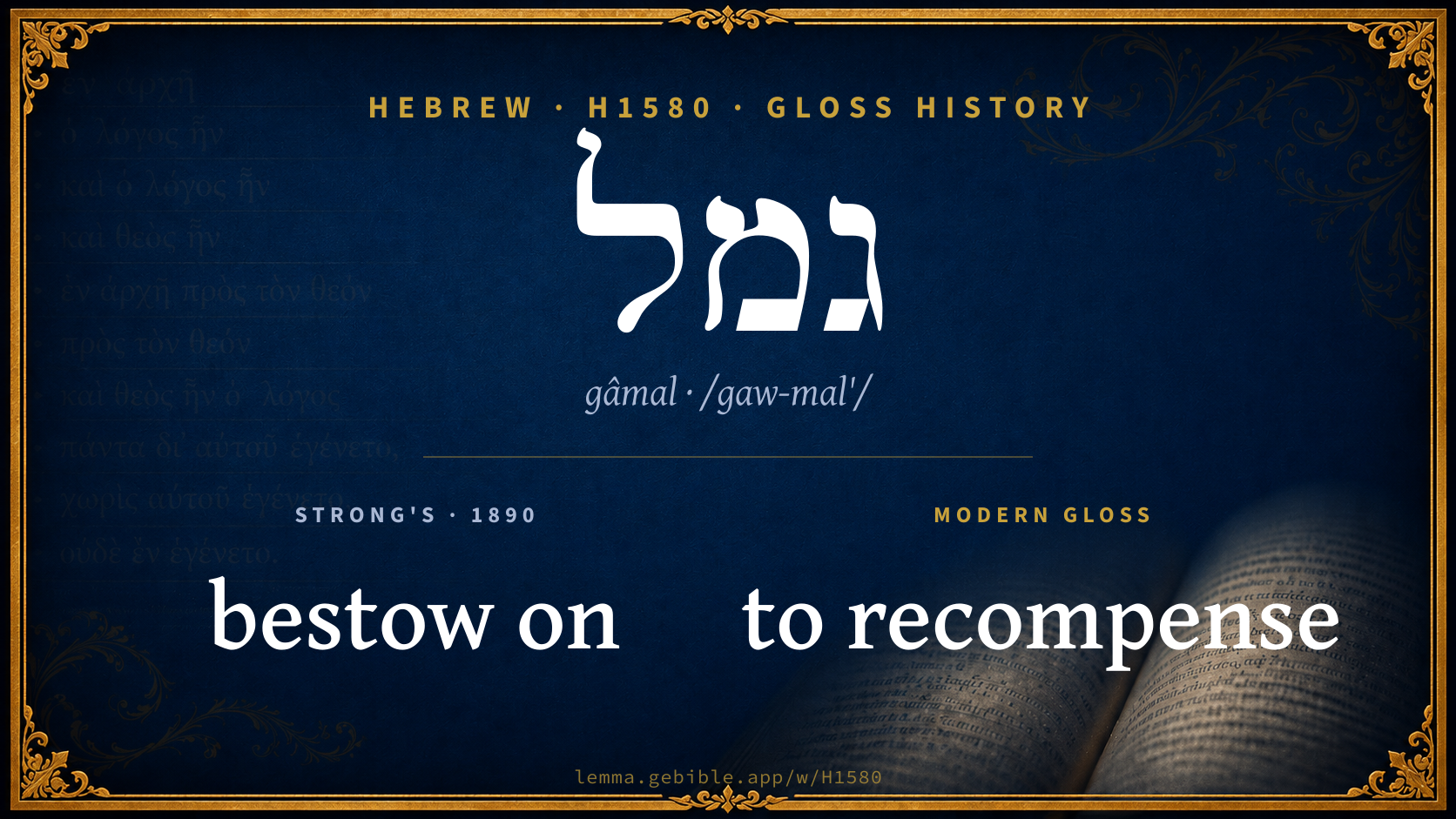
Gloss history
Strong's 1890 vs modern scholarship
About this word
Strong's H1580 catalogs a Hebrew word from the Hebrew Old Testament.
These counts are not copied from any lexicon or concordance. They are computed here, from the morphology-tagged Hebrew Old Testament. What Lemma adds →
- 32
- distinct verses
- The word appears in 32 distinct verses.
- 12 / 39
- OT books
- The word appears in 12 of 39 Old Testament books.
- #967
- by frequency
- Top 1000 most frequent Hebrew words (rank 967 of 8,640 Hebrew words by occurrence).
View all 32 occurrences in the concordance →
By section of the Old Testament
By traditional corpus
Conventional, traditional groupings — biblical authorship is debated, so this is a traditional corpus grouping, not an authorship claim. Each share is this word’s portion of its verses in that division of the Hebrew canon. Each figure is a share of the word’s 32 distinct verses.
- Prophets (Nevi'im) 14 verses · 44%
- Writings (Ketuvim) 13 verses · 41%
- Torah (Pentateuch) 5 verses · 16%
How translations render this word
Counts come from each version’s own published word-to-Strong’s tagging or interlinear alignment — an approximate guide to how each version renders this word, not a word-level alignment the data otherwise carries. Because each total is that version’s own tagged count, the per-version totals vary from one another and need not match the appearance or distinct-verse counts above. These counts may also differ from a printed concordance because Lemma counts each distinctly tagged rendering and does not collapse phrase taggings into a single head-word total. This is a fixed set of word-tagged versions (KJV, ASV, BSB, ULT) and does not change with the reading translation you choose elsewhere. Each version’s license is shown beside its name below (and on Sources).
- King James Version: Rewarded 3×, Was weaned 2×
- American Standard Version: Rewarded 2×, Was weaned 2×
- Berean Standard Bible: Has rewarded me 2×, Like a weaned child 2×, Was weaned 2×
- unfoldingWord Literal Text: Did 2×, Has rewarded me 2×, Like a weaned child 2×
King James Version Public Domain
Renders H1580 across 37 tagged occurrences — most commonly:
Plus 32 renderings that appear only once — usually multi-word phrases or single function words the recovered tagging swept in, not distinct renderings.
American Standard Version Public Domain
Renders H1580 across 37 tagged occurrences — most commonly:
Plus 33 renderings that appear only once — usually multi-word phrases or single function words the recovered tagging swept in, not distinct renderings.
Berean Standard Bible Public Domain
Renders H1580 across 36 tagged occurrences — most commonly:
Plus 30 renderings that appear only once — usually multi-word phrases or single function words the recovered tagging swept in, not distinct renderings. Not rendered by a distinct English word in 1 further occurrence.
unfoldingWord Literal Text CC BY-SA 4.0
Renders H1580 across 45 tagged occurrences — most commonly:
Plus 35 renderings that appear only once — usually multi-word phrases or single function words the recovered tagging swept in, not distinct renderings.
10 senses and sub-senses in the full BDB
Hebrew verbs can shift meaning by stem (binyan): Qal is the basic action, Niphal is often passive or reflexive, Piel often intensifies or makes it factitive, and Hiphil is typically causative. The senses below are grouped under the stem BDB assigns to each.
What do BDB’s symbols mean?
BDB uses these scholarly abbreviations:
| Symbol | Meaning |
|---|---|
| 𝔊 | the Septuagint (the ancient Greek translation, LXX) |
| 𝔙 | the Vulgate (the Latin translation) |
| 𝔖 | the Syriac version (the Peshitta) |
| 𝔗 | the Targum (the Aramaic translation) |
| ψ | the Psalms |
| √ | root (the underlying root or stem) |
| ‖ | parallel passage (a synonymous or contrasted parallel) |
| † | the dagger: every passage where the word occurs is cited |
The 10 senses and sub-senses the full Brown-Driver-Briggs lexicon distinguishes for this word, in lexicon order (not ranked by frequency), with BDB’s own verbatim wording and sub-sense lettering. Shown in Hebrew script with BDB’s own scholarly abbreviations. The condensed entry is in the Lexicon Entry tab. See also the Forms in the corpus table below.
- 1. deal fully or adequately with, deal out to.
- 2. wean.
- 3. ripen (Assyrian gamâlu, deal with, benefit, e.g. VR 35:19; NH גָּמַל, Aramaic גְּמַל; v. Palm. n.pr. אגמלא Vog.No. 124, Nab.n.pr.f. גמלת Vog.Nab. sub No. 7; perhaps orig. complete, accomplish, cogn. גמר;—Arabic جَمَلَ is collect, جَمُلَ / جَمِلَ be beautiful, goodly)— e.g. 2 Chronicles 35:19
Qal
- Pf. ψ 13:6 +; Impf. יִגְמֹל Nu 17:23 +; Imv. גְּמֹל ψ 119:17; Inf. גָּמְלֵךְ, גָּמְלָהּ 1 S 1:23; Pt. גֹּמֵל Pr 11:17 +; pass. גָּמוּל Is 11:8; גָּמֻל ψ 131:2(×2);— e.g. Psalms 13:6
- 1.
- a. deal out to, do to, c. 2 acc. גְּמָלַתְהוּ טוֹב וְלֹא רָע she doeth him good and not evil Pr 31:12; כִּי אַתָּה גְּמַלְתַּנִי הַטּוֹבָה וַאֲנִי גְּמַלְתִּיךָ הָֽרָעָה for thou hast done unto me the good but I have done unto thee the evil 1 S 24:18; do evil (ה)רע unto Gn 50:15, 17 Pr 3:30; c. לְ pers. Is 3:9; do good unto, 2 acc. Is 63:7(×2); cf. also גֹּמֵל נַפְשׁוֹ אִישׁ חֶסֶד Pr 11:17. e.g. Proverbs 31:12
- b. with עַל pers. deal bountifully with ψ 13:6; 116:7; 119:17; 142:8; c. acc. pers. reward 2 S 22:21 (= ψ 18:21), perhaps also לָמָּה יִגְמְלֵנִי הַגְּמוּלָה הַזֹּאת why should he reward me with this reward? 2 S 19:37. e.g. Psalms 13:6
- c. recompense, repay, requite, in a bad sense, with 2 acc. ψ 7:5; with לְ pers. Dt 32:6 ψ 137:8; with עַל pers. 2 Ch. 20:11 ψ 103:10 Jo 4:4. e.g. Psalms 7:5
- 2. wean a child (complete his nursing) 1 S 1:23(×2), 24 1 K 11:20 Ho 1:8; גָּמוּל weaned child ψ 131:2(×2) Is 11:8; גְּמוּלֵי מֵחָלָב weaned from milk Is 28:9. e.g. 1 Samuel 1:23
- 3. trans. ripen, bear ripe (almonds) Nu 17:23; intrans. become ripe (grapes) Is 18:5. e.g. Numbers 17:23
Niphal
- Impf. יִגָּמֵל 1 S 1:22; וַיִּגָּמַ֑ל Gn 21:8; Inf. הִגָּמֵל Gn 21:8;—be weaned. e.g. 1 Samuel 1:22
Senses from the full Brown-Driver-Briggs lexicon (Brown, Driver, Briggs; Oxford 1906 — public domain), digitized via Sefaria, supplemented by the OpenScriptures HebrewLexicon (CC BY 4.0). Full attribution on Sources.
Word origin
Origin: a primitive root
Jastrow Dictionary
A second Hebrew/Aramaic lexicon for comparison, covering Aramaic and post-biblical (Talmudic, Targumic, Midrashic) usage that the biblical-Hebrew BDB does not. Matched by lemma rather than by Strong’s number, so a lemma may carry more than one Jastrow headword (shown separately below), and the entries cover usage well beyond the Bible.
גָּמַל
- (b. h.) [to tie, couple, load,]
- 1. to load (good or evil) on, to deal with, esp. to do good to. Gen. R. s. 38 שהוא ג׳ עליך תחלה for he was the first to do thee good; Yalk. Prov. 956.—Sabb. 104ᵃ גְּמוֹל דלים, v. גימ"ל.—ג׳ חסד to be kind, charitable. Ib. שכן דרכו של גּוֹמֵל חסדים וכ׳ (Ms. M. דרכן של גּוֹמְלֵי) for such is the habit of the charitable to run after the poor. Yeb. 79ᵃ; a. v. fr.
- 2. to make even, repay. Dem. IV, 6 אע"פ שהן כגוֹמְלִין זה את זה although it has the appearance as if they were repaying each other (by mutual recommendations). Ab. Zar. 61ᵇ חיישינן לגומלין we reject witnesses suspected of favoring each other; Keth. 24ᵃ
- 3. (cmp. גָּמַר a. חֲסַל) [to finish,] to wean. B. Mets. 87ᵃ on that day שג׳ אברהם וכ׳ when Abraham celebrated the weaning of Isaac &c.; Yalk. Gen. 93; Deut. R. s. 1 שמל (corr. acc.). Pesik. R. s. 25 תינוק הגָּמוּל וכ׳ a Jewish infant just weaned; a. fr.
- 4. to ripen, be fully developed. Par. XI, 7 yon’koth are גבעולין שלא גָמְלוּ capsules of hyssop which are not yet developed; (Tosef. ib. XI (X), 7 גָּמְרוּ).
- to be weaned. Gen. R. s. 53 נ׳ מחלבו weaned from his mother’s milk; ג׳ מיה"ר weaned from the evil inclination (able to resist temptation); a. fr.
- to take turns.—Y. M. Kat. III, 82ᵇ bot. פרה מְגַמֶּלֶת a cow engaged for working in a team in turns; v. גַּמְלָא I, 2.
גְּמַל
- , to do one good or evil. Targ. I Sam. XXIV, 18; a. fr.—Y. Ḥag. II, 77ᵈ bot. the whole town stopped work מִיגְמוֹל ליה חסד in order to show kindness to him (to give him an honorable funeral).—Y. Ab. Zar. III, 42ᶜ top גָּמֵיל חיסדא the charitable.
- to be laden with; to be bestowed. Targ. II Esth. V, 2 (Targ. I אטעינת, h. text וַתִּשָּׂא).—Y. Ḥag. l. c. לא איתג׳ ליה חסד nobody cared to attend his funeral, v. supra.
גָּמָל
- [carrier of loads,] camel. Bekh. 8ᵃ. Ber. 56ᵇ; a. fr.—Pl. גְּמַלִּים. Keth. 67ᵃ ג׳ של ערביא וכ׳ camels in Arabia can be levied for a wife’s portion (כְּתוּבָּה); a. fr.
גַּמָּל
- (preced.) camel-driver. Kidd. IV, 13 one must not rear his son to be חמר ג׳ וכ׳ an ass-driver, or a camel-driver &c.; Y. ib. IV, end, 66ᶜ; a. e.—Pl. גַּמָּלִין. Ib.—Y. M. Kat. III, 62ᵃ bot. גַּמָּלָיו his drivers.—חַמָּר (וְ)גַמָּל ass-driver and camel-driver in one person (the camel-driver walking by the head of his beast, the ass-driver behind), one walking forward and backward, i.e. one who, owing to the loss of the object with which he appointed the central point for the movements of the day (v. עֵירוּב), may walk only from his home to that spot and back. Erub. III, 4 (35ᵃ); Tosef. ib. V (IV), 2; Y. ib. III, 21ᵇ top.
A Dictionary of the Targumim, the Talmud Babli and Yerushalmi, and the Midrashic Literature (Marcus Jastrow; London, Luzac, 1903) — Public Domain. Digitized via Sefaria. Digitized via Sefaria. Full attribution on Sources.
Forms in the corpus
The 35 distinct written forms H1580 takes in the Hebrew Bible, most frequent first — each parse links to that stem’s occurrences in the concordance. Hebrew forms include their vowel points and cantillation, so a single lemma takes many written forms.
Same root — word family
Other BDB entries built from the same root as H1580, grouped by Strong’s listed origin. These share a root / origin per the lexicon — not necessarily a shared meaning. Each links to that word’s own entry.
Derived from this word
Proper names from this root
People and places named from this root — a name, not an additional meaning of the word.
Compare all same-root words → Showing 4 of 6 — not the complete family. 2 of the same-root words are proper names (people or places). They share a root, not necessarily a meaning.
Septuagint verse parallels
This word appears in 29 verses that also exist in the Greek Old Testament (Septuagint), out of the 32 Hebrew verses it occurs in. You can read those verses in Greek by switching the Old Testament edition to the Septuagint.
Read these verses in the Septuagint
- Genesis 21:8
- Numbers 17:8
- Deuteronomy 32:6
- 1 Samuel 1:22
- 2 Samuel 19:36
- 1 Kings 11:20
- 2 Chronicles 20:11
- Psalms 7:4
- Proverbs 3:30
- Isaiah 3:9
- Hosea 1:8
- Joel 3:4
This is a verse-level parallel only — the same verses exist in both the Hebrew and Greek Old Testaments. No word-level Hebrew↔Greek correspondence is claimed: the data carries no such alignment, so no Greek word is shown as this Hebrew word’s translation. Coverage is not total — the Septuagint omits the deuterocanon and renumbers the Psalms, so some Hebrew verses have no direct Greek parallel.