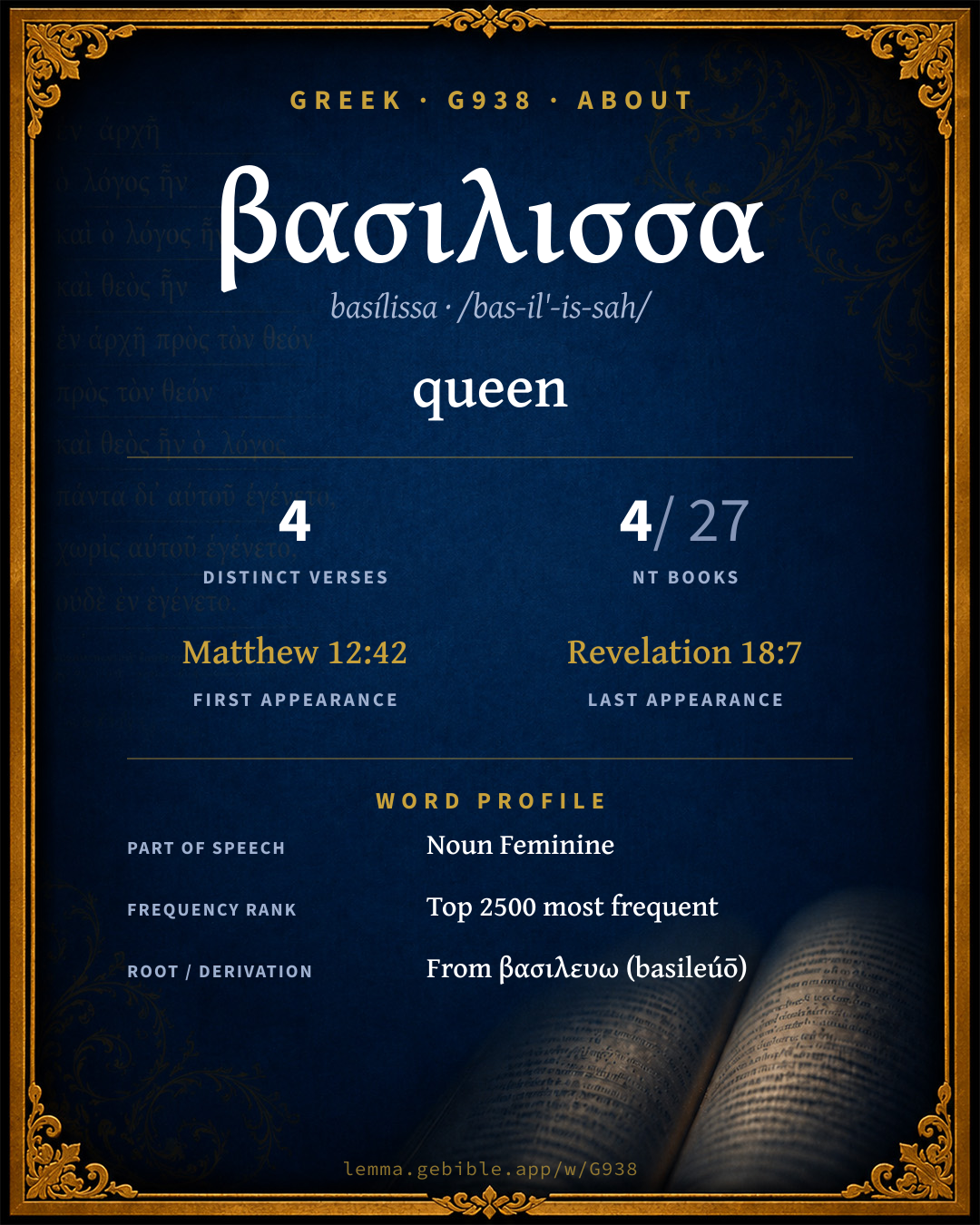
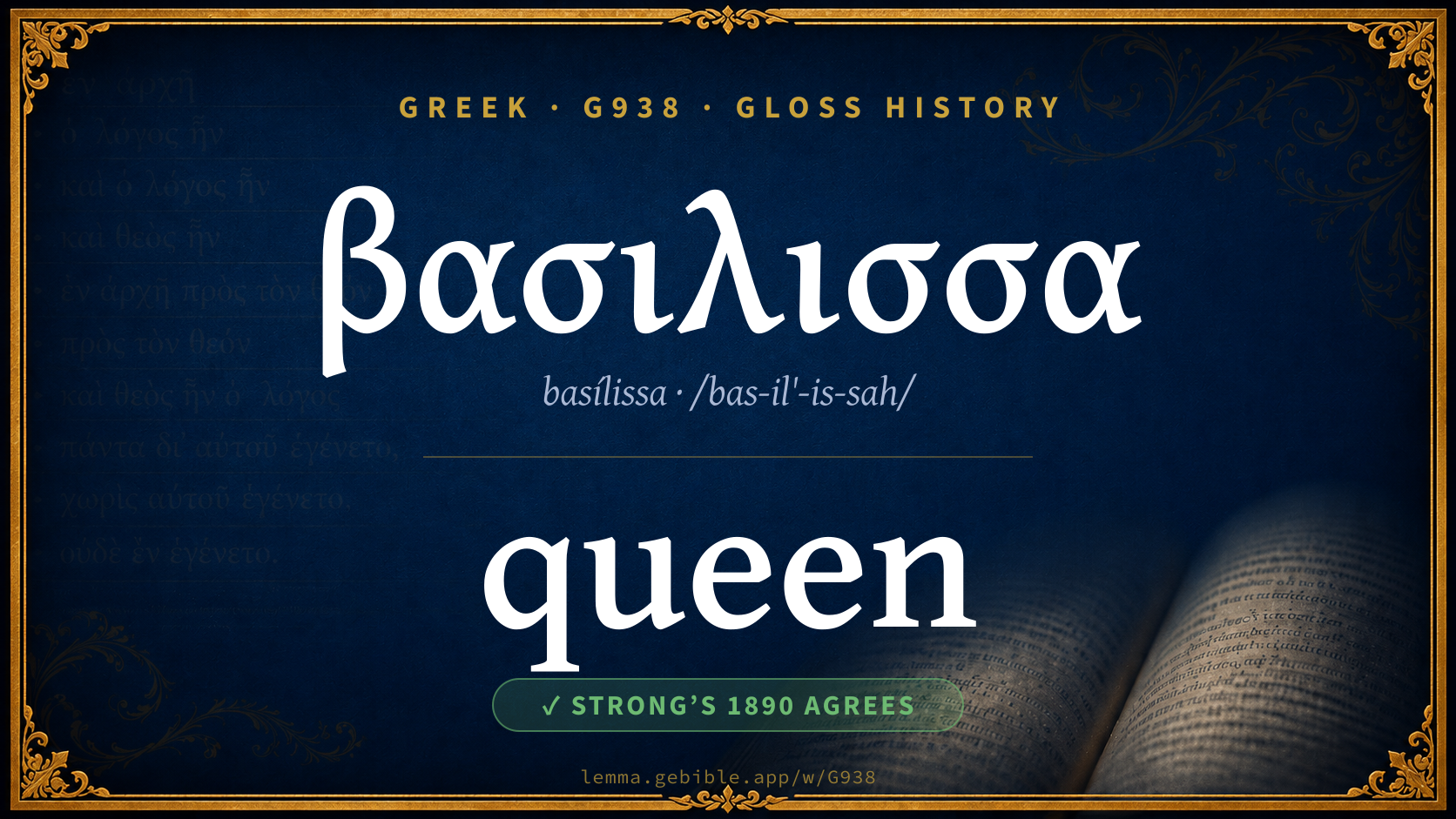
βασίλισσα
queen
Full lexicon entry — Thayer's Greek Lexicon
From Thayer's Greek Lexicon
Where this word appears
Grammar key — what these labels mean
Part of speech
- Noun
- A naming word — a person, place, thing, or idea.
Case
- Nominative
- The case of the subject (and the predicate nominative).
- Genitive
- The case of source, possession, or “of” — answers “whose / from what.”
Gender
- Feminine
- Grammatically feminine.
Number
- Singular
- One.
Every verse where G938 appears in the Book of Luke — 1 distinct verse. Click any verse to open its interlinear word-by-word view. Verse text shown in the World English Bible for context — . Each verse’s Greek form is shown with its reference; the English is not keyword-highlighted, since the data carries no word-level English alignment. Use “Compare translations” on any verse to read it across multiple English versions. This concordance covers the Greek New Testament; Septuagint (Greek Old Testament) occurrences of this word are not indexed here.
Luke
About this entry
At a glance — auto-summarized from this page’s data, not written by a person. Every figure links to its source below. This summary describes the numbers; it doesn’t interpret them.
βασιλισσα (basílissa) is a Greek noun most often rendered “queen.” It is rare — just 4 verses in the entire Greek New Testament. Matthew dominates its distribution — 1 of 4 verses. It first appears in Matthew 12:42. The sections below give every sense, occurrence, and version rendering.
Gloss history
Strong's 1890 vs modern scholarship
About this word
Strong's G938 catalogs a Greek word from the Greek New Testament.
These counts are not copied from any lexicon or concordance. They are computed here, from the morphology-tagged Greek New Testament. What Lemma adds →
- 4
- distinct verses
- The word appears in 4 distinct verses.
- 4 / 27
- NT books
- The word appears in 4 of 27 New Testament books.
- #1,877
- by frequency
- Top 2500 most frequent Greek words (rank 1,877 of 5,347 Greek words by occurrence).
View all 4 occurrences in the concordance →
By section of the New Testament
By traditional corpus
Conventional, traditional groupings — biblical authorship is debated, so this is a traditional corpus grouping, not an authorship claim. Some books belong to more than one corpus (Luke is in both the Gospels and the Lukan corpus, and so on), so these shares overlap and need not total 100%. Each figure is a share of the word’s 4 distinct verses.
- Gospels 2 verses · 50%
- Lukan (Luke–Acts) 2 verses · 50%
- Johannine 1 verse · 25%
- Revelation 1 verse · 25%
How translations render this word
Counts come from each version’s own published word-to-Strong’s tagging or interlinear alignment — an approximate guide to how each version renders this word, not a word-level alignment the data otherwise carries. Because each total is that version’s own tagged count, the per-version totals vary from one another and need not match the appearance or distinct-verse counts above. These counts may also differ from a printed concordance because Lemma counts each distinctly tagged rendering and does not collapse phrase taggings into a single head-word total. This is a fixed set of word-tagged versions (KJV, ASV, BSB, ULT) and does not change with the reading translation you choose elsewhere. Each version’s license is shown beside its name below (and on Sources).
- King James Version: Queen 4×
- American Standard Version: Queen 4×
- Berean Standard Bible: Queen 4×
- unfoldingWord Literal Text: Queen 4×
King James Version Public Domain
Renders G938 across 4 tagged occurrences — most commonly:
American Standard Version Public Domain
Renders G938 across 4 tagged occurrences — most commonly:
Berean Standard Bible Public Domain
Renders G938 across 4 tagged occurrences — most commonly:
unfoldingWord Literal Text CC BY-SA 4.0
Renders G938 across 4 tagged occurrences — most commonly:
Senses in Thayer's
The 1 sense Thayer's distinguishes for this word, in lexicon order (not ranked by frequency or importance). The full entry — with sub-senses — is in the Lexicon Entry tab.
- queen
Word origin
Derived from βασιλευω (basileúō) (G936) — to reign.
Feminine from G936 ; a queen : - queen.
— Strong’s Exhaustive Concordance (1890), public domain.
Forms in the corpus
The 2 distinct written forms G938 takes in the Greek New Testament, most frequent first — each parse links to that case’s occurrences in the concordance.
| Form | Parsing | Example | Uses |
|---|---|---|---|
| βασίλισσα basílissa | Noun, Nominative, Singular, Feminine | Matthew 12:42 | 3 |
| βασιλίσσης basilíssēs | Noun, Genitive, Singular, Feminine | Acts 8:27 | 1 |
Septuagint usage
The same Greek word βασιλισσα appears 36 times in the Greek Old Testament (Septuagint), across 36 verses in 7 books.
- 36
- LXX occurrences
- Tagged occurrences of this Greek word in the Septuagint.
- 36
- verses
- Distinct Septuagint verses containing this word.
- 7 / 39
- OT books
- The word appears in 7 of the 39 Old Testament books.
Sample Septuagint occurrences
- 1 Kings 10:1 βασίλισσα
- 2 Chronicles 9:1 βασίλισσα
- Esther 1:9 βασίλισσα
- Psalms 44:10 βασίλισσα
- Song of Solomon 6:8 βασίλισσα
- Jeremiah 30:23 βασίλισσα
- Daniel 5:9 βασίλισσα
Septuagint occurrences (same lexeme)
Every verse where the same Strong’s number (G938) appears in the Greek Septuagint. Verse text shown in the World English Bible for context; the Greek form is the matched word — the English is not keyword-highlighted.
- 1 Kings 10:1 βασίλισσα When the queen of Sheba heard of the fame of Solomon concerning the name of Yahweh, she came to prove him with hard questions.
- 1 Kings 10:4 βασίλισσα When the queen of Sheba had seen all the wisdom of Solomon, and the house that he had built,
- 1 Kings 10:10 βασίλισσα She gave the king one hundred twenty talents of gold, and of spices very great store, and precious stones: there came no more such abundance of spices as these which the queen of Sheba gave to king Solomon.
- 1 Kings 10:13 βασίλισσα King Solomon gave to the queen of Sheba all her desire, whatever she asked, besides that which Solomon gave her of his royal bounty. So she turned, and went to her own land, she and her servants.
- 2 Chronicles 9:1 βασίλισσα When the queen of Sheba heard of the fame of Solomon, she came to prove Solomon with hard questions at Jerusalem, with a very great train, and camels that bore spices, and gold in abundance, and precious stones: and when she was come to Solomon, she talked with him of all that was in her heart.
- 2 Chronicles 9:3 βασίλισσα When the queen of Sheba had seen the wisdom of Solomon, and the house that he had built,
- 2 Chronicles 9:9 βασίλισσα She gave the king one hundred and twenty talents of gold, and spices in great abundance, and precious stones: neither was there any such spice as the queen of Sheba gave to king Solomon.
- 2 Chronicles 9:12 βασίλισσα King Solomon gave to the queen of Sheba all her desire, whatever she asked, besides that which she had brought to the king. So she turned, and went to her own land, she and her servants.
- Esther 1:9 βασίλισσα Also Vashti the queen made a feast for the women in the royal house which belonged to king Ahasuerus.
- Esther 1:11 βασίλισσα to bring Vashti the queen before the king with the crown royal, to show the peoples and the princes her beauty; for she was beautiful to look on.
- Esther 1:12 βασίλισσα But the queen Vashti refused to come at the king's commandment by the chamberlains: therefore was the king very angry, and his anger burned in him.
- Esther 1:15 βασίλισσα What shall we do to the queen Vashti according to law, because she has not done the bidding of the king Ahasuerus by the chamberlains?
- Esther 1:16 βασίλισσα Memucan answered before the king and the princes, Vashti the queen has not done wrong to the king only, but also to all the princes, and to all the peoples who are in all the provinces of the king Ahasuerus.
- Esther 1:17 βασίλισσα For this deed of the queen will come abroad to all women, to make their husbands contemptible in their eyes, when it shall be reported, The king Ahasuerus commanded Vashti the queen to be brought in before him, but she didn't come.
- Esther 1:19 βασίλισσα If it please the king, let there go forth a royal commandment from him, and let it be written among the laws of the Persians and the Medes, that it not be altered, that Vashti come no more before king Ahasuerus; and let the king give her royal estate to another who is better than she.
- Esther 4:4 βασίλισσα Esther's maidens and her chamberlains came and told it her; and the queen was exceedingly grieved: and she sent clothing to clothe Mordecai, and to take his sackcloth from off him; but he didn't receive it.
- Esther 5:4 βασίλισσα Esther said, If it seem good to the king, let the king and Haman come this day to the banquet that I have prepared for him.
- Esther 5:10 βασίλισσα Nevertheless Haman refrained himself, and went home; and he sent and fetched his friends and Zeresh his wife.
- Esther 7:1 βασίλισσα So the king and Haman came to banquet with Esther the queen.
- Esther 7:2 βασίλισσα The king said again to Esther on the second day at the banquet of wine, What is your petition, queen Esther? and it shall be granted you: and what is your request? even to the half of the kingdom it shall be performed.
- Esther 7:6 βασίλισσα Esther said, An adversary and an enemy, even this wicked Haman. Then Haman was afraid before the king and the queen.
- Esther 7:7 βασίλισσα The king arose in his wrath from the banquet of wine [and went] into the palace garden: and Haman stood up to make request for his life to Esther the queen; for he saw that there was evil determined against him by the king.
- Esther 7:8 βασίλισσα Then the king returned out of the palace garden into the place of the banquet of wine; and Haman was fallen on the couch whereon Esther was. Then said the king, Will he even force the queen before me in the house? As the word went out of the king's mouth, they covered Haman's face.
- Esther 9:29 βασίλισσα Then Esther the queen, the daughter of Abihail, and Mordecai the Jew, wrote with all authority to confirm this second letter of Purim.
- Esther 9:31 βασίλισσα to confirm these days of Purim in their appointed times, according as Mordecai the Jew and Esther the queen had enjoined them, and as they had ordained for themselves and for their seed, in the matter of the fastings and their cry.
- Psalms 44:10 βασίλισσα You make us turn back from the adversary. Those who hate us take spoil for themselves.
- Song of Solomon 6:8 βασίλισσα There are sixty queens, eighty concubines, And virgins without number.
- Song of Solomon 6:9 βασίλισσα My dove, my perfect one, is unique. She is her mother's only daughter. She is the favorite one of her who bore her. The daughters saw her, and called her blessed, The queens and the concubines, and they praised her.
- Jeremiah 30:23 βασίλισσα Behold, the tempest of Yahweh, [even his] wrath, is gone forth, a sweeping tempest: it shall burst on the head of the wicked.
- Jeremiah 36:2 βασίλισσα Take a scroll of a book, and write therein all the words that I have spoken to you against Israel, and against Judah, and against all the nations, from the day I spoke to you, from the days of Josiah, even to this day.
- Jeremiah 51:17 βασίλισσα Every man is become brutish [and is] without knowledge; every goldsmith is disappointed by his image; for his molten image is falsehood, and there is no breath in them.
- Jeremiah 51:18 βασίλισσα They are vanity, a work of delusion: in the time of their visitation they shall perish.
- Jeremiah 51:19 βασίλισσα The portion of Jacob is not like these; for he is the former of all things; and [Israel] is the tribe of his inheritance: Yahweh of Hosts is his name.
- Jeremiah 51:25 βασίλισσα Behold, I am against you, destroying mountain, says Yahweh, which destroy all the earth; and I will stretch out my hand on you, and roll you down from the rocks, and will make you a burnt mountain.
- Daniel 5:9 βασίλισσα Then was king Belshazzar greatly troubled, and his face was changed in him, and his lords were perplexed.
- Daniel 5:10 βασίλισσα [Now] the queen by reason of the words of the king and his lords came into the banquet house: the queen spoke and said, O king, live forever; don't let your thoughts trouble you, nor let your face be changed.
These are occurrences of the same Greek lexeme (G938) in the Septuagint — not a translation of any one Hebrew word. The store carries no word-level Hebrew↔Greek alignment, so no Hebrew original is asserted here. Counts come from the recovered LXX Strong's tagging — high-frequency vocabulary is well covered, while rare or late forms may be untagged — so they reflect tagged occurrences and may slightly undercount.