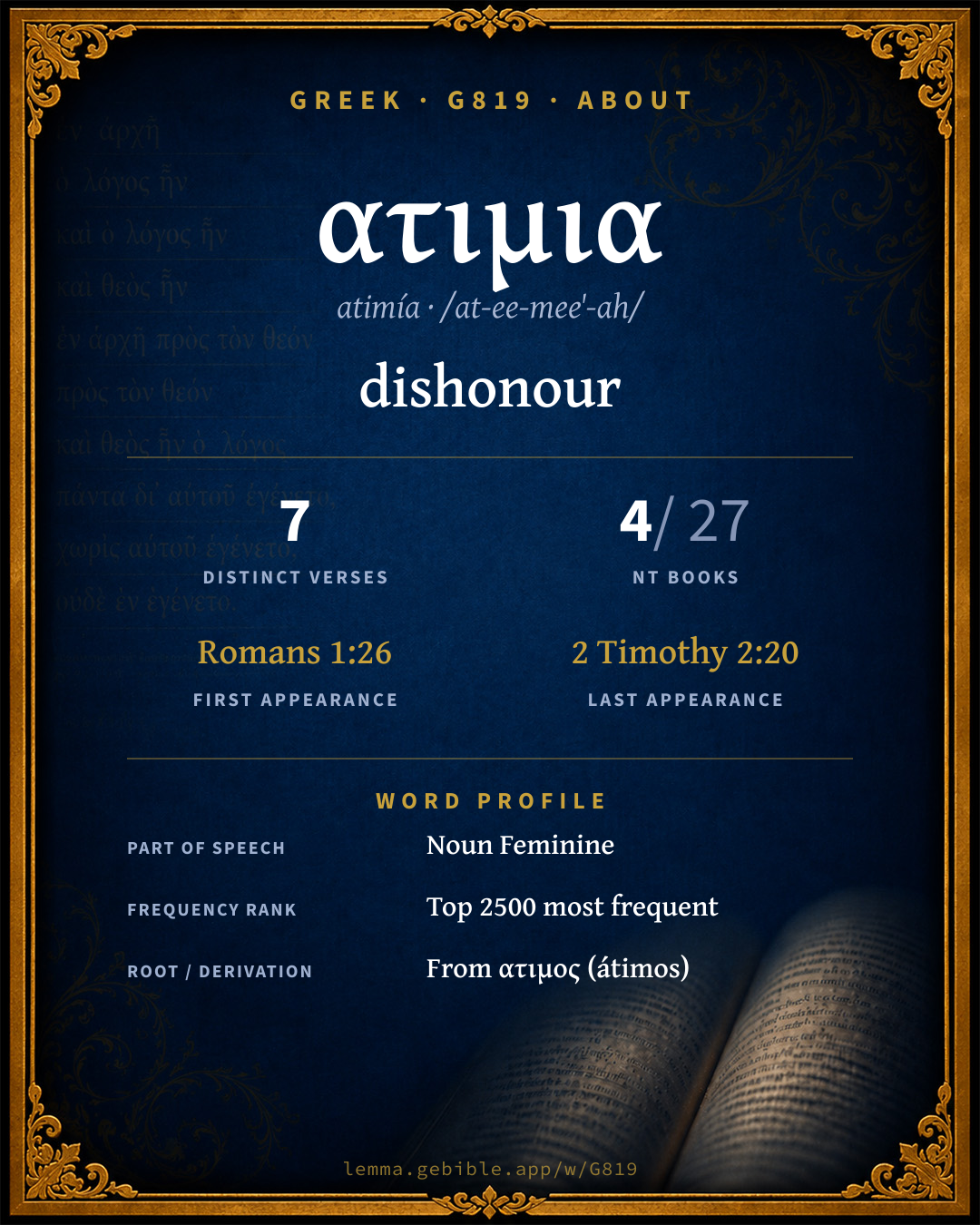
ἀτιμία
dishonour
Full lexicon entry — Thayer's Greek Lexicon
From Thayer's Greek Lexicon
Where this word appears
See every Dative-case word in the Greek New Testament →
Grammar key — what these labels mean
Part of speech
- Noun
- A naming word — a person, place, thing, or idea.
Case
- Accusative
- The case of the direct object and of extent.
- Genitive
- The case of source, possession, or “of” — answers “whose / from what.”
- Dative
- The case of the indirect object, means, or location — “to / for / with / in.”
- Nominative
- The case of the subject (and the predicate nominative).
Gender
- Feminine
- Grammatically feminine.
Number
- Singular
- One.
Every verse where G819 appears in the Book of 1 Corinthians — 2 distinct verses. Click any verse to open its interlinear word-by-word view. Verse text shown in the World English Bible for context — . Each verse’s Greek form is shown with its reference; the English is not keyword-highlighted, since the data carries no word-level English alignment. Use “Compare translations” on any verse to read it across multiple English versions. This concordance covers the Greek New Testament; Septuagint (Greek Old Testament) occurrences of this word are not indexed here.
1 Corinthians
About this entry
At a glance — auto-summarized from this page’s data, not written by a person. Every figure links to its source below. This summary describes the numbers; it doesn’t interpret them.
ατιμια (atimía) is a Greek noun most often rendered “dishonour.” It first appears in Romans 1:26. It turns up in 7 verses across 4 books, an uncommon footprint. It concentrates in Romans, which alone accounts for 29% of its uses. From the same root come ατιμος, ατιμαζω and ατιμοω. The sections below give every sense, occurrence, and version rendering.
Gloss history
Strong's 1890 vs modern scholarship
About this word
Strong's G819 catalogs a Greek word from the Greek New Testament.
These counts are not copied from any lexicon or concordance. They are computed here, from the morphology-tagged Greek New Testament. What Lemma adds →
- 7
- distinct verses
- The word appears in 7 distinct verses.
- 4 / 27
- NT books
- The word appears in 4 of 27 New Testament books.
- #1,358
- by frequency
- Top 2500 most frequent Greek words (rank 1,358 of 5,347 Greek words by occurrence).
View all 7 occurrences in the concordance →
Most concentrated in
- Romans 2 verses 29%
- 1 Corinthians 2 verses 29%
- 2 Corinthians 2 verses 29%
By section of the New Testament
By traditional corpus
Conventional, traditional groupings — biblical authorship is debated, so this is a traditional corpus grouping, not an authorship claim. Some books belong to more than one corpus (Luke is in both the Gospels and the Lukan corpus, and so on), so these shares overlap and need not total 100%. Each figure is a share of the word’s 7 distinct verses.
- Pauline corpus 7 verses · 100%
How translations render this word
Counts come from each version’s own published word-to-Strong’s tagging or interlinear alignment — an approximate guide to how each version renders this word, not a word-level alignment the data otherwise carries. Because each total is that version’s own tagged count, the per-version totals vary from one another and need not match the appearance or distinct-verse counts above. These counts may also differ from a printed concordance because Lemma counts each distinctly tagged rendering and does not collapse phrase taggings into a single head-word total. This is a fixed set of word-tagged versions (KJV, ASV, BSB, ULT) and does not change with the reading translation you choose elsewhere. Each version’s license is shown beside its name below (and on Sources).
- King James Version: Dishonour 4×
- American Standard Version: Dishonor 5×
- Berean Standard Bible: Dishonor 2×
- unfoldingWord Literal Text: Dishonor 6×
King James Version Public Domain
Renders G819 across 7 tagged occurrences — most commonly:
Plus 3 renderings that appear only once — usually multi-word phrases or single function words the recovered tagging swept in, not distinct renderings.
American Standard Version Public Domain
Renders G819 across 7 tagged occurrences — most commonly:
Plus 2 renderings that appear only once — usually multi-word phrases or single function words the recovered tagging swept in, not distinct renderings.
Berean Standard Bible Public Domain
Renders G819 across 7 tagged occurrences — most commonly:
Plus 5 renderings that appear only once — usually multi-word phrases or single function words the recovered tagging swept in, not distinct renderings.
unfoldingWord Literal Text CC BY-SA 4.0
Renders G819 across 7 tagged occurrences — most commonly:
Plus 1 rendering that appears only once — usually multi-word phrases or single function words the recovered tagging swept in, not distinct renderings.
Senses in Thayer's
The 1 sense Thayer's distinguishes for this word, in lexicon order (not ranked by frequency or importance). The full entry — with sub-senses — is in the Lexicon Entry tab.
- dishonour, ignominy, disgrace
Word origin
Derived from ατιμος (átimos) (G820) — unhonoured.
From G820 ; infamy that is (subjectively) comparative indignity (objectively) disgrace : - dishonour reproach shame vile.
— Strong’s Exhaustive Concordance (1890), public domain.
Forms in the corpus
The 4 distinct written forms G819 takes in the Greek New Testament, most frequent first — each parse links to that case’s occurrences in the concordance.
| Form | Parsing | Example | Uses |
|---|---|---|---|
| ἀτιμίαν atimían | Noun, Accusative, Singular, Feminine | Romans 9:21 | 3 |
| ἀτιμίας atimías | Noun, Genitive, Singular, Feminine | Romans 1:26 | 2 |
| ἀτιμία atimía | Noun, Nominative, Singular, Feminine | 1 Corinthians 11:14 | 1 |
| ἀτιμίᾳ atimía | Noun, Dative, Singular, Feminine | 1 Corinthians 15:43 | 1 |
Same root — word family
Other Thayer's entries built from the same root as G819, grouped by Strong’s listed origin. These share a root / origin per the lexicon — not necessarily a shared meaning. Each links to that word’s own entry.
Derives from
Shares the same root
Compare all same-root words → They share a root, not necessarily a meaning.
Septuagint usage
The same Greek word ατιμια appears 34 times in the Greek Old Testament (Septuagint), across 33 verses in 9 books.
- 34
- LXX occurrences
- Tagged occurrences of this Greek word in the Septuagint.
- 33
- verses
- Distinct Septuagint verses containing this word.
- 9 / 39
- OT books
- The word appears in 9 of the 39 Old Testament books.
Sample Septuagint occurrences
- Job 10:15 ἀτιμία
- Psalms 82:17 ἀτιμία
- Proverbs 3:35 ἀτιμία
- Isaiah 10:16 ἀτιμία
- Jeremiah 3:25 ἀτιμία
- Ezekiel 16:52 ἀτιμία
- Hosea 4:7 ἀτιμία
- Nahum 3:5 ἀτιμία
- Habakkuk 2:16 ἀτιμία
Septuagint occurrences (same lexeme)
Every verse where the same Strong’s number (G819) appears in the Greek Septuagint. Verse text shown in the World English Bible for context; the Greek form is the matched word — the English is not keyword-highlighted.
- Job 10:15 ἀτιμία If I am wicked, woe to me. If I am righteous, I still shall not lift up my head, Being filled with disgrace, And conscious of my affliction.
- Job 12:21 ἀτιμία He pours contempt on princes, And loosens the belt of the strong.
- Job 40:13 ἀτιμία Hide them in the dust together. Bind their faces in the hidden place.
- Psalms 82:17 ἀτιμία
- Proverbs 3:35 ἀτιμία The wise will inherit glory, But shame will be the promotion of fools.
- Proverbs 6:33 ἀτιμία He will get wounds and dishonor. His reproach will not be wiped away.
- Proverbs 9:7 ἀτιμία He who corrects a mocker invites insult. He who reproves a wicked man invites abuse.
- Proverbs 11:2 ἀτιμία When pride comes, then comes shame, But with humility comes wisdom.
- Proverbs 11:16 ἀτιμία A gracious woman obtains honor, But violent men obtain riches.
- Proverbs 12:9 ἀτιμία Better is he who is lightly esteemed, and has a servant, Than he who honors himself, and lacks bread.
- Proverbs 12:11 ἀτιμία He who tills his land shall have plenty of bread, But he who chases fantasies is void of understanding.
- Proverbs 12:16 ἀτιμία A fool shows his annoyance the same day, But one who overlooks an insult is prudent.
- Proverbs 13:18 ἀτιμία Poverty and shame come to him who refuses discipline, But he who heeds correction shall be honored.
- Proverbs 14:35 ἀτιμία The king's favor is toward a servant who deals wisely, But his wrath is toward one who causes shame.
- Proverbs 18:3 ἀτιμία When wickedness comes, contempt also comes, And with shame comes disgrace.
- Isaiah 10:16 ἀτιμία Therefore will the Lord, Yahweh of Hosts, send among his fat ones leanness; and under his glory there shall be kindled a burning like the burning of fire.
- Isaiah 22:18 ἀτιμία He will surely wind you round and round, [and toss you] like a ball into a large country; there shall you die, and there shall be the chariots of your glory, you shame of your lord's house.
- Jeremiah 3:25 ἀτιμία Let us lie down in our shame, and let our confusion cover us; for we have sinned against Yahweh our God, we and our fathers, from our youth even to this day; and we have not obeyed the voice of Yahweh our God.
- Jeremiah 6:15 ἀτιμία Were they ashamed when they had committed abomination? nay, they were not at all ashamed, neither could they blush: therefore they shall fall among those who fall; at the time that I visit them they shall be cast down, says Yahweh.
- Jeremiah 13:26 ἀτιμία Therefore will I also uncover your skirts on your face, and your shame shall appear.
- Jeremiah 20:11 ἀτιμία But Yahweh is with me as an awesome mighty one: therefore my persecutors shall stumble, and they shall not prevail; they shall be utterly disappointed, because they have not dealt wisely, even with an everlasting dishonor which shall never be forgotten.
- Jeremiah 23:40 ἀτιμία and I will bring an everlasting reproach on you, and a perpetual shame, which shall not be forgotten.
- Jeremiah 28:51 ἀτιμία
- Ezekiel 16:52 ἀτιμία You also, bear you your own shame, in that you have given judgment for your sisters; through your sins that you have committed more abominable than they, they are more righteous that you: yes, be also confounded, and bear your shame, in that you have justified your sisters.
- Ezekiel 16:63 ἀτιμία that you may remember, and be confounded, and never open your mouth any more, because of your shame, when I have forgiven you all that you have done, says the Lord Yahweh.
- Ezekiel 36:7 ἀτιμία therefore thus says the Lord Yahweh: I have sworn, [saying], Surely the nations that are round about you, they shall bear their shame.
- Ezekiel 36:15 ἀτιμία neither will I let you hear any more the shame of the nations, neither shall you bear the reproach of the peoples any more, neither shall you cause your nation to stumble any more, says the Lord Yahweh.
- Ezekiel 39:26 ἀτιμία They shall bear their shame, and all their trespasses by which they have trespassed against me, when they shall dwell securely in their land, and none shall make them afraid;
- Ezekiel 44:13 ἀτιμία They shall not come near to me, to execute the office of priest to me, nor to come near to any of my holy things, to the things that are most holy; but they shall bear their shame, and their abominations which they have committed.
- Hosea 4:7 ἀτιμία As they were multiplied, so they sinned against me. I will change their glory into shame.
- Hosea 4:18 ἀτιμία Their drink has become sour. They play the prostitute continually. Her rulers dearly love their shameful way.
- Nahum 3:5 ἀτιμία "Behold, I am against you," says Yahweh of Hosts, "and I will lift your skirts over your face. I will show the nations your nakedness, and the kingdoms your shame.
- Habakkuk 2:16 ἀτιμία You are filled with shame, and not glory. You will also drink, and be exposed! The cup of Yahweh's right hand will come around to you, and disgrace will cover your glory.
These are occurrences of the same Greek lexeme (G819) in the Septuagint — not a translation of any one Hebrew word. The store carries no word-level Hebrew↔Greek alignment, so no Hebrew original is asserted here. Counts come from the recovered LXX Strong's tagging — high-frequency vocabulary is well covered, while rare or late forms may be untagged — so they reflect tagged occurrences and may slightly undercount.