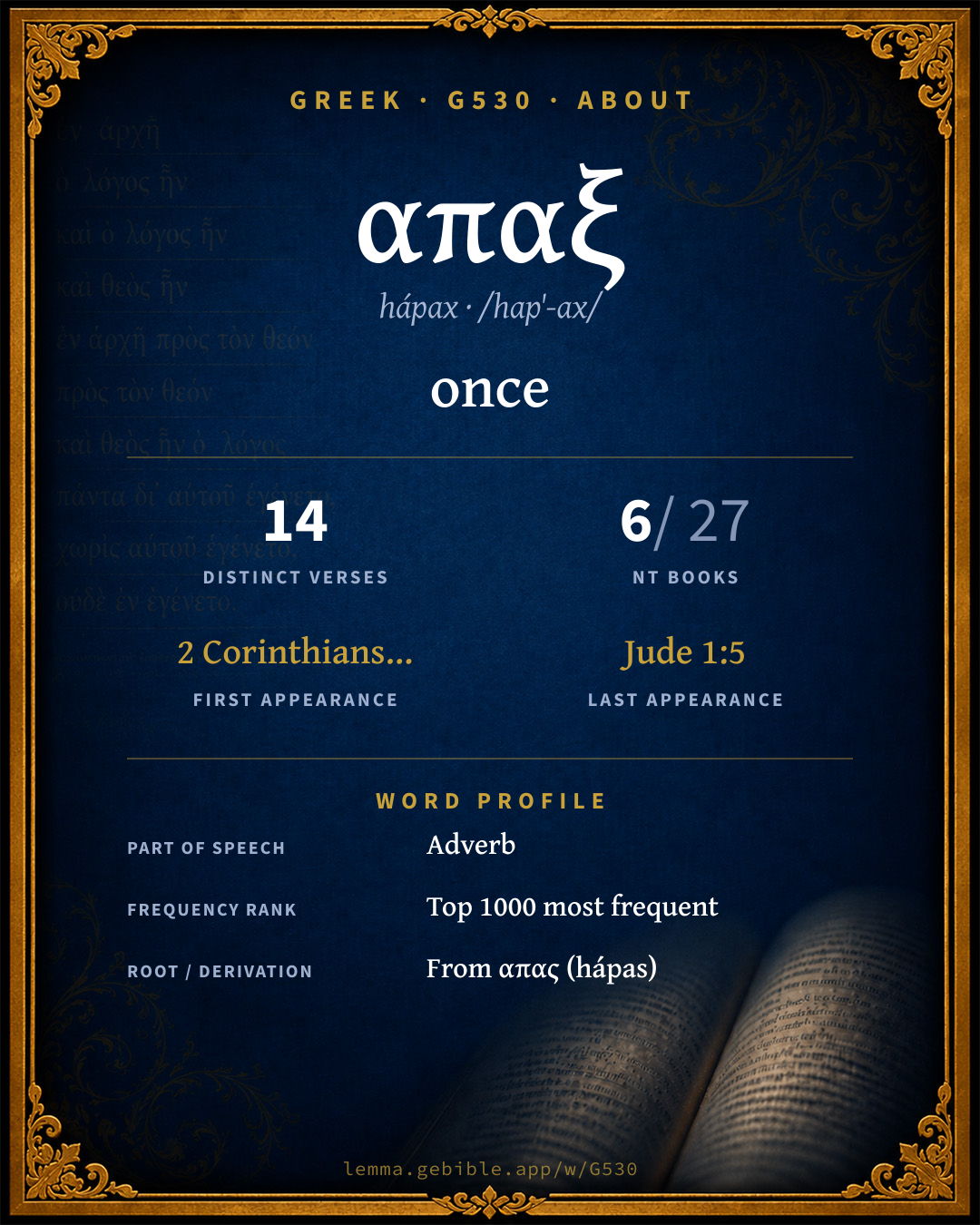
ἅπαξ
once
‘once’ is one of 2 main senses fuller range ↓
Full lexicon entry — Thayer's Greek Lexicon
From Thayer's Greek Lexicon
Where this word appears
Grammar key — what these labels mean
Part of speech
- Adverb
- A word that modifies a verb, adjective, or other adverb.
Every verse where G530 appears in the Book of Hebrews — 8 distinct verses. Click any verse to open its interlinear word-by-word view. Verse text shown in the World English Bible for context — . Each verse’s Greek form is shown with its reference; the English is not keyword-highlighted, since the data carries no word-level English alignment. Use “Compare translations” on any verse to read it across multiple English versions. This concordance covers the Greek New Testament; Septuagint (Greek Old Testament) occurrences of this word are not indexed here.
Hebrews
- Hebrews 6:4 ἅπαξ adv For concerning those who were once enlightened and tasted of the heavenly gift, and were made partakers of the Holy Spirit,
- Hebrews 9:7 ἅπαξ adv but into the second the high priest alone, once in the year, not without blood, which he offers for himself, and for the errors of the people.
- Hebrews 9:26 ἅπαξ adv or else he must have suffered often since the foundation of the world. But now once at the end of the ages, he has been revealed to put away sin by the sacrifice of himself.
- Hebrews 9:27 ἅπαξ adv Inasmuch as it is appointed for men to die once, and after this, judgment,
- Hebrews 9:28 ἅπαξ adv so Christ also, having been once offered to bear the sins of many, will appear a second time, without sin, to those who are eagerly waiting for him for salvation.
- Hebrews 10:2 ἅπαξ adv Or else wouldn't they have ceased to be offered, because the worshippers, having been once cleansed, would have had no more consciousness of sins?
- Hebrews 12:26 ἅπαξ adv whose voice shook the earth, then, but now he has promised, saying, "Yet once more I will shake not only the earth, but also the heavens."
- Hebrews 12:27 ἅπαξ adv This phrase, "Yet once more," signifies the removing of those things that are shaken, as of things that have been made, that those things which are not shaken may remain.
About this entry
At a glance — auto-summarized from this page’s data, not written by a person. Every figure links to its source below. This summary describes the numbers; it doesn’t interpret them.
The Greek verb απαξ centers on the idea of “once.” The word gravitates to Hebrews (57%), then Jude and 2 Corinthians. It appears 14 verses across 6 books of the Greek New Testament, among its uncommon vocabulary. Debuting at 2 Corinthians 11:25, it then recurs through the corpus. Thayer's distinguishes 2 senses for it. For the data behind this summary, explore the sense tree and the renderings breakdown below.
Gloss history
Strong's 1890 vs modern scholarship
About this word
Strong's G530 catalogs a Greek word from the Greek New Testament.
These counts are not copied from any lexicon or concordance. They are computed here, from the morphology-tagged Greek New Testament. What Lemma adds →
- 14
- distinct verses
- The word appears in 14 distinct verses.
- 6 / 27
- NT books
- The word appears in 6 of 27 New Testament books.
- #814
- by frequency
- Top 1000 most frequent Greek words (rank 814 of 5,347 Greek words by occurrence).
View all 14 occurrences in the concordance →
Most concentrated in
- Hebrews 8 verses 57%
- Jude 2 verses 14%
- 2 Corinthians 1 verse 7%
By section of the New Testament
By traditional corpus
Conventional, traditional groupings — biblical authorship is debated, so this is a traditional corpus grouping, not an authorship claim. Some books belong to more than one corpus (Luke is in both the Gospels and the Lukan corpus, and so on), so these shares overlap and need not total 100%. Each figure is a share of the word’s 14 distinct verses.
- Hebrews 8 verses · 57%
- Pauline corpus 3 verses · 21%
- General (Catholic) Epistles 3 verses · 21%
How translations render this word
Counts come from each version’s own published word-to-Strong’s tagging or interlinear alignment — an approximate guide to how each version renders this word, not a word-level alignment the data otherwise carries. Because each total is that version’s own tagged count, the per-version totals vary from one another and need not match the appearance or distinct-verse counts above. These counts may also differ from a printed concordance because Lemma counts each distinctly tagged rendering and does not collapse phrase taggings into a single head-word total. This is a fixed set of word-tagged versions (KJV, ASV, BSB, ULT) and does not change with the reading translation you choose elsewhere. Each version’s license is shown beside its name below (and on Sources).
- King James Version: Once 7×, Once more 2×, Was once 2×
- American Standard Version: Once 11×, Having been once 2×
- Berean Standard Bible: Once 5×, Again 2×, Once for all 2×
- unfoldingWord Literal Text: Once 12×, Once for all 2×
King James Version Public Domain
Renders G530 across 13 tagged occurrences — most commonly:
Plus 2 renderings that appear only once — usually multi-word phrases or single function words the recovered tagging swept in, not distinct renderings. Not rendered by a distinct English word in 2 further occurrences.
American Standard Version Public Domain
Renders G530 across 14 tagged occurrences — most commonly:
Plus 1 rendering that appears only once — usually multi-word phrases or single function words the recovered tagging swept in, not distinct renderings.
Berean Standard Bible Public Domain
Renders G530 across 12 tagged occurrences — most commonly:
Plus 1 rendering that appears only once — usually multi-word phrases or single function words the recovered tagging swept in, not distinct renderings. Not rendered by a distinct English word in 1 further occurrence.
unfoldingWord Literal Text CC BY-SA 4.0
Renders G530 across 14 tagged occurrences — most commonly:
Senses in Thayer's
The 2 senses Thayer's distinguishes for this word, in lexicon order (not ranked by frequency or importance). The full entry — with sub-senses — is in the Lexicon Entry tab.
- once, one time
- once for all
Word origin
Derived from απας (hápas) (G537) — all.
Probably from G537 ; one (or a single ) time (numerically or conclusively): - once.
— Strong’s Exhaustive Concordance (1890), public domain.
Septuagint usage
The same Greek word απαξ appears 37 times in the Greek Old Testament (Septuagint), across 30 verses in 17 books.
- 37
- LXX occurrences
- Tagged occurrences of this Greek word in the Septuagint.
- 30
- verses
- Distinct Septuagint verses containing this word.
- 17 / 39
- OT books
- The word appears in 17 of the 39 Old Testament books.
Sample Septuagint occurrences
- Genesis 18:32 ἅπαξ
- Exodus 30:10 ἅπαξ
- Leviticus 16:34 ἅπαξ
- Numbers 16:21 ἅπαξ
- Deuteronomy 9:13 ἅπαξ
- Joshua 10:42 ἅπαξ
- Judges 6:39 ἅπαξ
- 1 Samuel 3:10 ἅπαξ
- 2 Samuel 17:7 ἅπαξ
- 1 Chronicles 11:11 ἅπαξ
- 2 Chronicles 9:21 ἅπαξ
- Ezra 23:20 ἅπαξ
Septuagint occurrences (same lexeme)
Every verse where the same Strong’s number (G530) appears in the Greek Septuagint. Verse text shown in the World English Bible for context; the Greek form is the matched word — the English is not keyword-highlighted.
- Genesis 18:32 ἅπαξ He said, "Oh don't let the Lord be angry, and I will speak yet but this once. What if ten are found there?" He said, "I will not destroy it for the ten's sake."
- Exodus 30:10 ἅπαξ Aaron shall make atonement on its horns once in the year; with the blood of the sin offering of atonement once in the year he shall make atonement for it throughout your generations. It is most holy to Yahweh."
- Leviticus 16:34 ἅπαξ "This shall be an everlasting statute for you, to make atonement for the children of Israel once in the year because of all their sins." It was done as Yahweh commanded Moses.
- Numbers 16:21 ἅπαξ Separate yourselves from among this congregation, that I may consume them in a moment.
- Numbers 17:10 ἅπαξ Yahweh said to Moses, Put back the rod of Aaron before the testimony, to be kept for a token against the children of rebellion; that you may make an end of their murmurings against me, that they not die.
- Deuteronomy 9:13 ἅπαξ Furthermore Yahweh spoke to me, saying, I have seen this people, and, behold, it is a stiff-necked people:
- Joshua 10:42 ἅπαξ All these kings and their land did Joshua take at one time, because Yahweh, the God of Israel, fought for Israel.
- Judges 6:39 ἅπαξ Gideon said to God, Don't let your anger be kindled against me, and I will speak but this once: Please let me make a trial just this once with the fleece; let it now be dry only on the fleece, and on all the ground let there be dew.
- Judges 15:3 ἅπαξ Samson said to them, This time shall I be blameless in regard of the Philistines, when I do them a mischief.
- Judges 16:18 ἅπαξ When Delilah saw that he had told her all his heart, she sent and called for the lords of the Philistines, saying, Come up this once, for he has told me all his heart. Then the lords of the Philistines came up to her, and brought the money in their hand.
- Judges 16:20 ἅπαξ She said, The Philistines are on you, Samson. He awoke out of his sleep, and said, I will go out as at other times, and shake myself free. But he didn't know that Yahweh had departed from him.
- Judges 16:28 ἅπαξ Samson called to Yahweh, and said, Lord Yahweh, remember me, Please, and strengthen me, Please, only this once, God, that I may be at once avenged of the Philistines for my two eyes.
- Judges 20:30 ἅπαξ The children of Israel went up against the children of Benjamin on the third day, and set themselves in array against Gibeah, as at other times.
- Judges 20:31 ἅπαξ The children of Benjamin went out against the people, and were drawn away from the city; and they began to strike and kill of the people, as at other times, in the highways, of which one goes up to Bethel, and the other to Gibeah, in the field, about thirty men of Israel.
- 1 Samuel 3:10 ἅπαξ Yahweh came, and stood, and called as at other times, Samuel, Samuel. Then Samuel said, Speak; for your servant hears.
- 1 Samuel 17:19 ἅπαξ Now Saul, and they, and all the men of Israel, were in the valley of Elah, fighting with the Philistines.
- 1 Samuel 20:25 ἅπαξ The king sat on his seat, as at other times, even on the seat by the wall; and Jonathan stood up, and Abner sat by Saul's side: but David's place was empty.
- 1 Samuel 26:8 ἅπαξ Then said Abishai to David, God has delivered up your enemy into your hand this day: now therefore please let me strike him with the spear to the earth at one stroke, and I will not strike him the second time.
- 2 Samuel 17:7 ἅπαξ Hushai said to Absalom, The counsel that Ahithophel has given this time is not good.
- 2 Samuel 23:8 ἅπαξ These are the names of the mighty men whom David had: Josheb Basshebeth a Tahchemonite, chief of the captains; the same was Adino the Eznite, against eight hundred slain at one time.
- 1 Chronicles 11:11 ἅπαξ This is the number of the mighty men whom David had: Jashobeam, the son of a Hachmonite, the chief of the thirty; he lifted up his spear against three hundred and killed them at one time.
- 2 Chronicles 9:21 ἅπαξ For the king had ships that went to Tarshish with the servants of Huram; once every three years came the ships of Tarshish, bringing gold, and silver, ivory, and apes, and peacocks.
- Ezra 23:20 ἅπαξ
- Job 33:14 ἅπαξ For God speaks once, Yes twice, though man pays no attention.
- Job 40:5 ἅπαξ I have spoken once, and I will not answer; Yes, twice, but I will proceed no further."
- Psalms 61:12 ἅπαξ
- Psalms 88:36 ἅπαξ
- Isaiah 66:8 ἅπαξ Who has heard such a thing? who has seen such things? Shall a land be born in one day? shall a nation be brought forth at once? for as soon as Zion travailed, she brought forth her children.
- Daniel 3:46 ἅπαξ
- Haggai 2:6 ἅπαξ For this is what Yahweh of Hosts says: 'Yet once, it is a little while, and I will shake the heavens, the earth, the sea, and the dry land;
These are occurrences of the same Greek lexeme (G530) in the Septuagint — not a translation of any one Hebrew word. The store carries no word-level Hebrew↔Greek alignment, so no Hebrew original is asserted here. Counts come from the recovered LXX Strong's tagging — high-frequency vocabulary is well covered, while rare or late forms may be untagged — so they reflect tagged occurrences and may slightly undercount.