2 Corinthians 11:25

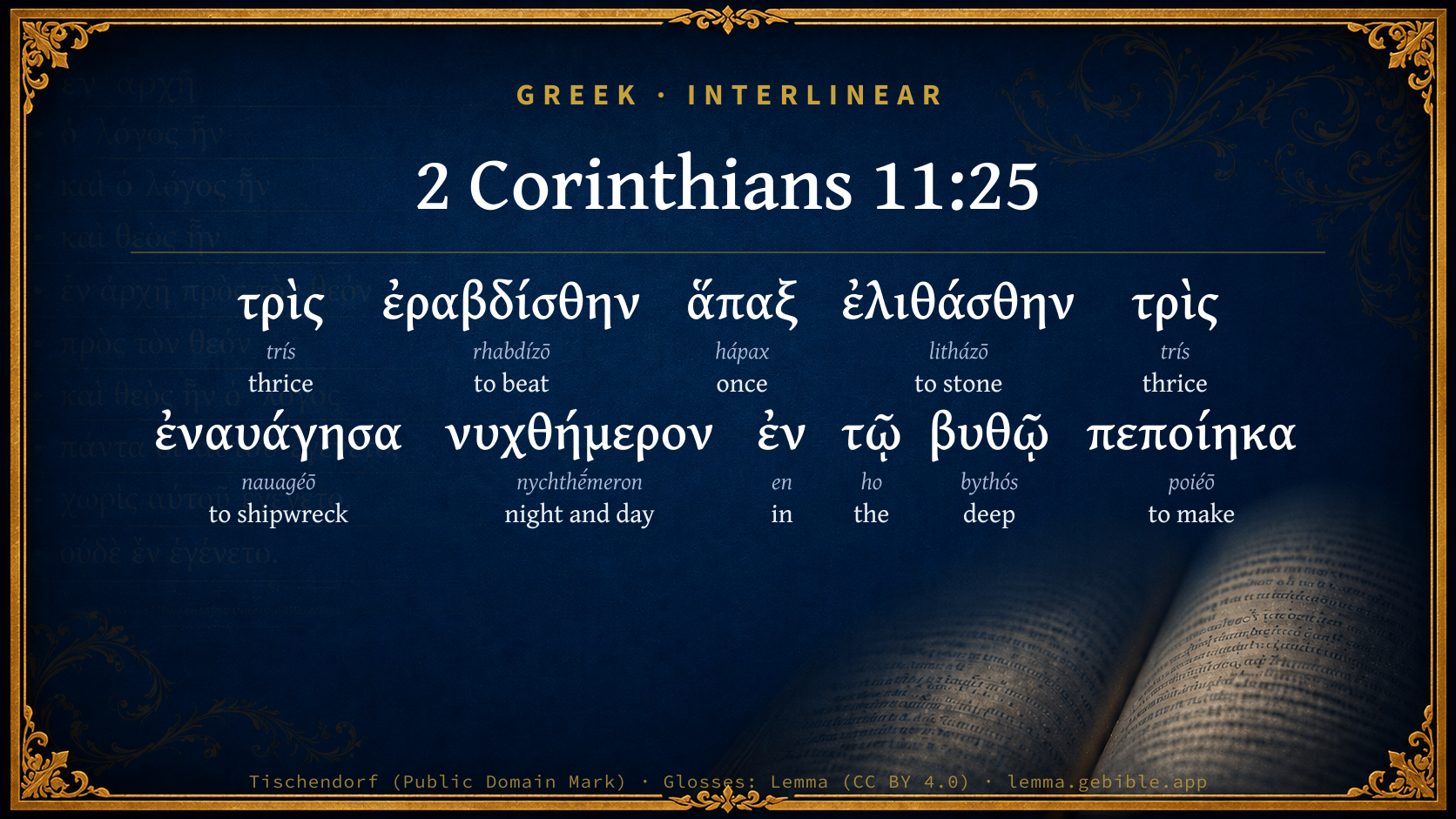
Greek (Tischendorf 8th ed.) 2 Corinthians 11:25 appears in the Greek New Testament. The text above is from the Tischendorf 8th edition. Each word links to its Strong’s number and a concise gloss. Click any word for its full Thayer’s Greek Lexicon entry.
Download image
Cite this verse

2 Corinthians 11:25 (World English Bible). Public Domain. Lemma interlinear Bible study tool, https://lemma.gebible.app/v/2-corinthians/11/25.

Show BibTeX & RIS
BibTeX
RIS
English Translation
Three times I was beaten with rods. Once I was stoned. Three times I suffered shipwreck. I have been a night and a day in the deep.
World English Bible · Public Domain
Highlights
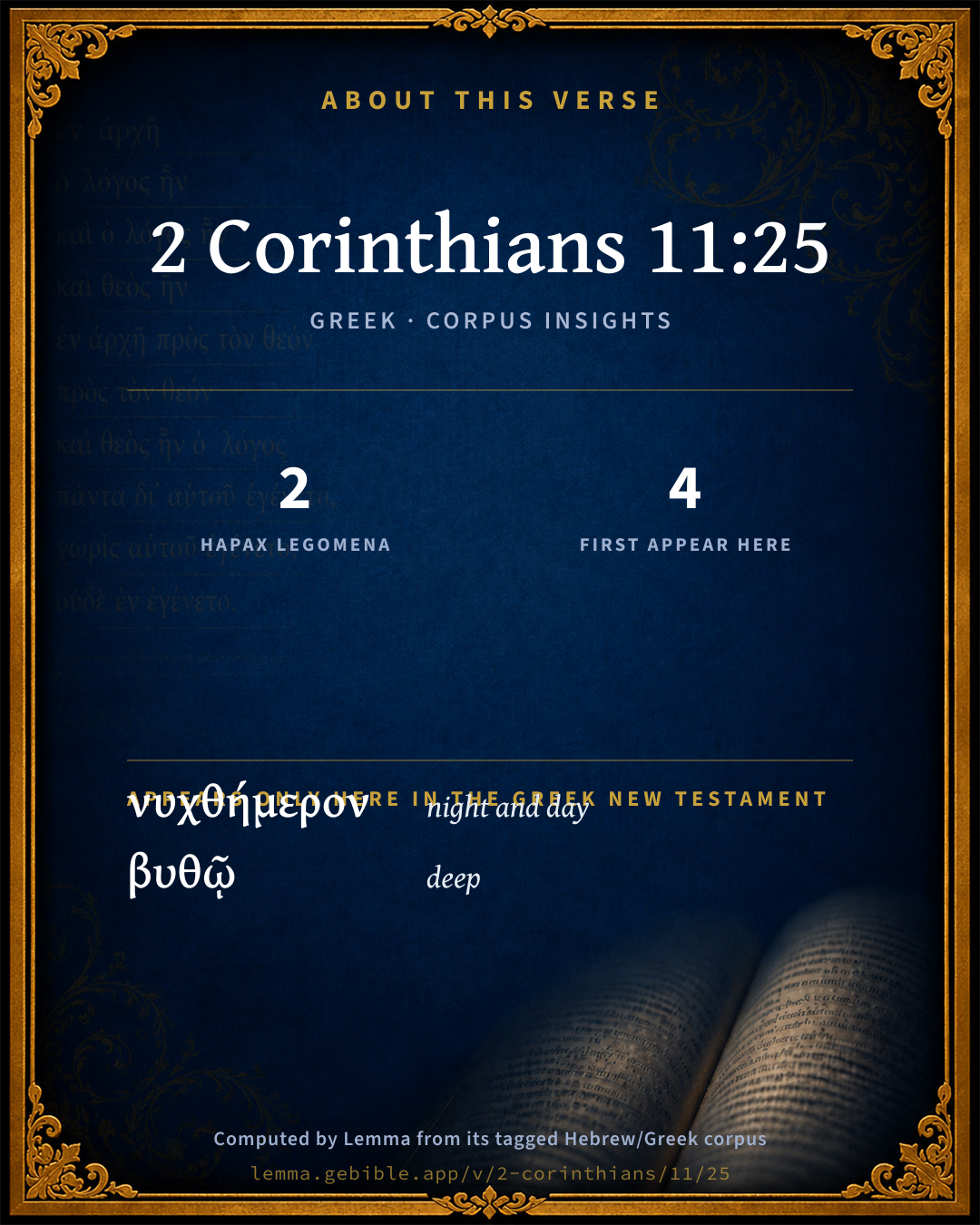
  • 2 hapax legomena — only here in the Greek New Testament
  • 4 first appearances in the Greek New Testament
Full analysis ↓
Download a study sheet

One document with this verse’s original text, its word-by-word gloss line, the meaning frame, cross-references with their text, attributed commentary, and full source and license credits — printable, and it pastes into notes with its structure intact.

This verse Autodidact and up

Study sheet (.html) Plain text (.txt)

A passage Seminary Student

Up to 50 verses in one chapter. A passage sheet keeps up to 6 commentary sources and 12 cross-references per verse, in the order this page ranks them, and says so on the sheet whenever that leaves anything out. Ask for a single verse and you get the Autodidact verse sheet above.

Everything on this page stays free to read, with no account — the sheet is a download of what is already on screen, not access to it.

Want to remove ads? Support Godless Engineer
Compare translations 3

The same verse in 3 English versions, stacked beneath the original-language interlinear above. Click any original word for its lexicon entry.

Each is an independent rendering of the whole verse — the interlinear is not word-aligned to these translations.

Highlighted words mark where these versions differ — a whole-verse word diff, not a word-by-word alignment.

  • World English Bible Public Domain
    Three times I was beaten with rods. Once I was stoned. Three times I suffered shipwreck. I have been a night and a day in the deep.
  • King James Version Public Domain
    Thrice was I beaten with rods, once was I stoned, thrice I suffered shipwreck, a night and a day I have been in the deep;
  • unfoldingWord Literal Text CC BY-SA 4.0
    Three times I was beaten with rods. Once I was stoned. Three times I was shipwrecked. I have spent a night and a day in the deep;

unfoldingWord Literal Text — © unfoldingWord, licensed CC BY-SA 4.0. Word-aligned USFM3 via Door43 (git.door43.org/unfoldingWord/en_ult).

Versions to compare (up to 4)

3 of 4 selected

Show all 19 translations

Every available English version of this verse, each an independent rendering of the whole verse.

  • World English Bible Public Domain
    Three times I was beaten with rods. Once I was stoned. Three times I suffered shipwreck. I have been a night and a day in the deep.
  • Berean Standard Bible Public Domain
    Three times I was beaten with rods, once I was stoned, three times I was shipwrecked. I spent a night and a day in the open sea.
  • Majority Standard Bible Public Domain
    Three times I was beaten with rods, once I was stoned, three times I was shipwrecked. I spent a night and a day in the open sea.
  • King James Version Public Domain
    Thrice was I beaten with rods, once was I stoned, thrice I suffered shipwreck, a night and a day I have been in the deep;
  • American Standard Version (1901) Public Domain
    Thrice was I beaten with rods, once was I stoned, thrice I suffered shipwreck, a night and a day have I been in the deep;
  • Revised Version (1885) Public Domain
    Thrice was I beaten with rods, once was I stoned, thrice I suffered shipwreck, a night and a day have I been in the deep;
  • Geneva Bible (1599) Public Domain
    I was thrise beaten with roddes: I was once stoned: I suffered thrise shipwracke: night and day haue I bene in the deepe sea.
  • Douay-Rheims (1899) Public Domain
    Thrice was I beaten with rods, once I was stoned, thrice I suffered shipwreck, a night and a day I was in the depth of the sea.
  • Young's Literal Translation Public Domain
    thrice was I beaten with rods, once was I stoned, thrice was I shipwrecked, a night and a day in the deep I have passed;
  • Literal Standard Version CC BY-SA 4.0
    three times I was beaten with rods, once I was stoned, three times I was shipwrecked, I have passed a night and a day in the deep;
  • Unlocked Literal Bible CC BY-SA 4.0
    Three times I was beaten with rods. Once I was stoned. Three times I was shipwrecked. I have spent a night and a day on the open sea.
  • unfoldingWord Literal Text CC BY-SA 4.0
    Three times I was beaten with rods. Once I was stoned. Three times I was shipwrecked. I have spent a night and a day in the deep;
  • Darby Bible Public Domain
    Thrice have I been scourged, once I have been stoned, three times I have suffered shipwreck, a night and day I passed in the deep:
  • World Messianic Bible Public Domain
    Three times I was beaten with rods. Once I was stoned. Three times I suffered shipwreck. I have been a night and a day in the deep.
  • Webster's Bible Public Domain
    Thrice was I beaten with rods, once I was stoned, thrice I suffered shipwreck, a night and a day I have been in the deep;
  • Free Bible Version CC BY-SA 4.0
    Three times I was beaten with rods, once I was stoned, three times I was shipwrecked. Once I spent twenty-four hours adrift on the ocean.
  • Bible in Basic English Public Domain
    Three times I was whipped with rods, once I was stoned, three times the ship I was in came to destruction at sea, a night and a day I have been in the water;
  • Text-Critical English NT CC BY 4.0
    Three times I was beaten with rods. Once I was stoned. Three times I was shipwrecked; a night and a day I spent in the open sea.
  • Tyndale New Testament (1534) Public Domain
    Thryse was I beten with roddes. I was once stoned. I suffered thryse shipwracke. Nyght and daye have I bene in the depe of the see.

Literal Standard Version (2020), Covenant Press — licensed CC BY-SA 4.0. Text via the HelloAO Bible API (eBible.org). Unlocked Literal Bible (unfoldingWord) — licensed CC BY-SA 4.0. Text via the HelloAO Bible API (eBible.org). unfoldingWord Literal Text — © unfoldingWord, licensed CC BY-SA 4.0. Word-aligned USFM3 via Door43 (git.door43.org/unfoldingWord/en_ult). Free Bible Version, Dr. Jonathan Gallagher — licensed CC BY-SA 4.0. Text via the HelloAO Bible API (eBible.org).

Word by word

More ways to search: Search by grammar → Find every occurrence → Compare this word →

Practice this passage: Drill this verse → Learn its vocabulary →

About this verse

These counts appear in no published source. They are computed here, from the morphology-tagged text and Lemma’s own curated glosses. What Lemma adds →

11
words
10
distinct lemmas
Pauline Epistles
section

Notable vocabulary

2 hapax legomena — words that appear only here in the entire Greek New Testament:

  • νυχθήμερον night and day G3574
  • βυθῷ deep G1037

First appearance in Scripture

These words make their first canonical appearance in the Greek New Testament here:

  • ἅπαξ once G530
  • ἐναυάγησα to shipwreck G3489
  • νυχθήμερον night and day G3574
  • βυθῷ deep G1037

Shared distinctive vocabulary

ἐραβδίσθην to beat G4463 occurs in 2 verses of the Greek New Testament. Also found in:

Repetition

A word recurs within this verse:

  • τρὶς thrice G5151 ×2

Cross-references

10

Topical passages linked to 2 Corinthians 11:25 in the Treasury of Scripture Knowledge — connected by theme and wording, ordered by reader-vote popularity; previews shown in the World English Bible.

  • Acts 14:19 But some Jews from Antioch and Iconium came there, and having persuaded the multitudes, they stoned Paul, and dragged him out of the city, supposing that he was dead.
  • Acts 16:22–23 The multitude rose up together against them, and the magistrates tore their clothes off of them, and commanded them to be beaten with rods.
  • Acts 16:33 He took them the same hour of the night, and washed their stripes, and was immediately baptized, he and all his household.
  • Acts 16:37 But Paul said to them, "They have beaten us publicly, without a trial, men who are Romans, and have cast us into prison! Do they now release us secretly? No, most assuredly, but let them come themselves and bring us out!"
  • Acts 27:1–44 When it was determined that we should sail for Italy, they delivered Paul and certain other prisoners to a centurion named Julius, of the Augustan band.
  • Hebrews 11:37 They were stoned. They were sawn apart. They were tempted. They were slain with the sword. They went around in sheep skins and in goat skins; being destitute, afflicted, ill-treated
  • Matthew 21:35 The farmers took his servants, beat one, killed another, and stoned another.
  • Acts 7:58–59 They threw him out of the city, and stoned him. The witnesses placed their garments at the feet of a young man named Saul.
  • Acts 14:5 When some of both the Gentiles and the Jews, with their rulers, made a violent attempt to mistreat and stone them,
  • Acts 22:24 the commanding officer commanded him to be brought into the barracks, ordering him to be examined by scourging, that he might know for what crime they shouted against him like that.

Cross-references courtesy of OpenBible.info (CC BY 4.0).

Commentary

Notes on 2 Corinthians 11:25 from classic Christian and Jewish commentators (each source and its license shown beneath its notes). The classic Christian expositions comment on the surrounding passage and are grouped to its opening verse, so a note may address several verses; the Jewish commentaries on the Tanakh (Rashi and others) are per-verse, so they appear only where the commentator wrote on this verse.

Lemma curates 59 commentaries, every one of them public domain or Creative Commons licensed, each selected and text-cleaned for this edition rather than reprinted as found. About our sources →

Jamieson, Fausset & Brown

Robert Jamieson, A. R. Fausset & David Brown

The beating by Roman magistrates at Philippi (Act 16:23) is the only one recorded in Acts, which does not profess to give a complete journal of his life, but only a sketch of it in connection with the design of the book, namely, to give an outline of the history of the Gospel Church from its foundation at Jerusalem, to the period of its reaching Rome, the capital of the Gentile world.

once was I stoned-- (Act 14:19).

thrice . . . shipwreck--before the shipwreck at Melita (Act 27:44). Probably in some of his voyages from Tarsus, where he stayed for some time after his conversion, and from which, as being a seafaring place, he was likely to make missionary voyages to adjoining places (Act 9:30; Act 11:25; Gal 1:21).

a night and a day . . . in the deep--probably in part swimming or in an open boat.

Jamieson, Fausset & Brown — Commentary Critical and Explanatory on the Whole Bible (1871) — public domain (CC PDM 1.0). Text via the HelloAO Bible API.

Tyndale Open Study Notes

Tyndale Open Resources

11:25 Three times I was beaten with rods: Paul suffered this Roman punishment at Philippi, though as a Roman citizen he should have been exempted (Acts 16:22-24, 37). • Once I was stoned: At Lystra (Acts 14:19). • Three times I was shipwrecked: These events are otherwise unknown; Paul’s shipwreck on the voyage to Rome would come later (Acts 27:1-44).

Tyndale Open Study Notes — © Tyndale Open Resources, licensed CC BY-SA 4.0. Text via the HelloAO Bible API.

Bengel's Gnomon

Johann Albrecht Bengel

2Co 11:25. Τρὶς ἐναυάγησα, thrice I was shipwrecked) before the shipwreck at Melita (Malta).—ἐν τῷ βυθῷ) ὁ βυθὸς denotes anything deep: but when it is used absolutely, the sea, especially here, as being connected with the mention of shipwrecks. The LXX. generally translate מצולה by βυθός.—ἐπόιησα) I have spent, swimming. Many persons, who have been shipwrecked, thus contend with the waters for many hours, so that they may at last escape.

Bengel's Gnomon of the New Testament — English translation (T&T Clark, Edinburgh, 1860) — public domain. Text from a community e-Sword module.

Expositor's Greek Testament

ed. W. Robertson Nicoll

2Co 11:25 . τρὶς ἐραβδίσθην κ . τ . λ .: thrice was I beaten with rods, i.e. , “virgis caesus sum,” a Roman , as distinct from the Fewish , method of scourging distinct too from flagellation with thongs (Mat 27:26 ). It was forbidden in the case of a Roman citizen by the Lex Porcia, but nevertheless St. Paul had endured it at Philippi (Act 16:23 ; Act 16:37 ), and barely escaped it at Jerusalem (Act 22:25 ). We do not know the other two occasions alluded to. ἅπαξ ἐλιθάσθην κ . τ . λ .: once was I stoned, i.e. , at Lystra (Act 14:19 , and almost at Iconium, 2Co 11:5 ), thrice I suffered shipwreck , of the circumstances of which we have no record, for the shipwreck on his voyage to Rome (Act 27 .) was subsequent to this, a night and a day have I been (there seems to be no special reason here for the perf. in preference to the aorist) in the deep , probably after one of the shipwrecks ( cf. Act 27:44 ). For ποιεῖν with words of time cf. Act 15:33 ; Act 20:3 , Jas 4:13 .

The Expositor's Greek Testament, edited by W. Robertson Nicoll (1897–1910) — public domain. Text from a community e-Sword module.

Geneva Bible (1599)

Geneva Bible translators

Of the Roman Magistrates.

Geneva Bible (1599) marginal notes — public domain. Text via Bolls.life.

Adam Clarke's Commentary

Verse 25. Thrice was I beaten with rods] This was under the Roman government, as their lictors beat criminals in this way. We hear of the apostle's being treated thus once, namely at Philippi, Ac 16:22. See sec. 9 of the introduction.

Once was I stoned] Namely, at Lystra, Ac 14:19, c.

A night and a day I have been in the deep] To what this refers we cannot tell it is generally supposed that in some shipwreck not on record the apostle had saved himself on a plank, and was a whole day and night on the sea, tossed about at the mercy of the waves. Others think that βυθος, the deep, signifies a dungeon of a terrible nature at Cyzicum, in the Propontis, into which Paul was cast as he passed from Troas. But this is not likely.

Adam Clarke's Commentary on the Bible (1810–1826) — public domain. Text from a community e-Sword/MySword module.

John Calvin's Commentaries

25. Thrice was I beaten with rods Hence it appears, that the Apostle suffered many things, of which no mention is made by Luke; for he makes mention of only one stoning, one scourging, and one shipwreck. We have not, however, a complete narrative, nor is there mention made in it of every particular that occurred, but only of the principal things.

John Calvin's Commentaries (1540-1563) — public domain. Text from the Calvin Translation Society English edition (1840s-50s) via the Christian Classics Ethereal Library (ccel.org). Calvin's coverage is partial (roughly two-thirds of the Bible); uncommented books and verses are honest gaps, never fabricated. The 19th-century editor's footnotes and remarks are omitted so the notes are faithfully Calvin's own voice.

Ellicott's Commentary for English Readers

(25) Once was I stoned.—Here the Acts (Act_14:19) give us the solitary instance at Lystra. The accuracy of the Apostle in referring to this form of suffering, where we can compare it with the history, may fairly be urged as evidence of a like accuracy in his other statements.

Thrice I suffered shipwreck.—Again we have a picture of unrecorded sufferings, which we must refer either to the period of his life between his departure from Jerusalem (Act_9:30) and his arrival at Antioch (Act_11:26), or to voyages among the islands of the Ægean Sea during his stay at Corinth or at Ephesus, or to that from Ephesus to Cæsarea in Act_18:22.

A night and a day I have been in the deep.—Taken in their natural sense the words probably point to one of the shipwrecks just mentioned, in which, either swimming or with the help of a plank (as in Act_27:44), he had kept himself floating for nearly a whole day, beginning with the night. They have, however, been referred by some writers to a dungeon pit, like that into which Jeremiah was cast (Jer_38:6), in which the Apostle was either thrown or hid himself after the stoning at Lystra. Bede (Qucest. iii. 8) relates, on the authority of Archbishop Theodore of Canterbury—whose evidence, as a native of Tarsus, has here a special interest—that there was such a dungeon known by the name of Bythos (the word used here for “deep”) in his time at Cyzicus, and, if so, it is probable enough that the same use of the word may have prevailed in other cities. So at Athens there was a dungeon known as the barathron—a word used also for a “gulf.” On the whole, however, though the conjecture is interesting enough to deserve mention, there seems no adequate reason for adopting it.

A Bible Commentary for English Readers, edited by Charles John Ellicott (1878–1897) — public domain. Text from a community e-Sword module.

The Cambridge Bible for Schools and Colleges

gen. ed. J. J. S. Perowne

25. Thrice was I beaten with rods] See Act_16:22-23, and note on 2Co_11:23. This punishment is also said frequently to have caused the death of the victim. It was inflicted by the Romans on those who did not possess the privilege of Roman citizenship, Act_22:25. A precisely similar scene to that in the Acts is recorded in Cicero in Verrem v. 62, where the victim is said to have uttered the well-known words, Civis Romanus sum. Cicero here invokes the ‘lex Porcia,’ by which the beating a Roman citizen with rods, which had been formerly lawful, was forbidden. See Livy, 2Co_10:9, “gravi poena si quis verberasset necassetve civem Romanum,” and cf. Sallust, Catilina, c. 51.

once was I stoned] See Act_14:19. Clement of Rome, St Paul’s companion and friend (Php_4:3), says in a somewhat obscure passage (Eph_1:5) that St Paul was “seven times imprisoned, put to flight and stoned.”

thrice I suffered shipwrack] The shipwreck related in Acts 27 is not one of these, but occurred some time afterwards. We have no other account of those referred to here.

a night and a day] The Apostle here speaks of some terrible peril, compared to which even the shipwreck related in Acts 27 was a trifling one. Probably for twenty-four hours he was exposed to the dangers of the ocean, with but a plank between him and death. The Acts of the Apostles, we are once more constrained to remark, gives us but a scanty account of the labours and perils undergone by this undaunted soul. The word translated ‘a night and a day’ is but a single word in the original, and signifies a period of twenty-four hours, commencing with sunset. Some have thought that the expression here, ‘in the deep,’ is the same as the LXX. of Exo_15:5, and that St Paul went down with the ship, and was delivered by a Divine interposition. So Wiclif, Tyndale and the Geneva and Rheims versions, following the Vulgate, seem to have interpreted this passage (in the depnesse of the see, Wiclif; in the depe of the see, Tyndale). But the expressions here and in Exo_15:5 (LXX.) are not identical. Cranmer renders, in the deepe see. So Chrysostom, who explains it, ‘swimming on the sea,’ and the Syriac version, which translates, ‘without a ship in the sea.’

The Cambridge Bible for Schools and Colleges (gen. ed. J. J. S. Perowne; Cambridge University Press, 1878–1918) — public domain. Text from a community e-Sword module.

John Gill's Exposition

In journeying often,.... Through several countries and kingdoms to preach the Gospel, as he did from Jerusalem round about to Illyricum:

in perils of waters; by the floods being out, which made it very troublesome and dangerous travelling, especially to persons on foot, as was the case of our apostle:

in perils of robbers; for though he had seldom much to lose, yet was in danger of being ill used, and of his life being taken away by such ruffians:

in perils by my own countrymen; the Jews, who bore an implacable hatred to him, because of the doctrines of grace he preached, in opposition to the works of the law of Moses, whether moral or ceremonial; and who generally were concerned in stirring up the Gentiles against him wherever he came:

in perils by the Heathen; the Gentiles, who were incensed against him for inveighing against their idols and idolatrous worship, and other wicked and enormous practices they were addicted to; particularly at Ephesus, by the means of Demetrius the shrine maker, Act 19:23,

in perils in the city; in any and every city he came into; for bonds and affliction abode him everywhere, as at Jerusalem, Damascus, Antioch, Ephesus, Philippi, Thessalonica, &c.

in perils in the wilderness; by robbers and wild beasts, through hunger and thirst, and by the sands in hurricanes and tempests; though this may be understood not strictly of desert places, but of the country in distinction from the city; See Gill on Mat 3:1 where travelling is difficult and dangerous, and the people more rustic and uncivil: the phrase, , "in perils of the wildernesses", is a Rabbinical one (p); as is also , "peril in the sea" (q), next mentioned:

in perils in the sea; not only by shipwreck, but through pirates, and the ill usage of mariners, want of provisions, &c.

in perils among false brethren; who pretended to be Christians, but "judaized", teaching the necessity of observing circumcision, and other ceremonies of the law, in order to salvation; these, as the apostle always warmly opposed, so they were sworn enemies to him, and ever sought to do him what mischief they could.

(p) Sepher Cosri, fol. 296. 2. (q) Sepher Cosri, fol. 297. 2.

John Gill's Exposition of the Whole Bible (1746–1763) — public domain (CC PDM 1.0). Text via the HelloAO Bible API.

Trapp's Complete Commentary

John Trapp

25 Thrice was I beaten with rods, once was I stoned, thrice I suffered shipwreck, a night and a day I have been in the deep;

Ver. 25. Thrice was I beaten, &c.] By the Roman magistrates, as also the martyrs were by the Romish bishops. Thomas Hinshaw was beaten with rods by Bonner, and abode his fury so long as the fat paunched bishop could endure with breath, and till for weariness he was fain to cease. So also he dealt by John Willis, and by Mr Bartlet Green, who greatly rejoiced in the same.

I have been in the deep] Sine nave in mari fui, I was in the sea without a ship, so the Syriac renders it. For 24 hours together I have been floating in the sea.

John Trapp, A Commentary or Exposition upon All the Books of the Old and New Testament (1647–1656) — public domain. Text from a community e-Sword module.

Albert Barnes' Notes on the Bible

Thrice was I beaten with rods - In the Acts of the Apostles there is mention made of his being beaten in this manner but once before the time when this Epistle was written. That occurred at Philippi; Act 16:22-23. But there is no reason to doubt that it was more frequently done. This was a frequent mode of punishment among the ancient nations, and as Paul was often persecuted, he would be naturally subjected to this shameful punishment.

Once I was stoned - This was the usual mode of punishment among the Jews for blasphemy. The instance referred to here occurred at Lystra; Act 14:19. Paley (Horae Paulinae) has remarked that this, when confronted with the history, furnished the nearest approach to a contradiction without a contradiction being actually incurred, that he ever had met with. The history Act 14:19 contains but one account of his being actually stoned. But prior to this Act 14:5, it mentions that “an assault was made both of the Gentiles, and also of the Jews with their rulers, to use them despitefully and to stone them, but they were aware of it, and fled to Lystra and Derbe.” “Now,” Paley remarks, “had the assault been completed; had the history related that a stone was thrown, as it relates that preparations were made both by Jews and Gentiles to stone Paul and his companions; or even had the account of this transaction stopped without going on to inform us that Paul and his companions were aware of their danger and fled, a contradiction between the history and the Epistle would have ensued. Truth is necessarily consistent; but it is scarcely possible that independent accounts, not having truth to guide them, should thus advance to the very brink of contradiction without falling into it.”

Thrice I suffered shipwreck - On what occasions, or where, is now unknown, as these instances are not referred to in the Acts of the Apostles. The instance of shipwreck recorded there Acts 27, which occurred when on his way to Rome, happened after this Epistle was written, and should not be supposed to be one of the instances referred to here. Paul made many voyages in going from Jerusalem to Tarsus, and to Antioch, and to various parts of Asia Minor, and to Cyprus; and shipwrecks in those seas were by no means such unusual occurrences as to render this account improbable.

A night and a day ... - The word used here (νυχθήμερον nuchthēmeron) denotes a complete natural day, or 24 hours.

In the deep - To what this refers we do not now certainly know. It is probable, however, that Paul refers to some period when, having been shipwrecked, he was saved by supporting himself on a plank or fragment of the vessel until he obtained relief. Such a situation is one of great peril, and he mentions it, therefore, among the trials which he had endured. The supposition of some commentators that he spent his time on some rock in the deep; or of others that this means some deep dungeon; or of others that he was swallowed by a whale (that is, a big fish), like Jonah, shows the extent to which the fancy is often indulged in interpreting the Bible.

Albert Barnes' Notes on the Bible (1834–1885) — public domain. Text from a community e-Sword/MySword module.

Haydock's Catholic Bible Commentary

Thrice I suffered shipwreck. This was before the shipwreck in his voyage to Rome, by which we make take notice, that St. Luke, in the Acts, omits a great many things relating to St. Paul; as also when he adds,[1] a night and a day I was in the depth of the sea. We do not read expressed in the Greek, of the sea; but the Greek word is observed to imply the same: and so it is understood by St. John Chrysostom who gives these two expositions; first, that he was truly and literally in the middle of the sea. Secondly, that he was floating or swimming in the sea after shipwreck, which seems the more common interpretation. (Witham) --- St. Paul could have avoided that disgrace, as a Roman. See Acts xxiii.; but in Acts xvi. he refused to claim his privilege, that he might have an opportunity of converting the guard of the prison. (Pastorini)

===============================

[BIBLIOGRAPHY]

Nocte et die in profundo maris sui, Greek: en to butho pepoieka.

====================

George Leo Haydock (1774–1849), Haydock's Catholic Family Bible and Commentary, 1859 edition — public domain. Excludes Psalms (Douay-Rheims chapter numbering differs from Protestant) and Deuterocanonical books (Catholic canon only).

Matthew Poole's English Annotations

Thrice was I beaten with rods; this was by the pagans, for the Jews whipped malefactor with a whip which had three cords. We read of one of these times. Act 16:23; and of a second, Act 22:24, when the captain commanded he should be so punished, but he avoided it, by pleading he was a citizen of Rome.

Once was I stoned: of his stoning, read Act 14:19, it was by a popular tumult at Lystra.

Thrice I suffered shipwreck: we read but of one time that Paul suffered shipwreck, Act 27:18; which was none of the three times here mentioned, for it was after the writing of this Epistle. But though many of the acts and sufferings of this apostle were written, yet all were not.

A night and a day I have been in the deep: some by the deep here understand the inner prison, mentioned Act 16:24, or some deep dungeon; but more probably he means, some time when, after a shipwreck, he might be put twenty-four hours to swim up and down the sea upon some broken part of the ship. It refers to some eminent danger Paul was in, of which the Scripture in no other place maketh mention particularly.

Matthew Poole's English Annotations on the Holy Bible (1683–1685) — public domain. Text from a community e-Sword/MySword module.

Whedon's Commentary on the Bible

Daniel D. Whedon

25. The above stripes being specially from Jews, these rods were doubtless in Gentile hands. The Roman rods often inflicted death. As a Roman citizen, Paul was by law exempt from this punishment, but he was doubtless often out of reach of law. So at Philippi he suffered it, following it with protest, and at Jerusalem narrowly escaped it. Act_16:37; Act_22:25.

Once… stoned—At Lystra. Act_14:19.

Thrice… shipwreck—In addition to the one in Acts 28, which was much later than this writing.

A night and a day—Twenty-four hours. Not, as some interpret, that Paul was sunk in the deep that time and saved from drowning by miracle. The natural image is, that he was floating that time in the deep, on a fragment of a wrecked ship.

Daniel D. Whedon (gen. ed.), Commentary on the Old and New Testaments (1874–1909) — public domain. Text from a community e-Sword module.

The Pulpit Commentary

Thrice was I beaten with rods. This alludes to scourgings inflicted by Gentile magistrates with the vitis, or vine stick, of soldiers, or with the fasces of lictors. Only one of these horrible scourgings, which likewise often ended in death, is narrated in the Acts. (Act_16:22) We do not know when the others were inflicted. In any case they were egregious violations of St. Paul"s right of Roman citizenship; but this claim (as we see in Cicero"s various orations) was often set at nought in the provinces. Once was I stoned. At Lystra. (Act_14:19) Thrice I suffered shipwreck. Not one of these shipwrecks is narrated in the Acts. The shipwreck of Acts 27, took place some years later. A night and a day I have been in the deep. An allusion, doubtless, to his escape from one of the shipwrecks by floating for twenty-four hours on a plank in the stormy sea. We have no right to assume that the deliverance was miraculous. The perfect tense shows St. Paul"s vivid reminiscence of this special horror. "In the deep" means "floating on the deep waves." Theophylact explains the words ejn buqw to mean "in Bythos," and says that it was a place near Lystra, apparently like the Athenian Barathrum and the Spartan Caeadas a place where the bodies of criminals were thrown. The word does notoccur elsewhere in the New Testament.

The Pulpit Commentary (1880–1919), ed. H.D.M. Spence-Jones & Joseph S. Exell — public domain. Text from a community e-Sword module.

John Wesley's Explanatory Notes

Thrice I have been shipwrecked - Before his voyage to Rome. In the deep - Probably floating on some part of the vessel.

John Wesley, Explanatory Notes Upon the Whole Bible (1754–1765) — public domain. Text via the GEBible commentary corpus.

Burkitt's Expository Notes on the New Testament

William Burkitt

Behold what a catalogue the apostle here gives of his sufferings and services: He was scourged by the Jews with whips, beaten by the Gentiles with rods, stoned by the rabble, thrice suffered shipwreck, a night and a day tossed to and fro upon the sea, and in great danger of perishing; in journeyings often from one country to another, to preach, plant, and propagate the gospel; in perils at sea and land, by pirates and robbers; in perils by his countrymen the Jews; in perils in the cities, Damascus, Ephesus, and Jerusalem; in perils in wildernesses and deserts; in perils amongst false brethren, men of the Christian profession; in weariness and painfulness, by travelling from place to place; in hunger and thirst, in fastings often, that is, in necessitated hunger often, and in voluntary fastings frequent, for spiritual purposes; in cold and nakedness, that is, very poor and thin in clothing.

Lord! what tongue can utter, or what heart can conceive, the pains which the apostle took, or the hazards which he run, in preaching the gospel to a lost world? And yet the good man heartily thanks our Lord Jesus Christ for all that, who had counted him faithful, and put him into the ministry. Verily none of the ministers of Christ have any reason or cause to repent of the the choice of their office, whatever services they undertake, or whatever sufferings or reproaches it either hath or may expose them to. Alas! what is all that we feel, to what this apostle underwent? And what is all that he underwent for Christ, compared with that transcendent reward which is in the hand of Christ, both for him and us.

William Burkitt's Expository Notes on the New Testament (1700–1703) — public domain. Text from a community e-Sword module.

McGarvey & Pendleton's Commentaries

J. W. McGarvey

Thrice was I beaten with rods, once was I stoned, thrice I suffered shipwreck, a night and a day have I been in the deep [The Romans punished by using the vine rods of the soldiers or the fasces of the lictors, and no law limited the number of strokes. Such beatings often caused death. Roman citizenship was presumed to protect from such punishment, but in his orations Cicero tells us that in the provinces the rights of citizenship were often set at nought in this respect. Luke tells of but one of these beatings ( Act_26:22 ). The stoning took place at Lystra ( Act_14:19 ). Luke tells in all six sea voyages, but says nothing of the wreckings here mentioned. In referring to the twenty-four-hour struggle for life amidst the waves, Paul uses the present tense, showing that the horror of his situation was still vividly remembered]:

J. W. McGarvey (with Philip Y. Pendleton), Commentaries on the New Testament (The Fourfold Gospel, 1914; Acts; and the epistles) — public domain. Text from a community e-Sword/MySword module.

The People's New Testament

B. W. Johnson

25. Thrice was I beaten with rods. This was the Roman scourging. Only one of these instances is reported in Acts, that in Acts 16:23. Once was I stoned. See Acts 14:19. Thrice I suffered shipwreck. No account elsewhere is given of these. The shipwreck, on the way to Italy, was of later date. A night and a day I have been in the deep. In an open boat, or on driftwood, after a shipwreck.

B. W. Johnson's The People's New Testament with Notes (1889–1891) — public domain. Electronic text from the Christian Classics Ethereal Library (CCEL) ThML edition.

Cambridge Greek Testament for Schools and Colleges

25. τρὶς ἐραβδίσθην. This beating with rods is a Roman punishment. We know of only one of these three cases, the one at Philippi (Act 16:23; comp. 1Th 2:2). Possibly the protest that he and Silas were Roman citizens, which frightened the praetors afterwards (Act 16:37-38), was not heard in the tumult (Ramsay, St Paul the Traveller and the Roman Citizen, p. 219). It was recognized by the tribune, when S. Paul urged it in a quiet interview at Jerusalem (Act 22:25). Comp. the case of Attains at Lyons (Eus. H. E. v. i. 44, 50). But the δ-text suggests that it was the earthquake which caused the change in the Philippian praetors; ἀναμνησθέντες τὸν σεισμὸν τὸν γεγονότα ἐφοβήθησαν καὶ ἀπέστειλαν τοὺς ῥαβδούχους κ.τ.λ. Cicero (in Verrem, v. 62) tells us that brutal magistrates sometimes ignored this plea. Gessius Florus, who succeeded Albinus as procurator of Judaea A.D. 64 or 65 (Lewin, Sacri Fasti, p. 334), behaved in this way (Joseph. B. J. II. xiv. 9). On the single ρ in ἐραβδίσθην see WH. II. App. p. 163.

ἄπαξ ἐλιθάσθην. This was at Lystra, where Barnabas and Paul had been taken to be gods, until malignant Jews came all the way from Antioch and Iconium and changed the fickle people (Act 14:11-19). The Apostles had been nearly stoned at Iconium, but escaped (Act 14:5-6). See Paley, Horae Paulinae, iv. 9. For λιθάζειν comp. Act 5:26; Act 14:19; Joh 11:8; Heb 11:37; καταλιθάζειν, Luk 20:6: λιθοβολεῖν is more common, especially in the LXX.

τρὶς ἐναυάγησα. We know of several voyages made by S. Paul before the shipwreck on the way to Rome; and in some of these, or in others of which we know nothing, the three shipwrecks took place. It was very likely after one of these shipwrecks that he ‘passed a night and a day in the deep,’ probably floating upon wreckage (comp. Act 27:44). In 1Ti 1:19 ναυαγεῖν is used metaphorically of shipwreck περὶ τὴν πίστιν. It is found in Hdt., Xen., Dem., but nowhere else in Biblical Greek.

νυχθήμερον. A very rare word, meaning a full day of twenty-four hours.

πεπροίηκα. The change from the preceding aorists is noteworthy. The perfect gives the terrible experience as vividly before the writer’s mind. For ποιεῖν of spending time comp. Act 15:33; Act 18:23; Act 20:3; Jas 4:13; Tob 10:7.

ἐν τῷ βυθῷ. This of course does not mean that he was super-naturally preserved for twenty-four hours under water, although the Vulgate’s in profundo maris has encouraged this interpretation. To say nothing of other objections, S. Paul would hardly have classed so miraculous a deliverance among his sufferings. By βυθός is here meant, not ‘the depth of the sea,’ but ‘the deep,’ i.e. the sea. Comp. αὐτοὶ εἴδοσαν τὰ ἔργα Κυρίου καὶ τὰ θαυμάσια αὐτοῦ ἐν τῷ βυθῷ (Psa 106:24): Pompeius tellure nova compressa profundi Ova videns (Lucan, Phar. II. 680).

Cambridge Greek Testament for Schools and Colleges (Cambridge University Press, 1896; 21 vols, various authors incl. Carr, Maclear, Plummer, Farrar, Lumby, Moule, M. R. James, Simcox) — public domain. Text from a community e-Sword module.

Alford’s Greek Testament

Henry Alford

25.] are parenthetical, explaining some of the foregoing expressions: the construction is resumed, ver. 26.

At the hands of the Jews five times received I forty save one (in Deu 25:3, it is prescribed that not more than forty stripes should be given, ‘lest thy brother should seem vile unto thee.’ For fear of exceeding this number, they kept within it. This seems a more likely account of the thirty-nine stripes than that given by Wetst.,—that thirteen were inflicted on the breast, and the same number on each shoulder, and the fortieth omitted, lest one part of the body should receive more than another. See the Rabbinical authorities in Wetst., and cf. Joseph. Antt. iv. 8. 21 and 23, and Stanley’s note here. He calls it τιμωρία αἰσχίστη: and Meyer remarks that Paul might well number it among the θάνατοι, for it was no rare occurrence for the criminal to die under its infliction.

None of these scourgings are mentioned in the Acts),—thrice was I beaten with rods (scil. by the Roman magistrates, see Act 16:22, Act 16:23, which is the only occasion mentioned in the Acts), once was I stoned (Act 14:19), thrice I suffered shipwreck (not one of these shipwrecks is known to us. Thus we see that perhaps three, perhaps two, voyages of Paul, but certainly one,—previous to this time, must be somewhere inserted in the history of the Acts: see Prolegg. ch. 3 § v. 5), a night and day have I spent (reff.) in the deep (i.e. the sea: probably on some remnant of a wreck after one of his shipwrecks alone or with others. To understand ὁ βυθός, as Thl. (τινὲς δέ φασιν ἔν τινι φρέατι μετὰ τὸνἐν Λύστροις κίνδυνον κατακρυφθείς, βύθῳ λεγομένῳ, νῦν τοῦτο λέγει), seems to be taking it out of its connexion here. Wetst. gives from. Ælian, H. An. viii. 7, ἀθέατον νήχεσθαι ἐν βυθῷ. Still less must we think of the characteristic interpretation of Estius: “Subjunxit aliud periculum marinum longe gravius, nempe quod demersus fuerit ex naufragio in profundum maris, ubi tamen divina ope fuerit servatus incolumis noctem et diem, atque inde postea liberatus”).

Henry Alford, The Greek Testament (1849–1861) — public domain. Text from a community e-Sword module.

International Critical Commentary

25. τρὶς ἐραβδίσθην. Ter vergis caesus sum. This was a Roman, and therefore a Gentile punishment, and of the three inflictions we know of only one, that inflicted at Philippi, in violation of Roman Law (ὑβρισθέντες ἐν Φιλίπποις, 1Th 2:2), by the praetors there (Act 16:22, Act 16:23, Act 16:37). Cf. Act 22:25-29. Cicero says that to beat a Roman citizen was scelus, but that reckless and ruthless magistrates sometimes committed the outrage (In Verr. v. 62, 66). Gessius Florus, who succeeded Albinus as procurator of Judaea, A.D. 64 or 65, caused persons of equestrian rank to be scourged and crucified, ignoring their rights as Romans (Joseph. B.J. II. xiv. 9). The fact that St Paul was thrice treated in this way is evidence that being a Roman citizen was an imperfect protection when magistrates were disposed to be brutal. We may be sure that he protested at Philippi, but there was an excited mob to hound on the domineering praetors. Ramsay, St Paul the Traveller, p. 219.

The best MSS. have ἐραβδίσθην, not ἐρραβδίσθην. “In most cases verbs beginning with ρ do double the ρ after the initial ἐ of the augmented tenses. Usually the evidence for the single ρ is overwhelming” (WH. App. p. 163).

ἅπαξ ἐλιθάσθην. At Lystra, and of this we have a full account. The Apostles had a narrow escape from stoning at Iconium. Their Jewish enemies followed them to Lystra, and there St Paul was nearly killed (Act 14:5, Act 14:6, Act 14:19). Clement of Rome (Cor. 5) has λιθασθείς after ἑπτάκις δεσμὰ φορέσας, φυγαδευθείς. Paley, Hor. Paul. iv. 9. In N.T. λιθοβολέω is more freq. than λιθάζω, and in LXX it is much more freq. In Acts we find both.

τρὶς ἐναυάγησα. We know nothing of these, for the one recorded in Act_27 took place later. The verb is classical, but it is very rare in Bibl. Grk. Cf. 1Ti 1:19.

νυχθήμερον. A very rare word, meaning a complete day and night.

πεποίηκα. The change from aorists to perfect is not casual. The perf. shows that the dreadful experience is vividly before the Apostle’s mind, and possibly indicates that the occurrence was recent. J. H. Moulton, p. 144.* Ποιέω occurs fairly often of spending time; Act 15:33, Act 15:28:23, Act 15:20:3; Jas 4:13; Tobit 10:7. ‘Make time’ in English is not parallel.

ἐν τῷ βυθῷ. Vulg., in profundo maris. This translation has helped the extraordinary idea that the Apostle had spent twentyfour hours under water; but ἐν τῷ βυθῷ means simply ‘in the sea,’ in alto mari, far away from land. In the other shipwrecks he was near the shore, which he soon reached, as in Act_27.; but in this case he was tossed about, probably on a bit of wreckage, for a night and a day. Chrysostorn rejects the other explanation as improbable, because St Paul is here speaking of his sufferings, not of his miracles. Those who adopt the miraculous interpretation point to Jonah as a case in point, as if that could be regarded as history. Cf. τὰ θαυμάσια αὐτοῦ ἐν τῷ βυθῷ (Psa 106:24), which certainly does not refer to the wonderful things in the depths of the ocean. Theophylact says that there was an underground chamber in which St Paul lay concealed after the peril at Lystra and that this was called βυθός. He gives this as a mere tradition; τινὲς δέ φασιν.

International Critical Commentary — older volumes (1896–1929), various authors — public domain. Text from a community e-Sword module.

Vincent's Word Studies in the New Testament

Marvin R. Vincent

Beaten with rods. Roman scourgings.

Stoned. At Lystra, Act 14:19.

Thrice I suffered shipwreck. The shipwreck at Malta, being later, is, of course, not referred to; so that no one of these three is on record. 158 A night and a day [νυχθημερον] . A compound term occurring only here in the New Testament, and rarely in later Greek.

Have I been in the deep [εν τω βυθω πεποιηκα] . Lit., I have made (spent) a night and a day in the deep. For a similar use of poiew to make, see Act 14:33; Act 18:23; Act 20:3; Jas 4:13. buqov bottom or depth occurs only here. Of the event itself there is no record.

Marvin R. Vincent, Word Studies in the New Testament (1887–1900) — public domain. Text from a community e-Sword/MySword module.

Lesson kit

Teaching starters — assembled from the data on this page, not authored interpretation. Every prompt links to the verse data it draws on. Edit before teaching.

2 Corinthians, in the Pauline Epistles, opens this verse with 11 words (10 distinct Greek lemmas). Its most distinctive word is nychthḗmeron (“night and day”). A historical commentator’s framing appears above. Read the whole chapter for the surrounding context.

Discussion questions

  1. The word nychthḗmeron carries the sense “night and day.” How does it shape the verse?
  2. 2 words here appear nowhere else in the Greek New Testament. Why might the author reach for such rare wording?
  3. 4 words make their first appearance in Scripture here. What does this debut establish?
  4. How does Acts 16:22, which shares the word «to beat», read alongside this verse?
  5. What does the repetition of “thrice” (2× in this one verse) do in this verse?
  6. The translations on this page render this verse differently — a whole-verse word diff, not a word-by-word alignment. What might account for the different wordings?
  7. Compare how Jamieson, Fausset & Brown and Tyndale Open Study Notes read this verse. Where do they agree or differ?

Things to notice

  • 2 words in this verse appear nowhere else in the Greek New Testament.
  • 4 words make their first canonical appearance in Scripture here.
  • These translations choose different wording for 8 words in this verse.
  • “thrice” occurs 2× in this single verse.
  • 10 distinct Greek lemmas span 11 words in this verse.

Reading settings

Reading text

Shown beneath each verse's original-language words.

Old Testament
Old Testament edition

Read the OT as the Masoretic Hebrew (MT) or the Greek Septuagint (LXX).

English shown for the Greek Septuagint (in the Hebrew ↔ Greek comparison).

Comparing translations? Open the Compare panel on any verse page to stack up to four side by side.