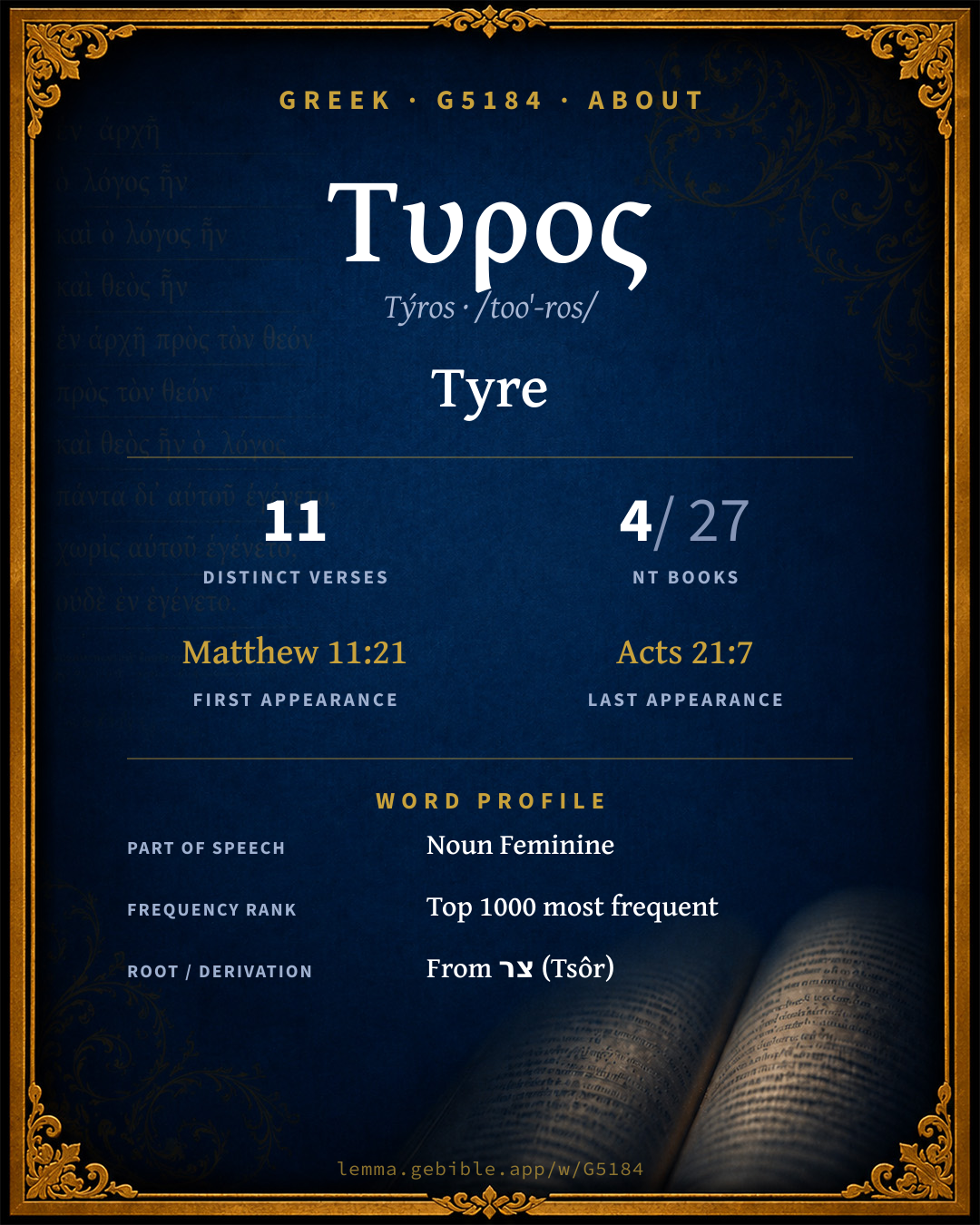
Τύρος
Tyre
Thayer's lists 2 entries for ‘Tyre’ fuller range ↓
Full lexicon entry — Thayer's Greek Lexicon
From Thayer's Greek Lexicon
Where this word appears
See every Genitive-case word in the Greek New Testament →
Grammar key — what these labels mean
Part of speech
- Noun
- A naming word — a person, place, thing, or idea.
Case
- Genitive
- The case of source, possession, or “of” — answers “whose / from what.”
- Dative
- The case of the indirect object, means, or location — “to / for / with / in.”
- Accusative
- The case of the direct object and of extent.
Gender
- Feminine
- Grammatically feminine.
Number
- Singular
- One.
Every verse where G5184 appears in the Book of Mark — 3 distinct verses. Click any verse to open its interlinear word-by-word view. Verse text shown in the World English Bible for context — . Each verse’s Greek form is shown with its reference; the English is not keyword-highlighted, since the data carries no word-level English alignment. Use “Compare translations” on any verse to read it across multiple English versions. This concordance covers the Greek New Testament; Septuagint (Greek Old Testament) occurrences of this word are not indexed here.
Mark
- Mark 3:8 Τύρον n acc sg fem from Jerusalem, from Idumaea, beyond the Jordan, and those from around Tyre and Sidon. A great multitude, hearing what great things he did, came to him.
- Mark 7:24 Τύρου n gen sg fem From there he arose, and went away into the borders of Tyre and Sidon. He entered into a house, and didn't want anyone to know it, but he couldn't escape notice.
- Mark 7:31 Τύρου n gen sg fem Again he departed from the borders of Tyre and Sidon, and came to the sea of Galilee, through the midst of the region of Decapolis.
About this entry
At a glance — auto-summarized from this page’s data, not written by a person. Every figure links to its source below. This summary describes the numbers; it doesn’t interpret them.
The Greek name Τυρος centers on the idea of “Tyre.” Debuting at Matthew 11:21, it then recurs through the corpus. Spanning 11 verses in 4 books, it ranks among the uncommon words of the Greek New Testament. Matthew dominates its distribution — 3 of 11 verses. For the data behind this summary, explore 11-verse concordance and the renderings breakdown below.
Gloss history
Strong's 1890 vs modern scholarship
About this word
Strong's G5184 catalogs a Greek word from the Greek New Testament.
These counts are not copied from any lexicon or concordance. They are computed here, from the morphology-tagged Greek New Testament. What Lemma adds →
- 11
- distinct verses
- The word appears in 11 distinct verses.
- 4 / 27
- NT books
- The word appears in 4 of 27 New Testament books.
- #978
- by frequency
- Top 1000 most frequent Greek words (rank 978 of 5,347 Greek words by occurrence).
View all 11 occurrences in the concordance →
By section of the New Testament
By traditional corpus
Conventional, traditional groupings — biblical authorship is debated, so this is a traditional corpus grouping, not an authorship claim. Some books belong to more than one corpus (Luke is in both the Gospels and the Lukan corpus, and so on), so these shares overlap and need not total 100%. Each figure is a share of the word’s 11 distinct verses.
- Gospels 9 verses · 82%
- Lukan (Luke–Acts) 5 verses · 45%
How translations render this word
Counts come from each version’s own published word-to-Strong’s tagging or interlinear alignment — an approximate guide to how each version renders this word, not a word-level alignment the data otherwise carries. Because each total is that version’s own tagged count, the per-version totals vary from one another and need not match the appearance or distinct-verse counts above. These counts may also differ from a printed concordance because Lemma counts each distinctly tagged rendering and does not collapse phrase taggings into a single head-word total. This is a fixed set of word-tagged versions (KJV, ASV, BSB, ULT) and does not change with the reading translation you choose elsewhere. Each version’s license is shown beside its name below (and on Sources).
- King James Version: Tyre 11×
- American Standard Version: Tyre 10×
- Berean Standard Bible: Tyre 11×
- unfoldingWord Literal Text: Tyre 11×
King James Version Public Domain
Renders G5184 across 11 tagged occurrences — most commonly:
American Standard Version Public Domain
Renders G5184 across 11 tagged occurrences — most commonly:
Plus 1 rendering that appears only once — usually multi-word phrases or single function words the recovered tagging swept in, not distinct renderings.
Berean Standard Bible Public Domain
Renders G5184 across 11 tagged occurrences — most commonly:
unfoldingWord Literal Text CC BY-SA 4.0
Renders G5184 across 11 tagged occurrences — most commonly:
Senses in Thayer's
The 2 senses Thayer's distinguishes for this word, in lexicon order (not ranked by frequency or importance). The full entry — with sub-senses — is in the Lexicon Entry tab.
- Tyre = "a rock"
- a Phoenician city on the Mediterranean…
Word origin
Derived from צר (Tsôr) (H6865) — Tyre.
Of hebrew origin [ H6865 ]; Tyrus (that is Tsor ) a place in Palestine : - Tyre.
— Strong’s Exhaustive Concordance (1890), public domain.
Forms in the corpus
The 3 distinct written forms G5184 takes in the Greek New Testament, most frequent first — each parse links to that case’s occurrences in the concordance.
| Form | Parsing | Example | Uses |
|---|---|---|---|
| Τύρου Týrou | Noun, Genitive, Singular, Feminine | Matthew 15:21 | 5 |
| Τύρῳ Týrō | Noun, Dative, Singular, Feminine | Matthew 11:21 | 4 |
| Τύρον Týron | Noun, Accusative, Singular, Feminine | Mark 3:8 | 2 |
Same root — word family
Other Thayer's entries built from the same root as G5184, grouped by Strong’s listed origin. These share a root / origin per the lexicon — not necessarily a shared meaning. Each links to that word’s own entry.
Derives from
Proper names from this root
People and places named from this root — a name, not an additional meaning of the word.
Compare all same-root words → Showing 4 of 5 — not the complete family. 4 of the same-root words are proper names (people or places). They share a root, not necessarily a meaning.
Bible dictionary
Public-domain dictionary articles matched to this entry by name (Tyre). A biblical name can be shared by more than one person or place, so an article may treat several.
Easton's Bible Dictionary · M. G. Easton, 1897
A rock, now es-Sur; an ancient Phoenician city, about 23 miles, in a direct line, north of Acre, and 20 south of Sidon. Sidon was the oldest Phoenician city, but Tyre had a longer and more illustrious history. The commerce of the whole world was gathered into the warehouses of Tyre. "Tyrian merchants were the first who ventured to navigate the Mediterranean waters; and they founded their colonies on the coasts and neighbouring islands of the AEgean Sea, in Greece, on the northern coast of Africa, at Carthage and other places, in Sicily and Corsica, in Spain at Tartessus, and even beyond the pillars of Hercules at Gadeira (Cadiz)" (Driver's Isaiah). In the time of David a friendly alliance was entered into between the Hebrews and the Tyrians, who were long ruled over by their native kings (2 Sam. 5:11; 1 Kings 5:1; 2 Chr. 2:3).
Tyre consisted of two distinct parts, a rocky fortress on the mainland, called "Old Tyre," and the city, built on a small, rocky island about half-a-mile distant from the shore. It was a place of great strength. It was besieged by Shalmaneser, who was assisted by the Phoenicians of the mainland, for five years, and by Nebuchadnezzar (B.C. 586-573) for thirteen years, apparently without success. It afterwards fell under the power of Alexander the Great, after a siege of seven months, but continued to maintain much of its commercial importance till the Christian era. It is referred to in Matt. 11:21 and Acts 12:20. In A.D. 1291 it was taken by the Saracens, and has remained a desolate ruin ever since.
"The purple dye of Tyre had a worldwide celebrity on account of the durability of its beautiful tints, and its manufacture proved a source of abundant wealth to the inhabitants of that city."
Both Tyre and Sidon "were crowded with glass-shops, dyeing and weaving establishments; and among their cunning workmen not the least important class were those who were celebrated for the engraving of precious stones." (2 Chr. 2:7, 14).
The wickedness and idolatry of this city are frequently denounced by the prophets, and its final destruction predicted (Isa. 23:1; Jer. 25:22; Ezek. 26; 28:1-19; Amos 1:9, 10; Zech. 9:2-4).
Here a church was founded soon after the death of Stephen, and Paul, on his return from his third missionary journey spent a week in intercourse with the disciples there (Acts 21:4). Here the scene at Miletus was repeated on his leaving them. They all, with their wives and children, accompanied him to the sea-shore. The sea-voyage of the apostle terminated at Ptolemais, about 38 miles from Tyre. Thence he proceeded to Caesarea (Acts 21:5-8).
"It is noticed on monuments as early as B.C. 1500, and claiming, according to Herodotus, to have been founded about B.C. 2700. It had two ports still existing, and was of commercial importance in all ages, with colonies at Carthage (about B.C. 850) and all over the Mediterranean. It was often attacked by Egypt and Assyria, and taken by Alexander the Great after a terrible siege in B.C. 332. It is now a town of 3,000 inhabitants, with ancient tombs and a ruined cathedral. A short Phoenician text of the fourth century B.C. is the only monument yet recovered."
Smith's Bible Dictionary · William Smith, 1863
(a rock), a celebrated commercial city of Phoenicia, on the coast of the Mediterranean. Its Hebrew name, Tzor, signifies a rock; which well agrees with the site of Sur, the modern town, on a rocky peninsula, formerly an island. There is no doubt that, previous to the siege of the city by Alexander the Great, Tyre was situated on an island; but, according to the tradition of the inhabitants, there was a city on the mainland before there was a city on the island; and the tradition receives some color from the name of Palaetyrus, or Old Tyre, which was borne in Greek times by a city on the continent, thirty stadia to the south. Notices in the Bible .--In the Bible Tyre is named for the first time in the of Joshua, ch. (Joshua 19:29) where it is adverted to as a fortified city (in the Authorized Version "the strong city") in reference to the boundaries of the tribe of Asher, But the first passages in the Hebrew historical writings, or in ancient history generally, which actual glimpses of the actual condition of Tyre are in the book of Samuel, (2 Samuel 6:11) in connection with Hiram king of Tyre sending cedar wood and workmen to David, for building him a palace; and subsequently in the book of Kings, in connection with the building of Solomon's temple. It is evident that under Solomon there was a close alliance between the Hebrews and the Tyrians. Hiram supplied Solomon with cedar wood, precious metals and workmen, and gave him sailors for the voyage to Ophir and India, while on the other hand Solomon gave Hiram supplies of corn and oil, ceded to him some cities, and permitted him to make use of some havens on the Red Sea. (1 Kings 9:11-14; 26-28; 10:22) These friendly relations survived for a time the disastrous secession of the ten tribes, and a century later Ahab married a daughter of Ethbaal king of the Sidonians, (1 Kings 16:31) who, according to Menander, was daughter of Ithobal king of Tyre. When mercantile cupidity induced the Tyrians and the neighboring Phoenicians to buy Hebrew captives from their enemies, and to sell them as slaves to the Greeks and Edomites, there commenced denunciations, and at first threats of retaliation. (Joel 3:4-8; Amos 1:9,10) When Shalmaneser, king of Assyria, had taken the city of Samaria, had conquered the kingdom of Israel, and carried its inhabitants into captivity, he laid siege to Tyre, which, however, successfully resisted his arms. It is in reference to this siege that the prophecy against Tyre in Isaiah, (Isaiah 23:1) ... was uttered. After the siege of Tyre by Shalmaneser (which must have taken place not long after 721 B.C.). Tyre remained a powerful state, with its own kings, (Jeremiah 25:22; 27:3; Ezekiel 28:2-12) remarkable for its wealth, with territory on the mainland, and protected by strong fortifications. (Ezekiel 26:4,6,8,10,12; 27:11; 28:5; Zechariah 9:3) Our knowledge of its condition thenceforward until the siege by Nebuchadnezzar depends entirely on various notices of it by the Hebrew prophets; but some of these notices are singularly full, and especially the twenty-seventh chapter of Ezekiel furnishes us, on some points, with details such as have scarcely come down to us respecting any one city of antiquity excepting Rome and Athens. Siege by Nebuchadnezzar .--In the midst of great prosperity and wealth, which was the natural result of extensive trade, (Ezekiel 28:4) Nebuchadnezzar, at the head of an army of the Chaldees, invaded Judea and captured Jerusalem. As Tyre was so near to Jerusalem, and as the conquerors were a fierce and formidable race, (Habakkuk 1:6) It would naturally he supposed that this event would have excited alarm and terror amongst the Tyrians. Instead of this, we may infer from Ezekiel's statement, (Ezekiel 26:2) that their predominant feeling was one of exultation. At first sight this appears strange and almost inconceivable; but it is rendered intelligible by some previous events in Jewish history. Only 34 years before the destruction of Jerusalem commenced the celebrated reformation of Josiah, B.C. 622. This momentous religious revolution, (2 Kings 22:1; 2 Kings 23:1) ... fully explains the exultation and malevolence of the Tyrians. In that reformation Josiah had heaped insults on the gods who were the objects of Tyrian veneration and love. Indeed, he seemed to have endeavored to exterminate their religion. (2 Kings 23:20) These acts must have been regarded by the Tyrians as a series of sacrilegious and abominable outrages; and we can scarcely doubt that the death in battle of Josiah at Megiddo and the subsequent destruction of the city and temple of Jerusalem, were hailed by them with triumph and retribution in human affairs. This joy, as instances of divine retribution in human affairs. This joy, however, must soon have given way to other feelings, when Nebuchadnezzar invaded Phoenicia and laid siege to Tyre. That siege lasted thirteen years, and it is still a disputed point whether Tyre was actually taken by Nebuchadnezzar on this occasion. However this may be, it is probable that, on some terms or other, Tyre submitted to the Chaldees. The rule of Nebuchadnezzar over Tyre, though real, may have been light, and in the nature of an alliance. Attack by the Persians; Capture by Alexander .--During the Persian domination the Tyrians were subject in name to the Persian king and may have given him tribute. With the rest of Phoenicia they had submitted to the Persians without striking a blow. Toward the close of the following century, B.C. 332, Tyre was assailed for the third time by a great conqueror. At that time Tyre was situated on an island nearly half a mile from the mainland; it was completely surrounded by prodigious walls, the loftiest portion of which on the side fronting the mainland reached a height of not less than 150 feet; and notwithstanding the persevering efforts of Alexander, he could not have succeeded in his attempt if the harbor of Tyre to the north had not been blockaded by the Cyprians and that to the south by the Phoenicians, thus affording an opportunity to Alexander for uniting the Island to the mainland by an; enormous artificial mole. (The materials for this he obtained from the remains of old Tyre scraping the very dust from her rocks into the sea, as prophesied by Ezekiel, (Ezekiel 26:3,4,12,21) more than 250 years before.) The immediate results of the capture by Alexander were most disastrous to Tyre, as its brave defenders were put to death; and in accordance with the barbarous policy of ancient times, 30,000 of its inhabitants, including slaves, free females and free children, were sold as slaves. It gradually, how ever, recovered its prosperity through the immigration of fresh settlers, though its trade is said to have suffered by the vicinity and rivalry of Alexandria. Under the Macedonian successors of Alexander it shared the fortunes of the Seleucidae. Under the Romans, at first it enjoyed a kind of freedom. Subsequently, however, on the arrival of Augustus in the East, he is said to have deprived both Tyre and Sidon of their liberties for seditious conduct. Still the prosperity of Tyre in the time of Augustus was undeniably great. Strabo gives an account of it at that period, speaks of the great wealth which it derived from the dyes of the celebrated Tyrian purple which, as is well known were extracted from shell-fish found on the coast, belonging to a species of the genus Murex . Tyre in the time of Christ and since.--When visited by Christ, (Matthew 15:21; Mark 7:24) Tyre was perhaps more populous than Jerusalem, and if so, it was undoubtedly the largest city which the saviour is known to have visited. At the time of the crusades it was still a flourishing; city, when if surrendered to the Christians on the 27th of June 1144. It continued more than a century and a half in the hands of Christians, but was deserted by its inhabitants in A.D. 1291 upon the conquest of Acre (Ptolemais) by the sultan of Egypt and Damascus. This was the turning-point in the history of Tyre, which has never recovered from the blow. Its present condition is a fulfillment of Ezekiel's prophecy (Ezekiel 28:5) It contains, according to Volney, 50 or 60 poor families, who live in part by fishing; and is, as Bruce describes it, "rock whereon fishers dry their nets."
Hitchcock's Bible Names Dictionary · Roswell D. Hitchcock, 1869
Tyrus, strength; rock; sharp
Classic public-domain reference works; full attribution on Sources.
Septuagint usage
The same Greek word Τυρος appears 35 times in the Greek Old Testament (Septuagint), across 33 verses in 14 books.
- 35
- LXX occurrences
- Tagged occurrences of this Greek word in the Septuagint.
- 33
- verses
- Distinct Septuagint verses containing this word.
- 14 / 39
- OT books
- The word appears in 14 of the 39 Old Testament books.
Sample Septuagint occurrences
- Joshua 19:35 τύρος
- 2 Samuel 5:11 τύρος
- 1 Kings 5:15 τύρος
- 1 Chronicles 14:1 τύρος
- 2 Chronicles 2:2 τύρος
- Job 10:10 τυρός
- Psalms 44:13 τύρος
- Isaiah 23:1 τύρος
- Jeremiah 29:4 τύρος
- Ezekiel 28:2 τύρος
- Joel 4:4 τύρος
- Amos 1:9 τύρος
Septuagint occurrences (same lexeme)
Every verse where the same Strong’s number (G5184) appears in the Greek Septuagint. Verse text shown in the World English Bible for context; the Greek form is the matched word — the English is not keyword-highlighted.
- Joshua 19:35 τύρος The fortified cities were Ziddim, Zer, and Hammath, Rakkath, and Chinnereth,
- 2 Samuel 5:11 τύρος Hiram king of Tyre sent messengers to David, and cedar trees, and carpenters, and masons; and they built David a house.
- 2 Samuel 24:7 τύρος and came to the stronghold of Tyre, and to all the cities of the Hivites, and of the Canaanites; and they went out to the south of Judah, at Beersheba.
- 1 Kings 5:15 τύρος Solomon had seventy thousand who bore burdens, and eighty thousand who were stone cutters in the mountains;
- 1 Kings 7:1 τύρος Solomon was building his own house thirteen years, and he finished all his house.
- 1 Kings 9:11 τύρος (now Hiram the king of Tyre had furnished Solomon with cedar trees and fir trees, and with gold, according to all his desire), that then king Solomon gave Hiram twenty cities in the land of Galilee.
- 1 Kings 9:12 τύρος Hiram came out from Tyre to see the cities which Solomon had given him; and they didn't please him.
- 1 Chronicles 14:1 τύρος Hiram king of Tyre sent messengers to David, and cedar trees, and masons, and carpenters, to build him a house.
- 2 Chronicles 2:2 τύρος Solomon counted out seventy thousand men to bear burdens, and eighty thousand men who were stone cutters in the mountains, and three thousand and six hundred to oversee them.
- 2 Chronicles 2:10 τύρος Behold, I will give to your servants, the cutters who cut timber, twenty thousand measures of beaten wheat, and twenty thousand measures of barley, and twenty thousand baths of wine, and twenty thousand baths of oil.
- Job 10:10 τυρός Haven't you poured me out like milk, And curdled me like cheese?
- Psalms 44:13 τύρος You make us a reproach to our neighbors, A scoffing and a derision to those who are around us.
- Psalms 82:8 τύρος Arise, God, judge the earth, For you inherit all of the nations.
- Psalms 86:4 τύρος Bring joy to the soul of your servant, For to you, Lord, do I lift up my soul.
- Isaiah 23:1 τύρος The burden of Tyre. Howl, you ships of Tarshish; for it is laid waste, so that there is no house, no entering in: from the land of Kittim it is revealed to them.
- Isaiah 23:5 τύρος When the report comes to Egypt, they shall be sorely pained at the report of Tyre.
- Isaiah 23:8 τύρος Who has purposed this against Tyre, the giver of crowns, whose merchants are princes, whose traffickers are the honorable of the earth?
- Isaiah 23:15 τύρος It shall come to pass in that day, that Tyre shall be forgotten seventy years, according to the days of one king: after the end of seventy years it shall be to Tyre as in the song of the prostitute.
- Isaiah 23:17 τύρος It shall happen after the end of seventy years, that Yahweh will visit Tyre, and she shall return to her hire, and shall play the prostitute with all the kingdoms of the world on the surface of the earth.
- Jeremiah 29:4 τύρος Thus says Yahweh of Hosts, the God of Israel, to all the captivity, whom I have caused to be carried away captive from Jerusalem to Babylon:
- Jeremiah 32:9 τύρος I bought the field that was in Anathoth of Hanamel my uncle's son, and weighed him the money, even seventeen shekels of silver.
- Jeremiah 34:3 τύρος and you shall not escape out of his hand, but shall surely be taken, and delivered into his hand; and your eyes shall see the eyes of the king of Babylon, and he shall speak with you mouth to mouth, and you shall go to Babylon.
- Ezekiel 28:2 τύρος Son of man, tell the prince of Tyre, Thus says the Lord Yahweh: Because your heart is lifted up, and you have said, I am a god, I sit in the seat of God, in the midst of the seas; yet you are man, and not God, though you did set your heart as the heart of God;-
- Ezekiel 28:12 τύρος Son of man, take up a lamentation over the king of Tyre, and tell him, Thus says the Lord Yahweh: You seal up the sum, full of wisdom, and perfect in beauty.
- Ezekiel 29:18 τύρος Son of man, Nebuchadrezzar king of Babylon caused his army to serve a great service against Tyre: every head was made bald, and every shoulder was worn; yet had he no wages, nor his army, from Tyre, for the service that he had served against it.
- Ezekiel 29:20 τύρος I have given him the land of Egypt as his recompense for which he served, because they worked for me, says the Lord Yahweh.
- Joel 4:4 τύρος
- Amos 1:9 τύρος Thus says Yahweh: "For three transgressions of Tyre, yes, for four, I will not turn away its punishment; Because they delivered up the whole community to Edom, And didn't remember the brotherly covenant;
- Amos 1:10 τύρος But I will send a fire on the wall of Tyre, And it will devour its palaces."
- Amos 3:11 τύρος Therefore thus says the Lord Yahweh: "An adversary will overrun the land; And he will pull down your strongholds, And your fortresses will be plundered."
- Micah 7:12 τύρος In that day they will come to you from Assyria and the cities of Egypt, And from Egypt even to the River, And from sea to sea, And mountain to mountain.
- Zechariah 9:2 τύρος And Hamath, also, which borders on it; Tyre and Sidon, because they are very wise.
- Zechariah 9:3 τύρος Tyre built herself a stronghold, And heaped up silver like the dust, And fine gold like the mire of the streets.
These are occurrences of the same Greek lexeme (G5184) in the Septuagint — not a translation of any one Hebrew word. The store carries no word-level Hebrew↔Greek alignment, so no Hebrew original is asserted here. Counts come from the recovered LXX Strong's tagging — high-frequency vocabulary is well covered, while rare or late forms may be untagged — so they reflect tagged occurrences and may slightly undercount.