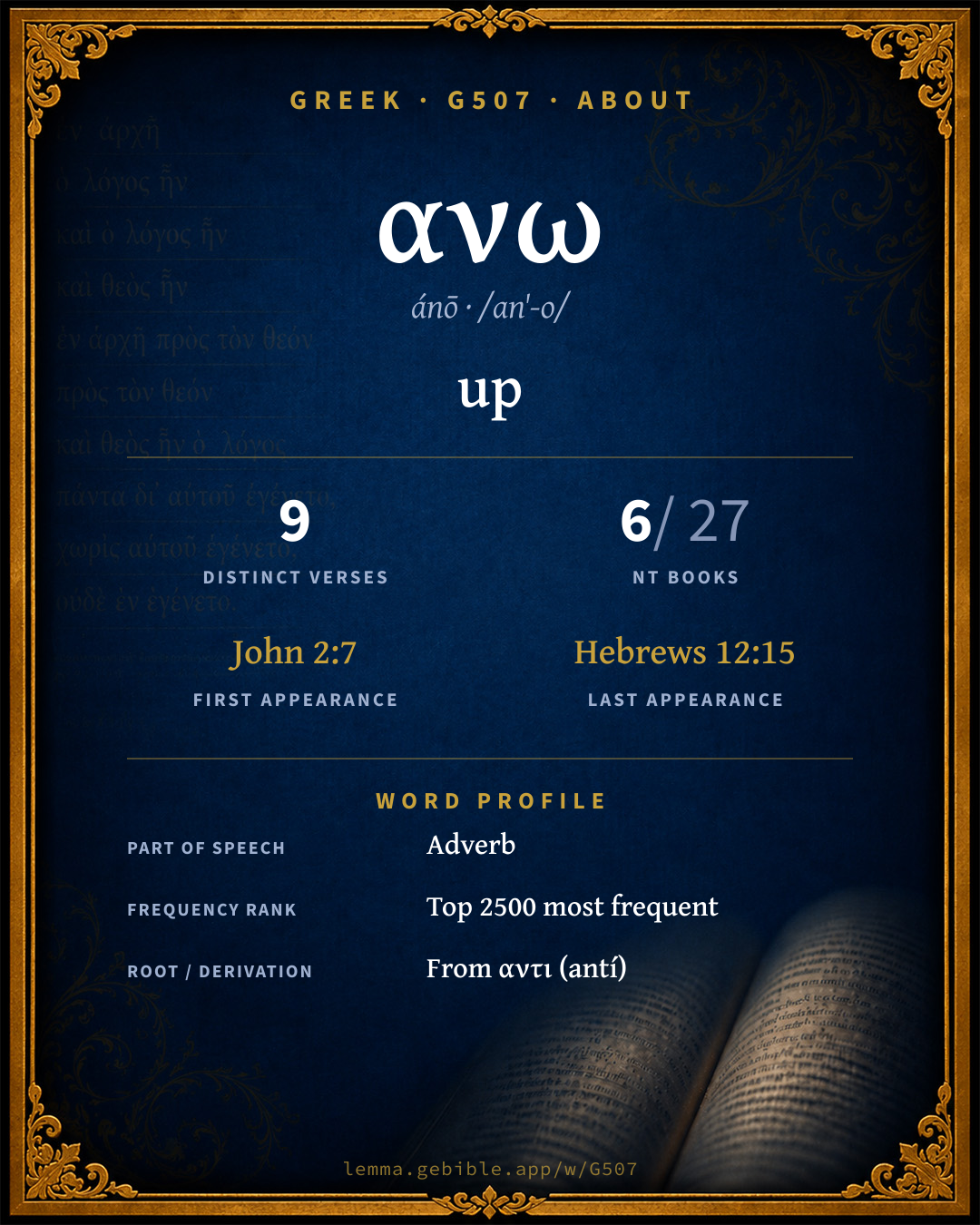
ἄνω
up
also: upwards, above, on high fuller range ↓
Full lexicon entry — Thayer's Greek Lexicon
From Thayer's Greek Lexicon
Where this word appears
Grammar key — what these labels mean
Part of speech
- Adverb
- A word that modifies a verb, adjective, or other adverb.
Every verse where G507 appears in the Book of Colossians — 2 distinct verses. Click any verse to open its interlinear word-by-word view. Verse text shown in the World English Bible for context — . Each verse’s Greek form is shown with its reference; the English is not keyword-highlighted, since the data carries no word-level English alignment. Use “Compare translations” on any verse to read it across multiple English versions. This concordance covers the Greek New Testament; Septuagint (Greek Old Testament) occurrences of this word are not indexed here.
Colossians
About this entry
At a glance — auto-summarized from this page’s data, not written by a person. Every figure links to its source below. This summary describes the numbers; it doesn’t interpret them.
The Greek verb ανω centers on the idea of “up.” Thayer's distinguishes 4 senses; alongside “up” it spans “upwards”, “above”, and “on high”. Spanning 9 verses in 6 books, it ranks among the uncommon words of the Greek New Testament. John dominates its distribution — 3 of 9 verses. Debuting at John 2:7, it then recurs through the corpus. Dig into 9-verse concordance and the renderings breakdown below.
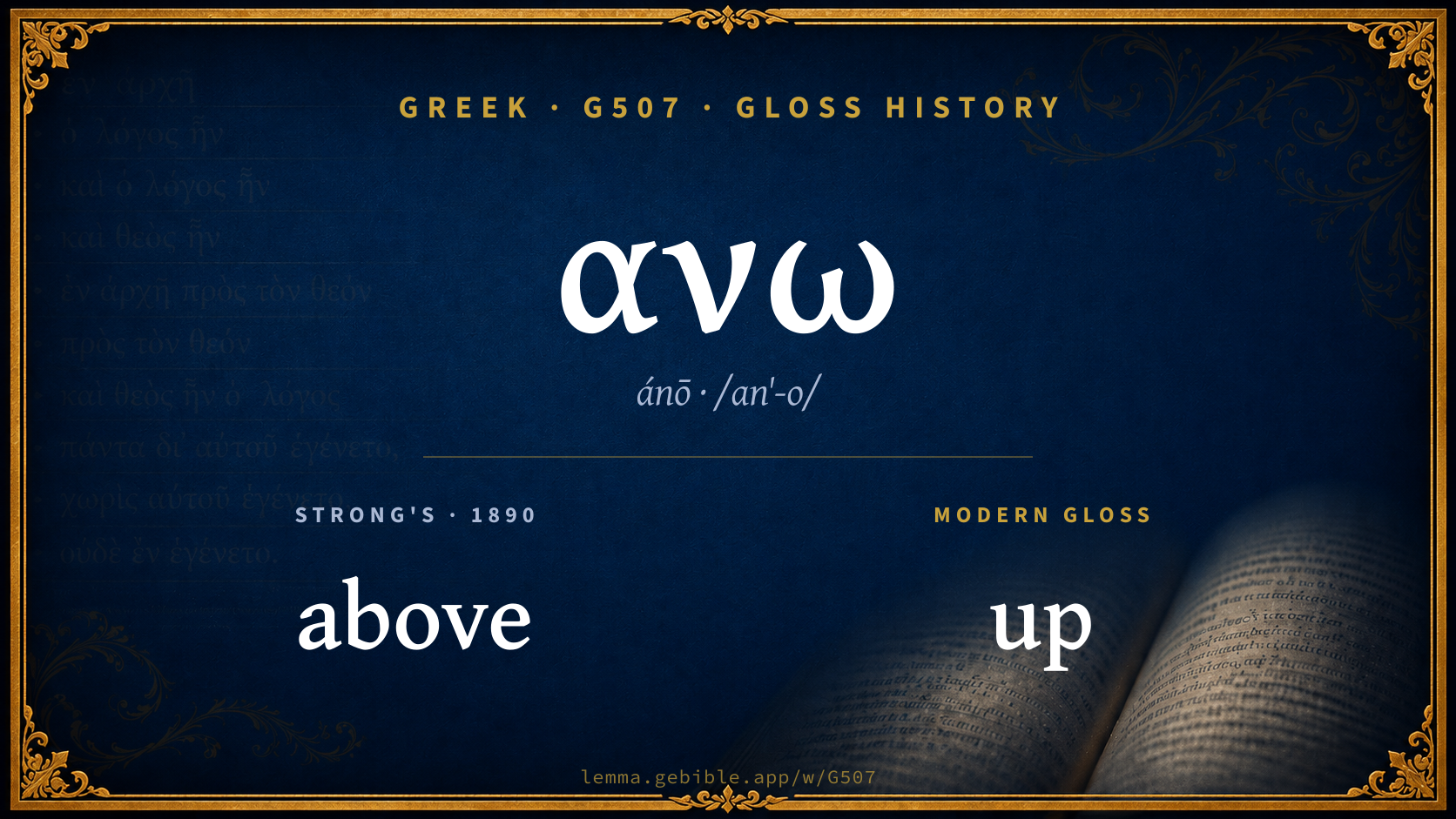
Gloss history
Strong's 1890 vs modern scholarship
About this word
Strong's G507 catalogs a Greek word from the Greek New Testament.
These counts are not copied from any lexicon or concordance. They are computed here, from the morphology-tagged Greek New Testament. What Lemma adds →
- 9
- distinct verses
- The word appears in 9 distinct verses.
- 6 / 27
- NT books
- The word appears in 6 of 27 New Testament books.
- #1,140
- by frequency
- Top 2500 most frequent Greek words (rank 1,140 of 5,347 Greek words by occurrence).
View all 9 occurrences in the concordance →
Most concentrated in
- John 3 verses 33%
- Colossians 2 verses 22%
- Acts 1 verse 11%
By section of the New Testament
By traditional corpus
Conventional, traditional groupings — biblical authorship is debated, so this is a traditional corpus grouping, not an authorship claim. Some books belong to more than one corpus (Luke is in both the Gospels and the Lukan corpus, and so on), so these shares overlap and need not total 100%. Each figure is a share of the word’s 9 distinct verses.
- Pauline corpus 4 verses · 44%
- Gospels 3 verses · 33%
- Johannine 3 verses · 33%
- Lukan (Luke–Acts) 1 verse · 11%
- Hebrews 1 verse · 11%
How translations render this word
Counts come from each version’s own published word-to-Strong’s tagging or interlinear alignment — an approximate guide to how each version renders this word, not a word-level alignment the data otherwise carries. Because each total is that version’s own tagged count, the per-version totals vary from one another and need not match the appearance or distinct-verse counts above. These counts may also differ from a printed concordance because Lemma counts each distinctly tagged rendering and does not collapse phrase taggings into a single head-word total. This is a fixed set of word-tagged versions (KJV, ASV, BSB, ULT) and does not change with the reading translation you choose elsewhere. Each version’s license is shown beside its name below (and on Sources).
- King James Version: Above 2×, Up 2×
- American Standard Version: Above 4×, Up 2×
- Berean Standard Bible: Above 5×
- unfoldingWord Literal Text: Above 5×, Up 2×
King James Version Public Domain
Renders G507 across 9 tagged occurrences — most commonly:
Plus 5 renderings that appear only once — usually multi-word phrases or single function words the recovered tagging swept in, not distinct renderings.
American Standard Version Public Domain
Renders G507 across 9 tagged occurrences — most commonly:
Plus 3 renderings that appear only once — usually multi-word phrases or single function words the recovered tagging swept in, not distinct renderings.
Berean Standard Bible Public Domain
Renders G507 across 9 tagged occurrences — most commonly:
Plus 4 renderings that appear only once — usually multi-word phrases or single function words the recovered tagging swept in, not distinct renderings.
unfoldingWord Literal Text CC BY-SA 4.0
Renders G507 across 9 tagged occurrences — most commonly:
Plus 2 renderings that appear only once — usually multi-word phrases or single function words the recovered tagging swept in, not distinct renderings.
Senses in Thayer's
The 4 senses Thayer's distinguishes for this word, in lexicon order (not ranked by frequency or importance). The full entry — with sub-senses — is in the Lexicon Entry tab.
- up, upwards, above, on high
- of the quarters of the heaven, northward
- of countries, inland, up from the coast
- of time, formerly In Gal. 4:26 the word could refer to either place or time, i.e. place - the Jerusalem which is above -…
Word origin
Derived from αντι (antí) (G473) — against.
Adverb from G473 ; upward or on the top : - above brim high up.
— Strong’s Exhaustive Concordance (1890), public domain.
Same root — word family
Other Thayer's entries built from the same root as G507, grouped by Strong’s listed origin. These share a root / origin per the lexicon — not necessarily a shared meaning. Each links to that word’s own entry.
Derives from
Shares the same root
- ανθιστημι anthístēmi G436 to resist
- ανθομολογεομαι anthomologéomai G437 to acknowledge
- ανθυπατος anthýpatos G446 proconsul
- ανταγωνιζομαι antagōnízomai G464 to struggle
- ανταλλαγμα antállagma G465 exchange
- ανταναπληροω antanaplēróō G466 to fill up
- ανταποδιδωμι antapodídōmi G467 to repay
- ανταποκρινομαι antapokrínomai G470 to contradict
- αντεπω antépō G471 to speak against
- αντεχομαι antéchomai G472 to withstand
- αντιβαλλω antibállō G474 to throw back
- αντιδιατιθεμαι antidiatíthemai G475 to oppose
- αντιδικος antídikos G476 opponent
- αντιθεσις antíthesis G477 opposition
- αντικαθιστημι antikathístēmi G478 to place opposite
- αντικαλεω antikaléō G479 to invite in turn
- αντικειμαι antíkeimai G480 to oppose
- αντικρυ antikrý G481 opposite
- αντιλαμβανομαι antilambánomai G482 to take hold
- αντιλεγω antilégō G483 to contradict
- αντιλοιδορεω antiloidoréō G486 to revile back
- αντιλυτρον antílytron G487 ransom
- αντιμετρεω antimetréō G488 to repay
- αντιμισθια antimisthía G489 reward
+7 more words share this root (not shown).
Derived from this word
Proper names from this root
People and places named from this root — a name, not an additional meaning of the word.
Compare all same-root words → Showing 4 of 38 — not the complete family. 2 of the same-root words are proper names (people or places). They share a root, not necessarily a meaning.
Septuagint usage
The same Greek word ανω appears 37 times in the Greek Old Testament (Septuagint), across 33 verses in 14 books.
- 37
- LXX occurrences
- Tagged occurrences of this Greek word in the Septuagint.
- 33
- verses
- Distinct Septuagint verses containing this word.
- 14 / 39
- OT books
- The word appears in 14 of the 39 Old Testament books.
Sample Septuagint occurrences
- Exodus 20:4 ἄνω
- Leviticus 11:21 ἄνω
- Deuteronomy 4:39 ἄνω
- Joshua 2:11 ἄνω
- Judges 7:13 ἄνω
- 1 Kings 8:23 ἄνω
- 2 Kings 18:17 ἄνω
- 1 Chronicles 7:24 ἄνω
- 2 Chronicles 4:4 ἄνω
- Ezra 13:28 ἄνω
- Psalms 49:4 ἄνω
- Proverbs 8:28 ἄνω
Septuagint occurrences (same lexeme)
Every verse where the same Strong’s number (G507) appears in the Greek Septuagint. Verse text shown in the World English Bible for context; the Greek form is the matched word — the English is not keyword-highlighted.
- Exodus 20:4 ἄνω "You shall not make for yourselves an idol, nor any image of anything that is in the heavens above, or that is in the earth beneath, or that is in the water under the earth:
- Leviticus 11:21 ἄνω Yet you may eat these: of all winged creeping things that go on all fours, which have legs above their feet, with which to hop on the earth.
- Deuteronomy 4:39 ἄνω Know therefore this day, and lay it to your heart, that Yahweh he is God in heaven above and on the earth beneath; there is none else.
- Deuteronomy 5:8 ἄνω "You shall not make an engraved image for yourself, [nor] any likeness [of anything] that is in heaven above, or that is in the earth beneath, or that is in the water under the earth:
- Deuteronomy 28:43 ἄνω The foreigner who is in the midst of you shall mount up above you higher and higher; and you shall come down lower and lower.
- Deuteronomy 29:17 ἄνω and you have seen their abominations, and their idols, wood and stone, silver and gold, which were among them);
- Deuteronomy 30:12 ἄνω It is not in heaven, that you should say, Who shall go up for us to heaven, and bring it to us, and make us to hear it, that we may do it?
- Joshua 2:11 ἄνω As soon as we had heard it, our hearts did melt, neither did there remain any more spirit in any man, because of you: for Yahweh your God, he is God in heaven above, and on earth beneath.
- Joshua 15:19 ἄνω She said, Give me a blessing; for that you have set me in the land of the South, give me also springs of water. He gave her the upper springs and the lower springs.
- Joshua 16:5 ἄνω The border of the children of Ephraim according to their families was [thus]: the border of their inheritance eastward was Ataroth Addar, to Beth Horon the upper;
- Joshua 21:22 ἄνω and Kibzaim with its suburbs, and Beth Horon with its suburbs; four cities.
- Judges 7:13 ἄνω When Gideon had come, behold, there was a man telling a dream to his fellow; and he said, Behold, I dreamed a dream; and, behold, a cake of barley bread tumbled into the camp of Midian, and came to the tent, and struck it so that it fell, and turned it upside down, so that the tent lay flat.
- 1 Kings 8:23 ἄνω and he said, Yahweh, the God of Israel, there is no God like you, in heaven above, or on earth beneath; who keep covenant and loving kindness with your servants, who walk before you with all their heart;
- 1 Kings 10:22 ἄνω For the king had at sea a navy of Tarshish with the navy of Hiram: once every three years came the navy of Tarshish, bringing gold, and silver, ivory, and apes, and peacocks.
- 1 Kings 12:24 ανω Thus says Yahweh, You shall not go up, nor fight against your brothers the children of Israel: return every man to his house; for this thing is of me. So they listened to the word of Yahweh, and returned and went their way, according to the word of Yahweh.
- 2 Kings 18:17 ἄνω The king of Assyria sent Tartan and Rabsaris and Rabshakeh from Lachish to king Hezekiah with a great army to Jerusalem. They went up and came to Jerusalem. When they were come up, they came and stood by the conduit of the upper pool, which is in the highway of the fuller's field.
- 2 Kings 19:30 ἄνω The remnant that has escaped of the house of Judah shall again take root downward, and bear fruit upward.
- 1 Chronicles 7:24 ἄνω His daughter was Sheerah, who built Beth Horon the lower and the upper, and Uzzen Sheerah.
- 1 Chronicles 22:5 ἄνω David said, Solomon my son is young and tender, and the house that is to be built for Yahweh must be exceedingly magnificent, of fame and of glory throughout all countries: I will therefore make preparation for it. So David prepared abundantly before his death.
- 2 Chronicles 4:4 ἄνω It stood on twelve oxen, three looking toward the north, and three looking toward the west, and three looking toward the south, and three looking toward the east: and the sea was set on them above, and all their hinder parts were inward.
- 2 Chronicles 8:5 ἄνω Also he built Beth Horon the upper, and Beth Horon the lower, fortified cities, with walls, gates, and bars;
- 2 Chronicles 26:8 ἄνω The Ammonites gave tribute to Uzziah: and his name spread abroad even to the entrance of Egypt; for he grew exceeding strong.
- 2 Chronicles 32:30 ἄνω This same Hezekiah also stopped the upper spring of the waters of Gihon, and brought them straight down on the west side of the city of David. Hezekiah prospered in all his works.
- Ezra 13:28 ἄνω
- Psalms 49:4 ἄνω I will incline my ear to a proverb. I will open my riddle on the harp.
- Psalms 113:11 ἄνω
- Proverbs 8:28 ἄνω When he established the clouds above, When the springs of the deep became strong,
- Ecclesiastes 3:21 ἄνω Who knows the spirit of man, whether it goes upward, and the spirit of the animal, whether it goes downward to the earth?"
- Isaiah 7:3 ἄνω Then Yahweh said to Isaiah, "Go out now to meet Ahaz, you, and Shearjashub your son, at the end of the conduit of the upper pool, on the highway of the fuller's field.
- Isaiah 8:21 ἄνω They shall pass through it, sore distressed and hungry; and it shall happen that when they shall be hungry, they shall fret themselves, and curse by their king and by their God, and turn their faces upward:
- Isaiah 34:10 ἄνω It shall not be quenched night nor day; the smoke of it shall go up for ever; from generation to generation it shall lie waste; none shall pass through it forever and ever.
- Isaiah 36:2 ἄνω The king of Assyria sent Rabshakeh from Lachish to Jerusalem to king Hezekiah with a great army. He stood by the conduit of the upper pool in the highway of the fuller's field.
- Isaiah 37:31 ἄνω The remnant that is escaped of the house of Judah shall again take root downward, and bear fruit upward.
These are occurrences of the same Greek lexeme (G507) in the Septuagint — not a translation of any one Hebrew word. The store carries no word-level Hebrew↔Greek alignment, so no Hebrew original is asserted here. Counts come from the recovered LXX Strong's tagging — high-frequency vocabulary is well covered, while rare or late forms may be untagged — so they reflect tagged occurrences and may slightly undercount.