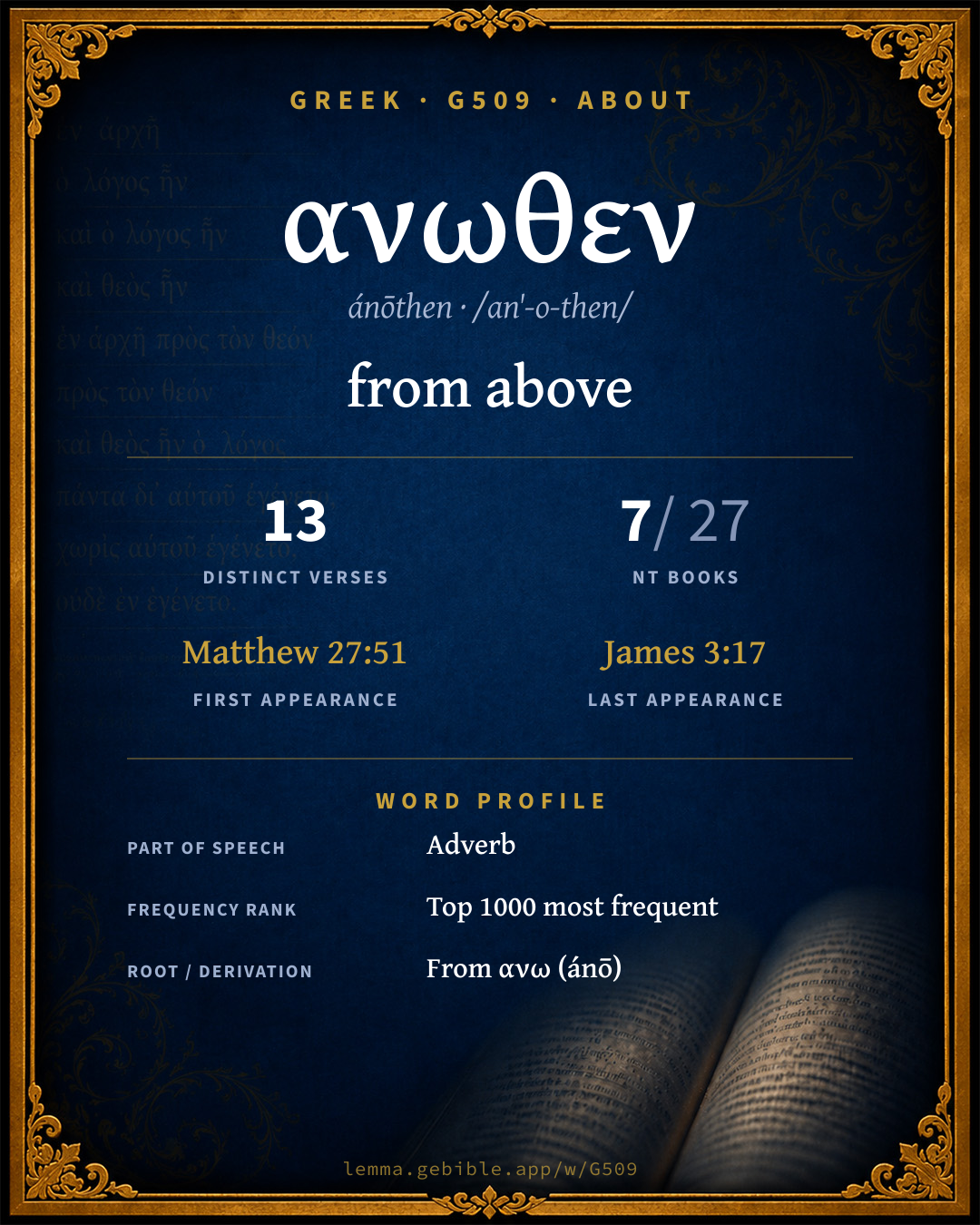
ἄνωθεν
from above
‘from above’ is one of 3 main senses fuller range ↓
Full lexicon entry — Thayer's Greek Lexicon
From Thayer's Greek Lexicon
Where this word appears
Grammar key — what these labels mean
Part of speech
- Adverb
- A word that modifies a verb, adjective, or other adverb.
Every verse where G509 appears — 13 distinct verses across 7 books. Click any verse to open its interlinear word-by-word view. Verse text shown in the World English Bible for context — . Each verse’s Greek form is shown with its reference; the English is not keyword-highlighted, since the data carries no word-level English alignment. Use “Compare translations” on any verse to read it across multiple English versions. This concordance covers the Greek New Testament; Septuagint (Greek Old Testament) occurrences of this word are not indexed here.
Matthew 1 verse
Mark 1 verse
Luke 1 verse
John 5 verses
- John 3:3 ἄνωθεν adv Jesus answered him, "Most assuredly, I tell you, unless one is born anew, he can't see the Kingdom of God."
- John 3:7 ἄνωθεν adv Don't marvel that I said to you, 'You must be born anew.'
- John 3:31 ἄνωθεν adv He who comes from above is above all. He who is from the Earth belongs to the Earth, and speaks of the Earth. He who comes from heaven is above all.
- John 19:11 ἄνωθεν adv Jesus answered, "You would have no power at all against me, unless it were given to you from above. Therefore he who delivered me to you has greater sin."
- John 19:23 ἄνωθεν adv Then the soldiers, when they had crucified Jesus, took his garments and made four parts, to every soldier a part; and also the coat. Now the coat was without seam, woven from the top throughout.
Acts 1 verse
Galatians 1 verse
James 3 verses
- James 1:17 ἄνωθέν adv Every good gift and every perfect gift is from above, coming down from the Father of lights, with whom can be no variation, nor turning shadow.
- James 3:15 ἄνωθεν adv This wisdom is not that which comes down from above, but is earthly, sensual, and demonic.
- James 3:17 ἄνωθεν adv But the wisdom that is from above is first pure, then peaceful, gentle, reasonable, full of mercy and good fruits, without partiality, and without hypocrisy.
About this entry
At a glance — auto-summarized from this page’s data, not written by a person. Every figure links to its source below. This summary describes the numbers; it doesn’t interpret them.
The Greek verb ανωθεν centers on the idea of “from above.” Its earliest occurrence is Matthew 27:51. It appears 13 verses across 7 books of the Greek New Testament, among its uncommon vocabulary. The word gravitates to John (38%), then James and Matthew. Lexicons map it across 3 senses. For the data behind this summary, explore the sense tree and the renderings breakdown below.
Gloss history
Strong's 1890 vs modern scholarship
About this word
Strong's G509 catalogs a Greek word from the Greek New Testament.
These counts are not copied from any lexicon or concordance. They are computed here, from the morphology-tagged Greek New Testament. What Lemma adds →
- 13
- distinct verses
- The word appears in 13 distinct verses.
- 7 / 27
- NT books
- The word appears in 7 of 27 New Testament books.
- #863
- by frequency
- Top 1000 most frequent Greek words (rank 863 of 5,347 Greek words by occurrence).
View all 13 occurrences in the concordance →
By section of the New Testament
By traditional corpus
Conventional, traditional groupings — biblical authorship is debated, so this is a traditional corpus grouping, not an authorship claim. Some books belong to more than one corpus (Luke is in both the Gospels and the Lukan corpus, and so on), so these shares overlap and need not total 100%. Each figure is a share of the word’s 13 distinct verses.
- Gospels 8 verses · 62%
- Johannine 5 verses · 38%
- General (Catholic) Epistles 3 verses · 23%
- Lukan (Luke–Acts) 2 verses · 15%
- Pauline corpus 1 verse · 8%
How translations render this word
Counts come from each version’s own published word-to-Strong’s tagging or interlinear alignment — an approximate guide to how each version renders this word, not a word-level alignment the data otherwise carries. Because each total is that version’s own tagged count, the per-version totals vary from one another and need not match the appearance or distinct-verse counts above. These counts may also differ from a printed concordance because Lemma counts each distinctly tagged rendering and does not collapse phrase taggings into a single head-word total. This is a fixed set of word-tagged versions (KJV, ASV, BSB, ULT) and does not change with the reading translation you choose elsewhere. Each version’s license is shown beside its name below (and on Sources).
- King James Version: Above 4×, Top 3×, Again 2×
- American Standard Version: Above 5×, Anew 2×, First 2×
- Berean Standard Bible: Above 5×, Again 2×, Top 2×
- unfoldingWord Literal Text: Above 5×, Again 3×, Top 3×
King James Version Public Domain
Renders G509 across 12 tagged occurrences — most commonly:
Plus 3 renderings that appear only once — usually multi-word phrases or single function words the recovered tagging swept in, not distinct renderings. Not rendered by a distinct English word in 1 further occurrence.
American Standard Version Public Domain
Renders G509 across 12 tagged occurrences — most commonly:
Plus 1 rendering that appears only once — usually multi-word phrases or single function words the recovered tagging swept in, not distinct renderings.
Berean Standard Bible Public Domain
Renders G509 across 13 tagged occurrences — most commonly:
Plus 4 renderings that appear only once — usually multi-word phrases or single function words the recovered tagging swept in, not distinct renderings.
unfoldingWord Literal Text CC BY-SA 4.0
Renders G509 across 13 tagged occurrences — most commonly:
Senses in Thayer's
The 3 senses Thayer's distinguishes for this word, in lexicon order (not ranked by frequency or importance). The full entry — with sub-senses — is in the Lexicon Entry tab.
- from above, from a higher place
- from the first, from the beginning, from the very first
- anew, over again
Word origin
Derived from ανω (ánō) (G507) — up.
From G507 ; from above ; by analogy from the first ; by implication anew : - from above again from the beginning (very first) the top.
— Strong’s Exhaustive Concordance (1890), public domain.
Forms in the corpus
The 2 distinct written forms G509 takes in the Greek New Testament, most frequent first — each parse links to that case’s occurrences in the concordance.
| Form | Parsing | Example | Uses |
|---|---|---|---|
| ἄνωθεν ánōthen | Adverb | Matthew 27:51 | 12 |
| ἄνωθέν ánōthén | Adverb | James 1:17 | 1 |
Same root — word family
Other Thayer's entries built from the same root as G509, grouped by Strong’s listed origin. These share a root / origin per the lexicon — not necessarily a shared meaning. Each links to that word’s own entry.
Derives from
Shares the same root
Compare all same-root words → They share a root, not necessarily a meaning.
Septuagint usage
The same Greek word ανωθεν appears 21 times in the Greek Old Testament (Septuagint), across 21 verses in 9 books.
- 21
- LXX occurrences
- Tagged occurrences of this Greek word in the Septuagint.
- 21
- verses
- Distinct Septuagint verses containing this word.
- 9 / 39
- OT books
- The word appears in 9 of the 39 Old Testament books.
Sample Septuagint occurrences
- Genesis 6:16 ἄνωθεν
- Exodus 25:21 ἄνωθεν
- Numbers 4:6 ἄνωθεν
- Joshua 3:16 ἄνωθεν
- 1 Kings 7:40 ἄνωθεν
- Job 3:4 ἄνωθεν
- Isaiah 45:8 ἄνωθεν
- Jeremiah 4:28 ἄνωθεν
- Ezekiel 1:11 ἄνωθεν
Septuagint occurrences (same lexeme)
Every verse where the same Strong’s number (G509) appears in the Greek Septuagint. Verse text shown in the World English Bible for context; the Greek form is the matched word — the English is not keyword-highlighted.
- Genesis 6:16 ἄνωθεν You shall make a roof in the ark, and to a cubit shall you finish it upward. You shall set the door of the ark in the side of it. You shall make it with lower, second, and third levels.
- Genesis 27:39 ἄνωθεν Isaac his father answered him, "Behold, of the fatness of the earth will be your dwelling, and of the dew of the sky from above.
- Genesis 49:25 ἄνωθεν Even by the God of your father, who will help you, By the Almighty, who will bless you, With blessings of heaven above, Blessings of the deep that lies below, Blessings of the breasts, and of the womb.
- Exodus 25:21 ἄνωθεν You shall put the mercy seat on top of the ark, and in the ark you shall put the testimony that I will give you.
- Exodus 25:22 ἄνωθεν There I will meet with you, and I will tell you from above the mercy seat, from between the two cherubim which are on the ark of the testimony, all that I command you for the children of Israel.
- Exodus 36:27 ἄνωθεν For the far part of the tent westward he made six boards.
- Exodus 36:38 ἄνωθεν and the five pillars of it with their hooks. He overlaid their capitals and their fillets with gold, and their five sockets were of brass.
- Exodus 38:16 ἄνωθεν All the hangings around the court were of fine twined linen.
- Exodus 38:19 ἄνωθεν Their pillars were four, and their sockets four, of brass; their hooks of silver, and the overlaying of their capitals, and their fillets, of silver.
- Exodus 40:19 ἄνωθεν He spread the covering over the tent, and put the roof of the tent above on it, as Yahweh commanded Moses.
- Numbers 4:6 ἄνωθεν and shall put a covering of sealskin on it, and shall spread over it a cloth all of blue, and shall put in its poles.
- Numbers 4:25 ἄνωθεν they shall carry the curtains of the tabernacle, and the Tent of Meeting, its covering, and the covering of sealskin that is above on it, and the screen for the door of the Tent of Meeting,
- Numbers 7:89 ἄνωθεν When Moses went into the Tent of Meeting to speak with Yahweh, he heard his voice speaking to him from above the mercy seat that was on the ark of the Testimony, from between the two cherubim: and he spoke to him.
- Joshua 3:16 ἄνωθεν that the waters which came down from above stood, and rose up in one heap, a great way off, at Adam, the city that is beside Zarethan; and those that went down toward the sea of the Arabah, even the Salt Sea, were wholly cut off: and the people passed over right against Jericho.
- 1 Kings 7:40 ἄνωθεν Hiram made the basins, and the shovels, and the basins. So Hiram made an end of doing all the work that he worked for king Solomon in the house of Yahweh:
- Job 3:4 ἄνωθεν Let that day be darkness; Don't let God from above seek for it, Neither let the light shine on it.
- Isaiah 45:8 ἄνωθεν Distil, you heavens, from above, and let the skies pour down righteousness: let the earth open, that it may bring forth salvation, and let it cause righteousness to spring up together; I, Yahweh, have created it.
- Jeremiah 4:28 ἄνωθεν For this shall the earth mourn, and the heavens above be black; because I have spoken it, I have purposed it, and I have not repented, neither will I turn back from it.
- Ezekiel 1:11 ἄνωθεν Their faces and their wings were separate above; two [wings] of everyone were joined one to another, and two covered their bodies.
- Ezekiel 1:26 ἄνωθεν Above the expanse that was over their heads was the likeness of a throne, as the appearance of a sapphire stone; and on the likeness of the throne was a likeness as the appearance of a man on it above.
- Ezekiel 41:7 ἄνωθεν The side-chambers were broader as they encompassed [the house] higher and higher; for the encompassing of the house went higher and higher round about the house: therefore the breadth of the house [continued] upward; and so one went up [from] the lowest [chamber] to the highest by the middle [chamber].
These are occurrences of the same Greek lexeme (G509) in the Septuagint — not a translation of any one Hebrew word. The store carries no word-level Hebrew↔Greek alignment, so no Hebrew original is asserted here. Counts come from the recovered LXX Strong's tagging — high-frequency vocabulary is well covered, while rare or late forms may be untagged — so they reflect tagged occurrences and may slightly undercount.