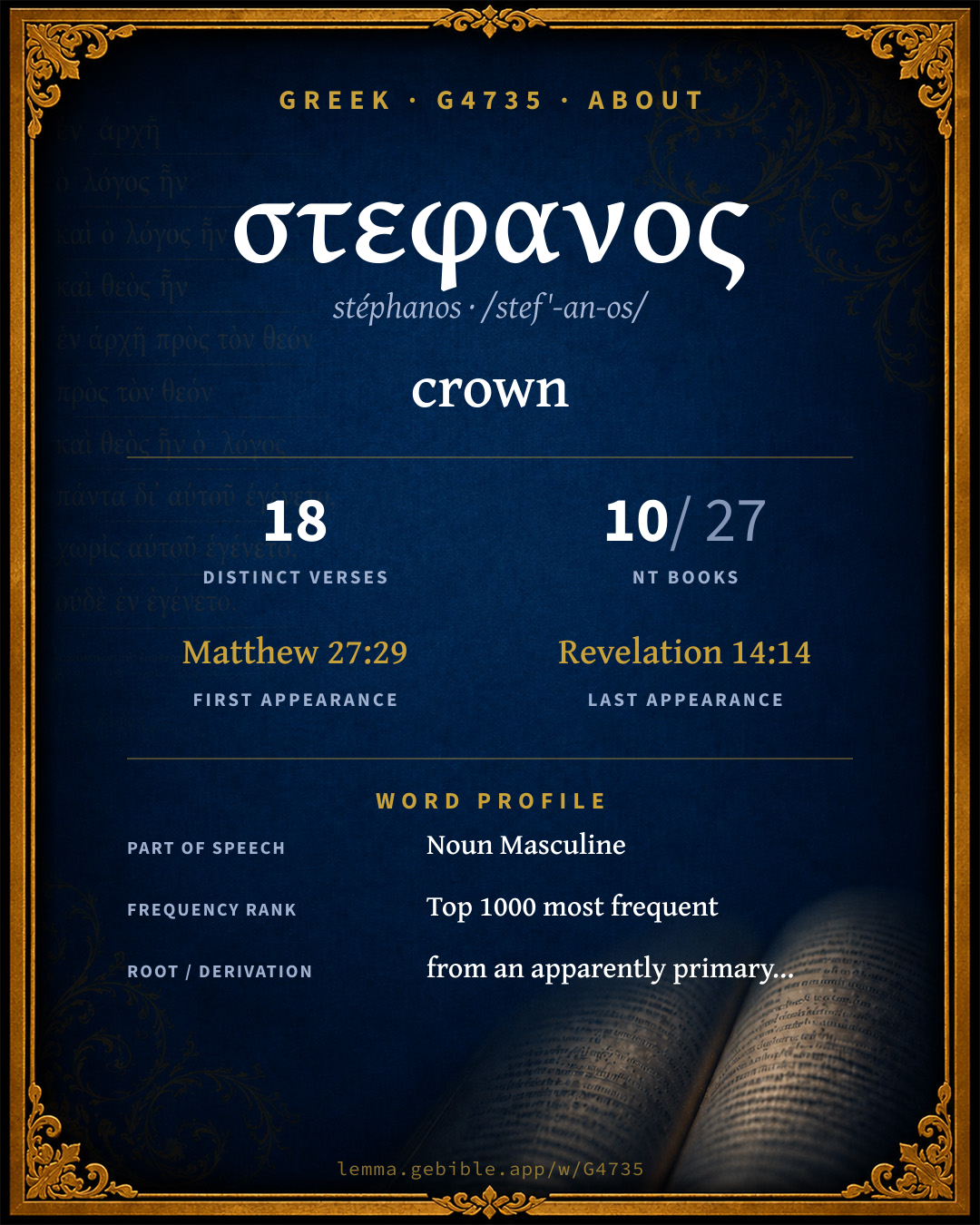
στέφανος
crown
‘crown’ is one of 3 main senses fuller range ↓
Full lexicon entry — Thayer's Greek Lexicon
From Thayer's Greek Lexicon
Where this word appears
Grammar key — what these labels mean
Part of speech
- Noun
- A naming word — a person, place, thing, or idea.
Case
- Accusative
- The case of the direct object and of extent.
- Nominative
- The case of the subject (and the predicate nominative).
Gender
- Masculine
- Grammatically masculine.
Number
- Singular
- One.
- Plural
- More than one.
Every verse where G4735 appears in the Book of 1 Peter — 1 distinct verse. Click any verse to open its interlinear word-by-word view. Verse text shown in the World English Bible for context — . Each verse’s Greek form is shown with its reference; the English is not keyword-highlighted, since the data carries no word-level English alignment. Use “Compare translations” on any verse to read it across multiple English versions. This concordance covers the Greek New Testament; Septuagint (Greek Old Testament) occurrences of this word are not indexed here.
1 Peter
About this entry
At a glance — auto-summarized from this page’s data, not written by a person. Every figure links to its source below. This summary describes the numbers; it doesn’t interpret them.
στεφανος — transliterated stéphanos — is a Greek noun carrying the sense “crown.” Its earliest occurrence is Matthew 27:29. Spanning 18 verses in 10 books, it ranks among the uncommon words of the Greek New Testament. Its uses concentrate in Revelation (44% of all occurrences). Thayer's distinguishes 3 senses for it. See the sense tree, 18-verse concordance, and the renderings breakdown below.
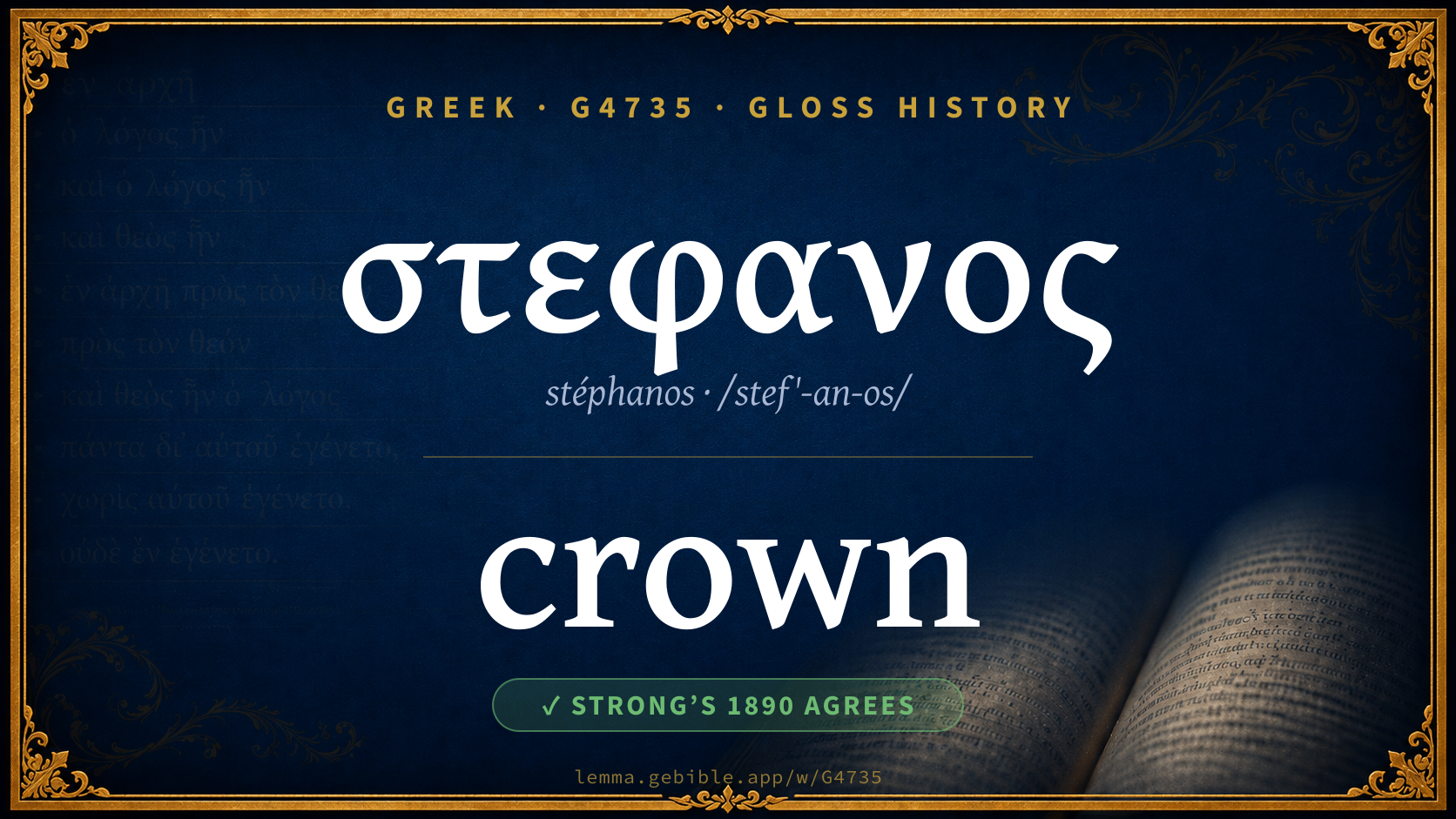
Gloss history
Strong's 1890 vs modern scholarship
About this word
Strong's G4735 catalogs a Greek word from the Greek New Testament.
These counts are not copied from any lexicon or concordance. They are computed here, from the morphology-tagged Greek New Testament. What Lemma adds →
- 18
- distinct verses
- The word appears in 18 distinct verses.
- 10 / 27
- NT books
- The word appears in 10 of 27 New Testament books.
- #664
- by frequency
- Top 1000 most frequent Greek words (rank 664 of 5,347 Greek words by occurrence).
View all 18 occurrences in the concordance →
Most concentrated in
- Revelation 8 verses 44%
- John 2 verses 11%
- Matthew 1 verse 6%
By section of the New Testament
By traditional corpus
Conventional, traditional groupings — biblical authorship is debated, so this is a traditional corpus grouping, not an authorship claim. Some books belong to more than one corpus (Luke is in both the Gospels and the Lukan corpus, and so on), so these shares overlap and need not total 100%. Each figure is a share of the word’s 18 distinct verses.
- Johannine 10 verses · 56%
- Revelation 8 verses · 44%
- Gospels 4 verses · 22%
- Pauline corpus 4 verses · 22%
- General (Catholic) Epistles 2 verses · 11%
How translations render this word
Counts come from each version’s own published word-to-Strong’s tagging or interlinear alignment — an approximate guide to how each version renders this word, not a word-level alignment the data otherwise carries. Because each total is that version’s own tagged count, the per-version totals vary from one another and need not match the appearance or distinct-verse counts above. These counts may also differ from a printed concordance because Lemma counts each distinctly tagged rendering and does not collapse phrase taggings into a single head-word total. This is a fixed set of word-tagged versions (KJV, ASV, BSB, ULT) and does not change with the reading translation you choose elsewhere. Each version’s license is shown beside its name below (and on Sources).
- King James Version: Crown 15×, Crowns 3×
- American Standard Version: Crown 14×, Crowns 3×
- Berean Standard Bible: Crown 15×, Crowns 3×
- unfoldingWord Literal Text: Crown 14×, Crowns 3×, A 2×
King James Version Public Domain
Renders G4735 across 18 tagged occurrences — most commonly:
American Standard Version Public Domain
Renders G4735 across 18 tagged occurrences — most commonly:
Plus 1 rendering that appears only once — usually multi-word phrases or single function words the recovered tagging swept in, not distinct renderings.
Berean Standard Bible Public Domain
Renders G4735 across 18 tagged occurrences — most commonly:
unfoldingWord Literal Text CC BY-SA 4.0
Renders G4735 across 21 tagged occurrences — most commonly:
Plus 2 renderings that appear only once — usually multi-word phrases or single function words the recovered tagging swept in, not distinct renderings.
Senses in Thayer's
The 3 senses Thayer's distinguishes for this word, in lexicon order (not ranked by frequency or importance). The full entry — with sub-senses — is in the Lexicon Entry tab.
- a mark of royal or (in general) exalted rank
- metaph. the eternal blessedness which will be given as a prize to the genuine servants of God and Christ: the crown…
- that which is an ornament and honour to one
Word origin
Origin: from an apparently primary stepho (to twine or wreathe)
From an apparently primary stepho (to twine or wreathe ); a chaplet (as a badge of royalty a prize in the public games or a symbol of honor generally; but more conspicuous and elaborate than the simple fillet G1238 ) literally or figuratively : - crown.
— Strong’s Exhaustive Concordance (1890), public domain.
Forms in the corpus
The 6 distinct written forms G4735 takes in the Greek New Testament, most frequent first — each parse links to that case’s occurrences in the concordance.
| Form | Parsing | Example | Uses |
|---|---|---|---|
| στέφανον stéphanon | Noun, Accusative, Singular, Masculine | Matthew 27:29 | 9 |
| στέφανος stéphanos | Noun, Nominative, Singular, Masculine | 1 Thessalonians 2:19 | 4 |
| στεφάνους stephánous | Noun, Accusative, Plural, Masculine | Revelation 4:4 | 2 |
| στέφανοι stéphanoi | Noun, Nominative, Plural, Masculine | Revelation 9:7 | 1 |
| στέφανόν stéphanón | Noun, Accusative, Singular, Masculine | Revelation 3:11 | 1 |
| στέφανός stéphanós | Noun, Nominative, Singular, Masculine | Philippians 4:1 | 1 |
Same root — word family
Other Thayer's entries built from the same root as G4735, grouped by Strong’s listed origin. These share a root / origin per the lexicon — not necessarily a shared meaning. Each links to that word’s own entry.
Derived from this word
Proper names from this root
People and places named from this root — a name, not an additional meaning of the word.
Compare all same-root words → Showing 4 of 5 — not the complete family. 1 of the same-root words is a proper name (a person or place). They share a root, not necessarily a meaning.
Septuagint usage
The same Greek word στεφανος appears 30 times in the Greek Old Testament (Septuagint), across 29 verses in 12 books.
- 30
- LXX occurrences
- Tagged occurrences of this Greek word in the Septuagint.
- 29
- verses
- Distinct Septuagint verses containing this word.
- 12 / 39
- OT books
- The word appears in 12 of the 39 Old Testament books.
Sample Septuagint occurrences
- 2 Samuel 12:30 στέφανος
- 1 Chronicles 20:2 στέφανος
- Esther 8:15 στέφανος
- Job 19:9 στέφανος
- Psalms 20:4 στέφανος
- Proverbs 1:9 στέφανος
- Song of Solomon 3:11 στέφανος
- Isaiah 22:18 στέφανος
- Jeremiah 13:18 στέφανος
- Lamentations 2:15 στέφανος
- Ezekiel 16:12 στέφανος
- Zechariah 6:11 στέφανος
Septuagint occurrences (same lexeme)
Every verse where the same Strong’s number (G4735) appears in the Greek Septuagint. Verse text shown in the World English Bible for context; the Greek form is the matched word — the English is not keyword-highlighted.
- 2 Samuel 12:30 στέφανος He took the crown of their king from off his head; and the weight of it was a talent of gold, and [in it were] precious stones; and it was set on David's head. He brought forth the spoil of the city, exceeding much.
- 1 Chronicles 20:2 στέφανος David took the crown of their king from off his head, and found it to weigh a talent of gold, and there were precious stones in it; and it was set on David's head: and he brought forth the spoil of the city, exceeding much.
- Esther 8:15 στέφανος Mordecai went forth from the presence of the king in royal clothing of blue and white, and with a great crown of gold, and with a robe of fine linen and purple: and the city of Shushan shouted and was glad.
- Job 19:9 στέφανος He has stripped me of my glory, And taken the crown from my head.
- Job 31:36 στέφανος Surely I would carry it on my shoulder; And I would bind it to me as a crown.
- Psalms 20:4 στέφανος May He grant you your heart's desire, And fulfill all your counsel.
- Psalms 64:12 στέφανος
- Proverbs 1:9 στέφανος For they will be a garland to grace your head, And chains around your neck.
- Proverbs 4:9 στέφανος She will give to your head a garland of grace. She will deliver a crown of splendor to you."
- Proverbs 12:4 στέφανος A worthy woman is the crown of her husband, But a disgraceful wife is as rottenness in his bones.
- Proverbs 14:24 στέφανος The crown of the wise is their riches, But the folly of fools crowns them with folly.
- Proverbs 16:27 στέφανος A worthless man devises mischief. His speech is like a scorching fire.
- Proverbs 17:6 στέφανος Children's children are the crown of old men; The glory of children are their parents.
- Song of Solomon 3:11 στέφανος Go forth, you daughters of Zion, and see king Solomon, With the crown with which his mother has crowned him, In the day of his weddings, In the day of the gladness of his heart. Lover
- Isaiah 22:18 στέφανος He will surely wind you round and round, [and toss you] like a ball into a large country; there shall you die, and there shall be the chariots of your glory, you shame of your lord's house.
- Isaiah 22:21 στέφανος and I will cloth him with your robe, and strengthen him with your belt, and I will commit your government into his hand; and he shall be a father to the inhabitants of Jerusalem, and to the house of Judah.
- Isaiah 28:1 στέφανος Woe to the crown of pride of the drunkards of Ephraim, and to the fading flower of his glorious beauty, which is on the head of the fat valley of those who are overcome with wine!
- Isaiah 28:3 στέφανος The crown of pride of the drunkards of Ephraim shall be trodden under foot:
- Isaiah 28:5 στέφανος In that day will Yahweh of Hosts become a crown of glory, and a diadem of beauty, to the residue of his people;
- Isaiah 62:3 στέφανος You shall also be a crown of beauty in the hand of Yahweh, and a royal diadem in the hand of your God.
- Jeremiah 13:18 στέφανος Say you to the king and to the queen-mother, Humble yourselves, sit down; for your headdresses are come down, even the crown of your glory.
- Lamentations 2:15 στέφανος All that pass by clap their hands at you; They hiss and wag their head at the daughter of Jerusalem, [saying], Is this the city that men called The perfection of beauty, The joy of the whole earth?
- Lamentations 5:16 στέφανος The crown is fallen from our head: Woe to us! for we have sinned.
- Ezekiel 16:12 στέφανος I put a ring on your nose, and ear-rings in your ears, and a beautiful crown on your head.
- Ezekiel 21:31 στέφανος I will pour out my indignation on you; I will blow on you with the fire of my wrath; and I will deliver you into the hand of brutish men, skillful to destroy.
- Ezekiel 23:42 στέφανος The voice of a multitude being at ease was with her: and with men of the common sort were brought drunkards from the wilderness; and they put bracelets on the hands of them [twain], and beautiful crowns on their heads.
- Ezekiel 28:12 στέφανος Son of man, take up a lamentation over the king of Tyre, and tell him, Thus says the Lord Yahweh: You seal up the sum, full of wisdom, and perfect in beauty.
- Zechariah 6:11 στέφανος Yes, take silver and gold, and make crowns, and set them on the head of Joshua the son of Jehozadak, the high priest;
- Zechariah 6:14 στέφανος The crowns shall be to Helem, and to Tobijah, and to Jedaiah, and to Hen the son of Zephaniah, for a memorial in the temple of Yahweh.
These are occurrences of the same Greek lexeme (G4735) in the Septuagint — not a translation of any one Hebrew word. The store carries no word-level Hebrew↔Greek alignment, so no Hebrew original is asserted here. Counts come from the recovered LXX Strong's tagging — high-frequency vocabulary is well covered, while rare or late forms may be untagged — so they reflect tagged occurrences and may slightly undercount.