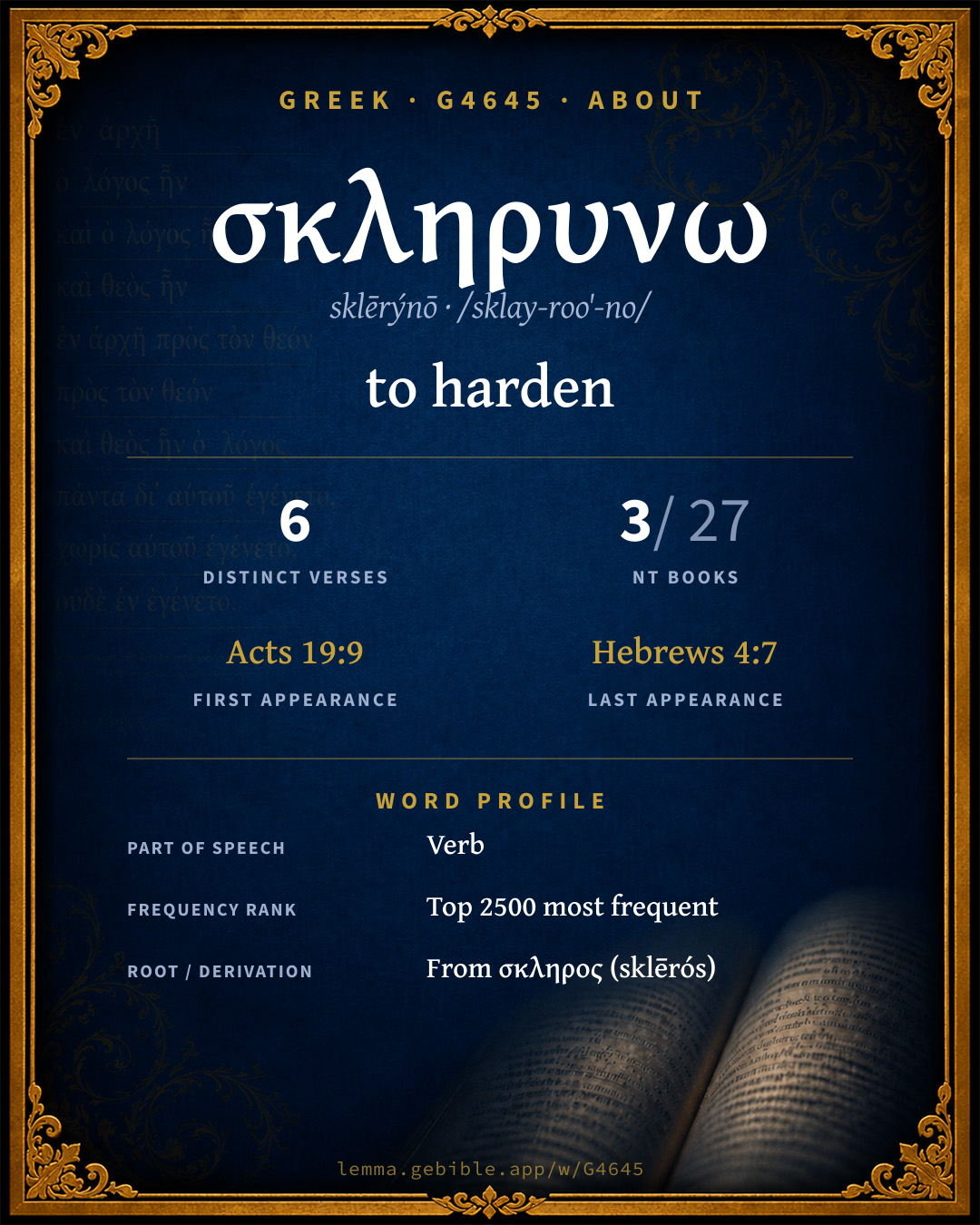
σκληρύνω
to harden
‘to harden’ is one of 2 main senses fuller range ↓
Full lexicon entry — Thayer's Greek Lexicon
From Thayer's Greek Lexicon
Where this word appears
See every Present-tense verb in the Greek New Testament →
Grammar key — what these labels mean
Part of speech
- Verb
- An action or state-of-being word.
Tense
- Present
- Ongoing or general action in present time (imperfective aspect).
- Aorist
- Action viewed as a simple whole, without regard to duration — often past (perfective aspect).
- Imperfect
- Continuous or repeated action in past time (“was writing”).
Voice
- Active
- The subject performs the action.
- Passive
- The subject receives the action.
Mood
- Subjunctive
- Expresses probability, purpose, or possibility (the mood of contingency).
- Indicative
- States a fact or asks a factual question (the mood of reality).
Person
- 2nd person
- The one addressed (“you”).
- 3rd person
- The one spoken about (“he / she / it / they”).
Number
- Plural
- More than one.
- Singular
- One.
Grammatical forms
- Verb, Present, Active, Subjunctive, 2nd person, Plural 3 times (50%)
- Verb, Aorist, Passive, Subjunctive, 3rd person, Singular 1 time (17%)
- Verb, Imperfect, Passive, Indicative, 3rd person, Plural 1 time (17%)
- Verb, Present, Active, Indicative, 3rd person, Singular 1 time (17%)
Parsed forms decoded from the imported morphology (Robinson–Tischendorf, public domain), counted across 6 parsed occurrences — not distinct verses.
Every verse where G4645 appears — 6 distinct verses across 3 books. Click any verse to open its interlinear word-by-word view. Verse text shown in the World English Bible for context — . Each verse’s Greek form is shown with its reference; the English is not keyword-highlighted, since the data carries no word-level English alignment. Use “Compare translations” on any verse to read it across multiple English versions. This concordance covers the Greek New Testament; Septuagint (Greek Old Testament) occurrences of this word are not indexed here.
Acts 1 verse
Romans 1 verse
Hebrews 4 verses
- Hebrews 3:8 σκληρύνητε pres act subj 2pl Don't harden your hearts, as in the provocation, Like as in the day of the trial in the wilderness,
- Hebrews 3:13 σκληρυνθῇ aor pass subj 3sg but exhort one another day by day, so long as it is called "today;" lest any one of you be hardened by the deceitfulness of sin.
- Hebrews 3:15 σκληρύνητε pres act subj 2pl while it is said, "Today if you will hear his voice, Don't harden your hearts, as in the rebellion."
- Hebrews 4:7 σκληρύνητε pres act subj 2pl he again defines a certain day, today, saying through David so long a time afterward (just as has been said), "Today if you will hear his voice, Don't harden your hearts."
About this entry
At a glance — auto-summarized from this page’s data, not written by a person. Every figure links to its source below. This summary describes the numbers; it doesn’t interpret them.
At its core, σκληρυνω (sklērýnō) means “to harden.” The word gravitates to Hebrews (67%), then Acts and Romans. It turns up in 6 verses across 3 books, an uncommon footprint. Scripture first uses it in Acts 19:9. Catalogued under 2 senses, its meaning is not single-sense. Dig into 6-verse concordance and the renderings breakdown below.
Gloss history
Strong's 1890 vs modern scholarship
About this word
Strong's G4645 catalogs a Greek word from the Greek New Testament.
These counts are not copied from any lexicon or concordance. They are computed here, from the morphology-tagged Greek New Testament. What Lemma adds →
- 6
- distinct verses
- The word appears in 6 distinct verses.
- 3 / 27
- NT books
- The word appears in 3 of 27 New Testament books.
- #1,476
- by frequency
- Top 2500 most frequent Greek words (rank 1,476 of 5,347 Greek words by occurrence).
View all 6 occurrences in the concordance →
By section of the New Testament
By traditional corpus
Conventional, traditional groupings — biblical authorship is debated, so this is a traditional corpus grouping, not an authorship claim. Some books belong to more than one corpus (Luke is in both the Gospels and the Lukan corpus, and so on), so these shares overlap and need not total 100%. Each figure is a share of the word’s 6 distinct verses.
- Hebrews 4 verses · 67%
- Lukan (Luke–Acts) 1 verse · 17%
- Pauline corpus 1 verse · 17%
How translations render this word
Counts come from each version’s own published word-to-Strong’s tagging or interlinear alignment — an approximate guide to how each version renders this word, not a word-level alignment the data otherwise carries. Because each total is that version’s own tagged count, the per-version totals vary from one another and need not match the appearance or distinct-verse counts above. These counts may also differ from a printed concordance because Lemma counts each distinctly tagged rendering and does not collapse phrase taggings into a single head-word total. This is a fixed set of word-tagged versions (KJV, ASV, BSB, ULT) and does not change with the reading translation you choose elsewhere. Each version’s license is shown beside its name below (and on Sources).
- King James Version: Harden 3×
- American Standard Version: Harden 3×
- Berean Standard Bible: Harden 3×
- unfoldingWord Literal Text: Do 3×, Harden 3×
King James Version Public Domain
Renders G4645 across 6 tagged occurrences — most commonly:
Plus 3 renderings that appear only once — usually multi-word phrases or single function words the recovered tagging swept in, not distinct renderings.
American Standard Version Public Domain
Renders G4645 across 6 tagged occurrences — most commonly:
Plus 3 renderings that appear only once — usually multi-word phrases or single function words the recovered tagging swept in, not distinct renderings.
Berean Standard Bible Public Domain
Renders G4645 across 6 tagged occurrences — most commonly:
Plus 3 renderings that appear only once — usually multi-word phrases or single function words the recovered tagging swept in, not distinct renderings.
unfoldingWord Literal Text CC BY-SA 4.0
Renders G4645 across 9 tagged occurrences — most commonly:
Plus 3 renderings that appear only once — usually multi-word phrases or single function words the recovered tagging swept in, not distinct renderings.
Senses in Thayer's
The 2 senses Thayer's distinguishes for this word, in lexicon order (not ranked by frequency or importance). The full entry — with sub-senses — is in the Lexicon Entry tab.
- to make hard, harden
- metaph.
Word origin
Derived from σκληρος (sklērós) (G4642) — hard.
From G4642 ; to indurate that is (figuratively) render stubborn : - harden.
— Strong’s Exhaustive Concordance (1890), public domain.
Forms in the corpus
The 4 distinct written forms G4645 takes in the Greek New Testament, most frequent first — each parse links to that tense’s occurrences in the concordance.
| Form | Parsing | Example | Uses |
|---|---|---|---|
| σκληρύνητε sklērýnēte | Verb, Present, Active, Subjunctive, 2nd person, Plural | Hebrews 3:8 | 3 |
| σκληρυνθῇ sklērynthē̂ | Verb, Aorist, Passive, Subjunctive, 3rd person, Singular | Hebrews 3:13 | 1 |
| σκληρύνει sklērýnei | Verb, Present, Active, Indicative, 3rd person, Singular | Romans 9:18 | 1 |
| ἐσκληρύνοντο esklērýnonto | Verb, Imperfect, Passive, Indicative, 3rd person, Plural | Acts 19:9 | 1 |
Same root — word family
Other Thayer's entries built from the same root as G4645, grouped by Strong’s listed origin. These share a root / origin per the lexicon — not necessarily a shared meaning. Each links to that word’s own entry.
Derives from
Shares the same root
- σκληροκαρδια sklērokardía G4641 hardness of heart
- σκληροτης sklērótēs G4643 hardness
- σκληροτραχηλος sklērotráchēlos G4644 stubborn
Compare all same-root words → Showing 4 of 5 — not the complete family. They share a root, not necessarily a meaning.
Septuagint usage
The same Greek word σκληρυνω appears 33 times in the Greek Old Testament (Septuagint), across 33 verses in 11 books.
- 33
- LXX occurrences
- Tagged occurrences of this Greek word in the Septuagint.
- 33
- verses
- Distinct Septuagint verses containing this word.
- 11 / 39
- OT books
- The word appears in 11 of the 39 Old Testament books.
Sample Septuagint occurrences
- Genesis 49:7 σκληρύνω
- Exodus 4:21 σκληρύνω
- Deuteronomy 2:30 σκληρύνω
- Judges 4:24 σκληρύνω
- 2 Samuel 19:44 σκληρύνω
- 2 Kings 2:10 σκληρύνω
- 2 Chronicles 10:4 σκληρύνω
- Ezra 19:16 σκληρύνω
- Psalms 89:6 σκληρύνω
- Isaiah 63:17 σκληρύνω
- Jeremiah 7:26 σκληρύνω
Septuagint occurrences (same lexeme)
Every verse where the same Strong’s number (G4645) appears in the Greek Septuagint. Verse text shown in the World English Bible for context; the Greek form is the matched word — the English is not keyword-highlighted.
- Genesis 49:7 σκληρύνω Cursed be their anger, for it was fierce; And their wrath, for it was cruel. I will divide them in Jacob, Scatter them in Israel.
- Exodus 4:21 σκληρύνω Yahweh said to Moses, "When you go back into Egypt, see that you do before Pharaoh all the wonders which I have put in your hand, but I will harden his heart and he will not let the people go.
- Exodus 7:3 σκληρύνω I will harden Pharaoh's heart, and multiply my signs and my wonders in the land of Egypt.
- Exodus 7:22 σκληρύνω The magicians of Egypt did in like manner with their enchantments; and Pharaoh's heart was hardened, and he didn't listen to them; as Yahweh had spoken.
- Exodus 8:15 σκληρύνω But when Pharaoh saw that there was a respite, he hardened his heart, and didn't listen to them, as Yahweh had spoken.
- Exodus 9:12 σκληρύνω Yahweh hardened the heart of Pharaoh, and he didn't listen to them, as Yahweh had spoken to Moses.
- Exodus 9:35 σκληρύνω The heart of Pharaoh was hardened, and he didn't let the children of Israel go, just as Yahweh had spoken through Moses.
- Exodus 10:1 σκληρύνω Yahweh said to Moses, "Go in to Pharaoh, for I have hardened his heart, and the heart of his servants, that I may show these my signs in the midst of them,
- Exodus 10:20 σκληρύνω But Yahweh hardened Pharaoh's heart, and he didn't let the children of Israel go.
- Exodus 10:27 σκληρύνω But Yahweh hardened Pharaoh's heart, and he wouldn't let them go.
- Exodus 11:10 σκληρύνω Moses and Aaron did all these wonders before Pharaoh, and Yahweh hardened Pharaoh's heart, and he didn't let the children of Israel go out of his land.
- Exodus 13:15 σκληρύνω and it happened, when Pharaoh would hardly let us go, that Yahweh killed all the firstborn in the land of Egypt, both the firstborn of man, and the firstborn of animal. Therefore I sacrifice to Yahweh all that opens the womb, being males; but all the firstborn of my sons I redeem.'
- Exodus 14:4 σκληρύνω I will harden Pharaoh's heart, and he will follow after them; and I will get honor over Pharaoh, and over all his host; and the Egyptians shall know that I am Yahweh." They did so.
- Exodus 14:8 σκληρύνω Yahweh hardened the heart of Pharaoh king of Egypt, and he pursued after the children of Israel; for the children of Israel went out with a high hand.
- Exodus 14:17 σκληρύνω I, behold, I will harden the hearts of the Egyptians, and they shall go in after them: and I will get myself honor over Pharaoh, and over all his host, over his chariots, and over his horsemen.
- Deuteronomy 2:30 σκληρύνω But Sihon king of Heshbon would not let us pass by him; for Yahweh your God hardened his spirit, and made his heart obstinate, that he might deliver him into your hand, as at this day.
- Deuteronomy 10:16 σκληρύνω Circumcise therefore the foreskin of your heart, and be no more stiff-necked.
- Judges 4:24 σκληρύνω The hand of the children of Israel prevailed more and more against Jabin the king of Canaan, until they had destroyed Jabin king of Canaan.
- 2 Samuel 19:44 σκληρύνω
- 2 Kings 2:10 σκληρύνω He said, You have asked a hard thing: [nevertheless], if you see me when I am taken from you, it shall be so to you; but if not, it shall not be so.
- 2 Kings 17:14 σκληρύνω Notwithstanding, they would not hear, but hardened their neck, like the neck of their fathers, who didn't believe in Yahweh their God.
- 2 Chronicles 10:4 σκληρύνω Your father made our yoke grievous: now therefore make you the grievous service of your father, and his heavy yoke which he put on us, lighter, and we will serve you.
- 2 Chronicles 30:8 σκληρύνω Now don't you be stiff-necked, as your fathers were; but yield yourselves to Yahweh, and enter into his sanctuary, which he has sanctified forever, and serve Yahweh your God, that his fierce anger may turn away from you.
- 2 Chronicles 36:13 σκληρύνω He also rebelled against king Nebuchadnezzar, who had made him swear by God: but he stiffened his neck, and hardened his heart against turning to Yahweh, the God of Israel.
- Ezra 19:16 σκληρύνω
- Ezra 19:17 σκληρύνω
- Ezra 19:29 σκληρύνω
- Psalms 89:6 σκληρύνω For who in the skies can be compared to Yahweh? Who among the sons of the heavenly beings is like Yahweh,
- Psalms 94:8 σκληρύνω Consider, you senseless among the people; You fools, when will you be wise?
- Isaiah 63:17 σκληρύνω O Yahweh, why do you make us to err from your ways, and harden our heart from your fear? Return for your servants' sake, the tribes of your inheritance.
- Jeremiah 7:26 σκληρύνω yet they didn't listen to me, nor inclined their ear, but made their neck stiff: they did worse than their fathers.
- Jeremiah 17:23 σκληρύνω But they didn't listen, neither turn their ear, but made their neck stiff, that they might not hear, and might not receive instruction.
- Jeremiah 19:15 σκληρύνω Thus says Yahweh of Hosts, the God of Israel, Behold, I will bring on this city and on all its towns all the evil that I have pronounced against it; because they have made their neck stiff, that they may not hear my words.
These are occurrences of the same Greek lexeme (G4645) in the Septuagint — not a translation of any one Hebrew word. The store carries no word-level Hebrew↔Greek alignment, so no Hebrew original is asserted here. Counts come from the recovered LXX Strong's tagging — high-frequency vocabulary is well covered, while rare or late forms may be untagged — so they reflect tagged occurrences and may slightly undercount.