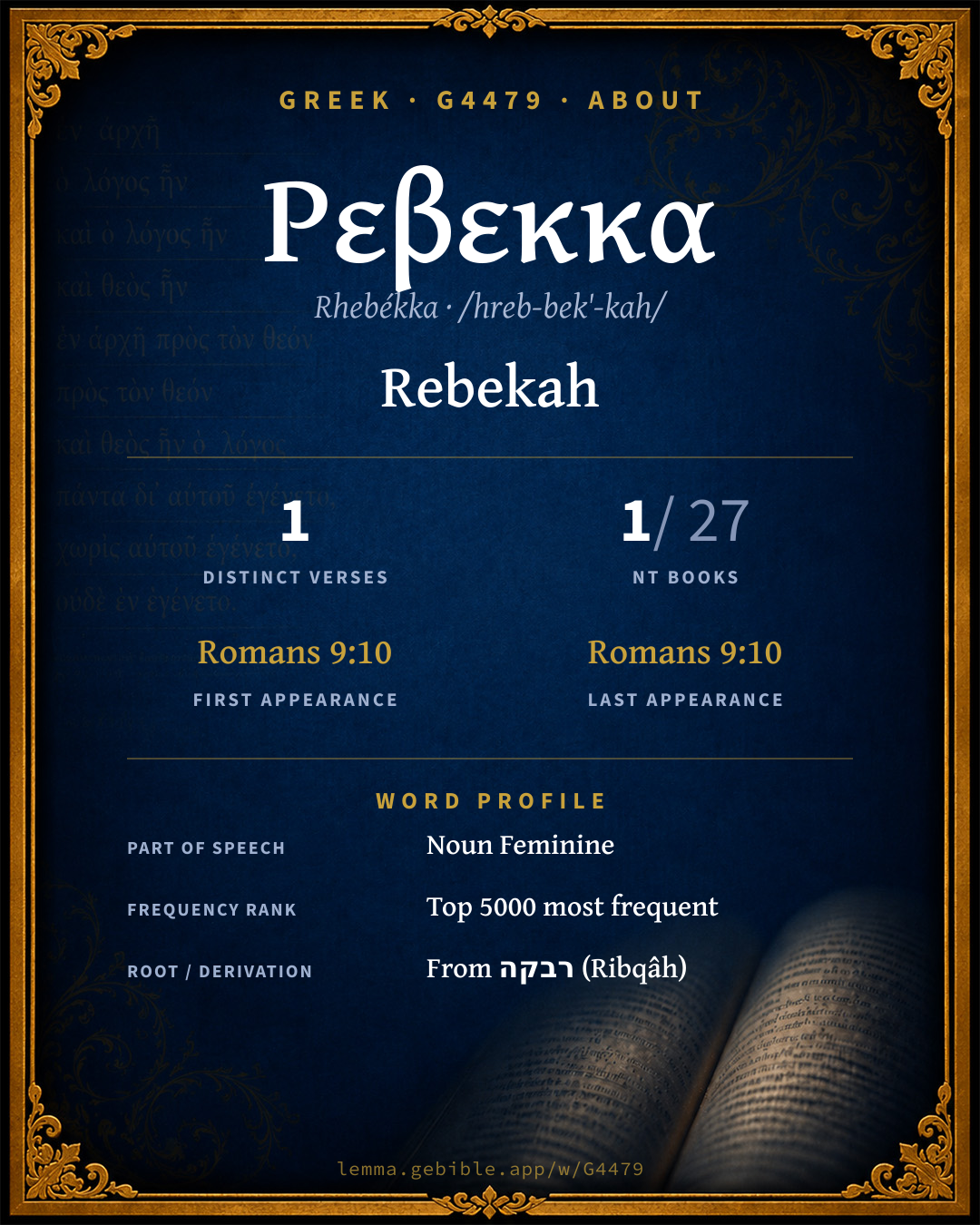
Ῥεβέκκα
Rebekah
Thayer's lists 2 entries for ‘Rebekah’ fuller range ↓
Full lexicon entry — Thayer's Greek Lexicon
From Thayer's Greek Lexicon
Where this word appears
Grammar key — what these labels mean
Part of speech
- Noun
- A naming word — a person, place, thing, or idea.
Case
- Nominative
- The case of the subject (and the predicate nominative).
Gender
- Feminine
- Grammatically feminine.
Number
- Singular
- One.
Every verse where G4479 appears — 1 distinct verse across 1 book. Click any verse to open its interlinear word-by-word view. Verse text shown in the World English Bible for context — . Each verse’s Greek form is shown with its reference; the English is not keyword-highlighted, since the data carries no word-level English alignment. Use “Compare translations” on any verse to read it across multiple English versions. This concordance covers the Greek New Testament; Septuagint (Greek Old Testament) occurrences of this word are not indexed here.
Romans 1 verse
About this entry
At a glance — auto-summarized from this page’s data, not written by a person. Every figure links to its source below. This summary describes the numbers; it doesn’t interpret them.
Ρεβεκκα — transliterated Rhebékka — is a Greek name carrying the sense “Rebekah.” A scarce word — 1 verse in all of the Greek New Testament. More than three-quarters of its appearances fall in Romans. It occurs only once, in Romans 9:10. See 1-verse concordance and the renderings breakdown below.
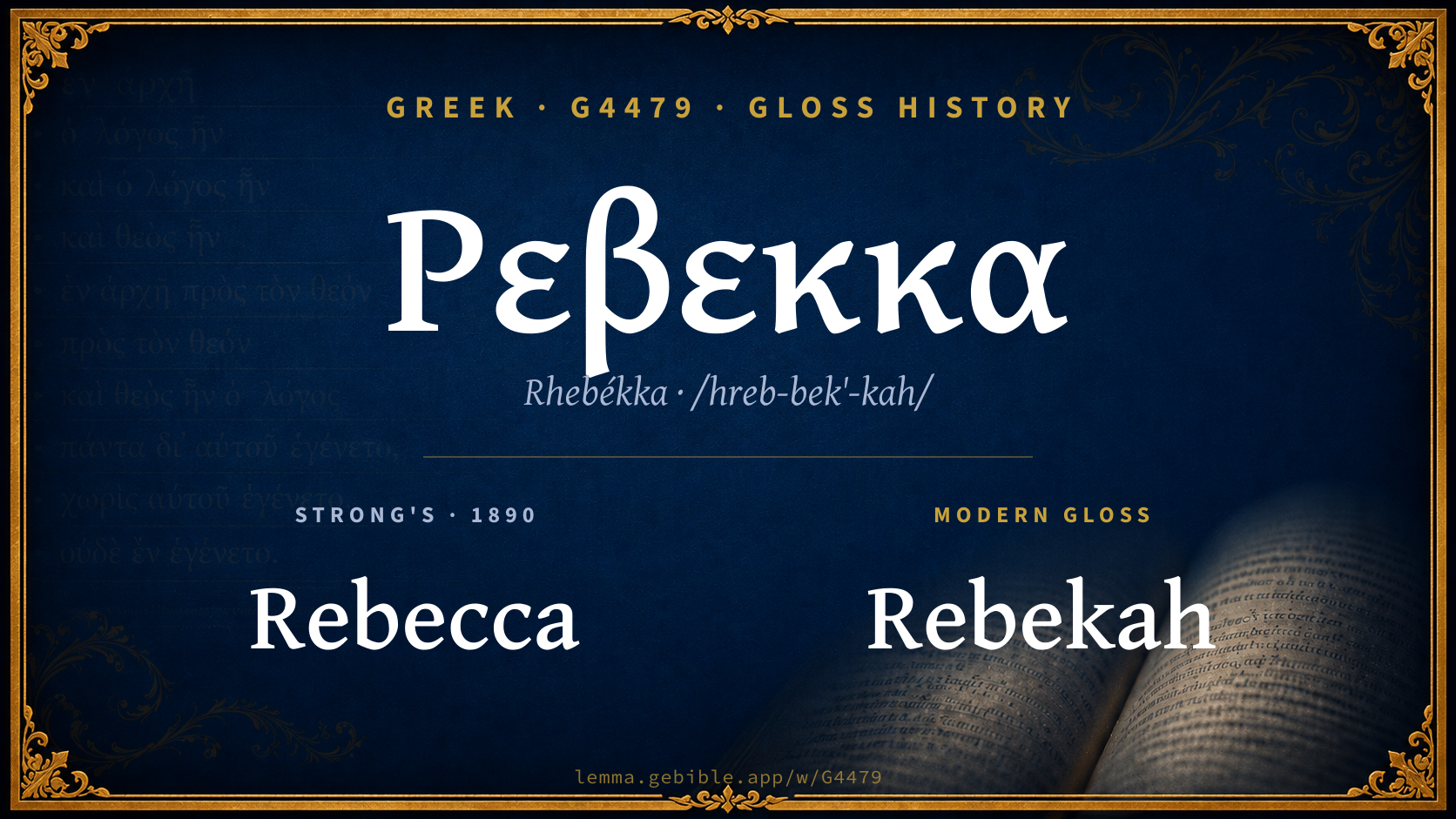
Gloss history
Strong's 1890 vs modern scholarship
About this word
Strong's G4479 catalogs a Greek word from the Greek New Testament.
These counts are not copied from any lexicon or concordance. They are computed here, from the morphology-tagged Greek New Testament. What Lemma adds →
- 1
- distinct verses
- The word appears in 1 distinct verse.
- 1 / 27
- NT books
- The word appears in 1 of 27 New Testament books.
- #3,503
- by frequency
- Top 5000 most frequent Greek words (rank 3,503 of 5,347 Greek words by occurrence).
View all 1 occurrence in the concordance →
Most concentrated in
- Romans 1 verse 100%
By section of the New Testament
By traditional corpus
Conventional, traditional groupings — biblical authorship is debated, so this is a traditional corpus grouping, not an authorship claim. Some books belong to more than one corpus (Luke is in both the Gospels and the Lukan corpus, and so on), so these shares overlap and need not total 100%. Each figure is a share of the word’s 1 distinct verse.
- Pauline corpus 1 verse · 100%
How translations render this word
Counts come from each version’s own published word-to-Strong’s tagging or interlinear alignment — an approximate guide to how each version renders this word, not a word-level alignment the data otherwise carries. Because each total is that version’s own tagged count, the per-version totals vary from one another and need not match the appearance or distinct-verse counts above. These counts may also differ from a printed concordance because Lemma counts each distinctly tagged rendering and does not collapse phrase taggings into a single head-word total. This is a fixed set of word-tagged versions (KJV, ASV, BSB, ULT) and does not change with the reading translation you choose elsewhere. Each version’s license is shown beside its name below (and on Sources).
- King James Version: Rebecca 1×
- American Standard Version: Rebecca 1×
- Berean Standard Bible: Rebecca’s 1×
- unfoldingWord Literal Text: Rebekah 1×
King James Version Public Domain
Renders G4479 across 1 tagged occurrence — most commonly:
American Standard Version Public Domain
Renders G4479 across 1 tagged occurrence — most commonly:
Berean Standard Bible Public Domain
Renders G4479 across 1 tagged occurrence — most commonly:
unfoldingWord Literal Text CC BY-SA 4.0
Renders G4479 across 1 tagged occurrence — most commonly:
Senses in Thayer's
The 2 senses Thayer's distinguishes for this word, in lexicon order (not ranked by frequency or importance). The full entry — with sub-senses — is in the Lexicon Entry tab.
- Rebekah = "ensnarer"
- the wife of Isaac
Word origin
Derived from רבקה (Ribqâh) (H7259) — Rebekah.
Of hebrew origin [ H7259 ]; Rebecca (that is Ribkah ) the wife of Isaac : - Rebecca.
— Strong’s Exhaustive Concordance (1890), public domain.
Bible dictionary
Public-domain dictionary articles matched to this entry by name (Rebekah). A biblical name can be shared by more than one person or place, so an article may treat several.
Easton's Bible Dictionary · M. G. Easton, 1897
A noose, the daughter of Bethuel, and the wife of Isaac (Gen. 22:23; 24:67). The circumstances under which Abraham's "steward" found her at the "city of Nahor," in Padan-aram, are narrated in Gen. 24-27. "She can hardly be regarded as an amiable woman. When we first see her she is ready to leave her father's house for ever at an hour's notice; and her future life showed not only a full share of her brother Laban's duplicity, but the grave fault of partiality in her relations to her children, and a strong will, which soon controlled the gentler nature of her husband." The time and circumstances of her death are not recorded, but it is said that she was buried in the cave of Machpelah (Gen. 49:31).
Smith's Bible Dictionary · William Smith, 1863
(ensnarer), daughter of Bethuel, (Genesis 22:23) and sister of Laban, married to Isaac. She is first presented to us in (Genesis 24:1) ... where the beautiful story of her marriage is related. (B.C. 1857.) For nineteen years she was childless: then Esau and Jacob were born, the younger being the mother's companion and favorite. (Genesis 25:19-28) Rebekah suggested the deceit that was practiced by Jacob on his blind father. She directed and aided him in carrying it out, foresaw the probable consequence of Esau's anger, and prevented it by moving Isaac to send Jacob away to Padan-aram, (Genesis 27:1) ... to her own kindred. (Genesis 29:12) Rebekah's beauty became at one time a source of danger to her husband. (Genesis 26:7) It has been conjectured that she died during Jacob's sojourn in Padan-aram.
Hitchcock's Bible Names Dictionary · Roswell D. Hitchcock, 1869
fat; fattened; a quarrel appeased
Classic public-domain reference works; full attribution on Sources.
Septuagint usage
The same Greek word Ρεβεκκα appears 34 times in the Greek Old Testament (Septuagint), across 31 verses in 1 book.
- 34
- LXX occurrences
- Tagged occurrences of this Greek word in the Septuagint.
- 31
- verses
- Distinct Septuagint verses containing this word.
- 1 / 39
- OT books
- The word appears in 1 of the 39 Old Testament books.
Sample Septuagint occurrences
- Genesis 22:23 ρεβεκκα
Septuagint occurrences (same lexeme)
Every verse where the same Strong’s number (G4479) appears in the Greek Septuagint. Verse text shown in the World English Bible for context; the Greek form is the matched word — the English is not keyword-highlighted.
- Genesis 22:23 ρεβεκκα Bethuel became the father of Rebekah. These eight Milcah bore to Nahor, Abraham's brother.
- Genesis 24:15 ρεβεκκα It happened, before he had done speaking, that behold, Rebekah came out, who was born to Bethuel the son of Milcah, the wife of Nahor, Abraham's brother, with her pitcher on her shoulder.
- Genesis 24:29 ρεβεκκα Rebekah had a brother, and his name was Laban. Laban ran out to the man, to the spring.
- Genesis 24:30 ρεβεκκα It happened, when he saw the ring, and the bracelets on his sister's hands, and when he heard the words of Rebekah his sister, saying, "This is what the man said to me," that he came to the man. Behold, he was standing by the camels at the spring.
- Genesis 24:45 ρεβεκκα Before I had done speaking in my heart, behold, Rebekah came forth with her pitcher on her shoulder. She went down to the spring, and drew. I said to her, 'Please let me drink.'
- Genesis 24:51 ρεβεκκα Behold, Rebekah is before you, take her, and go, and let her be your master's son's wife, as Yahweh has spoken."
- Genesis 24:53 ρεβεκκα The servant brought forth jewels of silver, and jewels of gold, and clothing, and gave them to Rebekah. He gave also to her brother and to her mother precious things.
- Genesis 24:58 ρεβεκκα They called Rebekah, and said to her, "Will you go with this man?" She said, "I will go."
- Genesis 24:59 ρεβεκκα They sent away Rebekah, their sister, with her nurse, Abraham's servant, and his men.
- Genesis 24:60 ρεβεκκα They blessed Rebekah, and said to her, "Our sister, may you be the mother of thousands of ten thousands, and let your seed possess the gate of those who hate them."
- Genesis 24:61 ρεβεκκα Rebekah arose with her ladies. They rode on the camels, and followed the man. The servant took Rebekah, and went his way.
- Genesis 24:64 ρεβεκκα Rebekah lifted up her eyes, and when she saw Isaac, she dismounted from the camel.
- Genesis 24:67 ρεβεκκα Isaac brought her into his mother Sarah's tent, and took Rebekah, and she became his wife. He loved her. Isaac was comforted after his mother's death.
- Genesis 25:20 ρεβεκκα Isaac was forty years old when he took Rebekah, the daughter of Bethuel the Syrian of Paddan Aram, the sister of Laban the Syrian, to be his wife.
- Genesis 25:21 ρεβεκκα Isaac entreated Yahweh for his wife, because she was barren. Yahweh was entreated by him, and Rebekah his wife conceived.
- Genesis 25:26 ρεβεκκα After that, his brother came out, and his hand had hold on Esau's heel. He was named Jacob. Isaac was sixty years old when she bore them.
- Genesis 25:28 ρεβεκκα Now Isaac loved Esau, because he ate his venison. Rebekah loved Jacob.
- Genesis 26:7 ρεβεκκα The men of the place asked him about his wife. He said, "She is my sister," for he was afraid to say, "My wife," lest, he thought, the men of the place might kill me for Rebekah, because she was beautiful to look on.
- Genesis 26:8 ρεβεκκα It happened, when he had been there a long time, that Abimelech king of the Philistines looked out at a window, and saw, and, behold, Isaac was caressing Rebekah, his wife.
- Genesis 26:35 ρεβεκκα They grieved Isaac and Rebekah's spirits.
- Genesis 27:5 ρεβεκκα Rebekah heard when Isaac spoke to Esau his son. Esau went to the field to hunt for venison, and to bring it.
- Genesis 27:6 ρεβεκκα Rebekah spoke to Jacob her son, saying, "Behold, I heard your father speak to Esau your brother, saying,
- Genesis 27:11 ρεβεκκα Jacob said to Rebekah his mother, "Behold, Esau my brother is a hairy man, and I am a smooth man.
- Genesis 27:15 ρεβεκκα Rebekah took the good clothes of Esau, her elder son, which were with her in the house, and put them on Jacob, her younger son.
- Genesis 27:42 ρεβεκκα The words of Esau, her elder son, were told to Rebekah. She sent and called Jacob her younger son, and said to him, "Behold, your brother Esau comforts himself about you by planning to kill you.
- Genesis 27:46 ρεβεκκα Rebekah said to Isaac, "I am weary of my life because of the daughters of Heth. If Jacob takes a wife of the daughters of Heth, such as these, of the daughters of the land, what good will my life do me?"
- Genesis 28:5 ρεβεκκα Isaac sent Jacob away. He went to Paddan Aram to Laban, son of Bethuel the Syrian, Rebekah's brother, Jacob's and Esau's mother.
- Genesis 29:1 ρεβεκκα Then Jacob went on his journey, and came to the land of the children of the east.
- Genesis 29:12 ρεβεκκα Jacob told Rachel that he was her father's brother, and that he was Rebekah's son. She ran and told her father.
- Genesis 35:8 ρεβεκκα Deborah, Rebekah's nurse, died, and she was buried below Bethel under the oak; and the name of it was called Allon Bacuth.
- Genesis 49:31 ρεβεκκα There they buried Abraham and Sarah, his wife. There they buried Isaac and Rebekah, his wife, and there I buried Leah:
These are occurrences of the same Greek lexeme (G4479) in the Septuagint — not a translation of any one Hebrew word. The store carries no word-level Hebrew↔Greek alignment, so no Hebrew original is asserted here. Counts come from the recovered LXX Strong's tagging — high-frequency vocabulary is well covered, while rare or late forms may be untagged — so they reflect tagged occurrences and may slightly undercount.