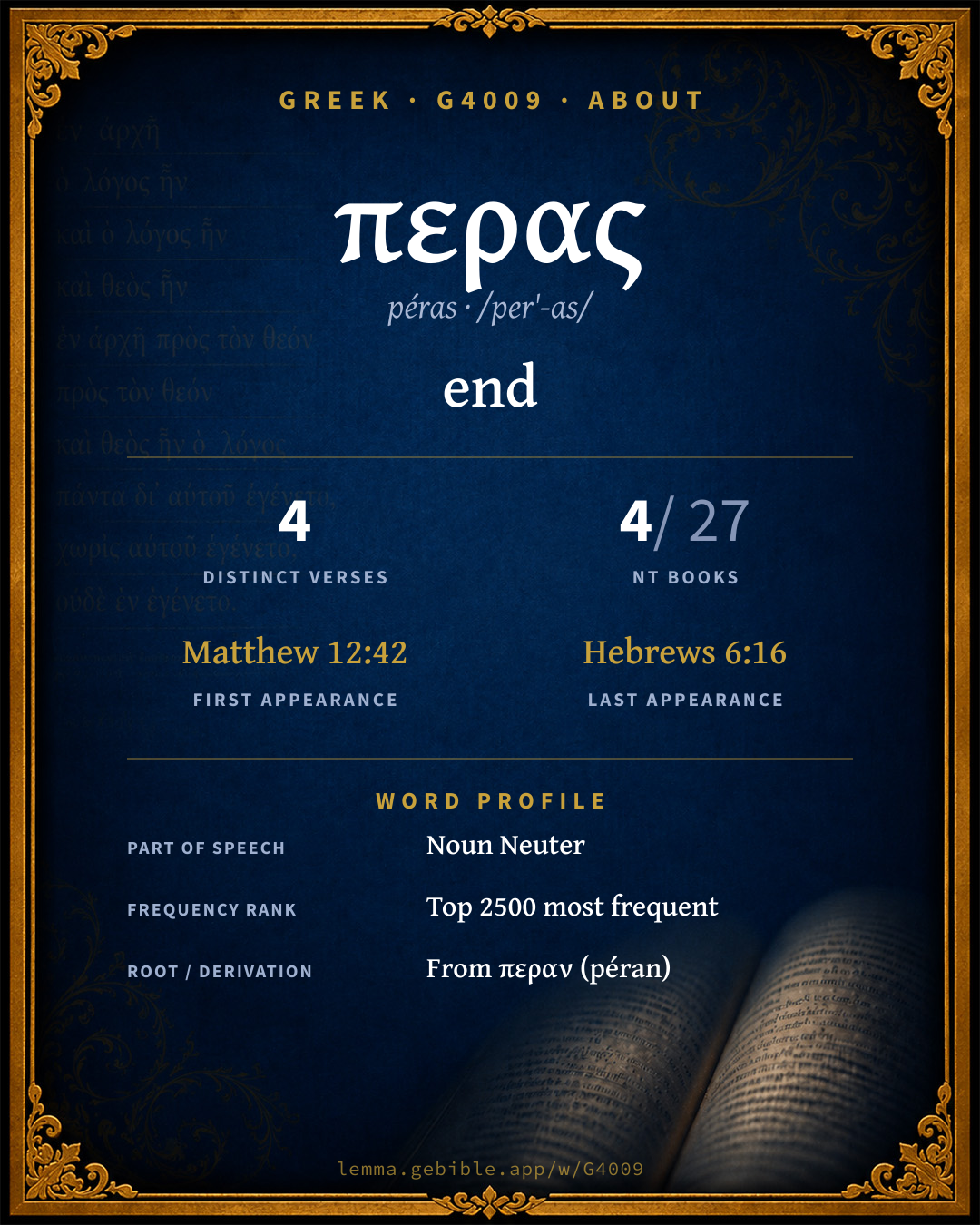
πέρας
end
Full lexicon entry — Thayer's Greek Lexicon
From Thayer's Greek Lexicon
Where this word appears
See every Genitive-case word in the Greek New Testament →
Grammar key — what these labels mean
Part of speech
- Noun
- A naming word — a person, place, thing, or idea.
Case
- Genitive
- The case of source, possession, or “of” — answers “whose / from what.”
- Accusative
- The case of the direct object and of extent.
- Nominative
- The case of the subject (and the predicate nominative).
Gender
- Neuter
- Grammatically neuter.
Number
- Plural
- More than one.
- Singular
- One.
1 distinct verse where G4009 appears in the Nominative case, across 1 book. Filtered view — show all forms. Click any verse to open its interlinear word-by-word view. Verse text shown in the World English Bible for context — . Each verse’s Greek form is shown with its reference; the English is not keyword-highlighted, since the data carries no word-level English alignment. Use “Compare translations” on any verse to read it across multiple English versions. This concordance covers the Greek New Testament; Septuagint (Greek Old Testament) occurrences of this word are not indexed here.
Hebrews 1 verse
About this entry
At a glance — auto-summarized from this page’s data, not written by a person. Every figure links to its source below. This summary describes the numbers; it doesn’t interpret them.
περας (péras) is a Greek noun most often rendered “end.” It is rare — just 4 verses in the entire Greek New Testament. Matthew dominates its distribution — 1 of 4 verses. Debuting at Matthew 12:42, it then recurs through the corpus. Related forms include περαν, πειρα and περ. The sections below give every sense, occurrence, and version rendering.
Gloss history
Strong's 1890 vs modern scholarship

About this word
Strong's G4009 catalogs a Greek word from the Greek New Testament.
These counts are not copied from any lexicon or concordance. They are computed here, from the morphology-tagged Greek New Testament. What Lemma adds →
- 4
- distinct verses
- The word appears in 4 distinct verses.
- 4 / 27
- NT books
- The word appears in 4 of 27 New Testament books.
- #1,877
- by frequency
- Top 2500 most frequent Greek words (rank 1,877 of 5,347 Greek words by occurrence).
View all 4 occurrences in the concordance →
By section of the New Testament
By traditional corpus
Conventional, traditional groupings — biblical authorship is debated, so this is a traditional corpus grouping, not an authorship claim. Some books belong to more than one corpus (Luke is in both the Gospels and the Lukan corpus, and so on), so these shares overlap and need not total 100%. Each figure is a share of the word’s 4 distinct verses.
- Gospels 2 verses · 50%
- Lukan (Luke–Acts) 1 verse · 25%
- Pauline corpus 1 verse · 25%
- Hebrews 1 verse · 25%
How translations render this word
Counts come from each version’s own published word-to-Strong’s tagging or interlinear alignment — an approximate guide to how each version renders this word, not a word-level alignment the data otherwise carries. Because each total is that version’s own tagged count, the per-version totals vary from one another and need not match the appearance or distinct-verse counts above. These counts may also differ from a printed concordance because Lemma counts each distinctly tagged rendering and does not collapse phrase taggings into a single head-word total. This is a fixed set of word-tagged versions (KJV, ASV, BSB, ULT) and does not change with the reading translation you choose elsewhere. Each version’s license is shown beside its name below (and on Sources).
- King James Version: End 1×, Ends 1×, Utmost parts 1×
- American Standard Version: Ends 2×
- Berean Standard Bible: Ends 3×
- unfoldingWord Literal Text: Ends 3×
King James Version Public Domain
Renders G4009 across 4 tagged occurrences — most commonly:
American Standard Version Public Domain
Renders G4009 across 3 tagged occurrences — most commonly:
Plus 1 rendering that appears only once — usually multi-word phrases or single function words the recovered tagging swept in, not distinct renderings.
Berean Standard Bible Public Domain
Renders G4009 across 4 tagged occurrences — most commonly:
Plus 1 rendering that appears only once — usually multi-word phrases or single function words the recovered tagging swept in, not distinct renderings.
unfoldingWord Literal Text CC BY-SA 4.0
Renders G4009 across 4 tagged occurrences — most commonly:
Plus 1 rendering that appears only once — usually multi-word phrases or single function words the recovered tagging swept in, not distinct renderings.
Senses in Thayer's
The 1 sense Thayer's distinguishes for this word, in lexicon order (not ranked by frequency or importance). The full entry — with sub-senses — is in the Lexicon Entry tab.
- extremity, bound, end
Word origin
Derived from περαν (péran) (G4008) — beyond.
From the same as G4008 ; an extremity : - end ut- (ter-) most part.
— Strong’s Exhaustive Concordance (1890), public domain.
Forms in the corpus
The 3 distinct written forms G4009 takes in the Greek New Testament, most frequent first — each parse links to that case’s occurrences in the concordance.
| Form | Parsing | Example | Uses |
|---|---|---|---|
| περάτων perátōn | Noun, Genitive, Plural, Neuter | Matthew 12:42 | 2 |
| πέρας péras | Noun, Nominative, Singular, Neuter | Hebrews 6:16 | 1 |
| πέρατα pérata | Noun, Accusative, Plural, Neuter | Romans 10:18 | 1 |
Same root — word family
Other Thayer's entries built from the same root as G4009, grouped by Strong’s listed origin. These share a root / origin per the lexicon — not necessarily a shared meaning. Each links to that word’s own entry.
Derives from
Shares the same root
- πειρα peîra G3984 trial
- περ per G4007 very much
- περι perí G4012 about
- περπερευομαι perpereúomai G4068 to boast
- πιπρασκω pipráskō G4097 to sell
- φαραγξ pháranx G5327 ravine
Derived from this word
Proper names from this root
People and places named from this root — a name, not an additional meaning of the word.
Compare all same-root words → Showing 4 of 10 — not the complete family. 1 of the same-root words is a proper name (a person or place). They share a root, not necessarily a meaning.
Septuagint usage
The same Greek word περας appears 36 times in the Greek Old Testament (Septuagint), across 35 verses in 9 books.
- 36
- LXX occurrences
- Tagged occurrences of this Greek word in the Septuagint.
- 35
- verses
- Distinct Septuagint verses containing this word.
- 9 / 39
- OT books
- The word appears in 9 of the 39 Old Testament books.
Sample Septuagint occurrences
- Job 28:3 πέρας
- Psalms 2:8 πέρας
- Jeremiah 18:7 πέρας
- Ezekiel 7:2 πέρας
- Daniel 4:14 πέρας
- Amos 8:2 πέρας
- Nahum 2:10 πέρας
- Habakkuk 2:3 πέρας
- Zephaniah 3:10 πέρας
Septuagint occurrences (same lexeme)
Every verse where the same Strong’s number (G4009) appears in the Greek Septuagint. Verse text shown in the World English Bible for context; the Greek form is the matched word — the English is not keyword-highlighted.
- Job 28:3 πέρας Man sets an end to darkness, And searches out, to the furthest bound, The stones of obscurity and of thick darkness.
- Psalms 2:8 πέρας Ask of me, and I will give the nations for your inheritance, The uttermost parts of the earth for your possession.
- Psalms 7:7 πέρας Let the congregation of the peoples surround you. Rule over them on high.
- Psalms 18:5 πέρας The cords of Sheol were round about me; The snares of death came on me.
- Psalms 21:28 πέρας
- Psalms 38:5 πέρας My wounds are loathsome and corrupt, Because of my foolishness.
- Psalms 45:10 πέρας Listen, daughter, consider, and turn your ear. Forget your own people, and also your father's house.
- Psalms 47:11 πέρας
- Psalms 58:14 πέρας
- Psalms 60:3 πέρας You have shown your people hard things. You have made us drink the wine that makes us stagger.
- Psalms 64:6 πέρας They plot injustice, saying, "We have made a perfect plan!" Surely man's mind and heart are cunning.
- Psalms 64:9 πέρας All mankind shall be afraid. They shall declare the work of God, And shall wisely ponder what he has done.
- Psalms 66:8 πέρας Praise our God, you peoples! Make the sound of his praise heard,
- Psalms 71:8 πέρας My mouth shall be filled with your praise, With your honor all the day.
- Psalms 94:4 πέρας They pour out arrogant words. All the evil-doers boast.
- Psalms 97:3 πέρας A fire goes before him, And burns up his adversaries on every side.
- Psalms 118:96 πέρας
- Psalms 144:3 πέρας Yahweh, what is man, that you care for him? Or the son of man, that you think of him?
- Jeremiah 18:7 πέρας At what instant I shall speak concerning a nation, and concerning a kingdom, to pluck up and to break down and to destroy it;
- Jeremiah 18:9 πέρας At what instant I shall speak concerning a nation, and concerning a kingdom, to build and to plant it;
- Jeremiah 28:13 πέρας Go, and tell Hananiah, saying, Thus says Yahweh: You have broken the bars of wood; but you have made in their place bars of iron.
- Ezekiel 7:2 πέρας You, son of man, thus says the Lord Yahweh to the land of Israel, An end: the end is come on the four corners of the land.
- Ezekiel 7:3 πέρας Now is the end on you, and I will send my anger on you, and will judge you according to your ways; and I will bring on you all your abominations.
- Ezekiel 7:7 πέρας Your doom is come to you, inhabitant of the land: the time is come, the day is near, [a day of] tumult, and not [of] joyful shouting, on the mountains.
- Ezekiel 7:10 πέρας Behold, the day, behold, it comes: your doom is gone forth; the rod has blossomed, pride has budded.
- Ezekiel 21:30 πέρας Cause it to return into its sheath. In the place where you were created, in the land of your birth, will I judge you.
- Ezekiel 21:34 πέρας
- Ezekiel 30:3 πέρας For the day is near, even the day of Yahweh is near; it shall be a day of clouds, a time of the nations.
- Daniel 4:14 πέρας He cried aloud, and said thus, Hew down the tree, and cut off its branches, shake off its leaves, and scatter its fruit: let the animals get away from under it, and the fowls from its branches.
- Amos 8:2 πέρας He said, "Amos, what do you see?" I said, "A basket of summer fruit." Then Yahweh said to me, "The end has come on my people Israel. I will not again pass by them any more.
- Nahum 2:10 πέρας She is empty, void, and waste. The heart melts, the knees knock together, their bodies and faces have grown pale.
- Nahum 3:3 πέρας the horseman mounting, and the flashing sword, the glittering spear, and a multitude of slain, and a great heap of corpses, and there is no end of the bodies. They stumble on their bodies,
- Nahum 3:9 πέρας Cush and Egypt were her boundless strength. Put and Libya were her helpers.
- Habakkuk 2:3 πέρας For the vision is yet for the appointed time, and it hurries toward the end, and won't prove false. Though it takes time, wait for it; because it will surely come. It won't delay.
- Zephaniah 3:10 πέρας From beyond the rivers of Cush, my worshipers, even the daughter of my dispersed people, will bring my offering.
These are occurrences of the same Greek lexeme (G4009) in the Septuagint — not a translation of any one Hebrew word. The store carries no word-level Hebrew↔Greek alignment, so no Hebrew original is asserted here. Counts come from the recovered LXX Strong's tagging — high-frequency vocabulary is well covered, while rare or late forms may be untagged — so they reflect tagged occurrences and may slightly undercount.