Ezekiel 48:30

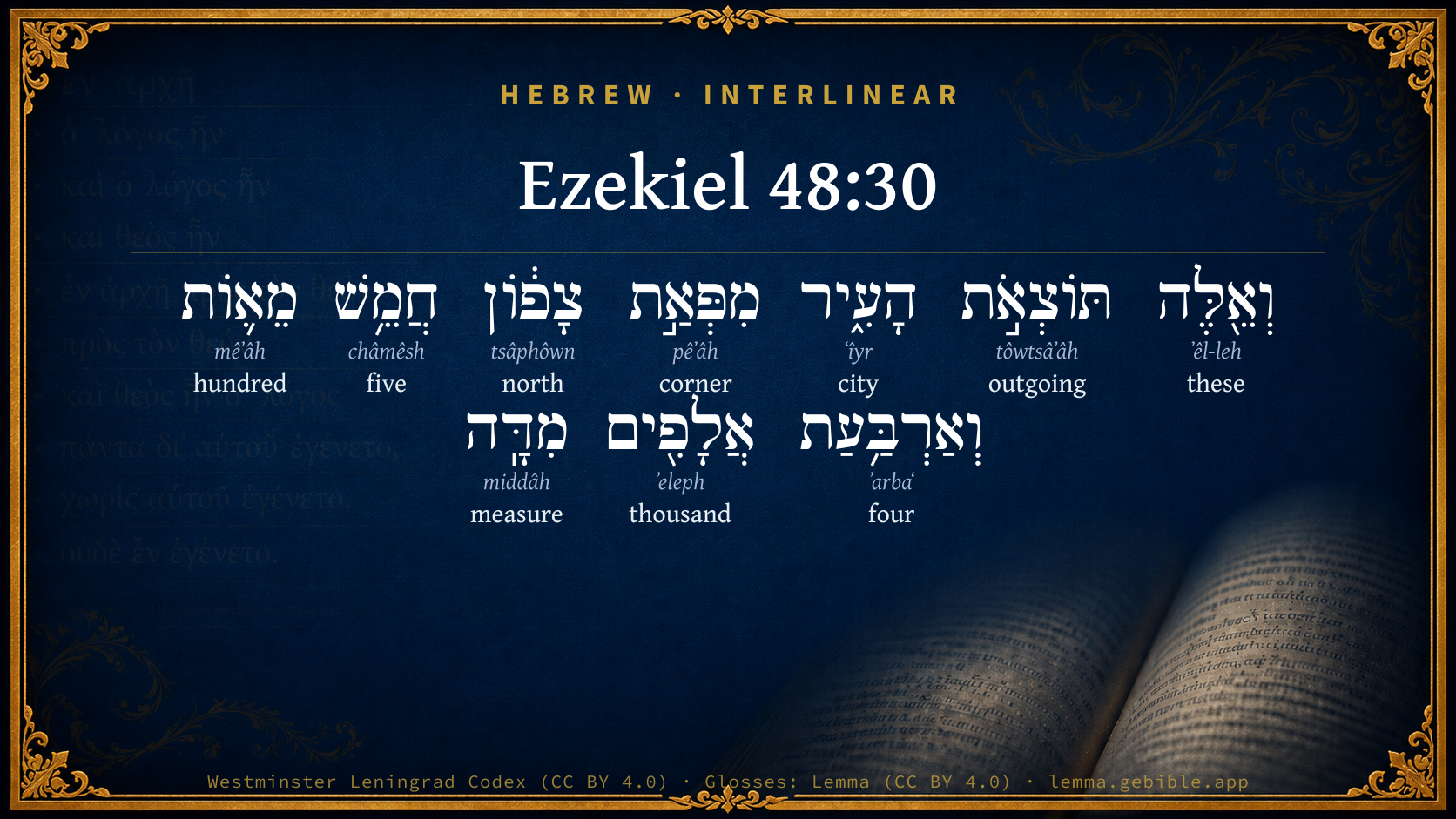
Hebrew (Westminster Leningrad Codex) Ezekiel 48:30 appears in the Hebrew Old Testament. The text above is from the Westminster Leningrad Codex. Each word links to its Strong’s number, a concise gloss, and parsing drawn from the Open Scriptures Hebrew Bible morphology. Click any word for its full Brown-Driver-Briggs (BDB) entry.
Download image
Cite this verse

Ezekiel 48:30 (World English Bible). Public Domain. Lemma interlinear Bible study tool, https://lemma.gebible.app/v/ezekiel/48/30.

Show BibTeX & RIS
BibTeX
RIS
English Translation
These are the exits of the city: On the north side four thousand and five hundred [reeds] by measure;
World English Bible · Public Domain
Download a study sheet

One document with this verse’s original text, its word-by-word gloss line, the meaning frame, cross-references with their text, attributed commentary, and full source and license credits — printable, and it pastes into notes with its structure intact.

This verse Autodidact and up

Study sheet (.html) Plain text (.txt)

A passage Seminary Student

Up to 50 verses in one chapter. A passage sheet keeps up to 6 commentary sources and 12 cross-references per verse, in the order this page ranks them, and says so on the sheet whenever that leaves anything out. Ask for a single verse and you get the Autodidact verse sheet above.

Everything on this page stays free to read, with no account — the sheet is a download of what is already on screen, not access to it.

Want to remove ads? Support Godless Engineer
Compare translations 3

The same verse in 3 English versions, stacked beneath the original-language interlinear above. Click any original word for its lexicon entry.

Each is an independent rendering of the whole verse — the interlinear is not word-aligned to these translations.

Highlighted words mark where these versions differ — a whole-verse word diff, not a word-by-word alignment.

  • World English Bible Public Domain
    These are the exits of the city: On the north side four thousand and five hundred [reeds] by measure;
  • King James Version Public Domain
    And these are the goings out of the city on the north side, four thousand and five hundred measures.
  • unfoldingWord Literal Text CC BY-SA 4.0
    These will be the exits from the city: On the north side, which will measure 4,500 cubits in length,

unfoldingWord Literal Text — © unfoldingWord, licensed CC BY-SA 4.0. Word-aligned USFM3 via Door43 (git.door43.org/unfoldingWord/en_ult).

Versions to compare (up to 4)

3 of 4 selected

Show all 18 translations

Every available English version of this verse, each an independent rendering of the whole verse.

  • World English Bible Public Domain
    These are the exits of the city: On the north side four thousand and five hundred [reeds] by measure;
  • Berean Standard Bible Public Domain
    “These will be the exits of the city: Beginning on the north side, which will be 4,500 cubits long,
  • Majority Standard Bible Public Domain
    “These will be the exits of the city: Beginning on the north side, which will be 4,500 cubits long,
  • King James Version Public Domain
    And these are the goings out of the city on the north side, four thousand and five hundred measures.
  • American Standard Version (1901) Public Domain
    And these are the egresses of the city: On the north side four thousand and five hundred `reeds' by measure;
  • Revised Version (1885) Public Domain
    And these are the goings out of the city; on the north side four thousand and five hundred reeds by measure:
  • Geneva Bible (1599) Public Domain
    And these are the boundes of the citie, on the North side fiue hundreth, and foure thousande measures.
  • Douay-Rheims (1899) Public Domain
    And these are the goings out of the city: on the north side thou shalt measure four thousand and five hundred.
  • Young's Literal Translation Public Domain
    `And these `are' the outgoings of the city on the north side, five hundred, and four thousand measures.
  • Literal Standard Version CC BY-SA 4.0
    “And these [are] the outgoings of the city: on the north side, four thousand and five hundred measures;
  • Unlocked Literal Bible CC BY-SA 4.0
    These will be the exits from the city: On the north side, which will measure 4,500 cubits in length,
  • unfoldingWord Literal Text CC BY-SA 4.0
    These will be the exits from the city: On the north side, which will measure 4,500 cubits in length,
  • Darby Bible Public Domain
    And these are the goings out of the city. On the north side, four thousand and five hundred [cubits] by measure.
  • World Messianic Bible Public Domain
    “These are the exits of the city: On the north side four thousand five hundred reeds by measure;
  • Webster's Bible Public Domain
    And these are the goings out of the city on the north side, four thousand and five hundred measures.
  • Free Bible Version CC BY-SA 4.0
    These are to be the city exits, starting on the north side, which is 4,500 cubits long.
  • Bible in Basic English Public Domain
    And these are the outskirts of the town: on the north side, four thousand five hundred by measure;
  • JPS Tanakh (1917) Public Domain
    And these are the goings out of the city: on the north side four thousand and five hundred reeds by measure;

Literal Standard Version (2020), Covenant Press — licensed CC BY-SA 4.0. Text via the HelloAO Bible API (eBible.org). Unlocked Literal Bible (unfoldingWord) — licensed CC BY-SA 4.0. Text via the HelloAO Bible API (eBible.org). unfoldingWord Literal Text — © unfoldingWord, licensed CC BY-SA 4.0. Word-aligned USFM3 via Door43 (git.door43.org/unfoldingWord/en_ult). Free Bible Version, Dr. Jonathan Gallagher — licensed CC BY-SA 4.0. Text via the HelloAO Bible API (eBible.org).

Word by word

More ways to search: Search by grammar → Find every occurrence → Compare this word →

Practice this passage: Drill this verse → Learn its vocabulary →

תּוֹצְאֹ֣ת
tôwtsâʼâh
H8444
“outgoings of”
Noun, Common, Feminine, Plural, Construct
Part of Speech
Noun
Type
Common
Gender
Feminine
Number
Plural
State
Construct
Full BDB Definition

Origin: from H3318

TWOT: 893e

outgoing, border, a going out, extremity, end, source, escape - outgoing, extremity (of border) - source (of life) - escape (from death)
  1. וְאֵ֖לֶּה ʼêl-leh H428 “and · these” Conjunction + Pronoun, Demonstrative, Common, Plural
  2. הָעִ֑יר ʻîyr H5892 “the · city” Particle, Definite Article + Noun, Common, Feminine, Singular, Absolute
  3. מִפְּאַ֣ת pêʼâh H6285 “from · corner of” Preposition + Noun, Common, Feminine, Singular, Construct
  4. צָפ֔וֹן tsâphôwn H6828 “north” Noun, Common, Feminine, Singular, Absolute
  5. חֲמֵ֥שׁ châmêsh H2568 “five” Adjective, Cardinal number, Feminine, Singular, Absolute
  6. מֵא֛וֹת mêʼâh H3967 “hundred” Adjective, Cardinal number, Both, Plural, Absolute
  7. וְאַרְבַּ֥עַת ʼarbaʻ H702 “and · four” Conjunction + Adjective, Cardinal number, Masculine, Singular, Construct
  8. אֲלָפִ֖ים ʼeleph H505 “thousand” Adjective, Cardinal number, Both, Plural, Absolute
  9. מִדָּֽה middâh H4060 “measure” Noun, Common, Feminine, Singular, Absolute

About this verse

These counts appear in no published source. They are computed here, from the morphology-tagged text and Lemma’s own curated glosses. What Lemma adds →

10
words
10
distinct lemmas
Prophets
section

Notable vocabulary

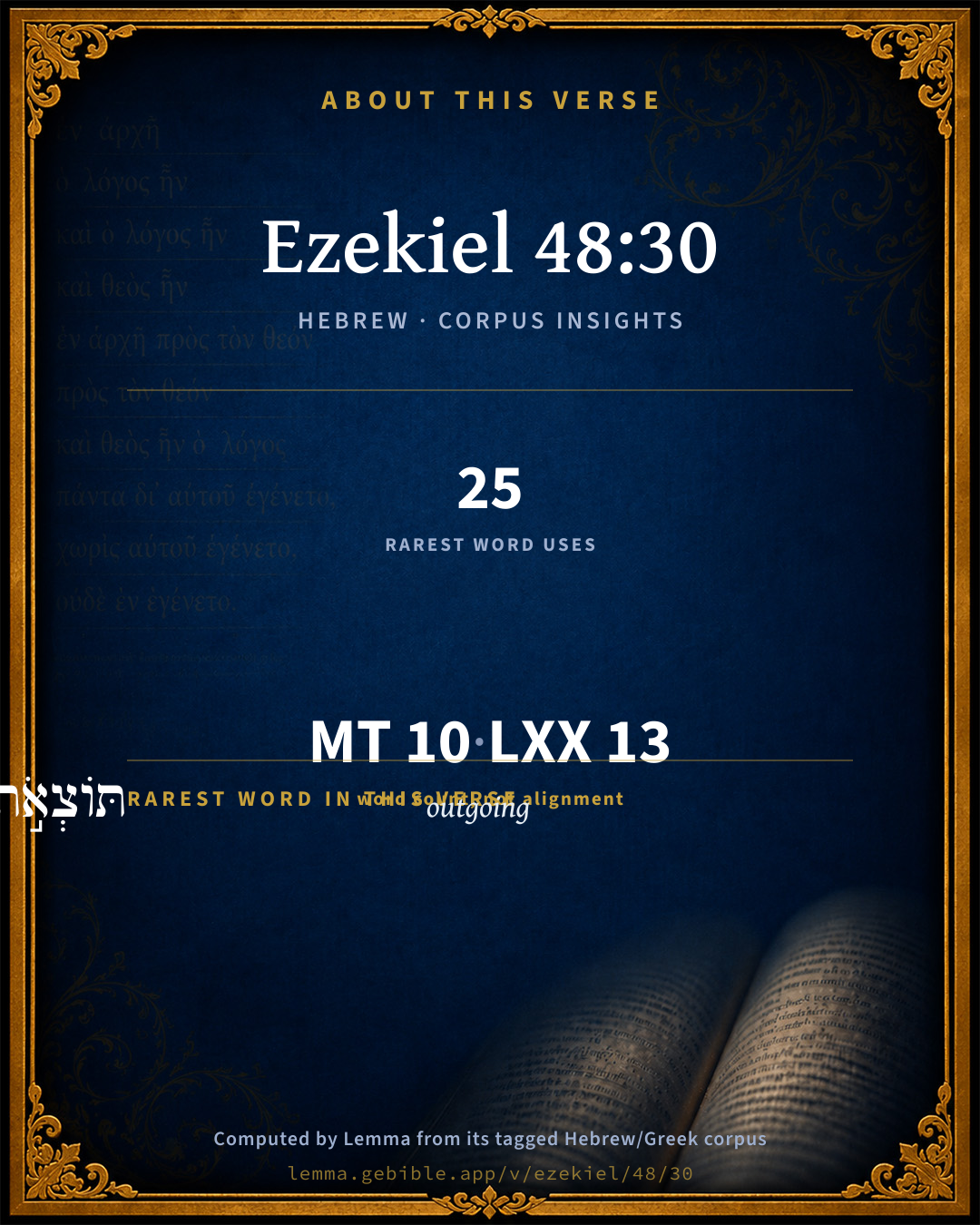
The rarest word here is תּוֹצְאֹ֣ת outgoing H8444 — appearing just 25 times in the whole Hebrew Bible.

Shared distinctive vocabulary

תּוֹצְאֹ֣ת outgoing H8444 occurs in 23 verses of the Hebrew Bible. Also found in:

Grammatical profile

  • 5 nouns
  • 4 adjectives
  • 1 pronoun

Hebrew & Septuagint length

In English translation the verse runs 19 words from the Hebrew and 17 from the Septuagint (LXX English) — closely comparable.

A rough comparison of the two English renderings, which tokenize alike — not a word-level alignment.

Word counts can differ between the Hebrew and the Greek without any difference in meaning — e.g. the Hebrew direct-object marker אֵת has no separate Greek word, and Greek often adds the article ὁ.

In the original languages it is 10 Hebrew tokens and 13 Greek tokens — but the two are counted differently (Hebrew bundles its prefixes and suffixes into one token; the Greek is in lemma form), so that isn’t a like-for-like length.

Cross-references

3

Topical passages linked to Ezekiel 48:30 in the Treasury of Scripture Knowledge — connected by theme and wording, ordered by reader-vote popularity; previews shown in the World English Bible.

  • Ezekiel 48:16 These shall be the measures of it: the north side four thousand and five hundred, and the south side four thousand and five hundred, and on the east side four thousand and five hundred, and the west side four thousand and five hundred.
  • Ezekiel 48:32–35 At the east side four thousand and five hundred [reeds], and three gates: even the gate of Joseph, one; the gate of Benjamin, one; the gate of Dan, one.
  • Revelation 21:16 The city lies foursquare, and its length is as great as its breadth. He measured the city with the reed, Twelve thousand twelve stadia. Its length, breadth, and height are equal.

Cross-references courtesy of OpenBible.info (CC BY 4.0).

Hebrew and Greek witnesses Masoretic Hebrew ↔ Greek Septuagint

The same verse in the two great witnesses to the Old Testament, shown verse-for-verse.

These are two independent witnesses, not word-aligned to each other, and the Septuagint is shown in lemma (dictionary) form.

Hebrew Ezekiel 48:30 Masoretic · Westminster Leningrad Codex

וְאֵ֖לֶּה תּוֹצְאֹ֣ת הָעִ֑יר מִפְּאַ֣ת צָפ֔וֹן חֲמֵ֥שׁ מֵא֛וֹת וְאַרְבַּ֥עַת אֲלָפִ֖ים מִדָּֽה

These are the exits of the city: On the north side four thousand and five hundred [reeds] by measure;

World English Bible · Public Domain

Greek LXX Ezekiel 48:30 Septuagint · lemma form

καί οὗτος ὁ διεκβολή ὁ πόλις ὁ πρός βορέας τετρακισχίλιοι καί πεντακόσιοι μέτρον

And these are the goings out of the city northward, four thousand and five hundred by measure.

LXX2012 (modern English Septuagint) · Public Domain

Hebrew: Westminster Leningrad Codex (CC BY 4.0). Greek: Septuagint (public domain); English from LXX2012 (modern English Septuagint) (Public Domain). How the Septuagint differs from the Hebrew →

Targum (Aramaic paraphrase)

1

The Targum is the ancient Jewish Aramaic paraphrase of the Hebrew Scriptures — an interpretive translation, not the Hebrew text itself. Onkelos (literal) and Pseudo-Jonathan (expansive) render the Torah, and Jonathan the Prophets. Coverage is partial: where no permissively-licensed English translation exists for a verse, only the Aramaic is shown. This is verse-level text, not a word-by-word alignment to the Hebrew.

  1. Targum Jonathan Prophets (Joshua–Malachi)
    וְאִלֵין מַפְקָנֵי קַרְתָּא מֵרוּחַ צִפּוּנָא אַרְבַּע אַלְפִין וַחֲמֵשׁ מְאָה מִשְׁחָא:

    (no public-domain English translation for this verse)

    Targum Jonathan — Aramaic: “Mikraot Gedolot” (public domain). English: “Sefaria Community Translation” (CC0 1.0 (public-domain dedication)); “London "Chaldee Paraphrase," 1871” (public domain). Text via Sefaria.

Commentary

Notes on Ezekiel 48:30 from classic Christian and Jewish commentators (each source and its license shown beneath its notes). The classic Christian expositions comment on the surrounding passage and are grouped to its opening verse, so a note may address several verses; the Jewish commentaries on the Tanakh (Rashi and others) are per-verse, so they appear only where the commentator wrote on this verse.

Lemma curates 59 commentaries, every one of them public domain or Creative Commons licensed, each selected and text-cleaned for this edition rather than reprinted as found. About our sources →

Ellicott's Commentary for English Readers

(30) The goings out of the city.—In Eze_48:30-34 the dimensions of the city are again given for the purpose of introducing the mention of the gates, three on each side, one for each of the tribes of Israel. In this enumeration Levi takes his place as a tribe, and Joseph is therefore reckoned as only one tribe; but the order of their names is neither that of their geographical arrangement nor of their seniority. It will be remembered that the symbolism of the twelve gates enters also into the vision of Rev_21:12; Rev_21:21.

A Bible Commentary for English Readers, edited by Charles John Ellicott (1878–1897) — public domain. Text from a community e-Sword module.

Trapp's Complete Commentary

John Trapp

Eze 48:30 And these [are] the goings out of the city on the north side, four thousand and five hundred measures.

Ver. 30. And these are the goings out of the city.] That is the utmost bounds, as Rabbi Solomon glosseth.

John Trapp, A Commentary or Exposition upon All the Books of the Old and New Testament (1647–1656) — public domain. Text from a community e-Sword module.

Albert Barnes' Notes on the Bible

The goings out of the city - The gates described in Eze 48:31. “Measures” (reeds) concern the sides. Divide the verses thus: Eze 48:30. “And these are the goings out of the city. Eze 48:31. On the north side 4500 measures: and the gates of the city after the names of the tribes of Israel: three gates northward etc.”

Albert Barnes' Notes on the Bible (1834–1885) — public domain. Text from a community e-Sword/MySword module.

Tyndale Open Study Notes

Tyndale Open Resources

48:30-31 At the end of the book, Ezekiel focuses attention on the exits to the city, highlighting once again the theme of access that runs throughout chs 40–48. Like the Temple, the city was a measured square with twelve gates, one for each of the tribes, which established a focus of tribal unity. Unusually, the three most important gates, named for Reuben (the oldest of the sons of Israel), Judah (the royal tribe), and Levi (the priestly tribe), faced north rather than east. This is because the most important direction was northward toward the Temple, the center of the renewed land. South was the second most important side because it was on the axis that pointed toward the Temple.

Tyndale Open Study Notes — © Tyndale Open Resources, licensed CC BY-SA 4.0. Text via the HelloAO Bible API.

Adam Clarke's Commentary

Verse 30. These are the goings out] Each of the four sides of the city was four thousand five hundred cubits long. There were three gates on each side, as mentioned below; and the whole circumference of the city was eighteen thousand cubits. See the map, plan B. dddd. See Clarke on Eze 48:35.

The rector of New Haven College, in New England, supposes the preceding representations to refer to the happy state of the Church in what is called the Millennium. Leaving this period out of the question, the following observations are worthy of notice:-

"The Jews, for whom this vision was intended, would conceive their country to be divided to the twelve tribes, in lots of a regular and mathematical form; and not confused or intermixed, as in Joshua's time. Their city laid out larger than before; and exactly foursquare, with regular suburbs; the temple and appendages much more commodious for their sacrifices, and the habitations of the priests and Levites regularly formed round about the temple. So that this whole plan of the division of the country, laying out of the city, temple, and all the appendages, appears to be perfectly regular and uniform, as if it were drawn all at one time, and by one hand, who had power to effect it; and therefore conveyed to the Jews the most complete idea they were capable of conceiving of the most perfect church, commonwealth, city, temple, and conveniences, for Divine worship.

I. The Holy Land, as described Eze 47:13-21 and Eze 48:1-35 according to the original grant, being about two hundred and fifty miles long, north and south, and about one hundred and fifty miles wide, is divided, by parallel lines east and west, to the twelve tribes, each of them having a portion twenty miles wide. Only between Judah and Benjamin there is a holy portion near ten miles wide; in the middle of which is the holy oblation, twenty-five thousand cubits; that is, about ten miles square for the priests, Levites, city, and temple, Ezek 45:1; Ezek 48:8; the two ends are for the prince, Eze 45:7, c.

II. The holy oblation, lying in the middle of the holy portion, is twenty-five thousand cubits square, which is near ten miles of which ten thousand cubits, or four miles, are taken off from the north side for a habitation for the priests, and as much for the Levites on the south side, Eze 45:4-45:5, and Eze 48:20; and five thousand cubits in the middle for the city portion, Eze 45:6; in the middle of which is the city, four thousand five hundred cubits square, which is nearly two miles, Eze 48:15-16. Round about this is left two hundred and fifty cubits, near thirty rods, for suburbs, Eze 48:17. The remaining ten thousand cubits on the east side, and the ten thousand cubits on the west side, are for the profit of those who serve the city, out of all the tribes, Eze 48:18-19. The sanctuary is in the midst o! the city, Eze 48:8.

III. The sanctuary or temple, and its appendages, were entirely surrounded with a wall six cubits high and six cubits thick, Eze 40:5; and five hundred cubits long on each side, Eze 42:15, c., and Eze 45:2. In the middle square stands the temple, which was surrounded by a wall one hundred cubits long on each side, Eze 41:13, and six cubits thick, Eze 41:8. The side-chambers on the outside four cubits, Eze 41:5. The Holy of Holies, at the west end, was twenty cubits square on the inside, Eze 41:4. The holy place or outer court at the east end, was forty cubits, Eze 41:12. The length of the porch on the north side was twenty cubits the breadth was eleven cubits, Eze 40:49; and the width of the separate place on the south side twenty cubits. On each side of the temple, towards the four gates in the outer wall, stood two courts, eight in the whole, each one hundred cubits square, Eze 40:19; Eze 40:23; Eze 40:27. In each of these were thirty-six little chambers or buildings, about six cubits square, viz., six at the entrance of the gate, Eze 40:7; Eze 40:17; Eze 40:20, &c., and thirty on the pavement, Eze 40:17, &c., which were for lodgings for the priests, for hanging up their garments, and their part of the sacrifices, Eze 42:13."

Calmet has constructed a map to show the position of the tribes, and the quantum of space each was to possess. As this will give a better view of the subject than any written description can, I have inserted one constructed for this work, which, consulting the places said to be connected with the possessions of the different tribes, shows that the tribes did not all possess the same quantum of space, five of the southern tribes possessing only one half as much as those of the north.

Adam Clarke's Commentary on the Bible (1810–1826) — public domain. Text from a community e-Sword/MySword module.

The Cambridge Bible for Schools and Colleges

gen. ed. J. J. S. Perowne

30–35. The city with its twelve gates, named after the tribes. Cf. Rev_21:12 seq

30. goings out of the city] i.e. the extensions on all sides.

measures] in measure, i.e. extent. The 4500 are naturally cubits. The city lies foursquare, each side being 4500. But on each side is a free place of 250 cubits, so that the city forms a square of 5000 cubits.

The Cambridge Bible for Schools and Colleges (gen. ed. J. J. S. Perowne; Cambridge University Press, 1878–1918) — public domain. Text from a community e-Sword module.

Haydock's Catholic Bible Commentary

Out, or gates. (Haydock) --- There were three on each of the four sides. (Calmet)

George Leo Haydock (1774–1849), Haydock's Catholic Family Bible and Commentary, 1859 edition — public domain. Excludes Psalms (Douay-Rheims chapter numbering differs from Protestant) and Deuterocanonical books (Catholic canon only).

Matthew Poole's English Annotations

Now the prophet hath a general topography of the city, which lay four-square. The first side mentioned is the north, for there he began to describe the land, or because it was nearest the temple. It was, as Eze 48:16, which see, four thousand five hundred cubits, i.e. about a mile and one third of a mile.

Matthew Poole's English Annotations on the Holy Bible (1683–1685) — public domain. Text from a community e-Sword/MySword module.

Whedon's Commentary on the Bible

Daniel D. Whedon

30-34. These closing verses relate to the goings out (literally, outer boundaries, Toy) of the city. On each side (exclusive of the suburbs, Eze_48:17) it measures four thousand five hundred cubits (see notes Eze_45:15; Eze_48:8-9), and twelve gates lead out of the city, each gate named after one of the tribes. (Compare Rev_21:2.) The three gates on the north (as one looks from west to east) are those of Reuben, Judah, and Levi; on the east (from north to south) those of Joseph, Benjamin, and Dan; on the south (from east to west) those of Simeon, Issachar, and Zebulun; on the west (from south to north) those of Gad, Asher, and Naphtali. (Compare Genesis 29, 30, 40; Deuteronomy 33.)

Daniel D. Whedon (gen. ed.), Commentary on the Old and New Testaments (1874–1909) — public domain. Text from a community e-Sword module.

The Pulpit Commentary

Vers. 30-35 The closing paragraph is devoted to a statement of the gates, dimensions, and name of the city.

The goings out of the city. These were not, as Hitzig, Gesenius, Ewald, Schroder, and Currey have supposed, the city exits, or gates, which are afterwards referred to, but, as Kliefoth, Keil, Hengstenberg, and Smend suggest, the extensions or boundary-lines of the city, in other words, the city walls in which the gates should be placed, and which are measured before the gates are specified. The north wall, with which the rest should correspond, should be four thousand and five hundred measures; literally, five hundred and four thousand (not cubits, as Ewald states, but reeds) by measure.

The Pulpit Commentary (1880–1919), ed. H.D.M. Spence-Jones & Joseph S. Exell — public domain. Text from a community e-Sword module.

Kretzmann's Popular Commentary

Paul E. Kretzmann

Concerning the Capital City

v. 30. And these are the goings out of the city, the extreme ends, or the gates, of the city on the north side, four thousand and five hundred measures, this being flue extent of the wall with reference to its portals, inclusive of its gates, Cf v. 16.

v. 31. And the gates of the city shall be after the names of the tribes of Israel, bearing the names of the individual tribes: three gates northward, one gate of Reuben, as the first-born in point of time, one gate of Judah, as the first-born by virtue of the patriarchal blessing, one gate of Levi, as the one chosen to be the representative of all the first-born in Israel in the service of the Lord.

v. 32. And at the east side four thousand and five hundred; and three gates: and one gate of Joseph, whose two tribes are here taken together, one gate of Benjamin, one gate of Daniel

v. 33. And at the south side four thousand and five hundred measures; and three gates: one gate of Simeon, one gate of Issachar, one gate of Zebulun.

v. 34. At the west side four thousand and five hundred, with their three gates: one gate of Gad, one gate of Asher, one gate of Naphtali. The gates had a general relation to the location of every tribe’s portion in the New Canaan.

v. 35. It was round about eighteen thousand measures; and the name of the city from that day shall be "The Lord Is There," which is not a mere name, but expresses the fact that Jehovah, the God of the covenant, truly lives in the midst of His Church. The entire wonderful vision, as stated at the beginning, is Messianic in character. Every attempt at interpreting the individual points of this great painting are both futile and foolish; but this one great fact stands out, namely, that the Lord, speaking in terms of Old Testament worship, intended to give the believers some idea of His great Temple of the New Testament, of the communion of saints, bound together by the true faith in Jesus, the Messiah.

Paul E. Kretzmann, Popular Commentary of the Bible (1921–1924) — public domain. Text from a community e-Sword module.

unfoldingWord translationNotes

Door43 World Missions Community

4,500 cubits

"four thousand five hundred cubits." Each long cubit was about 54 centimeters. See how you translated this in Ezekiel 40:5. AT: "about 2.4 kilometers" (See: Numbers and Biblical Distance)

translationWords

gate

Reuben

Judah

Levi

Joseph (OT)

Benjamin

Dan

unfoldingWord translationNotes — © Distant Shores Media and the Door43 World Missions Community, licensed CC BY-SA 4.0. Source: git.door43.org/Door43/en_tn.

Rashi

Rabbi Shlomo Yitzchaki (Rashi)

The exits of the city the gates of its four sides.

measures that is of the measuring rod: 4,500 rods.

Rashi on the Tanakh — English translations: “The Judaica Press complete Tanach with Rashi, translated by A. J. Rosenberg” (CC BY 4.0); “Pentateuch with Rashi's commentary by M. Rosenbaum and A.M. Silbermann, 1929-1934” (public domain); “The Metsudah Tanach series, Lakewood, N.J” (CC BY 4.0); and “The Book of Joshua, Metsudah Publications, 1997” (CC BY 4.0). Text via Sefaria.

Lesson kit

Teaching starters — assembled from the data on this page, not authored interpretation. Every prompt links to the verse data it draws on. Edit before teaching.

Ezekiel, in the Prophets, opens this verse with 10 words (10 distinct Hebrew lemmas). Its most distinctive word is tôwtsâʼâh (“outgoing”). A historical commentator’s framing appears above. Read the whole chapter for the surrounding context.

Discussion questions

  1. What does “outgoing” (tôwtsâʼâh) contribute to the verse as a whole?
  2. Numbers 34:4 shares the word «outgoing» with this verse. How do the two illuminate each other?
  3. The translations on this page render this verse differently — a whole-verse word diff, not a word-by-word alignment. What might account for the different wordings?
  4. Reading how Ellicott's Commentary for English Readers and Trapp's Complete Commentary read this verse, where do the two commentators agree and where do they part?

Things to notice

Reading settings

Reading text

Shown beneath each verse's original-language words.

Old Testament
Old Testament edition

Read the OT as the Masoretic Hebrew (MT) or the Greek Septuagint (LXX).

English shown for the Greek Septuagint (in the Hebrew ↔ Greek comparison).

Comparing translations? Open the Compare panel on any verse page to stack up to four side by side.