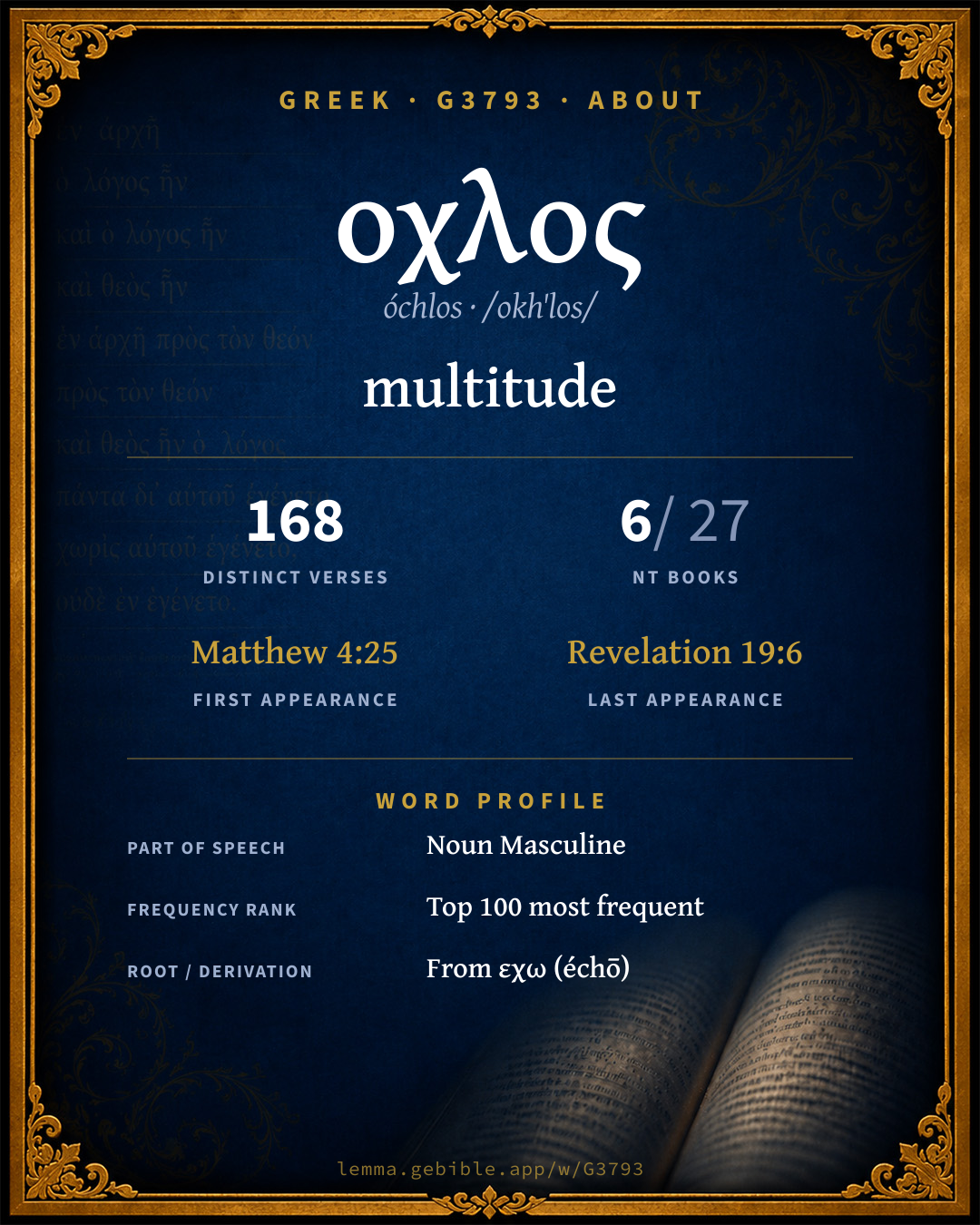
ὄχλος
multitude
‘multitude’ is one of 2 main senses fuller range ↓
Full lexicon entry — Thayer's Greek Lexicon
From Thayer's Greek Lexicon
Where this word appears
See every Accusative-case word in the Greek New Testament →
Grammar key — what these labels mean
Part of speech
- Noun
- A naming word — a person, place, thing, or idea.
Case
- Nominative
- The case of the subject (and the predicate nominative).
- Accusative
- The case of the direct object and of extent.
- Genitive
- The case of source, possession, or “of” — answers “whose / from what.”
- Dative
- The case of the indirect object, means, or location — “to / for / with / in.”
Gender
- Masculine
- Grammatically masculine.
Number
- Singular
- One.
- Plural
- More than one.
Every verse where G3793 appears in the Book of Acts — 22 distinct verses. Click any verse to open its interlinear word-by-word view. Verse text shown in the World English Bible for context — . Each verse’s Greek form is shown with its reference; the English is not keyword-highlighted, since the data carries no word-level English alignment. Use “Compare translations” on any verse to read it across multiple English versions. This concordance covers the Greek New Testament; Septuagint (Greek Old Testament) occurrences of this word are not indexed here.
Acts
- Acts 1:15 ὄχλος n nom sg masc In these days, Peter stood up in the midst of the disciples (and the number of names was about one hundred twenty), and said,
- Acts 6:7 ὄχλος n nom sg masc The word of God increased and the number of the disciples multiplied in Jerusalem exceedingly. A great company of the priests were obedient to the faith.
- Acts 8:6 ὄχλοι n nom pl masc The multitudes listened with one accord to the things that were spoken by Philip, when they heard and saw the signs which he did.
- Acts 11:24 ὄχλος n nom sg masc For he was a good man, and full of the Holy Spirit and of faith, and many people were added to the Lord.
- Acts 11:26 ὄχλον n acc sg masc When he had found him, he brought him to Antioch. It happened, that for a whole year they were gathered together with the assembly, and taught many people. The disciples were first called Christians in Antioch.
- Acts 13:45 ὄχλους n acc pl masc But when the Jews saw the multitudes, they were filled with jealousy, and contradicted the things which were spoken by Paul, and blasphemed.
- Acts 14:11 ὄχλοι n nom pl masc When the multitude saw what Paul had done, they lifted up their voice, saying in the language of Lycaonia, "The gods have come down to us in the likeness of men!"
- Acts 14:13 ὄχλοις n dat pl masc The priest of Jupiter, whose temple was in front of their city, brought oxen and garlands to the gates, and would have made a sacrifice along with the multitudes.
- Acts 14:14 ὄχλον n acc sg masc But when the apostles, Barnabas and Paul, heard of it, they tore their clothes, and sprang into the multitude, crying out,
- Acts 14:18 ὄχλους n acc pl masc Even saying these things, they hardly stopped the multitudes from making a sacrifice to them.
- Acts 14:19 ὄχλους n acc pl masc But some Jews from Antioch and Iconium came there, and having persuaded the multitudes, they stoned Paul, and dragged him out of the city, supposing that he was dead.
- Acts 16:22 ὄχλος n nom sg masc The multitude rose up together against them, and the magistrates tore their clothes off of them, and commanded them to be beaten with rods.
- Acts 17:8 ὄχλον n acc sg masc The multitude and the rulers of the city were troubled when they heard these things.
- Acts 17:13 ὄχλους n acc pl masc But when the Jews of Thessalonica had knowledge that the word of God was proclaimed by Paul at Beroea also, they came there likewise, agitating the multitudes.
- Acts 19:26 ὄχλον n acc sg masc You see and hear, that not at Ephesus alone, but almost throughout all Asia, this Paul has persuaded and turned away many people, saying that they are no gods, that are made with hands.
- Acts 19:33 ὄχλου n gen sg masc They brought Alexander out of the multitude, the Jews putting him forward. Alexander beckoned with his hand, and would have made a defense to the people.
- Acts 19:35 ὄχλον n acc sg masc When the town clerk had quieted the multitude, he said, "You men of Ephesus, what man is there who doesn't know that the city of the Ephesians is temple-keeper of the great goddess Artemis, and of the image which fell down from Zeus?
- Acts 21:27 ὄχλον n acc sg masc When the seven days were almost completed, the Jews from Asia, when they saw him in the temple, stirred up all the multitude and laid hands on him,
- Acts 21:34 ὄχλῳ n dat sg masc Some shouted one thing, and some another, among the crowd. When he couldn't find out the truth because of the noise, he commanded him to be brought into the barracks.
- Acts 21:35 ὄχλου n gen sg masc When he came to the stairs, it happened that he was carried by the soldiers because of the violence of the crowd;
- Acts 24:12 ὄχλου n gen sg masc In the temple they didn't find me disputing with anyone or stirring up a crowd, either in the synagogues, or in the city.
- Acts 24:18 ὄχλου n gen sg masc amid which certain Jews from Asia found me purified in the temple, not with a mob, nor with turmoil.
About this entry
At a glance — auto-summarized from this page’s data, not written by a person. Every figure links to its source below. This summary describes the numbers; it doesn’t interpret them.
At its core, οχλος (óchlos) means “multitude.” Older and newer Bibles part ways — “people” in the King James Version, “crowd” (Berean Standard Bible) in modern versions. See the renderings breakdown. It appears 168 verses across 6 books of the Greek New Testament, among its common vocabulary. The word gravitates to Matthew (28%), then Luke and Mark. Ranging over 2 senses, it is not a single-sense word. Each statement above links to its evidence; the full detail follows below.
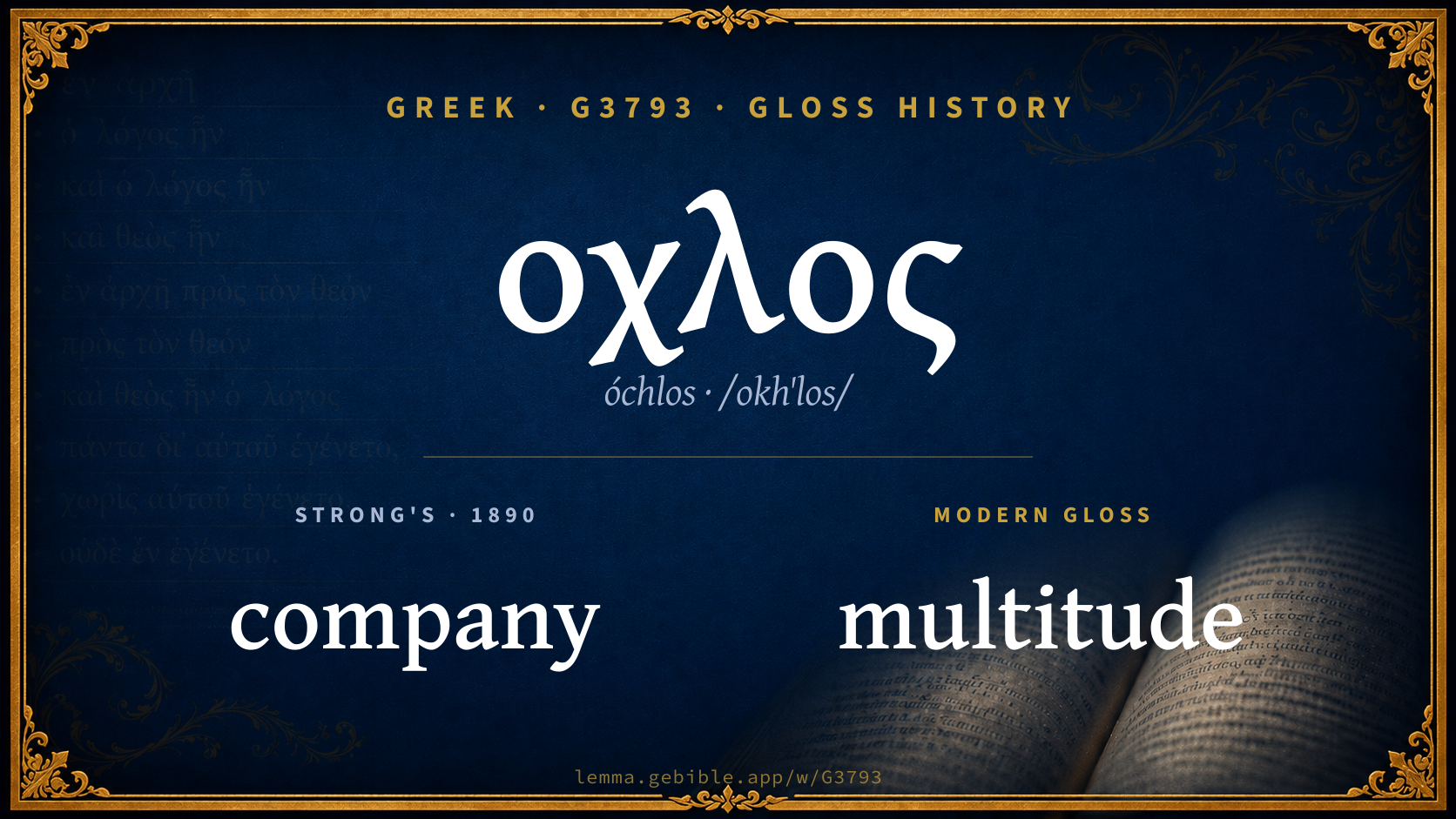
Gloss history
Strong's 1890 vs modern scholarship
About this word
Strong's G3793 catalogs a Greek word from the Greek New Testament.
These counts are not copied from any lexicon or concordance. They are computed here, from the morphology-tagged Greek New Testament. What Lemma adds →
- 168
- distinct verses
- The word appears in 168 distinct verses.
- 6 / 27
- NT books
- The word appears in 6 of 27 New Testament books.
- #92
- by frequency
- Top 100 most frequent Greek words (rank 92 of 5,347 Greek words by occurrence).
View all 168 occurrences in the concordance →
By section of the New Testament
By traditional corpus
Conventional, traditional groupings — biblical authorship is debated, so this is a traditional corpus grouping, not an authorship claim. Some books belong to more than one corpus (Luke is in both the Gospels and the Lukan corpus, and so on), so these shares overlap and need not total 100%. Each figure is a share of the word’s 168 distinct verses.
- Gospels 142 verses · 85%
- Lukan (Luke–Acts) 63 verses · 38%
- Johannine 23 verses · 14%
- Revelation 4 verses · 2%
How translations render this word
Counts come from each version’s own published word-to-Strong’s tagging or interlinear alignment — an approximate guide to how each version renders this word, not a word-level alignment the data otherwise carries. Because each total is that version’s own tagged count, the per-version totals vary from one another and need not match the appearance or distinct-verse counts above. These counts may also differ from a printed concordance because Lemma counts each distinctly tagged rendering and does not collapse phrase taggings into a single head-word total. This is a fixed set of word-tagged versions (KJV, ASV, BSB, ULT) and does not change with the reading translation you choose elsewhere. Each version’s license is shown beside its name below (and on Sources).
- King James Version: People 82×, Multitude 57×, Multitudes 19×
- American Standard Version: Multitude 90×, Multitudes 52×, Crowd 12×
- Berean Standard Bible: Crowd 97×, Crowds 49×, People 17×
- unfoldingWord Literal Text: Crowd 116×, Crowds 55×, A 26×
King James Version Public Domain
Renders G3793 across 175 tagged occurrences — most commonly:
Plus 5 renderings that appear only once — usually multi-word phrases or single function words the recovered tagging swept in, not distinct renderings.
American Standard Version Public Domain
Renders G3793 across 181 tagged occurrences — most commonly:
Plus 11 renderings that appear only once — usually multi-word phrases or single function words the recovered tagging swept in, not distinct renderings.
Berean Standard Bible Public Domain
Renders G3793 across 171 tagged occurrences — most commonly:
Plus 5 renderings that appear only once — usually multi-word phrases or single function words the recovered tagging swept in, not distinct renderings. Not rendered by a distinct English word in 4 further occurrences.
unfoldingWord Literal Text CC BY-SA 4.0
Renders G3793 across 202 tagged occurrences — most commonly:
Plus 3 renderings that appear only once — usually multi-word phrases or single function words the recovered tagging swept in, not distinct renderings.
Senses in Thayer's
The 2 senses Thayer's distinguishes for this word, in lexicon order (not ranked by frequency or importance). The full entry — with sub-senses — is in the Lexicon Entry tab.
- a casual collection of people
- a multitude
Word origin
Derived from εχω (échō) (G2192) — to have.
From a derivative of G2192 (meaning a vehicle ); a throng (as borne along); by implication the rabble ; by extension a class of people; figuratively a riot : - company multitude number (of people) people press.
— Strong’s Exhaustive Concordance (1890), public domain.
Forms in the corpus
The 8 distinct written forms G3793 takes in the Greek New Testament, most frequent first — each parse links to that case’s occurrences in the concordance.
| Form | Parsing | Example | Uses |
|---|---|---|---|
| ὄχλος óchlos | Noun, Nominative, Singular, Masculine | Matthew 9:25 | 46 |
| ὄχλον óchlon | Noun, Accusative, Singular, Masculine | Matthew 9:23 | 33 |
| ὄχλοι óchloi | Noun, Nominative, Plural, Masculine | Matthew 4:25 | 27 |
| ὄχλου óchlou | Noun, Genitive, Singular, Masculine | Matthew 27:24 | 25 |
| ὄχλους óchlous | Noun, Accusative, Plural, Masculine | Matthew 5:1 | 18 |
| ὄχλῳ óchlō | Noun, Dative, Singular, Masculine | Matthew 15:35 | 13 |
| ὄχλοις óchlois | Noun, Dative, Plural, Masculine | Matthew 11:7 | 10 |
| ὄχλων óchlōn | Noun, Genitive, Plural, Masculine | Luke 11:29 | 1 |
Same root — word family
Other Thayer's entries built from the same root as G3793, grouped by Strong’s listed origin. These share a root / origin per the lexicon — not necessarily a shared meaning. Each links to that word’s own entry.
Derives from
Shares the same root
- εξης hexēs G1836 next in order
- εξις héxis G1838 habit
- εσχατος éschatos G2078 last
- ευνουχος eunoûchos G2135 eunuch
- ισχυς ischýs G2479 strength
- οχυρωμα ochýrōma G3794 fortress
- σχεδον schedón G4975 near
- σχημα schēma G4976 appearance
- σχολη scholḗ G4981 leisure
Derived from this word
Compare all same-root words → Showing 4 of 13 — not the complete family. They share a root, not necessarily a meaning.
Septuagint usage
The same Greek word οχλος appears 24 times in the Greek Old Testament (Septuagint), across 22 verses in 10 books.
- 24
- LXX occurrences
- Tagged occurrences of this Greek word in the Septuagint.
- 22
- verses
- Distinct Septuagint verses containing this word.
- 10 / 39
- OT books
- The word appears in 10 of the 39 Old Testament books.
Sample Septuagint occurrences
- Numbers 20:20 ὄχλος
- Joshua 6:13 ὄχλος
- 2 Samuel 15:22 ὄχλος
- 1 Kings 21:13 ὄχλος
- 2 Chronicles 20:15 ὄχλος
- Ezra 3:12 ὄχλος
- Isaiah 43:17 ὄχλος
- Jeremiah 31:42 ὄχλος
- Ezekiel 16:40 ὄχλος
- Daniel 3:4 ὄχλος
Septuagint occurrences (same lexeme)
Every verse where the same Strong’s number (G3793) appears in the Greek Septuagint. Verse text shown in the World English Bible for context; the Greek form is the matched word — the English is not keyword-highlighted.
- Numbers 20:20 ὄχλος He said, You shall not pass through. Edom came out against him with much people, and with a strong hand.
- Joshua 6:13 ὄχλος The seven priests bearing the seven trumpets of rams' horns before the ark of Yahweh went on continually, and blew the trumpets: and the armed men went before them; and the rearward came after the ark of Yahweh, [the priests] blowing the trumpets as they went.
- 2 Samuel 15:22 ὄχλος David said to Ittai, Go and pass over. Ittai the Gittite passed over, and all his men, and all the little ones who were with him.
- 1 Kings 21:13 ὄχλος The two men, the base fellows, came in and sat before him: and the base fellows bore witness against him, even against Naboth, in the presence of the people, saying, Naboth did curse God and the king. Then they carried him forth out of the city, and stoned him to death with stones.
- 2 Chronicles 20:15 ὄχλος and he said, Listen you, all Judah, and you inhabitants of Jerusalem, and you king Jehoshaphat: Thus says Yahweh to you, Don't be afraid you, neither be dismayed by reason of this great multitude; for the battle is not yours, but God's.
- Ezra 3:12 ὄχλος But many of the priests and Levites and heads of fathers' [houses], the old men who had seen the first house, when the foundation of this house was laid before their eyes, wept with a loud voice; and many shouted aloud for joy:
- Ezra 16:13 ὄχλος
- Isaiah 43:17 ὄχλος who brings forth the chariot and horse, the army and the mighty man (they lie down together, they shall not rise; they are extinct, they are quenched as a wick):
- Jeremiah 31:42 ὄχλος
- Jeremiah 38:8 ὄχλος Ebedmelech went forth out of the king's house, and spoke to the king, saying,
- Jeremiah 39:24 ὄχλος
- Ezekiel 16:40 ὄχλος They shall also bring up a company against you, and they shall stone you with stones, and thrust you through with their swords.
- Ezekiel 17:17 ὄχλος Neither shall Pharaoh with his mighty army and great company help him in the war, when they cast up mounds and build forts, to cut off many persons.
- Ezekiel 23:24 ὄχλος They shall come against you with weapons, chariots, and wagons, and with a company of peoples; they shall set themselves against you with buckler and shield and helmet round about; and I will commit the judgment to them, and they shall judge you according to their judgments.
- Ezekiel 23:46 ὄχλος For thus says the Lord Yahweh: I will bring up a company against them, and will give them to be tossed back and forth and robbed.
- Ezekiel 23:47 ὄχλος The company shall stone them with stones, and dispatch them with their swords; they shall kill their sons and their daughters, and burn up their houses with fire.
- Daniel 3:4 ὄχλος Then the herald cried aloud, To you it is commanded, peoples, nations, and languages,
- Daniel 11:8 ὄχλος Also their gods, with their molten images, [and] with their goodly vessels of silver and of gold, shall he carry captive into Egypt; and he shall refrain some years from the king of the north.
- Daniel 11:10 ὄχλος His sons shall war, and shall assemble a multitude of great forces, which shall come on, and overflow, and pass through; and they shall return and war, even to his fortress.
- Daniel 11:13 ὄχλος The king of the north shall return, and shall set forth a multitude greater than the former; and he shall come on at the end of the times, [even of] years, with a great army and with much substance.
- Daniel 11:25 ὄχλος He shall stir up his power and his courage against the king of the south with a great army; and the king of the south shall war in battle with an exceeding great and mighty army; but he shall not stand; for they shall devise devices against him.
- Daniel 11:43 ὄχλος But he shall have power over the treasures of gold and of silver, and over all the precious things of Egypt; and the Libyans and the Ethiopians shall be at his steps.
These are occurrences of the same Greek lexeme (G3793) in the Septuagint — not a translation of any one Hebrew word. The store carries no word-level Hebrew↔Greek alignment, so no Hebrew original is asserted here. Counts come from the recovered LXX Strong's tagging — high-frequency vocabulary is well covered, while rare or late forms may be untagged — so they reflect tagged occurrences and may slightly undercount.