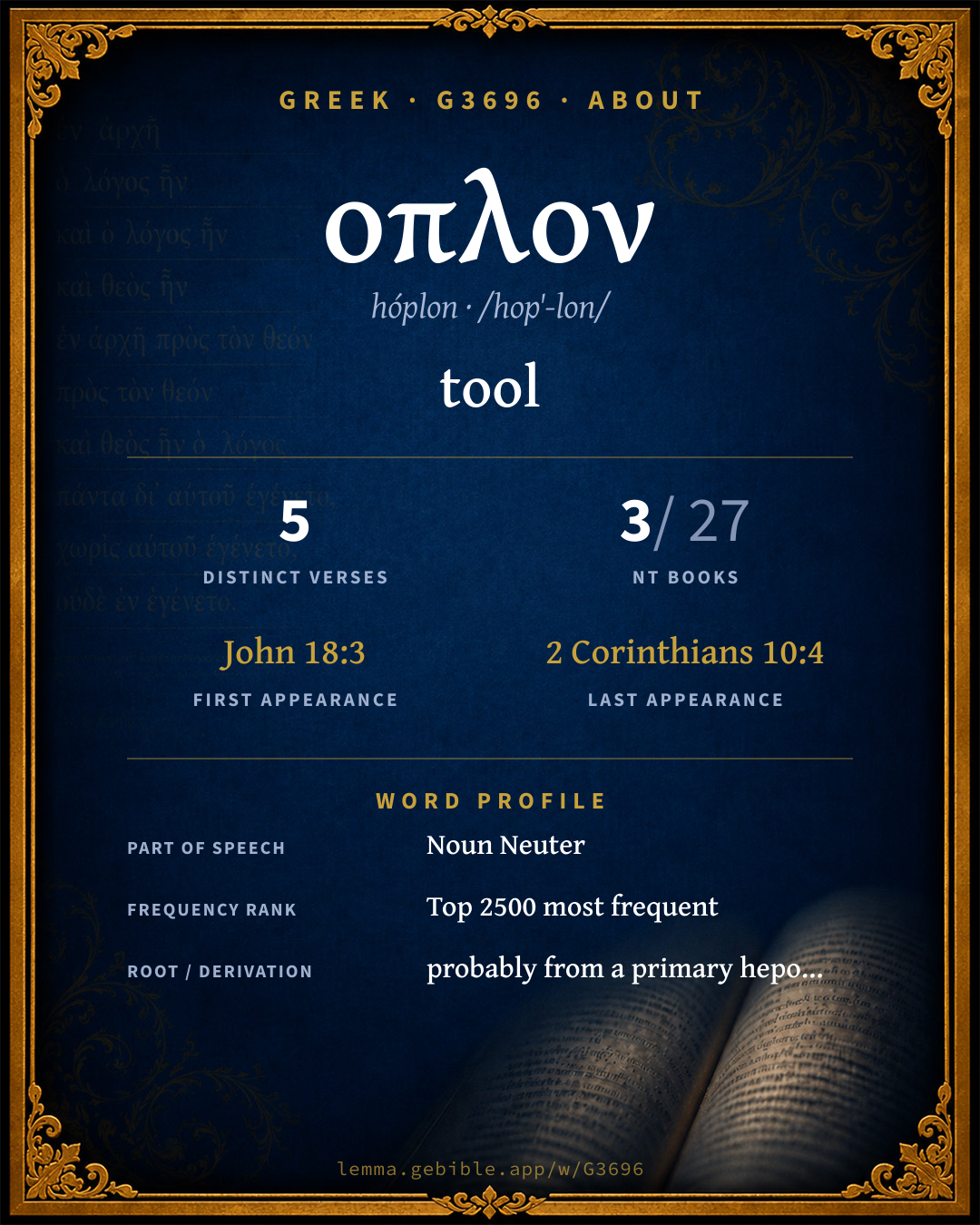
ὅπλον
tool
‘tool’ is one of 2 main senses fuller range ↓
Full lexicon entry — Thayer's Greek Lexicon
From Thayer's Greek Lexicon
Where this word appears
See every Accusative-case word in the Greek New Testament →
Grammar key — what these labels mean
Part of speech
- Noun
- A naming word — a person, place, thing, or idea.
Case
- Accusative
- The case of the direct object and of extent.
- Genitive
- The case of source, possession, or “of” — answers “whose / from what.”
- Nominative
- The case of the subject (and the predicate nominative).
Gender
- Neuter
- Grammatically neuter.
Number
- Plural
- More than one.
2 distinct verses where G3696 appears in the Genitive case, across 2 books. Filtered view — show all forms. Click any verse to open its interlinear word-by-word view. Verse text shown in the World English Bible for context — . Each verse’s Greek form is shown with its reference; the English is not keyword-highlighted, since the data carries no word-level English alignment. Use “Compare translations” on any verse to read it across multiple English versions. This concordance covers the Greek New Testament; Septuagint (Greek Old Testament) occurrences of this word are not indexed here.
John 1 verse
2 Corinthians 1 verse
About this entry
At a glance — auto-summarized from this page’s data, not written by a person. Every figure links to its source below. This summary describes the numbers; it doesn’t interpret them.
At its core, οπλον (hóplon) means “tool.” A scarce word — 5 verses in all of the Greek New Testament. The word gravitates to Romans (40%), then 2 Corinthians and John. Scripture first uses it in John 18:3. Ranging over 2 senses, it is not a single-sense word. Each statement above links to its evidence; the full detail follows below.
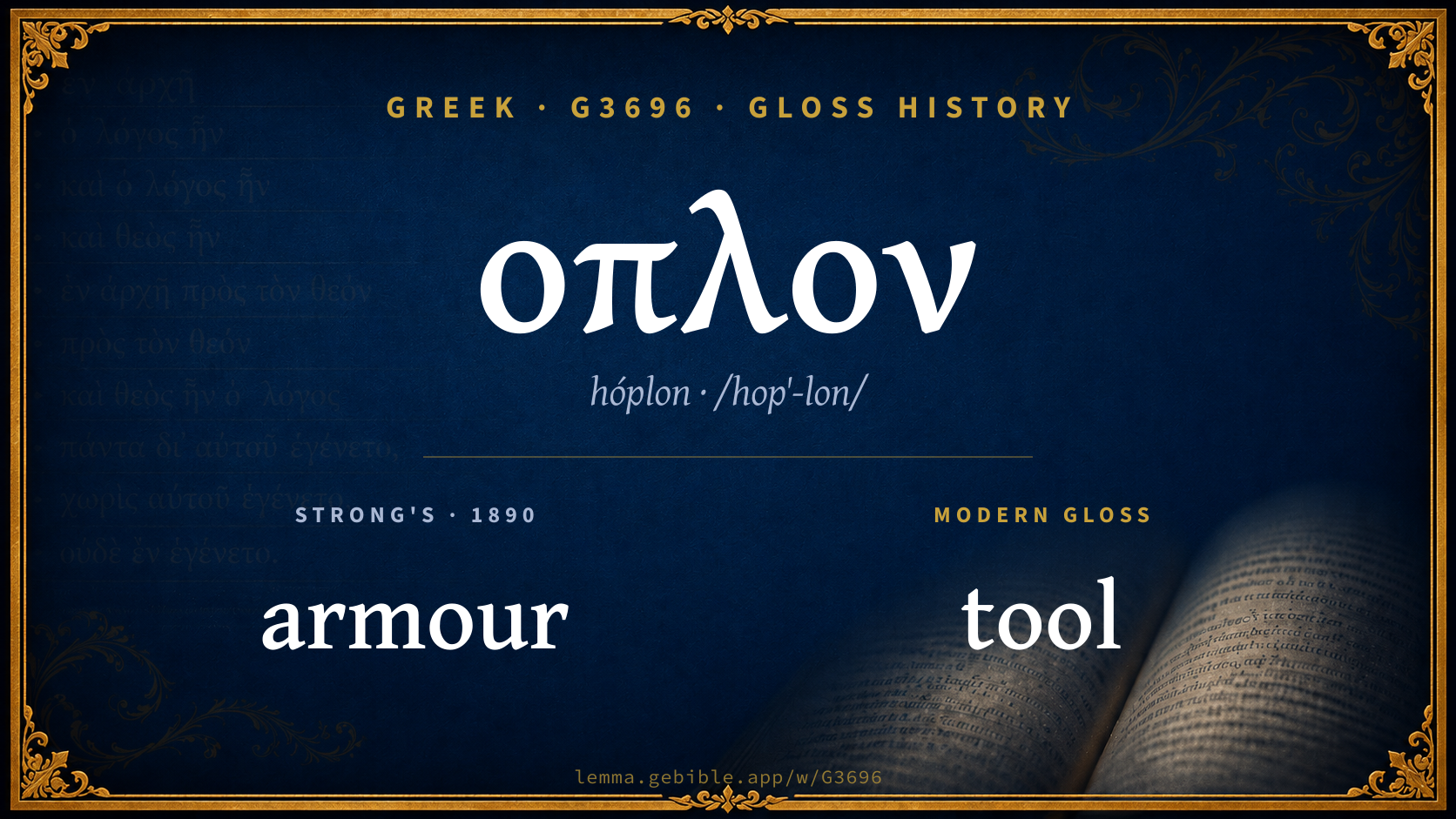
Gloss history
Strong's 1890 vs modern scholarship
About this word
Strong's G3696 catalogs a Greek word from the Greek New Testament.
These counts are not copied from any lexicon or concordance. They are computed here, from the morphology-tagged Greek New Testament. What Lemma adds →
- 5
- distinct verses
- The word appears in 5 distinct verses.
- 3 / 27
- NT books
- The word appears in 3 of 27 New Testament books.
- #1,476
- by frequency
- Top 2500 most frequent Greek words (rank 1,476 of 5,347 Greek words by occurrence).
View all 5 occurrences in the concordance →
Most concentrated in
- Romans 2 verses 40%
- 2 Corinthians 2 verses 40%
- John 1 verse 20%
By section of the New Testament
By traditional corpus
Conventional, traditional groupings — biblical authorship is debated, so this is a traditional corpus grouping, not an authorship claim. Some books belong to more than one corpus (Luke is in both the Gospels and the Lukan corpus, and so on), so these shares overlap and need not total 100%. Each figure is a share of the word’s 5 distinct verses.
- Pauline corpus 4 verses · 80%
- Gospels 1 verse · 20%
- Johannine 1 verse · 20%
How translations render this word
Counts come from each version’s own published word-to-Strong’s tagging or interlinear alignment — an approximate guide to how each version renders this word, not a word-level alignment the data otherwise carries. Because each total is that version’s own tagged count, the per-version totals vary from one another and need not match the appearance or distinct-verse counts above. These counts may also differ from a printed concordance because Lemma counts each distinctly tagged rendering and does not collapse phrase taggings into a single head-word total. This is a fixed set of word-tagged versions (KJV, ASV, BSB, ULT) and does not change with the reading translation you choose elsewhere. Each version’s license is shown beside its name below (and on Sources).
- King James Version: Armour 2×, Instruments 2×, Weapons 2×
- American Standard Version: Armor 2×, Instruments 2×, Weapons 2×
- Berean Standard Bible: Weapons 3×, Instruments 2×
- unfoldingWord Literal Text: Weapons 4×, Tools 2×
King James Version Public Domain
Renders G3696 across 6 tagged occurrences — most commonly:
American Standard Version Public Domain
Renders G3696 across 6 tagged occurrences — most commonly:
Berean Standard Bible Public Domain
Renders G3696 across 6 tagged occurrences — most commonly:
Plus 1 rendering that appears only once — usually multi-word phrases or single function words the recovered tagging swept in, not distinct renderings.
unfoldingWord Literal Text CC BY-SA 4.0
Renders G3696 across 6 tagged occurrences — most commonly:
Senses in Thayer's
The 2 senses Thayer's distinguishes for this word, in lexicon order (not ranked by frequency or importance). The full entry — with sub-senses — is in the Lexicon Entry tab.
- any tool or implement for preparing a thing
- an instrument
Word origin
Origin: probably from a primary hepo (to be busy about)
Probably from the primary word ἕπω hepō (to be busy about); an implement or utensil or tool (literally or figuratively especially offensive for war): - armour instrument weapon.
— Strong’s Exhaustive Concordance (1890), public domain.
Forms in the corpus
The 2 distinct written forms G3696 takes in the Greek New Testament, most frequent first — each parse links to that case’s occurrences in the concordance.
| Form | Parsing | Example | Uses |
|---|---|---|---|
| ὅπλα hópla | Noun, Accusative, Plural, Neuter | Romans 6:13 | 4 |
| ὅπλων hóplōn | Noun, Genitive, Plural, Neuter | John 18:3 | 2 |
Same root — word family
Other Thayer's entries built from the same root as G3696, grouped by Strong’s listed origin. These share a root / origin per the lexicon — not necessarily a shared meaning. Each links to that word’s own entry.
Derived from this word
Compare all same-root words → They share a root, not necessarily a meaning.
Septuagint usage
The same Greek word οπλον appears 33 times in the Greek Old Testament (Septuagint), across 32 verses in 13 books.
- 33
- LXX occurrences
- Tagged occurrences of this Greek word in the Septuagint.
- 32
- verses
- Distinct Septuagint verses containing this word.
- 13 / 39
- OT books
- The word appears in 13 of the 39 Old Testament books.
Sample Septuagint occurrences
- 1 Samuel 17:7 ὅπλον
- 1 Kings 10:17 ὅπλον
- 2 Kings 10:2 ὅπλον
- 2 Chronicles 21:3 ὅπλον
- Ezra 14:11 ὅπλον
- Psalms 5:13 ὅπλον
- Proverbs 14:7 ὅπλον
- Jeremiah 21:4 ὅπλον
- Ezekiel 26:8 ὅπλον
- Joel 2:8 ὅπλον
- Amos 4:2 ὅπλον
- Nahum 2:4 ὅπλον
Septuagint occurrences (same lexeme)
Every verse where the same Strong’s number (G3696) appears in the Greek Septuagint. Verse text shown in the World English Bible for context; the Greek form is the matched word — the English is not keyword-highlighted.
- 1 Samuel 17:7 ὅπλον The staff of his spear was like a weaver's beam; and his spear's head [weighed] six hundred shekels of iron: and his shield-bearer went before him.
- 1 Kings 10:17 ὅπλον [he made] three hundred shields of beaten gold; three minas of gold went to one shield: and the king put them in the house of the forest of Lebanon.
- 1 Kings 14:6 ὅπλον It was so, when Ahijah heard the sound of her feet, as she came in at the door, that he said, Come in, you wife of Jeroboam; why feign you yourself to be another? for I am sent to you with heavy news.
- 1 Kings 14:7 ὅπλον Go, tell Jeroboam, Thus says Yahweh, the God of Israel: Because I exalted you from among the people, and made you prince over my people Israel,
- 2 Kings 10:2 ὅπλον Now as soon as this letter comes to you, seeing your master's sons are with you, and there are with you chariots and horses, a fortified city also, and armor;
- 2 Chronicles 21:3 ὅπλον Their father gave them great gifts, of silver, and of gold, and of precious things, with fortified cities in Judah: but the kingdom gave he to Jehoram, because he was the firstborn.
- 2 Chronicles 23:9 ὅπλον Jehoiada the priest delivered to the captains of hundreds the spears, and bucklers, and shields, that had been king David's, which were in the house of God.
- 2 Chronicles 23:10 ὅπλον He set all the people, every man with his weapon in his hand, from the right side of the house to the left side of the house, along by the altar and the house, by the king round about.
- 2 Chronicles 32:5 ὅπλον He took courage, and built up all the wall that was broken down, and raised [it] up to the towers, and the other wall outside, and strengthened Millo [in] the city of David, and made weapons and shields in abundance.
- Ezra 14:11 ὅπλον
- Psalms 5:13 ὅπλον
- Psalms 34:2 ὅπλον My soul shall boast in Yahweh. The humble shall hear of it, and be glad.
- Psalms 45:10 ὅπλον Listen, daughter, consider, and turn your ear. Forget your own people, and also your father's house.
- Psalms 56:5 ὅπλον All day long they twist my words. All their thoughts are against me for evil.
- Psalms 75:4 ὅπλον I said to the arrogant, "Don't boast;" To the wicked, "Don't lift up the horn.
- Psalms 90:4 ὅπλον For a thousand years in your sight Are but as yesterday when it is past, As a watch in the night.
- Proverbs 14:7 ὅπλον Stay away from a foolish man, For you won't find knowledge on his lips.
- Jeremiah 21:4 ὅπλον Thus says Yahweh, the God of Israel, Behold, I will turn back the weapons of war that are in your hands, with which you fight against the king of Babylon, and against the Chaldeans who besiege you, without the walls; and I will gather them into the midst of this city.
- Jeremiah 26:3 ὅπλον It may be they will listen, and turn every man from his evil way; that I may repent me of the evil which I purpose to do to them because of the evil of their doings.
- Jeremiah 26:9 ὅπλον Why have you prophesied in the name of Yahweh, saying, This house shall be like Shiloh, and this city shall be desolate, without inhabitant? All the people were gathered to Jeremiah in the house of Yahweh.
- Jeremiah 28:3 ὅπλον Within two full years will I bring again into this place all the vessels of Yahweh's house, that Nebuchadnezzar king of Babylon took away from this place, and carried to Babylon:
- Jeremiah 28:12 ὅπλον Then the word of Yahweh came to Jeremiah, after that Hananiah the prophet had broken the bar from off the neck of the prophet Jeremiah, saying,
- Jeremiah 50:10 ὅπλον Chaldea shall be a prey: all who prey on her shall be satisfied, says Yahweh.
- Ezekiel 26:8 ὅπλον He shall kill with the sword your daughters in the field; and he shall make forts against you, and cast up a mound against you, and raise up the buckler against you.
- Ezekiel 32:27 ὅπλον They shall not lie with the mighty who are fallen of the uncircumcised, who are gone down to Sheol with their weapons of war, and have laid their swords under their heads, and their iniquities are on their bones; for [they were] the terror of the mighty in the land of the living.
- Ezekiel 39:9 ὅπλον Those who dwell in the cities of Israel shall go forth, and shall make fires of the weapons and burn them, both the shields and the bucklers, the bows and the arrows, and the war clubs, and the spears, and they shall make fires of them seven years;
- Ezekiel 39:10 ὅπλον so that they shall take no wood out of the field, neither cut down any out of the forests; for they shall make fires of the weapons; and they shall plunder those who plundered them, and rob those who robbed them, says the Lord Yahweh.
- Joel 2:8 ὅπλον Neither does one jostle another; They march everyone in his path, And they burst through the defenses, And don't break ranks.
- Amos 4:2 ὅπλον The Lord Yahweh has sworn by his holiness that behold, "The days shall come on you that they will take you away with hooks, And the last of you with fish hooks.
- Nahum 2:4 ὅπλον The chariots rage in the streets. They rush back and forth in the broad ways. Their appearance is like torches. They run like the lightnings.
- Nahum 3:3 ὅπλον the horseman mounting, and the flashing sword, the glittering spear, and a multitude of slain, and a great heap of corpses, and there is no end of the bodies. They stumble on their bodies,
- Habakkuk 3:11 ὅπλον The sun and moon stood still in the sky, At the light of your arrows as they went, At the shining of your glittering spear.
These are occurrences of the same Greek lexeme (G3696) in the Septuagint — not a translation of any one Hebrew word. The store carries no word-level Hebrew↔Greek alignment, so no Hebrew original is asserted here. Counts come from the recovered LXX Strong's tagging — high-frequency vocabulary is well covered, while rare or late forms may be untagged — so they reflect tagged occurrences and may slightly undercount.