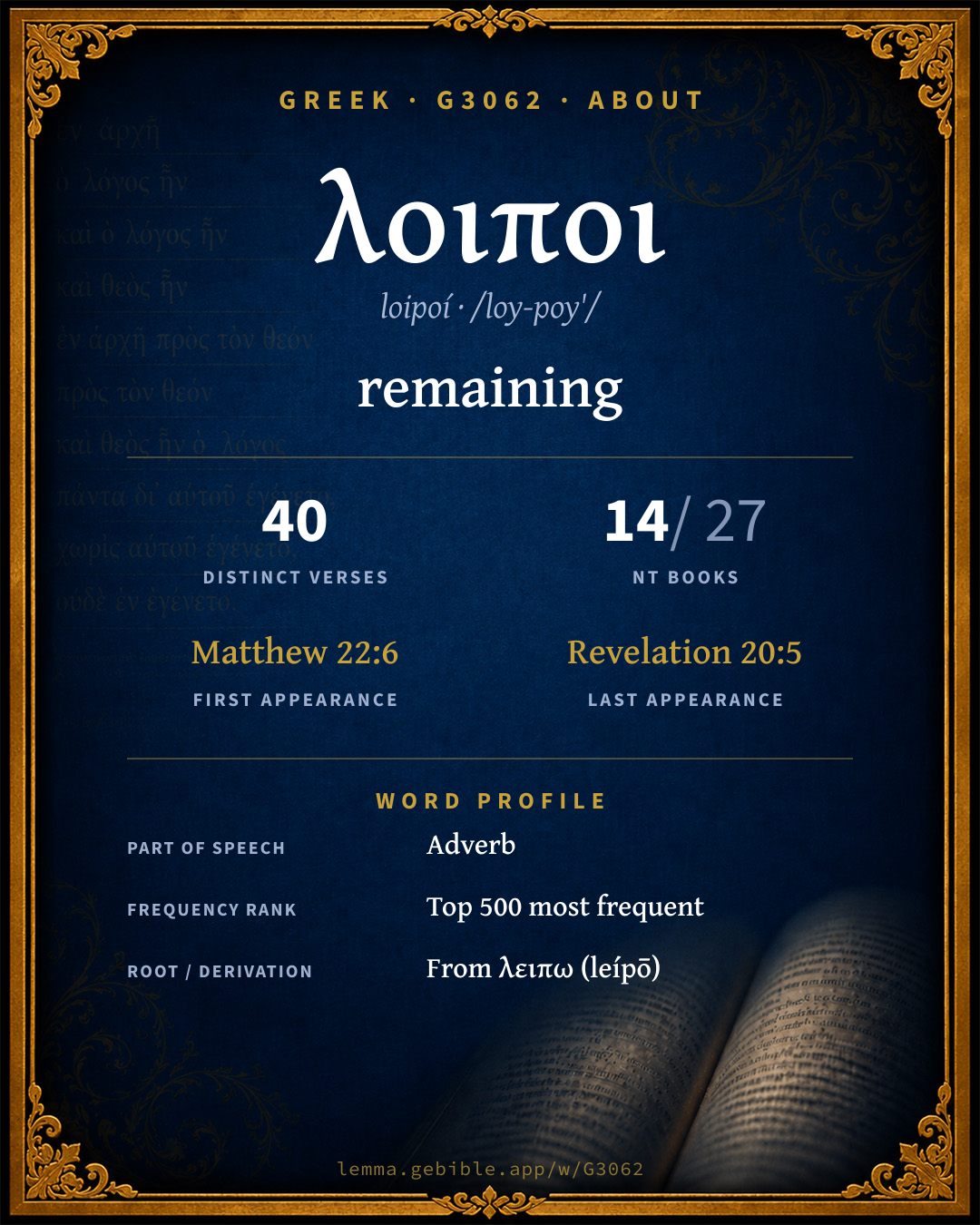
λοιποί
remaining
Full lexicon entry — Thayer's Greek Lexicon
From Thayer's Greek Lexicon
Where this word appears
See every Nominative-case word in the Greek New Testament →
Grammar key — what these labels mean
Part of speech
- Adjective
- A word that describes or qualifies a noun.
Case
- Nominative
- The case of the subject (and the predicate nominative).
- Dative
- The case of the indirect object, means, or location — “to / for / with / in.”
- Genitive
- The case of source, possession, or “of” — answers “whose / from what.”
- Accusative
- The case of the direct object and of extent.
Gender
- Masculine
- Grammatically masculine.
- Neuter
- Grammatically neuter.
- Feminine
- Grammatically feminine.
Number
- Plural
- More than one.
Grammatical forms 9 distinct
- Adjective, Nominative, Plural, Masculine 15 times (38%)
- Adjective, Dative, Plural, Masculine 7 times (18%)
- Adjective, Genitive, Plural, Masculine 6 times (15%)
- Adjective, Accusative, Plural, Masculine 3 times (8%)
- Adjective, Accusative, Plural, Neuter 3 times (8%)
- Adjective, Accusative, Plural, Feminine 2 times (5%)
- Adjective, Nominative, Plural, Feminine 2 times (5%)
- Adjective, Dative, Plural, Neuter 1 time (3%)
+1 more form (1 occurrence)
Parsed forms decoded from the imported morphology (Robinson–Tischendorf, public domain), counted across 40 parsed occurrences — not distinct verses.
Every verse where G3062 appears — 40 distinct verses across 14 books. Click any verse to open its interlinear word-by-word view. Verse text shown in the World English Bible for context — . Each verse’s Greek form is shown with its reference; the English is not keyword-highlighted, since the data carries no word-level English alignment. Use “Compare translations” on any verse to read it across multiple English versions. This concordance covers the Greek New Testament; Septuagint (Greek Old Testament) occurrences of this word are not indexed here.
Matthew 3 verses
- Matthew 22:6 λοιποὶ adj nom pl masc and the rest grabbed his servants, and treated them shamefully, and killed them.
- Matthew 25:11 λοιπαὶ adj nom pl fem Afterward the other virgins also came, saying, 'Lord, Lord, open to us.'
- Matthew 27:49 λοιποὶ adj nom pl masc The rest said, "Let him be. Let's see whether Elijah comes to save him."
Mark 2 verses
Luke 6 verses
- Luke 8:10 λοιποῖς adj dat pl masc He said, "To you it is given to know the mysteries of the Kingdom of God, but to the rest in parables; that 'seeing they may not see, and hearing they may not understand.'
- Luke 12:26 λοιπῶν adj gen pl neut If then you aren't able to do even the least things, why are you anxious about the rest?
- Luke 18:9 λοιποὺς adj acc pl masc He spoke also this parable to certain people who were convinced of their own righteousness, and who despised all others.
- Luke 18:11 λοιποὶ adj nom pl masc The Pharisee stood and prayed to himself like this: 'God, I thank you, that I am not like the rest of men, extortioners, unrighteous, adulterers, or even like this tax collector.
- Luke 24:9 λοιποῖς adj dat pl masc returned from the tomb, and told all these things to the eleven, and to all the rest.
- Luke 24:10 λοιπαὶ adj nom pl fem Now they were Mary Magdalene, Joanna, and Mary the mother of James. The other women with them told these things to the apostles.
Acts 5 verses
- Acts 2:37 λοιποὺς adj acc pl masc Now when they heard this, they were cut to the heart, and said to Peter and the rest of the apostles, "Brothers, what shall we do?"
- Acts 5:13 λοιπῶν adj gen pl masc None of the rest dared to join them, however the people honored them.
- Acts 17:9 λοιπῶν adj gen pl masc When they had taken security from Jason and the rest, they let them go.
- Acts 27:44 λοιποὺς adj acc pl masc and the rest should follow, some on planks, and some on other things from the ship. So it happened that they all escaped safely to the land.
- Acts 28:9 λοιποὶ adj nom pl masc Then when this was done, the rest also who had diseases in the island came, and were cured.
Romans 2 verses
- Romans 1:13 λοιποῖς adj dat pl neut Now I don't desire to have you unaware, brothers, that I often planned to come to you, and was hindered so far, that I might have some fruit among you also, even as among the rest of the Gentiles.
- Romans 11:7 λοιποὶ adj nom pl masc What then? That which Israel seeks for, that he didn't obtain, but the chosen ones obtained it, and the rest were hardened.
1 Corinthians 4 verses
- 1 Corinthians 7:12 λοιποῖς adj dat pl masc But to the rest I--not the Lord--say, if any brother has an unbelieving wife, and she is content to live with him, let him not leave her.
- 1 Corinthians 9:5 λοιποὶ adj nom pl masc Have we no right to take along a wife who is a believer, even as the rest of the apostles, and the brothers of the Lord, and Cephas?
- 1 Corinthians 11:34 λοιπὰ adj acc pl neut But if anyone is hungry, let him eat at home, lest your coming together be for judgment. The rest I will set in order whenever I come.
- 1 Corinthians 15:37 λοιπῶν adj gen pl masc That which you sow, you don't sow the body that will be, but a bare grain, maybe of wheat, or of some other kind.
2 Corinthians 2 verses
- 2 Corinthians 12:13 λοιπὰς adj acc pl fem For what is there in which you were made inferior to the rest of the assemblies, unless it is that I myself was not a burden to you? Forgive me this wrong.
- 2 Corinthians 13:2 λοιποῖς adj dat pl masc I have said beforehand, and I do say beforehand, as when I was present the second time, so now, being absent, I write to those who have sinned before now, and to all the rest, that, if I come again, I will not spare;
Galatians 1 verse
Ephesians 1 verse
Philippians 2 verses
- Philippians 1:13 λοιποῖς adj dat pl masc so that it became evident to the whole praetorian guard, and to all the rest, that my bonds are in Christ;
- Philippians 4:3 λοιπῶν adj gen pl masc Yes, I beg you also, true yoke-fellow, help these women, for they labored with me in the Gospel, with Clement also, and the rest of my fellow workers, whose names are in the book of life.
1 Thessalonians 2 verses
- 1 Thessalonians 4:13 λοιποὶ adj nom pl masc But we don't want you to be ignorant, brothers, concerning those who have fallen asleep, so that you don't grieve like the rest, who have no hope.
- 1 Thessalonians 5:6 λοιποί adj nom pl masc so then let's not sleep, as the rest do, but let's watch and be sober.
1 Timothy 1 verse
2 Peter 1 verse
Revelation 8 verses
- Revelation 2:24 λοιποῖς adj dat pl masc But to you I say, to the rest who are in Thyatira, as many as don't have this teaching, who don't know what some call 'the deep things of Satan,' to you I say, I am not putting any other burden on you.
- Revelation 3:2 λοιπὰ adj acc pl neut Wake up, and keep the things that remain, which you were about to throw away, for I have found no works of yours perfected before my God.
- Revelation 8:13 λοιπῶν adj gen pl masc I saw, and I heard an eagle, flying in mid heaven, saying with a loud voice, "Woe! Woe! Woe for those who dwell on the earth, because of the other voices of the trumpets of the three angels, who are yet to sound!"
- Revelation 9:20 λοιποὶ adj nom pl masc The rest of mankind, who were not killed with these plagues, didn't repent of the works of their hands, that they wouldn't worship demons, and the idols of gold, and of silver, and of brass, and of stone, and of wood; which can neither see, nor hear, nor walk.
- Revelation 11:13 λοιποὶ adj nom pl masc In that day there was a great earthquake, and a tenth of the city fell. Seven thousand people were killed in the earthquake, and the rest were terrified, and gave glory to the God of heaven.
- Revelation 12:17 λοιπῶν adj gen pl masc The dragon grew angry with the woman, and went away to make war with the rest of her seed, who keep God's commandments and hold Jesus' testimony.
- Revelation 19:21 λοιποὶ adj nom pl masc The rest were killed with the sword of him who sat on the horse, the sword which came forth out of his mouth. All the birds were filled with their flesh.
- Revelation 20:5 λοιποὶ adj nom pl masc The rest of the dead didn't live until the thousand years were finished. This is the first resurrection.
About this entry
At a glance — auto-summarized from this page’s data, not written by a person. Every figure links to its source below. This summary describes the numbers; it doesn’t interpret them.
The Greek verb λοιποι centers on the idea of “remaining.” Its earliest occurrence is Matthew 22:6. It turns up in 40 verses across 14 books, a moderately common footprint. It shares a root with λειπω, λειμμα and λιμος. Dig into 40-verse concordance and the renderings breakdown below.
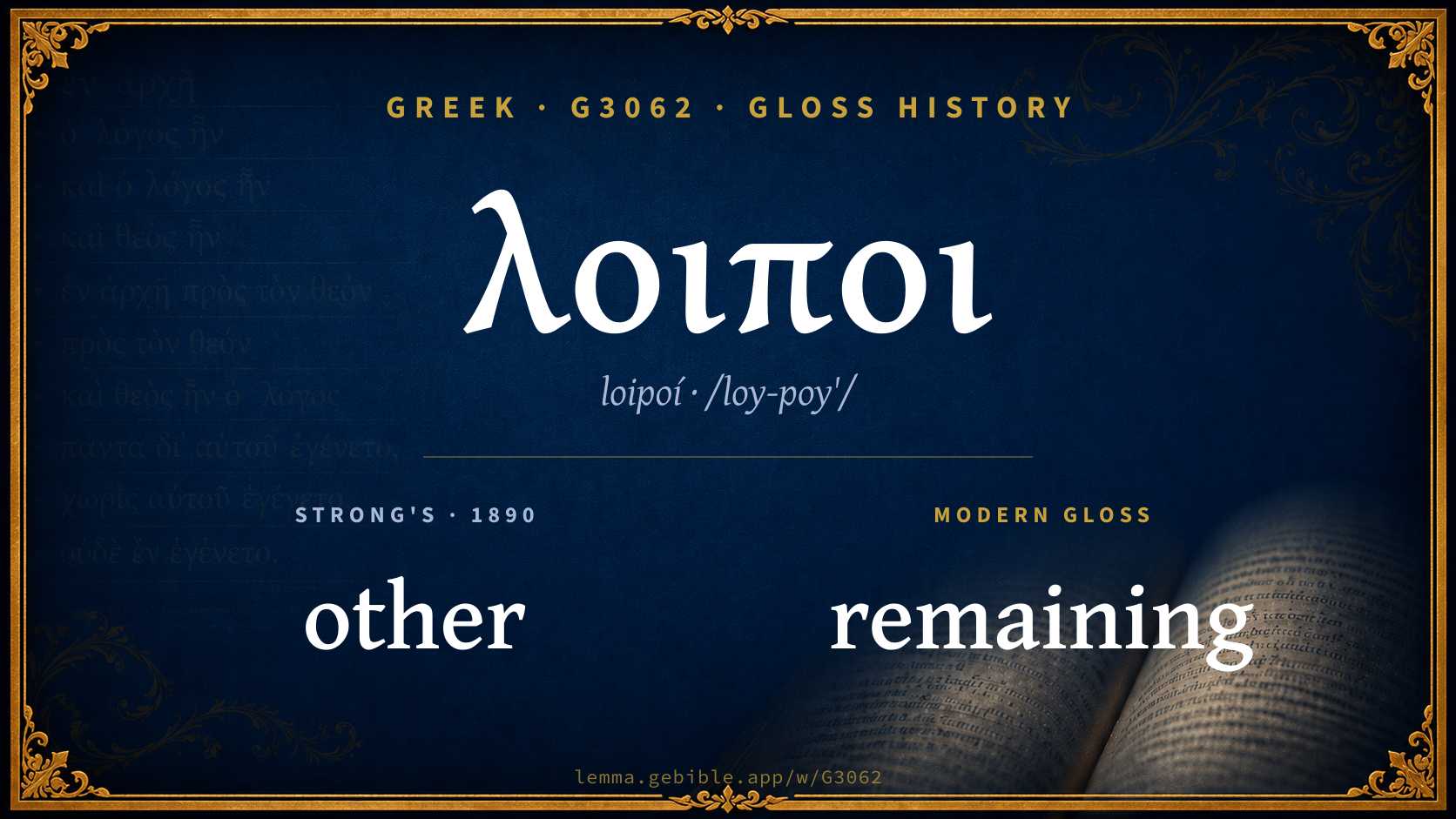
Gloss history
Strong's 1890 vs modern scholarship
About this word
Strong's G3062 catalogs a Greek word from the Greek New Testament.
These counts are not copied from any lexicon or concordance. They are computed here, from the morphology-tagged Greek New Testament. What Lemma adds →
- 40
- distinct verses
- The word appears in 40 distinct verses.
- 14 / 27
- NT books
- The word appears in 14 of 27 New Testament books.
- #380
- by frequency
- Top 500 most frequent Greek words (rank 380 of 5,347 Greek words by occurrence).
View all 40 occurrences in the concordance →
Most concentrated in
- Revelation 8 verses 20%
- Luke 6 verses 15%
- Acts 5 verses 13%
By section of the New Testament
By traditional corpus
Conventional, traditional groupings — biblical authorship is debated, so this is a traditional corpus grouping, not an authorship claim. Some books belong to more than one corpus (Luke is in both the Gospels and the Lukan corpus, and so on), so these shares overlap and need not total 100%. Each figure is a share of the word’s 40 distinct verses.
- Pauline corpus 15 verses · 38%
- Gospels 11 verses · 28%
- Lukan (Luke–Acts) 11 verses · 28%
- Johannine 8 verses · 20%
- Revelation 8 verses · 20%
- General (Catholic) Epistles 1 verse · 3%
How translations render this word
Counts come from each version’s own published word-to-Strong’s tagging or interlinear alignment — an approximate guide to how each version renders this word, not a word-level alignment the data otherwise carries. Because each total is that version’s own tagged count, the per-version totals vary from one another and need not match the appearance or distinct-verse counts above. These counts may also differ from a printed concordance because Lemma counts each distinctly tagged rendering and does not collapse phrase taggings into a single head-word total. This is a fixed set of word-tagged versions (KJV, ASV, BSB, ULT) and does not change with the reading translation you choose elsewhere. Each version’s license is shown beside its name below (and on Sources).
- King James Version: Other 15×, Rest 12×, Others 6×
- American Standard Version: Rest 31×, Other 4×
- Berean Standard Bible: Rest 15×, Other 7×, Others 7×
- unfoldingWord Literal Text: Rest 29×, Others 4×, Other 3×
King James Version Public Domain
Renders G3062 across 41 tagged occurrences — most commonly:
Plus 4 renderings that appear only once — usually multi-word phrases or single function words the recovered tagging swept in, not distinct renderings.
American Standard Version Public Domain
Renders G3062 across 42 tagged occurrences — most commonly:
Plus 7 renderings that appear only once — usually multi-word phrases or single function words the recovered tagging swept in, not distinct renderings.
Berean Standard Bible Public Domain
Renders G3062 across 40 tagged occurrences — most commonly:
Plus 7 renderings that appear only once — usually multi-word phrases or single function words the recovered tagging swept in, not distinct renderings.
unfoldingWord Literal Text CC BY-SA 4.0
Renders G3062 across 55 tagged occurrences — most commonly:
Plus 8 renderings that appear only once — usually multi-word phrases or single function words the recovered tagging swept in, not distinct renderings.
Senses in Thayer's
The 1 sense Thayer's distinguishes for this word, in lexicon order (not ranked by frequency or importance). The full entry — with sub-senses — is in the Lexicon Entry tab.
- remaining, the rest
Word origin
Derived from λειπω (leípō) (G3007) — to leave.
Masculine plural of a derivative of G3007 ; remaining ones : - other which remain remnant residue rest.
— Strong’s Exhaustive Concordance (1890), public domain.
Forms in the corpus
The 8 distinct written forms G3062 takes in the Greek New Testament, most frequent first — each parse links to that case’s occurrences in the concordance.
| Form | Parsing | Example | Uses |
|---|---|---|---|
| λοιποὶ loipoì | Adjective, Nominative, Plural, Masculine | Matthew 22:6 | 13 |
| λοιποῖς loipoîs | Adjective, Dative, Plural, Masculine | Mark 16:13 | 8 |
| λοιπῶν loipō̂n | Adjective, Genitive, Plural, Masculine | Acts 5:13 | 7 |
| λοιποὺς loipoùs | Adjective, Accusative, Plural, Masculine | Luke 18:9 | 3 |
| λοιπὰ loipà | Adjective, Accusative, Plural, Neuter | Mark 4:19 | 3 |
| λοιπαὶ loipaì | Adjective, Nominative, Plural, Feminine | Matthew 25:11 | 2 |
| λοιποί loipoí | Adjective, Nominative, Plural, Masculine | Ephesians 2:3 | 2 |
| λοιπὰς loipàs | Adjective, Accusative, Plural, Feminine | 2 Corinthians 12:13 | 2 |
Same root — word family
Other Thayer's entries built from the same root as G3062, grouped by Strong’s listed origin. These share a root / origin per the lexicon — not necessarily a shared meaning. Each links to that word’s own entry.
Derives from
Shares the same root
Derived from this word
Compare all same-root words → Showing 4 of 6 — not the complete family. They share a root, not necessarily a meaning.