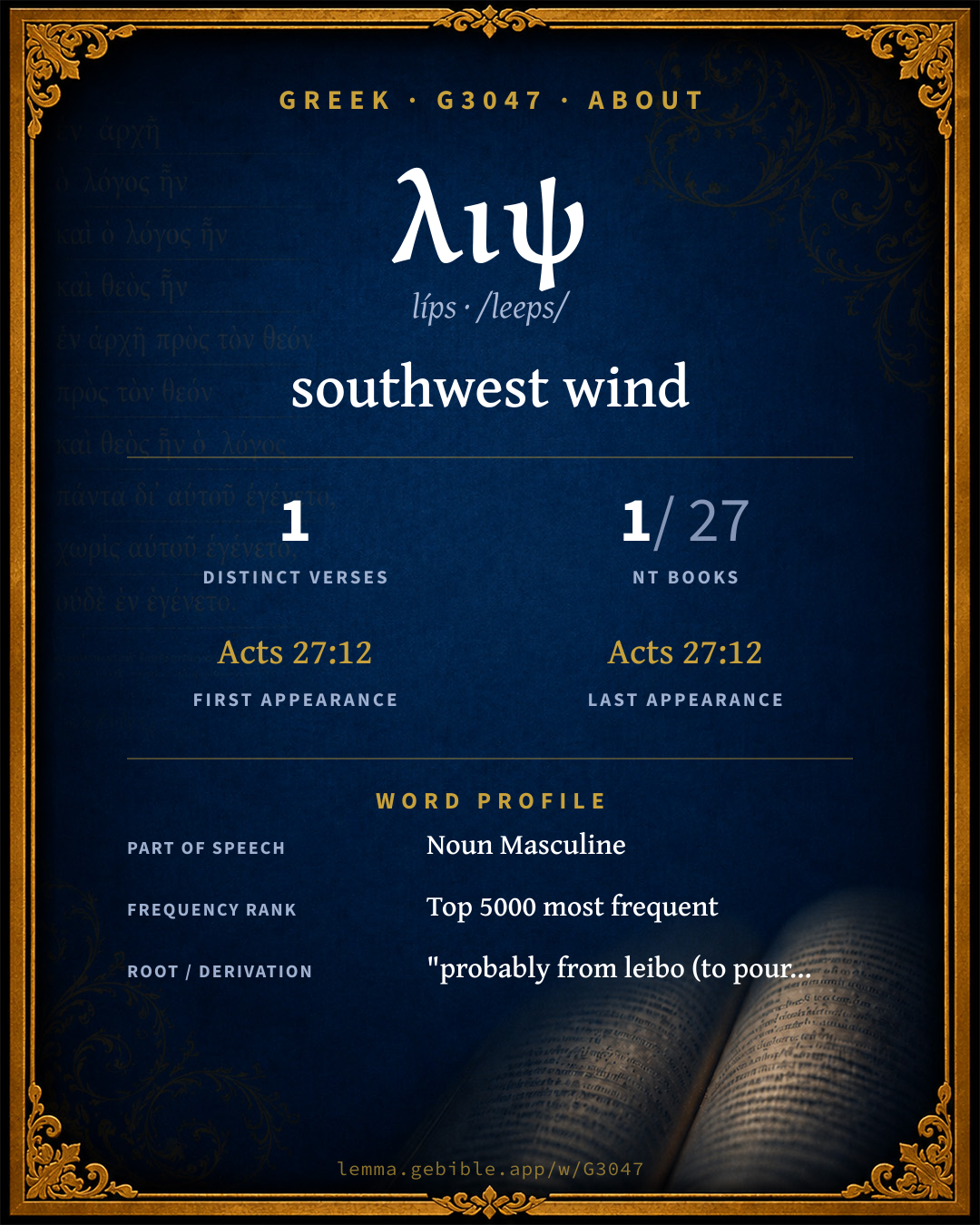
λίψ
southwest wind
‘southwest wind’ is one of 2 main senses fuller range ↓
Full lexicon entry — Thayer's Greek Lexicon
From Thayer's Greek Lexicon
Where this word appears
Grammar key — what these labels mean
Part of speech
- Noun
- A naming word — a person, place, thing, or idea.
Case
- Accusative
- The case of the direct object and of extent.
Gender
- Masculine
- Grammatically masculine.
Number
- Singular
- One.
Every verse where G3047 appears — 1 distinct verse across 1 book. Click any verse to open its interlinear word-by-word view. Verse text shown in the World English Bible for context — . Each verse’s Greek form is shown with its reference; the English is not keyword-highlighted, since the data carries no word-level English alignment. Use “Compare translations” on any verse to read it across multiple English versions. This concordance covers the Greek New Testament; Septuagint (Greek Old Testament) occurrences of this word are not indexed here.
Acts 1 verse
About this entry
At a glance — auto-summarized from this page’s data, not written by a person. Every figure links to its source below. This summary describes the numbers; it doesn’t interpret them.
At its core, λιψ (líps) means “southwest wind.” It is rare — just 1 verse in the entire Greek New Testament. The word gravitates to Acts (100%). Its lone occurrence is Acts 27:12. Catalogued under 2 senses, its meaning is not single-sense. Each statement above links to its evidence; the full detail follows below.
Gloss history
Strong's 1890 vs modern scholarship
About this word
Strong's G3047 catalogs a Greek word from the Greek New Testament.
These counts are not copied from any lexicon or concordance. They are computed here, from the morphology-tagged Greek New Testament. What Lemma adds →
- 1
- distinct verses
- The word appears in 1 distinct verse.
- 1 / 27
- NT books
- The word appears in 1 of 27 New Testament books.
- #3,503
- by frequency
- Top 5000 most frequent Greek words (rank 3,503 of 5,347 Greek words by occurrence).
View all 1 occurrence in the concordance →
Most concentrated in
- Acts 1 verse 100%
By section of the New Testament
By traditional corpus
Conventional, traditional groupings — biblical authorship is debated, so this is a traditional corpus grouping, not an authorship claim. Some books belong to more than one corpus (Luke is in both the Gospels and the Lukan corpus, and so on), so these shares overlap and need not total 100%. Each figure is a share of the word’s 1 distinct verse.
- Lukan (Luke–Acts) 1 verse · 100%
How translations render this word
Counts come from each version’s own published word-to-Strong’s tagging or interlinear alignment — an approximate guide to how each version renders this word, not a word-level alignment the data otherwise carries. Because each total is that version’s own tagged count, the per-version totals vary from one another and need not match the appearance or distinct-verse counts above. These counts may also differ from a printed concordance because Lemma counts each distinctly tagged rendering and does not collapse phrase taggings into a single head-word total. This is a fixed set of word-tagged versions (KJV, ASV, BSB, ULT) and does not change with the reading translation you choose elsewhere. Each version’s license is shown beside its name below (and on Sources).
- King James Version: South west 1×
- American Standard Version: Looking north-east 1×
- Berean Standard Bible: Southwest 1×
- unfoldingWord Literal Text: Southwest wind 1×
King James Version Public Domain
Renders G3047 across 1 tagged occurrence — most commonly:
American Standard Version Public Domain
Renders G3047 across 1 tagged occurrence — most commonly:
Berean Standard Bible Public Domain
Renders G3047 across 1 tagged occurrence — most commonly:
unfoldingWord Literal Text CC BY-SA 4.0
Renders G3047 across 1 tagged occurrence — most commonly:
Senses in Thayer's
The 2 senses Thayer's distinguishes for this word, in lexicon order (not ranked by frequency or importance). The full entry — with sub-senses — is in the Lexicon Entry tab.
- the south west wind
- the quarter of the heavens whence the south west wind blows
Word origin
Origin: "probably from leibo (to pour a "libation")"
Probably from λείβω leibō (to pour a libation); the south (southwest) wind (as bringing rain) that is (by extension) the south quarter : - southwest.
— Strong’s Exhaustive Concordance (1890), public domain.
Same root — word family
Other Thayer's entries built from the same root as G3047, grouped by Strong’s listed origin. These share a root / origin per the lexicon — not necessarily a shared meaning. Each links to that word’s own entry.
Proper names from this root
People and places named from this root — a name, not an additional meaning of the word.
Compare all same-root words → 1 of the same-root words is a proper name (a person or place). They share a root, not necessarily a meaning.
Septuagint usage
The same Greek word λιψ appears 45 times in the Greek Old Testament (Septuagint), across 38 verses in 9 books.
- 45
- LXX occurrences
- Tagged occurrences of this Greek word in the Septuagint.
- 38
- verses
- Distinct Septuagint verses containing this word.
- 9 / 39
- OT books
- The word appears in 9 of the 39 Old Testament books.
Sample Septuagint occurrences
- Genesis 13:14 λίψ
- Exodus 27:9 λίψ
- Numbers 2:10 λίψ
- Deuteronomy 1:7 λίψ
- Joshua 15:1 λίψ
- 2 Chronicles 28:18 λίψ
- Psalms 77:26 λίψ
- Isaiah 43:6 λίψ
- Ezekiel 47:19 λίψ
Septuagint occurrences (same lexeme)
Every verse where the same Strong’s number (G3047) appears in the Greek Septuagint. Verse text shown in the World English Bible for context; the Greek form is the matched word — the English is not keyword-highlighted.
- Genesis 13:14 λίψ Yahweh said to Abram, after Lot was separated from him, "Now, lift up your eyes, and look from the place where you are, northward and southward and eastward and westward,
- Genesis 20:1 λίψ Abraham traveled from there toward the land of the South, and lived between Kadesh and Shur. He lived as a foriegner in Gerar.
- Genesis 24:62 λίψ Isaac came from the way of Beer Lahai Roi. For he lived in the land of the South.
- Genesis 28:14 λίψ Your seed will be as the dust of the earth, and you will spread abroad to the west, and to the east, and to the north, and to the south. In you and in your seed will all the families of the earth be blessed.
- Exodus 27:9 λίψ "You shall make the court of the tent: for the south side southward there shall be hangings for the court of fine twined linen one hundred cubits long for one side:
- Exodus 37:7 λίψ He made two cherubim of gold. He made them of beaten work them, at the two ends of the mercy seat;
- Numbers 2:10 λίψ "On the south side shall be the standard of the camp of Reuben according to their divisions. The prince of the children of Reuben shall be Elizur the son of Shedeur.
- Numbers 3:29 λίψ The families of the sons of Kohath shall encamp on the south side of the tabernacle.
- Numbers 10:6 λίψ When you blow an alarm the second time, the camps that lie on the south side shall take their journey: they shall blow an alarm for their journeys.
- Numbers 34:3 λίψ then your south quarter shall be from the wilderness of Zin along by the side of Edom, and your south border shall be from the end of the Salt Sea eastward;
- Numbers 34:4 λίψ and your border shall turn about southward of the ascent of Akrabbim, and pass along to Zin; and the goings out of it shall be southward of Kadesh-barnea; and it shall go forth to Hazar Addar, and pass along to Azmon;
- Numbers 35:5 λίψ You shall measure outside of the city for the east side two thousand cubits, and for the south side two thousand cubits, and for the west side two thousand cubits, and for the north side two thousand cubits, the city being in the midst. This shall be to them the suburbs of the cities.
- Deuteronomy 1:7 λίψ turn you, and take your journey, and go to the hill-country of the Amorites, and to all [the places] near thereunto, in the Arabah, in the hill-country, and in the lowland, and in the South, and by the sea-shore, the land of the Canaanites, and Lebanon, as far as the great river, the river Euphrates.
- Deuteronomy 3:27 λίψ Go up to the top of Pisgah, and lift up your eyes westward, and northward, and southward, and eastward, and see with your eyes: for you shall not go over this Jordan.
- Deuteronomy 33:23 λίψ Of Naphtali he said, Naphtali, satisfied with favor, Full with the blessing of Yahweh, Possess you the west and the south.
- Joshua 15:1 λίψ The lot for the tribe of the children of Judah according to their families was to the border of Edom, even to the wilderness of Zin southward, at the uttermost part of the south.
- Joshua 15:2 λίψ Their south border was from the uttermost part of the Salt Sea, from the bay that looks southward;
- Joshua 15:3 λίψ and it went out southward of the ascent of Akrabbim, and passed along to Zin, and went up by the south of Kadesh-barnea, and passed along by Hezron, and went up to Addar, and turned about to Karka;
- Joshua 15:4 λίψ and it passed along to Azmon, and went out at the brook of Egypt; and the goings out of the border were at the sea: this shall be your south border.
- Joshua 15:7 λίψ and the border went up to Debir from the valley of Achor, and so northward, looking toward Gilgal, that is over against the ascent of Adummim, which is on the south side of the river; and the border passed along to the waters of En Shemesh, and the goings out of it were at En Rogel;
- Joshua 15:8 λίψ and the border went up by the valley of the son of Hinnom to the side of the Jebusite southward (the same is Jerusalem); and the border went up to the top of the mountain that lies before the valley of Hinnom westward, which is at the uttermost part of the valley of Rephaim northward;
- Joshua 15:10 λίψ and the border turned about from Baalah westward to Mount Seir, and passed along to the side of Mount Jearim on the north (the same is Chesalon), and went down to Beth-shemesh, and passed along by Timnah;
- Joshua 17:9 λίψ The border went down to the brook of Kanah, southward of the brook: these cities belonged to Ephraim among the cities of Manasseh: and the border of Manasseh was on the north side of the brook, and the goings out of it were at the sea:
- Joshua 17:10 λίψ southward it was Ephraim's, and northward it was Manasseh's, and the sea was his border; and they reached to Asher on the north, and to Issachar on the east.
- Joshua 18:5 λίψ They shall divide it into seven portions: Judah shall abide in his border on the south, and the house of Joseph shall abide in their border on the north.
- Joshua 18:13 λίψ The border passed along from there to Luz, to the side of Luz (the same is Bethel), southward; and the border went down to Ataroth Addar, by the mountain that lies on the south of Beth Horon the lower.
- Joshua 18:14 λίψ The border extended [there], and turned about on the west quarter southward, from the mountain that lies before Beth Horon southward; and the goings out of it were at Kiriath Baal (the same is Kiriath Jearim), a city of the children of Judah: this was the west quarter.
- Joshua 18:15 λίψ The south quarter was from the uttermost part of Kiriath Jearim; and the border went out westward, and went out to the spring of the waters of Nephtoah;
- Joshua 18:16 λίψ and the border went down to the uttermost part of the mountain that lies before the valley of the son of Hinnom, which is in the valley of Rephaim northward; and it went down to the valley of Hinnom, to the side of the Jebusite southward, and went down to En Rogel;
- Joshua 18:19 λίψ and the border passed along to the side of Beth Hoglah northward; and the goings out of the border were at the north bay of the Salt Sea, at the south end of the Jordan: this was the south border.
- Joshua 19:8 λίψ and all the villages that were round about these cities to Baalath Beer, Ramah of the South. This is the inheritance of the tribe of the children of Simeon according to their families.
- 2 Chronicles 28:18 λίψ The Philistines also had invaded the cities of the lowland, and of the South of Judah, and had taken Beth-shemesh, and Aijalon, and Gederoth, and Soco with the towns of it, and Timnah with the towns of it, Gimzo also and the towns of it: and they lived there.
- 2 Chronicles 32:30 λίψ This same Hezekiah also stopped the upper spring of the waters of Gihon, and brought them straight down on the west side of the city of David. Hezekiah prospered in all his works.
- 2 Chronicles 33:14 λίψ Now after this he built an outer wall to the city of David, on the west side of Gihon, in the valley, even to the entrance at the fish gate; and he compassed Ophel about [with it], and raised it up to a very great height: and he put valiant captains in all the fortified cities of Judah.
- Psalms 77:26 λίψ
- Isaiah 43:6 λίψ I will tell the north, Give up; and to the south, Don't keep back; bring my sons from far, and my daughters from the end of the earth;
- Ezekiel 47:19 λίψ The south side southward shall be from Tamar as far as the waters of Meriboth Kadesh, to the brook [of Egypt], to the great sea. This is the south side southward.
- Ezekiel 48:28 λίψ By the border of Gad, at the south side southward, the border shall be even from Tamar to the waters of Meribath Kadesh, to the brook [of Egypt], to the great sea.
These are occurrences of the same Greek lexeme (G3047) in the Septuagint — not a translation of any one Hebrew word. The store carries no word-level Hebrew↔Greek alignment, so no Hebrew original is asserted here. Counts come from the recovered LXX Strong's tagging — high-frequency vocabulary is well covered, while rare or late forms may be untagged — so they reflect tagged occurrences and may slightly undercount.