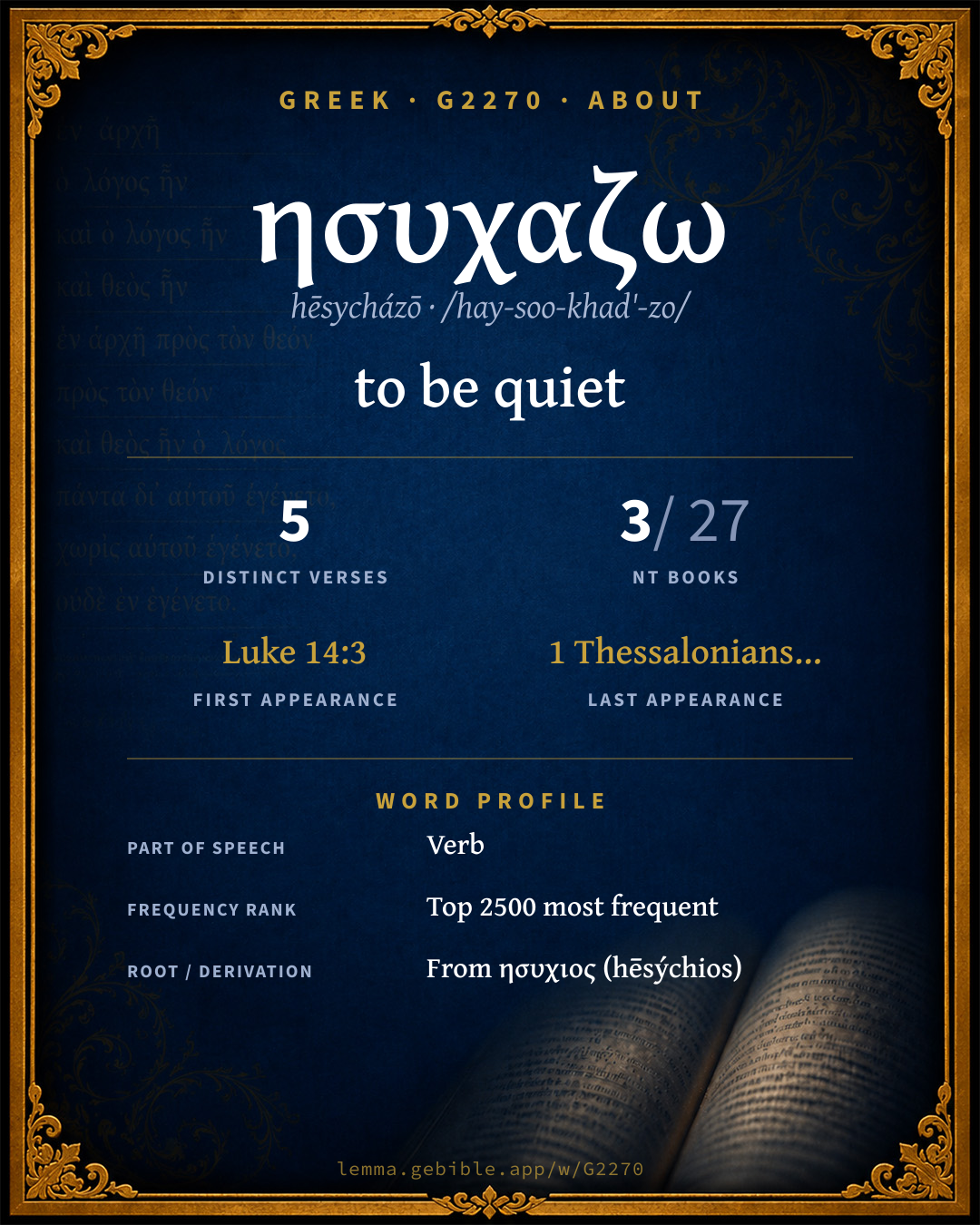
ἡσυχάζω
to be quiet
‘to be quiet’ is one of 3 main senses fuller range ↓
Full lexicon entry — Thayer's Greek Lexicon
From Thayer's Greek Lexicon
Where this word appears
See every Aorist-tense verb in the Greek New Testament →
Grammar key — what these labels mean
Part of speech
- Verb
- An action or state-of-being word.
Tense
- Aorist
- Action viewed as a simple whole, without regard to duration — often past (perfective aspect).
- Present
- Ongoing or general action in present time (imperfective aspect).
Voice
- Active
- The subject performs the action.
Mood
- Indicative
- States a fact or asks a factual question (the mood of reality).
- Infinitive
- A verbal noun (“to write”), unmarked for person or number.
Person
- 3rd person
- The one spoken about (“he / she / it / they”).
- 1st person
- The speaker (“I / we”).
Number
- Plural
- More than one.
Grammatical forms
- Verb, Aorist, Active, Indicative, 3rd person, Plural 3 times (60%)
- Verb, Aorist, Active, Indicative, 1st person, Plural 1 time (20%)
- Verb, Present, Active, Infinitive 1 time (20%)
Parsed forms decoded from the imported morphology (Robinson–Tischendorf, public domain), counted across 5 parsed occurrences — not distinct verses.
Every verse where G2270 appears — 5 distinct verses across 3 books. Click any verse to open its interlinear word-by-word view. Verse text shown in the World English Bible for context — . Each verse’s Greek form is shown with its reference; the English is not keyword-highlighted, since the data carries no word-level English alignment. Use “Compare translations” on any verse to read it across multiple English versions. This concordance covers the Greek New Testament; Septuagint (Greek Old Testament) occurrences of this word are not indexed here.
Luke 2 verses
Acts 2 verses
1 Thessalonians 1 verse
About this entry
At a glance — auto-summarized from this page’s data, not written by a person. Every figure links to its source below. This summary describes the numbers; it doesn’t interpret them.
The Greek verb ησυχαζω centers on the idea of “to be quiet.” With only 5 verses it sits in the long tail of Greek New Testament vocabulary. The word gravitates to Luke (40%), then Acts and 1 Thessalonians. First canonically at Luke 14:3, it enters the text early. Ranging over 3 senses, it is not a single-sense word. Each statement above links to its evidence; the full detail follows below.
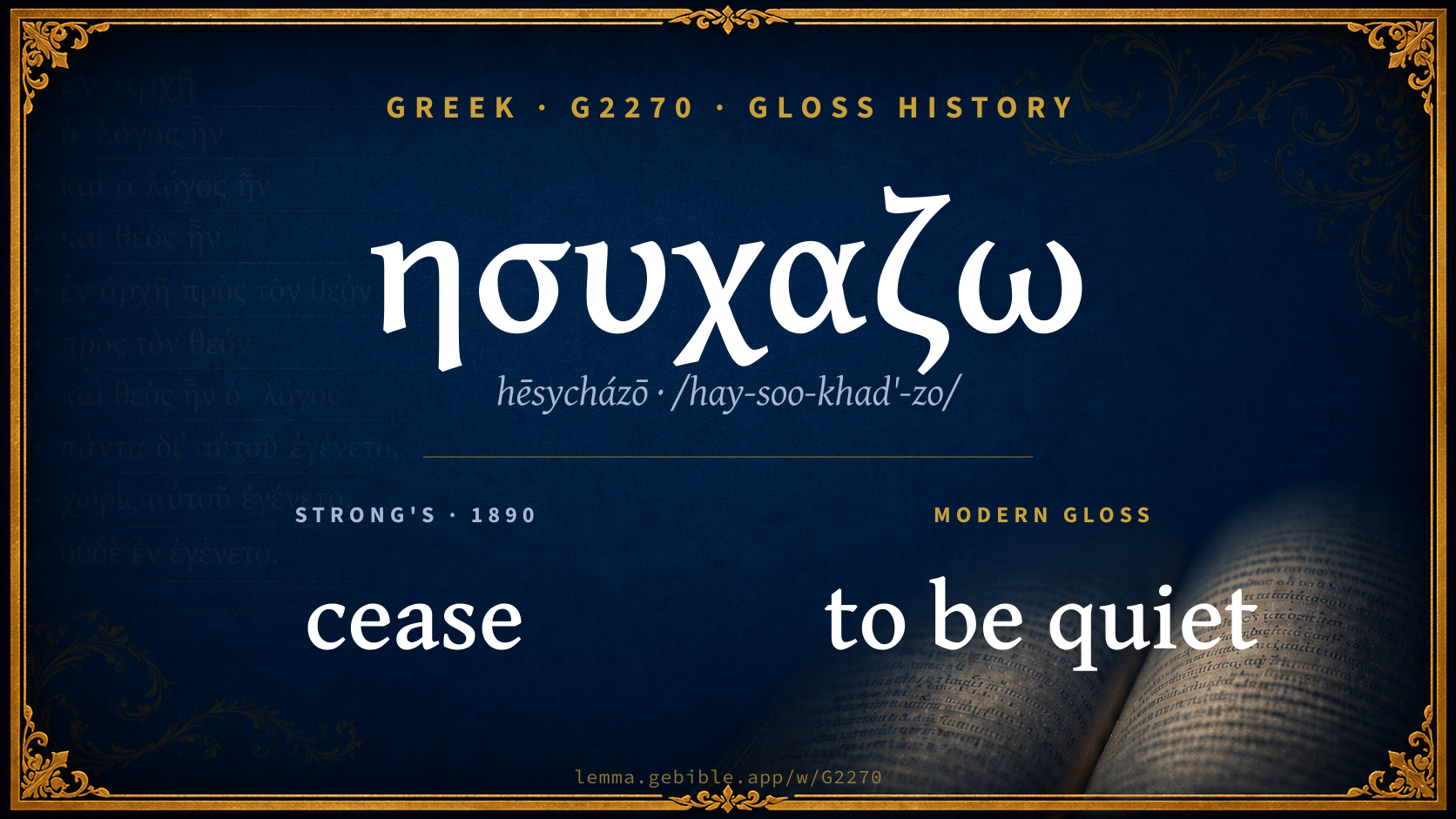
Gloss history
Strong's 1890 vs modern scholarship
About this word
Strong's G2270 catalogs a Greek word from the Greek New Testament.
These counts are not copied from any lexicon or concordance. They are computed here, from the morphology-tagged Greek New Testament. What Lemma adds →
- 5
- distinct verses
- The word appears in 5 distinct verses.
- 3 / 27
- NT books
- The word appears in 3 of 27 New Testament books.
- #1,648
- by frequency
- Top 2500 most frequent Greek words (rank 1,648 of 5,347 Greek words by occurrence).
View all 5 occurrences in the concordance →
Most concentrated in
- Luke 2 verses 40%
- Acts 2 verses 40%
- 1 Thessalonians 1 verse 20%
By section of the New Testament
By traditional corpus
Conventional, traditional groupings — biblical authorship is debated, so this is a traditional corpus grouping, not an authorship claim. Some books belong to more than one corpus (Luke is in both the Gospels and the Lukan corpus, and so on), so these shares overlap and need not total 100%. Each figure is a share of the word’s 5 distinct verses.
- Lukan (Luke–Acts) 4 verses · 80%
- Gospels 2 verses · 40%
- Pauline corpus 1 verse · 20%
How translations render this word
Counts come from each version’s own published word-to-Strong’s tagging or interlinear alignment — an approximate guide to how each version renders this word, not a word-level alignment the data otherwise carries. Because each total is that version’s own tagged count, the per-version totals vary from one another and need not match the appearance or distinct-verse counts above. These counts may also differ from a printed concordance because Lemma counts each distinctly tagged rendering and does not collapse phrase taggings into a single head-word total. This is a fixed set of word-tagged versions (KJV, ASV, BSB, ULT) and does not change with the reading translation you choose elsewhere. Each version’s license is shown beside its name below (and on Sources).
- King James Version: They held their peace 2×
- American Standard Version: They held their peace 2×
- Berean Standard Bible: Live quietly 1×, They had no further 1×, They remained silent 1×
- unfoldingWord Literal Text: Be quiet 1×, Kept silent 1×, They became quiet 1×
King James Version Public Domain
Renders G2270 across 5 tagged occurrences — most commonly:
Plus 3 renderings that appear only once — usually multi-word phrases or single function words the recovered tagging swept in, not distinct renderings.
American Standard Version Public Domain
Renders G2270 across 5 tagged occurrences — most commonly:
Plus 3 renderings that appear only once — usually multi-word phrases or single function words the recovered tagging swept in, not distinct renderings.
Berean Standard Bible Public Domain
Renders G2270 across 5 tagged occurrences — most commonly:
unfoldingWord Literal Text CC BY-SA 4.0
Renders G2270 across 5 tagged occurrences — most commonly:
Senses in Thayer's
The 3 senses Thayer's distinguishes for this word, in lexicon order (not ranked by frequency or importance). The full entry — with sub-senses — is in the Lexicon Entry tab.
- to rest, cease from labour
- to lead a quiet life, said of those who are not running hither and thither, but stay at home and mind their business
- to be silent, i.e. to say nothing, hold one's peace
Word origin
Derived from ησυχιος (hēsýchios) (G2272) — quiet.
From the same as G2272 ; to keep still (intransitively) that is refrain from labor meddlesomeness or speech : - cease hold peace be quiet rest.
— Strong’s Exhaustive Concordance (1890), public domain.
Forms in the corpus
The 3 distinct written forms G2270 takes in the Greek New Testament, most frequent first — each parse links to that tense’s occurrences in the concordance.
| Form | Parsing | Example | Uses |
|---|---|---|---|
| ἡσύχασαν hēsýchasan | Verb, Aorist, Active, Indicative, 3rd person, Plural | Luke 14:3 | 3 |
| ἡσυχάζειν hēsycházein | Verb, Present, Active, Infinitive | 1 Thessalonians 4:11 | 1 |
| ἡσυχάσαμεν hēsychásamen | Verb, Aorist, Active, Indicative, 1st person, Plural | Acts 21:14 | 1 |
Same root — word family
Other Thayer's entries built from the same root as G2270, grouped by Strong’s listed origin. These share a root / origin per the lexicon — not necessarily a shared meaning. Each links to that word’s own entry.
Derives from
Shares the same root
Compare all same-root words → They share a root, not necessarily a meaning.
Septuagint usage
The same Greek word ησυχαζω appears 36 times in the Greek Old Testament (Septuagint), across 36 verses in 15 books.
- 36
- LXX occurrences
- Tagged occurrences of this Greek word in the Septuagint.
- 36
- verses
- Distinct Septuagint verses containing this word.
- 15 / 39
- OT books
- The word appears in 15 of the 39 Old Testament books.
Sample Septuagint occurrences
- Genesis 4:7 ἡσυχάζω
- Exodus 24:14 ἡσυχάζω
- Judges 3:11 ἡσυχάζω
- Ruth 3:18 ἡσυχάζω
- 2 Kings 11:20 ἡσυχάζω
- 2 Chronicles 13:23 ἡσυχάζω
- Ezra 15:8 ἡσυχάζω
- Job 3:13 ἡσυχάζω
- Psalms 75:9 ἡσυχάζω
- Proverbs 1:33 ἡσυχάζω
- Isaiah 7:4 ἡσυχάζω
- Jeremiah 26:27 ἡσυχάζω
Septuagint occurrences (same lexeme)
Every verse where the same Strong’s number (G2270) appears in the Greek Septuagint. Verse text shown in the World English Bible for context; the Greek form is the matched word — the English is not keyword-highlighted.
- Genesis 4:7 ἡσυχάζω If you do well, will it not be lifted up? If you don't do well, sin crouches at the door. Its desire is for you, but you are to rule over it."
- Exodus 24:14 ἡσυχάζω He said to the elders, "Wait here for us, until we come again to you. Behold, Aaron and Hur are with you. Whoever is involved in a dispute can go to them."
- Judges 3:11 ἡσυχάζω The land had rest forty years. Othniel the son of Kenaz died.
- Judges 3:30 ἡσυχάζω So Moab was subdued that day under the hand of Israel. The land had rest eighty years.
- Judges 5:31 ἡσυχάζω So let all your enemies perish, Yahweh: But let those who love him be as the sun when he goes forth in his might. The land had rest forty years.
- Judges 8:28 ἡσυχάζω So Midian was subdued before the children of Israel, and they lifted up their heads no more. The land had rest forty years in the days of Gideon.
- Judges 18:7 ἡσυχάζω Then the five men departed, and came to Laish, and saw the people who were therein, how they lived in security, after the manner of the Sidonians, quiet and secure; for there was none in the land, possessing authority, that might put [them] to shame in anything, and they were far from the Sidonians, and had no dealings with any man.
- Judges 18:9 ἡσυχάζω They said, Arise, and let us go up against them; for we have seen the land, and, behold, it is very good: and are you still? don't be slothful to go and to enter in to possess the land.
- Judges 18:27 ἡσυχάζω They took that which Micah had made, and the priest whom he had, and came to Laish, to a people quiet and secure, and struck them with the edge of the sword; and they burnt the city with fire.
- Ruth 3:18 ἡσυχάζω Then said she, "Sit still, my daughter, until you know how the matter will fall; for the man will not rest, until he has finished the thing this day."
- 2 Kings 11:20 ἡσυχάζω So all the people of the land rejoiced, and the city was quiet. Athaliah they had slain with the sword at the king's house.
- 2 Chronicles 13:23 ἡσυχάζω
- 2 Chronicles 23:21 ἡσυχάζω So all the people of the land rejoiced, and the city was quiet. Athaliah they had slain with the sword.
- Ezra 15:8 ἡσυχάζω
- Job 3:13 ἡσυχάζω For now should I have lain down and been quiet. I should have slept, then I would have been at rest,
- Job 3:26 ἡσυχάζω I am not at ease, neither am I quiet, neither have I rest; But trouble comes."
- Job 11:19 ἡσυχάζω Also you shall lie down, and none shall make you afraid; Yes, many shall court your favor.
- Job 14:6 ἡσυχάζω Look away from him, that he may rest, Until he shall accomplish, as a hireling, his day.
- Job 32:1 ἡσυχάζω So these three men ceased to answer Job, because he was righteous in his own eyes.
- Job 32:6 ἡσυχάζω Elihu the son of Barachel the Buzite answered, "I am young, and you are very old; Therefore I held back, and didn't dare show you my opinion.
- Job 37:8 ἡσυχάζω Then the animals take cover, And remain in their dens.
- Job 37:17 ἡσυχάζω You whose clothing is warm, When the earth is still by reason of the south wind?
- Psalms 75:9 ἡσυχάζω But I will declare this forever: I will sing praises to the God of Jacob.
- Psalms 106:30 ἡσυχάζω Then Phinehas stood up, and executed judgment, So the plague was stopped.
- Proverbs 1:33 ἡσυχάζω But whoever listens to me will dwell securely, And will be at ease, without fear of harm."
- Proverbs 7:11 ἡσυχάζω She is loud and defiant. Her feet don't stay in her house.
- Proverbs 15:15 ἡσυχάζω All the days of the afflicted are wretched, But one who has a cheerful heart enjoys a continual feast.
- Proverbs 26:20 ἡσυχάζω For lack of wood a fire goes out; Without gossip, a quarrel dies down.
- Isaiah 7:4 ἡσυχάζω Tell him, 'Be careful, and keep calm. Don't be afraid, neither let your heart be faint because of these two tails of smoking firebrands, for the fierce anger of Rezin and Syria, and of the son of Remaliah.
- Jeremiah 26:27 ἡσυχάζω
- Jeremiah 29:6 ἡσυχάζω Take wives, and father sons and daughters; and take wives for your sons, and give your daughters to husbands, that they may bear sons and daughters; and multiply you there, and don't be diminished.
- Jeremiah 29:7 ἡσυχάζω Seek the peace of the city where I have caused you to be carried away captive, and pray to Yahweh for it; for in the peace of it shall you have peace.
- Lamentations 3:26 ἡσυχάζω It is good that a man should hope and quietly wait for the salvation of Yahweh.
- Ezekiel 32:14 ἡσυχάζω Then will I make their waters clear, and cause their rivers to run like oil, says the Lord Yahweh.
- Ezekiel 38:11 ἡσυχάζω and you shall say, I will go up to the land of unwalled villages; I will go to those who are at rest, who dwell securely, all of them dwelling without walls, and having neither bars nor gates;
- Zechariah 1:11 ἡσυχάζω They reported to the angel of Yahweh who stood among the myrtle trees, and said, "We have walked back and forth through the earth, and, behold, all the earth is at rest and in peace."
These are occurrences of the same Greek lexeme (G2270) in the Septuagint — not a translation of any one Hebrew word. The store carries no word-level Hebrew↔Greek alignment, so no Hebrew original is asserted here. Counts come from the recovered LXX Strong's tagging — high-frequency vocabulary is well covered, while rare or late forms may be untagged — so they reflect tagged occurrences and may slightly undercount.