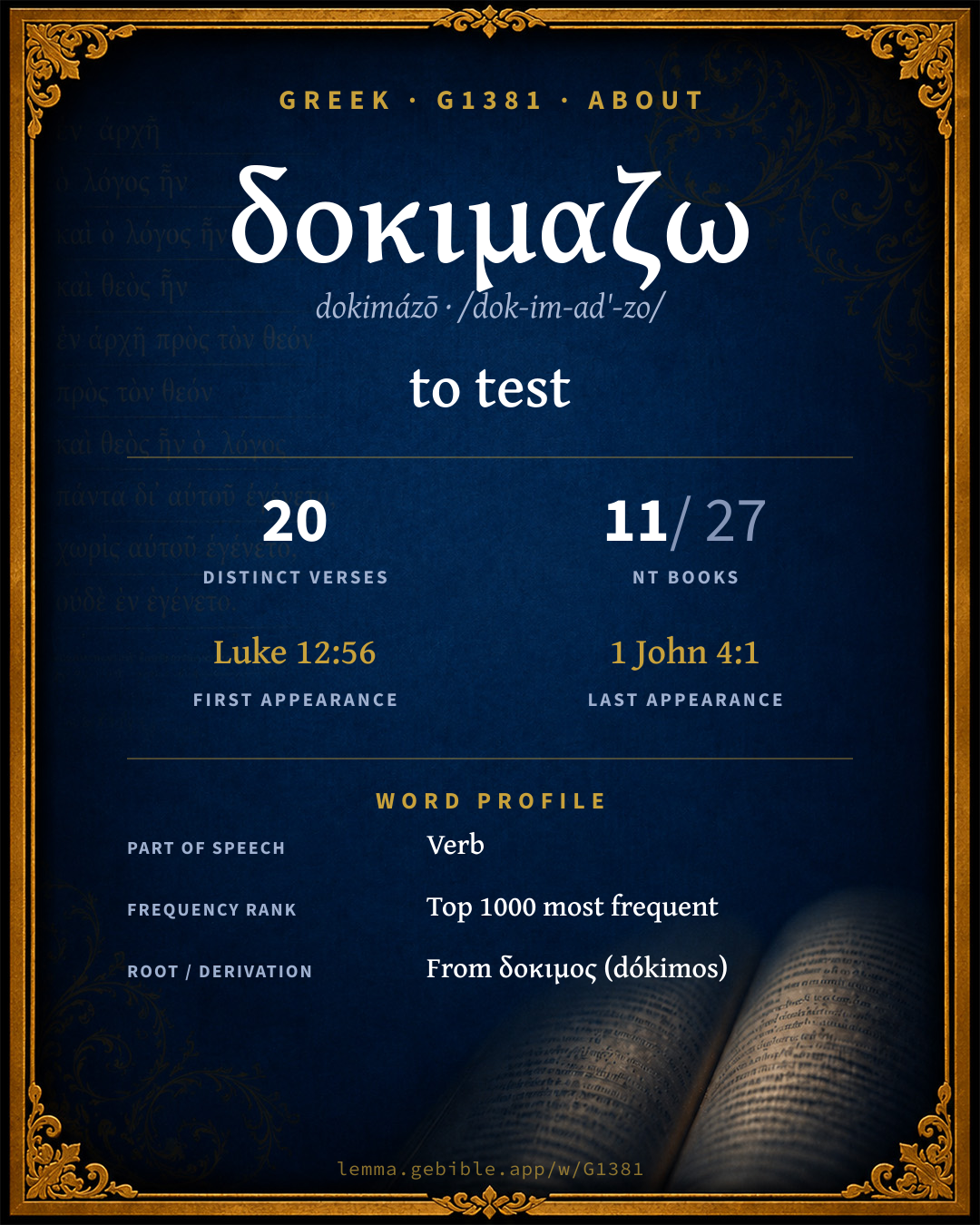
δοκιμάζω
to test
also: examine, prove, scrutinise, as metals fuller range ↓
Full lexicon entry — Thayer's Greek Lexicon
From Thayer's Greek Lexicon
Where this word appears
See every Present-tense verb in the Greek New Testament →
Grammar key — what these labels mean
Part of speech
- Verb
- An action or state-of-being word.
Tense
- Present
- Ongoing or general action in present time (imperfective aspect).
- Aorist
- Action viewed as a simple whole, without regard to duration — often past (perfective aspect).
- Future
- Action expected in future time.
- Perfect
- A completed past action with continuing present results.
Voice
- Active
- The subject performs the action.
- Passive
- The subject receives the action.
Mood
- Imperative
- Expresses a command or request.
- Infinitive
- A verbal noun (“to write”), unmarked for person or number.
- Indicative
- States a fact or asks a factual question (the mood of reality).
- Subjunctive
- Expresses probability, purpose, or possibility (the mood of contingency).
- Participle
- A verbal adjective (“writing,” “having written”).
Case
- Dative
- The case of the indirect object, means, or location — “to / for / with / in.”
- Nominative
- The case of the subject (and the predicate nominative).
- Genitive
- The case of source, possession, or “of” — answers “whose / from what.”
Person
- 2nd person
- The one addressed (“you”).
- 3rd person
- The one spoken about (“he / she / it / they”).
- 1st person
- The speaker (“I / we”).
Gender
- Masculine
- Grammatically masculine.
- Neuter
- Grammatically neuter.
Number
- Plural
- More than one.
- Singular
- One.
Grammatical forms 16 distinct
- Verb, Present, Active, Imperative, 2nd person, Plural 4 times (18%)
- Verb, Present, Active, Infinitive 3 times (14%)
- Verb, Present, Active, Imperative, 3rd person, Singular 2 times (9%)
- Verb, Aorist, Active, Indicative, 1st person, Plural 1 time (5%)
- Verb, Aorist, Active, Indicative, 3rd person, Plural 1 time (5%)
- Verb, Aorist, Active, Infinitive 1 time (5%)
- Verb, Aorist, Active, Subjunctive, 2nd person, Plural 1 time (5%)
- Verb, Future, Active, Indicative, 3rd person, Singular 1 time (5%)
+8 more forms (8 occurrences)
Parsed forms decoded from the imported morphology (Robinson–Tischendorf, public domain), counted across 22 parsed occurrences — not distinct verses.
Every verse where G1381 appears — 20 distinct verses across 11 books. Click any verse to open its interlinear word-by-word view. Verse text shown in the World English Bible for context — . Each verse’s Greek form is shown with its reference; the English is not keyword-highlighted, since the data carries no word-level English alignment. Use “Compare translations” on any verse to read it across multiple English versions. This concordance covers the Greek New Testament; Septuagint (Greek Old Testament) occurrences of this word are not indexed here.
Luke 2 verses
- Luke 12:56 δοκιμάζειν δοκιμάζετε pres act inf pres act impv 2pl You hypocrites! You know how to interpret the appearance of the earth and the sky, but how is it that you don't interpret this time?
- Luke 14:19 δοκιμάσαι aor act inf "Another said, 'I have bought five yoke of oxen, and I must go try them out. Please have me excused.'
Romans 4 verses
- Romans 1:28 ἐδοκίμασαν aor act ind 3pl Even as they refused to have God in their knowledge, God gave them up to a reprobate mind, to do those things which are not fitting;
- Romans 2:18 δοκιμάζεις pres act ind 2sg and know his will, and approve the things that are excellent, being instructed out of the law,
- Romans 12:2 δοκιμάζειν pres act inf Don't be conformed to this world, but be transformed by the renewing of your mind, so that you may prove what is the good, well-pleasing, and perfect will of God.
- Romans 14:22 δοκιμάζει pres act ind 3sg Do you have faith? Have it to yourself before God. Happy is he who doesn't judge himself in that which he approves.
1 Corinthians 3 verses
- 1 Corinthians 3:13 δοκιμάσει fut act ind 3sg each man's work will be revealed. For the Day will declare it, because it is revealed in fire; and the fire itself will test what sort of work each man's work is.
- 1 Corinthians 11:28 δοκιμαζέτω pres act impv 3sg But let a man examine himself, and so let him eat of the bread, and drink of the cup.
- 1 Corinthians 16:3 δοκιμάσητε aor act subj 2pl When I arrive, I will send whoever you approve with letters to carry your gracious gift to Jerusalem.
2 Corinthians 3 verses
- 2 Corinthians 8:8 δοκιμάζων pres act ptcp nom sg masc I speak not by way of commandment, but as proving through the earnestness of others the sincerity also of your love.
- 2 Corinthians 8:22 ἐδοκιμάσαμεν aor act ind 1pl We have sent with them our brother, whom we have many times proved earnest in many things, but now much more earnest, by reason of the great confidence which he has in you.
- 2 Corinthians 13:5 δοκιμάζετε pres act impv 2pl Test your own selves, whether you are in the faith. Test your own selves. Or don't you know as to your own selves, that Jesus Christ is in you?--unless indeed you are disqualified.
Galatians 1 verse
Ephesians 1 verse
Philippians 1 verse
1 Thessalonians 2 verses
- 1 Thessalonians 2:4 δεδοκιμάσμεθα δοκιμάζοντι perf pass ind 1pl pres act ptcp dat sg masc But even as we have been approved by God to be entrusted with the Gospel, so we speak; not as pleasing men, but God, who tests our hearts.
- 1 Thessalonians 5:21 δοκιμάζετε pres act impv 2pl Test all things, and hold firmly that which is good.
1 Timothy 1 verse
1 Peter 1 verse
1 John 1 verse
About this entry
At a glance — auto-summarized from this page’s data, not written by a person. Every figure links to its source below. This summary describes the numbers; it doesn’t interpret them.
δοκιμαζω — transliterated dokimázō — is a Greek verb carrying the sense “to test.” Its earliest occurrence is Luke 12:56. It appears 20 verses across 11 books of the Greek New Testament, among its uncommon vocabulary. Thayer's distinguishes 2 senses; alongside “to test” it spans “examine”, “prove”, and “scrutinise”. It shares a root with δοκιμος and δοκιμη. Each statement above links to its evidence; the full detail follows below.
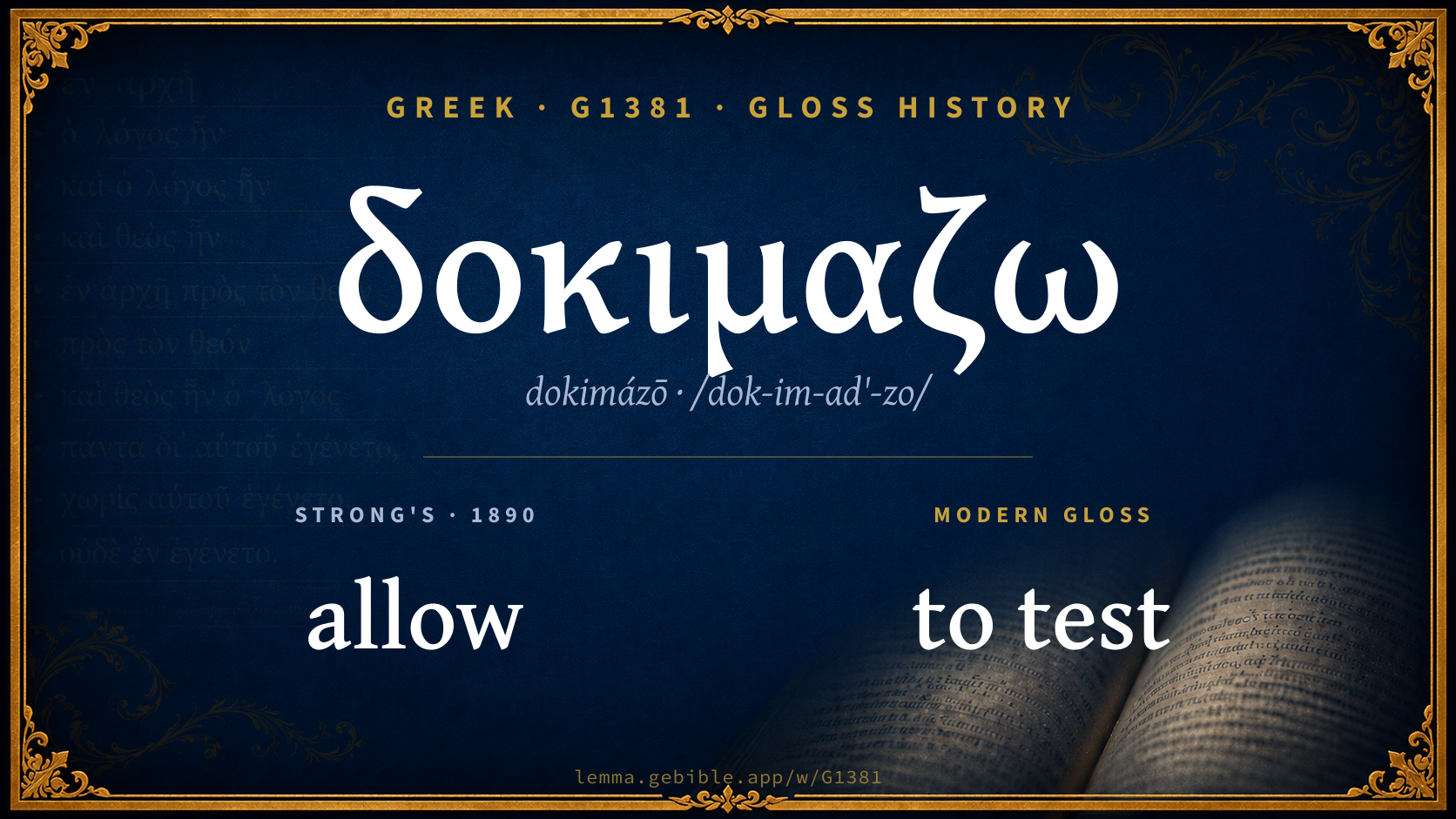
Gloss history
Strong's 1890 vs modern scholarship
About this word
Strong's G1381 catalogs a Greek word from the Greek New Testament.
These counts are not copied from any lexicon or concordance. They are computed here, from the morphology-tagged Greek New Testament. What Lemma adds →
- 20
- distinct verses
- The word appears in 20 distinct verses.
- 11 / 27
- NT books
- The word appears in 11 of 27 New Testament books.
- #586
- by frequency
- Top 1000 most frequent Greek words (rank 586 of 5,347 Greek words by occurrence).
View all 20 occurrences in the concordance →
Most concentrated in
- Romans 4 verses 20%
- 1 Corinthians 3 verses 15%
- 2 Corinthians 3 verses 15%
By section of the New Testament
By traditional corpus
Conventional, traditional groupings — biblical authorship is debated, so this is a traditional corpus grouping, not an authorship claim. Some books belong to more than one corpus (Luke is in both the Gospels and the Lukan corpus, and so on), so these shares overlap and need not total 100%. Each figure is a share of the word’s 20 distinct verses.
- Pauline corpus 16 verses · 80%
- Gospels 2 verses · 10%
- Lukan (Luke–Acts) 2 verses · 10%
- General (Catholic) Epistles 2 verses · 10%
- Johannine 1 verse · 5%
How translations render this word
Counts come from each version’s own published word-to-Strong’s tagging or interlinear alignment — an approximate guide to how each version renders this word, not a word-level alignment the data otherwise carries. Because each total is that version’s own tagged count, the per-version totals vary from one another and need not match the appearance or distinct-verse counts above. These counts may also differ from a printed concordance because Lemma counts each distinctly tagged rendering and does not collapse phrase taggings into a single head-word total. This is a fixed set of word-tagged versions (KJV, ASV, BSB, ULT) and does not change with the reading translation you choose elsewhere. Each version’s license is shown beside its name below (and on Sources).
- King James Version: Prove 5×, Let 3×, Discern 2×
- American Standard Version: Prove 6×, Let 3×, Proving 3×
- Berean Standard Bible: Test 3×, Interpret 2×
- unfoldingWord Literal Text: Examine 3×, Let 3×, Interpret 2×
King James Version Public Domain
Renders G1381 across 28 tagged occurrences — most commonly:
Plus 16 renderings that appear only once — usually multi-word phrases or single function words the recovered tagging swept in, not distinct renderings.
American Standard Version Public Domain
Renders G1381 across 28 tagged occurrences — most commonly:
Plus 14 renderings that appear only once — usually multi-word phrases or single function words the recovered tagging swept in, not distinct renderings.
Berean Standard Bible Public Domain
Renders G1381 across 22 tagged occurrences — most commonly:
Plus 17 renderings that appear only once — usually multi-word phrases or single function words the recovered tagging swept in, not distinct renderings.
unfoldingWord Literal Text CC BY-SA 4.0
Renders G1381 across 29 tagged occurrences — most commonly:
Plus 19 renderings that appear only once — usually multi-word phrases or single function words the recovered tagging swept in, not distinct renderings.
Senses in Thayer's
The 2 senses Thayer's distinguishes for this word, in lexicon order (not ranked by frequency or importance). The full entry — with sub-senses — is in the Lexicon Entry tab.
- to test, examine, prove, scrutinise (to see whether a thing is genuine or not), as metals
- to recognise as genuine after examination, to approve, deem worthy
Word origin
Derived from δοκιμος (dókimos) (G1384) — approved.
From G1384 ; to test (literally or figuratively); by implication to approve : - allow discern examine X like (ap-) prove try.
— Strong’s Exhaustive Concordance (1890), public domain.
Forms in the corpus
The 16 distinct written forms G1381 takes in the Greek New Testament, most frequent first — each parse links to that tense’s occurrences in the concordance.
Same root — word family
Other Thayer's entries built from the same root as G1381, grouped by Strong’s listed origin. These share a root / origin per the lexicon — not necessarily a shared meaning. Each links to that word’s own entry.
Derives from
Shares the same root
Compare all same-root words → They share a root, not necessarily a meaning.
Septuagint usage
The same Greek word δοκιμαζω appears 22 times in the Greek Old Testament (Septuagint), across 20 verses in 5 books.
- 22
- LXX occurrences
- Tagged occurrences of this Greek word in the Septuagint.
- 20
- verses
- Distinct Septuagint verses containing this word.
- 5 / 39
- OT books
- The word appears in 5 of the 39 Old Testament books.
Sample Septuagint occurrences
- Job 34:3 δοκιμάζω
- Psalms 16:3 δοκιμάζω
- Proverbs 8:10 δοκιμάζω
- Jeremiah 6:27 δοκιμάζω
- Zechariah 11:13 δοκιμάζω
Septuagint occurrences (same lexeme)
Every verse where the same Strong’s number (G1381) appears in the Greek Septuagint. Verse text shown in the World English Bible for context; the Greek form is the matched word — the English is not keyword-highlighted.
- Job 34:3 δοκιμάζω For the ear tries words, As the palate tastes food.
- Psalms 16:3 δοκιμάζω As for the saints who are in the earth, They are the excellent ones in whom is all my delight.
- Psalms 25:2 δοκιμάζω My God, I have trusted in you, Don't let me be shamed. Don't let my enemies triumph over me.
- Psalms 65:10 δοκιμάζω You drench its furrows. You level its ridges. You soften it with showers. You bless it with a crop.
- Psalms 67:31 δοκιμάζω
- Psalms 80:8 δοκιμάζω You brought a vine out of Egypt. You drove out the nations, and planted it.
- Psalms 94:9 δοκιμάζω He who implanted the ear, won't he hear? He who formed the eye, won't he see?
- Psalms 138:1 δοκιμάζω I will give you thanks with my whole heart. Before the gods, I will sing praises to you.
- Psalms 138:23 δοκιμάζω
- Proverbs 8:10 δοκιμάζω Receive my instruction rather than silver; Knowledge rather than choice gold.
- Proverbs 17:3 δοκιμάζω The refining pot is for silver, and the furnace for gold, But Yahweh tests the hearts.
- Proverbs 27:21 δοκιμάζω The crucible is for silver, And the furnace for gold; But man is refined by his praise.
- Jeremiah 6:27 δοκιμάζω I have made you a tester of metals [and] a fortress among my people; that you may know and try their way.
- Jeremiah 9:6 δοκιμάζω Your habitation is in the midst of deceit; through deceit they refuse to know me, says Yahweh.
- Jeremiah 11:20 δοκιμάζω But, Yahweh of Hosts, who judge righteously, who try the heart and the mind, I shall see your vengeance on them; for to you have I revealed my cause.
- Jeremiah 12:3 δοκιμάζω But you, Yahweh, know me; you see me, and try my heart toward you: pull them out like sheep for the slaughter, and prepare them for the day of slaughter.
- Jeremiah 17:10 δοκιμάζω I, Yahweh, search the mind, I try the heart, even to give every man according to his ways, according to the fruit of his doings.
- Jeremiah 20:12 δοκιμάζω But, Yahweh of Hosts, who tests the righteous, who sees the heart and the mind, let me see your vengeance on them; for to you have I revealed my cause.
- Zechariah 11:13 δοκιμάζω Yahweh said to me, "Throw it to the potter, the handsome price that I was valued at by them!" I took the thirty pieces of silver, and threw them to the potter, in the house of Yahweh.
- Zechariah 13:9 δοκιμάζω I will bring the third part into the fire, And will refine them as silver is refined, And will test them like gold is tested. They will call on my name, and I will hear them. I will say, 'It is my people;' And they will say, 'Yahweh is my God.'"
These are occurrences of the same Greek lexeme (G1381) in the Septuagint — not a translation of any one Hebrew word. The store carries no word-level Hebrew↔Greek alignment, so no Hebrew original is asserted here. Counts come from the recovered LXX Strong's tagging — high-frequency vocabulary is well covered, while rare or late forms may be untagged — so they reflect tagged occurrences and may slightly undercount.