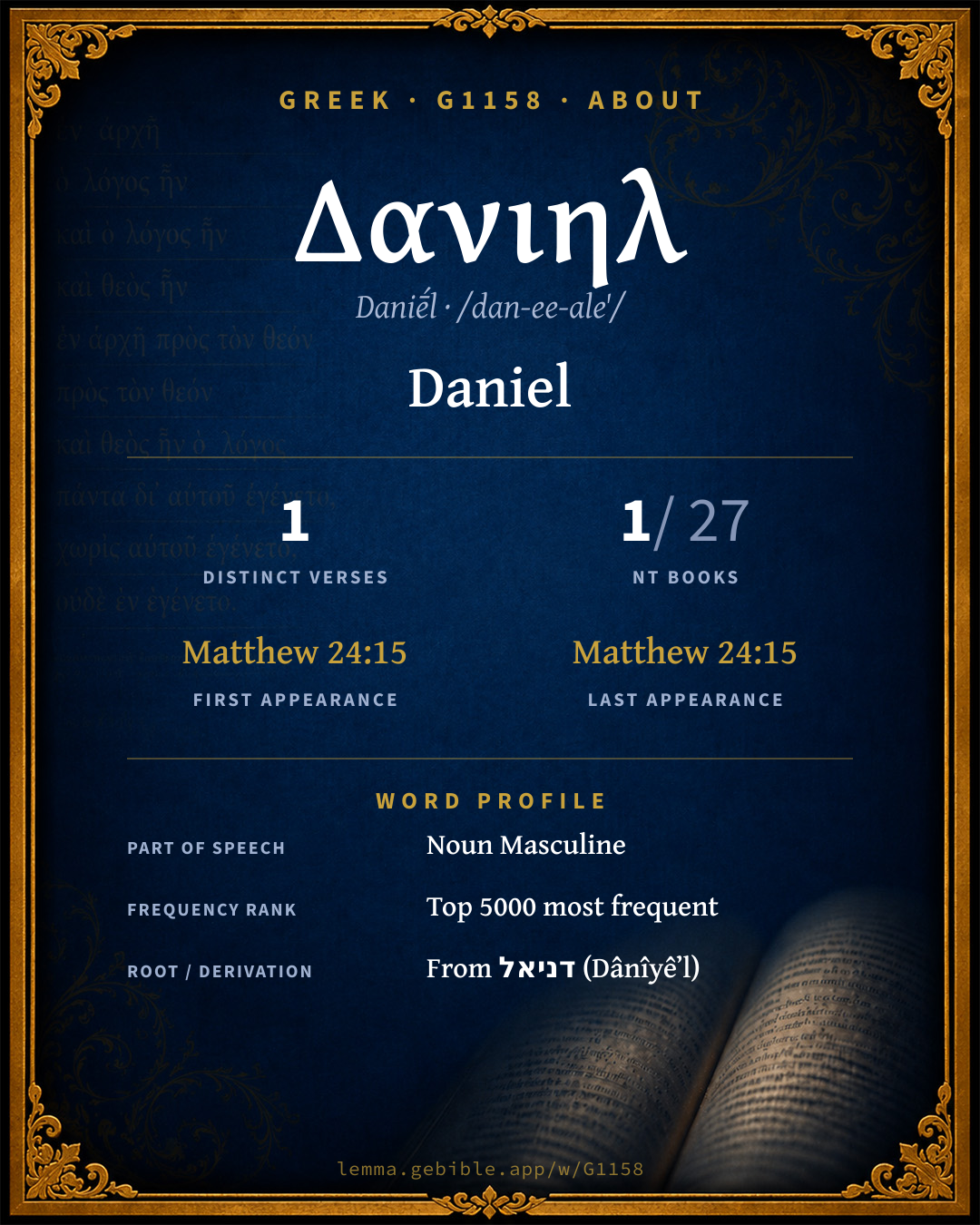
Δανιήλ
Daniel
Thayer's lists 2 entries for ‘Daniel’ fuller range ↓
Full lexicon entry — Thayer's Greek Lexicon
From Thayer's Greek Lexicon
Where this word appears
Every verse where G1158 appears — 1 distinct verse across 1 book. Click any verse to open its interlinear word-by-word view. Verse text shown in the World English Bible for context — . Each verse’s Greek form is shown with its reference; the English is not keyword-highlighted, since the data carries no word-level English alignment. Use “Compare translations” on any verse to read it across multiple English versions. This concordance covers the Greek New Testament; Septuagint (Greek Old Testament) occurrences of this word are not indexed here.
Matthew 1 verse
About this entry
At a glance — auto-summarized from this page’s data, not written by a person. Every figure links to its source below. This summary describes the numbers; it doesn’t interpret them.
“Daniel” is the headline sense of the Greek name Δανιηλ (Daniḗl). It is rare — just 1 verse in the entire Greek New Testament. It clusters heavily in Matthew, which alone accounts for 100% of its uses. Its lone occurrence is Matthew 24:15. The sections below give every occurrence and version rendering.
Gloss history
Strong's 1890 vs modern scholarship
About this word
Strong's G1158 catalogs a Greek word from the Greek New Testament.
These counts are not copied from any lexicon or concordance. They are computed here, from the morphology-tagged Greek New Testament. What Lemma adds →
- 1
- distinct verses
- The word appears in 1 distinct verse.
- 1 / 27
- NT books
- The word appears in 1 of 27 New Testament books.
- #3,503
- by frequency
- Top 5000 most frequent Greek words (rank 3,503 of 5,347 Greek words by occurrence).
View all 1 occurrence in the concordance →
Most concentrated in
- Matthew 1 verse 100%
By section of the New Testament
By traditional corpus
Conventional, traditional groupings — biblical authorship is debated, so this is a traditional corpus grouping, not an authorship claim. Some books belong to more than one corpus (Luke is in both the Gospels and the Lukan corpus, and so on), so these shares overlap and need not total 100%. Each figure is a share of the word’s 1 distinct verse.
- Gospels 1 verse · 100%
How translations render this word
Counts come from each version’s own published word-to-Strong’s tagging or interlinear alignment — an approximate guide to how each version renders this word, not a word-level alignment the data otherwise carries. Because each total is that version’s own tagged count, the per-version totals vary from one another and need not match the appearance or distinct-verse counts above. These counts may also differ from a printed concordance because Lemma counts each distinctly tagged rendering and does not collapse phrase taggings into a single head-word total. This is a fixed set of word-tagged versions (KJV, ASV, BSB, ULT) and does not change with the reading translation you choose elsewhere. Each version’s license is shown beside its name below (and on Sources).
- King James Version: Daniel 2×
- American Standard Version: Daniel 1×
- Berean Standard Bible: Daniel 1×
- unfoldingWord Literal Text: Daniel 1×
King James Version Public Domain
Renders G1158 across 2 tagged occurrences — most commonly:
American Standard Version Public Domain
Renders G1158 across 1 tagged occurrence — most commonly:
Berean Standard Bible Public Domain
Renders G1158 across 1 tagged occurrence — most commonly:
unfoldingWord Literal Text CC BY-SA 4.0
Renders G1158 across 1 tagged occurrence — most commonly:
Senses in Thayer's
The 2 senses Thayer's distinguishes for this word, in lexicon order (not ranked by frequency or importance). The full entry — with sub-senses — is in the Lexicon Entry tab.
- Daniel = "judgment of God"
- the name of a Jewish prophet, noted for his wisdom and prophecies
Word origin
Derived from דניאל (Dânîyêʼl) (H1840) — Daniel.
Of hebrew origin [ H1840 ]; Daniel an Israelite : - Daniel.
— Strong’s Exhaustive Concordance (1890), public domain.
Same root — word family
Other Thayer's entries built from the same root as G1158, grouped by Strong’s listed origin. These share a root / origin per the lexicon — not necessarily a shared meaning. Each links to that word’s own entry.
Derives from
Proper names from this root
People and places named from this root — a name, not an additional meaning of the word.
Compare all same-root words → 2 of the same-root words are proper names (people or places). They share a root, not necessarily a meaning.
Bible dictionary
Public-domain dictionary articles matched to this entry by name (Daniel). A biblical name can be shared by more than one person or place, so an article may treat several.
Easton's Bible Dictionary · M. G. Easton, 1897
God is my judge, or judge of God. (1.) David's second son, "born unto him in Hebron, of Abigail the Carmelitess" (1 Chr. 3:1). He is called also Chileab (2 Sam. 3:3).
(2.) One of the four great prophets, although he is not once spoken of in the Old Testament as a prophet. His life and prophecies are recorded in the Book of Daniel. He was descended from one of the noble families of Judah (Dan. 1:3), and was probably born in Jerusalem about B.C. 623, during the reign of Josiah. At the first deportation of the Jews by Nebuchadnezzar (the kingdom of Israel had come to an end nearly a century before), or immediately after his victory over the Egyptians at the second battle of Carchemish, in the fourth year of the reign of Jehoiakim (B.C. 606), Daniel and other three noble youths were carried off to Babylon, along with part of the vessels of the temple. There he was obliged to enter into the service of the king of Babylon, and in accordance with the custom of the age received the Chaldean name of Belteshazzar, i.e., "prince of Bel," or "Bel protect the king!" His residence in Babylon was very probably in the palace of Nebuchadnezzar, now identified with a mass of shapeless mounds called the Kasr, on the right bank of the river.
His training in the schools of the wise men in Babylon (Dan. 1:4) was to fit him for service to the empire. He was distinguished during this period for his piety and his stict observance of the Mosaic law (1:8-16), and gained the confidence and esteem of those who were over him. His habit of attention gained during his education in Jerusalem enabled him soon to master the wisdom and learning of the Chaldeans, and even to excel his compeers.
At the close of his three years of discipline and training in the royal schools, Daniel was distinguished for his proficiency in the "wisdom" of his day, and was brought out into public life. He soon became known for his skill in the interpretation of dreams (1:17; 2:14), and rose to the rank of governor of the province of Babylon, and became "chief of the governors" (Chald. Rab-signin) over all the wise men of Babylon. He made known and also interpreted Nebuchadnezzar's dream; and many years afterwards, when he was now an old man, amid the alarm and consternation of the terrible night of Belshazzar's impious feast, he was called in at the instance of the queen-mother (perhaps Nitocris, the daughter of Nebuchadnezzar) to interpret the mysterious handwriting on the wall. He was rewarded with a purple robe and elevation to the rank of "third ruler." The place of "second ruler" was held by Belshazzar as associated with his father, Nabonidus, on the throne (5:16). Daniel interpreted the handwriting, and "in that night was Belshazzar the king of the Chaldeans slain."
After the taking of Babylon, Cyrus, who was now master of all Asia from India to the Dardanelles, placed Darius (q.v.), a Median prince, on the throne, during the two years of whose reign Daniel held the office of first of the "three presidents" of the empire, and was thus practically at the head of affairs, no doubt interesting himself in the prospects of the captive Jews (Dan. 9), whom he had at last the happiness of seeing restored to their own land, although he did not return with them, but remained still in Babylon. His fidelity to God exposed him to persecution, and he was cast into a den of lions, but was miraculously delivered; after which Darius issued a decree enjoining reverence for "the God of Daniel" (6:26). He "prospered in the reign of Darius, and in the reign of Cyrus the Persian," whom he probably greatly influenced in the matter of the decree which put an end to the Captivity (B.C. 536).
He had a series of prophetic visions vouch-safed to him which opened up the prospect of a glorious future for the people of God, and must have imparted peace and gladness to his spirit in his old age as he waited on at his post till the "end of the days." The time and circumstances of his death are not recorded. He probably died at Susa, about eighty-five years of age.
Ezekiel, with whom he was contemporary, mentions him as a pattern of righteousness (14:14, 20) and wisdom (28:3). (See NEBUCHADNEZZAR.)
Smith's Bible Dictionary · William Smith, 1863
(judgment of God).
+ The second son of David, by Abigail the Carmelitess. (1 Chronicles 3:1) In (2 Samuel 3:3) he is called Chileab. (B.C. about 1051.) + The fourth of 'the greater prophets." Nothing is known of his parentage or family. He appears, however, to have been of royal or noble descent, (Daniel 1:3) and to have possessed considerable personal endowments. (Daniel 1:4) He was taken to Babylon in "the third year of Jehoiakim" (B.C. 604), and trained for the king's service. He was divinely supported in his resolve to abstain from the "king's meat" for fear of defilement. (Daniel 1:8-16) At the close of his three years discipline, (Daniel 1:5,18) Daniel had an opportunity of exercising his peculiar gift, (Daniel 1:17) of interpreting dreams, on the occasion of Nebuchadnezzar's decree against the Magi. (Daniel 2:14) ff. In consequence of his success he was made "ruler of the whole province of Babylon." (Daniel 2:48) He afterwards interpreted the second dream of Nebuchadnezzar, (Daniel 4:8-27) and the handwriting on the wall which disturbed the feast of Belshazzar. (Daniel 5:10-28) At the accession of Darius he was made first of the "three presidents" of the empire, (Daniel 6:2) and was delivered from the lion's den, into which he had been cast for his faithfulness to the rites of his faith. (Daniel 6:10-23) cf. Bel and Dr. 29-42. At the accession of Cyrus he still retained his prosperity, (Daniel 6:28) cf. Dani 1:21 Though he does not appear to have remained at Babylon, cf. (Daniel 1:21) and in "the third year of Cyrus" (B.C. 534) he saw his last recorded vision, on the banks of the Tigris. (Daniel 10:1,4) In the prophecies of Ezekiel mention is made of Daniel as a pattern of righteousness, (Ezekiel 14:14,20) and wisdom. (Ezekiel 28:3) The narrative in (Daniel 1:11) implies that Daniel was conspicuously distinguished for purity and knowledge at a very early age. + A descendant of Ithamar, who returned with Ezra. (Ezra 8:2) + A priest who sealed the covenant drawn up by Nehemiah, B.C. 445. (Nehemiah 10:6) He is perhaps the same as No. 3.
Hitchcock's Bible Names Dictionary · Roswell D. Hitchcock, 1869
judgment of God; God my judge
Classic public-domain reference works; full attribution on Sources.
Septuagint usage
The same Greek word Δανιηλ appears 85 times in the Greek Old Testament (Septuagint), across 72 verses in 4 books.
- 85
- LXX occurrences
- Tagged occurrences of this Greek word in the Septuagint.
- 72
- verses
- Distinct Septuagint verses containing this word.
- 4 / 39
- OT books
- The word appears in 4 of the 39 Old Testament books.
Sample Septuagint occurrences
- 1 Chronicles 3:1 δανιηλ
- Ezra 8:2 δανιηλ
- Ezekiel 14:14 δανιηλ
- Daniel 1:6 δανιηλ
Septuagint occurrences (same lexeme)
Every verse where the same Strong’s number (G1158) appears in the Greek Septuagint — showing the first 50 of 72. Verse text shown in the World English Bible for context; the Greek form is the matched word — the English is not keyword-highlighted.
- 1 Chronicles 3:1 δανιηλ Now these were the sons of David, who were born to him in Hebron: the firstborn, Amnon, of Ahinoam the Jezreelitess; the second, Daniel, of Abigail the Carmelitess;
- Ezra 8:2 δανιηλ Of the sons of Phinehas, Gershom. Of the sons of Ithamar, Daniel. Of the sons of David, Hattush.
- Ezra 20:7 δανιηλ
- Ezekiel 14:14 δανιηλ though these three men, Noah, Daniel, and Job, were in it, they should deliver but their own souls by their righteousness, says the Lord Yahweh.
- Ezekiel 14:20 δανιηλ though Noah, Daniel, and Job, were in it, as I live, says the Lord Yahweh, they should deliver neither son nor daughter; they should but deliver their own souls by their righteousness.
- Ezekiel 28:3 δανιηλ behold, you are wiser than Daniel; there is no secret that is hidden from you;
- Daniel 1:6 δανιηλ Now among these were, of the children of Judah, Daniel, Hananiah, Mishael, and Azariah.
- Daniel 1:7 δανιηλ The prince of the eunuchs gave names to them: to Daniel he gave [the name of] Belteshazzar; and to Hananiah, [of] Shadrach; and to Mishael, [of] Meshach; and to Azariah, [of] Abednego.
- Daniel 1:8 δανιηλ But Daniel purposed in his heart that he would not defile himself with the king's dainties, nor with the wine which he drank: therefore he requested of the prince of the eunuchs that he might not defile himself.
- Daniel 1:9 δανιηλ Now God made Daniel to find kindness and compassion in the sight of the prince of the eunuchs.
- Daniel 1:10 δανιηλ The prince of the eunuchs said to Daniel, I fear my lord the king, who has appointed your food and your drink: for why should he see your faces worse looking than the youths who are of your own age? so would you endanger my head with the king.
- Daniel 1:11 δανιηλ Then said Daniel to the steward whom the prince of the eunuchs had appointed over Daniel, Hananiah, Mishael, and Azariah:
- Daniel 1:17 δανιηλ Now as for these four youths, God gave them knowledge and skill in all learning and wisdom: and Daniel had understanding in all visions and dreams.
- Daniel 1:19 δανιηλ The king talked with them; and among them all was found none like Daniel, Hananiah, Mishael, and Azariah: therefore stood they before the king.
- Daniel 1:21 δανιηλ Daniel continued even to the first year of king Cyrus.
- Daniel 2:13 δανιηλ So the decree went forth, and the wise men were to be slain; and they sought Daniel and his companions to be slain.
- Daniel 2:14 δανιηλ Then Daniel returned answer with counsel and prudence to Arioch the captain of the king's guard, who was gone forth to kill the wise men of Babylon;
- Daniel 2:15 δανιηλ he answered Arioch the king's captain, Why is the decree so urgent from the king? Then Arioch made the thing known to Daniel.
- Daniel 2:16 δανιηλ Daniel went in, and desired of the king that he would appoint him a time, and he would show the king the interpretation.
- Daniel 2:17 δανιηλ Then Daniel went to his house, and made the thing known to Hananiah, Mishael, and Azariah, his companions:
- Daniel 2:18 δανιηλ that they would desire mercies of the God of heaven concerning this secret; that Daniel and his companions should nor perish with the rest of the wise men of Babylon.
- Daniel 2:19 δανιηλ Then was the secret revealed to Daniel in a vision of the night. Then Daniel blessed the God of heaven.
- Daniel 2:24 δανιηλ Therefore Daniel went in to Arioch, whom the king had appointed to destroy the wise men of Babylon; he went and said thus to him: Don't destroy the wise men of Babylon; bring me in before the king, and I will show to the king the interpretation.
- Daniel 2:25 δανιηλ Then Arioch brought in Daniel before the king in haste, and said thus to him, I have found a man of the children of the captivity of Judah, who will make known to the king the interpretation.
- Daniel 2:26 δανιηλ The king answered Daniel, whose name was Belteshazzar, Are you able to make known to me the dream which I have seen, and the interpretation of it?
- Daniel 2:27 δανιηλ Daniel answered before the king, and said, The secret which the king has demanded can neither wise men, enchanters, magicians, nor soothsayers, show to the king;
- Daniel 2:46 δανιηλ Then the king Nebuchadnezzar fell on his face, and worshiped Daniel, and commanded that they should offer an offering and sweet odors to him.
- Daniel 2:47 δανιηλ The king answered to Daniel, and said, Of a truth your God is the God of gods, and the Lord of kings, and a revealer of secrets, seeing you have been able to reveal this secret.
- Daniel 2:48 δανιηλ Then the king made Daniel great, and gave him many great gifts, and made him to rule over the whole province of Babylon, and to be chief governor over all the wise men of Babylon.
- Daniel 2:49 δανιηλ Daniel requested of the king, and he appointed Shadrach, Meshach, and Abednego, over the affairs of the province of Babylon: but Daniel was in the gate of the king.
- Daniel 4:11 δανιηλ The tree grew, and was strong, and the height of it reached to the sky, and the sight of it to the end of all the earth.
- Daniel 4:12 δανιηλ The leaves of it were beautiful, and the fruit of it much, and in it was food for all: the animals of the field had shadow under it, and the birds of the sky lived in the branches of it, and all flesh was fed from it.
- Daniel 5:10 δανιηλ [Now] the queen by reason of the words of the king and his lords came into the banquet house: the queen spoke and said, O king, live forever; don't let your thoughts trouble you, nor let your face be changed.
- Daniel 5:13 δανιηλ Then was Daniel brought in before the king. The king spoke and said to Daniel, Are you that Daniel, who are of the children of the captivity of Judah, whom the king my father brought out of Judah?
- Daniel 5:14 δανιηλ I have heard of you, that the spirit of the gods is in you, and that light and understanding and excellent wisdom are found in you.
- Daniel 5:15 δανιηλ Now the wise men, the enchanters, have been brought in before me, that they should read this writing, and make known to me the interpretation of it; but they could not show the interpretation of the thing.
- Daniel 5:18 δανιηλ You king, the Most High God gave Nebuchadnezzar your father the kingdom, and greatness, and glory, and majesty:
- Daniel 6:3 δανιηλ Then this Daniel was distinguished above the presidents and the satraps, because an excellent spirit was in him; and the king thought to set him over the whole realm.
- Daniel 6:4 δανιηλ Then the presidents and the satraps sought to find occasion against Daniel as touching the kingdom; but they could find no occasion nor fault, because he was faithful, neither was there any error or fault found in him.
- Daniel 6:5 δανιηλ Then said these men, We shall not find any occasion against this Daniel, except we find it against him concerning the law of his God.
- Daniel 6:6 δανιηλ Then these presidents and satraps assembled together to the king, and said thus to him, King Darius, live forever.
- Daniel 6:9 δανιηλ Therefore king Darius signed the writing and the interdict.
- Daniel 6:11 δανιηλ Then these men assembled together, and found Daniel making petition and supplication before his God.
- Daniel 6:12 δανιηλ Then they came near, and spoke before the king concerning the king's interdict: Haven't you signed an interdict, that every man who shall make petition to any god or man within thirty days, save to you, O king, shall be cast into the den of lions? The king answered, The thing is true, according to the law of the Medes and Persians, which doesn't alter.
- Daniel 6:14 δανιηλ Then the king, when he heard these words, was sore displeased, and set his heart on Daniel to deliver him; and he labored until the going down of the sun to rescue him.
- Daniel 6:15 δανιηλ Then these men assembled together to the king, and said to the king, Know, O king, that it is a law of the Medes and Persians, that no interdict nor statute which the king establishes may be changed.
- Daniel 6:17 δανιηλ A stone was brought, and laid on the mouth of the den; and the king sealed it with his own signet, and with the signet of his lords; that nothing might be changed concerning Daniel.
- Daniel 6:18 δανιηλ Then the king went to his palace, and passed the night fasting; neither were instruments of music brought before him: and his sleep fled from him.
- Daniel 6:19 δανιηλ Then the king arose very early in the morning, and went in haste to the den of lions.
- Daniel 6:21 δανιηλ Then said Daniel to the king, O king, live forever.
These are occurrences of the same Greek lexeme (G1158) in the Septuagint — not a translation of any one Hebrew word. The store carries no word-level Hebrew↔Greek alignment, so no Hebrew original is asserted here. Counts come from the recovered LXX Strong's tagging — high-frequency vocabulary is well covered, while rare or late forms may be untagged — so they reflect tagged occurrences and may slightly undercount.