Daniel 2:13

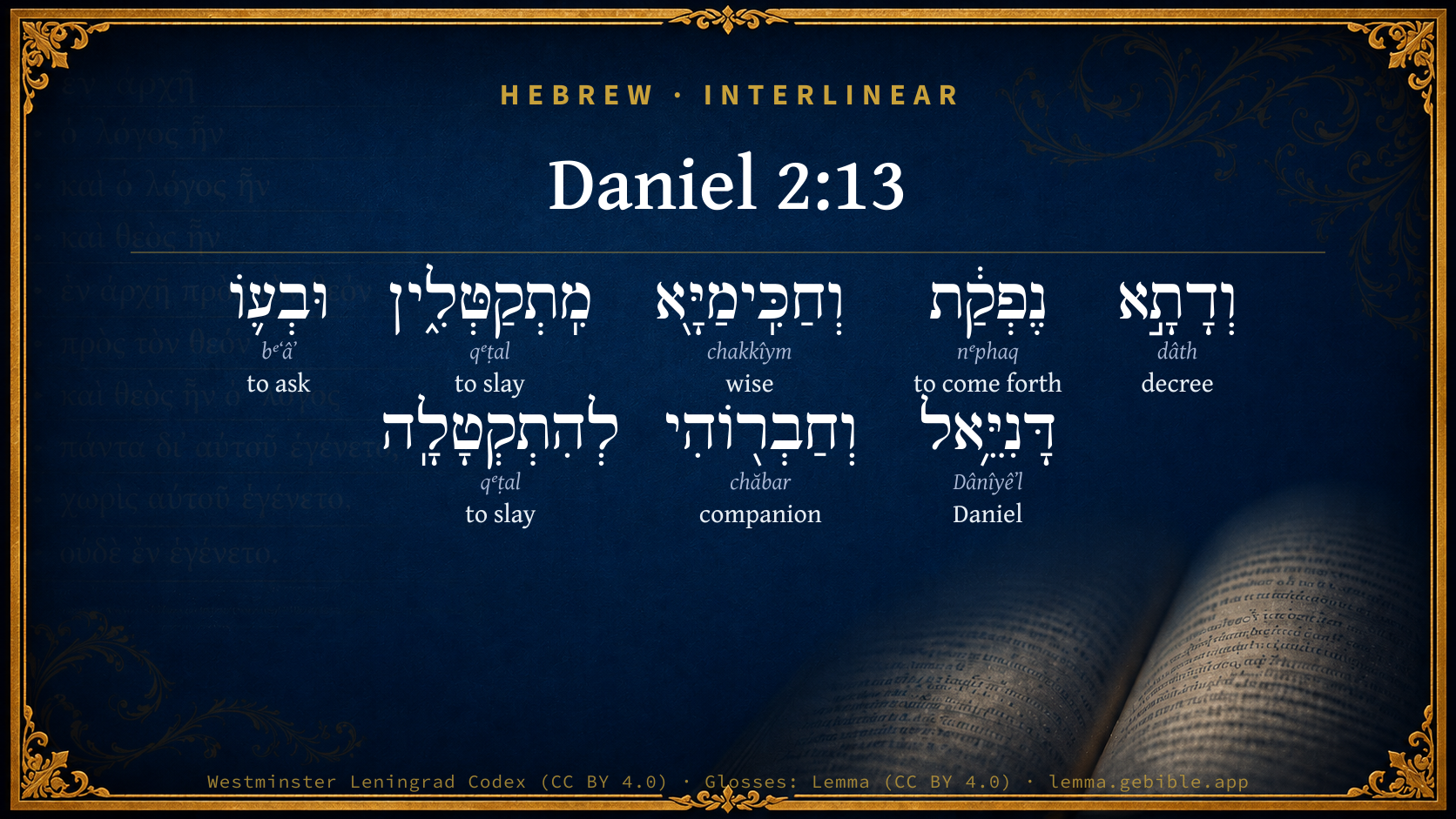
Hebrew (Westminster Leningrad Codex) Daniel 2:13 appears in the Hebrew Old Testament. The text above is from the Westminster Leningrad Codex. Each word links to its Strong’s number, a concise gloss, and parsing drawn from the Open Scriptures Hebrew Bible morphology. Click any word for its full Brown-Driver-Briggs (BDB) entry.
Download image
Cite this verse

Daniel 2:13 (World English Bible). Public Domain. Lemma interlinear Bible study tool, https://lemma.gebible.app/v/daniel/2/13.

Show BibTeX & RIS
BibTeX
RIS
English Translation
So the decree went forth, and the wise men were to be slain; and they sought Daniel and his companions to be slain.
World English Bible · Public Domain
Highlights
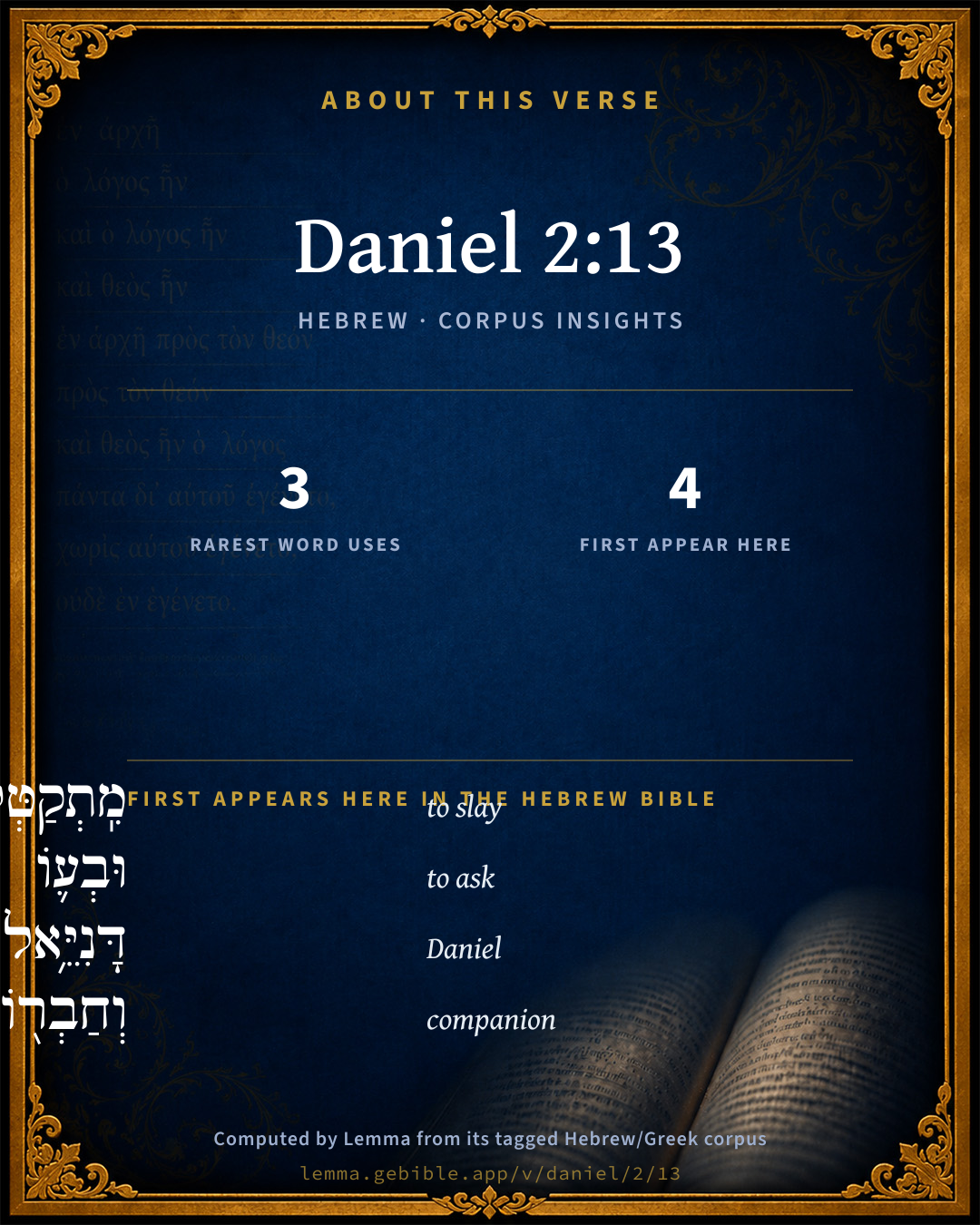
  • 4 first appearances in the Hebrew Bible
Full analysis ↓
Download a study sheet

One document with this verse’s original text, its word-by-word gloss line, the meaning frame, cross-references with their text, attributed commentary, and full source and license credits — printable, and it pastes into notes with its structure intact.

This verse Autodidact and up

Study sheet (.html) Plain text (.txt)

A passage Seminary Student

Up to 50 verses in one chapter. A passage sheet keeps up to 6 commentary sources and 12 cross-references per verse, in the order this page ranks them, and says so on the sheet whenever that leaves anything out. Ask for a single verse and you get the Autodidact verse sheet above.

Everything on this page stays free to read, with no account — the sheet is a download of what is already on screen, not access to it.

Want to remove ads? Support Godless Engineer
Compare translations 3

The same verse in 3 English versions, stacked beneath the original-language interlinear above. Click any original word for its lexicon entry.

Each is an independent rendering of the whole verse — the interlinear is not word-aligned to these translations.

Highlighted words mark where these versions differ — a whole-verse word diff, not a word-by-word alignment.

  • World English Bible Public Domain
    So the decree went forth, and the wise men were to be slain; and they sought Daniel and his companions to be slain.
  • King James Version Public Domain
    And the decree went forth that the wise men should be slain; and they sought Daniel and his fellows to be slain.
  • unfoldingWord Literal Text CC BY-SA 4.0
    So the decree went out that the wise men were to be killed; and they searched for Daniel and his friends to kill them.

unfoldingWord Literal Text — © unfoldingWord, licensed CC BY-SA 4.0. Word-aligned USFM3 via Door43 (git.door43.org/unfoldingWord/en_ult).

Versions to compare (up to 4)

3 of 4 selected

Show all 18 translations

Every available English version of this verse, each an independent rendering of the whole verse.

  • World English Bible Public Domain
    So the decree went forth, and the wise men were to be slain; and they sought Daniel and his companions to be slain.
  • Berean Standard Bible Public Domain
    So the decree went out that the wise men were to be executed, and men went to look for Daniel and his friends to execute them.
  • Majority Standard Bible Public Domain
    So the decree went out that the wise men were to be executed, and men went to look for Daniel and his friends to execute them.
  • King James Version Public Domain
    And the decree went forth that the wise men should be slain; and they sought Daniel and his fellows to be slain.
  • American Standard Version (1901) Public Domain
    So the decree went forth, and the wise men were to be slain; and they sought Daniel and his companions to be slain.
  • Revised Version (1885) Public Domain
    So the decree went forth, and the wise men were to be slain; and they sought Daniel and his companions to be slain.
  • Geneva Bible (1599) Public Domain
    And when sentence was giuen, the wise men were slayne: and they sought Daniel and his fellowes to be put to death.
  • Douay-Rheims (1899) Public Domain
    And the decree being gone forth, the wise men were slain: and Daniel and his companions were sought for, to be put to death.
  • Young's Literal Translation Public Domain
    And the sentence hath gone forth, and the wise men are being slain, and they have sought Daniel and his companions to be slain.
  • Literal Standard Version CC BY-SA 4.0
    And the sentence has gone forth, and the wise men are being slain, and they have sought Daniel and his companions to be slain.
  • Unlocked Literal Bible CC BY-SA 4.0
    So the decree went out that all those who were known for their wisdom were to be put to death. Because of this decree, they searched for Daniel and his friends so they could be put to death.
  • unfoldingWord Literal Text CC BY-SA 4.0
    So the decree went out that the wise men were to be killed; and they searched for Daniel and his friends to kill them.
  • Darby Bible Public Domain
    And the decree went forth that the wise men were to be slain; and they sought Daniel and his companions to slay them.
  • World Messianic Bible Public Domain
    So the decree went out, and the wise men were to be slain. They sought Daniel and his companions to be slain.
  • Webster's Bible Public Domain
    And the decree went forth that the wise men should be slain; and they sought Daniel and his fellows to be slain.
  • Free Bible Version CC BY-SA 4.0
    The decree was issued. The wise men were about to be executed, and the king's men went looking for Daniel and his friends.
  • Bible in Basic English Public Domain
    So the order went out that the wise men were to be put to death; and they were looking for Daniel and his friends to put them to death.
  • JPS Tanakh (1917) Public Domain
    So the decree went forth, and the wise men were to be slain; and they sought Daniel and his companions to be slain.

Literal Standard Version (2020), Covenant Press — licensed CC BY-SA 4.0. Text via the HelloAO Bible API (eBible.org). Unlocked Literal Bible (unfoldingWord) — licensed CC BY-SA 4.0. Text via the HelloAO Bible API (eBible.org). unfoldingWord Literal Text — © unfoldingWord, licensed CC BY-SA 4.0. Word-aligned USFM3 via Door43 (git.door43.org/unfoldingWord/en_ult). Free Bible Version, Dr. Jonathan Gallagher — licensed CC BY-SA 4.0. Text via the HelloAO Bible API (eBible.org).

Word by word

More ways to search: Search by grammar → Find every occurrence → Compare this word →

Practice this passage: Drill this verse → Learn its vocabulary →

וְחַבְר֖וֹהִי
chăbar
H2269
“and · companions · his”
Adjective, C + Noun, Common, Masculine, Plural, Construct + Suffix, Personal, 3rd Person, Masculine, Singular
Part of Speech
Adjective + Noun
Type
Common
Gender
Masculine
Number
Plural
State
Construct
Full BDB Definition

Origin: from a root corresponding to H2266

TWOT: 2717 , 2717a

associate, companion, friend, comrade, fellow
  1. וְדָתָ֣א dâth H1882 “and · decree · the” Adjective, C + Noun, Common, Feminine, Singular, Determined + Particle, Definite Article
  2. נֶפְקַ֔ת nᵉphaq H5312 “to come forth” Adjective, V, Plural
  3. וְחַכִּֽימַיָּ֖א chakkîym H2445 “and · wise men · the” Adjective, C + Noun, Common, Masculine, Plural, Determined + Particle, Definite Article
  4. מִֽתְקַטְּלִ֑ין qᵉṭal H6992 “slaying” Adjective, V
  5. וּבְע֛וֹ bᵉʻâʼ H1156 “and · to ask” Adjective, C + Verb, Qal, Perfect, 3rd Person, Masculine, Plural
  6. דָּנִיֵּ֥אל Dânîyêʼl H1841 “Daniel” Adjective, N
  7. לְהִתְקְטָלָֽה qᵉṭal H6992 “to slay” Adjective, R + Verb, Poal, Infinitive Construct

About this verse

These counts appear in no published source. They are computed here, from the morphology-tagged text and Lemma’s own curated glosses. What Lemma adds →

8
words
7
distinct lemmas
Prophets
section

Notable vocabulary

The rarest word here is וְחַבְר֖וֹהִי companion H2269 — appearing just 3 times in the whole Hebrew Bible.

First appearance in Scripture

These words make their first canonical appearance in the Hebrew Bible here:

  • מִֽתְקַטְּלִ֑ין to slay H6992
  • וּבְע֛וֹ to ask H1156
  • דָּנִיֵּ֥אל Daniel H1841
  • וְחַבְר֖וֹהִי companion H2269

Shared distinctive vocabulary

וְחַבְר֖וֹהִי companion H2269 occurs in 3 verses of the Hebrew Bible. Also found in:

Grammatical profile

  • 2 verbs
  • 1 noun
  • 3 adjectives
  • 2 particles

Verb forms

  • וּבְע֛וֹ Qal · Perfect
  • לְהִתְקְטָלָֽה Poal · Infinitive Construct

Repetition

A word recurs within this verse — often emphatic in Hebrew:

  • מִֽתְקַטְּלִ֑ין to slay H6992 ×2

Hebrew & Septuagint length

In English translation the verse runs 23 words from the Hebrew and 23 from the Septuagint (LXX English) — the same length.

A rough comparison of the two English renderings, which tokenize alike — not a word-level alignment.

Word counts can differ between the Hebrew and the Greek without any difference in meaning — e.g. the Hebrew direct-object marker אֵת has no separate Greek word, and Greek often adds the article ὁ.

Cross-references

6

Topical passages linked to Daniel 2:13 in the Treasury of Scripture Knowledge — connected by theme and wording, ordered by reader-vote popularity; previews shown in the World English Bible.

  • Daniel 1:19–20 The king talked with them; and among them all was found none like Daniel, Hananiah, Mishael, and Azariah: therefore stood they before the king.
  • Esther 3:12–15 Then were the king's scribes called in the first month, on the thirteenth day of it; and there was written according to all that Haman commanded to the king's satraps, and to the governors who were over every province, and to the princes of every people, to every province according to the writing of it, and to every people after their language; in the name of king Ahasuerus was it written, and it was sealed with the king's ring.
  • Psalms 94:20 Shall the throne of wickedness have fellowship with you, Which brings about mischief by statute?
  • Proverbs 28:15–17 As a roaring lion or a charging bear, So is a wicked ruler over helpless people.
  • Isaiah 10:1 Woe to those who decree unrighteous decrees, and to the writers who write perverseness;
  • Daniel 6:9–15 Therefore king Darius signed the writing and the interdict.

Cross-references courtesy of OpenBible.info (CC BY 4.0).

Hebrew and Greek witnesses Masoretic Hebrew ↔ Greek Septuagint

The same verse in the two great witnesses to the Old Testament, shown verse-for-verse.

These are two independent witnesses, not word-aligned to each other, and the Septuagint is shown in lemma (dictionary) form.

Hebrew Daniel 2:13 Masoretic · Westminster Leningrad Codex

וְדָתָ֣א נֶפְקַ֔ת וְחַכִּֽימַיָּ֖א מִֽתְקַטְּלִ֑ין וּבְע֛וֹ דָּנִיֵּ֥אל וְחַבְר֖וֹהִי לְהִתְקְטָלָֽה

So the decree went forth, and the wise men were to be slain; and they sought Daniel and his companions to be slain.

World English Bible · Public Domain

Greek LXX Daniel 2:13 Septuagint · lemma form

καί δογματίζω πᾶς ἀποκτείνω ζητέω δέ ὁ δανιηλ καί πᾶς ὁ μετά αὐτός χάρις ὁ συν ἀποὄλλυμι

So the decree went forth, and they began to kill the wise men; and they sought Daniel and his fellows to kill them.

LXX2012 (modern English Septuagint) · Public Domain

On this verse, John Gill's Exposition discusses the Septuagint’s reading. Read the note in Commentary ↓

Hebrew: Westminster Leningrad Codex (CC BY 4.0). Greek: Septuagint (public domain); English from LXX2012 (modern English Septuagint) (Public Domain). How the Septuagint differs from the Hebrew →

Commentary

Notes on Daniel 2:13 from classic Christian and Jewish commentators (each source and its license shown beneath its notes). The classic Christian expositions comment on the surrounding passage and are grouped to its opening verse, so a note may address several verses; the Jewish commentaries on the Tanakh (Rashi and others) are per-verse, so they appear only where the commentator wrote on this verse.

Lemma curates 59 commentaries, every one of them public domain or Creative Commons licensed, each selected and text-cleaned for this edition rather than reprinted as found. About our sources →

Trapp's Complete Commentary

John Trapp

Dan 2:13 And the decree went forth that the wise [men] should be slain; and they sought Daniel and his fellows to be slain.

Ver. 13. And the decree went forth that the wise men should be slain.] And the wise men were slain, saith the Vulgate; some of them likely were cut off. The end of worldly wisdom is certain destruction.

And they sought Daniel and his fellows to be slain.] Wicked decrees are wrested to the butchery of the saints; as was that of the six articles here in Henry VIII’s days.

John Trapp, A Commentary or Exposition upon All the Books of the Old and New Testament (1647–1656) — public domain. Text from a community e-Sword module.

Ibn Ezra

Rabbi Abraham ibn Ezra

[Daniel 2:13] V'data nefqat (וְדָתָא נֶפְקַת - And the decree went out): The decree went out from before the king.

Ibn Ezra on the Tanakh — English translations: “Sefaria Community Translation” (CC0 1.0 (public-domain dedication)); “Yalkut, Sifsei Chachomim Chumash, Metsudah Publications, 2009” (CC BY 4.0); and “Commentary of Ibn Ezra on Isaiah - trans. by M. Friedlander, 1873” (public domain). Text via Sefaria.

Geneva Bible (1599)

Geneva Bible translators

Which declareth that God would not have his servant joined in the company of these sorcerers and Astrologers, whose arts were wicked, and therefore justly ought to die, though the king did it upon a rage and no zeal.

Geneva Bible (1599) marginal notes — public domain. Text via Bolls.life.

Adam Clarke's Commentary

Verse 13. They sought Daniel and his fellows] As the decree stated that all the wise men of Babylon should be slain, the four young Hebrews, being reputed among the wisest, were considered as sentenced to death also.

Adam Clarke's Commentary on the Bible (1810–1826) — public domain. Text from a community e-Sword/MySword module.

John Calvin's Commentaries

It appears from these words that some of the wise men had been slain, for Daniel at first is not required for slaughter; but when the Magi and Chaldeans were promiscuously dragged out for punishment, Daniel and his companions were in the same danger. And this is clearly expressed thus — widen the edict had gone forth, that is, was published, according to the Latin phrase, and the wise mere were slain, then Daniel was also sought for; because the king would never suffer his decree to be despised after it had once been published; for if he had publicly commanded this to be done, and no execution had been added, would not this have been ridiculous? Hence, very probably, the slaughter of the Magi and Chaldeans was extensive. Although the king had no lawful reason for this conduct, yet they deserved their punishment; for, as we said yesterday, they deserved to be exterminated from the world, and the pest must be removed if it could possibly be accomplished. If Nebuchadnezzar had been like David, or Hezekiah, or Josiah, he might most justly have destroyed them all, and have purged the land from such defilements; but as he was only carried away by the fervor of his wrath, he was himself in fault. Meanwhile, God justly punishes the Chaldeans, and this admonition ought to profit the whole people. They were hardened in their error, and were doubtless rendered more excuseless by being blinded against such a judgment of God. Because Daniel was condemned to death, though he had not been called by the king, the injustice of the edicts of those kings who do not inquire into the causes of which they are judges, becomes more manifest.

John Calvin's Commentaries (1540-1563) — public domain. Text from the Calvin Translation Society English edition (1840s-50s) via the Christian Classics Ethereal Library (ccel.org). Calvin's coverage is partial (roughly two-thirds of the Bible); uncommented books and verses are honest gaps, never fabricated. The 19th-century editor's footnotes and remarks are omitted so the notes are faithfully Calvin's own voice.

The Cambridge Bible for Schools and Colleges

gen. ed. J. J. S. Perowne

13. the decree went forth] Cf. Luk_2:2, where the Greek is exactly the same as that of Theodotion’s rendering here (τὸ δόγμα ἐξῆλθε).

that the wise men, &c.] and the wise men were to be slain (R.V.). See Kautzsch, Gramm. § 76. 3.

fellows] companions (R.V.), as Dan_2:17. So Dan_2:18.

13–16. Daniel and his three companions, being regarded now (cf. Dan_1:17-20) as belonging to the class of ‘wise men,’ and being consequently involved in the condemnation, are in danger of their lives; but Daniel, through Arioch’s intervention, obtains an audience of the king, and promising to tell him his dream, gets execution of the sentence deferred.

The Cambridge Bible for Schools and Colleges (gen. ed. J. J. S. Perowne; Cambridge University Press, 1878–1918) — public domain. Text from a community e-Sword module.

John Gill's Exposition

And the decree went forth that the wise men should be slain,.... Or, "and the wise men were slain" (h), as the Septuagint, Vulgate Latin, and Syriac versions render it; and so Saadiah: orders were given by the king to his proper officers, and his edict was published, and his will made known in the usual manner; upon which the wise men, at least some of them, were slain; very probably those who were in the king's presence, and at court; and the officers were gone out to slay the rest:

and they sought Daniel and his fellows to be slain; who had the character of wise men, and might be envied at court, and so the officers took this opportunity, having these orders, to slay them: there was, no doubt, a particular providence, that Daniel and his friends should not be at court at this time; both that the vanity of the Chaldean wisdom and arts might be the more manifest and made known, and the divine and superior wisdom and knowledge of Daniel might be more conspicuous, and his fame be spread in Babylon, and in other provinces.

(h) "et sapientes interficiebantur", Pagninus, Montanus, Munster, Piscator, Michaelis.

John Gill's Exposition of the Whole Bible (1746–1763) — public domain (CC PDM 1.0). Text via the HelloAO Bible API.

Albert Barnes' Notes on the Bible

And the decree went forth that the wise men should be slain - The original here will bear a somewhat different translation, meaning, “the decree went forth, “and” the wise men were slain;” that is, the execution of the sentence was actually commenced. So the Vulgate: Et egressa sententia, sapientes interficiebantur. So also the Greek version: καὶ οἱ σοφοί ἀπεκτέννοντο kai hoi sophoi apektennonto - “and the wise men were slain.” This seems to me to be the more probable interpretation, and better to suit the connection. Then it would mean that they had actually begun to execute the decree, and that in the prosecution of their bloody work they sought out Daniel and his companions, and that by his influence with Arioch the execution of the sentence was arrested.

And they sought Daniel and his fellows to be slain - His three companions Dan 1:6, who probably had not been among those who were summoned to court to explain the matter. Had they been consulted at first, the issuing of the decree would have been prevented, but it seems to have been the design of Providence to give the fairest trial of the ability of these sages, and to allow matters to come to a crisis, in order to show that what was done was wholly beyond human power.

Albert Barnes' Notes on the Bible (1834–1885) — public domain. Text from a community e-Sword/MySword module.

Haydock's Catholic Bible Commentary

Slain. Literally, "were slaughtering;" interficiebantur. (Haydock) --- Many think that some had already suffered. (Geier.; Menochius) --- The had been perhaps jealous of Daniel, and had not informed him of the matter. (St. Jerome)

George Leo Haydock (1774–1849), Haydock's Catholic Family Bible and Commentary, 1859 edition — public domain. Excludes Psalms (Douay-Rheims chapter numbering differs from Protestant) and Deuterocanonical books (Catholic canon only).

Matthew Poole's English Annotations

This was unjust, that Daniel and his fellows should have their share in the punishment, and yet be excluded from the other part which was the reward; the reason why they were not called was because of their youth, which the Chaldeans despised, wherein we have these three things observable.

1. The magicians confessed this, that knowledge and revelation must come from God, and therefore what Daniel did was not by any human strength, but Divine only.

2. That the Lord held the governor’s hands, so that he did not slay Daniel presently with the first.

3. That Daniel, by his prudence and piety, saved all the magicians’ lives.

Matthew Poole's English Annotations on the Holy Bible (1683–1685) — public domain. Text from a community e-Sword/MySword module.

The Pulpit Commentary

And the decree went forth that the wise men should be slain. As the Aramaic stands, it might be translated as does Professor Fuller, "And the decree went forth, and the wise men were being slain;" the wO of co-ordination maybe regarded as here used of Subordination. Further, the use of the participle for the preterite is not by any means uncommon in Daniel, certainly mainly in the principal clause, as in ver. 5 of the present chapter. Noldeke, in his "Syriac Grammar," 278 a, gives examples of the passive participle being used as here in the subordinate clause. The Septuagint is very condensed, but possibly drawn from a similar text, only such extreme condensation is unlike the translator elsewhere. It is possible that some part of the dqP. (peqad), "to decree," was used, perhaps the participle hithpael. It is possible that the verb qetal was in the infinitive. Theodotion renders, "And the decree went forth, and the wise men were slain." This, though a possible translation, does not fit what we find represented to be the circumstances, as ver. 24 seems to assume that the wise men were not yet destroyed. On the other hand, it would be hardly possible to imagine the king allowing these wise men who had refused to answer his question, to go out of his presence in safety and unbound. It would seem more natural to imagine that they were carried off to prison, and that all the soothsaying class were intended to be gathered together in prison, in order that the vengeance of the king might be more appallingly manifest. The sentence looks at first sight to us as too savage to be true, but just as savage proofs of vengeance were given by Asshurbanipal. And they sought Daniel and his fellows to be slain. The Septuagint translation of this clause is somewhat paraphrastic, "And Daniel was sought for and all those with him in order to be put to death." The want of an antecedent to fix the nominative of the verb probably led to the sentence assuming its present mould; but "all" seems to have no word to occasion it. Theodotion follows the Massoretic text closely; so also does the Peshitta. It is clear from this that Daniel and his companions had not been summoned into the royal presence when the question concerning the dream was put to the wise men. This would seem to contradict the statement of Dan_1:19, "Therefore stood they to wit these Hebrew youths the king." Their position was probably like those who had passed the examination for the Indian Civil Service they are accepted, but they have still a season of study, and then, after they go out to India, they occupy only subordinate situations at first. While permited to enter the ranks of the soothsayers and astrologers to the court, they were placed at first only in the lower grades, and would have to rise by degrees, and in ordinary circumstances a long time would elapse before they would be summoned into the immediate presence of the sovereign. On the reading of the LXX, Daniel and his friends would not, because they were Jews, and not Chaldeans. One has only to turn to the Talumdic tales to see how unlike this reasonable position is to the ordinary Jewish fictitious narrative. The Book of Daniel is not nearly prodigal enough in wonders to be a representative of the Jewish Midrash. It is further clear that the decree of the king went beyond those who had actually been in his council-chamber on that merest-able day. The idea of the king probably was that the treason which he had found in the heads of the various classes of Chaldean soothsayers would have permeated all the members. Babylonian and foreign, as well; therefore he orders them all to suffer a common fate. Wieseler"s hypothesis, that this event took place close to the end of the three years of study which had been assigned to these youths, would suit the statement of events which we find here; although it is not necessary, yet on this assumption, the succession of events as narrated in this chapter becomes perfectly natural.

The Pulpit Commentary (1880–1919), ed. H.D.M. Spence-Jones & Joseph S. Exell — public domain. Text from a community e-Sword module.

John Wesley's Explanatory Notes

Daniel and his fellows - Daniel and his fellows were not called, because of their youth, which the Chaldeans despised. Here it is observable:

1. The magicians confessed, that knowledge and Revelation must come from God, and therefore what Daniel did, was not of any human strength.

2. That the Lord held the governor's hands, so that he did not slay Daniel presently with the first.

3. That Daniel by his prudence and piety, saved all the magicians lives.

John Wesley, Explanatory Notes Upon the Whole Bible (1754–1765) — public domain. Text via the GEBible commentary corpus.

Rashi

Rabbi Shlomo Yitzchaki (Rashi)

And a decree was issued The law of the king and his decree were issued in the province.

and Daniel and his colleagues were sought to be slain [as translated,] and Daniel and his colleagues were sought to be slain.

Rashi on the Tanakh — English translations: “The Judaica Press complete Tanach with Rashi, translated by A. J. Rosenberg” (CC BY 4.0); “Pentateuch with Rashi's commentary by M. Rosenbaum and A.M. Silbermann, 1929-1934” (public domain); “The Metsudah Tanach series, Lakewood, N.J” (CC BY 4.0); and “The Book of Joshua, Metsudah Publications, 1997” (CC BY 4.0). Text via Sefaria.

Lesson kit

Teaching starters — assembled from the data on this page, not authored interpretation. Every prompt links to the verse data it draws on. Edit before teaching.

Daniel, in the Prophets, opens this verse with 8 words (7 distinct Hebrew lemmas). Its most distinctive word is chăbar (“companion”). A historical commentator’s framing appears above. Read the whole chapter for the surrounding context.

Discussion questions

  1. The word chăbar carries the sense “companion.” How does it shape the verse?
  2. 4 words make their first appearance in Scripture here. What does this debut establish?
  3. How does Daniel 2:17, which shares the word «companion», read alongside this verse?
  4. What does the repetition of “to slay” (2× in this one verse) do in this verse?
  5. These translations render this verse differently. What is at stake in choosing one wording over another?
  6. «וּבְע֛וֹ» is a Qal Perfect verb. How does that grammatical form shape the action described?
  7. Compare how Trapp's Complete Commentary and Ibn Ezra read this verse. Where do they agree or differ?

Things to notice

  • 4 words make their first canonical appearance in Scripture here.
  • These translations choose different wording for 11 words in this verse.
  • “to slay” occurs 2× in this single verse.
  • 7 distinct Hebrew lemmas span 8 words in this verse.

Reading settings

Reading text

Shown beneath each verse's original-language words.

Old Testament
Old Testament edition

Read the OT as the Masoretic Hebrew (MT) or the Greek Septuagint (LXX).

English shown for the Greek Septuagint (in the Hebrew ↔ Greek comparison).

Comparing translations? Open the Compare panel on any verse page to stack up to four side by side.