
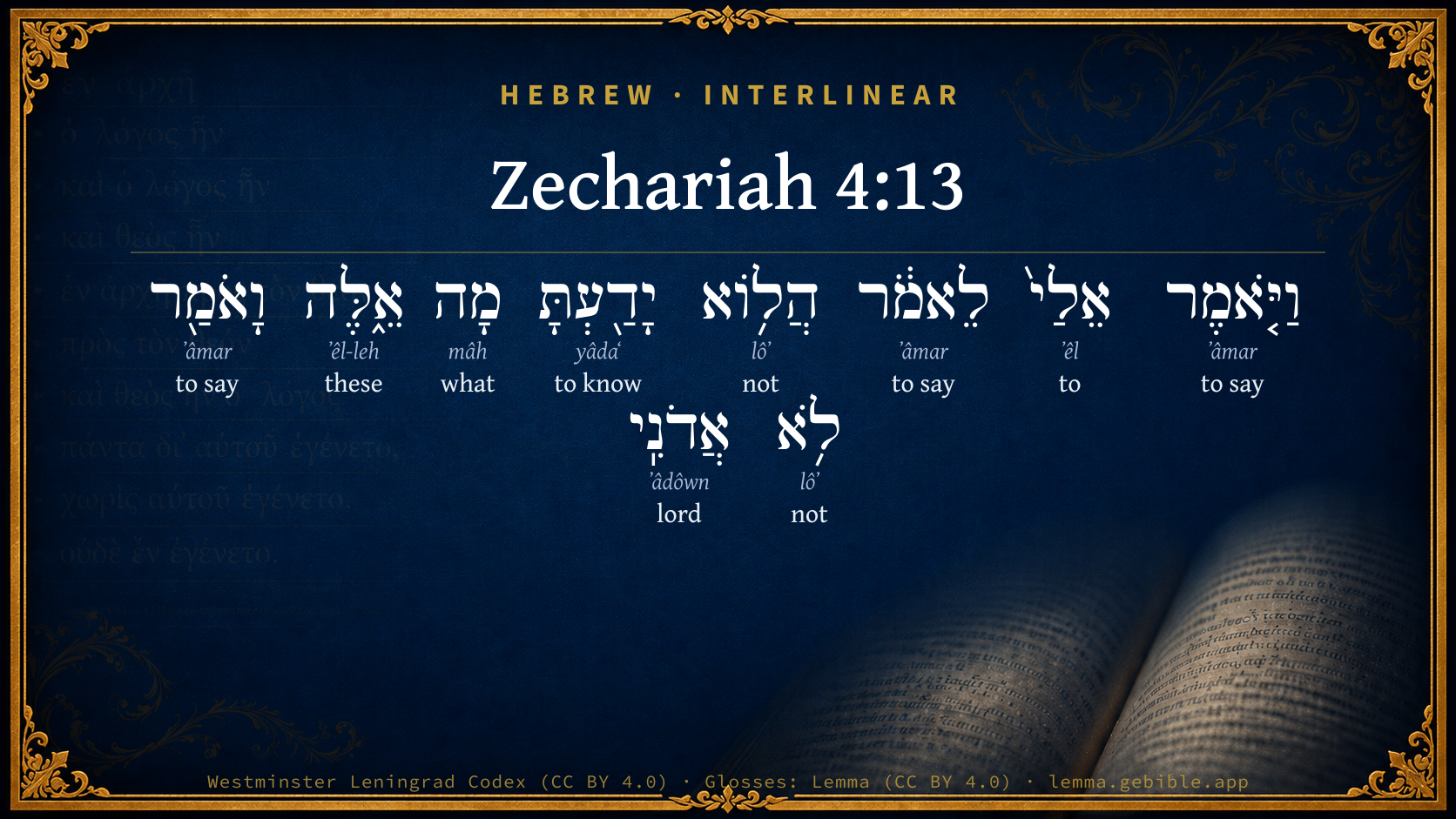
Zechariah 4:13

Hebrew (Westminster Leningrad Codex) Zechariah 4:13 appears in the Hebrew Old Testament. The text above is from the Westminster Leningrad Codex. Each word links to its Strong’s number, a concise gloss, and parsing drawn from the Open Scriptures Hebrew Bible morphology. Click any word for its full Brown-Driver-Briggs (BDB) entry.
Download image
Cite this verse

Zechariah 4:13 (World English Bible). Public Domain. Lemma interlinear Bible study tool, https://lemma.gebible.app/v/zechariah/4/13.

Show BibTeX & RIS
BibTeX
RIS
English Translation
He answered me, "Don't you know what these are?" I said, "No, my lord."
World English Bible · Public Domain
Download a study sheet

One document with this verse’s original text, its word-by-word gloss line, the meaning frame, cross-references with their text, attributed commentary, and full source and license credits — printable, and it pastes into notes with its structure intact.

This verse Autodidact and up

Study sheet (.html) Plain text (.txt)

A passage Seminary Student

Up to 50 verses in one chapter. A passage sheet keeps up to 6 commentary sources and 12 cross-references per verse, in the order this page ranks them, and says so on the sheet whenever that leaves anything out. Ask for a single verse and you get the Autodidact verse sheet above.

Everything on this page stays free to read, with no account — the sheet is a download of what is already on screen, not access to it.

Want to remove ads? Support Godless Engineer
Compare translations 3

The same verse in 3 English versions, stacked beneath the original-language interlinear above. Click any original word for its lexicon entry.

Each is an independent rendering of the whole verse — the interlinear is not word-aligned to these translations.

Highlighted words mark where these versions differ — a whole-verse word diff, not a word-by-word alignment.

  • World English Bible Public Domain
    He answered me, "Don't you know what these are?" I said, "No, my lord."
  • King James Version Public Domain
    And he answered me and said, Knowest thou not what these be? And I said, No, my lord.
  • unfoldingWord Literal Text CC BY-SA 4.0
    And he said to me, saying, “Do you not know what these are?” And I said, “No, my lord.”

unfoldingWord Literal Text — © unfoldingWord, licensed CC BY-SA 4.0. Word-aligned USFM3 via Door43 (git.door43.org/unfoldingWord/en_ult).

Versions to compare (up to 4)

3 of 4 selected

Show all 18 translations

Every available English version of this verse, each an independent rendering of the whole verse.

  • World English Bible Public Domain
    He answered me, "Don't you know what these are?" I said, "No, my lord."
  • Berean Standard Bible Public Domain
    “Do you not know what these are?” he inquired. “No, my lord,” I replied.
  • Majority Standard Bible Public Domain
    “Do you not know what these are?” he inquired. “No, my lord,” I replied.
  • King James Version Public Domain
    And he answered me and said, Knowest thou not what these be? And I said, No, my lord.
  • American Standard Version (1901) Public Domain
    And he answered me and said, Knowest thou not what these are? And I said, No, my lord.
  • Revised Version (1885) Public Domain
    And he answered me and said, Knowest thou not what these be? And I said, No, my lord.
  • Geneva Bible (1599) Public Domain
    And hee answered me, and saide, Knowest thou not what these bee? And I sayde, No, my Lord.
  • Douay-Rheims (1899) Public Domain
    And he spoke to me, saying: Knowest thou not what these are? And I said: No, my lord.
  • Young's Literal Translation Public Domain
    And he speaketh unto me, saying, `Hast thou not known what these `are'?' And I say, `No, my lord.'
  • Literal Standard Version CC BY-SA 4.0
    And he speaks to me, saying, “Have you not known what these [are]?” And I say, “No, my lord.”
  • Unlocked Literal Bible CC BY-SA 4.0
    Then he said to me, “Do you not know what these are?” I said, “No, my master.”
  • unfoldingWord Literal Text CC BY-SA 4.0
    And he said to me, saying, “Do you not know what these are?” And I said, “No, my lord.”
  • Darby Bible Public Domain
    And he spoke to me, saying, Knowest thou not what these are? And I said, No, my lord.
  • World Messianic Bible Public Domain
    He answered me, “Don’t you know what these are?” I said, “No, my lord.”
  • Webster's Bible Public Domain
    And he answered me and said, Knowest thou not what these are? And I said, No, my lord.
  • Free Bible Version CC BY-SA 4.0
    “Don't you know?” the angel replied. “No, my lord,” I responded.
  • Bible in Basic English Public Domain
    And he said in answer to me, Have you no knowledge what these are? And I said, No, my lord.
  • JPS Tanakh (1917) Public Domain
    And he answered me and said: 'Knowest thou not what these are?' And I said: 'No, my lord.'

Literal Standard Version (2020), Covenant Press — licensed CC BY-SA 4.0. Text via the HelloAO Bible API (eBible.org). Unlocked Literal Bible (unfoldingWord) — licensed CC BY-SA 4.0. Text via the HelloAO Bible API (eBible.org). unfoldingWord Literal Text — © unfoldingWord, licensed CC BY-SA 4.0. Word-aligned USFM3 via Door43 (git.door43.org/unfoldingWord/en_ult). Free Bible Version, Dr. Jonathan Gallagher — licensed CC BY-SA 4.0. Text via the HelloAO Bible API (eBible.org).

Word by word

More ways to search: Search by grammar → Find every occurrence → Compare this word →

Practice this passage: Drill this verse → Learn its vocabulary →

אֲדֹנִֽי
ʼâdôwn
H113
“lord · my”
Noun, Common, Masculine, Singular, Construct + Suffix, Personal, 1st Person, Common, Singular
Part of Speech
Noun
Type
Common
Gender
Masculine
Number
Singular
State
Construct
Full BDB Definition

Origin: from an unused root (meaning to rule)

TWOT: 27b

firm, strong, lord, master - lord, master - reference to men - superintendent of household, of affairs - master - king - reference to God - the Lord God - Lord of the whole earth - lords, kings - reference to men - proprietor of hill of Samaria - master - husband - prophet - governor - prince - king - reference to God - Lord of lords (probably = "thy husband, Yahweh" ) - my lord, my master - reference to men - master - husband - prophet - prince - king - father - Moses - priest - theophanic angel - captain - general recognition of superiority - reference to God - my Lord, my Lord and my God - Adonai (parallel with Yahweh)
  1. וַיֹּ֤אמֶר ʼâmar H559 “and · to say” Conjunction + Verb, Qal, Sequential Imperfect, 3rd Person, Masculine, Singular
  2. אֵלַי֙ ʼêl H413 “to · me” Preposition + Suffix, Personal, 1st Person, Common, Singular
  3. לֵאמֹ֔ר ʼâmar H559 “to say” Preposition + Verb, Qal, Infinitive Construct
  4. הֲל֥וֹא lôʼ H3808 “not” Particle, Interrogative + Particle, Negative
  5. יָדַ֖עְתָּ yâdaʻ H3045 “to know” Verb, Qal, Perfect, 2nd Person, Masculine, Singular
  6. מָה mâh H4100 “what” Particle, Interrogative
  7. אֵ֑לֶּה ʼêl-leh H428 “these” Pronoun, Demonstrative, Common, Plural
  8. וָאֹמַ֖ר ʼâmar H559 “and · to say” Conjunction + Verb, Qal, Sequential Imperfect, 1st Person, Common, Singular
  9. לֹ֥א lôʼ H3808 “not” Particle, Negative

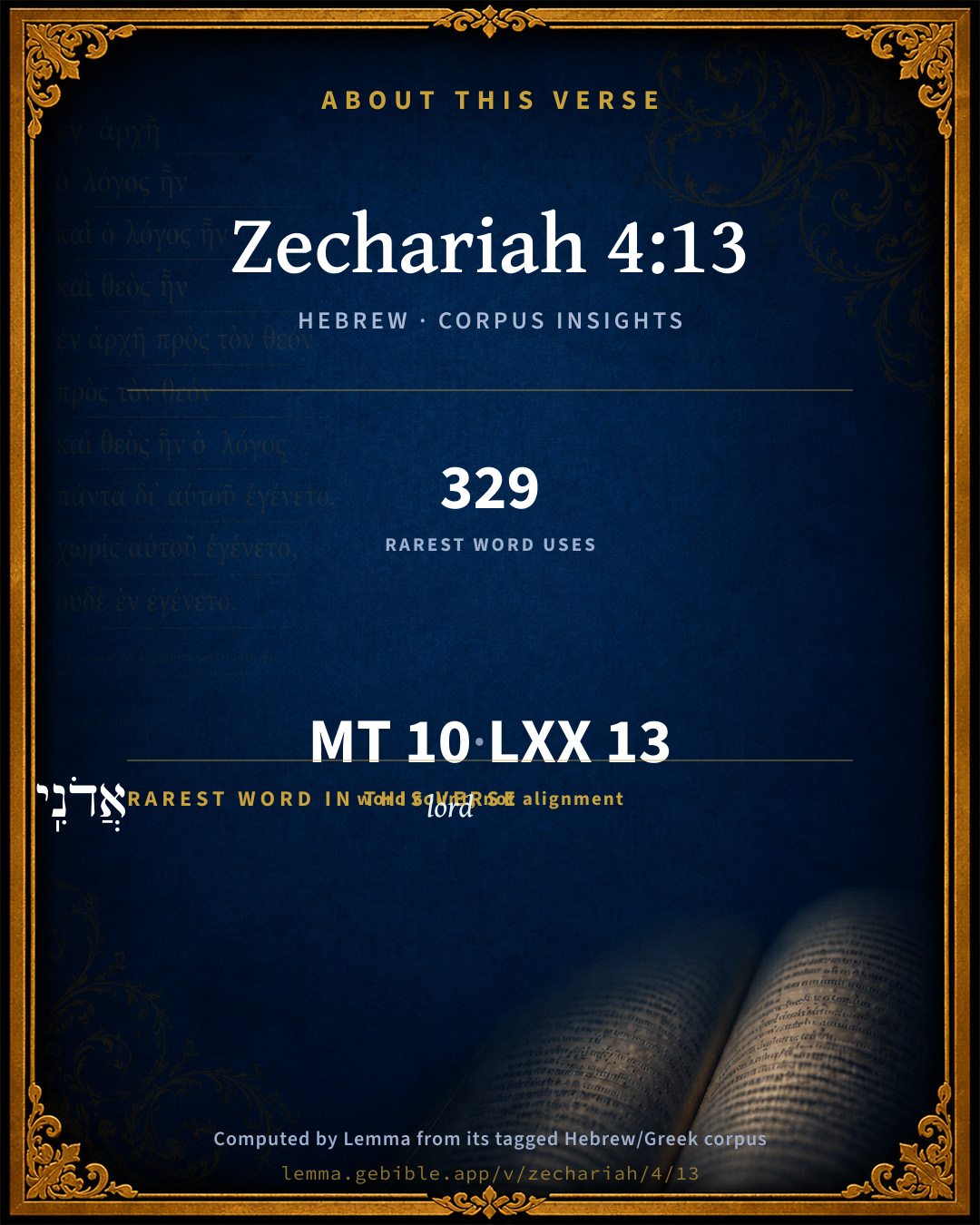
About this verse

These counts appear in no published source. They are computed here, from the morphology-tagged text and Lemma’s own curated glosses. What Lemma adds →

10
words
7
distinct lemmas
Prophets
section

Grammatical profile

  • 4 verbs
  • 1 noun
  • 1 pronoun
  • 1 preposition
  • 3 particles

Verb forms

  • וַיֹּ֤אמֶר Qal · Sequential Imperfect
  • לֵאמֹ֔ר Qal · Infinitive Construct
  • יָדַ֖עְתָּ Qal · Perfect
  • וָאֹמַ֖ר Qal · Sequential Imperfect

Repetition

Words recur within this verse — often emphatic in Hebrew:

  • וַיֹּ֤אמֶר to say H559 ×3
  • הֲל֥וֹא not H3808 ×2

Hebrew & Septuagint length

In English translation the verse runs 14 words from the Hebrew and 17 from the Septuagint (LXX English) — closely comparable.

A rough comparison of the two English renderings, which tokenize alike — not a word-level alignment.

Word counts can differ between the Hebrew and the Greek without any difference in meaning — e.g. the Hebrew direct-object marker אֵת has no separate Greek word, and Greek often adds the article ὁ.

In the original languages it is 10 Hebrew tokens and 13 Greek tokens — but the two are counted differently (Hebrew bundles its prefixes and suffixes into one token; the Greek is in lemma form), so that isn’t a like-for-like length.

Cross-references

2

Topical passages linked to Zechariah 4:13 in the Treasury of Scripture Knowledge — connected by theme and wording, ordered by reader-vote popularity; previews shown in the World English Bible.

  • Zechariah 4:5 Then the angel who talked with me answered me, "Don't you know what these are?" I said, "No, my lord."
  • Hebrews 5:11–12 About him we have many words to say, and hard to interpret, seeing you have become dull of hearing.

Cross-references courtesy of OpenBible.info (CC BY 4.0).

Hebrew and Greek witnesses Masoretic Hebrew ↔ Greek Septuagint

The same verse in the two great witnesses to the Old Testament, shown verse-for-verse.

These are two independent witnesses, not word-aligned to each other, and the Septuagint is shown in lemma (dictionary) form.

Hebrew Zechariah 4:13 Masoretic · Westminster Leningrad Codex

וַיֹּ֤אמֶר אֵלַי֙ לֵאמֹ֔ר הֲל֥וֹא יָדַ֖עְתָּ מָה אֵ֑לֶּה וָאֹמַ֖ר לֹ֥א אֲדֹנִֽי

He answered me, "Don't you know what these are?" I said, "No, my lord."

World English Bible · Public Domain

Greek LXX Zechariah 4:13 Septuagint · lemma form

καί εἶπον πρός ἐγώ οὐ οἶδα τίς εἰμί οὗτος καί εἶπον οὐ κύριος

And he said to me, Know you not what these are? and I said, No, my lord.

LXX2012 (modern English Septuagint) · Public Domain

Hebrew: Westminster Leningrad Codex (CC BY 4.0). Greek: Septuagint (public domain); English from LXX2012 (modern English Septuagint) (Public Domain). How the Septuagint differs from the Hebrew →

Targum (Aramaic paraphrase)

1

The Targum is the ancient Jewish Aramaic paraphrase of the Hebrew Scriptures — an interpretive translation, not the Hebrew text itself. Onkelos (literal) and Pseudo-Jonathan (expansive) render the Torah, and Jonathan the Prophets. Coverage is partial: where no permissively-licensed English translation exists for a verse, only the Aramaic is shown. This is verse-level text, not a word-by-word alignment to the Hebrew.

  1. Targum Jonathan Prophets (Joshua–Malachi)
    וַאֲמַר לִי לְמֵימַר הֲלָא יְדַעַתְּ מַן אִלֵין וַאֲמָרֵית לָא רִבּוֹנִי:

    (no public-domain English translation for this verse)

    Targum Jonathan — Aramaic: “Mikraot Gedolot” (public domain). English: “Sefaria Community Translation” (CC0 1.0 (public-domain dedication)); “London "Chaldee Paraphrase," 1871” (public domain). Text via Sefaria.

Commentary

Notes on Zechariah 4:13 from classic Christian and Jewish commentators (each source and its license shown beneath its notes). The classic Christian expositions comment on the surrounding passage and are grouped to its opening verse, so a note may address several verses; the Jewish commentaries on the Tanakh (Rashi and others) are per-verse, so they appear only where the commentator wrote on this verse.

Lemma curates 59 commentaries, every one of them public domain or Creative Commons licensed, each selected and text-cleaned for this edition rather than reprinted as found. About our sources →

Trapp's Complete Commentary

John Trapp

Zec 4:13 And he answered me and said, Knowest thou not what these [be]? And I said, No, my lord.

Ver. 13. Knowest thou not what, &c.] {See Trapp on "Zec 4:5"}

John Trapp, A Commentary or Exposition upon All the Books of the Old and New Testament (1647–1656) — public domain. Text from a community e-Sword module.

Jamieson, Fausset & Brown

Robert Jamieson, A. R. Fausset & David Brown

Knowest thou not--God would awaken His people to zeal in learning His truth.

Jamieson, Fausset & Brown — Commentary Critical and Explanatory on the Whole Bible (1871) — public domain (CC PDM 1.0). Text via the HelloAO Bible API.

John Calvin's Commentaries

We have also mentioned before, that the desire of improvement observed in Zechariah ought to be noticed. For though we attain not immediately what God teaches, yet the obscurity of a passage ought not to damp our ardor; but we ought rather to imitate the Prophet, who, in things difficult and unknown to him, asked explanations from the angel. Angels are not indeed sent now to us from heaven to answer our questions; but yet no one shall be without benefit who will humbly and with a sincere desire ask of God; for God will either by his ministers so elucidate what seems obscure to us and full of darkness, that we shall know that there is nothing but what is clear in his word; or he will by the Spirit of knowledge and judgment supply what is deficient in the ministrations of men.

And this is also the reason why the angel replies, Dost thou not know what these mean? For he does not upbraid Zechariah with ignorance, but rather reminds all the faithful, that they ought to quicken themselves, and to exert all their ardor to learn, lest sloth should close up the way against them. This reply, then, of the angel no doubt belongs to us all, “Dost thou not know what these mean?” We ought to remember that the things we esteem as common far exceed our thoughts. It indeed often happens that one runs over many parts of Scripture, and thinks that he reads nothing but what is clear and well known, while yet experience teaches us that we are inflated with too much self-confidence; for we look down, as it were from on high, on that doctrine which ought, on the contrary, to be reverently adored by us. Then let every one of us, being warned by this sentence of the angel, acknowledge that he as yet cleaves to first principles, or, at least, does not comprehend all those things which are necessary to be known; and that therefore progress is to be made to the very end of life: for this is our wisdom, to be learners to the end.

John Calvin's Commentaries (1540-1563) — public domain. Text from the Calvin Translation Society English edition (1840s-50s) via the Christian Classics Ethereal Library (ccel.org). Calvin's coverage is partial (roughly two-thirds of the Bible); uncommented books and verses are honest gaps, never fabricated. The 19th-century editor's footnotes and remarks are omitted so the notes are faithfully Calvin's own voice.

John Gill's Exposition

Then said he, These are the two anointed ones,.... Or "sons of oil" (t). Some think the gifts and graces of the Spirit are meant, which come from the God of all grace, remain with Christ, are given freely by him to the sons of God, and are always for the service of the church, and sufficient for it; others, Christ the Son of God, and the Holy Spirit. Christ is the anointed One, or son of oil, being anointed with the Holy Ghost to the office of Prophet, Priest, and King; and with which oil he has supplied his candlestick, the church, in all ages. The Holy Spirit is the oil of gladness, and that anointing which teacheth all things. And this is the sense of Capellus, as has been observed on Zac 4:2. And the learned and judicious Pemble makes a "query" of it, whether Christ and the Comforter; or Christ in his two natures; or Christ in his two offices of King and Priest of his church; or how else the words are to be understood: and this was the sense of Origen long ago, though censured by Jerom; it may be the rather, because he interprets the candlestick of the Father. But these epithets, "anointed ones", and "sons of oil", are very suitable to them; the one being called the Messiah, or anointed; and the other the unction, and the oil of gladness: and indeed, if by the golden oil emptied out of them is meant the grace of God, as it frequently signifies in Scripture, no other can be meant; since they are the inexhaustible fountain of all grace and gifts to the church in all ages, whereby it is supplied and supported; and may be said to "stand before the Lord of the whole earth", God the Father; who does not immediately by himself administer to the church, but by Christ the Head of it; and Christ communicates by his Spirit, whom he sends from himself, and from the Father: and the rather they may be thought to be meant, since the ministers of the word seem to be designed by the seven lamps which receive the oil, or gifts and graces of the Spirit, fitting them for their work, from the bowl on the top of the candlestick, which is supplied with it from these two olive trees; and therefore must be distinct from them, or otherwise they will be said to be supplied from themselves: though, whereas both Christ and the Spirit communicate by the word and the ordinances, administered by the faithful dispensers of the word; hence those witnesses of Christ, in all ages, may with propriety enough be called two anointed ones, and "the two olive trees", as they are in Rev 11:4 where there is a plain allusion to this passage. The Targum renders the words, "these are the two sons of princes", or "great men". Some Jewish writers interpret them of their two Messiahs, Messiah ben Joseph, and Messiah ben David (u). Some interpreters understand by them Enoch and Elias; others Peter and Paul; others, better, with Kimchi and Ben Melech, Joshua and Zerubbabel, the one anointed for the priesthood, and the other for the kingdom; of which two offices Jarchi interprets them; and others the two churches, Jewish and Christian.

That stand by the Lord of the whole earth; the Creator and Governor of the universe: ministers of the word are on his side, abide by his truths and ordinances, and are faithful to his cause and interest: or, "before the Lord of the whole earth" (w); they are his ministers, and serve him; they "stand", as it becomes them, which shows their work is not done; and that it is the Lord's work they are engaged in; and that they continue and persevere in it: likewise it shows that they are under his eye, notice, dispose, care, and protection; that they are in his favour, and enjoy his presence. How this may be applied to the two divine Persons standing by or before God the Father has been before observed, and to be understood of them as in their office capacity.

(t) "filii olei", V. L. Pagninus, Montanus, Munster, Tigurine version, Vatablus, Cocceius, Burkius. (u) Tzeror Hammor, fol. 114. 3. (w) "super Dominum", Montanus.

Next: Zechariah Chapter 5

John Gill's Exposition of the Whole Bible (1746–1763) — public domain (CC PDM 1.0). Text via the HelloAO Bible API.

Matthew Poole's English Annotations

See Zec 1:4.

Matthew Poole's English Annotations on the Holy Bible (1683–1685) — public domain. Text from a community e-Sword/MySword module.

The Pulpit Commentary

Knowest thou not? (comp. ver. 5). The angel wishes to impress upon the prophet whence came the power of the theocracy and the Divine order manifested therein.

The Pulpit Commentary (1880–1919), ed. H.D.M. Spence-Jones & Joseph S. Exell — public domain. Text from a community e-Sword module.

Lesson kit

Teaching starters — assembled from the data on this page, not authored interpretation. Every prompt links to the verse data it draws on. Edit before teaching.

Zechariah, in the Prophets, opens this verse with 10 words (7 distinct Hebrew lemmas). Its most distinctive word is ʼâdôwn (“lord”). A historical commentator’s framing appears above. Read the whole chapter for the surrounding context.

Discussion questions

  1. The word ʼâdôwn carries the sense “lord.” How does it shape the verse?
  2. How does Zechariah 4:5, which shares this passage’s theme, read alongside this verse?
  3. What does the repetition of “to say” (3× in this one verse) do in this verse?
  4. These translations render this verse differently; the difference is in the English rendering, not the original. What questions does that raise?
  5. «וַיֹּ֤אמֶר» is a Qal Sequential Imperfect verb. How does that grammatical form shape the action described?
  6. Compare how Trapp's Complete Commentary and Jamieson, Fausset & Brown read this verse. Where do they agree or differ?

Things to notice

Reading settings

Reading text

Shown beneath each verse's original-language words.

Old Testament
Old Testament edition

Read the OT as the Masoretic Hebrew (MT) or the Greek Septuagint (LXX).

English shown for the Greek Septuagint (in the Hebrew ↔ Greek comparison).

Comparing translations? Open the Compare panel on any verse page to stack up to four side by side.