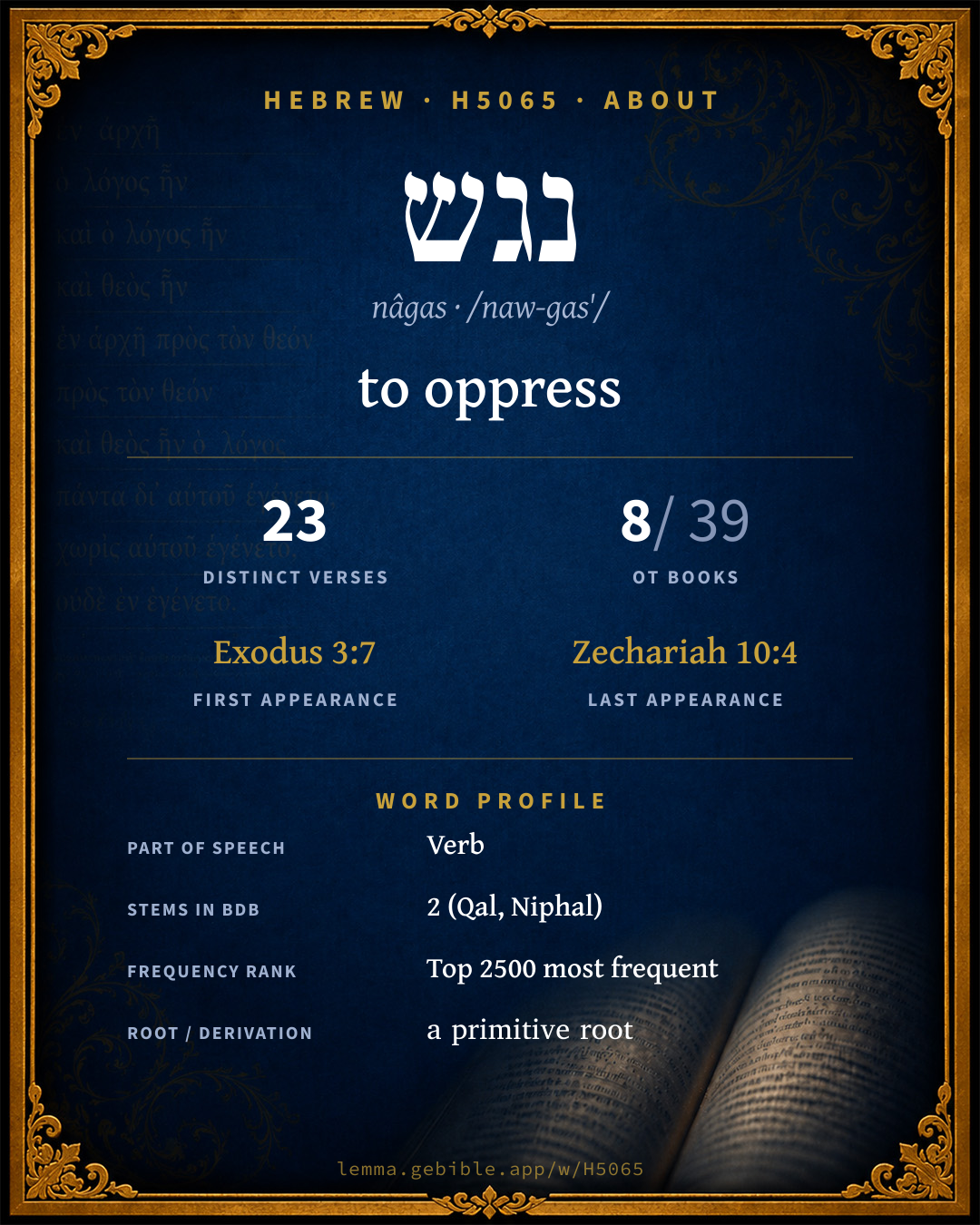
נָגַשׂ
to oppress
‘to oppress’ is one of 2 main senses fuller range ↓
Full lexicon entry — Brown-Driver-Briggs (BDB)
From Brown-Driver-Briggs (BDB)
Where this word appears
See every Qal verb in the Hebrew Bible →
Grammar key — what these labels mean
Part of speech
- Verb
- An action or state-of-being word.
Stem
- Qal
- The basic, simple active stem — the plain form of the verb (“he wrote”). Here: ‘press’
- Niphal
- Usually the simple passive or reflexive of the Qal (“he was written”).
Form
- Participle Active
- A verbal adjective expressing ongoing or characteristic action (“writing / one who writes”).
- Perfect
- A completed action or state — Hebrew marks aspect (completeness) more than strict tense (“he wrote”).
- Sequential Perfect
- A perfect with prefixed waw continuing a preceding imperfect or command (waw-consecutive perfect).
- Imperfect
- An incomplete, ongoing, or future action (“he will / would write”).
State
- Absolute
- The independent form of a noun, not bound to a following word.
- Construct
- A noun bound to a following noun in a possessive / “of” relationship (the construct chain).
Person
- 3rd Person
- The one spoken about (“he / she / it / they”).
- 2nd Person
- The one addressed (“you”).
Gender
- Masculine
- Grammatically masculine.
Number
- Singular
- One.
- Plural
- More than one (in Hebrew, generally three or more).
Grammatical forms 9 distinct
- Verb, Qal, Participle Active, Masculine, Singular, Absolute 7 times (30%)
- Verb, Qal, Participle Active, Masculine, Plural, Construct 6 times (26%)
- Verb, Niphal, Perfect, 3rd Person, Masculine, Singular 3 times (13%)
- Verb, Qal, Participle Active, Masculine, Plural, Absolute 2 times (9%)
- Verb, Niphal, Sequential Perfect, 3rd Person, Masculine, Singular 1 time (4%)
- Verb, Qal, Imperfect, 2nd Person, Masculine, Plural 1 time (4%)
- Verb, Qal, Imperfect, 2nd Person, Masculine, Singular 1 time (4%)
- Verb, Qal, Imperfect, 3rd Person, Masculine, Singular 1 time (4%)
+1 more form (1 occurrence)
Parsed forms decoded from the imported morphology (morphhb / Westminster Leningrad Codex — WLC text public domain, morphhb tagging CC BY 4.0), counted across 23 parsed occurrences — not distinct verses.
Every verse where H5065 appears — 23 distinct verses across 8 books. Click any verse to open its interlinear word-by-word view. Verse text shown in the World English Bible for context — . Each verse’s Hebrew form is shown with its reference; the English is not keyword-highlighted, since the data carries no word-level English alignment. Use “Compare translations” on any verse to read it across multiple English versions. This concordance covers the Hebrew Bible; Septuagint (Greek Old Testament) occurrences are not indexed here.
Exodus 5 verses
- Exodus 3:7 נֹֽגְשָׂ֔י/ו Qal ptcp.act mp cs + sfx pers 3ms Yahweh said, "I have surely seen the affliction of my people who are in Egypt, and have heard their cry because of their taskmasters, for I know their sorrows.
- Exodus 5:6 הַ/נֹּגְשִׂ֣ים ptcl def.art + Qal ptcp.act mp The same day Pharaoh commanded the taskmasters of the people, and their officers, saying,
- Exodus 5:10 נֹגְשֵׂ֤י Qal ptcp.act mp cs The taskmasters of the people went out, and their officers, and they spoke to the people, saying, This is what Pharaoh says: "I will not give you straw.
- Exodus 5:13 וְ/הַ/נֹּגְשִׂ֖ים conj + ptcl def.art + Qal ptcp.act mp The taskmasters were urgent saying, "Fulfill your work quota daily, as when there was straw!"
- Exodus 5:14 נֹגְשֵׂ֥י Qal ptcp.act mp cs The officers of the children of Israel, whom Pharaoh's taskmasters had set over them, were beaten, and demanded, "Why haven't you fulfilled your quota both yesterday and today, in making brick as before?"
Deuteronomy 2 verses
- Deuteronomy 15:2 יִגֹּ֤שׂ Qal impf 3ms This is the manner of the release: every creditor shall release that which he has lent to his neighbor; he shall not exact it of his neighbor and his brother; because Yahweh's release has been proclaimed.
- Deuteronomy 15:3 תִּגֹּ֑שׂ Qal impf 2ms Of a foreigner you may exact it: but whatever of your is with your brother your hand shall release.
1 Samuel 2 verses
- 1 Samuel 13:6 נִגַּ֖שׂ Niphal pf 3ms When the men of Israel saw that they were in a strait (for the people were distressed), then the people did hide themselves in caves, and in thickets, and in rocks, and in coverts, and in pits.
- 1 Samuel 14:24 נִגַּ֖שׂ Niphal pf 3ms The men of Israel were distressed that day; for Saul had adjured the people, saying, Cursed be the man who eats any food until it be evening, and I be avenged on my enemies. So none of the people tasted food.
2 Kings 1 verse
Job 2 verses
Isaiah 8 verses
- Isaiah 3:5 וְ/נִגַּ֣שׂ conj + Niphal wpf 3ms The people will be oppressed, Everyone by another, And everyone by his neighbor. The child will behave himself proudly against the old man, And the base against the honorable.
- Isaiah 3:12 נֹגְשָׂ֣י/ו Qal ptcp.act mp cs + sfx pers 3ms As for my people, children are their oppressors, And women rule over them. My people, those who lead you cause you to err, And destroy the way of your paths.
- Isaiah 9:4 הַ/נֹּגֵ֣שׂ ptcl def.art + Qal ptcp.act ms For the yoke of his burden, and the staff of his shoulder, the rod of his oppressor, you have broken as in the day of Midian.
- Isaiah 14:2 בְּ/נֹגְשֵׂי/הֶֽם prep + Qal ptcp.act mp cs + sfx pers 3mp The peoples shall take them, and bring them to their place; and the house of Israel shall possess them in the land of Yahweh for servants and for handmaids: and they shall take them captive whose captives they were; and they shall rule over their oppressors.
- Isaiah 14:4 נֹגֵ֔שׂ Qal ptcp.act ms that you shall take up this parable against the king of Babylon, and say, How has the oppressor ceased! the golden city ceased!
- Isaiah 53:7 נִגַּ֨שׂ Niphal pf 3ms He was oppressed, yet when he was afflicted he didn't open his mouth; as a lamb that is led to the slaughter, and as a sheep that before its shearers is mute, so he didn't open his mouth.
- Isaiah 58:3 תִּנְגֹּֽשׂוּ Qal impf 2mp Why have we fasted, [say they], and you don't see? [why] have we afflicted our soul, and you take no knowledge? Behold, in the day of your fast you find [your own] pleasure, and exact all your labors.
- Isaiah 60:17 וְ/נֹגְשַׂ֖יִ/ךְ conj + Qal ptcp.act mp cs + sfx pers 2fs For brass I will bring gold, and for iron I will bring silver, and for wood brass, and for stones iron. I will also make your officers peace, and righteousness your ruler.
Daniel 1 verse
Zechariah 2 verses
- Zechariah 9:8 נֹגֵ֑שׂ Qal ptcp.act ms I will encamp around my house against the army, That none pass through or return; And no oppressor will pass through them any more: For now I have seen with my eyes.
- Zechariah 10:4 נוֹגֵ֖שׂ Qal ptcp.act ms From him will come forth the corner-stone, From him the nail, From him the battle bow, From him every ruler together.
About this entry
At a glance — auto-summarized from this page’s data, not written by a person. Every figure links to its source below. This summary describes the numbers; it doesn’t interpret them.
נגש — transliterated nâgas — is a Hebrew verb carrying the sense “to oppress.” Debuting at Exodus 3:7, it then recurs through the corpus. Spanning 23 verses in 8 books, it ranks among the uncommon words of the Hebrew Bible. Its uses concentrate in Isaiah (35% of all occurrences). Across 2 stems, its meaning turns on the binyan (Qal, Niphal). Each statement above links to its evidence; the full detail follows below.
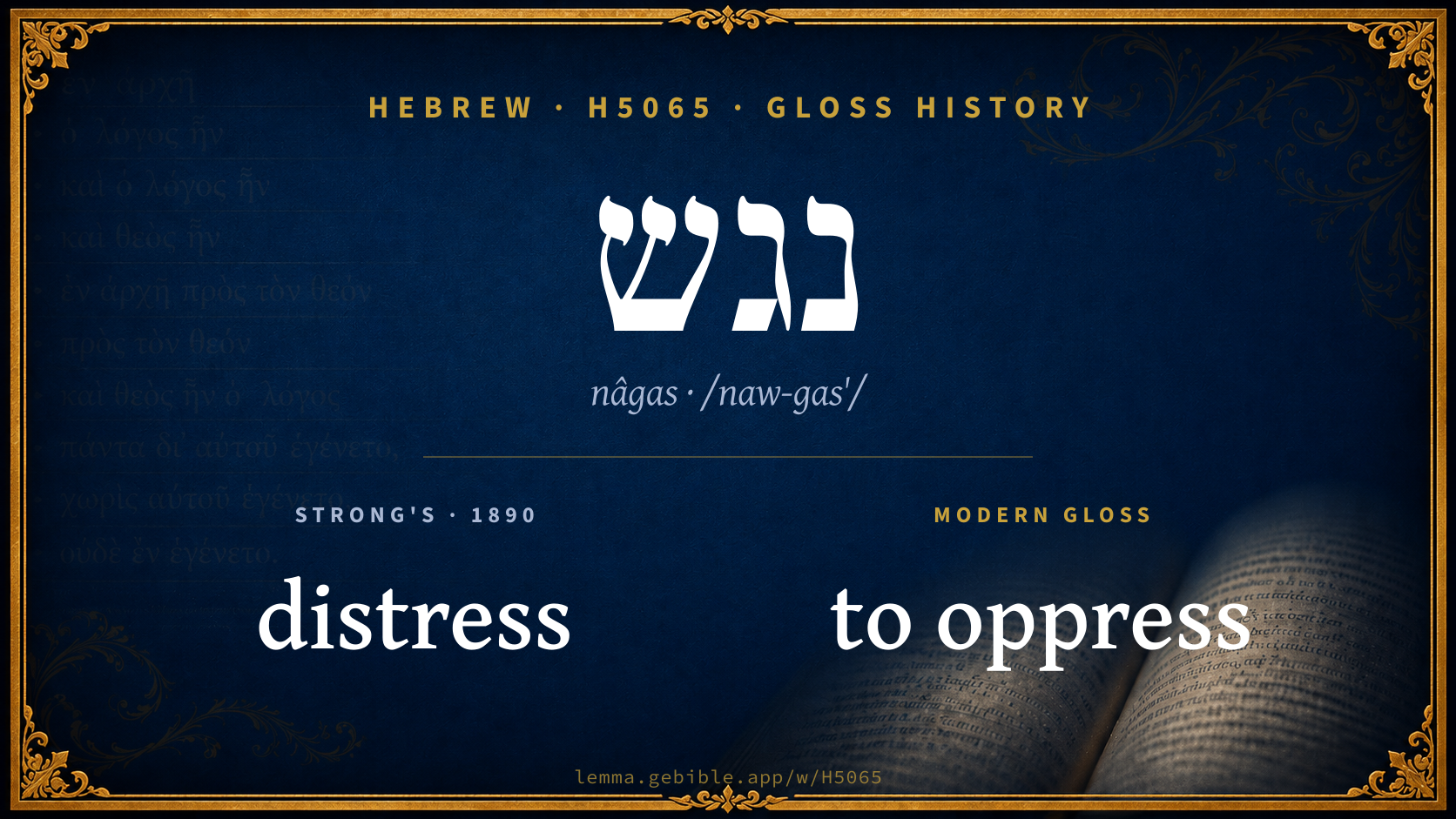
Gloss history
Strong's 1890 vs modern scholarship
About this word
Strong's H5065 catalogs a Hebrew word from the Hebrew Old Testament.
These counts are not copied from any lexicon or concordance. They are computed here, from the morphology-tagged Hebrew Old Testament. What Lemma adds →
- 23
- distinct verses
- The word appears in 23 distinct verses.
- 8 / 39
- OT books
- The word appears in 8 of 39 Old Testament books.
- #1,368
- by frequency
- Top 2500 most frequent Hebrew words (rank 1,368 of 8,640 Hebrew words by occurrence).
View all 23 occurrences in the concordance →
Most concentrated in
- Isaiah 8 verses 35%
- Exodus 5 verses 22%
- Deuteronomy 2 verses 9%
By section of the Old Testament
By traditional corpus
Conventional, traditional groupings — biblical authorship is debated, so this is a traditional corpus grouping, not an authorship claim. Each share is this word’s portion of its verses in that division of the Hebrew canon. Each figure is a share of the word’s 23 distinct verses.
- Prophets (Nevi'im) 13 verses · 57%
- Torah (Pentateuch) 7 verses · 30%
- Writings (Ketuvim) 3 verses · 13%
How translations render this word
Counts come from each version’s own published word-to-Strong’s tagging or interlinear alignment — an approximate guide to how each version renders this word, not a word-level alignment the data otherwise carries. Because each total is that version’s own tagged count, the per-version totals vary from one another and need not match the appearance or distinct-verse counts above. These counts may also differ from a printed concordance because Lemma counts each distinctly tagged rendering and does not collapse phrase taggings into a single head-word total. This is a fixed set of word-tagged versions (KJV, ASV, BSB, ULT) and does not change with the reading translation you choose elsewhere. Each version’s license is shown beside its name below (and on Sources).
- King James Version: Taskmasters 5×, Oppressor 3×, Were distressed 2×
- American Standard Version: Taskmasters 4×, Oppressor 2×, Were distressed 2×
- Berean Standard Bible: Taskmasters 4×, Oppressor 3×, Ruler 2×
- unfoldingWord Literal Text: And 2×, Taskmasters of 2×, Were distressed 2×
King James Version Public Domain
Renders H5065 across 23 tagged occurrences — most commonly:
Plus 13 renderings that appear only once — usually multi-word phrases or single function words the recovered tagging swept in, not distinct renderings.
American Standard Version Public Domain
Renders H5065 across 23 tagged occurrences — most commonly:
Plus 15 renderings that appear only once — usually multi-word phrases or single function words the recovered tagging swept in, not distinct renderings.
Berean Standard Bible Public Domain
Renders H5065 across 23 tagged occurrences — most commonly:
Plus 14 renderings that appear only once — usually multi-word phrases or single function words the recovered tagging swept in, not distinct renderings.
unfoldingWord Literal Text CC BY-SA 4.0
Renders H5065 across 26 tagged occurrences — most commonly:
Plus 20 renderings that appear only once — usually multi-word phrases or single function words the recovered tagging swept in, not distinct renderings.
Senses in the full BDB
Hebrew verbs can shift meaning by stem (binyan): Qal is the basic action, Niphal is often passive or reflexive, Piel often intensifies or makes it factitive, and Hiphil is typically causative. The senses below are grouped under the stem BDB assigns to each.
What do BDB’s symbols mean?
BDB uses these scholarly abbreviations:
| Symbol | Meaning |
|---|---|
| 𝔊 | the Septuagint (the ancient Greek translation, LXX) |
| 𝔙 | the Vulgate (the Latin translation) |
| 𝔖 | the Syriac version (the Peshitta) |
| 𝔗 | the Targum (the Aramaic translation) |
| ψ | the Psalms |
| √ | root (the underlying root or stem) |
| ‖ | parallel passage (a synonymous or contrasted parallel) |
| † | the dagger: every passage where the word occurs is cited |
The 5 senses and sub-senses the full Brown-Driver-Briggs lexicon distinguishes for this word, in lexicon order (not ranked by frequency), with BDB’s own verbatim wording and sub-sense lettering. Shown in Hebrew script with BDB’s own scholarly abbreviations. The condensed entry is in the Lexicon Entry tab. See also the Forms in the corpus table below.
Qal
- Pf. נ׳ 2 K 23:25; Impf. יִגּשֹׁ Dt 15:2; 2 ms. תִּגּשֹׁ Dt 15:3; 2 mpl. תִּנְנֹּ֑שׂוּ Is 58:3;—Pt. נֹגֵשׂ Is 9:3 +, etc.;— e.g. 2 Kings 23:25
- 1. press, drive to work (obj. עַצְּבֵיכֶם your workmen), Is 58:3 (GesComm., De Di Du; exact [changing ע׳, q.v.] Che, etc.); v. 3. e.g. Isaiah 58:3
- 2. exact c. acc. כֶּסֶף, 2 K 23:35; sq. acc. pers. only Dt 15:2, 3. e.g. 2 Kings 23:35
- 3. Pt. (= subst.) driver, taskmaster Ex 3:7; 5:6, 10, 13, 14 Jb 3:18; (ass-)driver Jb 39:7; of (arbitrary) ruler Is 3:12, ruler (good sense) Zc 10:4; = foreign oppressor, tyrant Is 9:3 (c. בְּ) 14:2, 4 Zc 9:8; exactor of tribute, Dn 11:20; pl. abstr. lordship = lord, ruler, fig. of צְדָקָה (personif.) Is 60:17 (‖ פְּקֻדָּתֵךְ שָׁלוֹם). e.g. Exodus 3:7
Niphal
- Pf. נִגַּשׂ 1 S 13:6 + 2 times + Is 3:5 (וְ consec.);—hard pressed by enemy 1 S 13:6, and so 14:24 (but om. by emend., after 𝔊, Th We Dr Kit Bu HPS); treated harshly, of suffering servant of י׳ Is 53:7; recipr. tyrannize over (ב׳) each other Is 3:5. e.g. 1 Samuel 13:6
Senses from the full Brown-Driver-Briggs lexicon (Brown, Driver, Briggs; Oxford 1906 — public domain), digitized via Sefaria, supplemented by the OpenScriptures HebrewLexicon (CC BY 4.0). Full attribution on Sources.
Word origin
vb. press, drive, oppress, exact (Assyrian nagâšu, throw down, overthrow, DlHWB 448; Arabic نَجَشَ rouse and drive game, drive vehemently; Ethiopic ነግሠ reign, wield power, ንጉሥ king);—
— Brown-Driver-Briggs (Oxford 1906, public domain), digitized via Sefaria, supplemented by the OpenScriptures HebrewLexicon (CC BY 4.0). See Sources.
Origin: a primitive root
Jastrow Dictionary
A second Hebrew/Aramaic lexicon for comparison, covering Aramaic and post-biblical (Talmudic, Targumic, Midrashic) usage that the biblical-Hebrew BDB does not. Matched by lemma rather than by Strong’s number, so a lemma may carry more than one Jastrow headword (shown separately below), and the entries cover usage well beyond the Bible.
נָגַשׁ
- (b. h.) also Nif. נִגַּשׁ to come in contact; to draw near. Yalk. Ps. 842 (ref. to יגש, Ps. XCI, 7) אין אחד מהם נִגָּשׁ אליך וכ׳ none of them comes to thee, none says, provide for me; Midr. Till. to Ps. XVII, 7 נוֹגֵשׁ אצלך ed. Bub. (oth. ed. נוֹגֵשׂ אותך, v. נָגַשׂ).—Tanḥ. Vayigg. 5 (ref. to Gen. XLIV, 18) שנ׳ בתוכחות he came near (attacked him, v. next w.) with rebukes. Yalk. Gen. 150 (ref. to Gen. l. c.) אין וַיִּגַּשׁ אלא לשון שלום vayyigash has the meaning of (coming near in) peacefulness &c., v. הַגָּשָׁה. e.g. Psalms 91:7
- to bring near. B. Kam. 46ᵇ (ref. to Ex. XXIV, 14) יַגִּישׁ ראיה אליהם (a claimant) must offer evidence &c.; יגיש דבריו וכ׳ must prefer his claims &c., is the first to be heard; a. e. e.g. Exodus 24:14
נְגַשׁ
- , to attack, gore. Targ. Y. Ex. XXI, 28. Ib. 32 (ed. Amst. a. oth. נגח).—[Yalk. Gen. 148, v. נְגַס.]—Part. נָגֵישׁ; f. נְגִישָׁא. Gen. R. s. 80, beg. (prov.) לית תורתא נ׳ עד וכ׳ ‘Rashi’ (ed. ענישא; Ar. עגישא) no cow is a gorer until her calf is a kicker (the mother is judged by her daughter).
נָגַשׂ
- cmp. preced.) to push on, drive, press. Midr. Till. to Ps. XVII, 7 ואין אחד מהם נוֹגֵשׂ אותך וכ׳ none of them presses thee &c., v. נָגַשׁ.—נוֹגֵשׂ task-master. Tanḥ. Sh’moth 9 אותו נ׳ עשוי וכ׳ that taskmaster was appointed over &c.; Ex. R. s. 1 נ׳ ממונה על עשרה שוטרים one (Egyptian) taskmaster was appointed over ten (Israelitish) officers. Lev. R. s. 32 (in Chald. dict.) קרץ נ׳ גבי וכ׳ Ar. (ed. קדם) the taskmaster came early to the officer, saying, go and gather thy men &c.; a. fr.—Pl. נוֹגְשִׂים, נוֹגְשִׂין. Ib.; Ex. R. l. c. Pirké d’R. El. ch. XLVIII נוֹגְשֵׂי פרעה the taskmasters appointed by Pharaoh; a. fr.—Esp. to exact a debt. Macc. 3ᵇ (ref. to Deut. XV, 2) לא קרינן ביה לא יִגּוֹשׂ we do not apply to him (he does not violate the law) ‘he shall not exact’; סוף אתי לידי יגוש he will finally (after the lapse of ten years) transgress &c.—Sifré Deut. 113 (ref. to Deut. XV, 3) ואת אחיך לא תִגּוֹשׂ but thou must not exact of thy brother. e.g. Deuteronomy 15:2
A Dictionary of the Targumim, the Talmud Babli and Yerushalmi, and the Midrashic Literature (Marcus Jastrow; London, Luzac, 1903) — Public Domain. Digitized via Sefaria. Digitized via Sefaria. Full attribution on Sources.
Forms in the corpus
The 21 distinct written forms H5065 takes in the Hebrew Bible, most frequent first — each parse links to that stem’s occurrences in the concordance. Hebrew forms include their vowel points and cantillation, so a single lemma takes many written forms.
Septuagint verse parallels
This word appears in 23 verses that also exist in the Greek Old Testament (Septuagint), out of the 23 Hebrew verses it occurs in. You can read those verses in Greek by switching the Old Testament edition to the Septuagint.
Read these verses in the Septuagint
- Exodus 3:7
- Deuteronomy 15:2
- 1 Samuel 13:6
- 2 Kings 23:35
- Job 3:18
- Isaiah 3:5
- Daniel 11:20
- Zechariah 9:8
This is a verse-level parallel only — the same verses exist in both the Hebrew and Greek Old Testaments. No word-level Hebrew↔Greek correspondence is claimed: the data carries no such alignment, so no Greek word is shown as this Hebrew word’s translation. Coverage is not total — the Septuagint omits the deuterocanon and renumbers the Psalms, so some Hebrew verses have no direct Greek parallel.