3 John 1:9

Greek (Tischendorf 8th ed.) 3 John 1:9 appears in the Greek New Testament. The text above is from the Tischendorf 8th edition. Each word links to its Strong’s number and a concise gloss. Click any word for its full Thayer’s Greek Lexicon entry.
Download image
Cite this verse

3 John 1:9 (World English Bible). Public Domain. Lemma interlinear Bible study tool, https://lemma.gebible.app/v/3-john/1/9.

Show BibTeX & RIS
BibTeX
RIS
English Translation
I wrote to the assembly, but Diotrephes, who loves to be first among them, doesn't accept what we say.
World English Bible · Public Domain
Highlights
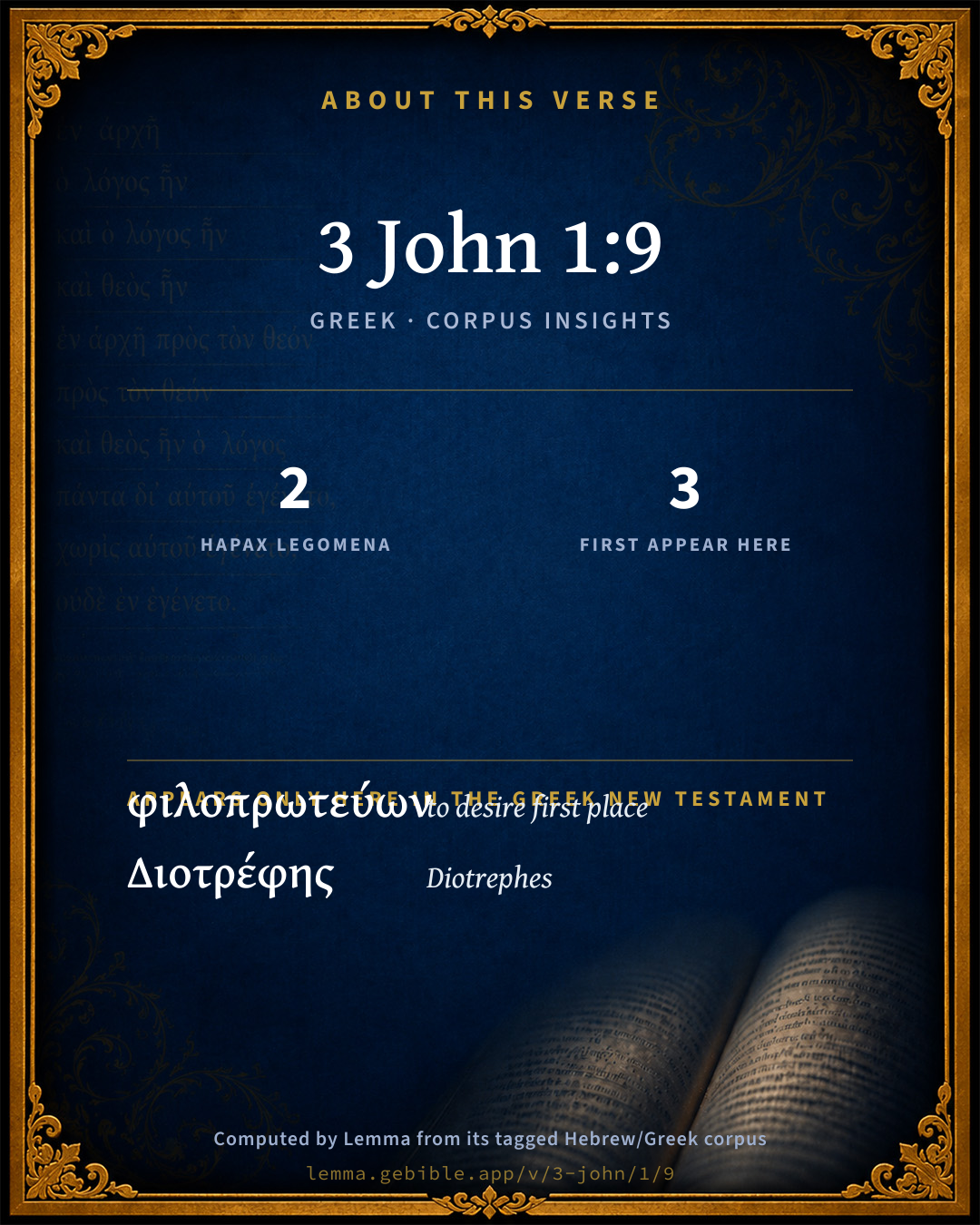
  • 2 hapax legomena — only here in the Greek New Testament
  • 3 first appearances in the Greek New Testament
Full analysis ↓
Download a study sheet

One document with this verse’s original text, its word-by-word gloss line, the meaning frame, cross-references with their text, attributed commentary, and full source and license credits — printable, and it pastes into notes with its structure intact.

This verse Autodidact and up

Study sheet (.html) Plain text (.txt)

A passage Seminary Student

Up to 50 verses in one chapter. A passage sheet keeps up to 6 commentary sources and 12 cross-references per verse, in the order this page ranks them, and says so on the sheet whenever that leaves anything out. Ask for a single verse and you get the Autodidact verse sheet above.

Everything on this page stays free to read, with no account — the sheet is a download of what is already on screen, not access to it.

Want to remove ads? Support Godless Engineer
Compare translations 3

The same verse in 3 English versions, stacked beneath the original-language interlinear above. Click any original word for its lexicon entry.

Each is an independent rendering of the whole verse — the interlinear is not word-aligned to these translations.

Highlighted words mark where these versions differ — a whole-verse word diff, not a word-by-word alignment.

  • World English Bible Public Domain
    I wrote to the assembly, but Diotrephes, who loves to be first among them, doesn't accept what we say.
  • King James Version Public Domain
    I wrote unto the church: but Diotrephes, who loveth to have the preeminence among them, receiveth us not.
  • unfoldingWord Literal Text CC BY-SA 4.0
    I wrote something to the church, but Diotrephes, the one loving to be first among them, does not receive us.

unfoldingWord Literal Text — © unfoldingWord, licensed CC BY-SA 4.0. Word-aligned USFM3 via Door43 (git.door43.org/unfoldingWord/en_ult).

Versions to compare (up to 4)

3 of 4 selected

Show all 19 translations

Every available English version of this verse, each an independent rendering of the whole verse.

  • World English Bible Public Domain
    I wrote to the assembly, but Diotrephes, who loves to be first among them, doesn't accept what we say.
  • Berean Standard Bible Public Domain
    I have written to the church about this, but Diotrephes, who loves to be first, will not accept our instruction.
  • Majority Standard Bible Public Domain
    I have written to the church about this, but Diotrephes, who loves to be first, will not accept our instruction.
  • King James Version Public Domain
    I wrote unto the church: but Diotrephes, who loveth to have the preeminence among them, receiveth us not.
  • American Standard Version (1901) Public Domain
    I wrote somewhat unto the church: but Diotrephes, who loveth to have the preeminence among them, receiveth us not.
  • Revised Version (1885) Public Domain
    I wrote somewhat unto the church: but Diotrephes, who loveth to have the preeminence among them, receiveth us not.
  • Geneva Bible (1599) Public Domain
    I wrote vnto the Church: but Diotrephes which loueth to haue the preeminence among them, receiueth vs not.
  • Douay-Rheims (1899) Public Domain
    I had written perhaps to the church: but Diotrephes, who loveth to have the pre-eminence among them, doth not receive us.
  • Young's Literal Translation Public Domain
    I did write to the assembly, but he who is loving the first place among them -- Diotrephes -- doth not receive us;
  • Literal Standard Version CC BY-SA 4.0
    I wrote to the assembly, but he who is loving to be first among them—Diotrephes—does not receive us;
  • Unlocked Literal Bible CC BY-SA 4.0
    I wrote something to the congregation, but Diotrephes, who loves to be first among them, does not receive us.
  • unfoldingWord Literal Text CC BY-SA 4.0
    I wrote something to the church, but Diotrephes, the one loving to be first among them, does not receive us.
  • Darby Bible Public Domain
    I wrote something to the assembly; but Diotrephes, who loves to have the first place among them, receives us not.
  • World Messianic Bible Public Domain
    I wrote to the assembly, but Diotrephes, who loves to be first among them, doesn’t accept what we say.
  • Webster's Bible Public Domain
    I wrote to the church: but Diotrephes, who loveth to have the pre-eminence among them, receiveth us not.
  • Free Bible Version CC BY-SA 4.0
    I did write about this to the church, but Diotrephes, who loves being in charge, refuses to accept our authority.
  • Bible in Basic English Public Domain
    I sent a letter to the church, but Diotrephes, whose desire is ever to have the first place among them, will not have us there.
  • Text-Critical English NT CC BY 4.0
    I wrote to the church, but Diotrephes, who loves to put himself first, does not acknowledge us.
  • Tyndale New Testament (1534) Public Domain
    I wrote vnto the congregacion: but Diotrephes which loveth to have the preeminence amonge them receaveth vs not.

Literal Standard Version (2020), Covenant Press — licensed CC BY-SA 4.0. Text via the HelloAO Bible API (eBible.org). Unlocked Literal Bible (unfoldingWord) — licensed CC BY-SA 4.0. Text via the HelloAO Bible API (eBible.org). unfoldingWord Literal Text — © unfoldingWord, licensed CC BY-SA 4.0. Word-aligned USFM3 via Door43 (git.door43.org/unfoldingWord/en_ult). Free Bible Version, Dr. Jonathan Gallagher — licensed CC BY-SA 4.0. Text via the HelloAO Bible API (eBible.org).

Word by word

More ways to search: Search by grammar → Find every occurrence → Compare this word →

Practice this passage: Drill this verse → Learn its vocabulary →

φιλοπρωτεύων
philoprōteúō
G5383
“to desire first place”
Verb, Present, Active, Participle, Nominative, Singular, Masculine
Part of Speech
Verb
Tense
Present
Voice
Active
Mood
Participle
Case
Nominative
Number
Singular
Gender
Masculine
Full Thayer's Definition

Origin: from a compound of G5384 and G4413

TDNT: None

1. to aspire to pre-eminence, to desire to be first
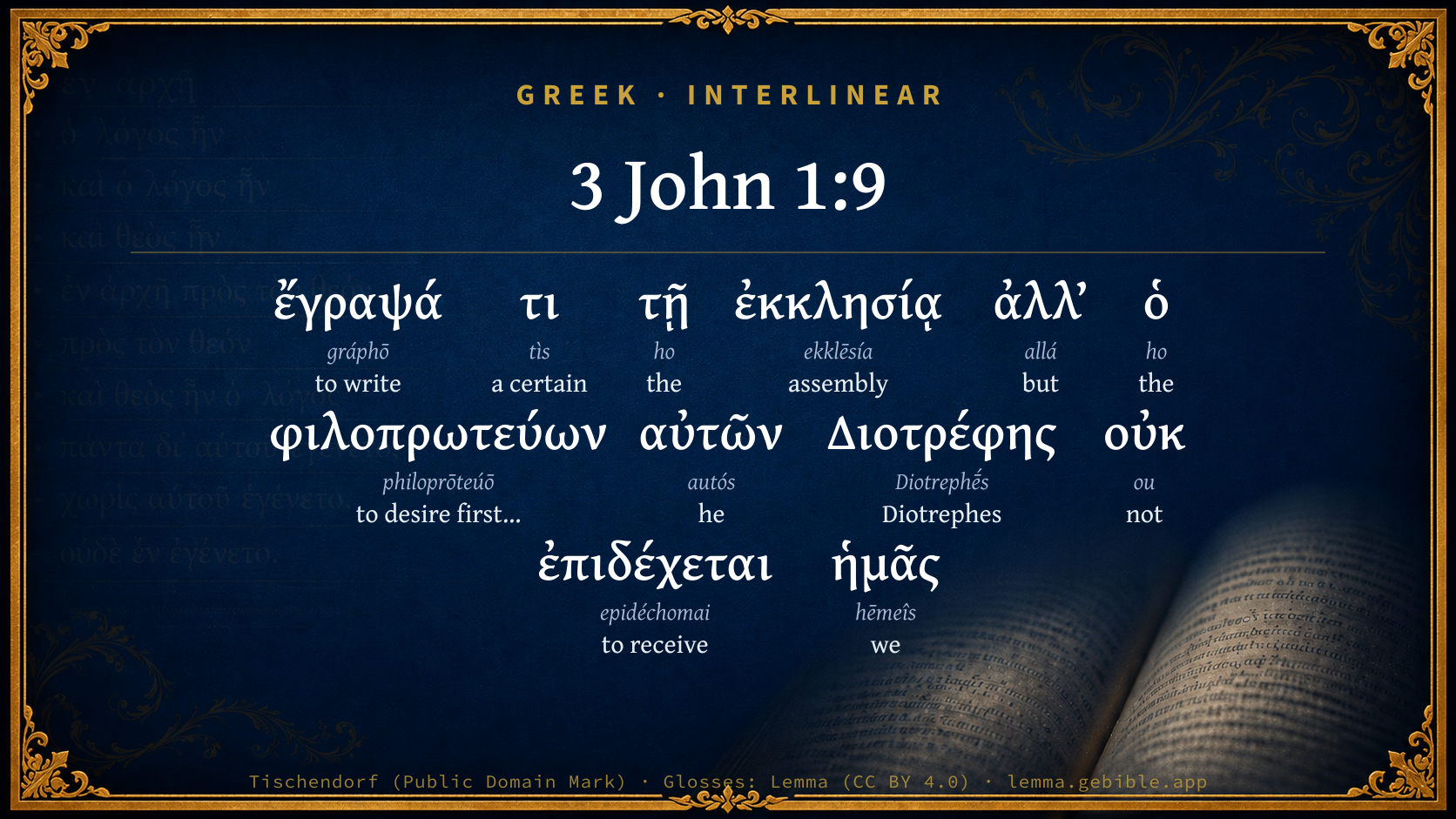
  1. ἔγραψά gráphō G1125 “to write” Verb, Aorist, Active, Indicative, 1st person, Singular
  2. τι tìs G5100 “a certain” Indefinite pronoun, Accusative, Singular, Neuter
  3. τῇ ho G3588 “the” Article, Dative, Singular, Feminine
  4. ἐκκλησίᾳ ekklēsía G1577 “assembly” Noun, Dative, Singular, Feminine
  5. ἀλλ’ allá G235 “but” Conjunction
  6. ὁ ho G3588 “the” Article, Nominative, Singular, Masculine
  7. αὐτῶν autós G846 “he” Personal pronoun, Genitive, Plural, Feminine
  8. Διοτρέφης Diotrephḗs G1361 “Diotrephes” Noun, Nominative, Singular, Masculine
  9. οὐκ ou G3756 “not” Particle, Negative
  10. ἐπιδέχεται epidéchomai G1926 “to receive” Verb, Present, Middle or Passive deponent, Indicative, 3rd person, Singular
  11. ἡμᾶς hēmeîs G2249 “we” Personal pronoun, 1st person, Accusative, Plural

About this verse

These counts appear in no published source. They are computed here, from the morphology-tagged text and Lemma’s own curated glosses. What Lemma adds →

12
words
11
distinct lemmas
General Epistles
section

Notable vocabulary

2 hapax legomena — words that appear only here in the entire Greek New Testament:

  • φιλοπρωτεύων to desire first place G5383
  • Διοτρέφης Diotrephes G1361

First appearance in Scripture

These words make their first canonical appearance in the Greek New Testament here:

  • φιλοπρωτεύων to desire first place G5383
  • Διοτρέφης Diotrephes G1361
  • ἐπιδέχεται to receive G1926

Shared distinctive vocabulary

ἐπιδέχεται to receive G1926 occurs in 2 verses of the Greek New Testament. Also found in:

Repetition

A word recurs within this verse:

Cross-references

12

Topical passages linked to 3 John 1:9 in the Treasury of Scripture Knowledge — connected by theme and wording, ordered by reader-vote popularity; previews shown in the World English Bible.

  • Titus 1:7–16 For the overseer must be blameless, as God's steward; not self-pleasing, not easily angered, not given to wine, not violent, not greedy for dishonest gain;
  • Luke 22:24–27 There arose also a contention among them, which of them was considered to be greatest.
  • Matthew 23:4–8 For they bind heavy burdens that are grievous to be borne, and lay them on men's shoulders; but they themselves will not lift a finger to help them.
  • Luke 9:48 and said to them, "Whoever receives this little child in my name receives me. Whoever receives me receives him who sent me. For whoever is least among you all, this one will be great."
  • Matthew 10:40–42 He who receives you receives me, and he who receives me receives him who sent me.
  • Mark 9:34 But they were silent, for they had disputed one with another on the way about who was the greatest.
  • Romans 12:10 In love of the brothers be tenderly affectionate one to another; in honor preferring one another;
  • Philippians 2:3–5 doing nothing through rivalry or through conceit, but in humility, each counting others better than himself;
  • Matthew 20:20–28 Then the mother of the sons of Zebedee came to him with her sons, kneeling and asking a certain thing of him.
  • Mark 9:37 "Whoever receives one such little child in my name, receives me, and whoever receives me, doesn't receive me, but him who sent me."
  • Mark 10:35–45 James and John, the sons of Zebedee, came near to him, saying, "Teacher, we want you to do for us whatever we will ask."
  • 3 John 1:8 We therefore ought to receive such, that we may be fellow workers for the truth.

Cross-references courtesy of OpenBible.info (CC BY 4.0).

Commentary

Notes on 3 John 1:9 from classic Christian and Jewish commentators (each source and its license shown beneath its notes). The classic Christian expositions comment on the surrounding passage and are grouped to its opening verse, so a note may address several verses; the Jewish commentaries on the Tanakh (Rashi and others) are per-verse, so they appear only where the commentator wrote on this verse.

Lemma curates 59 commentaries, every one of them public domain or Creative Commons licensed, each selected and text-cleaned for this edition rather than reprinted as found. About our sources →

The Cambridge Bible for Schools and Colleges

gen. ed. J. J. S. Perowne

9. I wrote unto the Church] The best authorities give I wrote somewhat to the Church; i.e. ‘I wrote a short letter, a something on which I do not lay much stress’. There is yet another reading; I would have written to the Church: but this is an obvious corruption to avoid the unwelcome conclusion that an official letter from S. John has been lost. The reference cannot be to either the First or the Second Epistle, neither of which contains any mention of this subject. There is nothing surprising in such a letter having perished: and Diotrephes would be likely to suppress it. That the brethren whom Gaius received were the bearers of it, and that his hospitality was specially acceptable on account of the violence of Diotrephes, does not seem to fit in well with the context. ‘To the Church’ probably means ‘to the Church’ of which Diotrephes was a prominent member: that he was presbyter of it cannot be either affirmed or denied from what is stated here.

who loveth to have the preeminence] The expression (ὁ φιλοπρωτεύων) occurs nowhere else in N.T.; but it comes very close to “whosoever willeth to be first among you” (Mat_20:28). Perhaps the meaning is that Diotrephes meant to make his Church independent: hitherto it had been governed by S. John from Ephesus, but Diotrephes wished to make it autonomous to his own glorification. Just as the antichristian teachers claimed to be first in the intellectual sphere (2Jn_1:9), so the unchristian Diotrephes claimed to be first in influence and authority.

9, 10. Diotrephes condemned for his Arrogance and Hostility

This is the most surprising part of the letter; and of the internal evidence this is the item which seems to weigh most heavily against the Apostolic authorship. That any Christian should be found to act in this manner towards the last surviving Apostle is nothing less than astounding. Those who opposed S. Paul, like Alexander the coppersmith (2Ti_4:14), afford only remote parallels (1Ti_1:20; 2Ti_1:15). They do not seem to have gone the lengths of Diotrephes: the authority of Apostles was less understood in S. Paul’s time: and his claim to be an Apostle was at least open to question; for he was not one of the Twelve, and he had himself been a persecutor. But from the very first the N.T. is full of the saddest surprises. And those who accept as historical the unbelief of Christ’s brethren, the treachery of Judas, the flight of all the Disciples, the denial of S. Peter, the quarrels of Apostles both before and after their Lord’s departure, and the flagrant abuses in the Church of Corinth, with much more of the same kind, will not be disposed to think it incredible that Diotrephes acted in the manner here described even towards the Apostle S. John.

The Cambridge Bible for Schools and Colleges (gen. ed. J. J. S. Perowne; Cambridge University Press, 1878–1918) — public domain. Text from a community e-Sword module.

The Biblical Illustrator

Joseph S. Exell

3Jn_1:9-11

Diotrephes, who loveth to have the pre-eminence.

Diotrephes

Besides the light which this brief Epistle casts on the state of the Christian Church toward the close of the first century, it presents us with the portraits in little of three remarkable men--Demetrius, Diotrephes, and Gaius. We are to study a man of a very inferior stamp--the vain, irritable, and loquacious Diotrephes, whose religion seems to have been quite compatible with a slippery morality. What exactly it was at which Diotrephes took offence, whether in the letter of St. John or in the conduct of Demetrius, we are not told; but it is not difficult to offend a man who has an undue sense of his own importance, and whose self-love may be set on fire by any match, however innocently it may be struck. St. John clearly implies that it was some wound to his love of pre-eminence, his determination to stand first and to exact a homage he did not deserve. But whatever the prick which his vanity had received, the character of the man comes out in his wholly disproportionate and extravagant resentment of the offence. In his resentment he sets himself against men far wiser and better than himself; he imperils the peace of the Church; he diminishes its numbers and strength. Nothing less than the excommunication of all who had dared to differ from him, all who had ventured to receive the Evangelists whom he would not receive, and whom he had forbidden them to receive, would satisfy him. But the democratic constitution of the primitive Church would not permit one man, however eminent, to excommunicate those who had offended him, simply because they had offended him. Before that extreme sentence was passed upon them, he must have won over a majority of his and their fellow-members to his side. He must have taken a bypath to his end. And, indeed, a man of inferior gifts and of a spirit less informed by the grace of Christ, who will stand first, will put himself forward and attempt to rule a free Christian congregation, must take this course. He must play on the ignorance, and even on the piety, of those who follow him, must affect a superior wisdom, or a superior orthodoxy. He will not let facts speak for themselves, but sets himself with his glib tongue to lick them out of their natural shape. He cannot suffer learning, wisdom, godliness, experience, to exert their natural and beneficent influence, but must at all risks counterwork that influence and suggest plausible reasons for not yielding to it. How else can he win and maintain a pre-eminence he does not deserve? There is nothing in the Epistle to suggest that Diotrephes held unsound doctrinal views, or that he fell into what are called gross and open sins. Had he been unorthodox, indeed, or flagrantly immoral, he would never have gained that eminence in the Church which he insisted on converting into pre-eminence. All that he is blamed for is the conceit and self-assurance which rendered him impatient of rivalry or resistance, and set him on seeking power rather than usefulness. Any man who will have his own way is only too likely to come to a bad end. Any man who insists on the Church taking his way is only too certain to prove a blind guide, who will lead those who follow him into a ditch, and perhaps leave them in the ditch when he himself scrambles out of it. But you may be asking, How did Diotrephes induce his fellow-members to follow his lead, since they must, most of them at least, have been good men who were not likely to excommunicate their fellows either for an excess of charity or for wounding his self-conceit? And the answer to that question is suggested by St. Johns words: He receiveth not us; prating against us with wicked (or malicious) words. Yet Diotrephes could hardly have openly denied the authority of an apostle so revered and beloved as St. John. No; but he may have questioned it indirectly. He may have dilated on the independence of the Church, of every separate community of believers, on its competence and right to manage its own affairs, to appoint its own agents, to decide on its own course of action, and have asked whether they would suffer, whether it would be right to suffer, any outsider, however honoured and beloved he might be, to govern and control them. He may even have persuaded himself, as well as others, that John had taken a new departure and was giving a new tone to Christian thought and life, and that the Church was in no small danger of being led away from its old standards, and thinking too much of the mercy and too little of the severity of God. If he could not say bluntly, I mean to stand first in this Church, let who will oppose me, or, I hate Gaius and his pretensions to advise and rule, or, I dislike Demetrius, and resent his lack of deference for me, he could at least appeal to the memory and teaching of their venerated founder, and avow his preference of St. Pauls gospel over that of St. John. For we must now remember that we are told two things about Diotrephes. We are told not only that he loved to have the pre-eminence, but also that he was cursed with a voluble tongue, that he would still be speaking; for how often does a fluent tongue lead a man whither, in his reasonable moods, he would not go, and betray him into positions which he would not willingly have assumed? Mr. Talkative, as Bunyan calls him, may do, and often does do, quite as much harm as Mr. Illwill. It is his own way he wants, not the best way, not the way which will be most beneficial to others; and if he cannot get it by fair means, he will often stoop to foul or dubious means, stirring up division and discontent, prating with malicious words against those who oppose him when fair words will no longer serve his turn. And if the itch of speaking is apt to lead on to the prating of idle, and even of malicious, words, the lust of power commonly leads to an abuse of power. John, or Demetrius, has slighted me. Gaius does not defer to me or my wishes. He has received strange brethren without consulting me, or when he knew that I had forbidden their reception. Nothing, then, shall induce me to receive them. I will move heaven and earth against them, and against all who abet them, be they who they will--when a man has once reached that point, and Diotrephes seems to have reached it, he is not far from any evil word or any evil work. No punishment is more unwelcome to such an one than that with which John threatens Diotrephes: I will put him in mind of his words and his works, bring him to book for them in his own presence and in that of the Church. They dislike nothing so much as being compelled to face their own whispers, and to see how they sound in honest and impartial ears, or even in their own ears now that their excitement and irritation have subsided. Diotrephes, then, was a man who was not necessarily, or wholly bad; a man who may have had many good qualities and have done some service to the Church; but his good qualities were blended with, and their good effects vitiated by, an exorbitant self-conceit and loquacity. Beloved, exclaims St. John, when he had completed his miniature of Diotrephes, imitate not that which is evil, but that which is good. He that doeth good is of God; he that doeth evil hath not seen God. And by this exhortation I do not understand him to imply that Diotrephes was an utterly bad man who had never seen God, never taken the first step toward a participation of the Divine nature, any more than he means that Demetrius, whom he forthwith begins to describe, was a man wholly good in whom no fault could be found. But I do understand him to mean that a vain man, too fond of hearing himself talk, too bent on taking the foremost place, is closing his eyes against the heavenly vision, and may do as much harm as if his intents were bad. The apostle may imply that, as Demetrius was undoubtedly doing a good work, he was a good man; and that Diotrephes, in so far as he opposed and crippled that work, was doing an evil work and took his place among evil men. (S. Cox, D. D.)

Diotrephes

I. I will show you who is not diotrephes.

1. He whose godly walk and conversation secures for him the entire confidence of the brethren, and thus gives him a great influence.

2. He whose talents and education necessarily make him a man of influence.

3. Nor he, whose well-known and oft-proved wisdom and prudence make him much sought unto in counsel.

4. These men generally do not seek influence. It is unavoidable. It follows them as their shadow.

II. I proceed to show who diotrephes is.

1. Sometimes he is a man who never had his will broken. As a Church member, he expects the household of Christ to give way to him. He is wilful and headstrong, often as unreasonable as a mere animal.

2. Sometimes he is a man of wealth. His riches give him authority in the world; and he takes it for granted they ought to do so in the Church.

3. Sometimes he is a man of some learning and much volubility, who fancies that his capacity ought to give his opinion authority.

III. I proceed to set forth diotrephes in action. If the minister does not take him for counsellor he is his enemy. With every movement does he find fault unless he originated it.

IV. In the next place, I remark upon diotrephes character.

1. He is very unlike Christ, who was meek and lowly.

2. He is very disobedient to the word, Let each esteem other better than himself.

3. He is against that equality which Christ has established in His Church.

Practical observations:

1. Diotrephes is most of the time in trouble. Always looking for deference, he is always liable to think it wanting.

2. The Church can take no surer road to trouble than to give way to Diotrephes.

3. Diotrephes will scarce be the friend of the minister. The natural influence of the religious teacher disturbs him.

4. It is best to look for Diotrephes in his own pew. Perhaps we may find him in our own seat.

5. Diotrephes is sometimes married, and his partner may be a true yoke-fellow. (Christian Treasury.)

Love of pre-eminence

It is not Diotrephes alone whose character my text describes--it is human nature generally; it is every man whose heart is unrenewed by grace.

1. A haughty heart, a lofty look, a proud temper, ambition, spirit, vanity--these are, more or less, the characteristic marks of the natural man. No such man is content with the station in which it has pleased Providence to place him. All are for being greater than they are. Each must have his own will executed--his own humour gratified. Things must be done exactly to his taste, and every other persons will and pleasure must give way to his.

2. Whence arises this love of the pre-eminence? to what is it to be ascribed? To an awful ignorance of ourselves. We all entertain naturally a very high opinion of our own characters--a vast notion of our own merits. We cannot really think that we are miserable sinners whilst we are striving which shall be the greatest.

3. Is this love of the pre-eminence consistent with a state of grace? Search the Scriptures for the answer. The Bible indeed is not a levelling book. It does not sweep away distinctions. But as for men of such a spirit as Diotrephes--of a vain, proud, self-exalting spirit--the Bible passes upon them its sentence of condemnation, and gives us everywhere to understand that heaven is shut against them (Mat_18:3; 1Ti_3:5).

4. But why is a love of the pre-eminence so utterly condemned in the Word of God? Wherein does the great guilt of it consist?

(1) First, it is utterly unsuitable to our condition as fallen guilty creatures.

(2) There is another reason why it is so utterly inconsistent with the character of a Christian to love the pre-eminence. That post of honour is preoccupied. It belongs, not to the Christian, but to the Christians Lord--not to the saved sinner, but to that sinners Saviour. (A. Roberts, M. A.)

The true method of eminence

Men are not so much mistaken in desiring to advance, as in judging what will be an advance, and what the right method of it. A man proves himself fit to go higher who shows that he is faithful where he is. When workmen are building the foundation of vast structures they must needs labour far below the surface, and in disagreeable conditions. But every course of stone which they lay raises them higher, and, at length, when they reach the surface, they have laid such solid work under them that they need not fear now to carry up their walls, through towering storeys, till they overlook the whole neighbourhood. A man that will not do well in his present place because he longs to be higher is already too high, and should be put lower.

Ambition

Unless they can be top-sawyers they will not touch a saw. (C. H. Spurgeon.)

I will remember his deeds which he doeth, prating against us.

Diotrephes rebuked

Here St. John sets up a flag of defiance against Diotrephes. We must all pluck up the like courage against the adversaries of the truth. To give wild horses the rein too much is to spoil them and their riders too; to loose the cords of the ship is to drown the ship; to be too remiss in the Church is to over throw the Church. Lenitives will serve for little sores, but great sores must have drawing plasters, otherwise we do not cure but kill. We must bear our own enemies, but our backs must not be so broad as to bear Gods enemies. Then he makes an enumeration of his deeds; they be in number four, like four stairs in a ladder, one higher than another; the lowest stair of all is his prating, the next to that is his not receiving of the brethren; the third is his forbidding of others to do it; the last and greatest of all is his casting of them out of the Church. (W. Jones, D. D.)

Censorious men

commonly take up magnifying glasses to look at other persons imperfections, and diminishing glasses to look at their own enormities.

Not content therewith.--

Covetousness in sinning

There is a kind of covetousness in sinning: a covetous man is not content with that which he hath, though he have the riches of Croesus, yet still he would have more. So he that hath begun to drink of the water of sin, must needs drink more and more. A man that sinneth is like one that is tumbled down from a steep hill, he cannot stay till he come to the bottom unless there be an extraordinary stop by the way; there is no stay in sinning unless God stay us by the hand of His Spirit. Not content therewith, neither doth he himself receive the brethren, which notwithstanding he ought to do, for in receiving of them he receives Christ (Mat_25:35). Yet not content with that, he forbids them that would, like the dog in the manger that would neither eat provender himself nor suffer the horse to eat it; like the Pharisees that shut up the kingdom of heaven before men, neither go in themselves nor suffer others to enter in; these be vile wretches, neither give to good uses themselves nor suffer others, dissuade others; these are guilty of their own damnation, and of the damnation of others. (W. Jones, D. D.)

The Biblical Illustrator, edited by Joseph S. Exell (c. 1880s–1900s) — public domain. Text from a community e-Sword module.

Joseph Benson's Commentary

3Jn 1:9-11. I wrote — Or have written; to the church — Probably that to which they came; but Diotrephes &c. — As if he had said, But I fear lest my letter should not produce the desired effect; for Diotrephes, perhaps the pastor of it, who loveth to have the pre-eminence among them — To govern all things according to his own will; receiveth us not — Neither them nor me; or, does not acknowledge my authority as an apostle of Christ. So did the mystery of iniquity already begin to work! As six or seven MSS. read here, εγραψα αν, a reading which is followed by the Vulgate, the Syriac, and the Coptic versions, Macknight, supposing it to be the genuine reading, renders the clause, I would have written; remarking, that the letters which the apostles wrote to the churches, were all sent to the bishops and elders in those churches, to be by them read to the people in their public assemblies. So that “if Diotrephes was a bishop or elder of the church to which St. John would have written, the apostle might suspect that that imperious, arrogant man, would have suppressed his letter; consequently, to have written to a church of which he had usurped the sole government, would have answered no good purpose.” Wherefore, if I come — As I hope I quickly shall; I will remember — Or, as υπομνησω more properly signifies, I will bring to remembrance; his deeds which he practiseth, prating against us — Both them and me; with malicious words — As if I were not an apostle, but had assumed that office. “In thus speaking, the writer of this epistle showed himself to be Diotrephes’s superior. It is therefore highly probable that the writer of it was not the person called by the ancients John the presbyter, but John the apostle. Heuman and Lardner are of opinion the apostle only meant that he would put Diotrephes in mind of his evil deeds, and endeavour to persuade him to repent of them by mild admonitions. But there is no occasion to give a mild sense to the apostle’s words: for, allowing that John threatened to punish Diotrephes for his insolence, in prating against him with malicious words, and for his uncharitableness in refusing to entertain and assist the brethren and the strangers, his threatenings did not proceed from resentment, but from zeal for the interests of religion, in which he is to be commended; because, as Whitby remarks on this verse, ‘private offences against ourselves must be forgiven and forgotten; but when the offence is an impediment to the faith, and very prejudicial to the church, it is to be opposed and publicly reproved.’” — Macknight. Neither doth he himself receive the brethren — Though he knows they come from us; and forbiddeth them that would — Receive them, to do it; and casteth them — Who entertain them contrary to his orders; out of the church. But as for thee, beloved, follow — Or imitate; not that which is evil — In Diotrephes, or any one; but that which thou seest to be good in those with whom thou art acquainted; that is, behold such a conduct as that of Diotrephes with a just abhorrence, and act according to that model of humility and condescension which you have seen in others. He that doeth good — From a proper principle, namely, from love to God, in obedience to his will, and with a view to his glory; is of God — He knows God, and, as one of his people, imitates him; but he that doeth evil — That harbours unkind tempers in his heart, and acts in an unfriendly manner toward the servants of Christ, in their wants and necessities, whatever high notions he may entertain of himself, hath not seen or known God — But is evidently ignorant of his perfections and of his will, and even an enemy to him.

Joseph Benson's Commentary on the Old and New Testaments (1811–1818) — public domain. Text from a community e-Sword module.

Tyndale Open Study Notes

Tyndale Open Resources

1:9-12 In these verses, John condemns Diotrephes and presents Demetrius as the model of a faithful Christian who lives according to the truth. Gaius is urged to emulate Demetrius.

1:9 I wrote to the church about this: This could refer to 1 John or to a letter that is now lost. • Diotrephes was full of pride and self-importance (cp. 1 Tim 3:6), motivated by selfish ambition. • refuses to have anything to do with us: This dissidence was one of the key issues John dealt with in 1 John (see, e.g., 1 Jn 2:19; 4:5-6). Diotrephes rejected the teachers sent by John and excommunicated any members of the church who did accept them. He wanted to rule the local church without answering to any outside authority.

Tyndale Open Study Notes — © Tyndale Open Resources, licensed CC BY-SA 4.0. Text via the HelloAO Bible API.

Bengel's Gnomon

Johann Albrecht Bengel

3Jn 1:9. Ἔγραψα, I wrote) concerning these things. That epistle is not extant.—τῇ ἐκκλησίᾳ, to the church) of that place from which they went forth: 3Jn 1:7. Here is the anticipation of an objection: lest Caius should say, Why do they come to us?—ὁ φιλοπρωτεύων αὐτῶν, who wishes to be the first of them) If even then, during the life of the apostle, Diotrephes exalted himself, what was not the case afterwards?—ἡμᾶς, us) who commend them, and those who are commended by us.

Bengel's Gnomon of the New Testament — English translation (T&T Clark, Edinburgh, 1860) — public domain. Text from a community e-Sword module.

Meyer's Critical & Exegetical Commentary

Heinrich August Wilhelm Meyer

3Jn_1:9-10. Notice of Diotrephes.

ἔγραψά τι τῇ ἐκκλησίᾳ] The τι, which according to the authorities is probably genuine, does not serve, as Lücke rightly remarks, to intensify = something important, but rather to weaken = something, a little.

The reading: ἔγραψα ἄν (Vulg.: scripsissem forsitan), has originated in the idea that the apostle would not write an epistle, of the unsuccessfulness of which he was previously convinced. The Church to which the apostle wrote is not that from which the brethren (3Jn_1:7) went forth (Bengel, Besser), but that to which Caius belonged. The opinion that this writing is the so-called First Epistle of John (Wolf, Storr, etc.) is just as untenable as the view that it is the Second Epistle of John (Ewald, Besser, etc.), for the contents of these two have nothing in common with the circumstances which are here alluded to. This writing must, according to the context in which it is mentioned, have treated of the reception or support of the missionary brethren. If it was only such a short occasional writing, it is easily intelligible how it may have been lost; besides, however, it is natural to suppose that it was withheld from the Church by Diotrephes.

ἀλλʼ ὁ φιλοπρωτεύων αὐτῶν Διοτρεφὴς οὐκ ἐπιδέχεται ἡμᾶς] In these words the apostle expresses the experience which he had had of Diotrephes. It may be assumed that the apostle wrote to the Church of Diotrephes in regard to the reception of the missionary brethren, and that the bearers of the Epistle reported to him the conduct of Diotrephes, which he now tells to Caius. As to the more particular circumstances of Diotrephes nothing further is known. From what John says about him, it cannot be inferred either that he was presbyter, or that he was deacon of the Church; yet the contrary conclusion cannot either be drawn. When Grotius represents him as an opponent of the Jewish-Christians, and others, on the contrary, regard him as a false teacher of Jewish or Gnostic views, these are unfounded conjectures; if either the one or the other were the case, John would certainly have indicated it. John only accuses him of one thing, namely, the φιλοπρωτεύειν, from which his unchristian conduct resulted. φιλοπρωτεύειν is a ἅπ. λεγ.; yet in the later Greek writers φιλόπρωτος and φιλοπρωτεία appear. The scholion in Matthiae rightly explains ὁ φιλοπρωτεύων by: ὁ ὑφαρπάζων τὰ πρωτεῖα; he ambitiously arrogated to himself the highest authority in the Church, which made himself an opponent of the apostle. By what means he was able to obtain validity for this assumptian we do not know; perhaps by assembling the Church in his house.

αὐτοῦ refers to ἐκκλησίᾳ, as a collective idea.

οὐκ ἐπιδέχεσθαι ἡμᾶς] ἐπιδέχεσθαι, in the N. T. only here and in 3Jn_1:10, means to receive; it is incorrect to change ἡμᾶς into our epistles or exhortations (Grotius, Lücke, de Wette, etc.). In the fact that Diotrephes rejected the communication of the apostle, and refused to receive the brethren recommended in it, he justly obtained rejection for himself (so also Braune). It is unnecessary, therefore, to ascribe to ἐπιδέχεσθαι here the modified meaning: to accept, to let pass, in which it appears in the classics. 3Jn_1:10. διὰ τοῦτο, ἐὰν ἔλθω, ὑπομνήσω κ.τ.λ.] Though, in the absence of John, Diotrephes resisted his authority, yet John hoped by his presence to obtain for it its due weight, and therefore he had resolved to come himself to that Church and personally to oppose the intrigues of Diotrephes.

With ὑπομνήσω, which is here used with the secondary signification of blame, it is not necessary to supply αὐτόν; although Diotrephes is meant, yet John did not write αὐτόν, because he had in view at the same time all those who adhered to him (so Braune correctly); comp. 2Ti_2:14. In what the ἔργα of Diotrephes, to which the apostle intends the ὑπομιμνήσκειν to refer, consisted, the following participial clauses state.[22]

ΛΌΓΟς ΠΟΝΗΡΟῖς ΦΛΥΑΡῶΝ ἩΜᾶς] ΦΛΥΑΡΕῖΝ (in the N. T. a ἍΠ. ΛΕΓ.; the adj. ΦΛΎΑΡΟς, 1Ti_5:13) = nugari; Oecumenius paraphrases it by ΛΟΙΔΟΡΕῖΝ, ΚΑΚΟΛΟΓΕῖΝ: this, however, does not express the idea of the chatter that sags nothing which is contained in φλυαρεῖν. The verb, in itself intransitive, is here construed with the accusative (as ΘΡΙΑΜΒΕΎΩ, Col_2:15; ΜΑΘΗΤΕΎΩ, Mat_28:19), thus: he prates against us slanderously with wicked words.

καὶ μὴ ἀρκούμενος ἐπὶ τούτοις] Diotrephes did not content himself with ΦΛΥΑΡΕῖΝ against the apostle alone (ἈΡΚΕῖΣΘΑΙ is only here used in construction with ἘΠΊ; elsewhere the dative is found: Luk_3:14; Heb_13:5, and other passages); he injured the brethren also.

ΟὔΤΕ ΑὐΤῸς ἘΠΙΔΈΧΕΤΑΙ ΤΟῪς ἈΔΕΛΦΟῪς ΚΑῚ Κ.Τ.Λ.] With ΟὔΤΕ the following ΚΑΊ corresponds; ΑὐΤΌς is contrasted with ΤΟῪς ΒΟΥΛΟΜΈΝΟΥς.

There is no reason to take ἘΠΙΔΈΧΕΣΘΑΙ here in a different sense from that of 3Jn_1:9, although it takes a different bearing towards different persons, one way in regard to the apostle, another way in regard to the ἈΔΕΛΦΟΊ, who are here mentioned, and who are to be regarded as ΞΈΝΟΙ; they are the same as were spoken of previously (3Jn_1:7, etc.).

With ΤΟῪς ΒΟΥΛΟΜΈΝΟΥς we are to understand ἘΠΙΔΈΧΕΣΘΑΙ ΑὐΤΟΎς (C reads just ἘΠΙΔΕΧΟΜΈΝΟΥς instead of ΒΟΥΛ.); there were therefore some persons in the Church who were ready to receive the strangers, in opposition to Diotrephes; but Diotrephes did not permit it, nay, he opposed them with all force.

ΚΑῚ ἘΚ Τῆς ἘΚΚΛΗΣΊΑς ἘΚΒΆΛΛΕΙ] It is not ΤΟῪς ἈΔΕΛΦΟΎς, but ΤΟῪς ΒΟΥΛΟΜΈΝΟΥς that is the object.

ἘΚΒΆΛΛΕΙΝ ἘΚ Τῆς ἘΚΚΛΗΣΊΑς signifies expulsion from the Church, as the object is not ΤΟῪς ἈΔΕΛΦΟΎς, but ΤΟῪς ΒΟΥΛΟΜΈΝΟΥς; the expression is arbitrarily weakened if we understand by it merely that Diotrephes no longer admitted those who opposed him to the meetings of the Church which he held in his house (Braune). The common opinion is, that Diotrephes had actually already expelled some persons from the Church, whether irregularly by means of faction, or with arrogant violence, or whether by intrigues he had brought about resolutions of the Church to that effect; but it is also possible that the apostle describes as an act of Diotrephes what he in his pride had threatened to do, so that the expression then is one of keen irony.

If arbitrary hypotheses are not admitted, we must regard as the cause of the behaviour of Diotrephes only his vanitywhich showed itself in his ΦΙΛΟΠΡΩΤΕΎΕΙΝ. By the way in which a part of the Church (especially Caius) had interested itself in the strangers, and had been mentioned in Johns communications on the subject, Diotrephes, in his vanity, had probably felt offended, and this had excited his anger, which led him to the conduct which John rebukes in such simple but severe words.

[22] Ewald strangely overlooks the following words when, after translating the preceding words, he says: But the author cannot dwell on this painful incident; he breaks off abruptly, to turn back to the good, exclaiming: Beloved! etc.

Meyer — Critical and Exegetical Commentary on the New Testament — English translation by Peter Christie, edited by Frederick Crombie (T&T Clark, 1880) — public domain. Text from a community e-Sword module.

Expositor's Greek Testament

ed. W. Robertson Nicoll

3Jn 1:9-10 . Churlishness of Diotrephes. “I wrote something to the Church, but Diotrephes, who loveth pre-eminence over them, doth not receive us. Therefore, if I come, I shall call to remembrance his works which he doeth, prating about us with evil words; and, not content therewith, neither doth he himself receive the brethren and them that would he preventeth and casteth out of the Church.”

“Der Zweck des 3. Briefes liegt in der Empfehlung der Gastfreundschaft gegen wandernde Glaubensboten” (Holtzm.).

3Jn 1:9 . ἔγραψά τι , a brief letter of commendation, συστατικὴ ἐπιστολή (2Co 3:1 ), introducing and authorising a company of itinerant brethren, probably those referred to in 3Jn 1:5 . φιλοπρωτεύειν , “love to be first, to be chief” ( ἅπαξ λεγόμενον ). The noun is φιλοπρωτεία and the adj. φιλόπρωτος (Polyb., Plut). προάγειν (2Jn 1:9 ) and φιλοπρωτεύειν denote two tempers which disturbed the Christian life of Asia Minor intellectual arrogance and personal aggrandisement. αὐτῶν refers κατὰ σύνεσιν to ἐκκλησίᾳ . οὐκ ἐπιδέχεται ἡμᾶς , “doth not receive me in the person of my delegates” ( cf. Mat 10:40 ), i.e. , “disowneth my authority”.

The Expositor's Greek Testament, edited by W. Robertson Nicoll (1897–1910) — public domain. Text from a community e-Sword module.

Cambridge Greek Testament for Schools and Colleges

9, 10. DIOTREPHES CONDEMNED FOR HIS ARROGANCE AND HOSTILITY

This is the most surprising part of the letter; and of the internal evidence this is the item which seems to weigh most heavily against the Apostolic authorship. That any Christian should be found to act in this manner towards the last surviving Apostle is nothing less than astounding. Those who opposed S. Paul, like Alexander the coppersmith (2Ti 4:14), afford only remote parallels (1Ti 1:20; 2Ti 1:15). They do not seem to have gone the lengths of Diotrephes: the authority of Apostles was less understood in S. Paul’s time: and his claim to be an Apostle was at least open to question; for he was not one of the Twelve, and he had himself been a persecutor. But from the very first the N.T. is full of the saddest surprises. And those who accept as historical the unbelief of Christ’s brethren, the treachery of Judas, the flight of all the Disciples, the denial of S. Peter, the quarrels of Apostles both before and after their Lord’s departure, and the flagrant abuses in the Church of Corinth, with much more of the same kind, will not be disposed to think it incredible that Diotrephes acted in the manner here described even towards the Apostle S. John.

9. After ἔγραψα insert τι with [975]1[976][977][978] against [979][980]. For ἔγραψα [981] has ἔγραψας. For τι [982]3 and Vulgate have ἄν. In the Vulgate forsitan is an obvious attempt to give a separate word to translate ἄν. See on 1Jn 2:19.

[975] 4th century. Discovered by Tischendorf in 1859 at the monastery of S. Catherine on Mount Sinai, and now at Petersburg. All three Epistles.

[976] 5th century. Brought by Cyril Lucar, Patriarch of Constantinople, from Alexandria, and afterwards presented by him to Charles I. in 1628. In the British Museum. All three Epistles.

[977] 4th century. Brought to Rome about 1460. It is entered in the earliest catalogue of the Vatican Library, 1475. All three Epistles.

[978] 5th century. A palimpsest: the original writing has been partially rubbed out and the works of Ephraem the Syrian have been written over it. In the National Library at Paris. Part of the First and Third Epistles; 1Jn 1:1 to 1Jn 4:2; 3Jn 1:3-14. Of the whole N.T. the only Books entirely missing are 2 John and 2 Thessalonians.

[979] 9th century. All three Epistles.

[980] 9th century. All three Epistles.

[981] 4th century. Brought to Rome about 1460. It is entered in the earliest catalogue of the Vatican Library, 1475. All three Epistles.

[982] 4th century. Discovered by Tischendorf in 1859 at the monastery of S. Catherine on Mount Sinai, and now at Petersburg. All three Epistles.

9. ἔγραψά τι τῇ ἐκκλησίᾳ. I wrote somewhat to the Church; i.e. ‘I wrote a short letter, a something on which I do not lay much stress.’ This was perhaps an ἐπιστολὴ συστατική respecting φιλοξενία. The other reading (I would have written to the Church, ἔγραψα ἄν, scripsissem forsitan) is an obvious corruption to avoid the unwelcome conclusion that an official letter from S. John has been lost (comp. 1Co 5:9). The reference cannot be to either the First or the Second Epistle, neither of which contains any mention of this subject: though some do consider that the Second Epistle is meant. There is nothing surprising in such a letter having perished: and Diotrephes would be likely to suppress it. That the brethren whom Gaius received were the bearers of it, and that his hospitality was specially acceptable on account of the violence of Diotrephes, does not seem to fit in well with the context. ‘To the Church’ probably means ‘to the Church’ of which Diotrephes was a prominent member: that he was in authority seems to be implied from what is stated 3Jn 1:10.

ὁ φιλοπρωτεύων. The expression occurs nowhere else in N.T.; but it comes very close to “whosoever willeth to be first among you” (Mat 20:27). Φιλόπρωτος occurs in Polybius. Perhaps the meaning is that Diotrephes meant to make his Church independent: hitherto it had been governed by S. John from Ephesus, but Diotrephes wished to make it autonomous to his own glorification. Just as the antichristian teachers claimed to be first in the intellectual sphere (2Jn 1:9), so the unchristian Diotrephes claimed to be first in influence and authority. This looks as if ecclesiastical government by a single official was in existence in Asia Minor in S. John’s lifetime.

οὐκ ἐπιδέχεται ἡμᾶς. Such inhospitality was unheard of: Rom 12:13; Rom 16:23; Heb 13:2; 1Pe 4:9; 1Ti 3:2; 1Ti 5:10; Tit 1:8; Act 16:15; Act 17:7; Act 21:8; Act 21:16. So also in the Doctrine of the Twelve Apostles: “Let every Apostle that cometh to you be received as the Lord” (xi. 4); where ‘Apostle’ is used in the generic sense of Rom 16:7 for an itinerant Evangelist, such as are described by Eusebius (H. E. III. xxxvii. 2–4). The passage throws much light on this Epistle, as also does what follows in the Doctrine of the Twelve Apostles. ‘The Apostle is not to remain more than one day, or if need be two: but if he remains three, he is a ψευδοπροφήτης. And when he departs, he is to take nothing (μηδὲν λαμβανέτω) but bread to last him to his next night-quarters: but if he asks for money, he is a ψευδοπροφήτης.’ These precautions shew that the hospitality, universally shewn to missionaries, was sometimes abused. The chapter ends thus: “Whoever says in the spirit, Give me money, or any other thing, ye shall not listen to him; but if for the sake of others who are in want he bid you give, let no one judge him.”

Cambridge Greek Testament for Schools and Colleges (Cambridge University Press, 1896; 21 vols, various authors incl. Carr, Maclear, Plummer, Farrar, Lumby, Moule, M. R. James, Simcox) — public domain. Text from a community e-Sword module.

Geneva Bible (1599)

Geneva Bible translators

Ambition and covetousness, two pestilent plagues (especially in them which have any Ecclesiastical function) are condemned in Diotrephes’ person.

Geneva Bible (1599) marginal notes — public domain. Text via Bolls.life.

Matthew Henry's Commentary

I. Diotrephes, unlike Gaius, loved preeminence and refused apostolic authority, spreading malicious words. He did not accept John’s letter and discouraged others from showing hospitality, casting them out of the church. John warns that he will address this behavior when he visits. II. John cautions against following Diotrephes’ evil example and encourages believers to imitate what is good, for those who do good are of God, while those who do evil have not seen God.

Matthew Henry's Commentary on the Whole Bible (1708–1710) — public domain (CC PDM 1.0). Text via the HelloAO Bible API.

Jamieson, Fausset & Brown

Robert Jamieson, A. R. Fausset & David Brown

I wrote--The oldest manuscripts add "something": a communication, probably, on the subject of receiving the brethren with brotherly love (Jo3 1:8, Jo3 1:10). That Epistle was not designed by the Spirit for the universal Church, or else it would have been preserved.

unto the church--of which Gaius is a member.

loveth . . . pre-eminence--through ambition. Evidently occupying a high place in the Church where Gaius was (Jo3 1:10).

among them--over the members of the Church.

receiveth us not--virtually, namely, by not receiving with love the brethren whom we recommended to be received (Jo3 1:8, Jo3 1:10; compare Mat 10:40).

Jamieson, Fausset & Brown — Commentary Critical and Explanatory on the Whole Bible (1871) — public domain (CC PDM 1.0). Text via the HelloAO Bible API.

Adam Clarke's Commentary

Verse 9. I wrote unto the Church.] The Church where Caius was; but Diotrephes, who loveth to have the pre-eminence, φιλοπρωτευων, who loves the presidency, or chief place in the Church. He was doubtless an officer in the Church, at least a deacon, probably a bishop; and, being one, he magnified himself in his office; he loved such eminence, and behaved himself haughtily in it.

Receiveth us not.] Does not acknowledge the apostolical authority. As some MSS. supply αν after εγραψα, and several judicious critics believe it is implied, the translation will run thus: I would have written to the Church to receive these men kindly, but Diotrephes, who affects the presidency; and into whose hands, if I wrote to the Church, my letter must come, receiveth us not-would not acknowledge my authority to interfere with any of the matters of his Church; and therefore I have written unto thee, whose love to the brethren and general hospitality are well known, that thou wouldst receive those strangers and persecuted followers of our common Lord.

Adam Clarke's Commentary on the Bible (1810–1826) — public domain. Text from a community e-Sword/MySword module.

John Gill's Exposition

I wrote unto the church,.... Where Gaius was a member: those who take Gaius to be the same with Paul's host, and whom he baptized at Corinth, think the church at Corinth is here meant; but it seems rather to be meant of some church in Asia nearer Ephesus; nor is it likely that John's first epistle should be here intended, which makes no mention of relieving the brethren, the ministers of the Gospel, that came from Judea: and that this epistle should not be preserved, need not seem strange; for it cannot be thought that everything that was written by him to particular persons, or churches, should be continued. The Alexandrian copy and one of Stephens's read, "I wrote something to the church"; upon this head, concerning receiving and supporting ministers of the Gospel, and so prevents an objection that Gaius might make, why did he not write to the church about it? The Vulgate Latin version reads, "I should", or "would have wrote": and the Syriac version, "I desired", or "wished to have wrote"; suggesting, that though he had not wrote, yet it was much upon his mind, he had a great desire to it:

but Diotrephes, who loveth to have the preeminence among them,

receiveth us not; which hindered him from writing, or was the reason why he wrote now to Gaius since Diotrephes gave no heed to what he had wrote, suppressed his letter, and would not suffer it to be read to the brethren. This Diotrephes, by his name, which signifies one "nourished", or "brought up by Jupiter", was a Gentile; there was one of this name, who was one of the kings of Athens (a); and what may confirm this is, his slighting and rejecting the brethren that came from Judea: it is very likely he was more than a private member in the church, and that he was an officer, and it may be the pastor; and though there is a preeminence, which of right belongs to such an officer, as to preside over the church, to govern, guide, and direct, according to the laws of Christ, he being set over the church, as a ruler, governor, and guide; yet this may be carried too far, as it was by this man, who coveted more than was his due, and lorded it over God's heritage, ruled the flock with force and cruelty, and usurped a tyrannical power over them; whereas every thing in a church ought to be done, by pastor and people, in love, meekness, and with mutual consent. And it may be also, that he sought to have the preeminence over the rest of the elders of the church, for in those large churches there were oftentimes more elders and pastors than one; see Act 20:17. This ambitious spirit prevailed and obtained among the false teachers, who set up themselves at the head of parties, and above the apostles of Christ, and paved the way for antichrist, who assumed the title of universal bishop, which has introduced all the errors and impieties of the Romish church. Now this man such an ambitious, lordly, and governing spirit, received not the Apostle John, and those that were with him; meaning not their persons, for as yet he and they were not in person where he was; but his letter, his orders, and instructions; these he paid no regard to, concealed them from the church, and would not admit them to be read: or else the apostle's sense is, that he received not the brethren that came from him, and were recommended by him, and whom he affectionately loved, and who were near and dear to him as himself; and therefore not receiving them is interpreted by him as not receiving himself.

(a) Vid. Fabricii Bibliograph. Antiqu. p. 211.

John Gill's Exposition of the Whole Bible (1746–1763) — public domain (CC PDM 1.0). Text via the HelloAO Bible API.

Trapp's Complete Commentary

John Trapp

9 I wrote unto the church: but Diotrephes, who loveth to have the preeminence among them, receiveth us not.

Ver. 9. I wrote unto the church] sc. Of Corinth, where Paul baptized Gaius, and where Diotrephes seems to have been a great sect-master, and chief of those deceitful workers that there so much disparaged Paul.

Diotrephes, who loveth, &c.] Ambition is like the crocodile, which groweth as long as it liveth. What stirs made proud Paulus Samosatenus in the primitive Church! What continual quarrelings were there between the bishops of Constantinople and of Rome for the primacy, and between the archbishops of Canterbury and of York for precedence! What a deal suffered learned Zanchy at Argentina from his ambitious colleagues; and various of our English divines and others, from the lordly prelates! Pareus was wont to say that the chief cause of all the Church’s troubles was the Churchmen’s affectation of dominion. This trouble town if we could cast out of the Church, said he, great hopes there were that we should all εις το θειον κηρυγμα ομοφρονως και ορθοδοξως συνδραμειν, concur and consent in one and the same truth. (Isidor. Pelus. iv. eph 54.)

John Trapp, A Commentary or Exposition upon All the Books of the Old and New Testament (1647–1656) — public domain. Text from a community e-Sword module.

Albert Barnes' Notes on the Bible

I wrote unto the church - That is on the former occasion when they went forth. At that time, John naturally commended them to the kind attentions of the church, not doubting but that aid would be rendered them in prosecuting their benevolent work among the Gentiles. The Epistle which was written on that occasion is now lost, and its contents cannot now be ascertained. It was, probably, however, a letter of mere commendation, perhaps stating the object which these brethren had in view, and soliciting the aid of the church. The Latin Vulgate renders this: “scripsissem forsan ecclesiae, “I would have written, perhaps, to the church, but Diotrephes,” etc. Macknight also renders this, “I would have written,” supposing the sense to be, that John would have commended them to the whole church rather than to a private member, if he had not been aware of the influence and opposition of Diotrephes. The Syriac version also adopts the same rendering. Several manuscripts also, of later date, introduced a particle, (αν an,) by which the same rendering would be demanded in the Greek, though that reading is not sustained by good authority. Against this mode of rendering the passage, the reasons seem to me to be clear.

(1)As already remarked, the reading in the Greek which would require it is not sustained by good authority.

(2)The fair and obvious interpretation of the Greek word used by the apostle, (ἔγραψα egrapsa,) without that particle, is, I “wrote” - implying that it had been already done.

(3)It is more probable that John had written to the church on some former occasion, and that his recommendation had been rejected by the influence of Diotrephes, than that he would be deterred by the apprehension that his recommendation would be rejected.

It seems to me, therefore, that the fair interpretation of this passage is, that these brethren had gone forth on some former occasion, commended by John to the church, and had been rejected by the influence of Diotrephes, and that now he commends them to Gains, by whom they had been formerly entertained, and asks him to renew his hospitality to them.

But Diotrephes, who loveth to have the pre-eminence among them, receiveth us not - Does not admit our authority, or would not comply with any such recommendation. The idea is, that he rejected his interference in the matter, and was not disposed to acknowledge him in any way. Of Diotrephes, nothing more is known than is here specified. Compare the analysis of the Epistle. If he was an officer in the church - a pastor, a ruling elder, a deacon, a vestry-man, a warden, or a private individual - we have no means of ascertaining. The presumption, from the phrase “who loveth to have the pre-eminence,” would rather seem to be that he was an aspiring man, arrogating rights which he did not have, and assuming authority to which he was not entitled by virtue of any office. Still he might have held an office, and might have arrogated authority, as many have done, beyond what properly belonged to it.

The single word rendered “who loveth to have the pre-eminence,” φιλοπρωτεύων philoprōteuōn, occurs nowhere else in the New Testament. It means simply, “who loves to be first” - meaning that he loved to be at the head of all things, to rule, to lord it over others. It is clearly supposed here, that the church would have complied with the request of the writer if it had not been for this man. What were the alleged grounds for the course which he constrained the church to take, we are not informed; the real ground, the apostle says, was his desire to rule. There may have been at the bottom of it some secret dislike of John, or some private grudge; but the alleged ground may have been, that the church was independent, and that it should reject all foreign interference; or that the church was unable to support those men; or that the work in which they were engaged was one of doubtful propriety.

Whatever was the cause, the case furnishes an illustration of the bad influence of one ambitious and arrogant man in a church. It is often in the power of one such man to bring a whole church under his control, and effectually to embarrass all its movements, and to prevent all the good which it would otherwise accomplish. When it is said, “but Diotrephes receiveth us not,” the reference is doubtless to John, and the meaning is, either that he did not acknowledge him as an apostle, or that he did not recognize his right to interfere in the affairs of the church, or that he did not regard his recommendation of these brethren. The first of these suppositions is hardly probable; but, though he may have admitted that he was an apostle, there were perhaps some reasons operating in this particular case why he prevailed on the church to reject those who had been thus commended to their hospitality.

Albert Barnes' Notes on the Bible (1834–1885) — public domain. Text from a community e-Sword/MySword module.

Haydock's Catholic Bible Commentary

Diotrephes....doth not receive us, nor those we recommend, but prattles and talks against me. We know no more of this man, nor of Demetrius, of whom St. John gives so favourable a character. (Witham) --- It seemeth, saith Ven. Bede, that he was an arch heretic, or proud sect master --- Greek: upomneso. I will rebuke them, and make them know to be wicked. (Ven. Bede)

George Leo Haydock (1774–1849), Haydock's Catholic Family Bible and Commentary, 1859 edition — public domain. Excludes Psalms (Douay-Rheims chapter numbering differs from Protestant) and Deuterocanonical books (Catholic canon only).

Matthew Poole's English Annotations

I wrote unto the church; this was probably some church of which Gaius was.

Diotrephes, one who had received or usurped some office or authority in it, to so ill a purpose, as when he had no inclination to be hospitable himself to fellow Christians, prevented others from being so; and upon pretence of the little differences of these Jewish from the Gentile Christians, excluded them their communion.

Matthew Poole's English Annotations on the Holy Bible (1683–1685) — public domain. Text from a community e-Sword/MySword module.

Whedon's Commentary on the Bible

Daniel D. Whedon

9. I wrote—Perhaps in a letter sent by these missionaries on their first tour.

The church—Of the city where Gaius resided. The letter doubtless commended the missionaries to the entire Church, but met with rejection from Diotrephes. We suppose that in a full sense the word church included the entire body of Christians in the city. Yet it consisted of separate congregations, each perhaps under its own elder or pastor, and each would be called a church. The period of great church buildings had not commenced. One congregation would worship in a private house, (Rom_16:5,) another in a hired hall, (Act_19:9,) a third in a synagogue, (Jas_2:2.) But Diotrephes, an elder over one of these congregations, rejected the apostle’s letter and authority.

Loveth to have the pre-eminence—Literally, making himself first. He would be master and supreme in his own congregation. He would obey none of these mandates from Ephesus, even though from an apostle. He was an independent, a high congregationalist. Bede says, that he was “a heresiarch of that time, proud and insolent, preferring, by maintaining novelties, to usurp the primacy of knowledge to himself than to listen humbly to the ancient doctrines of John.” Alford denies the possibility of his heresy, and maintains that he was simply “an ambitious man, who wished that not the apostle, but himself, should rule the Church.” But certainly he would not reject the apostle but upon some doctrinal ground. And that he was tinctured with the antinomianism arising from finding all sin in matter, will appear from 3Jn_1:11.

Receiveth us not—By us is meant primarily the apostle himself, through his letters and messengers; yet inclusively, the whole party of apostolic Christians and Christianity.

Daniel D. Whedon (gen. ed.), Commentary on the Old and New Testaments (1874–1909) — public domain. Text from a community e-Sword module.

The Pulpit Commentary

I wrote somewhat to the Church (reading, with the best authorities, egraya ti probably means that St. John had written a letter, now lost, and perhaps destroyed by Diotrephes, to the Church to which Diotrephes belonged. That Diotrephes was bishop of this Church is conjecture; as also that he opposed St. John"s emissaries "because they were bent on carrying the gospel to the Gentiles, he himself being, no doubt, both a Jew and of the Jewish faction." He may have been an influential layman. But the context favours the view that he was at least a presbyter. This ecclesiastical Cleon is the type of all vain, noisy, self-asserting teachers, whose main object is to get their own way an object which they effect by browbeating all who differ from them. No authority is respected and no character spared which seems to oppose their policy. Even an apostle is denounced if he ventures to maintain that the truth may be larger than their view of it. Christian ministers now must not be surprised if they sometimes meet with no better treatment.

Vers. 9, 10.

Diotrephes: a beacon.

"I wrote unto the Church: but Diotrephes," etc.

I THE CHARACTER OF DIOTREPHES BRIEFLY STATED. "Diotrephes, who loveth to have the pre-eminence among them." We do not know who or what this man was beyond what is stated in our text. Whether he was pastor, elder, deacon, or other office-bearer in the Church, we cannot tell. Whatever he was in other respects, we know that he was ambitious of the highest place and of the greatest power in the Church: he would be first and chief of all, or he would be nothing. An evil and dangerous character in any one. "Before honour is humility." "A man"s pride shall bring him low; but honour shall uphold the humble in spirit." "Every one that is proud in heart is an abomination to the Lord." "Pride goeth before destruction," etc. "Whosoever would become great among you shall be your minister or, "servant"; and whosoever would be first among you shall be your servant or, "bondservant"; even as the Son of man came not to be ministered unto," etc. The chiefship is to be given, not to him who loveth to be first, but to him who most humbly and faithfully serves others. "For every one that exalteth himself shall be humbled; and he that humbleth himself shall be exalted." "Humility is the surest path to exaltation." "The highest honour is won by the deepest humility." He who will be first of all, or nothing, will in the end be last and lowest of all.

II THE CHARACTER OF DIOTREPHES ILLUSTRATED IN HIS CONDUCT,

1. He rejected the highest commendation. "I wrote somewhat unto the Church: but Diotrephes receiveth us not." He would not recognize the authority of St. John, and rejected the letter of commendation which the apostle had sent to the Church. Neither would he receive the missionaries, and that probably because St. John commended them, and he would acknowledge no one to be greater than himself in the Church to which he belonged. He was determined "that not the apostle, but himself, should rule the Church.

2. He defamed the fairest reputation. "Prating against us with wicked words." Here are two evils, and one worse than the other.

(1) Loquacity. "Prating running on with speech. "The reproaches were mere tattle, worth nothing, irrelevant." "In the multitude of words there wanteth not sin." "Be slow to speak." "If any man bridleth not his tongue, this man"s religion is vain." Beware of the slavery of the tongue, and the sin of gab.

(2) Slander. "With wicked words." The holiest man is exposed to the venom of the tongue of the slanderer. Arrogance leads to terrible extremes; it dares to calumniate the most beautiful-spirited apostle. When a man has done wrong to another, he finds it necessary either to confess the wrong or to say false and wicked things against him he has wronged, hoping thereby to justify himself. So Diotrephes prated against St. John with wicked words. Therefore beware of the first wrong step. The slanderer frequently assails the best of men. Our Lord was thus attacked. "A gluttonous man and a wine-bibber." "He hath Beelzebub, and by the prince of the demons casteth he out the demons.

No might nor greatness in mortality Can censure "scape; back-wounding calumny The whitest virtue strikes: what king so strong Can tie the gall up in the slanderous tongue? (Shakespeare.)

Be thou as chaste as ice, as pure as snow, Thou shalt not escape calumny. (Ibid.)

Be not dismayed if you are thus assailed. Loathe this sin.

3. He prohibited the exercise of a sacred privilege and duty. "Neither doth he himself receive the brethren, and them that would he forbiddeth," etc. He would neither receive the missionaries himself nor allow others to do so. "The dog in the manger" is the best exponent of his spirit and conduct. He prevented some from doing two things which are at once duties and privileges:

(1) exercising hospitality to the "brethren and strangers;

(2) aiding them in their work of evangelization.

How terribly evil was the course he pursued! He injured the apostle, the missionaries, those who would have received them, those to whom they were sent, the whole Church, and the Church"s Lord; and yet he was a member of the Church, and the chief man in it! He went so far as to expel from the Church those who would have entertained the evangelists. "And casteth them out of the Church.

III THE CHARACTER AND CONDUCT OF DIOTREPHES CONDEMNED. In this letter they are justly censured. And further rebuke is referred to: "If I come, I will bring to remembrance his works which he doeth," etc. There is nothing vindictive in this. The apostle would vindicate his own authority and the commission of the missionaries, enlighten the Church, and rebuke Diotrephes. "There are awkward men in the Church; men who, if they have any grace at all, have so much of the devil in them still that their grace has but little control over them. Good men should resist such persons. It may be very pleasant to talk of dealing with them in a spirit of charity, and being gentle with them, and forbearing and kind. Up to a certain point this is perfectly right. There is a work which compassion has to do; there is a sphere in which pity may be called into active exercise; at the same time, we are to mark those who cause divisions and offences, and to avoid them; and there is a certain class of men on whom pity has no effect, and compassion is lost; and the only thing which can be done is to "deliver them over unto Satan, that they may learn not to blaspheme (Dr. Joseph Parker).

One masterful, power-loving man in a Church may work incalculable mischief and injury; therefore

(1) let us guard against the presence or growth of such a spirit in ourselves;

(2) let us take heed that we afford no encouragement or countenance to such a spirit in others. W.J.

The Pulpit Commentary (1880–1919), ed. H.D.M. Spence-Jones & Joseph S. Exell — public domain. Text from a community e-Sword module.

John Wesley's Explanatory Notes

I wrote to the church - Probably that to which they came. But Diotrephes - Perhaps the pastor of it. Who loveth to have the preeminence among them - To govern all things according to his own will. Receiveth us not - Neither them nor me. So did the mystery of iniquity already work!

John Wesley, Explanatory Notes Upon the Whole Bible (1754–1765) — public domain. Text via the GEBible commentary corpus.

Kretzmann's Popular Commentary

Paul E. Kretzmann

The insolence of Diotrephes:

v. 9. I wrote unto the church; but Diotrephes, who loveth to have the preeminence among them, receiveth us not.

v. 10. Wherefore, if I come, I will remember his deeds which he doeth, prating against us with malicious words; and not content therewith, neither doth he himself receive the brethren, and forbiddeth them that would, and casteth them out of the church.

v. 11. Beloved, follow not that which is evil, but that which Is good. He that doeth good is of God; but he that doeth evil hath not seen God.

Diotrephes seems to have held some office in the church; he may have been an elder in the congregation to which Gaius belonged. His behavior shows to what lengths a person will go that seeks personal aggrandizement in church-work: I wrote something to the church; but Diotrephes, who is seeking to obtain the leadership among them, does not receive us. John had given the itinerant missionaries short letters of introduction, addressed to all the congregations, just as letters of that kind are now often given. But this Diotrephes absolutely ignored the authority of the apostle, refused to receive his delegates. And all this was because Diotrephes had the intention of making himself a leader, probably in that entire province. It was a case of misguided ambition which did not shrink from any degree of insolence.

But John was equal to the occasion: For that reason, if I come, I shall remind him of his works which he does, prating against us with evil words; and, not content therewith, neither does he himself receive the brethren, and those that are willing to do so he hinders and casts them out of the church. This was the form of reckoning which John had in mind for this upstart. He would visit the congregation in person, and would recite the various evidence of insolence and false ambition at a meeting of the church: the evil speaking against the person and office of John, the refusal to receive the missionaries as Christian brethren, the attempt to hinder the true Christians in the performance of their duties, and the false excommunication which Diotrephes practiced in the ease of those that refused to comply with his unwarranted interference. This picture is not overdrawn in a single line, but has often been duplicated in the Christian Church since those days.

The apostle’s earnest admonition to Gaius in view of such conditions is: Beloved, do not imitate the evil, but the good; he that does good is of God; he that does evil has not seen God. Gaius is to keep before him as a pattern and example only such things as have the approval of the Lord, as are good in His sight, and he is to shun everything that is evil. Every one that actually does live a life of sanctification in doing that which is good thereby gives evidence that he is of God, that he is born out of God, that he is a child of God. Of those that do evil it is ever true that they are so far from being the children of God that they have not even seen Him, that there is not the faintest idea of their knowing the Lord. But note the gentleness of the apostle, even in this case, since he does not say that the doers of evil are children of the devil.

Paul E. Kretzmann, Popular Commentary of the Bible (1921–1924) — public domain. Text from a community e-Sword module.

Burkitt's Expository Notes on the New Testament

William Burkitt

Observe here, 1. The pious care which St. John took for the relief and succour of such faithful Christians as now travelled amongst them, both to avoid persecutation, and to preach the gospel; he wrote to the church on their behalf, desiring their reception, and advising their relief; I wrote to the church, that is, I wrote for them, and sent my testimonial to the church on their behalf; every one has a pen to plead for himself, happy he that has both tongue and pen to intercede for others.

Observe, 2. The opposition which St. John met with in so good a work; Diotrephes, a proud man, regarded not his letters, acknowledged not his authority, yea, slighted the apostle, prating against him with malicious words: the holiest men may meet with opposition in the holiest and best of actions, wherein the glory of God and the public good are most concerned. I wrote to the church, but Diotrephes received us not.

Observe, 3. The holy apostle’s resentment of this indignity, and wise resolution thereupon: When I come, I will remember his deeds: that is, I will sharply rebuke him, and use that severity towards him which his crime deserves, according to the authority which God has given me.

Learn hence, That though private offences against Christ’s ministers must be forgiven and forgotten by them, yet when an offence is prejudicial to the church, it must be opposed, and openly censured.

William Burkitt's Expository Notes on the New Testament (1700–1703) — public domain. Text from a community e-Sword module.

Godbey's Commentary on the New Testament

William B. Godbey

ARGUMENT 16

ECCLESIASTICAL TYRANNY

9. The Holy Ghost is the only legitimate Ruler of God’s Church. Of course He uses such human instrumentalities as He can manage in harmony with the will of God. When unspiritual men get control they soon turn it over to Satan. Diotrephes is an example of ecclesiastical tyranny, which in the fallen Church always becomes the normal procedure.

10. The Holy Ghost ruled the Church through John and other holy people. The carnal administration of Diotrephes has characterized the worldly church in all ages, casting out and often killing the good and promoting the unspiritual, filling the world with ecclesiastical leprosy, developing in atrocious expulsions and decapitations of God’s most efficient preachers and truest saints. Lift up your head, turn whithersoever you will, behold Diotrephes in all denominations, refusing to receive the brethren, prohibiting them that want to receive them, and casting the brethren out of the church.

11, 12. We are to do right regardless of all the persecutions Diotrephes and Satan can inflict on us. Demetrius is commended as a true saint in contrast with Diotrephes, the tyrant.

13-15. The apostle and patriarch sends friendly greeting to all his friends, with the hope of meeting them.

William B. Godbey, Commentary on the New Testament (1896–1900) — public domain. Text from a community e-Sword module.

The People's New Testament

B. W. Johnson

9–12. I wrote somewhat unto the church. Of which Gaius was a member. The letter referred to is not extant. But Diotrephes. This man is not elsewhere named. He was evidently an ambitious and unscrupulous church official, who rebelled against the apostle's authority (receiveth us not), and who refused to heed the letter. The letter may have been sent by those whom Gaius entertained.

B. W. Johnson's The People's New Testament with Notes (1889–1891) — public domain. Electronic text from the Christian Classics Ethereal Library (CCEL) ThML edition.

unfoldingWord translationNotes

Door43 World Missions Community

General Information:

The word "us" refers to John and those with him and does not include Gaius. (See: Exclusive and Inclusive "We")

congregation

This refers to Gaius and the group of believers who met together to worship God.

Diotrephes

He was a member of the congregation. (See: How to Translate Names)

who loves to be first among them

"who loves to be the most important one among them" or "who loves to act as though he's their leader"

talking wicked nonsense against us

"and how he says evil things about us that certainly are not true"

refused to welcome the brothers

"did not welcome the fellow believers"

stops those who want to welcome them

"stops those who want to welcome the believers"

puts them out of the church

"he forces them to leave the congregation"

translationWords

love

receive

works

evil

brother

unfoldingWord translationNotes — © Distant Shores Media and the Door43 World Missions Community, licensed CC BY-SA 4.0. Source: git.door43.org/Door43/en_tn.

International Critical Commentary

9. ἔγραψα] The addition of αν is clearly an attempt to remove the (supposed) difficulty of admitting that a letter written by an Apostle has not been preserved, or could have failed in its object. It must have been added at a time when the supposed reference to the Second Epistle was unknown, or at any rate not accepted.

τι] Cf. Mat 20:20, αἰτοῦσά τι ἀπʼ αὐτοῦ. It must be taken as strictly indefinite. It suggests neither something great (Gal 2:6, τῶν δοκούντων εἶναί τι) nor something insignificant. Its omission in the Textus Receptus is probably due to error.

τῇ ἐκκλησίᾳ] The local Church of which Gaius and Diotrephes were members. Cf. S. Paul’s usage in his earlier Epistles (1, 2 Th.; Gal.; 1, 2 Co.) and the usage of the Apocalypse (1:4, 2:1, etc.).In spite of the close resemblance in form between the Second and Third Epistles, which certainly favours the view that they are companion Epistles, and the many points of similarity in the circumstances of the Churches to which, or to members of which, they are addressed, the context of ver. 9; makes it almost impossible to see in the words ἔγραψά τι τῇἐκκλησίᾳa reference to the Second Epistle. (Cf. Introduction, 83.) It must, of course, be admitted that Diotrephes probably favoured, or at least condoned, the Gnostic or other teaching which the writer condemns in the Second Epistle. And in spite of what Harnack has said, it is doubtful whether that Epistle “must have contained a reference to the sins of Diotrephes if it had been addressed to the Church of which he was a member.” But ver. 9; must be read as it stands, between verses 8 and 10. The reception, or the refusal to receive, the Missionary brethren is the subject of both these verses. The letter to which reference is made in the intermediate verse, and which the writer fears that Diotrephes will suppress or persuade his Church to neglect, if, indeed, he has not already done so, must have contained some reference to the question of the hospitable reception of these brethren. If we add to this the totally different aim of the two letters, on which Harnack rightly lays stress, the warning not to receive false brethren in the Second, and the exhortation to welcome the true brethren in the Third Epistle, the case against the supposed reference is convincingly strong. The most natural interpretation of the words is that the Elder wrote to the Church a letter of similar content to the private letter to Gaius, exhorting them to show hospitality to Demetrius and the brethren whom he commends to their care: but knowing the power of Diotrephes to oppose his wishes he wrote a private letter to Gaius, a member of the Church on whose loyalty he could thoroughly depend. The Second Epistle, with its sharply expressed prohibition of any intercourse with those who claimed the rights of brethren, but who had forfeited them by their false teaching, fails altogether to correspond to the requirements of the case.

ἀλλʼ] The letter had been written, but the writer feared that it would fail to secure the carrying out of his wishes.φιλοπρωτεύων] not found elsewhere, except in Patristic writings, where it is derived from this passage. A scholion in Matthaei (p. 162) explains it as equivalent to ὁ ὑφαρπάζων τὰπρωτεῖα. The cognate φιλόπρωτος and φιλοπρωτεία are both found. Of the passages quoted by Wettstein in illustration of the word two will suffice: Plutarch, Alcibiad. p. 192, φύσει δὲπολλῶν ὄντων καὶ μεγάλων παθῶν ἐν αὐτῷ τὸ φιλόνεικον ἰσχυρότατον ἦν καὶ τὸ φιλόπρωτον: Agesil. 596 D, φιλονεικότατος γὰρ ὢνκαὶ θυμοειδέστατος ἐν τοῖς νέοις καὶ πάντα πρωτεύειν βουλόμενος. The word expresses ambition, the desire to have the first place in everything. It should not be pressed either to prove or disprove the possession by Diotrephes of an “episcopal” position. It certainly does not suggest “aspiring to a place not already obtained.”

αὐτῶν] The members of the Church to which the Elder had written. For the construction, cf. 1Co 1:2, τῇ ἐκκλησίᾳ τοῦθεοῦ… ἡγιασμένοις ἐν Χριστῷ Ἰησοῦ.

οὐκ ἐπιδέχεται ἡμᾶς] ἐπιδέχεσθαι is not found in the N.T., except here and in the following verse, where it is used in a somewhat different sense. Diotrephes refuses to recognize the authority of the Elder and those who side with him. Cf. 1 Mac. 10:1, κατελάβετο Πτολεμαίδα καὶ ἐπεδέξαντο αὐτὸν καὶ ἐβασίλευσενἐκει: 12:8, ἐπεδέξατο… τὸν ἄνδρα… ἐνδόξως: 12:43, 14:23. In papyri it is used for “accepting” the terms, of a lease, etc. (esp. ἐπιδέχομαι μισθώσασθαι). For its use in ver. 10 we may compare Oxyrh. Pap. 2:281 (p. 272), ἐγὼ μὲν οὖν ἐπιδεξαμένη αὐτὸν εἰς τὰ τῶν γόνεων μου οἰκητήρια λειτὸν παντελῶς ὄντα.

εγραψα] εγραψας B sah.: + αν אc 13. 15. 18. 26. 29. 33**. 36. 40. 49. 66**. 73. 180 dscr cat. vg. syrbodl et p | τι א A B C 7. 29. 66**. 68 sah. cop. arm.] om. K L P al. pler. vg. syrbodl et p aeth. Thphyl. Oec. | αλλ] quia sah. | ο] οτιIa 106, 397 (179) | αυτων] pr. τη αληθειαIa 173 (156) | Διοτρεφης]ΔιοτροφηςIa 264 (233) boh-ced.: ΔιατρεφηςH162 (61) | οτρεφηςHδ6 (Ψ)| ουκ] ουδεH162 (61) | αποδέχεταιIa 397f (96).

International Critical Commentary — older volumes (1896–1929), various authors — public domain. Text from a community e-Sword module.

Vincent's Word Studies in the New Testament

Marvin R. Vincent

I wrote unto the Church. The best texts insert ti somewhat, which indicates that the apostle did not regard the communication as specially important.

Diotrephes [διοτρεφης] . The name is from Diov of Zeus (Jove), and trefw to nourish, and means Jove - nursed.

Who loveth to have the pre - eminence [ο φιλοπρωτευων] . From the adjective filoprwtov fond of being first. The word occurs here only.

Marvin R. Vincent, Word Studies in the New Testament (1887–1900) — public domain. Text from a community e-Sword/MySword module.

Westcott on Hebrews & the Epistles of John

Brooke Foss Westcott

9. “Eypaya ri} scripsissem forsitan V., I wrote a few words. The use of τι to express ‘something of importance’ is foreign to the N. T. and unsuitable to the context. St John treats his letter lightly. The letter, which may be regarded as the type of a class, has not been preserved. To escape from the difficylty supposed to be involved in the loss of an apostolic letter several early authorities introduced dy (as V.).

τῇ ἐκκλησίᾳ] to the Church to which Gaius belonged, as well as now to Gaius himself. St John had by this time heard that his letter had for the present failed. This is the only passage in his Epistles (v. 6 is different) in which St John speaks of ‘a Church.’ The word ἐκκλησία does not occur in his Gospel. In the Apocalypse (as here) ‘the Church’ is always used of the special society in a particular place (comp. Apoc. xxii. 16 ἐπὶ ταῖς gives a distinct expression to the thought worked out in Eph. i. 22, v. 23 ff.; though he records the gift. of its now life, John xx. 21 ff.

ὁ φιλοπρ....Δ.] ts gui amat primatum gerere in tis D. V., he that loveth to have the preeminence among (or over) them.... The word φιλόπρωτος occurs in late Greek (Polyb. Plut.), but φιλοπρωτεύειν is not quoted from any other passage. The idea of πρωτεύειν governs the gen. αὐτῶν, which answers

to ἡ ἐκκλησία (comp. 1 Cor. i. 2 τῇ ἐκκλ., ἡγιασμένοις), It is of interest to compare the two sources of failure noticed in the two Epistles, προάγειν (2 John 9) and φιλοπρωτεύειν, the undue claims to intellectual progress and to personal authority. There is nothing to indicate that Diotrephes held false opinions: his ambition only is blamed. Comp. Herm. Zim. viii. 7, 4 ἔχοντες ζῆλόν τινα ἐν ἀλλήλοις περὶ

οὐκ ἐπιδέχ. ἡ.] In ὁ. το the word is used of the literal welcome of visitors : here it is naturally understood of the recognition of the apostle’s wish as authoritative. Comp. 1 Macc. x. I 26 ered. παιδείαν. By the use of ἡμᾶς (contrast ἔγραψα Ὁ. 1 eyo) St John removes the question from a personal issue. He identifies himself with the 14 f.).

Brooke Foss Westcott (1825–1901), The Epistle to the Hebrews (1889) and The Epistles of St John (1883) — public domain (pre-1929). Text recovered from Internet Archive / Google Books OCR scans. Westcott’s Gospel of John commentary is not included (its OCR lost the chapter running-heads required for reliable verse-keying). Some Greek quoted in the Hebrews volume is imperfectly rendered by the OCR.

Lesson kit

Teaching starters — assembled from the data on this page, not authored interpretation. Every prompt links to the verse data it draws on. Edit before teaching.

3 John, in the General Epistles, opens this verse with 12 words (11 distinct Greek lemmas). Its most distinctive word is philoprōteúō (“to desire first place”). A historical commentator’s framing appears above. Read the whole chapter for the surrounding context.

Discussion questions

  1. The word philoprōteúō carries the sense “to desire first place.” How does it shape the verse?
  2. This verse holds 2 words here found nowhere else in the Greek New Testament. What might the rare words draw attention to?
  3. 3 words here appear for the first time in Scripture. What is being introduced at this debut?
  4. 3 John 1:10 shares the word «to receive» with this verse. How do the two illuminate each other?
  5. “the” occurs 2× in this one verse. What is the effect of the repetition?
  6. These translations render this verse differently. What is at stake in choosing one wording over another?
  7. Reading how The Cambridge Bible for Schools and Colleges and The Biblical Illustrator read this verse, where do the two commentators agree and where do they part?

Things to notice

  • 2 words in this verse appear nowhere else in the Greek New Testament.
  • 3 words make their first canonical appearance in Scripture here.
  • These translations choose different wording for 20 words in this verse.
  • “the” occurs 2× in this single verse.
  • 11 distinct Greek lemmas span 12 words in this verse.

Reading settings

Reading text

Shown beneath each verse's original-language words.

Old Testament
Old Testament edition

Read the OT as the Masoretic Hebrew (MT) or the Greek Septuagint (LXX).

English shown for the Greek Septuagint (in the Hebrew ↔ Greek comparison).

Comparing translations? Open the Compare panel on any verse page to stack up to four side by side.