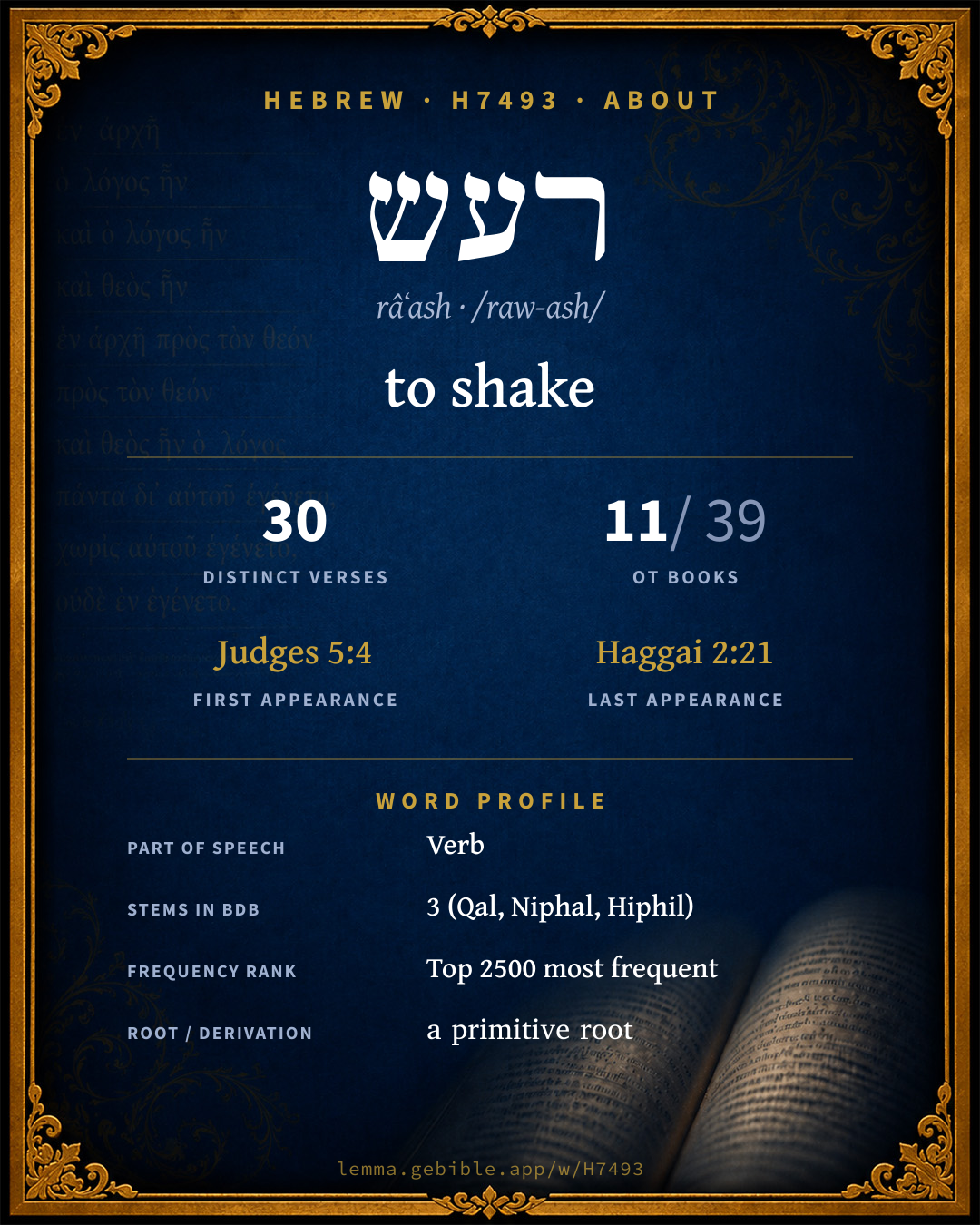
רָעַשׁ
to shake
‘to shake’ is one of 3 main senses fuller range ↓
Full lexicon entry — Brown-Driver-Briggs (BDB)
From Brown-Driver-Briggs (BDB)
Where this word appears
See every Qal verb in the Hebrew Bible →
Grammar key — what these labels mean
Part of speech
- Verb
- An action or state-of-being word.
Stem
- Qal
- The basic, simple active stem — the plain form of the verb (“he wrote”). Here: ‘quake’
- Hiphil
- The causative active stem (“he caused / brought about”). Here: ‘cause to quake’
- Niphal
- Usually the simple passive or reflexive of the Qal (“he was written”).
Form
- Sequential Imperfect
- An imperfect with prefixed waw — the standard past-narrative form (waw-consecutive imperfect).
- Perfect
- A completed action or state — Hebrew marks aspect (completeness) more than strict tense (“he wrote”).
- Participle Active
- A verbal adjective expressing ongoing or characteristic action (“writing / one who writes”).
- Imperfect
- An incomplete, ongoing, or future action (“he will / would write”).
- Sequential Perfect
- A perfect with prefixed waw continuing a preceding imperfect or command (waw-consecutive perfect).
State
- Absolute
- The independent form of a noun, not bound to a following word.
Person
- 3rd Person
- The one spoken about (“he / she / it / they”).
- 1st Person
- The speaker (“I / we”).
- 2nd Person
- The one addressed (“you”).
Gender
- Feminine
- Grammatically feminine.
- Masculine
- Grammatically masculine.
- Common
- Either gender — not distinguished for this form.
Number
- Singular
- One.
- Plural
- More than one (in Hebrew, generally three or more).
Grammatical forms 15 distinct
- Verb, Qal, Sequential Imperfect, 3rd Person, Feminine, Singular 4 times (13%)
- Verb, Qal, Perfect, 3rd Person, Feminine, Singular 4 times (13%)
- Verb, Qal, Imperfect, 3rd Person, Masculine, Plural 4 times (13%)
- Verb, Hiphil, Participle Active, Masculine, Singular, Absolute 3 times (10%)
- Verb, Qal, Sequential Perfect, 3rd Person, Common, Plural 2 times (7%)
- Verb, Qal, Perfect, 3rd Person, Common, Plural 2 times (7%)
- Verb, Hiphil, Perfect, 1st Person, Common, Singular 2 times (7%)
- Verb, Qal, Imperfect, 3rd Person, Feminine, Singular 2 times (7%)
+7 more forms (7 occurrences)
Parsed forms decoded from the imported morphology (morphhb / Westminster Leningrad Codex — WLC text public domain, morphhb tagging CC BY 4.0), counted across 30 parsed occurrences — not distinct verses.
Every verse where H7493 appears — 30 distinct verses across 11 books. Click any verse to open its interlinear word-by-word view. Verse text shown in the World English Bible for context — . Each verse’s Hebrew form is shown with its reference; the English is not keyword-highlighted, since the data carries no word-level English alignment. Use “Compare translations” on any verse to read it across multiple English versions. This concordance covers the Hebrew Bible; Septuagint (Greek Old Testament) occurrences are not indexed here.
Judges 1 verse
2 Samuel 1 verse
Job 1 verse
Psalms 6 verses
- Psalms 18:7 וַ/תִּרְעַ֨שׁ conj + Qal wimpf 3fs Then the earth shook and trembled. The foundations also of the mountains quaked and were shaken, Because he was angry.
- Psalms 46:3 יִֽרְעֲשֽׁוּ Qal impf 3mp Though the waters of it roar and are troubled, Though the mountains tremble with their swelling. Selah.
- Psalms 60:2 הִרְעַ֣שְׁתָּה Hiphil pf 2ms You have made the land tremble. You have torn it. Mend its fractures, For it quakes.
- Psalms 68:8 רָעָ֨שָׁה Qal pf 3fs The earth trembled. The sky also poured down rain at the presence of the God of Sinai-- At the presence of God, the God of Israel.
- Psalms 72:16 יִרְעַ֣שׁ Qal impf 3ms There shall be abundance of grain throughout the land. Its fruit sways like Lebanon. Let it flourish, thriving like the grass of the field.
- Psalms 77:18 וַ/תִּרְעַ֣שׁ conj + Qal wimpf 3fs The voice of your thunder was in the whirlwind. The lightnings lit up the world. The earth trembled and shook.
Isaiah 3 verses
- Isaiah 13:13 וְ/תִרְעַ֥שׁ conj + Qal impf 3fs Therefore I will make the heavens to tremble, and the earth shall be shaken out of its place, in the wrath of Yahweh of hosts, and in the day of his fierce anger.
- Isaiah 14:16 מַרְעִ֖ישׁ Hiphil ptcp.act ms Those who see you shall gaze at you, they shall consider you, [saying], "Is this the man who made the earth to tremble, who shook kingdoms;
- Isaiah 24:18 וַֽ/יִּרְעֲשׁ֖וּ conj + Qal wimpf 3mp It shall happen, that he who flees from the noise of the fear shall fall into the pit; and he who comes up out of the midst of the pit shall be taken in the snare: for the windows on high are opened, and the foundations of the earth tremble.
Jeremiah 6 verses
- Jeremiah 4:24 רֹעֲשִׁ֑ים Qal ptcp.act mp I saw the mountains, and, behold, they trembled, and all the hills moved back and forth.
- Jeremiah 8:16 רָעֲשָׁ֖ה Qal pf 3fs The snorting of his horses is heard from Dan: at the sound of the neighing of his strong ones the whole land trembles; for they are come, and have devoured the land and all that is in it; the city and those who dwell therein.
- Jeremiah 10:10 תִּרְעַ֣שׁ Qal impf 3fs But Yahweh is the true God; he is the living God, and an everlasting King: at his wrath the earth trembles, and the nations are not able to abide his indignation.
- Jeremiah 49:21 רָעֲשָׁ֖ה Qal pf 3fs The earth trembles at the noise of their fall; there is a cry, the noise which is heard in the Red Sea.
- Jeremiah 50:46 נִרְעֲשָׁ֖ה Niphal pf 3fs At the noise of the taking of Babylon the earth trembles, and the cry is heard among the nations.
- Jeremiah 51:29 וַ/תִּרְעַ֥שׁ conj + Qal wimpf 3fs The land trembles and is in pain; for the purposes of Yahweh against Babylon do stand, to make the land of Babylon a desolation, without inhabitant.
Ezekiel 5 verses
- Ezekiel 26:10 תִּרְעַ֨שְׁנָה֙ Qal impf 3fp By reason of the abundance of his horses their dust shall cover you: your walls shall shake at the noise of the horsemen, and of the wagons, and of the chariots, when he shall enter into your gates, as men enter into a city in which is made a breach.
- Ezekiel 26:15 יִרְעֲשׁ֖וּ Qal impf 3mp Thus says the Lord Yahweh to Tyre: shall not the isles shake at the sound of your fall, when the wounded groan, when the slaughter is made in the midst of you?
- Ezekiel 27:28 יִרְעֲשׁ֖וּ Qal impf 3mp At the sound of the cry of your pilots the suburbs shall shake.
- Ezekiel 31:16 הִרְעַ֣שְׁתִּי Hiphil pf 1cs I made the nations to shake at the sound of his fall, when I cast him down to Sheol with those who descend into the pit; and all the trees of Eden, the choice and best of Lebanon, all that drink water, were comforted in the lower parts of the earth.
- Ezekiel 38:20 וְ/רָעֲשׁ֣וּ conj + Qal wpf 3cp so that the fish of the sea, and the birds of the sky, and the animals of the field, and all creeping things who creep on the earth, and all the men who are on the surface of the earth, shall shake at my presence, and the mountains shall be thrown down, and the steep places shall fall, and every wall shall fall to the ground.
Joel 2 verses
- Joel 2:10 רָעֲשׁ֖וּ Qal pf 3cp The earth quakes before them. The heavens tremble. The sun and the moon are darkened, And the stars withdraw their shining.
- Joel 3:16 וְ/רָעֲשׁ֖וּ conj + Qal wpf 3cp Yahweh will roar from Zion, And thunder from Jerusalem; And the heavens and the earth will shake; But Yahweh will be a refuge to his people, And a stronghold to the children of Israel.
Amos 1 verse
Nahum 1 verse
Haggai 3 verses
- Haggai 2:6 מַרְעִישׁ֙ Hiphil ptcp.act ms For this is what Yahweh of Hosts says: 'Yet once, it is a little while, and I will shake the heavens, the earth, the sea, and the dry land;
- Haggai 2:7 וְ/הִרְעַשְׁתִּי֙ conj + Hiphil pf 1cs and I will shake all nations. The precious things of all nations will come, and I will fill this house with glory, says Yahweh of Hosts.
- Haggai 2:21 מַרְעִ֔ישׁ Hiphil ptcp.act ms "Speak to Zerubbabel, governor of Judah, saying, 'I will shake the heavens and the earth.
About this entry
At a glance — auto-summarized from this page’s data, not written by a person. Every figure links to its source below. This summary describes the numbers; it doesn’t interpret them.
“to shake” is the headline sense of the Hebrew verb רעש (râʻash). Its earliest occurrence is Judges 5:4. The Hebrew Bible uses it across 30 verses — moderately common. Read the stem: it spans 3 stems, including Qal and Niphal. Related forms include רעש. The sections below give every sense, occurrence, and version rendering.
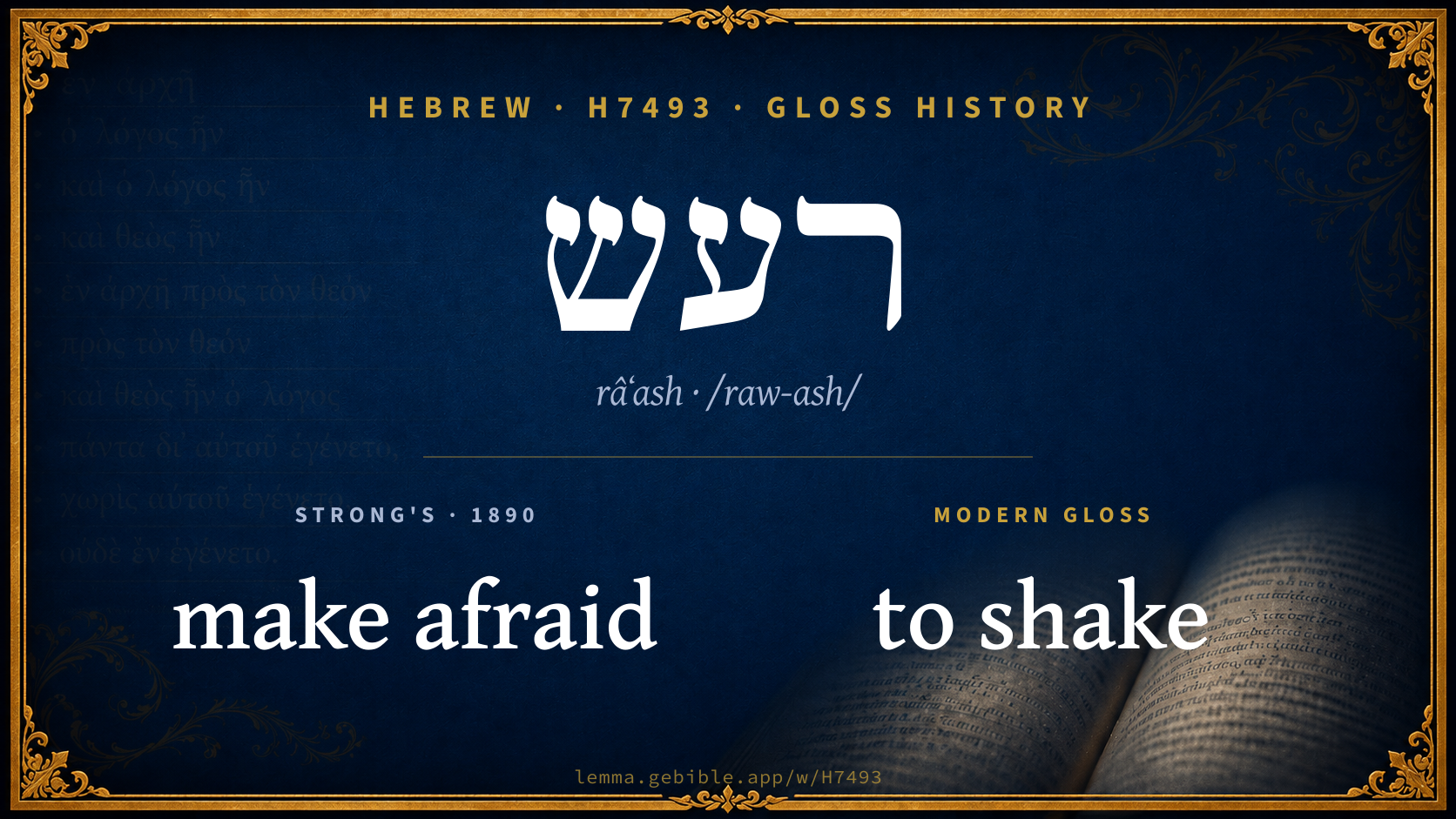
Gloss history
Strong's 1890 vs modern scholarship
About this word
Strong's H7493 catalogs a Hebrew word from the Hebrew Old Testament.
These counts are not copied from any lexicon or concordance. They are computed here, from the morphology-tagged Hebrew Old Testament. What Lemma adds →
- 30
- distinct verses
- The word appears in 30 distinct verses.
- 11 / 39
- OT books
- The word appears in 11 of 39 Old Testament books.
- #1,139
- by frequency
- Top 2500 most frequent Hebrew words (rank 1,139 of 8,640 Hebrew words by occurrence).
View all 30 occurrences in the concordance →
By section of the Old Testament
By traditional corpus
Conventional, traditional groupings — biblical authorship is debated, so this is a traditional corpus grouping, not an authorship claim. Each share is this word’s portion of its verses in that division of the Hebrew canon. Each figure is a share of the word’s 30 distinct verses.
- Prophets (Nevi'im) 23 verses · 77%
- Writings (Ketuvim) 7 verses · 23%
How translations render this word
Counts come from each version’s own published word-to-Strong’s tagging or interlinear alignment — an approximate guide to how each version renders this word, not a word-level alignment the data otherwise carries. Because each total is that version’s own tagged count, the per-version totals vary from one another and need not match the appearance or distinct-verse counts above. These counts may also differ from a printed concordance because Lemma counts each distinctly tagged rendering and does not collapse phrase taggings into a single head-word total. This is a fixed set of word-tagged versions (KJV, ASV, BSB, ULT) and does not change with the reading translation you choose elsewhere. Each version’s license is shown beside its name below (and on Sources).
- King James Version: Shall shake 4×, Trembled 4×, I will shake 3×
- American Standard Version: Trembleth 5×, Trembled 4×, I will shake 3×
- Berean Standard Bible: Quake 4×, Quaked 3×, Quakes 3×
- unfoldingWord Literal Text: Will shake 5×, And 3×, Quake 2×
King James Version Public Domain
Renders H7493 across 30 tagged occurrences — most commonly:
Plus 9 renderings that appear only once — usually multi-word phrases or single function words the recovered tagging swept in, not distinct renderings.
American Standard Version Public Domain
Renders H7493 across 30 tagged occurrences — most commonly:
Plus 10 renderings that appear only once — usually multi-word phrases or single function words the recovered tagging swept in, not distinct renderings.
Berean Standard Bible Public Domain
Renders H7493 across 30 tagged occurrences — most commonly:
Plus 11 renderings that appear only once — usually multi-word phrases or single function words the recovered tagging swept in, not distinct renderings.
unfoldingWord Literal Text CC BY-SA 4.0
Renders H7493 across 34 tagged occurrences — most commonly:
Plus 18 renderings that appear only once — usually multi-word phrases or single function words the recovered tagging swept in, not distinct renderings.
Senses in the full BDB
Hebrew verbs can shift meaning by stem (binyan): Qal is the basic action, Niphal is often passive or reflexive, Piel often intensifies or makes it factitive, and Hiphil is typically causative. The senses below are grouped under the stem BDB assigns to each.
What do BDB’s symbols mean?
BDB uses these scholarly abbreviations:
| Symbol | Meaning |
|---|---|
| 𝔊 | the Septuagint (the ancient Greek translation, LXX) |
| 𝔙 | the Vulgate (the Latin translation) |
| 𝔖 | the Syriac version (the Peshitta) |
| 𝔗 | the Targum (the Aramaic translation) |
| ψ | the Psalms |
| √ | root (the underlying root or stem) |
| ‖ | parallel passage (a synonymous or contrasted parallel) |
| † | the dagger: every passage where the word occurs is cited |
The 4 senses and sub-senses the full Brown-Driver-Briggs lexicon distinguishes for this word, in lexicon order (not ranked by frequency), with BDB’s own verbatim wording and sub-sense lettering. Shown in Hebrew script with BDB’s own scholarly abbreviations. The condensed entry is in the Lexicon Entry tab. See also the Forms in the corpus table below.
Qal
- quake, shake
Niphal
- . is made to quake
Hiphil
- 1. cause to quake
- 2. cause (horse) to spring, leap (like locust)
Senses from the full Brown-Driver-Briggs lexicon (Brown, Driver, Briggs; Oxford 1906 — public domain), digitized via Sefaria, supplemented by the OpenScriptures HebrewLexicon (CC BY 4.0). Full attribution on Sources.
Word origin
[ רָעַשׁ ] vb. quake, shake
— Brown-Driver-Briggs (Oxford 1906, public domain), digitized via Sefaria, supplemented by the OpenScriptures HebrewLexicon (CC BY 4.0). See Sources.
Origin: a primitive root
Jastrow Dictionary
A second Hebrew/Aramaic lexicon for comparison, covering Aramaic and post-biblical (Talmudic, Targumic, Midrashic) usage that the biblical-Hebrew BDB does not. Matched by lemma rather than by Strong’s number, so a lemma may carry more than one Jastrow headword (shown separately below), and the entries cover usage well beyond the Bible.
רָעַשׁ
- (b. h.) to tremble, be in commotion, rage. Ex. R. s. 29 (ref. to Ps. LXVIII, 9) ומה אם … ארץ רָעֲשָׁה וכ׳ if the earth trembled when he gave life to the world, how much more (will it tremble), when he comes to &c. Ib. השמים … רוֹעֲשִׁים heaven and earth tremble. e.g. Psalms 68:9
- to shake, disturb. Gen. R. s. 71 (play on יערשיה I Chr. VIII, 27) בשעה … מַרְעִישׁ עולמו וכ׳ whenever God caused the world to quake, he remembered the merits of the fathers &c. Koh. R. to VII, 1 להַרְעִישׁ, v. גָּעַשׁ. Pesik. R. s. 10 הַרְעִישָׁה, v. אֲפַרְכֶסֶת. Tanḥ. P’kudé 3, v. רַעַשׁ; a. e.—[Yalk. Gen. 132 והרעיש עצמו, read: והרפיש, v. רָפַשׁ.] e.g. 1 Chronicles 8:27
רְעַשׁ
- Targ. II Esth. III, 3 רָעֵישׁ.
רַעַשׁ
- preced.) commotion; earthquake. Ex. R. s. 29 מהיכן הר׳ נעשה for what cause does the earthquake come? Y. Ber. IX, 13ᶜ bot. אין ר׳ אלא וכ׳ raʿash (commotion) means a cessation of government, v. הֶפְסַק; Midr. Till. to Ps. CIV, 29; Midr. Till. to Ps. XVIII, 8 (corr. acc. to ed. Bub.). Tanḥ. P’kude 3 (ref. to I Kings XIX, 11) ואחר הרוח ר׳ … שדומה לר׳ שמרעיש וכ׳ ‘and after the wind an earthquake’, after this world comes the day of death, which is like an earthquake, for it shakes the whole body of man; a. e. e.g. 1 Kings 19:11
A Dictionary of the Targumim, the Talmud Babli and Yerushalmi, and the Midrashic Literature (Marcus Jastrow; London, Luzac, 1903) — Public Domain. Digitized via Sefaria. Digitized via Sefaria. Full attribution on Sources.
Forms in the corpus
The 28 distinct written forms H7493 takes in the Hebrew Bible, most frequent first — each parse links to that stem’s occurrences in the concordance. Hebrew forms include their vowel points and cantillation, so a single lemma takes many written forms.
Same root — word family
Other BDB entries built from the same root as H7493, grouped by Strong’s listed origin. These share a root / origin per the lexicon — not necessarily a shared meaning. Each links to that word’s own entry.
Derived from this word
Compare all same-root words → They share a root, not necessarily a meaning.
Septuagint verse parallels
This word appears in 28 verses that also exist in the Greek Old Testament (Septuagint), out of the 30 Hebrew verses it occurs in. You can read those verses in Greek by switching the Old Testament edition to the Septuagint.
Read these verses in the Septuagint
- Judges 5:4
- 2 Samuel 22:8
- Job 39:20
- Psalms 18:7
- Isaiah 13:13
- Jeremiah 4:24
- Ezekiel 26:10
- Joel 2:10
- Amos 9:1
- Nahum 1:5
- Haggai 2:6
This is a verse-level parallel only — the same verses exist in both the Hebrew and Greek Old Testaments. No word-level Hebrew↔Greek correspondence is claimed: the data carries no such alignment, so no Greek word is shown as this Hebrew word’s translation. Coverage is not total — the Septuagint omits the deuterocanon and renumbers the Psalms, so some Hebrew verses have no direct Greek parallel.