
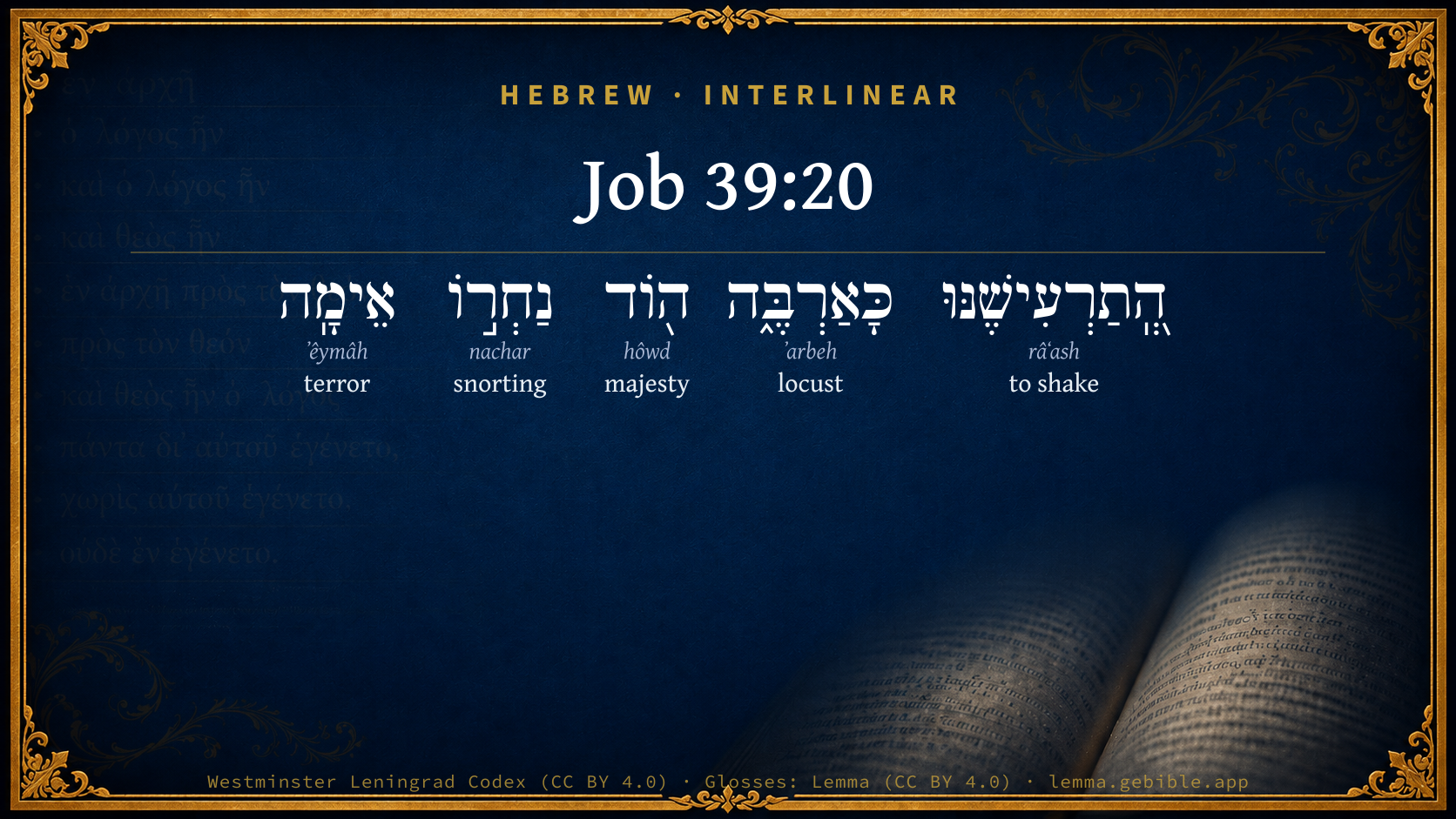
Job 39:20

Hebrew (Westminster Leningrad Codex) Job 39:20 appears in the Hebrew Old Testament. The text above is from the Westminster Leningrad Codex. Each word links to its Strong’s number, a concise gloss, and parsing drawn from the Open Scriptures Hebrew Bible morphology. Click any word for its full Brown-Driver-Briggs (BDB) entry.
Download image
Cite this verse

Job 39:20 (World English Bible). Public Domain. Lemma interlinear Bible study tool, https://lemma.gebible.app/v/job/39/20.

Show BibTeX & RIS
BibTeX
RIS
English Translation
Have you made him to leap as a locust? The glory of his snorting is awesome.
World English Bible · Public Domain
Highlights
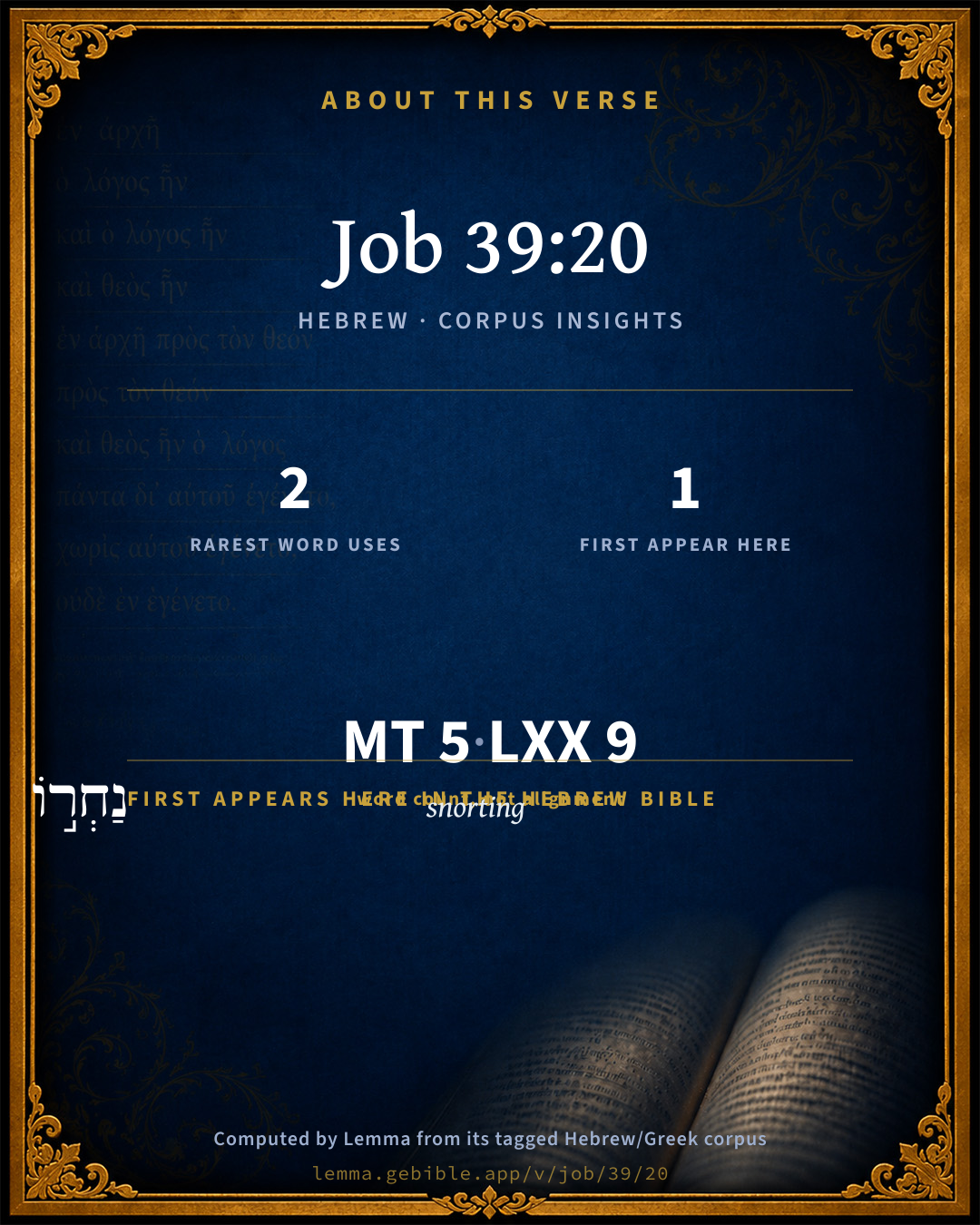
  • 1 first appearance in the Hebrew Bible
Full analysis ↓
Download a study sheet

One document with this verse’s original text, its word-by-word gloss line, the meaning frame, cross-references with their text, attributed commentary, and full source and license credits — printable, and it pastes into notes with its structure intact.

This verse Autodidact and up

Study sheet (.html) Plain text (.txt)

A passage Seminary Student

Up to 50 verses in one chapter. A passage sheet keeps up to 6 commentary sources and 12 cross-references per verse, in the order this page ranks them, and says so on the sheet whenever that leaves anything out. Ask for a single verse and you get the Autodidact verse sheet above.

Everything on this page stays free to read, with no account — the sheet is a download of what is already on screen, not access to it.

Want to remove ads? Support Godless Engineer
Compare translations 3

The same verse in 3 English versions, stacked beneath the original-language interlinear above. Click any original word for its lexicon entry.

Each is an independent rendering of the whole verse — the interlinear is not word-aligned to these translations.

Highlighted words mark where these versions differ — a whole-verse word diff, not a word-by-word alignment.

  • World English Bible Public Domain
    Have you made him to leap as a locust? The glory of his snorting is awesome.
  • King James Version Public Domain
    Canst thou make him afraid as a grasshopper? the glory of his nostrils is terrible.
  • unfoldingWord Literal Text CC BY-SA 4.0
    Have you made it jump like a locust? The majesty of its snorting is terrifying!

unfoldingWord Literal Text — © unfoldingWord, licensed CC BY-SA 4.0. Word-aligned USFM3 via Door43 (git.door43.org/unfoldingWord/en_ult).

Versions to compare (up to 4)

3 of 4 selected

Show all 18 translations

Every available English version of this verse, each an independent rendering of the whole verse.

  • World English Bible Public Domain
    Have you made him to leap as a locust? The glory of his snorting is awesome.
  • Berean Standard Bible Public Domain
    Do you make him leap like a locust, striking terror with his proud snorting?
  • Majority Standard Bible Public Domain
    Do you make him leap like a locust, striking terror with his proud snorting?
  • King James Version Public Domain
    Canst thou make him afraid as a grasshopper? the glory of his nostrils is terrible.
  • American Standard Version (1901) Public Domain
    Hast thou made him to leap as a locust? The glory of his snorting is terrible.
  • Revised Version (1885) Public Domain
    Hast thou made him to leap as a locust? the glory of his snorting is terrible.
  • Geneva Bible (1599) Public Domain
    For God had depriued him of wisedom, and hath giuen him no part of vnderstanding.
  • Douay-Rheims (1899) Public Domain
    Wilt thou lift him up like the locusts? the glory of his nostrils is terror.
  • Young's Literal Translation Public Domain
    Dost thou cause him to rush as a locust? The majesty of his snorting `is' terrible.
  • Literal Standard Version CC BY-SA 4.0
    Do you cause him to rush as a locust? The splendor of his snorting [is] terrible.
  • Unlocked Literal Bible CC BY-SA 4.0
    Have you ever made him jump like a locust? The majesty of his snorting is fearsome.
  • unfoldingWord Literal Text CC BY-SA 4.0
    Have you made it jump like a locust? The majesty of its snorting is terrifying!
  • Darby Bible Public Domain
    Dost thou make him to leap as a locust? His majestic snorting is terrible.
  • World Messianic Bible Public Domain
    Have you made him to leap as a locust? The glory of his snorting is awesome.
  • Webster's Bible Public Domain
    \\39:17\\Because God hath withheld wisdom from her, neither hath he imparted to her understanding.
  • Free Bible Version CC BY-SA 4.0
    Did you make it able to jump like a locust? Its loud snorting is terrifying!
  • Bible in Basic English Public Domain
    For God has taken wisdom from her mind, and given her no measure of knowledge.
  • JPS Tanakh (1917) Public Domain
    Hast thou made him to leap as a locust? The glory of his snorting is terrible.

Literal Standard Version (2020), Covenant Press — licensed CC BY-SA 4.0. Text via the HelloAO Bible API (eBible.org). Unlocked Literal Bible (unfoldingWord) — licensed CC BY-SA 4.0. Text via the HelloAO Bible API (eBible.org). unfoldingWord Literal Text — © unfoldingWord, licensed CC BY-SA 4.0. Word-aligned USFM3 via Door43 (git.door43.org/unfoldingWord/en_ult). Free Bible Version, Dr. Jonathan Gallagher — licensed CC BY-SA 4.0. Text via the HelloAO Bible API (eBible.org).

Word by word

More ways to search: Search by grammar → Find every occurrence → Compare this word →

Practice this passage: Drill this verse → Learn its vocabulary →

About this verse

These counts appear in no published source. They are computed here, from the morphology-tagged text and Lemma’s own curated glosses. What Lemma adds →

5
words
5
distinct lemmas
Wisdom
section

Notable vocabulary

The rarest word here is נַחְר֣וֹ snorting H5170 — appearing just 2 times in the whole Hebrew Bible.

First appearance in Scripture

This word makes its first canonical appearance in the Hebrew Bible here:

  • נַחְר֣וֹ snorting H5170

Shared distinctive vocabulary

נַחְר֣וֹ snorting H5170 occurs in 2 verses of the Hebrew Bible. Also found in:

Grammatical profile

  • 1 verb
  • 4 nouns

Verb forms

  • הְֽ֭תַרְעִישֶׁנּוּ Hiphil · Imperfect

Hebrew & Septuagint length

In English translation the verse runs 16 words from the Hebrew and 15 from the Septuagint (LXX English) — closely comparable.

A rough comparison of the two English renderings, which tokenize alike — not a word-level alignment.

Word counts can differ between the Hebrew and the Greek without any difference in meaning — e.g. the Hebrew direct-object marker אֵת has no separate Greek word, and Greek often adds the article ὁ.

In the original languages it is 5 Hebrew tokens and 9 Greek tokens — but the two are counted differently (Hebrew bundles its prefixes and suffixes into one token; the Greek is in lemma form), so that isn’t a like-for-like length.

Cross-references

3

Topical passages linked to Job 39:20 in the Treasury of Scripture Knowledge — connected by theme and wording, ordered by reader-vote popularity; previews shown in the World English Bible.

  • Jeremiah 8:16 The snorting of his horses is heard from Dan: at the sound of the neighing of his strong ones the whole land trembles; for they are come, and have devoured the land and all that is in it; the city and those who dwell therein.
  • Job 41:20–21 Out of his nostrils a smoke goes, As of a boiling pot over a fire of reeds.
  • Joel 2:5 Like the noise of chariots on the tops of the mountains do they leap, Like the noise of a flame of fire that devours the stubble, As a strong people set in battle array.

Cross-references courtesy of OpenBible.info (CC BY 4.0).

Hebrew and Greek witnesses Masoretic Hebrew ↔ Greek Septuagint

The same verse in the two great witnesses to the Old Testament, shown verse-for-verse.

These are two independent witnesses, not word-aligned to each other, and the Septuagint is shown in lemma (dictionary) form.

Hebrew Job 39:20 Masoretic · Westminster Leningrad Codex

הְֽ֭תַרְעִישֶׁנּוּ כָּאַרְבֶּ֑ה ה֖וֹד נַחְר֣וֹ אֵימָֽה

Have you made him to leap as a locust? The glory of his snorting is awesome.

World English Bible · Public Domain

Greek LXX Job 39:20 Septuagint · lemma form

περιτίθημι δέ αὐτός πανοπλία δόξα δέ στῆθος αὐτός τόλμα

And have you clad him in perfect armor, and made his breast glorious with courage?

LXX2012 (modern English Septuagint) · Public Domain

On this verse, Haydock's Catholic Bible Commentary discusses the Septuagint’s reading. Read the note in Commentary ↓

Hebrew: Westminster Leningrad Codex (CC BY 4.0). Greek: Septuagint (public domain); English from LXX2012 (modern English Septuagint) (Public Domain). How the Septuagint differs from the Hebrew →

Commentary

Notes on Job 39:20 from classic Christian and Jewish commentators (each source and its license shown beneath its notes). The classic Christian expositions comment on the surrounding passage and are grouped to its opening verse, so a note may address several verses; the Jewish commentaries on the Tanakh (Rashi and others) are per-verse, so they appear only where the commentator wrote on this verse.

Lemma curates 59 commentaries, every one of them public domain or Creative Commons licensed, each selected and text-cleaned for this edition rather than reprinted as found. About our sources →

Trapp's Complete Commentary

John Trapp

Job 39:20 Canst thou make him afraid as a grasshopper? the glory of his nostrils [is] terrible.

Ver. 20. Canst thou make him afraid as a grasshopper?] Which soon flincheth and flieth with the least noise. But the horse is more like that formidable army of locusts described Joe 2:1-32, that bare down all before them, and shook all places wherever they came.

The glory of his nostrils is terrible] Heb. Terrors; his snorting and sneezing strikes terror into people. The more wonderful is God’s goodness in subduing to weak man so lusty a creature, to be ridden and ruled at his pleasure. He trains him to the great saddle, and teacheth him to obey his hand and spur, to bound in the air, to observe his measures, to show that docility, dexterity, and vigour, which none but God hath given him, and be every way so serviceable and useful, both in war and peace. Joannes Bodin hath observed (Theat. Nat. 405), That whereas lions, wolves, and other ravenous creatures have a gall and choler, whereby they are easily stirred up to anger and revenge; not so horses, asses, camels, elephants, and other creatures made for man’s help; these have neither gall nor horns, wherein appeareth summa Opifieis sapientia, the great wisdom and goodness of the Creator.

John Trapp, A Commentary or Exposition upon All the Books of the Old and New Testament (1647–1656) — public domain. Text from a community e-Sword module.

Geneva Bible (1599)

Geneva Bible translators

That is, to have a care and natural affection toward his young.

Geneva Bible (1599) marginal notes — public domain. Text via Bolls.life.

Jamieson, Fausset & Brown

Robert Jamieson, A. R. Fausset & David Brown

make . . . afraid--rather, "canst thou (as I do) make him spring as the locust?" So in Joe 2:4, the comparison is between locusts and war-horses. The heads of the two are so similar that the Italians call the locusts cavaletta, "little horse."

nostrils--snorting furiously.

Jamieson, Fausset & Brown — Commentary Critical and Explanatory on the Whole Bible (1871) — public domain (CC PDM 1.0). Text via the HelloAO Bible API.

Ellicott's Commentary for English Readers

(20) Canst thou make him afraid as a grasshopper?—Rather, Hast thou made him to leap as a locust?

A Bible Commentary for English Readers, edited by Charles John Ellicott (1878–1897) — public domain. Text from a community e-Sword module.

The Cambridge Bible for Schools and Colleges

gen. ed. J. J. S. Perowne

20. The comparison of the horse to the locust is not uncommon, Joe_2:4, Rev_9:7. The picture of the horse is taken at the moment immediately preceding the onset, and thus his “bounding” and “snorting” are brought into connexion.

The Cambridge Bible for Schools and Colleges (gen. ed. J. J. S. Perowne; Cambridge University Press, 1878–1918) — public domain. Text from a community e-Sword module.

John Gill's Exposition

Canst thou make him afraid as a grasshopper?.... Which is frightened at every noise, and at any approach of men; but not so the horse; or canst thou move him, or cause him to skip and jump, or rather leap like a grasshopper? that is, hast thou given, or canst thou give him the faculty of leaping over hedges and ditches, for which the horse is famous? so Neptune's war horses are said (q) to be good leapers;

the glory of his nostrils is terrible: which may be understood of his sneezing, snorting, pawing, and neighing, when his nostrils are broad, spread, and enlarged; and especially when enraged and in battle, when he foams and fumes, and his breath comes out of his nostrils like smoke (r), and is very terrible.

(q) Homeri Iliad. 13. v. 31. (r) "Iguescunt patulae nares". Claudian. in 4. Consul. Honor.

John Gill's Exposition of the Whole Bible (1746–1763) — public domain (CC PDM 1.0). Text via the HelloAO Bible API.

Albert Barnes' Notes on the Bible

Canst thou make him afraid as a grasshopper? - Or, rather, “as a locust” - כארבה kā'arbeh. This is the word which is commonly applied to the locust considered as gregarious, or as appearing in great numbers (from רבה râbâh, “to be multiplied”). On the variety of the species of locusts, see Bochart “Hieroz.” P. ii. Lib. iv. c. 1ff The Hebrew word here rendered “make afraid” (רעשׁ râ‛ash) means properly “to be moved, to be shaken,” and hence, to tremble, to be afraid. In the Hiphil, the form used here, it means to cause to tremble, to shake; and then “to cause to leap,” as a horse; and the idea here is, Canst thou cause the horse, an animal so large and powerful, to leap with the agility of a locust? See Gesenius, “Lex.” The allusion here is to the leaping or moving of the locusts as they advance in the appearance of squadrons or troops; but the comparison is not so much that of a single horse to a single locust, as of cavalry or a company of war-horses to an army of locusts; and the point of comparison turns on the elasticity or agility of the motion of cavalry advancing to the field of battle.

The sense is, that God could cause that rapid and beautiful movement in animals so large and powerful as the horse, but that it was wholly beyond the power of man to effect it. It is quite common in the East to compare a horse with a locust, and travelers have spoken of the remarkable resemblance between the heads of the two. This comparison occurs also in the Bible; see Joe 2:4, “The appearance of them is as the appearance of horses; and as horsemen so shall they run;” Rev 9:7. The Italians, from this resemblance, call the locust “cavaletta,” or little horse. Sir W. Ouseley says, “Zakaria Cavini divides the locusts into two classes, like horsemen and footmen, ‘mounted and pedestrian.’ “Niebuhr says that he heard from a Bedouin near Bassorah, a particular comparison of the locust with other animals; but he thought it a mere fancy of the Arabs, until he heard it repeated at Bagdad. He compared the head of a locust to that of a horse, the breast to that of a lion, the feet to those of a camel, the belly with that of a serpent, the tail with that of a scorpion, and the feelers with the hair of a virgin; see the Pictorial Bible on Joe 2:4.

The glory of his nostrils is terrible - Margin, as in Hebrew, “terrors.” That is, it is fitted to inspire terror or awe. The reference is to the wide-extended and fiery looking nostrils of the horse when animated, and impatient, for action. So Lucretius, L. v.:

Et fremitum patulis sub naribus edit ad arma.

So Virgil, “Georg.” iii. 87:

Collectumque premens voluit sub naribus ignem.

Claudian, in iv. “Consulatu Honorii:”

Ignescunt patulae nares.

Albert Barnes' Notes on the Bible (1834–1885) — public domain. Text from a community e-Sword/MySword module.

Haydock's Catholic Bible Commentary

Up. Hebrew, "frighten," (Haydock) or "make him leap." (Bochart) (Calmet) --- Nostrils. Septuagint, "of his chest, or shoulders, is boldness." (Haydock) --- This inspires the rider with courage, and the enemy with fear. But the Vulgate is more followed. (Calmet) -----Frænoque teneri

Impatiens crebros expirat naribus ignes. (Silius vi.)

George Leo Haydock (1774–1849), Haydock's Catholic Family Bible and Commentary, 1859 edition — public domain. Excludes Psalms (Douay-Rheims chapter numbering differs from Protestant) and Deuterocanonical books (Catholic canon only).

Matthew Poole's English Annotations

As a grasshopper; which is easily affrighted, and chased away by the least noise of a man. Or, as divers others render the place, Didst thou make him to move like a grasshopper, skipping and leaping as he goes? So he describes the posture of a gallant and generous horse, who curvets, and pranceth, and as it were danceth as he walks.

The glory of his nostrils; that snorting, or sound, and smoke which cometh out of his nostrils, especially when he is enraged and engaged in battle, which is another note of a generous horse, and strikes a terror into his adversary. Or, the vehemency, or majesty, or magnificence of his snorting, or snoring, as this word is rendered, Jer 8:16.

Matthew Poole's English Annotations on the Holy Bible (1683–1685) — public domain. Text from a community e-Sword/MySword module.

Whedon's Commentary on the Bible

Daniel D. Whedon

20. Make him afraid — Make him bound or spring, like the locust. Comp. Joe_2:4. It is a common saying among the Arabs, that “the horse acts the locust,” i.e., he leaps from place to place like the locust. The head of the latter so much resembles that of the horse that the Italians call him cavaletta, little horse.

Nostrils — Literally, snorting. Compare Jer_8:16.

Daniel D. Whedon (gen. ed.), Commentary on the Old and New Testaments (1874–1909) — public domain. Text from a community e-Sword module.

The Pulpit Commentary

Canst thou make him afraid as a grasshopper? rather, Canst thou make him leap forward as a grasshopper? The bound with which a war-horse rushes to battle seems intended. The glory of his nostrils is terrible. When the war-horse snorts, men tremble. (see Jer_8:16, "The snorting of his horses was heard from Dan: the whole land trembled at the sound of the neighing of his strong ones

The Pulpit Commentary (1880–1919), ed. H.D.M. Spence-Jones & Joseph S. Exell — public domain. Text from a community e-Sword module.

Rashi

Rabbi Shlomo Yitzchaki (Rashi)

like a locust He skips and leaps like a locust and shakes himself all over.

his snorting When he blows with his nostrils, it is with an awesome sound.

Rashi on the Tanakh — English translations: “The Judaica Press complete Tanach with Rashi, translated by A. J. Rosenberg” (CC BY 4.0); “Pentateuch with Rashi's commentary by M. Rosenbaum and A.M. Silbermann, 1929-1934” (public domain); “The Metsudah Tanach series, Lakewood, N.J” (CC BY 4.0); and “The Book of Joshua, Metsudah Publications, 1997” (CC BY 4.0). Text via Sefaria.

Lesson kit

Teaching starters — assembled from the data on this page, not authored interpretation. Every prompt links to the verse data it draws on. Edit before teaching.

Job, in the Wisdom, opens this verse with 5 words (5 distinct Hebrew lemmas). Its most distinctive word is nachar (“snorting”). A historical commentator’s framing appears above. Read the whole chapter for the surrounding context.

Discussion questions

  1. What does “snorting” (nachar) contribute to the verse as a whole?
  2. This is the first place “snorting” appears in Scripture (first appears here). What does its debut here establish?
  3. How does Jeremiah 8:16, which shares the word «snorting», read alongside this verse?
  4. The translations on this page render this verse differently — a whole-verse word diff, not a word-by-word alignment. What might account for the different wordings?
  5. «הְֽ֭תַרְעִישֶׁנּוּ» is a Hiphil Imperfect verb. How does that grammatical form shape the action described?
  6. Compare how Trapp's Complete Commentary and Geneva Bible (1599) read this verse. Where do they agree or differ?

Things to notice

Reading settings

Reading text

Shown beneath each verse's original-language words.

Old Testament
Old Testament edition

Read the OT as the Masoretic Hebrew (MT) or the Greek Septuagint (LXX).

English shown for the Greek Septuagint (in the Hebrew ↔ Greek comparison).

Comparing translations? Open the Compare panel on any verse page to stack up to four side by side.