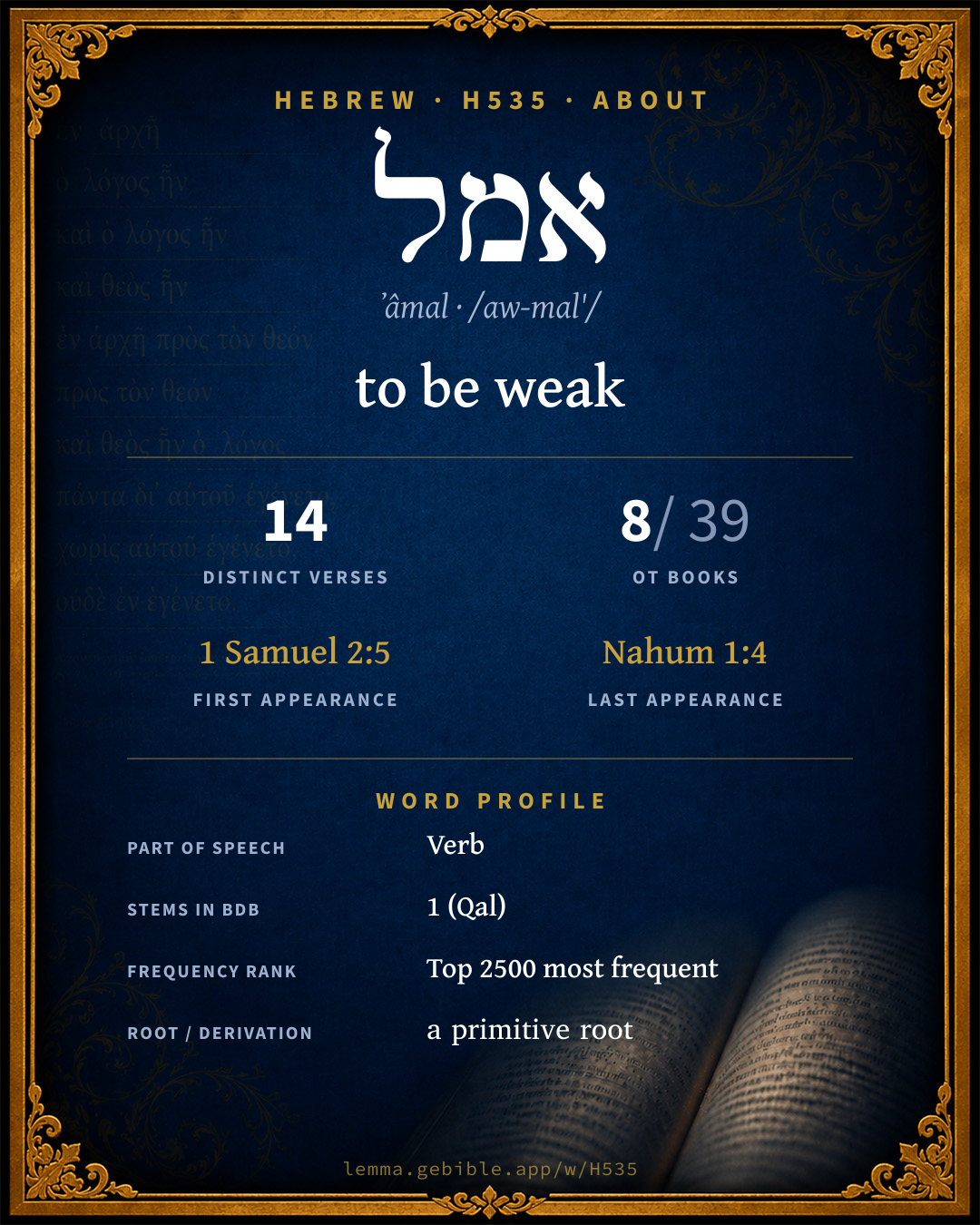
אָמַל
to be weak
also: to droop, to languish, to be exhausted fuller range ↓
Full lexicon entry — Brown-Driver-Briggs (BDB)
From Brown-Driver-Briggs (BDB)
Where this word appears
See every Pulal verb in the Hebrew Bible →
Grammar key — what these labels mean
Part of speech
- Verb
- An action or state-of-being word.
Stem
- Qal
- The basic, simple active stem — the plain form of the verb (“he wrote”).
Form
- Perfect
- A completed action or state — Hebrew marks aspect (completeness) more than strict tense (“he wrote”).
- Sequential Perfect
- A perfect with prefixed waw continuing a preceding imperfect or command (waw-consecutive perfect).
- Participle Passive
- A verbal adjective expressing action received (“written”).
State
- Absolute
- The independent form of a noun, not bound to a following word.
Person
- 3rd Person
- The one spoken about (“he / she / it / they”).
Gender
- Feminine
- Grammatically feminine.
- Common
- Either gender — not distinguished for this form.
- Masculine
- Grammatically masculine.
Number
- Singular
- One.
- Plural
- More than one (in Hebrew, generally three or more).
Grammatical forms
- Verb, Pulal, Perfect, 3rd Person, Feminine, Singular 6 times (38%)
- Verb, Pulal, Perfect, 3rd Person, Common, Plural 4 times (25%)
- Verb, Pulal, Perfect, 3rd Person, Masculine, Singular 4 times (25%)
- Verb, Pulal, Sequential Perfect, 3rd Person, Masculine, Singular 1 time (6%)
- Verb, Qal, Participle Passive, Feminine, Singular, Absolute 1 time (6%)
Parsed forms decoded from the imported morphology (morphhb / Westminster Leningrad Codex — WLC text public domain, morphhb tagging CC BY 4.0), counted across 16 parsed occurrences — not distinct verses.
Every verse where H535 appears — 14 distinct verses across 8 books. Click any verse to open its interlinear word-by-word view. Verse text shown in the World English Bible for context — . Each verse’s Hebrew form is shown with its reference; the English is not keyword-highlighted, since the data carries no word-level English alignment. Use “Compare translations” on any verse to read it across multiple English versions. This concordance covers the Hebrew Bible; Septuagint (Greek Old Testament) occurrences are not indexed here.
1 Samuel 1 verse
Isaiah 5 verses
- Isaiah 16:8 אֻמְלָ֜ל Pulal pf 3ms For the fields of Heshbon languish, [and] the vine of Sibmah; the lords of the nations have broken down the choice branches of it, which reached even to Jazer, which wandered into the wilderness; its shoots were spread abroad, they passed over the sea.
- Isaiah 19:8 אֻמְלָֽלוּ Pulal pf 3cp The fishermen shall lament, and all those who cast angle into the Nile shall mourn, and those who spread nets on the waters shall languish.
- Isaiah 24:4 אֻמְלְלָ֥ה אֻמְלָ֖לוּ Pulal pf 3fs Pulal pf 3cp The earth mourns and fades away, the world languishes and fades away, the lofty people of the earth do languish.
- Isaiah 24:7 אֻמְלְלָה Pulal pf 3fs The new wine mourns, the vine languishes, all the merry-hearted do sigh.
- Isaiah 33:9 אֻמְלְלָה֙ Pulal pf 3fs The land mourns and languishes; Lebanon is confounded and withers away; Sharon is like a desert; and Bashan and Carmel shake off [their leaves].
Jeremiah 2 verses
- Jeremiah 14:2 אֻמְלְל֖וּ Pulal pf 3cp Judah mourns, and the gates of it languish, they sit in black on the ground; and the cry of Jerusalem is gone up.
- Jeremiah 15:9 אֻמְלְלָ֞ה Pulal pf 3fs She who has borne seven languishes; she has given up the spirit; her sun is gone down while it was yet day; she has been disappointed and confounded: and the residue of them will I deliver to the sword before their enemies, says Yahweh.
Lamentations 1 verse
Ezekiel 1 verse
Hosea 1 verse
Joel 2 verses
- Joel 1:10 אֻמְלַ֥ל Pulal pf 3ms The field is laid waste. The land mourns, for the grain is destroyed, The new wine has dried up, And the oil languishes.
- Joel 1:12 אֻמְלָ֑לָה Pulal pf 3fs The vine has dried up, and the fig tree withered; the pomegranate tree, the palm tree also, and the apple tree, Even all of the trees of the field are withered; For joy has withered away from the sons of men.
Nahum 1 verse
About this entry
At a glance — auto-summarized from this page’s data, not written by a person. Every figure links to its source below. This summary describes the numbers; it doesn’t interpret them.
“to be weak” is the headline sense of the Hebrew verb אמל (ʼâmal). First canonically at 1 Samuel 2:5, it enters the text early. It turns up in 14 verses across 8 books, an uncommon footprint. It concentrates in Isaiah, which alone accounts for 36% of its uses. Not a single-sense word: its full sense range also takes in “to droop”, “to languish”, and “to be exhausted”. The sections below give every sense, occurrence, and version rendering.
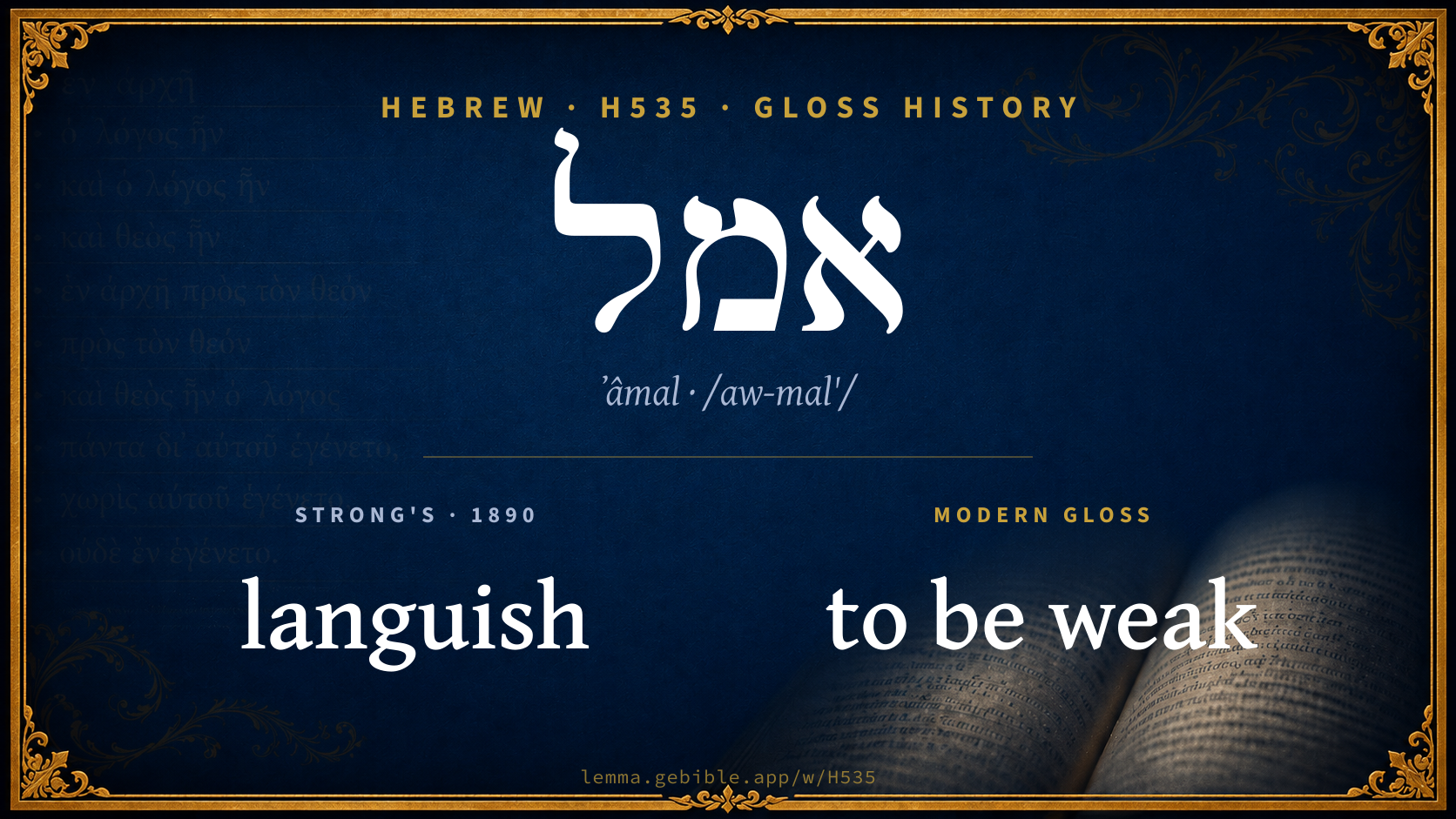
Gloss history
Strong's 1890 vs modern scholarship
About this word
Strong's H535 catalogs a Hebrew word from the Hebrew Old Testament.
These counts are not copied from any lexicon or concordance. They are computed here, from the morphology-tagged Hebrew Old Testament. What Lemma adds →
- 14
- distinct verses
- The word appears in 14 distinct verses.
- 8 / 39
- OT books
- The word appears in 8 of 39 Old Testament books.
- #1,752
- by frequency
- Top 2500 most frequent Hebrew words (rank 1,752 of 8,640 Hebrew words by occurrence).
View all 14 occurrences in the concordance →
By section of the Old Testament
By traditional corpus
Conventional, traditional groupings — biblical authorship is debated, so this is a traditional corpus grouping, not an authorship claim. Each share is this word’s portion of its verses in that division of the Hebrew canon. Each figure is a share of the word’s 14 distinct verses.
- Prophets (Nevi'im) 13 verses · 93%
- Writings (Ketuvim) 1 verse · 7%
How translations render this word
Counts come from each version’s own published word-to-Strong’s tagging or interlinear alignment — an approximate guide to how each version renders this word, not a word-level alignment the data otherwise carries. Because each total is that version’s own tagged count, the per-version totals vary from one another and need not match the appearance or distinct-verse counts above. These counts may also differ from a printed concordance because Lemma counts each distinctly tagged rendering and does not collapse phrase taggings into a single head-word total. This is a fixed set of word-tagged versions (KJV, ASV, BSB, ULT) and does not change with the reading translation you choose elsewhere. Each version’s license is shown beside its name below (and on Sources).
- King James Version: Languisheth 8×
- American Standard Version: Languisheth 9×
- Berean Standard Bible: Languishes 2×
- unfoldingWord Literal Text: Is enfeebled 3×, Languishes 2×
King James Version Public Domain
Renders H535 across 16 tagged occurrences — most commonly:
Plus 8 renderings that appear only once — usually multi-word phrases or single function words the recovered tagging swept in, not distinct renderings.
American Standard Version Public Domain
Renders H535 across 16 tagged occurrences — most commonly:
Plus 7 renderings that appear only once — usually multi-word phrases or single function words the recovered tagging swept in, not distinct renderings.
Berean Standard Bible Public Domain
Renders H535 across 15 tagged occurrences — most commonly:
Plus 13 renderings that appear only once — usually multi-word phrases or single function words the recovered tagging swept in, not distinct renderings. Not rendered by a distinct English word in 1 further occurrence.
unfoldingWord Literal Text CC BY-SA 4.0
Renders H535 across 17 tagged occurrences — most commonly:
Plus 12 renderings that appear only once — usually multi-word phrases or single function words the recovered tagging swept in, not distinct renderings.
Senses in the full BDB
What do BDB’s symbols mean?
BDB uses these scholarly abbreviations:
| Symbol | Meaning |
|---|---|
| 𝔊 | the Septuagint (the ancient Greek translation, LXX) |
| 𝔙 | the Vulgate (the Latin translation) |
| 𝔖 | the Syriac version (the Peshitta) |
| 𝔗 | the Targum (the Aramaic translation) |
| ψ | the Psalms |
| √ | root (the underlying root or stem) |
| ‖ | parallel passage (a synonymous or contrasted parallel) |
| † | the dagger: every passage where the word occurs is cited |
The 1 sense the full Brown-Driver-Briggs lexicon distinguishes for this word, in lexicon order (not ranked by frequency), with BDB’s own verbatim wording and sub-sense lettering. Shown in Hebrew script with BDB’s own scholarly abbreviations. The condensed entry is in the Lexicon Entry tab. See also the Forms in the corpus table below.
Qal
- Pt. pass. f. מָה אֲמֻלָה לִבָּתֵךְ how weak is thy heart! Ez 16:30 (but מַה־לִּי וְלִבְרִיתֵךְ); Puʿl. Pf. אֻמְלַל Jo 1:10 +; אֻמְלְלָה Is 33:9 +; אֻמְלְלוּ Je 14:2 etc.;—be or grow feeble, languish; of loss of fertility (woman) 1 S 2:5 Je 15:9; of fisherman whose trade fails Is 19:8 (‖ אנה, אבל); in genl. in inhab. of smitten land Ho 4:3 (‖ תֶּאֱבַל הָאָרֶץ); Is 24:4 cf. infr. usually subj. inanim., personif.; שַׁדְמוֹת חֶשְׁבּוֹן Is 16:8; cf. Na 1:4(×2); תֵּבֵל Is 24:4 (‖ נבל, אבל); אֶרֶץ 33:9 (‖ אבל); subj. גֶּפֶן Is 24:7 (‖ אָבַל תִּירוֹשׁ); יִצְּהָר Jo 1:10 (‖ שׁדד, אבל, הובישׁ; kindred subj.); תְּאֵנָה v 12 (‖ הַגֶּפֶן הוֹבִישָׁה); שְׁעָרִים Je 14:2 (‖ אָֽבְלָה יְהוּדָה); cf. La 2:8 וַיַּאֲבֶל־חֵל וְחוֹמָה יַחְדָּו אֻמְלָ֑לוּ. e.g. Ezekiel 16:30
Senses from the full Brown-Driver-Briggs lexicon (Brown, Driver, Briggs; Oxford 1906 — public domain), digitized via Sefaria, supplemented by the OpenScriptures HebrewLexicon (CC BY 4.0). Full attribution on Sources.
Word origin
vb. be weak, languish (cf. Arabic أَمَلَ hope, expect).
— Brown-Driver-Briggs (Oxford 1906, public domain), digitized via Sefaria, supplemented by the OpenScriptures HebrewLexicon (CC BY 4.0). See Sources.
Origin: a primitive root
Forms in the corpus
The 15 distinct written forms H535 takes in the Hebrew Bible, most frequent first — each parse links to that stem’s occurrences in the concordance. Hebrew forms include their vowel points and cantillation, so a single lemma takes many written forms.
Same root — word family
Other BDB entries built from the same root as H535, grouped by Strong’s listed origin. These share a root / origin per the lexicon — not necessarily a shared meaning. Each links to that word’s own entry.
Derived from this word
Compare all same-root words → They share a root, not necessarily a meaning.
Septuagint verse parallels
This word appears in 14 verses that also exist in the Greek Old Testament (Septuagint), out of the 14 Hebrew verses it occurs in. You can read those verses in Greek by switching the Old Testament edition to the Septuagint.
Read these verses in the Septuagint
This is a verse-level parallel only — the same verses exist in both the Hebrew and Greek Old Testaments. No word-level Hebrew↔Greek correspondence is claimed: the data carries no such alignment, so no Greek word is shown as this Hebrew word’s translation. Coverage is not total — the Septuagint omits the deuterocanon and renumbers the Psalms, so some Hebrew verses have no direct Greek parallel.