
Ezekiel 12:24

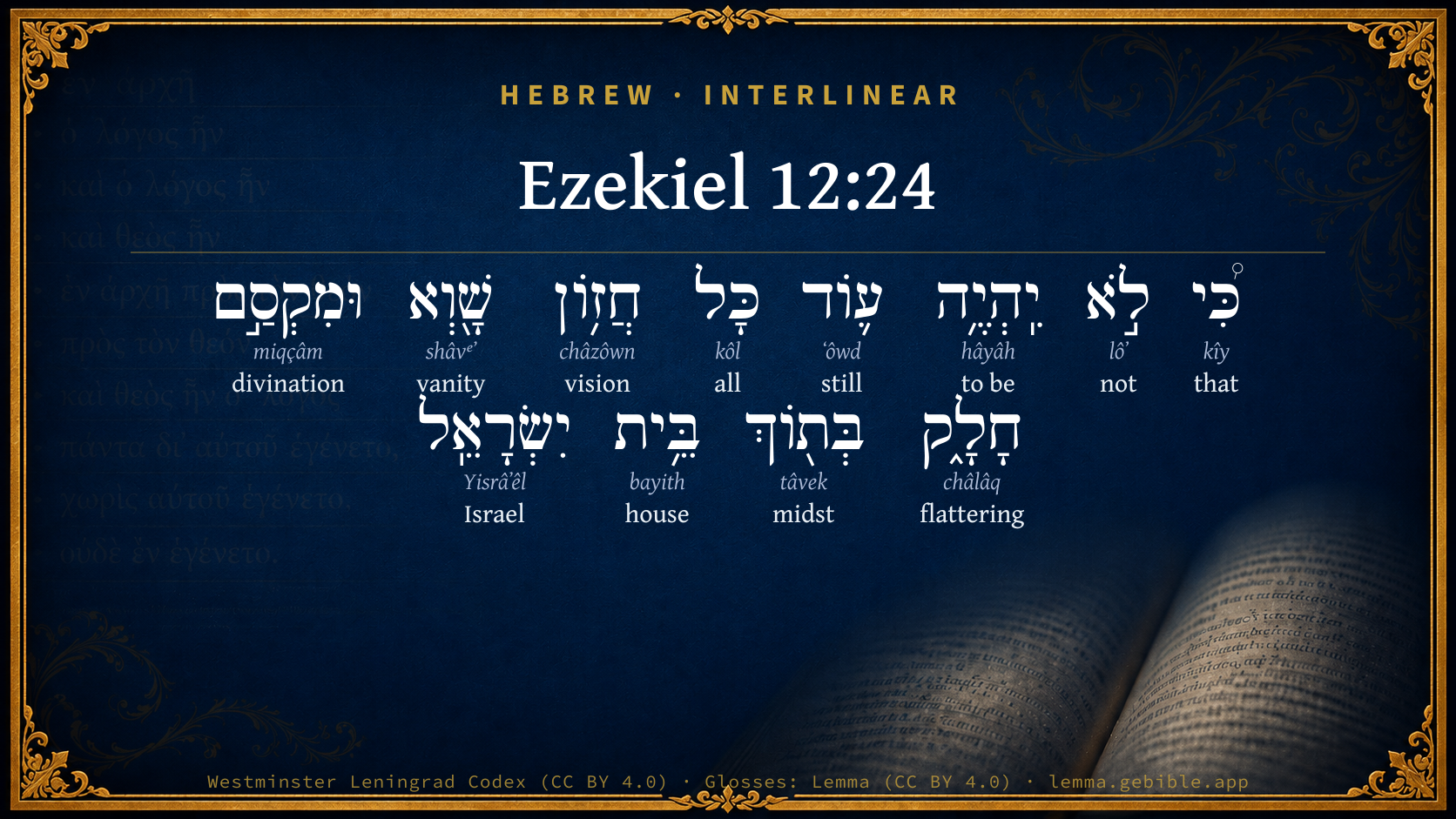
Hebrew (Westminster Leningrad Codex) Ezekiel 12:24 appears in the Hebrew Old Testament. The text above is from the Westminster Leningrad Codex. Each word links to its Strong’s number, a concise gloss, and parsing drawn from the Open Scriptures Hebrew Bible morphology. Click any word for its full Brown-Driver-Briggs (BDB) entry.
Download image
Cite this verse

Ezekiel 12:24 (World English Bible). Public Domain. Lemma interlinear Bible study tool, https://lemma.gebible.app/v/ezekiel/12/24.

Show BibTeX & RIS
BibTeX
RIS
English Translation
For there shall be no more any false vision nor flattering divination within the house of Israel.
World English Bible · Public Domain
Highlights
  • 1 first appearance in the Hebrew Bible
Full analysis ↓
Download a study sheet

One document with this verse’s original text, its word-by-word gloss line, the meaning frame, cross-references with their text, attributed commentary, and full source and license credits — printable, and it pastes into notes with its structure intact.

This verse Autodidact and up

Study sheet (.html) Plain text (.txt)

A passage Seminary Student

Up to 50 verses in one chapter. A passage sheet keeps up to 6 commentary sources and 12 cross-references per verse, in the order this page ranks them, and says so on the sheet whenever that leaves anything out. Ask for a single verse and you get the Autodidact verse sheet above.

Everything on this page stays free to read, with no account — the sheet is a download of what is already on screen, not access to it.

Want to remove ads? Support Godless Engineer
Compare translations 3

The same verse in 3 English versions, stacked beneath the original-language interlinear above. Click any original word for its lexicon entry.

Each is an independent rendering of the whole verse — the interlinear is not word-aligned to these translations.

Highlighted words mark where these versions differ — a whole-verse word diff, not a word-by-word alignment.

  • World English Bible Public Domain
    For there shall be no more any false vision nor flattering divination within the house of Israel.
  • King James Version Public Domain
    For there shall be no more any vain vision nor flattering divination within the house of Israel.
  • unfoldingWord Literal Text CC BY-SA 4.0
    For there will no longer be any false visions or favorable divinations within the house of Israel.

unfoldingWord Literal Text — © unfoldingWord, licensed CC BY-SA 4.0. Word-aligned USFM3 via Door43 (git.door43.org/unfoldingWord/en_ult).

Versions to compare (up to 4)

3 of 4 selected

Show all 18 translations

Every available English version of this verse, each an independent rendering of the whole verse.

  • World English Bible Public Domain
    For there shall be no more any false vision nor flattering divination within the house of Israel.
  • Berean Standard Bible Public Domain
    For there will be no more false visions or flattering divinations within the house of Israel,
  • Majority Standard Bible Public Domain
    For there will be no more false visions or flattering divinations within the house of Israel,
  • King James Version Public Domain
    For there shall be no more any vain vision nor flattering divination within the house of Israel.
  • American Standard Version (1901) Public Domain
    For there shall be no more any false vision nor flattering divination within the house of Israel.
  • Revised Version (1885) Public Domain
    For there shall be no more any vain vision, nor flattering divination within the house of Israel.
  • Geneva Bible (1599) Public Domain
    For no vision shall be any more in vaine, neither shall there bee any flattering diuination within the house of Israel.
  • Douay-Rheims (1899) Public Domain
    For there shall be no more any vain visions, nor doubtful divination in the midst of the children of Israel.
  • Young's Literal Translation Public Domain
    For there is no more any vain vision, and flattering divination, In the midst of the house of Israel.
  • Literal Standard Version CC BY-SA 4.0
    For there is no longer any vain vision, and flattering divination, || In the midst of the house of Israel.
  • Unlocked Literal Bible CC BY-SA 4.0
    For there will no longer be any false visions or favorable divinations within the house of Israel.
  • unfoldingWord Literal Text CC BY-SA 4.0
    For there will no longer be any false visions or favorable divinations within the house of Israel.
  • Darby Bible Public Domain
    For there shall be no more any vain vision nor flattering divination in the midst of the house of Israel.
  • World Messianic Bible Public Domain
    For there will be no more any false vision nor flattering divination within the house of Israel.
  • Webster's Bible Public Domain
    For there shall no more be any vain vision nor flattering divination within the house of Israel.
  • Free Bible Version CC BY-SA 4.0
    There won't be any more false visions or fake prophecies among the Israelites,
  • Bible in Basic English Public Domain
    For there will be no more false visions or smooth use of secret arts in Israel.
  • JPS Tanakh (1917) Public Domain
    For there shall be no more any vain vision nor smooth divination within the house of Israel.

Literal Standard Version (2020), Covenant Press — licensed CC BY-SA 4.0. Text via the HelloAO Bible API (eBible.org). Unlocked Literal Bible (unfoldingWord) — licensed CC BY-SA 4.0. Text via the HelloAO Bible API (eBible.org). unfoldingWord Literal Text — © unfoldingWord, licensed CC BY-SA 4.0. Word-aligned USFM3 via Door43 (git.door43.org/unfoldingWord/en_ult). Free Bible Version, Dr. Jonathan Gallagher — licensed CC BY-SA 4.0. Text via the HelloAO Bible API (eBible.org).

Word by word

More ways to search: Search by grammar → Find every occurrence → Compare this word →

Practice this passage: Drill this verse → Learn its vocabulary →

וּמִקְסַ֣ם
miqçâm
H4738
“and · divination of”
Conjunction + Noun, Common, Masculine, Singular, Construct
Part of Speech
Conjunction + Noun
Type
Common
Gender
Masculine
Number
Singular
State
Construct
Full BDB Definition

Origin: from H7080

TWOT: 2044b

divination
  1. כִּ֠י kîy H3588 “that” Conjunction
  2. לֹ֣א lôʼ H3808 “not” Particle, Negative
  3. יִֽהְיֶ֥ה hâyâh H1961 “to be” Verb, Qal, Imperfect, 3rd Person, Masculine, Singular
  4. ע֛וֹד ʻôwd H5750 “still” Adverb
  5. כָּל kôl H3605 “all of” Noun, Common, Masculine, Singular, Construct
  6. חֲז֥וֹן châzôwn H2377 “vision of” Noun, Common, Masculine, Singular, Construct
  7. שָׁ֖וְא shâvᵉʼ H7723 “vanity” Noun, Common, Masculine, Singular, Absolute
  8. חָלָ֑ק châlâq H2509 “flattering” Adjective, Adjective, Masculine, Singular, Absolute
  9. בְּת֖וֹךְ tâvek H8432 “in/at · midst of” Preposition + Noun, Common, Masculine, Singular, Construct
  10. בֵּ֥ית bayith H1004 “house of” Noun, Common, Masculine, Singular, Construct
  11. יִשְׂרָאֵֽל Yisrâʼêl H3478 “Israel” Noun, Proper

About this verse

These counts appear in no published source. They are computed here, from the morphology-tagged text and Lemma’s own curated glosses. What Lemma adds →

12
words
12
distinct lemmas
Prophets
section

Notable vocabulary

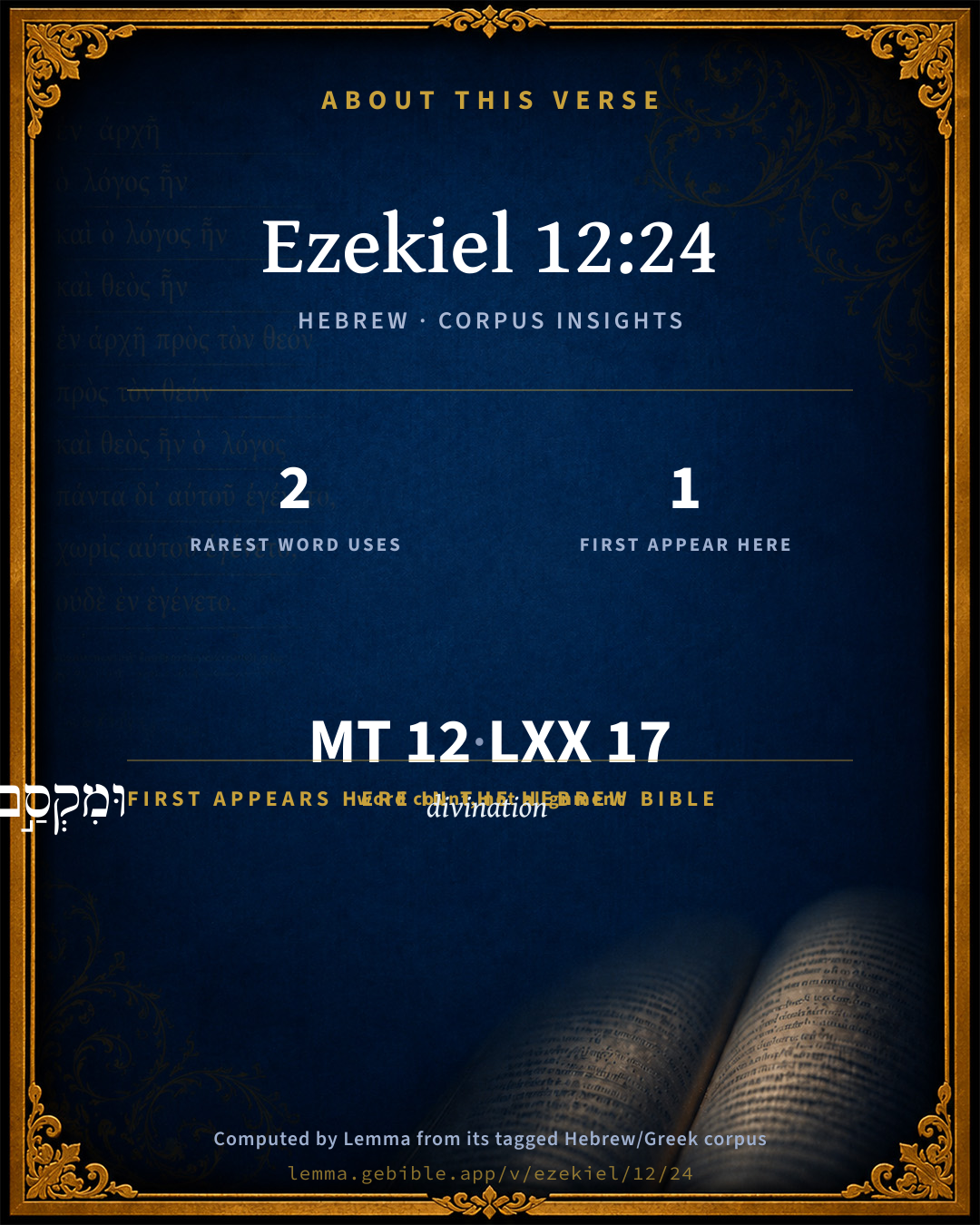
The rarest word here is וּמִקְסַ֣ם divination H4738 — appearing just 2 times in the whole Hebrew Bible.

First appearance in Scripture

This word makes its first canonical appearance in the Hebrew Bible here:

  • וּמִקְסַ֣ם divination H4738

Shared distinctive vocabulary

וּמִקְסַ֣ם divination H4738 occurs in 2 verses of the Hebrew Bible. Also found in:

Grammatical profile

  • 1 verb
  • 7 nouns
  • 1 adjective
  • 1 conjunction
  • 1 adverb
  • 1 particle

Verb forms

  • יִֽהְיֶ֥ה Qal · Imperfect

Hebrew & Septuagint length

In English translation the verse runs 17 words from the Hebrew and 22 from the Septuagint (LXX English) — closely comparable.

A rough comparison of the two English renderings, which tokenize alike — not a word-level alignment.

Word counts can differ between the Hebrew and the Greek without any difference in meaning — e.g. the Hebrew direct-object marker אֵת has no separate Greek word, and Greek often adds the article ὁ.

In the original languages it is 12 Hebrew tokens and 17 Greek tokens — but the two are counted differently (Hebrew bundles its prefixes and suffixes into one token; the Greek is in lemma form), so that isn’t a like-for-like length.

Cross-references

12

Topical passages linked to Ezekiel 12:24 in the Treasury of Scripture Knowledge — connected by theme and wording, ordered by reader-vote popularity; previews shown in the World English Bible.

  • Jeremiah 14:13–16 Then said I, Ah, Lord Yahweh! behold, the prophets tell them, You shall not see the sword, neither shall you have famine; but I will give you assured peace in this place.
  • Ezekiel 13:23 Therefore you shall no more see false visions, nor practice divination. I will deliver my people out of your hand; and you shall know that I am Yahweh.
  • Zechariah 13:2–4 It will come to pass in that day, says Yahweh of Hosts, that I will cut off the names of the idols out of the land, and they will no more be remembered; and also I will cause the prophets and the spirit of impurity to pass out of the land.
  • 1 Kings 22:11–13 Zedekiah the son of Chenaanah made him horns of iron, and said, Thus says Yahweh, With these shall you push the Syrians, until they be consumed.
  • 1 Kings 22:17 He said, I saw all Israel scattered on the mountains, as sheep that have no shepherd: and Yahweh said, These have no master; let them return every man to his house in peace.
  • Proverbs 26:28 A lying tongue hates those it hurts; And a flattering mouth works ruin.
  • Jeremiah 23:14–29 In the prophets of Jerusalem also I have seen a horrible thing: they commit adultery, and walk in lies; and they strengthen the hands of evil-doers, so that none does return from his wickedness: they are all of them become to me as Sodom, and the inhabitants of it as Gomorrah.
  • Lamentations 2:14 Your prophets have seen for you false and foolish visions; They have not uncovered your iniquity, to bring back your captivity, But have seen for you false oracles and causes of banishment.
  • Ezekiel 13:6 They have seen falsehood and lying divination, who say, Yahweh says; but Yahweh has not sent them: and they have made men to hope that the word would be confirmed.
  • Romans 16:18 For those who are such don't serve our Lord, Jesus Christ, but their own belly; and by their smooth and flattering speech, they deceive the hearts of the innocent.
  • 1 Thessalonians 2:5 For neither were we at any time found using words of flattery, as you know, nor a cloak of covetousness (God is witness),
  • 2 Peter 2:2–3 Many will follow their immoral ways, and as a result, the way of the truth will be maligned.

Cross-references courtesy of OpenBible.info (CC BY 4.0).

Hebrew and Greek witnesses Masoretic Hebrew ↔ Greek Septuagint

The same verse in the two great witnesses to the Old Testament, shown verse-for-verse.

These are two independent witnesses, not word-aligned to each other, and the Septuagint is shown in lemma (dictionary) form.

Hebrew Ezekiel 12:24 Masoretic · Westminster Leningrad Codex

כִּ֠י לֹ֣א יִֽהְיֶ֥ה ע֛וֹד כָּל חֲז֥וֹן שָׁ֖וְא וּמִקְסַ֣ם חָלָ֑ק בְּת֖וֹךְ בֵּ֥ית יִשְׂרָאֵֽל

For there shall be no more any false vision nor flattering divination within the house of Israel.

World English Bible · Public Domain

Greek LXX Ezekiel 12:24 Septuagint · lemma form

ὅτι οὐ εἰμί ἔτι πᾶς ὅρασις ψευδής καί μαντεύομαι ὁ πρός χάρις ἐν μέσος ὁ υἱός ἰσραήλ

For there shall no more be any false vision, nor any one prophesying flatteries in the midst of the children of Israel.

LXX2012 (modern English Septuagint) · Public Domain

On this verse, The Pulpit Commentary discusses the Septuagint’s reading. Read the note in Commentary ↓

Hebrew: Westminster Leningrad Codex (CC BY 4.0). Greek: Septuagint (public domain); English from LXX2012 (modern English Septuagint) (Public Domain). How the Septuagint differs from the Hebrew →

Targum (Aramaic paraphrase)

1

The Targum is the ancient Jewish Aramaic paraphrase of the Hebrew Scriptures — an interpretive translation, not the Hebrew text itself. Onkelos (literal) and Pseudo-Jonathan (expansive) render the Torah, and Jonathan the Prophets. Coverage is partial: where no permissively-licensed English translation exists for a verse, only the Aramaic is shown. This is verse-level text, not a word-by-word alignment to the Hebrew.

  1. Targum Jonathan Prophets (Joshua–Malachi)
    אֲרֵי לָא תְהֵי עוֹד כָּל נְבוּאָה שְׁקַר וּכְזַב כָּדְבִין בְּגוֹ בְנֵי יִשְׂרָאֵל:

    (no public-domain English translation for this verse)

    Targum Jonathan — Aramaic: “Mikraot Gedolot” (public domain). English: “Sefaria Community Translation” (CC0 1.0 (public-domain dedication)); “London "Chaldee Paraphrase," 1871” (public domain). Text via Sefaria.

Commentary

Notes on Ezekiel 12:24 from classic Christian and Jewish commentators (each source and its license shown beneath its notes). The classic Christian expositions comment on the surrounding passage and are grouped to its opening verse, so a note may address several verses; the Jewish commentaries on the Tanakh (Rashi and others) are per-verse, so they appear only where the commentator wrote on this verse.

Lemma curates 59 commentaries, every one of them public domain or Creative Commons licensed, each selected and text-cleaned for this edition rather than reprinted as found. About our sources →

Trapp's Complete Commentary

John Trapp

Eze 12:24 For there shall be no more any vain vision nor flattering divination within the house of Israel.

Ver. 24. For there shall be no more.] God could have really confuted them by present execution; but he is patient.

John Trapp, A Commentary or Exposition upon All the Books of the Old and New Testament (1647–1656) — public domain. Text from a community e-Sword module.

The Biblical Illustrator

Joseph S. Exell

Eze_12:24-25

It shall be no more prolonged: for in your days, O rebellious house, will I say the word, and will perform it, saith the Lord God.

Critical moments

Do not enter a fools paradise; do not enter upon vain imaginations, saying, As it was yesterday, so it will be tomorrow,--for there is a moment which changes all things. Study the action of time, and you will see how many critical moments there are. It is only a moment that separates the night from the day, the day from the not-day, the positive from the negative--an almost incalculable line, so minute, so infinitesimal. God can work wonders in a moment. He may take eternity for some works, but in many a moment He strikes men blind, and turns men into perdition. There is but a step between thee and death. Thy breath is in thy nostrils: a puncture in the right place, and life is gone. One touch, and the balance is lost, and he who was strong an hour since will be buried next week. Seizing these realities, grasping them with the whole mind and heart, the Church ought not to be other than in dead earnest. (J. Parker, D. D.)

Gods warnings to be heeded

You see that buoy, sir, moored in the bay? said the captain of the steamship in which we visited the Orlmeys. Yes, I replied, after carefully picking out in the twilight the well-known danger signal. Well, there is a reef of rocks, that, starting from the shore, runs to a point within ten yards of the buoy. The worst tiring about it is that there is no indication of the reef; even at low water it is covered with water, and woe be to the ship that should strike on that dangerous reef. In the dark nights that buoy is an object of deep interest to me. Anxiously do I look out for it, and we steer with care until it is found. The reef was never seen by the captain, but marked on his chart. He believed his chart to be true. So must we, as believers and Christians, trust in the testimony of the Word of God, and heed its warnings. (J. Ellis.)

Gods reckonings sometimes long delayed

An ungodly farmer one day met his Christian neighbour, also a farmer, and began to taunt him. Why, my corn grows as well as yours. What difference does it make, all your prayers and talking about Gods blessing? I dont see any good youll get by it. The Christian neighbour looked the man full in the face, and replied, Friend, God does not pay every week, but He does pay in the end.

The Biblical Illustrator, edited by Joseph S. Exell (c. 1880s–1900s) — public domain. Text from a community e-Sword module.

Jamieson, Fausset & Brown

Robert Jamieson, A. R. Fausset & David Brown

no more . . . vain vision . . . flattering divination--All those false prophets (Lam 2:14), who "flattered" the people with promises of peace and safety, shall be detected and confounded by the event itself.

Jamieson, Fausset & Brown — Commentary Critical and Explanatory on the Whole Bible (1871) — public domain (CC PDM 1.0). Text via the HelloAO Bible API.

John Calvin's Commentaries

Here God deprives the Jews of another source of confidence; for they flattered themselves, and had their own agitators, that is false Prophets, who puffed them up with flatteries: hence when they heard prophecies of sadness they despised them, and afterwards hardened themselves as if the Prophets had frightened them needlessly. Every one was too much inclined to this besotted confidence, but, as I have said, enticements were added, by which the flatterers deceived them. For the false Prophets said, that God would not be so severe, and that those predictions about the destruction of the city and temple were at variance with many promises. We see then that the Prophets were despised by the voluntary contumacy of the people, and also by the perverse acts of the false Prophets. Afterwards God asserted, that the days approached: now he adds, that there should be no more vision of vanity, not that the false Prophets were altogether removed, but because their mouth was stopped, since the event had proved their wickedness. Since then the people were made ashamed by slaughter, in this sense and for this reason it is said, that prophecies of vanity must be taken away: afterwards, divination of flattery from the midst of the house of Israel For in ease and shade they promised themselves a prosperous delivery from their miseries. For when the people were dragged out of the city into exile, some were slain, others spoiled of their fortunes and treated ignominiously, then the character of those Prophets appeared who had nursed the perverse confidence of the people by their vain enticements. Now we understand the Prophet’s genuine sense. It follows —

John Calvin's Commentaries (1540-1563) — public domain. Text from the Calvin Translation Society English edition (1840s-50s) via the Christian Classics Ethereal Library (ccel.org). Calvin's coverage is partial (roughly two-thirds of the Bible); uncommented books and verses are honest gaps, never fabricated. The 19th-century editor's footnotes and remarks are omitted so the notes are faithfully Calvin's own voice.

The Cambridge Bible for Schools and Colleges

gen. ed. J. J. S. Perowne

24. Another thing which robbed the word of the true prophets, who threatened judgment, of its force was the fact that there were other prophets who spoke in a contrary sense, preaching peace and security. Prophets, though alike speaking in the name of Jehovah, contradicted one another, and the people, even if anxious to know the truth, had no criterion whereby to judge between them. The scene between Jeremiah and Hananiah (Jeremiah 28) is very instructive as to the condition in which the people were left. There was nothing in Jeremiah to shew him to be a true prophet, and nothing in Hananiah to prove him false. Truth and falsehood could be distinguished in those days in no other way than now: he who has to distinguish must find the criterion in himself—he that is of the truth heareth my voice. The people believed that Jehovah spoke by prophets, but by which prophets, whether Jeremiah or his opponents, they had to decide out of their own hearts, and not unnaturally (Mic_2:11) they despised Jeremiah as a false prophet and held to his opponents (Jer_18:18).

no more … flattering divination] These false prophecies of peace shall cease, for the same judgment which confirms the true prophecy shall annihilate the false. The term “divination” was employed of the methods of reaching the mind of the deity used by the native populations of Canaan (Deu_18:10; 1Sa_6:2). They were such appliances as lots, arrows, and other methods of augury (Eze_21:21). Possibly these methods had in some degree passed into use in Israel, and were employed by a low prophecy. In true prophecy these mechanical arts were discarded: Jehovah spoke to the mind of the prophet in his mind. Here, however, the word “divination” is used of the oracles of the prophets who were false, even though not employing any external arts of augury. Their prophecy is called “flattering,” lit. smooth, because it promised immunity from trouble and disaster. Cf. Jer_14:14.

The Cambridge Bible for Schools and Colleges (gen. ed. J. J. S. Perowne; Cambridge University Press, 1878–1918) — public domain. Text from a community e-Sword module.

Matthew Poole's English Annotations

These proverbializing scoffers compared the true prophets with the false. These predict prosperity and return of the captives from Babylon within few years, and before Jerusalem be destroyed; so they flattered the people. The true prophets foretell long captivity, bloody slaughters, strait siege, a burnt city and temple. Now these scoffers bear up themselves on these flatteries, and argue against the Divine menaces, and are ready to inquire, Why may not Ezekiel’s vision be as vain as he saith theirs is? and if one, why not both? Well, these fools are capable of no better answer than that which will destroy at once their doubts and their hopes. Judgment executed shall convince the false prophets of their lying divination, and these atheists of their illogical inferences.

No more; for this many years, for seventy years to come, and till wickedness shall again take root with the prosperity of the returned captivity.

Matthew Poole's English Annotations on the Holy Bible (1683–1685) — public domain. Text from a community e-Sword/MySword module.

The Pulpit Commentary

Flattering divination. The word is the same as the "smooth things" of Isa_30:10, the "flattering lips" of menov Psa_12:2, Psa_12:3. LXX, manteuo ta prorin; Vulgate, ambigua. The "divinations" (the Hebrew word is found only here and in Eze_13:7, though cognate words are found elsewhere) are so described, not without a touch of scorn in the use of a word which is not applied to the utterance of the true prophets, because they promised a speedy deliverance, even within "two full years". (Jer_28:3)

The end of delusions.

The Jews had beer deluding themselves with a false proverb or at all events, with a proverb falsely applied (see ver. 22). Ezekiel tells them that such errors and those of flattering divination will both cease. There is to be an end to error.

I DELUSIONS WIN A TEMPORARY TRIUMPH. The false prophet has his day of success. Flattering errors easily win their way into popularity. The history of thought is largely made up of the story of errors their genesis, growth, prevalence, triumph, and decay. This fact shouldguard us against accepting any motive just because it happens to be triumphant. There are fashions in philosophy and theology. But truth is eternal and abiding, and it is therefore simply foolish to accept the ideas which chance to be in vogue at our own time without further inquiry.

II THE TRIUMPH OF DELUSIONS IS FRUITLESS. Error is always barren of any solid results. It is darkness, death, negation. Even when at the acme of prosperity it is but as a bubble; it has no substance in it. There came a time when the vain vision and the flattering divination of the Jews were to be put to the test in the siege of Jerusalem. At this moment of trial they were found to be utterly useless. This is the fatal defect of a false idea. We may cherish it for long until we need to use it. But directly we put it into practice it crumbles away.

III TROUBLE EXPOSES DELUSIONS. So long as Jerusalem prospered the vain visions continued, and the flattering divination was practised without intermission. It was the touch of real trouble that broke the bubble. Many a comfortable soul is living in a fool"s paradise or direful error without fear or pain until some real adversity comes. Then the utter delusiveness of the admired notions is suddenly revealed with appalling amazement. If we are able to hold to fatal notions till the end of life, we shall find at last that they are but rotten planks, which will break up when we try to float on them eve, the chill waters of death.

IV THE EXPOSURE OF DELUSIONS IS A BLESSING. Naturally enough, it first strikes the helpless dupes with dismay as a pure calamity. Why should they not be permitted to dream their lives away on a bed of roses although the volcano should be slumbering beneath? Because even apart from consequences truth is supremely desirable, and error is an evil thing. We ought to be thankful for a painful process which leads us out of darkness into light. But it is not necessary for us to wait for the alarming awakening. The revelation of God in Christ and the truths of inspiration are with us to spare us the terrible method of deliverance from error, and to lead us out of darkness into the light of Christ.

The Pulpit Commentary (1880–1919), ed. H.D.M. Spence-Jones & Joseph S. Exell — public domain. Text from a community e-Sword module.

unfoldingWord translationNotes

Door43 World Missions Community

General Information:

Yahweh continues to tell Ezekiel what to say to the people of Israel.

house of Israel

The word "house" is a metonym for the family that lives in the house, in this case the Israelites, the descendants of Jacob over many years. See how you translated this in Ezekiel 3:1. AT: "the Israelite people group" (See: Metonymy)

I carry out the words that I speak

This idiom means that Yahweh does what he says. AT: "I do the things that I say" (See: Idiom)

The matter will no longer be delayed

The "matter" refers to the things that Yahweh says will happen. AT: "What I say will no longer be delayed" or "What I say will happen soon" (See: Assumed Knowledge and Implicit Information)

I will speak this word

"I will speak this message" or "I will speak this prophecy"

in your days

This idiom refers to the period of time in which a person lives. AT: "while you are alive" or "during you lifetime" (See: Idiom)

rebellious house

This is a metonym for the family that lives in the house, in this case the Israelites, the descendants of Jacob over many years. See how you translated this in Ezekiel 2:5. AT: "rebellious people" (See: Metonymy)

this is the Lord Yahweh's declaration

Yahweh speaks of himself by name to express the certainty of what he is declaring. See how you translated this in Ezekiel 5:11. AT: "this is what the Lord Yahweh has declared" or "this is what I, the Lord Yahweh, have declared" (See: First, Second, or Third Person)

translationWords

vision

divination

house

Israel

Yahweh

word

rebel

Lord Yahweh

declare

unfoldingWord translationNotes — © Distant Shores Media and the Door43 World Missions Community, licensed CC BY-SA 4.0. Source: git.door43.org/Door43/en_tn.

Rashi

Rabbi Shlomo Yitzchaki (Rashi)

For there will never again be any false prophecy The false prophets will no longer be able to promise you peace with falsehood, for speedily I will bring near the [realization of the] words of the true prophets.

glib divination Heb. מִקְסַם חָלָק, devinaylle in Old French, soothsaying, divination. Divination of smoothness.

Rashi on the Tanakh — English translations: “The Judaica Press complete Tanach with Rashi, translated by A. J. Rosenberg” (CC BY 4.0); “Pentateuch with Rashi's commentary by M. Rosenbaum and A.M. Silbermann, 1929-1934” (public domain); “The Metsudah Tanach series, Lakewood, N.J” (CC BY 4.0); and “The Book of Joshua, Metsudah Publications, 1997” (CC BY 4.0). Text via Sefaria.

Lesson kit

Teaching starters — assembled from the data on this page, not authored interpretation. Every prompt links to the verse data it draws on. Edit before teaching.

Ezekiel, in the Prophets, opens this verse with 12 words (12 distinct Hebrew lemmas). Its most distinctive word is miqçâm (“divination”). A historical commentator’s framing appears above. Read the whole chapter for the surrounding context.

Discussion questions

  1. What does “divination” (miqçâm) contribute to the verse as a whole?
  2. The word “divination” first appears here in Scripture. What is being introduced at this debut?
  3. Ezekiel 13:7 shares the word «divination» with this verse. How do the two illuminate each other?
  4. The translations on this page render this verse differently — a whole-verse word diff, not a word-by-word alignment. What might account for the different wordings?
  5. The verb «יִֽהְיֶ֥ה» is Qal Imperfect. How does its form color the action?
  6. Reading how Trapp's Complete Commentary and The Biblical Illustrator read this verse, where do the two commentators agree and where do they part?

Things to notice

Reading settings

Reading text

Shown beneath each verse's original-language words.

Old Testament
Old Testament edition

Read the OT as the Masoretic Hebrew (MT) or the Greek Septuagint (LXX).

English shown for the Greek Septuagint (in the Hebrew ↔ Greek comparison).

Comparing translations? Open the Compare panel on any verse page to stack up to four side by side.