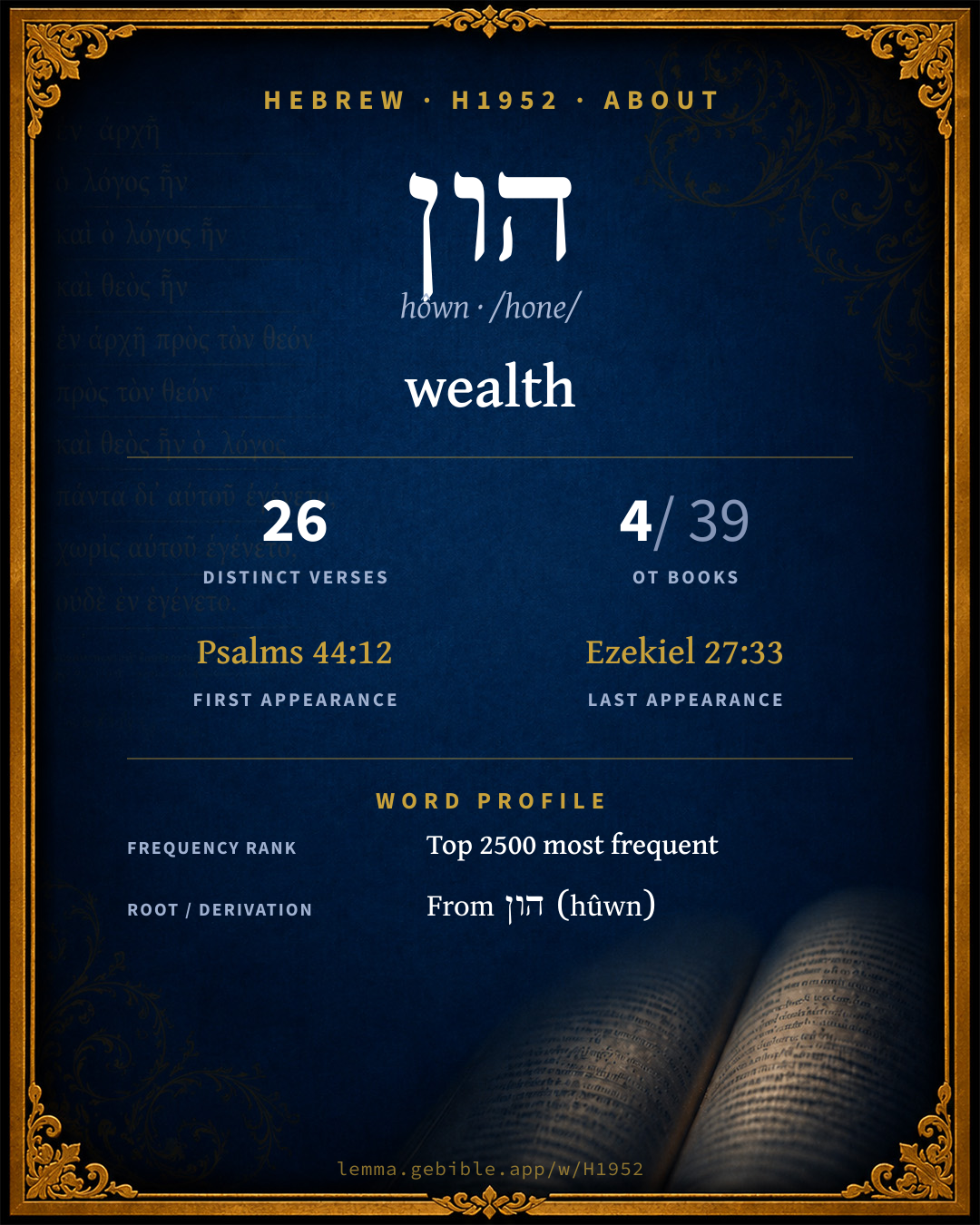
הוֹן
wealth
also: riches, substance fuller range ↓
Full lexicon entry — Brown-Driver-Briggs (BDB)
From Brown-Driver-Briggs (BDB)
Where this word appears
See every Absolute-state word in the Hebrew Bible →
Grammar key — what these labels mean
Part of speech
- Noun
- A naming word — a person, place, thing, or idea.
Noun type
- Common
- A common noun — a general class of person, place, or thing (“king,” “city,” “water”), not a specific name.
State
- Absolute
- The independent form of a noun, not bound to a following word.
- Construct
- A noun bound to a following noun in a possessive / “of” relationship (the construct chain).
Gender
- Masculine
- Grammatically masculine.
Number
- Singular
- One.
- Plural
- More than one (in Hebrew, generally three or more).
Grammatical forms
- Noun, Common, Masculine, Singular, Absolute 20 times (77%)
- Noun, Common, Masculine, Singular, Construct 5 times (19%)
- Noun, Common, Masculine, Plural, Construct 1 time (4%)
Parsed forms decoded from the imported morphology (morphhb / Westminster Leningrad Codex — WLC text public domain, morphhb tagging CC BY 4.0), counted across 26 parsed occurrences — not distinct verses.
Every verse where H1952 appears — 26 distinct verses across 4 books. Click any verse to open its interlinear word-by-word view. Verse text shown in the World English Bible for context — . Each verse’s Hebrew form is shown with its reference; the English is not keyword-highlighted, since the data carries no word-level English alignment. Use “Compare translations” on any verse to read it across multiple English versions. This concordance covers the Hebrew Bible; Septuagint (Greek Old Testament) occurrences are not indexed here.
Psalms 3 verses
Proverbs 18 verses
- Proverbs 1:13 ה֣וֹן n c ms We'll find all valuable wealth. We'll fill our houses with spoil.
- Proverbs 3:9 מֵ/הוֹנֶ֑/ךָ prep + n c ms cs + sfx pers 2ms Honor Yahweh with your substance, With the first fruits of all your increase:
- Proverbs 6:31 ה֖וֹן n c ms cs But if he is found, he shall restore seven times. He shall give all the wealth of his house.
- Proverbs 8:18 ה֥וֹן n c ms With me are riches, honor, Enduring wealth, and prosperity.
- Proverbs 10:15 ה֣וֹן n c ms The rich man's wealth is his strong city. The destruction of the poor is their poverty.
- Proverbs 11:4 ה֭וֹן n c ms Riches don't profit in the day of wrath, But righteousness delivers from death.
- Proverbs 12:27 וְ/הוֹן conj + n c ms The slothful man doesn't roast his game, But the possessions of diligent men are prized.
- Proverbs 13:7 וְ/ה֣וֹן conj + n c ms There are some who pretend to be rich, yet have nothing. There are some who pretend to be poor, yet have great wealth.
- Proverbs 13:11 ה֭וֹן n c ms Wealth gained dishonestly dwindles away, But he who gathers by hand makes it grow.
- Proverbs 18:11 ה֣וֹן n c ms The rich man's wealth is his strong city, Like an unscalable wall in his own imagination.
- Proverbs 19:4 ה֗וֹן n c ms Wealth adds many friends, But the poor is separated from his friend.
- Proverbs 19:14 וָ֭/הוֹן conj + n c ms House and riches are an inheritance from fathers, But a prudent wife is from Yahweh.
- Proverbs 24:4 ה֖וֹן n c ms By knowledge the rooms are filled With all rare and beautiful treasure.
- Proverbs 28:8 ה֭וֹנ/וֹ n c ms cs + sfx pers 3ms He who increases his wealth by excessive interest Gathers it for one who has pity on the poor.
- Proverbs 28:22 לַ/ה֗וֹן prep det + n c ms A stingy man hurries after riches, And doesn't know that poverty waits for him.
- Proverbs 29:3 הֽוֹן n c ms Whoever loves wisdom brings joy to his father; But a companion of prostitutes squanders his wealth.
- Proverbs 30:15 הֽוֹן n c ms "The leach has two daughters: 'Give, give.' "There are three things that are never satisfied; Four that don't say, 'Enough:'
- Proverbs 30:16 הֽוֹן n c ms Sheol, The barren womb; The earth that is not satisfied with water; And the fire that doesn't say, 'Enough.'
Song of Solomon 1 verse
Ezekiel 4 verses
- Ezekiel 27:12 ה֑וֹן n c ms Tarshish was your merchant by reason of the multitude of all kinds of riches; with silver, iron, tin, and lead, they traded for your wares.
- Ezekiel 27:18 ה֑וֹן n c ms Damascus was your merchant for the multitude of your handiworks, by reason of the multitude of all kinds of riches, with the wine of Helbon, and white wool.
- Ezekiel 27:27 הוֹנֵ/ךְ֙ n c ms cs + sfx pers 2fs Your riches, and your wares, your merchandise, your mariners, and your pilots, your repairers of ship seams, and the dealers in your merchandise, and all your men of war, who are in you, with all your company which is in the midst of you, shall fall into the heart of the seas in the day of your ruin.
- Ezekiel 27:33 הוֹנַ֨יִ/ךְ֙ n c mp cs + sfx pers 2fs When your wares went forth out of the seas, you filled many peoples; you did enrich the kings of the earth with the multitude of your riches and of your merchandise.
About this entry
At a glance — auto-summarized from this page’s data, not written by a person. Every figure links to its source below. This summary describes the numbers; it doesn’t interpret them.
At its core, הון (hôwn) means “wealth.” Its uses cluster heavily in Proverbs (69% of all occurrences). With 26 verses in 4 books, it is a moderately common word in the Hebrew Bible. Not a single-sense word: its full sense range also takes in “riches” and “substance”. Translators differ — “riches” in the King James Version, then “wealth” (Berean Standard Bible), as the renderings breakdown shows. Dig into 26-verse concordance and the renderings breakdown below.
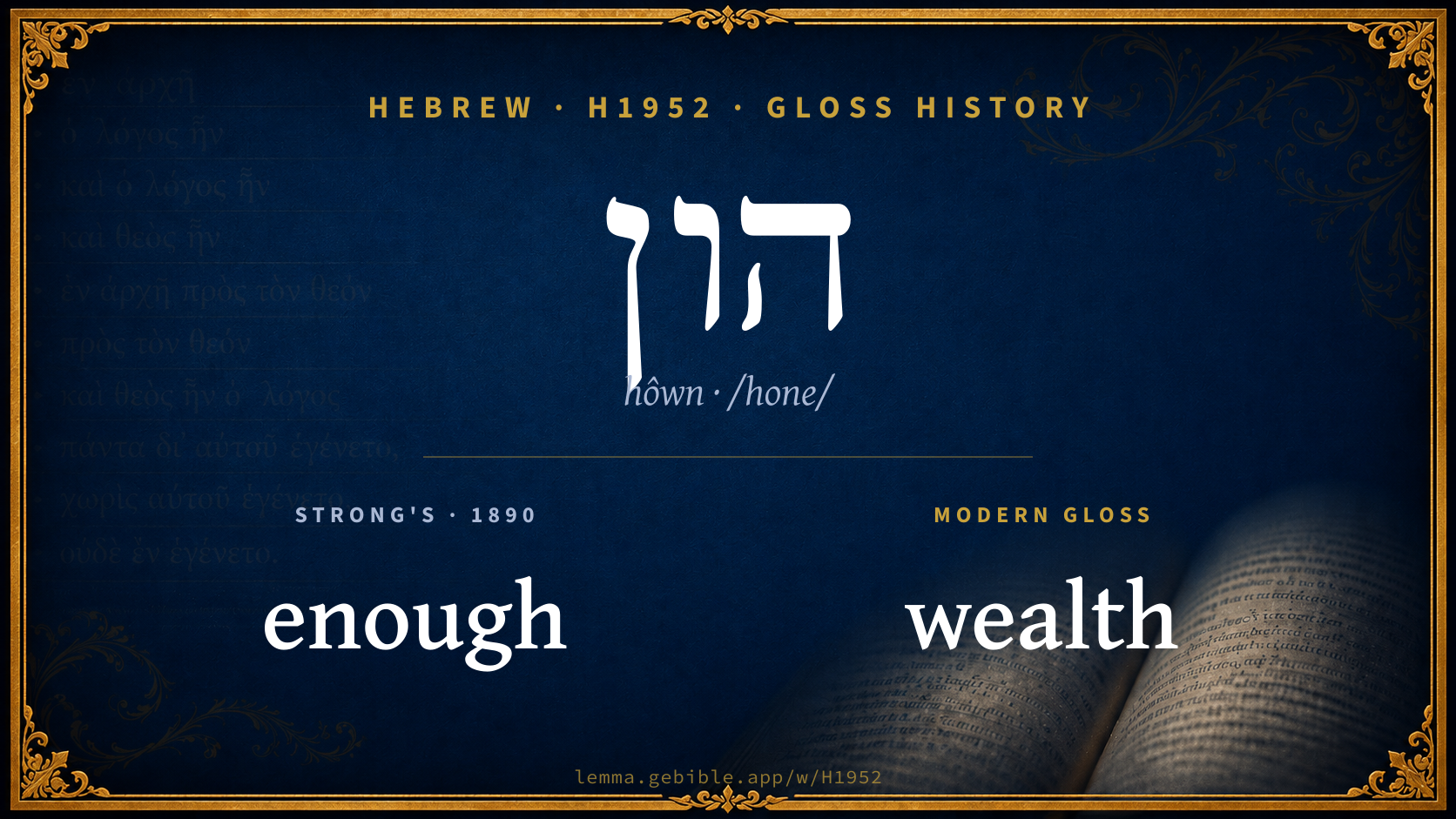
Gloss history
Strong's 1890 vs modern scholarship
About this word
Strong's H1952 catalogs a Hebrew word from the Hebrew Old Testament.
These counts are not copied from any lexicon or concordance. They are computed here, from the morphology-tagged Hebrew Old Testament. What Lemma adds →
- 26
- distinct verses
- The word appears in 26 distinct verses.
- 4 / 39
- OT books
- The word appears in 4 of 39 Old Testament books.
- #1,251
- by frequency
- Top 2500 most frequent Hebrew words (rank 1,251 of 8,640 Hebrew words by occurrence).
View all 26 occurrences in the concordance →
By section of the Old Testament
By traditional corpus
Conventional, traditional groupings — biblical authorship is debated, so this is a traditional corpus grouping, not an authorship claim. Each share is this word’s portion of its verses in that division of the Hebrew canon. Each figure is a share of the word’s 26 distinct verses.
- Writings (Ketuvim) 22 verses · 85%
- Prophets (Nevi'im) 4 verses · 15%
How translations render this word
Counts come from each version’s own published word-to-Strong’s tagging or interlinear alignment — an approximate guide to how each version renders this word, not a word-level alignment the data otherwise carries. Because each total is that version’s own tagged count, the per-version totals vary from one another and need not match the appearance or distinct-verse counts above. These counts may also differ from a printed concordance because Lemma counts each distinctly tagged rendering and does not collapse phrase taggings into a single head-word total. This is a fixed set of word-tagged versions (KJV, ASV, BSB, ULT) and does not change with the reading translation you choose elsewhere. Each version’s license is shown beside its name below (and on Sources).
- King James Version: Riches 7×, Substance 5×, Wealth 5×
- American Standard Version: Riches 5×, Substance 5×, Wealth 4×
- Berean Standard Bible: Wealth 14×, Enough 2×, Riches 2×
- unfoldingWord Literal Text: Wealth 17×, Wealth of 5×, Enough 2×
King James Version Public Domain
Renders H1952 across 26 tagged occurrences — most commonly:
Plus 3 renderings that appear only once — usually multi-word phrases or single function words the recovered tagging swept in, not distinct renderings.
American Standard Version Public Domain
Renders H1952 across 26 tagged occurrences — most commonly:
Plus 4 renderings that appear only once — usually multi-word phrases or single function words the recovered tagging swept in, not distinct renderings.
Berean Standard Bible Public Domain
Renders H1952 across 26 tagged occurrences — most commonly:
Plus 6 renderings that appear only once — usually multi-word phrases or single function words the recovered tagging swept in, not distinct renderings.
unfoldingWord Literal Text CC BY-SA 4.0
Renders H1952 across 27 tagged occurrences — most commonly:
Plus 3 renderings that appear only once — usually multi-word phrases or single function words the recovered tagging swept in, not distinct renderings.
Senses in the full BDB
What do BDB’s symbols mean?
BDB uses these scholarly abbreviations:
| Symbol | Meaning |
|---|---|
| 𝔊 | the Septuagint (the ancient Greek translation, LXX) |
| 𝔙 | the Vulgate (the Latin translation) |
| 𝔖 | the Syriac version (the Peshitta) |
| 𝔗 | the Targum (the Aramaic translation) |
| ψ | the Psalms |
| √ | root (the underlying root or stem) |
| ‖ | parallel passage (a synonymous or contrasted parallel) |
| † | the dagger: every passage where the word occurs is cited |
The 3 senses and sub-senses the full Brown-Driver-Briggs lexicon distinguishes for this word, in lexicon order (not ranked by frequency), with BDB’s own verbatim wording and sub-sense lettering. Shown in Hebrew script with BDB’s own scholarly abbreviations. The condensed entry is in the Lexicon Entry tab. See also the Forms in the corpus table below.
- 1. wealth ψ 112:3 (‖ עֹשֶׁר) Pr 8:18 (‖ id.) 1:13 (‖ שָׁלָל) cf. הוֹן עָשִׁיר Pr 10:15 (opp. דַּלִּים), 18:11; Pr 3:9 (‖ רֵאשִׁית כָּל־תְּבוּאָתֶ֑ךָ) הוֹן בֵּיתוֹ Pr 6:31 Ct 8:7, בַּיִת וָהוֹן Pr 19:14; see 19:4 (opp. דָּל) 28:8 (opp. דַּלִּים); also ψ 119:14 Pr 11:4; 12:27; 13:7, 11; 24:4; 28:22 (opp. חֶסֶר) 29:3; Ez 27:12, 18, 27, 33. e.g. Psalms 112:3
- 2. with מָכַר + בְּ pretii, = high value, or price תִּמְכֹּר עַמְּךָ בְּלֹא הוֹן ψ 44:13—i.e. cheaply, = ‘for no price at all’ (‖ מחיר). e.g. Psalms 44:13
- 3. sufficiency, enough! in exclam. Pr 30:15, 16 (so also 𝔖 𝔗, Aq Sym Theod ἀρκεῖ). e.g. Proverbs 30:15
Senses from the full Brown-Driver-Briggs lexicon (Brown, Driver, Briggs; Oxford 1906 — public domain), digitized via Sefaria, supplemented by the OpenScriptures HebrewLexicon (CC BY 4.0). Full attribution on Sources.
Word origin
n.m. Pr 8:18, wealth, sufficiency (poet., almost wholly WisdLt, especially Pr; cf. 1. אוֹן p. 20 supr.)—abs. הוֹן Pr 1:13 + 15 times + Ez 27:12, 18 (where 𝔊 𝔖 Co הוֹנֵךְ); cstr. Pr 6:31 + 3 times; sf. הוֶֹנ֑ךָ Pr 3:9; הוֹנֵךְ Ez 27:27 + v 12, 18 Co; הוֹנוֹ Pr 28:8; pl. sf. הוֹנַיִךְ Ez 27:33—
— Brown-Driver-Briggs (Oxford 1906, public domain), digitized via Sefaria, supplemented by the OpenScriptures HebrewLexicon (CC BY 4.0). See Sources.
Derived from הון (hûwn) (H1951) — to be easy.
Jastrow Dictionary
A second Hebrew/Aramaic lexicon for comparison, covering Aramaic and post-biblical (Talmudic, Targumic, Midrashic) usage that the biblical-Hebrew BDB does not. Matched by lemma rather than by Strong’s number, so a lemma may carry more than one Jastrow headword (shown separately below), and the entries cover usage well beyond the Bible.
הוֹן I
- he, v. הָן. [בְּהוֹן, לְהוֹן, v. הוּא ch.] [Targ. Y. II, Gen. XIV, 5 בְּהוֹן, taking בְּהָם = בָּהֶם; Y. I הֶמְתָּא.]
הוֹן II
- 1. possession, wealth. Y. Peah I, 15ᵈ top (ref. to Prov. III, 9) בין שיש לך ה׳ וכ׳ whether or not thou art wealthy; Pesik. R. s. 23—24; a. e.—Pesik. R. s. 25 (interpreting מהונך, Prov. l. c.) ממה שחננך from whatever He has graced thee with; Pesik. Asser, p. 97ᵃ, a. e e.g. Proverbs 3:9
- 2. natural condition, nature; faculty; health, sanity. Pesik. R. l. c. כבד … שאם … נוי וכ׳ honor the Lord with thy nature; if thou art handsome &c. Ib. (another interpretation) מהוֹנֶיךָ וכ׳ (pl.) while thou art in possession of thy powers (health); honor thy physician &c.; Ib. בקולך … with thy voice; Pesik. l. c.; a. fr.—Pesik. R. l. c. עד שהוֹנוֹ עליו while his mind was sound. Gen. R. s. 78 (interpret. לאטי, Gen. XXXIII, 14) להוֹנִי להוני אני מהלך I shall walk suitably to my condition (at my ease, slowly). Lam. R. to I, 13 לְהוֹנְךָ לה׳ come to thy senses (be not rash)! e.g. Genesis 33:14
הַוָּן
- Targ. Prov. XXXI, 5 (h. text מְחֻקָּק) proper conduct. Ib. XXVIII, 16 ed. Lag. (oth. ed. הַוְיָנָא, h. text תבונות). Ib. V, 19 הוונא ed. Lag. (ed. Wil. תַּדְוָנָא).—Pesik. Asser, p. 97ᵃ (ref. to מהונך, Prov. III, 9, v. preced.) עבוד בהַוְנָךְ עד וכ׳ (or בהוֹנָךְ) do (good) while in thy senses, ere thou be unable to do through the loss of thy senses; Tanḥ. R’eh 12; a. e.—Lev. R. s. 34 (play on ה̇אב̇יו̇ן̇) מיניה הַוְֹֹנָֹךְ אהן מסכינא ה̇ב̇ here is this poor man, give; thy nature is the same as his; Ruth R. to II, 19 ה̇אב̇יוֹן הַוְֹֹנָֹךְ ביה. e.g. Proverbs 3:9
A Dictionary of the Targumim, the Talmud Babli and Yerushalmi, and the Midrashic Literature (Marcus Jastrow; London, Luzac, 1903) — Public Domain. Digitized via Sefaria. Digitized via Sefaria. Full attribution on Sources.
Forms in the corpus
The 17 distinct written forms H1952 takes in the Hebrew Bible, most frequent first — each parse links to that state’s occurrences in the concordance. Hebrew forms include their vowel points and cantillation, so a single lemma takes many written forms.
Septuagint verse parallels
This word appears in 24 verses that also exist in the Greek Old Testament (Septuagint), out of the 26 Hebrew verses it occurs in. You can read those verses in Greek by switching the Old Testament edition to the Septuagint.
Read these verses in the Septuagint
This is a verse-level parallel only — the same verses exist in both the Hebrew and Greek Old Testaments. No word-level Hebrew↔Greek correspondence is claimed: the data carries no such alignment, so no Greek word is shown as this Hebrew word’s translation. Coverage is not total — the Septuagint omits the deuterocanon and renumbers the Psalms, so some Hebrew verses have no direct Greek parallel.