

Proverbs 6:31

Hebrew (Westminster Leningrad Codex) Proverbs 6:31 appears in the Hebrew Old Testament. The text above is from the Westminster Leningrad Codex. Each word links to its Strong’s number, a concise gloss, and parsing drawn from the Open Scriptures Hebrew Bible morphology. Click any word for its full Brown-Driver-Briggs (BDB) entry.
Download image
Cite this verse

Proverbs 6:31 (World English Bible). Public Domain. Lemma interlinear Bible study tool, https://lemma.gebible.app/v/proverbs/6/31.

Show BibTeX & RIS
BibTeX
RIS
English Translation
But if he is found, he shall restore seven times. He shall give all the wealth of his house.
World English Bible · Public Domain
Download a study sheet

One document with this verse’s original text, its word-by-word gloss line, the meaning frame, cross-references with their text, attributed commentary, and full source and license credits — printable, and it pastes into notes with its structure intact.

This verse Autodidact and up

Study sheet (.html) Plain text (.txt)

A passage Seminary Student

Up to 50 verses in one chapter. A passage sheet keeps up to 6 commentary sources and 12 cross-references per verse, in the order this page ranks them, and says so on the sheet whenever that leaves anything out. Ask for a single verse and you get the Autodidact verse sheet above.

Everything on this page stays free to read, with no account — the sheet is a download of what is already on screen, not access to it.

Want to remove ads? Support Godless Engineer
Compare translations 3

The same verse in 3 English versions, stacked beneath the original-language interlinear above. Click any original word for its lexicon entry.

Each is an independent rendering of the whole verse — the interlinear is not word-aligned to these translations.

Highlighted words mark where these versions differ — a whole-verse word diff, not a word-by-word alignment.

  • World English Bible Public Domain
    But if he is found, he shall restore seven times. He shall give all the wealth of his house.
  • King James Version Public Domain
    But if he be found, he shall restore sevenfold; he shall give all the substance of his house.
  • unfoldingWord Literal Text CC BY-SA 4.0
    but if he is found, he must repay sevenfold; all the wealth of his house he must give.

unfoldingWord Literal Text — © unfoldingWord, licensed CC BY-SA 4.0. Word-aligned USFM3 via Door43 (git.door43.org/unfoldingWord/en_ult).

Versions to compare (up to 4)

3 of 4 selected

Show all 18 translations

Every available English version of this verse, each an independent rendering of the whole verse.

  • World English Bible Public Domain
    But if he is found, he shall restore seven times. He shall give all the wealth of his house.
  • Berean Standard Bible Public Domain
    Yet if caught, he must pay sevenfold; he must give up all the wealth of his house.
  • Majority Standard Bible Public Domain
    Yet if caught, he must pay sevenfold; he must give up all the wealth of his house.
  • King James Version Public Domain
    But if he be found, he shall restore sevenfold; he shall give all the substance of his house.
  • American Standard Version (1901) Public Domain
    But if he be found, he shall restore sevenfold; He shall give all the substance of his house.
  • Revised Version (1885) Public Domain
    But if he be found, he shall restore sevenfold; he shall give all the substance of his house.
  • Geneva Bible (1599) Public Domain
    But if he be founde, he shall restore seuen folde, or he shall giue all the substance of his house.
  • Douay-Rheims (1899) Public Domain
    And if he be taken he shall restore sevenfold, and shall give up all the substance of his house.
  • Young's Literal Translation Public Domain
    And being found he repayeth sevenfold, All the substance of his house he giveth.
  • Literal Standard Version CC BY-SA 4.0
    And being found he repays sevenfold, || He gives all the substance of his house.
  • Unlocked Literal Bible CC BY-SA 4.0
    Yet if he is caught, he will pay back seven times what he stole; he must give up everything of value in his house.
  • unfoldingWord Literal Text CC BY-SA 4.0
    but if he is found, he must repay sevenfold; all the wealth of his house he must give.
  • Darby Bible Public Domain
    and if he be found, he shall restore sevenfold; he shall give all the substance of his house.
  • World Messianic Bible Public Domain
    but if he is found, he shall restore seven times. He shall give all the wealth of his house.
  • Webster's Bible Public Domain
    But if he is found, he shall restore seven-fold; he shall give all the substance of his house.
  • Free Bible Version CC BY-SA 4.0
    But if he's caught, he has to pay back seven times what he stole, even if it means handing over everything he has in his house.
  • Bible in Basic English Public Domain
    But if he is taken in the act he will have to give back seven times as much, giving up all his property which is in his house.
  • JPS Tanakh (1917) Public Domain
    But if he be found, he must restore sevenfold, he must give all the substance of his house.

Literal Standard Version (2020), Covenant Press — licensed CC BY-SA 4.0. Text via the HelloAO Bible API (eBible.org). Unlocked Literal Bible (unfoldingWord) — licensed CC BY-SA 4.0. Text via the HelloAO Bible API (eBible.org). unfoldingWord Literal Text — © unfoldingWord, licensed CC BY-SA 4.0. Word-aligned USFM3 via Door43 (git.door43.org/unfoldingWord/en_ult). Free Bible Version, Dr. Jonathan Gallagher — licensed CC BY-SA 4.0. Text via the HelloAO Bible API (eBible.org).

Word by word

More ways to search: Search by grammar → Find every occurrence → Compare this word →

Practice this passage: Drill this verse → Learn its vocabulary →

About this verse

These counts appear in no published source. They are computed here, from the morphology-tagged text and Lemma’s own curated glosses. What Lemma adds →

8
words
8
distinct lemmas
Wisdom
section

Notable vocabulary

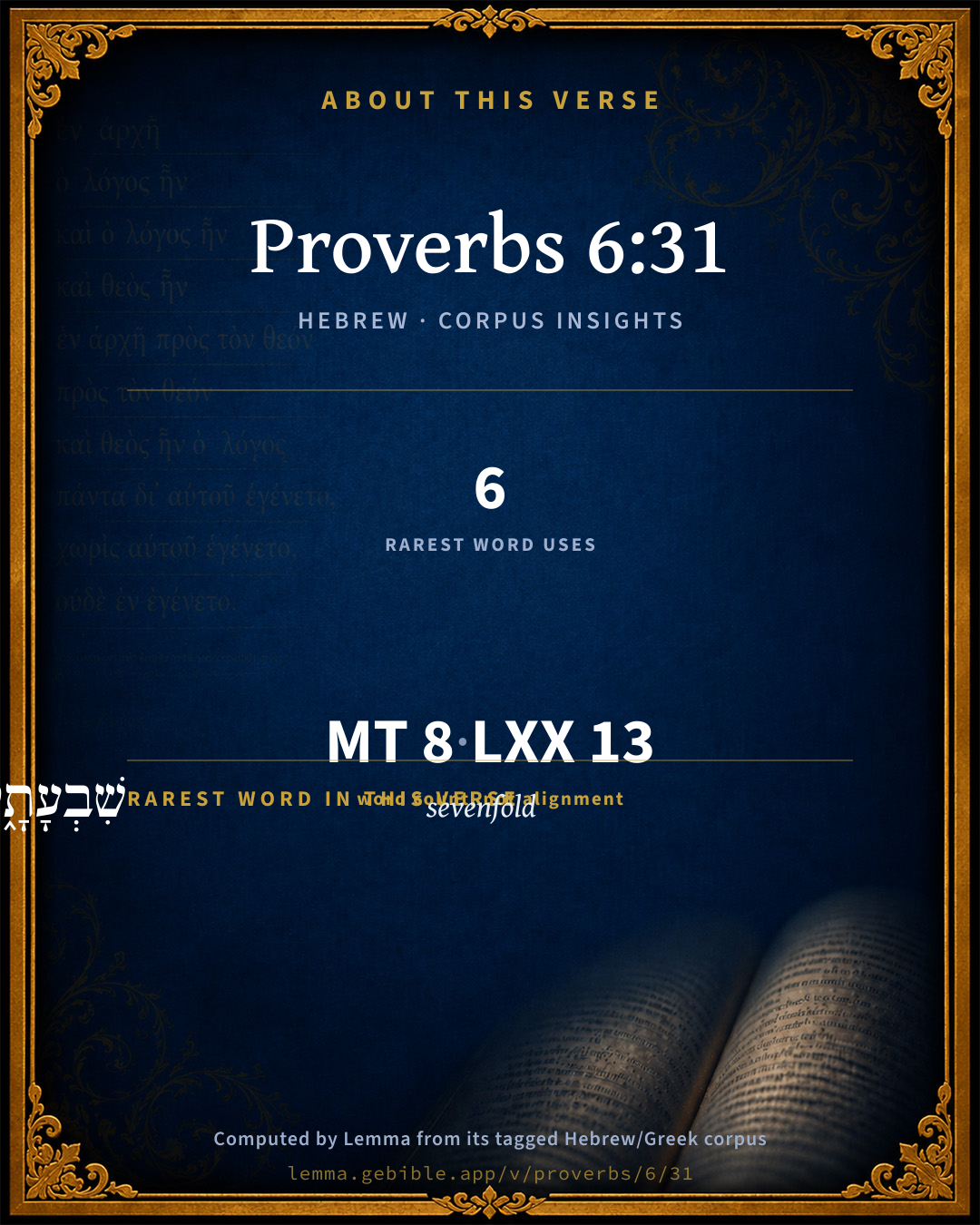
The rarest word here is שִׁבְעָתָ֑יִם sevenfold H7659 — appearing just 6 times in the whole Hebrew Bible.

Shared distinctive vocabulary

שִׁבְעָתָ֑יִם sevenfold H7659 occurs in 6 verses of the Hebrew Bible. Also found in:

Grammatical profile

  • 3 verbs
  • 3 nouns
  • 1 adjective
  • 1 particle

Verb forms

  • וְ֭נִמְצָא Niphal · Sequential Perfect
  • יְשַׁלֵּ֣ם Piel · Imperfect
  • יִתֵּֽן Qal · Imperfect

Hebrew & Septuagint length

In English translation the verse runs 19 words from the Hebrew and 19 from the Septuagint (LXX English) — the same length.

A rough comparison of the two English renderings, which tokenize alike — not a word-level alignment.

Word counts can differ between the Hebrew and the Greek without any difference in meaning — e.g. the Hebrew direct-object marker אֵת has no separate Greek word, and Greek often adds the article ὁ.

In the original languages it is 8 Hebrew tokens and 13 Greek tokens — but the two are counted differently (Hebrew bundles its prefixes and suffixes into one token; the Greek is in lemma form), so that isn’t a like-for-like length.

Cross-references

5

Topical passages linked to Proverbs 6:31 in the Treasury of Scripture Knowledge — connected by theme and wording, ordered by reader-vote popularity; previews shown in the World English Bible.

  • Luke 19:8 Zacchaeus stood and said to the Lord, "Behold, Lord, half of my goods I give to the poor. If I have wrongfully exacted anything of anyone, I restore four times as much."
  • Exodus 22:1–4 "If a man steals an ox or a sheep, and kills it, or sells it; he shall pay five oxen for an ox, and four sheep for a sheep.
  • 2 Samuel 12:6 He shall restore the lamb fourfold, because he did this thing, and because he had no pity!"
  • Job 20:18 That for which he labored he shall restore, and shall not swallow it down; According to the substance that he has gotten, he shall not rejoice.
  • Matthew 18:25 But because he couldn't pay, his lord commanded him to be sold, with his wife, his children, and all that he had, and payment to be made.

Cross-references courtesy of OpenBible.info (CC BY 4.0).

Hebrew and Greek witnesses Masoretic Hebrew ↔ Greek Septuagint

The same verse in the two great witnesses to the Old Testament, shown verse-for-verse.

These are two independent witnesses, not word-aligned to each other, and the Septuagint is shown in lemma (dictionary) form.

Hebrew Proverbs 6:31 Masoretic · Westminster Leningrad Codex

וְ֭נִמְצָא יְשַׁלֵּ֣ם שִׁבְעָתָ֑יִם אֶת כָּל ה֖וֹן בֵּית֣וֹ יִתֵּֽן

But if he is found, he shall restore seven times. He shall give all the wealth of his house.

World English Bible · Public Domain

Greek LXX Proverbs 6:31 Septuagint · lemma form

ἐάν δέ ἁλίσκω ἀποτίνω ἑπταπλάσιος καί πᾶς ὁ ὑποἄρχω αὐτός δίδωμι ῥύομαι ἑαυτοῦ

but if he should be taken, he shall repay sevenfold, and shall deliver himself by giving all his goods.

LXX2012 (modern English Septuagint) · Public Domain

On this verse, The Pulpit Commentary discusses the Septuagint’s reading. Read the note in Commentary ↓

Hebrew: Westminster Leningrad Codex (CC BY 4.0). Greek: Septuagint (public domain); English from LXX2012 (modern English Septuagint) (Public Domain). How the Septuagint differs from the Hebrew →

Commentary

Notes on Proverbs 6:31 from classic Christian and Jewish commentators (each source and its license shown beneath its notes). The classic Christian expositions comment on the surrounding passage and are grouped to its opening verse, so a note may address several verses; the Jewish commentaries on the Tanakh (Rashi and others) are per-verse, so they appear only where the commentator wrote on this verse.

Lemma curates 59 commentaries, every one of them public domain or Creative Commons licensed, each selected and text-cleaned for this edition rather than reprinted as found. About our sources →

Trapp's Complete Commentary

John Trapp

Pro 6:31 But [if] he be found, he shall restore sevenfold; he shall give all the substance of his house.

Ver. 31. He shall restore sevenfold,] i.e., Manifold, according as the law limiteth, though it be to the utmost of what the thief is worth. But what restitution can the adulterer make, should he make him amends with as much more? The thief steals out of want; the adulterer of wantonness.

John Trapp, A Commentary or Exposition upon All the Books of the Old and New Testament (1647–1656) — public domain. Text from a community e-Sword module.

Jamieson, Fausset & Brown

Robert Jamieson, A. R. Fausset & David Brown

sevenfold--(compare Exo 22:1-4), for many, ample (compare Gen 4:24; Mat 18:21), even if all his wealth is taken.

Jamieson, Fausset & Brown — Commentary Critical and Explanatory on the Whole Bible (1871) — public domain (CC PDM 1.0). Text via the HelloAO Bible API.

Ellicott's Commentary for English Readers

(31) But if he be found, he shall restore sevenfold.—Rather, And if he be found, he may restore sevenfold, he may give up all the wealth of his house. The law only required a two—or four—or fivefold compensation (Exodus 22); he may do even more. “Sevenfold” signifies full restitution. (Comp. Gen_4:24 : Lev_26:28.)

A Bible Commentary for English Readers, edited by Charles John Ellicott (1878–1897) — public domain. Text from a community e-Sword module.

The Cambridge Bible for Schools and Colleges

gen. ed. J. J. S. Perowne

31. sevenfold] This cannot refer to the legal penalty for theft, which was in no case greater than five times the value of the thing stolen (Exo_22:1-4. Comp. Luk_19:8). It had been suggested that the case contemplated in the second clause of the verse is different from that in the first: here is a man, who so far from being driven by abject poverty to steal in order to satisfy his hunger, is able and will be required to pay more than the law demanded (sevenfold) in order to avoid the shame of exposure. It is better, however, to understand sevenfold as a general term, meaning in full measure (comp. Gen_4:15; Lev_26:28; Mat_18:21). This explanation obviates the objection that if he had to steal for bread he could not pay sevenfold, because the full measure of the law was, “if he have nothing, then he shall be sold for his theft” (Exo_22:3, comp. Mat_18:25).

The Cambridge Bible for Schools and Colleges (gen. ed. J. J. S. Perowne; Cambridge University Press, 1878–1918) — public domain. Text from a community e-Sword module.

John Gill's Exposition

But whoso committeth adultery with a woman,.... Which is a greater degree of theft than the former, it being the stealing of another man's wife;

lacketh understanding; or "an heart" (t); the thief lacks bread, and therefore steals, but this man lacks wisdom, and therefore acts so foolish a part; the one does it to satisfy hunger, the other a brutish lust;

he that doeth it destroyeth his own soul; is liable to have his life taken away by the husband of the adulteress; so according to Solon's law (u) the adulterer taken in the act might be killed by the husband: or by the civil magistrate; for according to the law of. Moses he was to die, either to be strangled or stoned; see Gill on Joh 8:5; and besides, he not only ruins the natural faculties of his soul, besotting, corrupting, and depraving that, giving his heart to a whore, but brings eternal destruction on it; yet so foolish is he, though it issues in the ruin of his precious soul; "he does this" (w), for so the first part of this clause, which stands last in the original text, may be rendered.

(t) "deficit corde", Pagninus, Montanus; "caret corde", Mercerus, Gejerus; so Michaelis. (u) Plutarch. in Vita Solon. p. 90. (w) "ipse faeiet illud", Montanus; "ipse faciet hoc", so some in Vatablus; "is id faciet, sive facit", Cocceius; "ille facit id", Michaelis; "is patrabit illud", Schultens.

John Gill's Exposition of the Whole Bible (1746–1763) — public domain (CC PDM 1.0). Text via the HelloAO Bible API.

Haydock's Catholic Bible Commentary

Seven-fold. Or as much as may be required. The law never subjected the thief to restore above five-fold. If he had not enough, his person might be sold. (Calmet)

George Leo Haydock (1774–1849), Haydock's Catholic Family Bible and Commentary, 1859 edition — public domain. Excludes Psalms (Douay-Rheims chapter numbering differs from Protestant) and Deuterocanonical books (Catholic canon only).

Matthew Poole's English Annotations

He shall restore seven-fold.

Quest. How doth this agree with God’s law, which required only that he should restore double, or at most fourfold, or fivefold? Exo 22:1-4.

Answ. 1. The number of seven may be here put indefinitely for many times, as it is Gen 4:24; Lev 26:28, and in many other places.

2. Some think that as thefts were multiplied, so the punishment of it was increased, in Solomon’s time; or, at least, that it was the practice of some nations to require this sevenfold restitution.

3. He speaks not of that restitution which the law required, but of that which either the wronged person being potent might force the thief to make, or which the thief would willingly give rather than be exposed to public shame; as appears by the following clause, wherein he adds to this sevenfold restitution

all his substance, which no law of God or man required. See Poole "Exo 22:4".

Matthew Poole's English Annotations on the Holy Bible (1683–1685) — public domain. Text from a community e-Sword/MySword module.

The Pulpit Commentary

But if he be taken, he shill restore sevenfold. Men do not despise the thief, but yet they apprehend him and insist on fullest restitution. Be found; i.e. seized (Delitzsch), or legally convicted (Gejerus). He shall restore; i.e. he must restore (Zockler). Delitzsch, however, understands the future, y"shalem, as potential, "he may restore." Sevenfold; Hebrew, siv"athayim; LXX, eptaplasia ; Vulgate, septulum. On this word Geier remarks, "Haec vox nullibi in sacris ponitur pio numero definito;" i.e. "It is nowhere put in Scripture for a definite number." It is therefore to be understood indefinitely of complete restitution, or, as it is expressed in the second and parallel clauses, "all the substance of his house." The word is used in this sense in Gen_4:24 Lev_26:28 Job_5:19 (Lapide). Theft under the Mosaic Law was punishable by a fivefold, fourfold, and twofold restitution, (Exo_22:1-4, Exo_22:9) and, in the event of this not forthcoming, the delinquent was to be sold into slavery. (Lev_25:39) In 2Sa_12:6 a fourfold restitution is mentioned, and in the New Testament Zacchaeus promises to restore fourfold if he could be convicted of fraud. (Luk_19:8) In the attempts to reconcile the "sevenfold" of our passage with the requirements of the Mosaic Law, Aben Ezra says that the combined penalties for two cases of theft are contemplated, and others that in the time of the writer the penalties had been increased. But proof of this is wanting. Grotius"s explanation is more curious than correct, viz. that if the theft be repeated seven times, and he be "taken" seven times, the thief should only be punished by being forced to make restitution with some addition. Both the Greek and Roman law demanded a twofold restitution. Selden maintains that theft would have been subjected to the usual punishment (Selden, "De Jure Not. et Gent.," 6, 100, 6). We may therefore come to the conclusion that "sevenfold" is used in the sense indicated above. As to any objection which may be raised on the seem of inconsistency in talking of a man malting restitution, and giving all his substance when he steals to satisfy his hunger, it may be remarked that he need not necessarily be without substance of some sort or other, and he could acquire subsequently sufficient to satisfy the demand. On the question whether a person is justified by extreme want in stealing, see Grotius, "De Jure Belli et Pacis," 2, 100, 2, Puffendorf, "De Jure Not. et Gent," 2, 100, 6, Blackstone, "Commentary," 4:2

The Pulpit Commentary (1880–1919), ed. H.D.M. Spence-Jones & Joseph S. Exell — public domain. Text from a community e-Sword module.

John Wesley's Explanatory Notes

Restore - He speaks not of that restitution which the law required, but of that which either the wronged person might force the thief to make, or which the thief would willingly give rather than be exposed to public shame.

John Wesley, Explanatory Notes Upon the Whole Bible (1754–1765) — public domain. Text via the GEBible commentary corpus.

Lesson kit

Teaching starters — assembled from the data on this page, not authored interpretation. Every prompt links to the verse data it draws on. Edit before teaching.

Proverbs, in the Wisdom, opens this verse with 8 words (8 distinct Hebrew lemmas). Its most distinctive word is shibʻâthayim (“sevenfold”). A historical commentator’s framing appears above. Read the whole chapter for the surrounding context.

Discussion questions

  1. What does “sevenfold” (shibʻâthayim) contribute to the verse as a whole?
  2. How does Genesis 4:15, which shares the word «sevenfold», read alongside this verse?
  3. These translations render this verse differently. What is at stake in choosing one wording over another?
  4. «וְ֭נִמְצָא» is a Niphal Sequential Perfect verb. How does that grammatical form shape the action described?
  5. Compare how Trapp's Complete Commentary and Jamieson, Fausset & Brown read this verse. Where do they agree or differ?

Things to notice

Reading settings

Reading text

Shown beneath each verse's original-language words.

Old Testament
Old Testament edition

Read the OT as the Masoretic Hebrew (MT) or the Greek Septuagint (LXX).

English shown for the Greek Septuagint (in the Hebrew ↔ Greek comparison).

Comparing translations? Open the Compare panel on any verse page to stack up to four side by side.