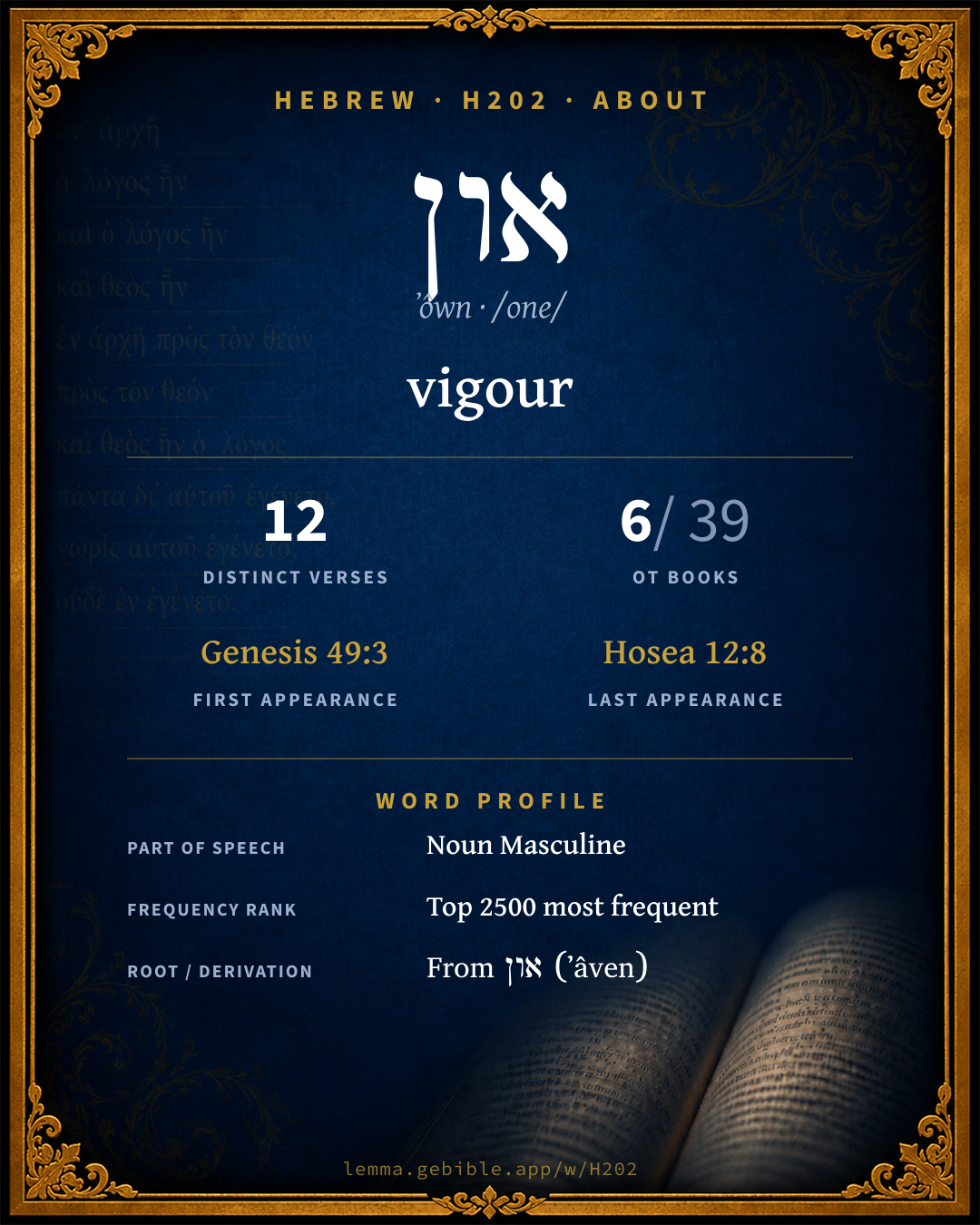
אוֹן
vigour
‘vigour’ is one of 3 main senses fuller range ↓
Full lexicon entry — Brown-Driver-Briggs (BDB)
From Brown-Driver-Briggs (BDB)
Where this word appears
See every Construct-state word in the Hebrew Bible →
Grammar key — what these labels mean
Part of speech
- Noun
- A naming word — a person, place, thing, or idea.
Noun type
- Common
- A common noun — a general class of person, place, or thing (“king,” “city,” “water”), not a specific name.
State
- Construct
- A noun bound to a following noun in a possessive / “of” relationship (the construct chain).
- Absolute
- The independent form of a noun, not bound to a following word.
Gender
- Masculine
- Grammatically masculine.
Number
- Singular
- One.
- Plural
- More than one (in Hebrew, generally three or more).
Grammatical forms
- Noun, Common, Masculine, Singular, Construct 8 times (67%)
- Noun, Common, Masculine, Plural, Absolute 3 times (25%)
- Noun, Common, Masculine, Singular, Absolute 1 time (8%)
Parsed forms decoded from the imported morphology (morphhb / Westminster Leningrad Codex — WLC text public domain, morphhb tagging CC BY 4.0), counted across 12 parsed occurrences — not distinct verses.
Every verse where H202 appears — 12 distinct verses across 6 books. Click any verse to open its interlinear word-by-word view. Verse text shown in the World English Bible for context — . Each verse’s Hebrew form is shown with its reference; the English is not keyword-highlighted, since the data carries no word-level English alignment. Use “Compare translations” on any verse to read it across multiple English versions. This concordance covers the Hebrew Bible; Septuagint (Greek Old Testament) occurrences are not indexed here.
Genesis 1 verse
Deuteronomy 1 verse
Job 4 verses
- Job 18:7 אוֹנ֑/וֹ n c ms cs + sfx pers 3ms The steps of his strength shall be shortened, His own counsel shall cast him down.
- Job 18:12 אֹנ֑/וֹ n c ms cs + sfx pers 3ms His strength shall be famished, Calamity shall be ready at his side.
- Job 20:10 אוֹנֽ/וֹ n c ms cs + sfx pers 3ms His children shall seek the favor of the poor. His hands shall give back his wealth.
- Job 40:16 וְ֝/אֹנ֗/וֹ conj + n c ms cs + sfx pers 3ms Look now, his strength is in his loins, His force is in the muscles of his belly.
Psalms 2 verses
Isaiah 2 verses
- Isaiah 40:26 אוֹנִים֙ n c mp Lift up your eyes on high, and see who has created these, who brings out their host by number; he calls them all by name; by the greatness of his might, and because he is strong in power, not one is lacking.
- Isaiah 40:29 אוֹנִ֖ים n c mp He gives power to the faint; and to him who has no might he increases strength.
Hosea 2 verses
- Hosea 12:3 וּ/בְ/אוֹנ֖/וֹ conj + prep + n c ms cs + sfx pers 3ms In the womb he took his brother by the heel; And in his manhood he had power with God.
- Hosea 12:8 א֖וֹן n c ms Ephraim said, "Surely I have become rich, I have found myself wealth. In all my wealth they won't find in me any iniquity that is sin."
About this entry
At a glance — auto-summarized from this page’s data, not written by a person. Every figure links to its source below. This summary describes the numbers; it doesn’t interpret them.
“vigour” is the headline sense of the Hebrew noun און (ʼôwn). Scripture first uses it in Genesis 49:3. With 12 verses in 6 books, it is an uncommon word in the Hebrew Bible. It concentrates in Job, which alone accounts for 33% of its uses. Carrying more than one sense, it rewards its full sense range. See the sense tree, 12-verse concordance, and the renderings breakdown below.
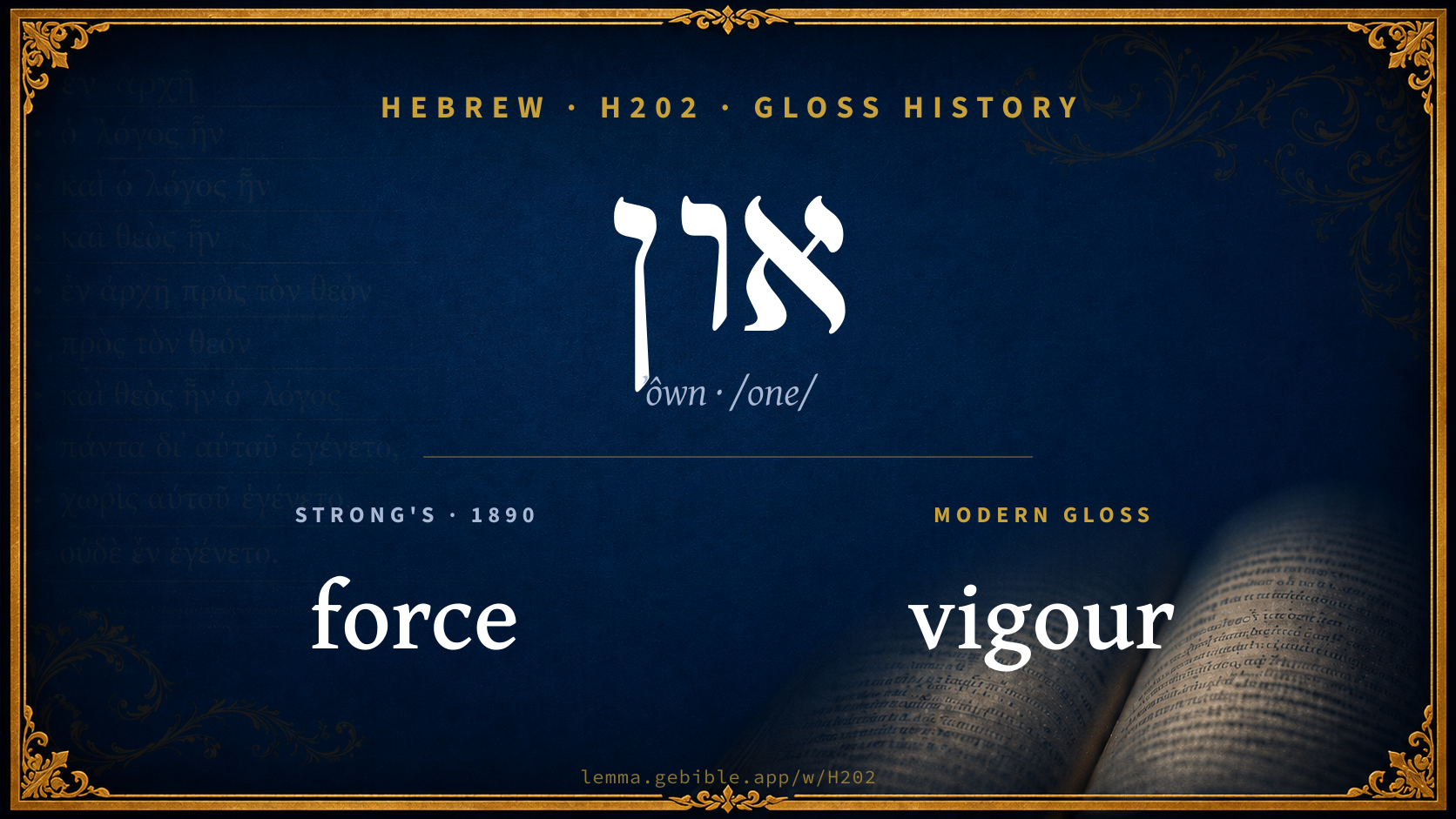
Gloss history
Strong's 1890 vs modern scholarship
About this word
Strong's H202 catalogs a Hebrew word from the Hebrew Old Testament.
These counts are not copied from any lexicon or concordance. They are computed here, from the morphology-tagged Hebrew Old Testament. What Lemma adds →
- 12
- distinct verses
- The word appears in 12 distinct verses.
- 6 / 39
- OT books
- The word appears in 6 of 39 Old Testament books.
- #2,101
- by frequency
- Top 2500 most frequent Hebrew words (rank 2,101 of 8,640 Hebrew words by occurrence).
View all 12 occurrences in the concordance →
By section of the Old Testament
By traditional corpus
Conventional, traditional groupings — biblical authorship is debated, so this is a traditional corpus grouping, not an authorship claim. Each share is this word’s portion of its verses in that division of the Hebrew canon. Each figure is a share of the word’s 12 distinct verses.
- Writings (Ketuvim) 6 verses · 50%
- Prophets (Nevi'im) 4 verses · 33%
- Torah (Pentateuch) 2 verses · 17%
How translations render this word
Counts come from each version’s own published word-to-Strong’s tagging or interlinear alignment — an approximate guide to how each version renders this word, not a word-level alignment the data otherwise carries. Because each total is that version’s own tagged count, the per-version totals vary from one another and need not match the appearance or distinct-verse counts above. These counts may also differ from a printed concordance because Lemma counts each distinctly tagged rendering and does not collapse phrase taggings into a single head-word total. This is a fixed set of word-tagged versions (KJV, ASV, BSB, ULT) and does not change with the reading translation you choose elsewhere. Each version’s license is shown beside its name below (and on Sources).
BDB lists this Strong’s number as 3 distinct words (homographs). Each count above pools all of them and is not split by sense — see the Senses section below. A low-frequency rendering may belong to a different one of those words, not the primary meaning.
- King James Version†: Strength 6×
- American Standard Version†: Strength 5×, Wealth 2×
- Berean Standard Bible†: Strength 4×, Power 2×, Vigor 2×
- unfoldingWord Literal Text†: Strength 6×, Wealth 2×
King James Version Public Domain
Renders H202 across 12† tagged occurrences — most commonly:
Plus 6 renderings that appear only once — usually multi-word phrases or single function words the recovered tagging swept in, not distinct renderings.
American Standard Version Public Domain
Renders H202 across 11† tagged occurrences — most commonly:
Plus 4 renderings that appear only once — usually multi-word phrases or single function words the recovered tagging swept in, not distinct renderings.
Berean Standard Bible Public Domain
Renders H202 across 12† tagged occurrences — most commonly:
Plus 2 renderings that appear only once — usually multi-word phrases or single function words the recovered tagging swept in, not distinct renderings. Not rendered by a distinct English word in 1 further occurrence.
unfoldingWord Literal Text CC BY-SA 4.0
Renders H202 across 12† tagged occurrences — most commonly:
Plus 4 renderings that appear only once — usually multi-word phrases or single function words the recovered tagging swept in, not distinct renderings.
Senses in the full BDB
What do BDB’s symbols mean?
BDB uses these scholarly abbreviations:
| Symbol | Meaning |
|---|---|
| 𝔊 | the Septuagint (the ancient Greek translation, LXX) |
| 𝔙 | the Vulgate (the Latin translation) |
| 𝔖 | the Syriac version (the Peshitta) |
| 𝔗 | the Targum (the Aramaic translation) |
| ψ | the Psalms |
| √ | root (the underlying root or stem) |
| ‖ | parallel passage (a synonymous or contrasted parallel) |
| † | the dagger: every passage where the word occurs is cited |
The 3 senses and sub-senses the full Brown-Driver-Briggs lexicon distinguishes for this word, in lexicon order (not ranked by frequency), with BDB’s own verbatim wording and sub-sense lettering. Shown in Hebrew script with BDB’s own scholarly abbreviations. The condensed entry is in the Lexicon Entry tab. See also the Forms in the corpus table below.
און I vigour, wealth
- 1. manly vigour בְּאוֹנוֹ שָׂרָה אֶת־אֱלֹהִים Ho 12:4 (of Jacob); רֵאשִׁית אוֹן beginning of manly vigour Gn 49:3 (of Reuben, first-born of Jacob); Dt 21:17 ψ 105:36 (first-born of Egyptians), so 78:51, רֵאשִׁית אוֹנִים where א׳ is assim. to מִצְרַיִם, or intens. pl. e.g. Hosea 12:4
- 2. strength of man Jb 18:7, 12; behemoth Jb 40:16; pl. intens. מֵרֹב אוֹנִים Is 40:26 because of the abundance of great strength (of God); of man אֵין אוֹנִים Is 40:29 one not having strength; תּוֹחֶלֶת אוֹנִים Pr 11:7 hope in strength (not the hope of iniquity RV, or of unjust men AV). e.g. Job 18:7
- 3. wealth Jb 20:10 Ho 12:9 מָצָאתִי א׳ לִי (‖ עָשַׁרְתִּי). e.g. Job 20:10
און II loc. v. אֹן.
Senses from the full Brown-Driver-Briggs lexicon (Brown, Driver, Briggs; Oxford 1906 — public domain), digitized via Sefaria, supplemented by the OpenScriptures HebrewLexicon (CC BY 4.0). Full attribution on Sources.
Word origin
I. n.m. vigour, wealth—abs. Ho 12:9, sf. אוֹנִי Gn 49:3 + etc.; pl. אוֹנִים ψ 78:51 +.
I. (Gn 41:45; 46:20) אוֹן (Gn 41:50 Ez 30:17) n.pr.loc. On (Egypt. Ȧn cf. EbGS 75 WiedSamml 46; perhaps = Assyrian Unu, SteindorffBAS i. 610, contr. DlPa 318) city in lower Egypt, prob. on border of land of Goshen, residence of ‘Potiphera, priest of On,’ father-in-law of Joseph Gn 41:45, 50; 46:20; also Ez 30:17 (where MT אָוֶן); it was celebrated for worship of sun-god Ra, & hence called also sun-city, בֵּית שֶׁמֶשׁ Je 43:13, 𝔊 Ἡλίου πόλις; mod. Matariye, on E. bank of Nile, c. 7 miles E. of N. from Cairo & 18 from Memphis;—cf. EbGS 75, 507 f. & map Wiedl.c.
— Brown-Driver-Briggs (Oxford 1906, public domain), digitized via Sefaria, supplemented by the OpenScriptures HebrewLexicon (CC BY 4.0). See Sources.
Derived from און (ʼâven) (H205) — trouble.
Jastrow Dictionary
A second Hebrew/Aramaic lexicon for comparison, covering Aramaic and post-biblical (Talmudic, Targumic, Midrashic) usage that the biblical-Hebrew BDB does not. Matched by lemma rather than by Strong’s number, so a lemma may carry more than one Jastrow headword (shown separately below), and the entries cover usage well beyond the Bible.
אָוֶן
- √או = עו to curve, be curved, hollow; to press, be pressed; v. אוי,
- 1. oppression, wrong (= עָוֹן)
- 2. falsehood, vanity (= הֶבֶל). א׳ גִּלְיוֹן a cacophemistic adaptation of εὐαγγέλιον (v. גליון). Sabb. 116ᵃ bot. (after לסכוניה, omitted in ed.) דר׳ מאיר א׳ ג׳ ר׳ יוחנן קרי ליה עון גליון (Rashi Ms. ר׳ מאיר, v. Rabb. D. S. a. l. note) R. Meïr called the gospel falsehood of blank paper (or of revelation), R. Yoḥ. called it sin of &c. [Ib. several times עון גליון or און ג׳ in Ms. a. older editions, for אירייתא אחריתי &c. in recent ed., v. Rabb. D. S. a. l.]
אוֹן
- possession, power. Tosef. Ab. Zar. III, 16 (IV, beg.) כתב לו או̇נו̇ if he (the seller of the slave) wrote to him (gave him in writing) the liberty of his disposal of himself, i.e. that the slave, if he should run away from the buyer, would not be claimed by him who sold him; Git. 43ᵇ כתב עליו אונו (read אליו or לו). Ib. מאי אונו what means ‘his own possession’? Ans. He wrote to him this, ‘If thou run away from him (the purchaser), I have nothing to do with thee. Ib. 85ᵇ.—[Y. B. Mets. I, end, 8ᵃ; Y. Kidd. I, 60ᶜ אונו, v. אוֹנִי.] V. אוֹנָה.
A Dictionary of the Targumim, the Talmud Babli and Yerushalmi, and the Midrashic Literature (Marcus Jastrow; London, Luzac, 1903) — Public Domain. Digitized via Sefaria. Digitized via Sefaria. Full attribution on Sources.
Forms in the corpus
The 12 distinct written forms H202 takes in the Hebrew Bible, most frequent first — each parse links to that state’s occurrences in the concordance. Hebrew forms include their vowel points and cantillation, so a single lemma takes many written forms.
| Form | Parsing | Example | Uses |
|---|---|---|---|
| א֖וֹן | Noun, Common, Masculine, Singular, Absolute | Hosea 12:8 | 1 |
| א֝וֹנִ֗ים | Noun, Common, Masculine, Plural, Absolute | Psalms 78:51 | 1 |
| אֹנ֑/וֹ | Noun, Common, Masculine, Singular, Construct | Job 18:12 | 1 |
| אֹנ֔/וֹ | Noun, Common, Masculine, Singular, Construct | Deuteronomy 21:17 | 1 |
| אוֹנ֑/וֹ | Noun, Common, Masculine, Singular, Construct | Job 18:7 | 1 |
| אוֹנִ֑/י | Noun, Common, Masculine, Singular, Construct | Genesis 49:3 | 1 |
| אוֹנִ֖ים | Noun, Common, Masculine, Plural, Absolute | Isaiah 40:29 | 1 |
| אוֹנִים֙ | Noun, Common, Masculine, Plural, Absolute | Isaiah 40:26 | 1 |
| אוֹנָֽ/ם | Noun, Common, Masculine, Singular, Construct | Psalms 105:36 | 1 |
| אוֹנֽ/וֹ | Noun, Common, Masculine, Singular, Construct | Job 20:10 | 1 |
| וְ֝/אֹנ֗/וֹ | Noun, Common, Masculine, Singular, Construct | Job 40:16 | 1 |
| וּ/בְ/אוֹנ֖/וֹ | Noun, Common, Masculine, Singular, Construct | Hosea 12:3 | 1 |
Same root — word family
Other BDB entries built from the same root as H202, grouped by Strong’s listed origin. These share a root / origin per the lexicon — not necessarily a shared meaning. Each links to that word’s own entry.
Derives from
Shares the same root
Proper names from this root
People and places named from this root — a name, not an additional meaning of the word.
Compare all same-root words → Showing 4 of 6 — not the complete family. 3 of the same-root words are proper names (people or places). They share a root, not necessarily a meaning.
Septuagint verse parallels
This word appears in 11 verses that also exist in the Greek Old Testament (Septuagint), out of the 12 Hebrew verses it occurs in. You can read those verses in Greek by switching the Old Testament edition to the Septuagint.
Read these verses in the Septuagint
This is a verse-level parallel only — the same verses exist in both the Hebrew and Greek Old Testaments. No word-level Hebrew↔Greek correspondence is claimed: the data carries no such alignment, so no Greek word is shown as this Hebrew word’s translation. Coverage is not total — the Septuagint omits the deuterocanon and renumbers the Psalms, so some Hebrew verses have no direct Greek parallel.