
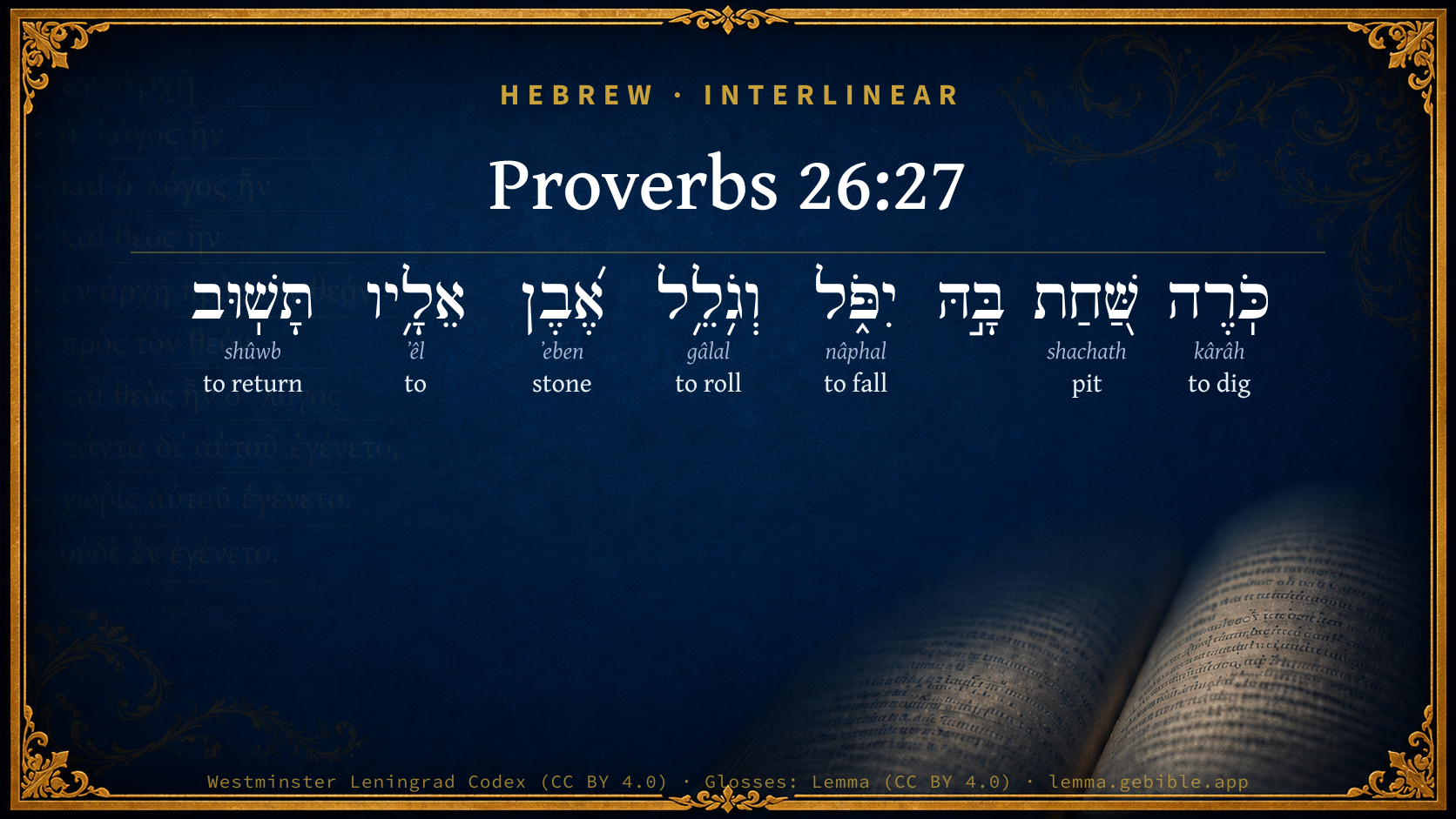

Proverbs 26:27

Hebrew (Westminster Leningrad Codex) Proverbs 26:27 appears in the Hebrew Old Testament. The text above is from the Westminster Leningrad Codex. Each word links to its Strong’s number, a concise gloss, and parsing drawn from the Open Scriptures Hebrew Bible morphology. Click any word for its full Brown-Driver-Briggs (BDB) entry.
Download image
Cite this verse

Proverbs 26:27 (World English Bible). Public Domain. Lemma interlinear Bible study tool, https://lemma.gebible.app/v/proverbs/26/27.

Show BibTeX & RIS
BibTeX
RIS
English Translation
Whoever digs a pit shall fall into it. Whoever rolls a stone, it will come back on him.
World English Bible · Public Domain
Download a study sheet

One document with this verse’s original text, its word-by-word gloss line, the meaning frame, cross-references with their text, attributed commentary, and full source and license credits — printable, and it pastes into notes with its structure intact.

This verse Autodidact and up

Study sheet (.html) Plain text (.txt)

A passage Seminary Student

Up to 50 verses in one chapter. A passage sheet keeps up to 6 commentary sources and 12 cross-references per verse, in the order this page ranks them, and says so on the sheet whenever that leaves anything out. Ask for a single verse and you get the Autodidact verse sheet above.

Everything on this page stays free to read, with no account — the sheet is a download of what is already on screen, not access to it.

Want to remove ads? Support Godless Engineer
Compare translations 3

The same verse in 3 English versions, stacked beneath the original-language interlinear above. Click any original word for its lexicon entry.

Each is an independent rendering of the whole verse — the interlinear is not word-aligned to these translations.

Highlighted words mark where these versions differ — a whole-verse word diff, not a word-by-word alignment.

  • World English Bible Public Domain
    Whoever digs a pit shall fall into it. Whoever rolls a stone, it will come back on him.
  • King James Version Public Domain
    Whoso diggeth a pit shall fall therein: and he that rolleth a stone, it will return upon him.
  • unfoldingWord Literal Text CC BY-SA 4.0
    One who digs a pit will fall into it, and one who rolls a stone, it will come back to him.

unfoldingWord Literal Text — © unfoldingWord, licensed CC BY-SA 4.0. Word-aligned USFM3 via Door43 (git.door43.org/unfoldingWord/en_ult).

Versions to compare (up to 4)

3 of 4 selected

Show all 18 translations

Every available English version of this verse, each an independent rendering of the whole verse.

  • World English Bible Public Domain
    Whoever digs a pit shall fall into it. Whoever rolls a stone, it will come back on him.
  • Berean Standard Bible Public Domain
    He who digs a pit will fall into it, and he who rolls a stone will have it roll back on him.
  • Majority Standard Bible Public Domain
    He who digs a pit will fall into it, and he who rolls a stone will have it roll back on him.
  • King James Version Public Domain
    Whoso diggeth a pit shall fall therein: and he that rolleth a stone, it will return upon him.
  • American Standard Version (1901) Public Domain
    Whoso diggeth a pit shall fall therein; And he that rolleth a stone, it shall return upon him.
  • Revised Version (1885) Public Domain
    Whoso diggeth a pit shall fall therein: and he that rolleth a stone, it shall return upon him.
  • Geneva Bible (1599) Public Domain
    He that diggeth a pit shall fall therein, and he that rolleth a stone, it shall returne vnto him.
  • Douay-Rheims (1899) Public Domain
    He that diggeth a pit, shall fall into it: and he that rolleth a stone, it shall return to him.
  • Young's Literal Translation Public Domain
    Whoso is digging a pit falleth into it, And the roller of a stone, to him it turneth.
  • Literal Standard Version CC BY-SA 4.0
    Whoever is digging a pit falls into it, || And the roller of a stone, it turns to him.
  • Unlocked Literal Bible CC BY-SA 4.0
    Whoever digs a pit will fall into it and the stone will roll back on the one who pushed it.
  • unfoldingWord Literal Text CC BY-SA 4.0
    One who digs a pit will fall into it, and one who rolls a stone, it will come back to him.
  • Darby Bible Public Domain
    Whoso diggeth a pit shall fall therein; and he that rolleth a stone, it shall return upon him.
  • World Messianic Bible Public Domain
    Whoever digs a pit shall fall into it. Whoever rolls a stone, it will come back on him.
  • Webster's Bible Public Domain
    Whoever diggeth a pit shall fall into it: and he that rolleth a stone, it will return upon him.
  • Free Bible Version CC BY-SA 4.0
    Those who dig pits to trap others will fall in themselves, and those who start boulders rolling will be crushed themselves.
  • Bible in Basic English Public Domain
    He who makes a hole in the earth will himself go falling into it: and on him by whom a stone is rolled the stone will come back again.
  • JPS Tanakh (1917) Public Domain
    Whoso diggeth a pit shall fall therein; and he that rolleth a stone, it shall return upon him.

Literal Standard Version (2020), Covenant Press — licensed CC BY-SA 4.0. Text via the HelloAO Bible API (eBible.org). Unlocked Literal Bible (unfoldingWord) — licensed CC BY-SA 4.0. Text via the HelloAO Bible API (eBible.org). unfoldingWord Literal Text — © unfoldingWord, licensed CC BY-SA 4.0. Word-aligned USFM3 via Door43 (git.door43.org/unfoldingWord/en_ult). Free Bible Version, Dr. Jonathan Gallagher — licensed CC BY-SA 4.0. Text via the HelloAO Bible API (eBible.org).

Word by word

More ways to search: Search by grammar → Find every occurrence → Compare this word →

Practice this passage: Drill this verse → Learn its vocabulary →

About this verse

These counts appear in no published source. They are computed here, from the morphology-tagged text and Lemma’s own curated glosses. What Lemma adds →

8
words
7
distinct lemmas
Wisdom
section

Notable vocabulary

The rarest word here is כֹּֽרֶה to dig H3738 — appearing just 17 times in the whole Hebrew Bible.

Shared distinctive vocabulary

כֹּֽרֶה to dig H3738 occurs in 17 verses of the Hebrew Bible. Also found in:

Grammatical profile

  • 4 verbs
  • 2 nouns
  • 2 prepositions

Verb forms

  • כֹּֽרֶה Qal · Participle Active
  • יִפֹּ֑ל Qal · Imperfect
  • וְגֹ֥לֵ֥ל Qal · Participle Active
  • תָּשֽׁוּב Qal · Imperfect

Hebrew & Septuagint length

In English translation the verse runs 18 words from the Hebrew and 22 from the Septuagint (LXX English) — closely comparable.

A rough comparison of the two English renderings, which tokenize alike — not a word-level alignment.

Word counts can differ between the Hebrew and the Greek without any difference in meaning — e.g. the Hebrew direct-object marker אֵת has no separate Greek word, and Greek often adds the article ὁ.

In the original languages it is 8 Hebrew tokens and 15 Greek tokens — but the two are counted differently (Hebrew bundles its prefixes and suffixes into one token; the Greek is in lemma form), so that isn’t a like-for-like length.

Cross-references

7

Topical passages linked to Proverbs 26:27 in the Treasury of Scripture Knowledge — connected by theme and wording, ordered by reader-vote popularity; previews shown in the World English Bible.

  • Proverbs 28:10 Whoever causes the upright to go astray in an evil way, He will fall into his own trap; But the blameless will inherit good.
  • Psalms 9:15 The nations have sunk down in the pit that they made; In the net which they hid, their own foot is taken.
  • Psalms 7:15–16 He has dug a hole, And has fallen into the pit which he made.
  • Psalms 10:2 In arrogance, the wicked hunt down the weak; They are caught in the schemes that they devise.
  • Ecclesiastes 10:8 He who digs a pit may fall into it; and whoever breaks through a wall may be bitten by a snake.
  • Psalms 57:6 They have prepared a net for my steps. My soul is bowed down. They dig a pit before me. They fall into the midst of it themselves. Selah.
  • Esther 7:10 So they hanged Haman on the gallows that he had prepared for Mordecai. Then was the king's wrath pacified.

Cross-references courtesy of OpenBible.info (CC BY 4.0).

Hebrew and Greek witnesses Masoretic Hebrew ↔ Greek Septuagint

The same verse in the two great witnesses to the Old Testament, shown verse-for-verse.

These are two independent witnesses, not word-aligned to each other, and the Septuagint is shown in lemma (dictionary) form.

Hebrew Proverbs 26:27 Masoretic · Westminster Leningrad Codex

כֹּֽרֶה שַּׁ֭חַת בָּ֣הּ יִפֹּ֑ל וְגֹ֥לֵ֥ל אֶ֝בֶן אֵלָ֥יו תָּשֽׁוּב

Whoever digs a pit shall fall into it. Whoever rolls a stone, it will come back on him.

World English Bible · Public Domain

Greek LXX Proverbs 26:27 Septuagint · lemma form

ὁ ὀρύσσω βόθρος ὁ πλησίον ἐνπίπτω εἰς αὐτός ὁ δέ κυλίω λίθος ἐπί ἑαυτοῦ κυλίω

He that digs a pit for his neighbor shall fall into it: and he that rolls a stone, rolls it upon himself.

LXX2012 (modern English Septuagint) · Public Domain

On this verse, John Gill's Exposition discusses the Septuagint’s reading. Read the note in Commentary ↓

Hebrew: Westminster Leningrad Codex (CC BY 4.0). Greek: Septuagint (public domain); English from LXX2012 (modern English Septuagint) (Public Domain). How the Septuagint differs from the Hebrew →

Commentary

Notes on Proverbs 26:27 from classic Christian and Jewish commentators (each source and its license shown beneath its notes). The classic Christian expositions comment on the surrounding passage and are grouped to its opening verse, so a note may address several verses; the Jewish commentaries on the Tanakh (Rashi and others) are per-verse, so they appear only where the commentator wrote on this verse.

Lemma curates 59 commentaries, every one of them public domain or Creative Commons licensed, each selected and text-cleaned for this edition rather than reprinted as found. About our sources →

Trapp's Complete Commentary

John Trapp

Pro 26:27 Whoso diggeth a pit shall fall therein: and he that rolleth a stone, it will return upon him.

Ver. 27. Whoso diggeth a pit shall fall thereinto.] This is the same with Psa 7:15, from which it seems to be taken; {See Trapp on "Psa 7:15"} Heathen writers have many proverbs to like purpose. See Erasm. Chiliad.

And he that rolleth a stone, it will return upon him.] Cardinal Benno relates a memorable story of Pope Hildebrand, or Gregory VII, that he hired a base fellow to lay a great stone upon a beam in the church where Henry IV, the emperor, used to pray, and so to lay it that it might fall as from the top of the church upon the emperor’s head, and kill him. But while this wretch was attempting to do it, the stone, with its weight, drew him down, and falling upon him, dashed him in pieces upon the pavement. The Thracians in Herodotus, being offended with Jupiter for raining unseasonably upon them, shot up their arrows at him, which soon after returned upon their own heads.

John Trapp, A Commentary or Exposition upon All the Books of the Old and New Testament (1647–1656) — public domain. Text from a community e-Sword module.

Joseph Benson's Commentary

Pro 26:27. Whoso diggeth a pit — That another may fall into it; shall fall therein — Himself. For, by the righteous judgment of God, the wicked are not only generally disappointed in their designs, but involve themselves in that mischief which they intended to do to others: see on Psa 7:15; Psa 9:15. And he that rolleth a stone — Namely, up a hill, with a design to do mischief to some person or thing with it; it will return upon him — And greatly injure if not crush him to pieces.

Joseph Benson's Commentary on the Old and New Testaments (1811–1818) — public domain. Text from a community e-Sword module.

Tyndale Open Study Notes

Tyndale Open Resources

26:27 People usually receive the bad consequences they intend for others (see 1:17-19).

Tyndale Open Study Notes — © Tyndale Open Resources, licensed CC BY-SA 4.0. Text via the HelloAO Bible API.

Matthew Henry's Commentary

See here, 1. What pains men take to do mischief to others. As they put a force upon themselves by concealing their design with a profession of friendship, so they put themselves to a great deal of labour to bring it about; it is digging a pit, it is rolling a stone, hard work, and yet men will not stick at it to gratify their passion and revenge. 2. What preparation they hereby make of mischief to themselves. Their violent dealing will return upon their own heads; they shall themselves fall into the pit they digged, and the stone they rolled will return upon them, Psa 7:15, Psa 7:16; Psa 9:15, Psa 9:16. The righteous God will take the wise, not only in their own craftiness, but in their own cruelty. It is the plotter's doom. Haman is hanged on a gallows of his own preparing.

- nec lex est justior ulla

Quam necis artifices arte perire sua -

Nor is there any law more just than that

the contrivers of destruction should perish

by their own arts.

Matthew Henry's Commentary on the Whole Bible (1708–1710) — public domain (CC PDM 1.0). Text via the HelloAO Bible API.

Adam Clarke's Commentary

Verse 27. Whoso diggeth a pit] See Clarke on Ps 7:15. There is a Latin proverb like this: Malum consilium consultori pessimum, "A bad counsel, but worst to the giver." Harm watch; harm catch.

Adam Clarke's Commentary on the Bible (1810–1826) — public domain. Text from a community e-Sword/MySword module.

Ellicott's Commentary for English Readers

(27) Whoso diggeth a pit shall fall therein,—A simile taken from hunters making pits as traps for wild animals. The same doctrine of retribution being brought upon the sinner’s head by God the righteous Judge is taught in Psa_7:11, sqq.

A Bible Commentary for English Readers, edited by Charles John Ellicott (1878–1897) — public domain. Text from a community e-Sword module.

The Cambridge Bible for Schools and Colleges

gen. ed. J. J. S. Perowne

27. Comp. Psa_7:15-16; Sir_27:25-27.

The Cambridge Bible for Schools and Colleges (gen. ed. J. J. S. Perowne; Cambridge University Press, 1878–1918) — public domain. Text from a community e-Sword module.

John Gill's Exposition

A lying tongue hateth those that are afflicted by it,.... That is, a man of a lying tongue, that is given to lying, hates those that are hurt and crushed by his lies; the reason why he hurts them with his lies is because he hates them; and, having hurt them, he hates them, being made his enemies, and from whom he may expect and be in fear of revenge: moreover, he hates those that are troubled at and disturbed with his lies; or the "contrite" (p) and humble men: or those who "smite" or "strike" (q) him, as some render the word, actively; that is, reprove him, and bring him to shame for lying. The words are by some translated, a "contrite" person, or everyone of "the contrite ones, hateth a lying tongue" (r); such as are of a broken and of a contrite spirit, and that tremble at the word of God, or are hurt by lies, these abhor a liar. The Targum is,

"a lying tongue bates the ways of truth;''

and the Septuagint, Syriac, and Arabic versions, render it, "a lying tongue hate truth"; and so the Vulgate Latin version, "a lying tongue loves not truth"; for nothing is more contrary to a lie than truth;

and a flattering mouth worketh ruin; both to itself and to the persons flattered by it: or, "makes an impulse" (s); a pushing, a driving away; it drives away such as cannot bear its flatteries: and pushes on such that are taken with it, both into sin and into ruin.

(p) "contritos suos", Montanus, Michaelis. (q) "Percutientes", Gejerus. (r) "Linguam falsitatis odit quisque contritorum ejus", Cocceius Lexic. col. 158. "quisque contritorum ab ea", ibid. version. (s) "expulsionem", Pagninus, Montanus; "impulsum sive lapsum", Vatablus; "impulsionem", Tigurine version, Mercerus, Junius & Tremellius, Piscator, Gejerus, Michaelis, Schultens.

Next: Proverbs Chapter 27

John Gill's Exposition of the Whole Bible (1746–1763) — public domain (CC PDM 1.0). Text via the HelloAO Bible API.

Albert Barnes' Notes on the Bible

Rolleth a stone - The illustration refers, probably, to the use made of stones in the rough warfare of an earlier age. Compare Jdg 9:53; 2Sa 11:21. The man is supposed to be rolling the stone up to the heights.

Albert Barnes' Notes on the Bible (1834–1885) — public domain. Text from a community e-Sword/MySword module.

Haydock's Catholic Bible Commentary

Him. "Bad advice is worst to him who gives it." (Varro. Rust. iii. 22.)

George Leo Haydock (1774–1849), Haydock's Catholic Family Bible and Commentary, 1859 edition — public domain. Excludes Psalms (Douay-Rheims chapter numbering differs from Protestant) and Deuterocanonical books (Catholic canon only).

Matthew Poole's English Annotations

Whoso diggeth a pit, that another may fall into it. It is a metaphor from hunters, who used to dig deep pits, and then to cover them slightly with earth, that wild beasts passing that way might fall into them, and sometimes in the heat of pursuit fell into them themselves.

That rolleth a stone, to wit, up the hill, with design to do mischief to some person or thing with it.

Matthew Poole's English Annotations on the Holy Bible (1683–1685) — public domain. Text from a community e-Sword/MySword module.

Whedon's Commentary on the Bible

Daniel D. Whedon

27. Diggeth a pit — That is, with evil intent.

Shall fall therein — There are many facts illustrative of this proverb. Wicked men often involve themselves in the mischief they intend for others. Witness Haman, in the Book of Esther. Compare Ecc_10:8; Mat_7:2; Psa_9:15; Psa_37:8.

Daniel D. Whedon (gen. ed.), Commentary on the Old and New Testaments (1874–1909) — public domain. Text from a community e-Sword module.

The Pulpit Commentary

Whoso diggeth a pit shall fall therein. This thought is found often elsewhere; e.g. Psa_7:16 Psa_9:16 Ecc_10:8; Ecc 27:25, Ecc 27:26. The pit is such a one as was made to catch wild animals; the maker is supposed to approach incautiously one of these traps, and to tall into it. And he that rolleth a stone, it will return upon him. This does not refer to throwing stones into the air, which fall upon the head of the thrower, but to rolling stones up a height in order to hurl them down upon the enemy. (comp. Jud_1:9:53 2Sa_11:21) Of such retributive justice we have numerous examples; e.g. Haman hung on the gallows which he had prepared for Mordecai. (Est_7:9, etc.) So the old story tells how Perillus, the inventor of the brazen bull in which prisoners were to be burned alive, was himself made to prove the efficacy of his own invention by the tyrant Phalaris; as Ovid says "Et Phalaris tauro violenti membra Perilli Torruit; infelix imbuit auctor opus. ("Art. Amat.," 1:653. )

So we have, "Damnosus aliis, damnosus est sibi;" H de boulh tw bouleusanti kakisth . St. Chrysostom speaks of the blindness of malice: "Let us not plot against others, lest we injure ourselves. When we supplant the reputation of others, let us consider that we injure ourselves, it is against ourselves that we plot. For perchance with men we do him harm, if we have power, but ourselves in the sight of God, by provoking him against us. Let us not, then, injure ourselves. For as we injure ourselves when we injure our neighbours, so by benefiting them we benefit ourselves" ("Hom. 14, in Phil.," Oxford transl.).

Caught in one"s own snare.

One man may be supposed to have dug a pit in some dark place in the road, or to have concealed it by covering it with boughs and earth like an Indian tiger trap so that he may catch some wild animal, or perhaps make a prisoner or a victim of his enemy. Then, not heeding its whereabouts, he fails into his own snare. Another may be rolling a stone against his enemy, when it falls back and crushes the author of the mischief. Consider first some cases in which these things might happen, and then the principle that underlies them.

I INSTANCES.

1. The deceiver. The pit is a snare. It is meant to deceive. Those who deceive others are likely to be deceived. They brand and blind the faculty of truth. They acclimatize themselves in a zone of falsehood. In the very belief that they think this well for them, they prove themselves deluded.

2. The swindler. This man may entrap unwary folk who trust his offers, and at first he may thrive and fatten on his ill-gotten gains; but his success is almost sure to be short-lived. Swindlers rarely prosper till old ago.

3. The tempter. One who imitates the work of the devil may have the devil"s wicked triumph over weakness and ignorance. He may succeed in luring his victims to shame and ruin, and he may find a hellish glee in the awful ease with which he overcomes their virtue. But he is a short-sighted self-deceiver. There is a pit prepared for the devil and his angels, and the tempter is one of the latter. Satan makes hell, and every tempter prepares his own pit of destruction.

4. The opponent of Christ. The Jews rejected their Lord and laid snares for catching him. He was keen to reply, and turned the shame on the head of each party in succession Pharisee, Sadducee, Herodian. In the end they accomplished his death. But they were punished in the frightful overthrow of their city. The world"s rejection of Christ would mean the world"s ruin. Every soul that plots against the kingdom of heaven unwarily plots for its own undoing.

II THE UNDERLYING PRINCIPLE. This principle is that sin brings its own retribution. There is no need lot the conception of a Deus ex machina. No heralds of justice are wanted to proclaim the guilt of the offender; no heavenly executioners with flaming swords are required to bring swift vengeance on the guilty. If only the foolish sinner is left to himself, he will certainly reap the fatal consequences of his wickedness. Sin is naturally fatal. "Whatsoever a man soweth, that shall he also reap. For he that soweth to the flesh shall of the flesh reap corruption." The vile harvest of death grows in the soil of the man"s own life. He is his own executioner. No doubt this terrible tact is based on a Divine decree that lies deeply embedded in the very constitution of the universe. Therefore, as the forest traveller unconsciously makes a circuit and returns to his old camp fire, so the sinner comes back to his own evil deeds, but to find them now as snares to entrap him and stones to crush him.

The Pulpit Commentary (1880–1919), ed. H.D.M. Spence-Jones & Joseph S. Exell — public domain. Text from a community e-Sword module.

John Wesley's Explanatory Notes

Rolleth - Up the hill with design to do mischief to some person.

John Wesley, Explanatory Notes Upon the Whole Bible (1754–1765) — public domain. Text via the GEBible commentary corpus.

Keil & Delitzsch

C. F. Keil & F. Delitzsch

27 He who diggeth a pit falleth therein;

And he that rolleth up a stone, upon himself it rolleth back.

The thought that destruction prepared for others recoils upon its contriver, has found its expression everywhere among men in divers forms of proverbial sayings; in the form which it here receives, 27a has its oldest original in Psa 7:16, whence it is repeated here and in Ecc 10:8, and Sir. 27:26. Regarding כּרה, vid., at Pro 16:27. בּהּ here has the sense of in eam ipsam; expressed in French, the proverb is: celui qui creuse la fosse, y tombera; in Italian: chi cava la fossa, cader in essa. The second line of this proverb accords with Psa 7:17 (vid., Hupfeld and Riehm on this passage). It is natural to think of the rolling as a rolling upwards; cf. Sir. 27:25, ὁ βάλλων λίθον εἰς ὕψος ἐπὶ κεφαλὴν αὐτοῦ βάλλει, i.e., throws it on his own head. וגלל אבן is to be syntactically judged of like Pro 18:13.

Keil & Delitzsch — Biblical Commentary on the Old Testament (1861–1891) — public domain (CC PDM 1.0). Text via the HelloAO Bible API. (Old Testament only.)

unfoldingWord translationNotes

Door43 World Missions Community

Whoever digs a pit will fall into it

It is implied that the person digs the pit as a trap so that someone will fall into it. AT: "Whoever digs a pit to trap someone will fall into it" or "If someone digs a pit in order to trap someone, the one who dug it will fall into it" (See: Assumed Knowledge and Implicit Information)

the stone will roll back on the one who pushed it

It is implied that the person pushed a large stone so that it would roll downhill and crush someone there. AT: "if someone pushed a stone so that it would roll downhill and crush someone, the stone will roll back on him instead" or "if someone maked a stone roll so that it would hurt someone, the stone will crush him instead" (See: Assumed Knowledge and Implicit Information)

A lying tongue hates the people it crushes

The phrase "a lying tongue" represents a person who tells lies. Crushing people represents causing them trouble. AT: "A liar hates those he hurts by his lies" (See: Synecdoche and Metaphor)

a flattering mouth brings about ruin

The phrase "a flattering mouth" represents a person who flatters people. Possible meanings are 1) a person who flatters others causes trouble or 2) a person who flatters others ruins them (See: Synecdoche)

flattering

praising someone in a manner that is not sincere, or praising someone about things that are not true

translationWords

pit

stone

tongue

ruin

unfoldingWord translationNotes — © Distant Shores Media and the Door43 World Missions Community, licensed CC BY-SA 4.0. Source: git.door43.org/Door43/en_tn.

Rashi

Rabbi Shlomo Yitzchaki (Rashi)

He who digs a pit For example, Balaam, who persuaded Balak to cause Israel to sin and caused twenty-four thousand of them to fall. He came to Midian to demand his pay and was slain by Israel.

and he who rolls That is to say that whoever places a stumbling block will ultimately stumble on it.

and he who rolls a stone He rolls it from place to place so that people will stumble on it. The Aggadah (Tanhuma Buber, Vayera 28, see footnote 157) interprets it in reference to Abimelech, who slew his seventy brothers on one stone and his end was that he died by a stone, as it is said (Jud. 9:53): “And a certain woman cast a piece of an upper millstone upon Abimelech’s head and crushed his skull.”

Rashi on the Tanakh — English translations: “The Judaica Press complete Tanach with Rashi, translated by A. J. Rosenberg” (CC BY 4.0); “Pentateuch with Rashi's commentary by M. Rosenbaum and A.M. Silbermann, 1929-1934” (public domain); “The Metsudah Tanach series, Lakewood, N.J” (CC BY 4.0); and “The Book of Joshua, Metsudah Publications, 1997” (CC BY 4.0). Text via Sefaria.

Lesson kit

Teaching starters — assembled from the data on this page, not authored interpretation. Every prompt links to the verse data it draws on. Edit before teaching.

Proverbs, in the Wisdom, opens this verse with 8 words (7 distinct Hebrew lemmas). Its most distinctive word is kârâh (“to dig”). A historical commentator’s framing appears above. Read the whole chapter for the surrounding context.

Discussion questions

  1. What does “to dig” (kârâh) contribute to the verse as a whole?
  2. Genesis 26:25 shares the word «to dig» with this verse. How do the two illuminate each other?
  3. These translations render this verse differently; the difference is in the English rendering, not the original. What questions does that raise?
  4. The verb «כֹּֽרֶה» is Qal Participle Active. How does its form color the action?
  5. Reading how Trapp's Complete Commentary and Joseph Benson's Commentary read this verse, where do the two commentators agree and where do they part?

Things to notice

Reading settings

Reading text

Shown beneath each verse's original-language words.

Old Testament
Old Testament edition

Read the OT as the Masoretic Hebrew (MT) or the Greek Septuagint (LXX).

English shown for the Greek Septuagint (in the Hebrew ↔ Greek comparison).

Comparing translations? Open the Compare panel on any verse page to stack up to four side by side.