Genesis 36:16

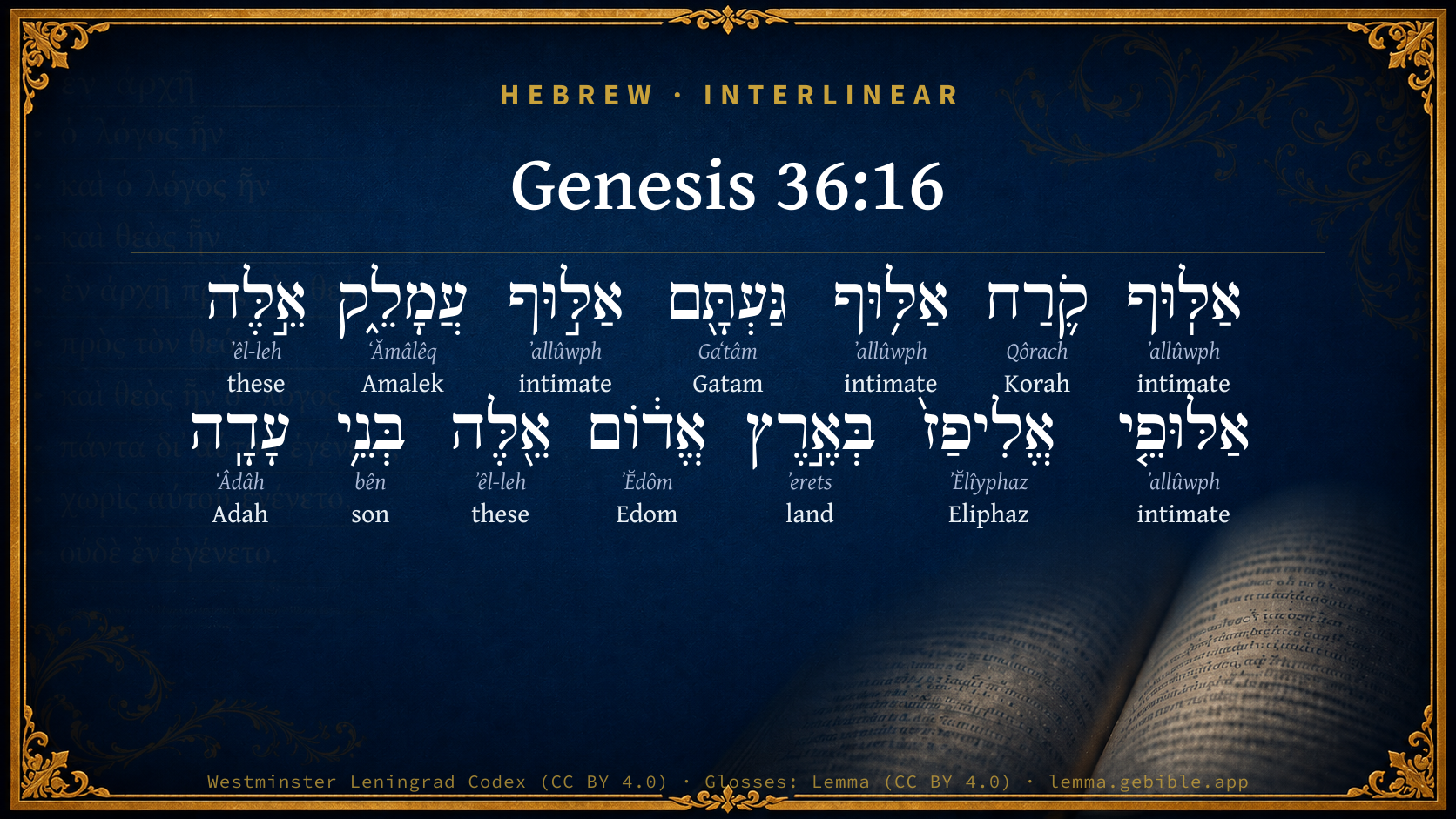
Hebrew (Westminster Leningrad Codex) Genesis 36:16 appears in the Hebrew Old Testament. The text above is from the Westminster Leningrad Codex. Each word links to its Strong’s number, a concise gloss, and parsing drawn from the Open Scriptures Hebrew Bible morphology. Click any word for its full Brown-Driver-Briggs (BDB) entry.
Download image
Cite this verse

Genesis 36:16 (World English Bible). Public Domain. Lemma interlinear Bible study tool, https://lemma.gebible.app/v/genesis/36/16.

Show BibTeX & RIS
BibTeX
RIS
English Translation
chief Korah, chief Gatam, chief Amalek: these are the chiefs who came of Eliphaz in the land of Edom; these are the sons of Adah.
World English Bible · Public Domain
Download a study sheet

One document with this verse’s original text, its word-by-word gloss line, the meaning frame, cross-references with their text, attributed commentary, and full source and license credits — printable, and it pastes into notes with its structure intact.

This verse Autodidact and up

Study sheet (.html) Plain text (.txt)

A passage Seminary Student

Up to 50 verses in one chapter. A passage sheet keeps up to 6 commentary sources and 12 cross-references per verse, in the order this page ranks them, and says so on the sheet whenever that leaves anything out. Ask for a single verse and you get the Autodidact verse sheet above.

Everything on this page stays free to read, with no account — the sheet is a download of what is already on screen, not access to it.

Want to remove ads? Support Godless Engineer
Compare translations 3

The same verse in 3 English versions, stacked beneath the original-language interlinear above. Click any original word for its lexicon entry.

Each is an independent rendering of the whole verse — the interlinear is not word-aligned to these translations.

Highlighted words mark where these versions differ — a whole-verse word diff, not a word-by-word alignment.

  • World English Bible Public Domain
    chief Korah, chief Gatam, chief Amalek: these are the chiefs who came of Eliphaz in the land of Edom; these are the sons of Adah.
  • King James Version Public Domain
    Duke Korah, duke Gatam, and duke Amalek: these are the dukes that came of Eliphaz in the land of Edom; these were the sons of Adah.
  • unfoldingWord Literal Text CC BY-SA 4.0
    Chief Korah, Chief Gatam, Chief Amalek. Those the chiefs of Eliphaz in the land of Edom. Those the grandsons of Adah.

unfoldingWord Literal Text — © unfoldingWord, licensed CC BY-SA 4.0. Word-aligned USFM3 via Door43 (git.door43.org/unfoldingWord/en_ult).

Versions to compare (up to 4)

3 of 4 selected

Show all 18 translations

Every available English version of this verse, each an independent rendering of the whole verse.

  • World English Bible Public Domain
    chief Korah, chief Gatam, chief Amalek: these are the chiefs who came of Eliphaz in the land of Edom; these are the sons of Adah.
  • Berean Standard Bible Public Domain
    Korah, Gatam, and Amalek. They are the chiefs of Eliphaz in the land of Edom, and they are the grandsons of Adah.
  • Majority Standard Bible Public Domain
    Korah, Gatam, and Amalek. They are the chiefs of Eliphaz in the land of Edom, and they are the grandsons of Adah.
  • King James Version Public Domain
    Duke Korah, duke Gatam, and duke Amalek: these are the dukes that came of Eliphaz in the land of Edom; these were the sons of Adah.
  • American Standard Version (1901) Public Domain
    chief Korah, chief Gatam, chief Amalek: these are the chiefs that came of Eliphaz in the land of Edom; these are the sons of Adah.
  • Revised Version (1885) Public Domain
    duke Korah, duke Gatam, duke Amalek: these are the dukes that came of Eliphaz in the land of Edom; these are the sons of Adah.
  • Geneva Bible (1599) Public Domain
    Duke Korah, Duke Gatam, Duke Amalek: these are the Dukes that came of Eliphaz in the land of Edom: these were the sonnes of Adah.
  • Douay-Rheims (1899) Public Domain
    Duke Core, duke Gatham, duke Amalech: these are the sons of Eliphaz, in the land of Edom, and these the Bone of Ada.
  • Young's Literal Translation Public Domain
    chief Korah, chief Gatam, chief Amalek; these `are' chiefs of Eliphaz, in the land of Edom; these `are' sons of Adah.
  • Literal Standard Version CC BY-SA 4.0
    Chief Korah, Chief Gatam, Chief Amalek; these [are] chiefs of Eliphaz, in the land of Edom; these [are] sons of Adah.
  • Unlocked Literal Bible CC BY-SA 4.0
    Korah, Gatam, and Amalek. These were the clans descended from Eliphaz in the land of Edom. They were the grandsons of Adah.
  • unfoldingWord Literal Text CC BY-SA 4.0
    Chief Korah, Chief Gatam, Chief Amalek. Those the chiefs of Eliphaz in the land of Edom. Those the grandsons of Adah.
  • Darby Bible Public Domain
    chief Korah, chief Gatam, chief Amalek. These are the chiefs of Eliphaz in the land of Edom; these are the sons of Adah.
  • World Messianic Bible Public Domain
    chief Korah, chief Gatam, chief Amalek. These are the chiefs who came of Eliphaz in the land of Edom. These are the sons of Adah.
  • Webster's Bible Public Domain
    Duke Korah, duke Gatam, and duke Amalek: these are the dukes, descendants of Eliphaz, in the land of Edom: these were the sons of Adah.
  • Free Bible Version CC BY-SA 4.0
    Korah, Gatam, and Amalek. They were the tribal leaders of Eliphaz in the country of Edom, and they were the descendants of Adah.
  • Bible in Basic English Public Domain
    Korah, Gatam, Amalek: all these were chiefs in the land of Edom, the offspring of Eliphaz, the seed of Adah.
  • JPS Tanakh (1917) Public Domain
    the chief of Korah, the chief of Gatam, the chief of Amalek. These are the chiefs that came of Eliphaz in the land of Edom. These are the sons of Adah.

Literal Standard Version (2020), Covenant Press — licensed CC BY-SA 4.0. Text via the HelloAO Bible API (eBible.org). Unlocked Literal Bible (unfoldingWord) — licensed CC BY-SA 4.0. Text via the HelloAO Bible API (eBible.org). unfoldingWord Literal Text — © unfoldingWord, licensed CC BY-SA 4.0. Word-aligned USFM3 via Door43 (git.door43.org/unfoldingWord/en_ult). Free Bible Version, Dr. Jonathan Gallagher — licensed CC BY-SA 4.0. Text via the HelloAO Bible API (eBible.org).

Word by word

More ways to search: Search by grammar → Find every occurrence → Compare this word →

Practice this passage: Drill this verse → Learn its vocabulary →

גַּעְתָּ֖ם
Gaʻtâm
H1609
“Gatam”
Noun, Proper
Part of Speech
Noun
Type
Proper
Full BDB Definition

Origin: of uncertain derivation

TWOT: None

Gatam = "a burnt valley" - fourth son of Eliphaz and grandson of Esau and one of the dukes of Eliphaz
  1. אַלּֽוּף ʼallûwph H441 “intimate” Noun, Common, Masculine, Singular, Absolute
  2. קֹ֛רַח Qôrach H7141 “Korah” Noun, Proper
  3. אַלּ֥וּף ʼallûwph H441 “intimate” Noun, Common, Masculine, Singular, Absolute
  4. אַלּ֣וּף ʼallûwph H441 “intimate” Noun, Common, Masculine, Singular, Absolute
  5. עֲמָלֵ֑ק ʻĂmâlêq H6002 “Amalek” Noun, Proper
  6. אֵ֣לֶּה ʼêl-leh H428 “these” Pronoun, Demonstrative, Common, Plural
  7. אַלּוּפֵ֤י ʼallûwph H441 “intimates of” Noun, Common, Masculine, Plural, Construct
  8. אֱלִיפַז֙ ʼĔlîyphaz H464 “Eliphaz” Noun, Proper
  9. בְּאֶ֣רֶץ ʼerets H776 “in/at · land of” Preposition + Noun, Common, Both, Singular, Construct
  10. אֱד֔וֹם ʼĔdôm H123 “Edom” Noun, Proper
  11. אֵ֖לֶּה ʼêl-leh H428 “these” Pronoun, Demonstrative, Common, Plural
  12. בְּנֵ֥י bên H1121 “sons of” Noun, Common, Masculine, Plural, Construct
  13. עָדָֽה ʻÂdâh H5711 “Adah” Noun, Proper

About this verse

These counts appear in no published source. They are computed here, from the morphology-tagged text and Lemma’s own curated glosses. What Lemma adds →

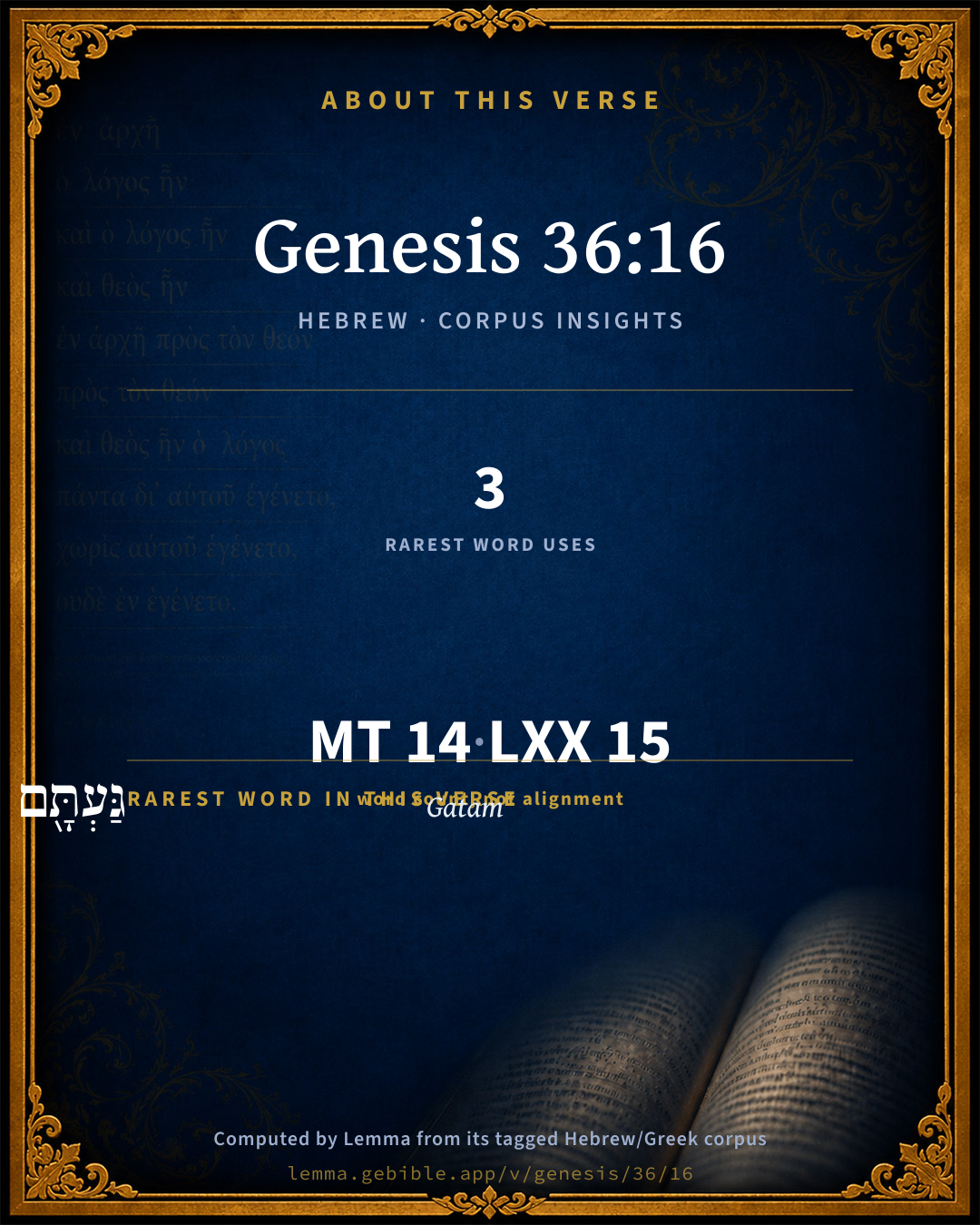
14
words
10
distinct lemmas
Pentateuch
section

Notable vocabulary

The rarest word here is גַּעְתָּ֖ם Gatam H1609 — appearing just 3 times in the whole Hebrew Bible.

Shared distinctive vocabulary

גַּעְתָּ֖ם Gatam H1609 occurs in 3 verses of the Hebrew Bible. Also found in:

Grammatical profile

  • 12 nouns
  • 2 pronouns

Repetition

Words recur within this verse — often emphatic in Hebrew:

  • אַלּֽוּף intimate H441 ×4
  • אֵ֣לֶּה these H428 ×2

Hebrew & Septuagint length

In English translation the verse runs 25 words from the Hebrew and 23 from the Septuagint (LXX English) — closely comparable.

A rough comparison of the two English renderings, which tokenize alike — not a word-level alignment.

Word counts can differ between the Hebrew and the Greek without any difference in meaning — e.g. the Hebrew direct-object marker אֵת has no separate Greek word, and Greek often adds the article ὁ.

In the original languages it is 14 Hebrew tokens and 15 Greek tokens — but the two are counted differently (Hebrew bundles its prefixes and suffixes into one token; the Greek is in lemma form), so that isn’t a like-for-like length.

Cross-references

1

Topical passages linked to Genesis 36:16 in the Treasury of Scripture Knowledge — connected by theme and wording, ordered by reader-vote popularity; previews shown in the World English Bible.

  • Exodus 15:15 Then the chiefs of Edom were dismayed. Trembling takes hold of the mighty men of Moab. All the inhabitants of Canaan are melted away.

Cross-references courtesy of OpenBible.info (CC BY 4.0).

Hebrew and Greek witnesses Masoretic Hebrew ↔ Greek Septuagint

The same verse in the two great witnesses to the Old Testament, shown verse-for-verse.

These are two independent witnesses, not word-aligned to each other, and the Septuagint is shown in lemma (dictionary) form.

Hebrew Genesis 36:16 Masoretic · Westminster Leningrad Codex

אַלּֽוּף קֹ֛רַח אַלּ֥וּף גַּעְתָּ֖ם אַלּ֣וּף עֲמָלֵ֑ק אֵ֣לֶּה אַלּוּפֵ֤י אֱלִיפַז֙ בְּאֶ֣רֶץ אֱד֔וֹם אֵ֖לֶּה בְּנֵ֥י עָדָֽה

chief Korah, chief Gatam, chief Amalek: these are the chiefs who came of Eliphaz in the land of Edom; these are the sons of Adah.

World English Bible · Public Domain

Greek LXX Genesis 36:16 Septuagint · lemma form

ἡγεμών κορε ἡγεμών γοθομ ἡγεμών αμαληκ οὗτος ἡγεμών ελιφας ἐν γῆ ιδουμαία οὗτος υἱός αδα

chief Core, chief Gothom, chief Amalec. These are the chiefs of Eliphas, in the land of Edom; these are the sons of Ada.

LXX2012 (modern English Septuagint) · Public Domain

Hebrew: Westminster Leningrad Codex (CC BY 4.0). Greek: Septuagint (public domain); English from LXX2012 (modern English Septuagint) (Public Domain). How the Septuagint differs from the Hebrew →

Targum (Aramaic paraphrase)

2

The Targum is the ancient Jewish Aramaic paraphrase of the Hebrew Scriptures — an interpretive translation, not the Hebrew text itself. Onkelos (literal) and Pseudo-Jonathan (expansive) render the Torah, and Jonathan the Prophets. Coverage is partial: where no permissively-licensed English translation exists for a verse, only the Aramaic is shown. This is verse-level text, not a word-by-word alignment to the Hebrew.

  1. Targum Onkelos Torah (Genesis–Deuteronomy)
    רַבָּא קֹרַח רַבָּא גַעְתָּם רַבָּא עֲמָלֵק אִלֵּין רַבְרְבֵי אֱלִיפַז בְּאַרְעָא דֶאֱדוֹם אִלֵּין בְּנֵי עָדָה

    (no public-domain English translation for this verse)

    Targum Onkelos — Aramaic: “Onkelos Genesis” (public domain); “Onkelos Exodus” (public domain); “Onkelos Leviticus” (public domain); “Onkelos Numbers” (public domain); “Onkelos Deuteronomy” (public domain). English: “Sefaria Community Translation” (CC0 1.0 (public-domain dedication)); “J.W. Etheridge. The Targums of Onkelos and Jonathan Ben Uzziel on the Pentateuch. London: Longmans, Green, 1862” (public domain). Text via Sefaria.

  2. Targum Pseudo-Jonathan Torah (Genesis–Deuteronomy)
    רַבָּא קרַח רַבָּא גַעְתָּם רַבָּא עֲמָלֵק אִלֵין רַבְרְבֵי אֱלִיפַז דִמְדוֹרְהוֹן בְּאַרְעָא דֶאֱדוֹם אִלֵין בְּנֵי עָדָה

    Rabba Korach, Rabba Gaatam, Rabba Amalek: these are the chieftains of Eliphaz, whose habitation was in the land of Edom; they are the sons of Adah.

    Targum Pseudo-Jonathan — Aramaic: “Targum Jonathan on Genesis” (public domain); “Targum Jonathan on Exodus” (public domain); “Targum Jonathan on Leviticus” (public domain); “Targum Jonathan on Numbers” (public domain); “Targum Jonathan on Deuteronomy” (public domain). English: “The Targum of Jonathan ben Uzziel, trans. J. W. Etheridge, London, 1862” (public domain). Text via Sefaria.

Commentary

Notes on Genesis 36:16 from classic Christian and Jewish commentators (each source and its license shown beneath its notes). The classic Christian expositions comment on the surrounding passage and are grouped to its opening verse, so a note may address several verses; the Jewish commentaries on the Tanakh (Rashi and others) are per-verse, so they appear only where the commentator wrote on this verse.

Lemma curates 59 commentaries, every one of them public domain or Creative Commons licensed, each selected and text-cleaned for this edition rather than reprinted as found. About our sources →

Adam Clarke's Commentary

Verse 16. Duke Korah] This Dr. Kennicott pronounces to be an interpolation. "It is certain, from Ge 36:4, that Eliphaz was Esau's son by Adah; and from Ge 36:11-12, that Eliphaz had but six sons, Teman, Omar, Zepho, Gatam, Kenaz, and Amalek. It is also certain, from Ge 36:5; Ge 36:14, that Korah was the son of Esau (not of Eliphaz) by Aholibamah; and as such he is properly mentioned in Ge 36:18: These are the sons of Aholibamah, Esau's wife: duke Jeush, duke Jaalam, DUKE KORAH. It is clear, therefore, that some transcriber has improperly inserted duke Korah in Ge 36:16; from which interpolation both the Samaritan text and the Samaritan version are free." - KENNICOTT'S Remarks. Everything considered, I incline to the opinion that these words were not originally in the text.

Adam Clarke's Commentary on the Bible (1810–1826) — public domain. Text from a community e-Sword/MySword module.

Geneva Bible (1599)

Geneva Bible translators

Or, nephews.

Geneva Bible (1599) marginal notes — public domain. Text via Bolls.life.

Ellicott's Commentary for English Readers

(16) Duke Korah.—The Samaritan Pentateuch rightly omits this name. He was a son of the Horite wife, Aholibamah.

A Bible Commentary for English Readers, edited by Charles John Ellicott (1878–1897) — public domain. Text from a community e-Sword module.

The Cambridge Bible for Schools and Colleges

gen. ed. J. J. S. Perowne

16. duke Korah] This name is out of place. It has come in from Gen_36:18. The other names in Gen_36:15-16 are drawn from Gen_36:11-12, while Korah, which occurs in Gen_36:14, is mentioned again in Gen_36:18.

The Cambridge Bible for Schools and Colleges (gen. ed. J. J. S. Perowne; Cambridge University Press, 1878–1918) — public domain. Text from a community e-Sword module.

John Gill's Exposition

These are the sons of Esua,.... See Gill on Gen 36:15.

.

Genesis 36:20

gen 36:20

gen 36:20

gen 36:20These are the sons of Seir the Horite, who inhabited the land,.... "Before", as the Targum of Jonathan adds, that is, before it was inhabited by Esau and his posterity, and called Edom, and had from him the name of Seir; but the Horites dwelt here before him, even in Abraham's time, Gen 14:6; and who were so called from their dwelling under ground in holes and caves, with which the further part of the land of Edom abounded, and are the same the Greeks call Trogloditae: Jarchi says, from their Rabbins, these were very expert in the nature of the land, and knew what was fit for olives and what for vines. Now the genealogy of this man is here given, partly to show who were the ancient inhabitants of this land before they were drove out, and succeeded by Esau and his sons, Deu 1:12; and partly because of the intermarriages of Esau and his posterity with them, whereby they more easily came into the possession of the country; for Esau married the daughter of Anah, the son of Zibeon, a son of Seir, Gen 36:11; and Eliphaz took Timna, a sister of Lotan the son of Seir, to be his concubine, Gen 36:12; the names of the sons of Seir follow:

Lotan, and Shobal, and Zibeon, and Anah: the first of these is said (b) to be the same with Latinus, a king that reigned in Italy, which seems to be taken from the fancied resemblance of names. Zibeon and Anah are here spoken of as brethren, the sons of Seir; whereas in Gen 36:24; they are made mention of as father and son; see Gill on Gen 36:2; Zibeon, according to the Jewish writers (c), committed incest with his mother, whence came Anah, and is called his brother, because of the same mother, and his son, as being begotten by him. They seem to seek for such kind of copulations to reproach the Edomites.

(b) Shalshalet Hakabala, fol. 79. 1. (c) T. Bab. Pesachim, fol. 54. 1. & Bava Bathra, fol. 115. 2. Bereshit Rabba, sect. 82. fol. 72. 1.

John Gill's Exposition of the Whole Bible (1746–1763) — public domain (CC PDM 1.0). Text via the HelloAO Bible API.

Haydock's Catholic Bible Commentary

Duke Core, being the son of Esau, is omitted in the Samaritan though found in all the versions and Hebrew. (Kennicott)

George Leo Haydock (1774–1849), Haydock's Catholic Family Bible and Commentary, 1859 edition — public domain. Excludes Psalms (Douay-Rheims chapter numbering differs from Protestant) and Deuterocanonical books (Catholic canon only).

Matthew Poole's English Annotations

Korah is not mentioned among the sons of Eliphaz, and therefore is thought to be his grandson. There is another Korah, Gen 36:14,18.

Matthew Poole's English Annotations on the Holy Bible (1683–1685) — public domain. Text from a community e-Sword/MySword module.

Radak

Rabbi David Kimhi (Radak)

אלוף קרח. Korach had not been mentioned earlier as a son of Eliphaz, but merely as a son of Oholovimah. Perhaps this Korach was another son of Eliphaz who had become an Aluf, and has now been mentioned with the other Aluphim who were sons of Eliphaz.

בארץ אדום, who had been born in the land of Edom and who had risen to the positions of Aluphim there.

אלה בני עדה, the sons of the son of Adah. Amalek was not a son of Adah, seeing he was the son of a concubine. The only reason why he is mentioned in this verse is because he too had risen to the position of an Aluph. The Torah, concentrating on the majority, simply lumps them all together as “sons of Adah.”

Radak on the Tanakh — English translations: “Sefaria Community Translation” (CC0 1.0 (public-domain dedication)); “Eliyahu Munk, HaChut Hameshulash” (CC BY 4.0); “Rabbi Mike Feuer, Jerusalem Anthology” (CC BY 4.0); and “R. David Kimhi on the first book of Psalms, Translated by R.G. Finch, London, 1919” (public domain). Text via Sefaria.

Lesson kit

Teaching starters — assembled from the data on this page, not authored interpretation. Every prompt links to the verse data it draws on. Edit before teaching.

Genesis, in the Pentateuch, opens this verse with 14 words (10 distinct Hebrew lemmas). Its most distinctive word is Gaʻtâm (“Gatam”). A historical commentator’s framing appears above. Read the whole chapter for the surrounding context.

Discussion questions

  1. What does “Gatam” (Gaʻtâm) contribute to the verse as a whole?
  2. Genesis 36:11 shares the word «Gatam» with this verse. How do the two illuminate each other?
  3. “intimate” occurs 4× in this one verse. What is the effect of the repetition?
  4. These translations render this verse differently; the difference is in the English rendering, not the original. What questions does that raise?
  5. Reading how Adam Clarke's Commentary and Geneva Bible (1599) read this verse, where do the two commentators agree and where do they part?

Things to notice

Reading settings

Reading text

Shown beneath each verse's original-language words.

Old Testament
Old Testament edition

Read the OT as the Masoretic Hebrew (MT) or the Greek Septuagint (LXX).

English shown for the Greek Septuagint (in the Hebrew ↔ Greek comparison).

Comparing translations? Open the Compare panel on any verse page to stack up to four side by side.