Nehemiah 6:12

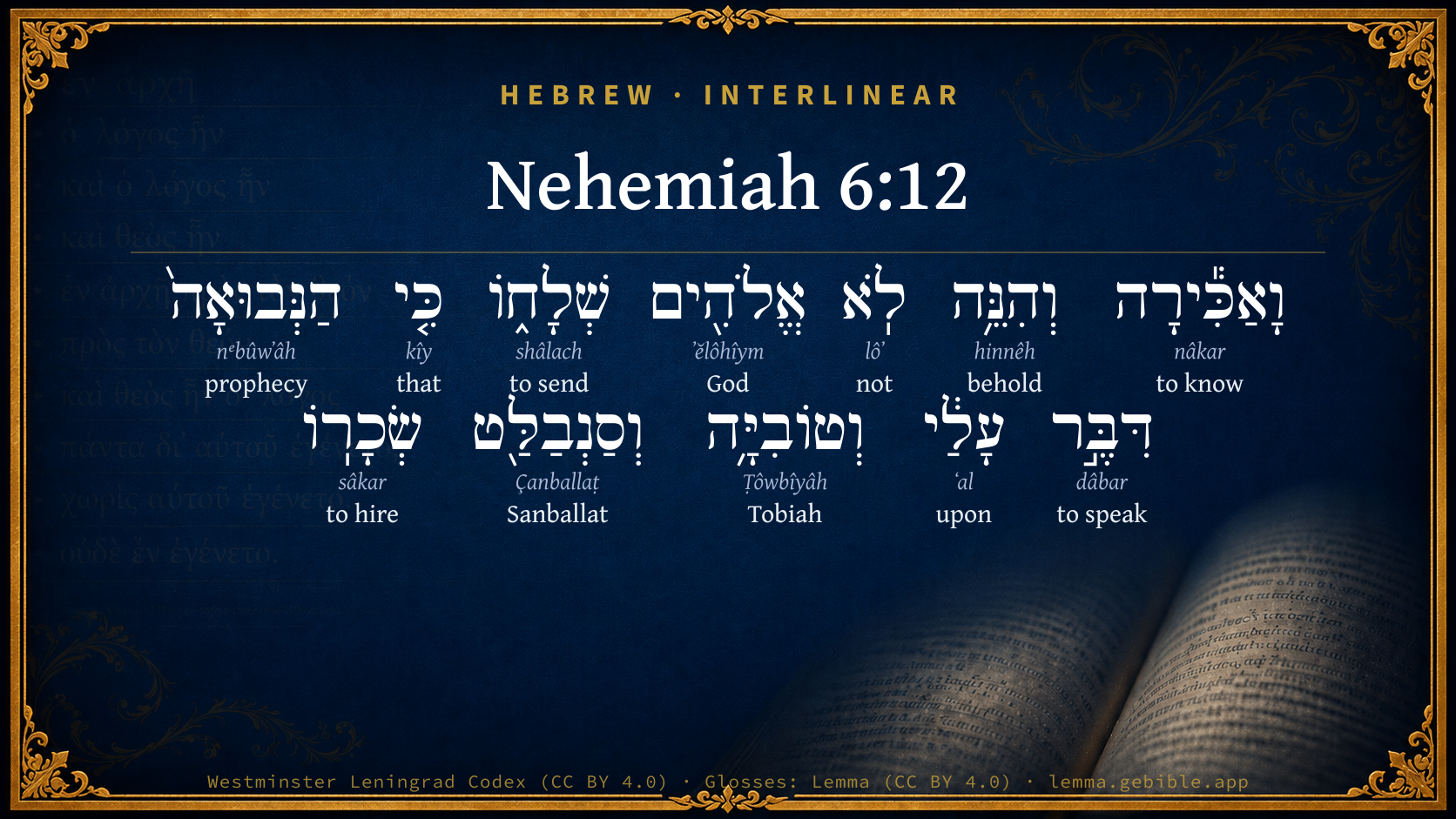
Hebrew (Westminster Leningrad Codex) Nehemiah 6:12 appears in the Hebrew Old Testament. The text above is from the Westminster Leningrad Codex. Each word links to its Strong’s number, a concise gloss, and parsing drawn from the Open Scriptures Hebrew Bible morphology. Click any word for its full Brown-Driver-Briggs (BDB) entry.
Download image
Cite this verse

Nehemiah 6:12 (World English Bible). Public Domain. Lemma interlinear Bible study tool, https://lemma.gebible.app/v/nehemiah/6/12.

Show BibTeX & RIS
BibTeX
RIS
English Translation
I discerned, and, behold, God had not sent him; but he pronounced this prophecy against me: and Tobiah and Sanballat had hired him.
World English Bible · Public Domain
Download a study sheet

One document with this verse’s original text, its word-by-word gloss line, the meaning frame, cross-references with their text, attributed commentary, and full source and license credits — printable, and it pastes into notes with its structure intact.

This verse Autodidact and up

Study sheet (.html) Plain text (.txt)

A passage Seminary Student

Up to 50 verses in one chapter. A passage sheet keeps up to 6 commentary sources and 12 cross-references per verse, in the order this page ranks them, and says so on the sheet whenever that leaves anything out. Ask for a single verse and you get the Autodidact verse sheet above.

Everything on this page stays free to read, with no account — the sheet is a download of what is already on screen, not access to it.

Want to remove ads? Support Godless Engineer
Compare translations 3

The same verse in 3 English versions, stacked beneath the original-language interlinear above. Click any original word for its lexicon entry.

Each is an independent rendering of the whole verse — the interlinear is not word-aligned to these translations.

Highlighted words mark where these versions differ — a whole-verse word diff, not a word-by-word alignment.

  • World English Bible Public Domain
    I discerned, and, behold, God had not sent him; but he pronounced this prophecy against me: and Tobiah and Sanballat had hired him.
  • King James Version Public Domain
    And, lo, I perceived that God had not sent him; but that he pronounced this prophecy against me: for Tobiah and Sanballat had hired him.
  • unfoldingWord Literal Text CC BY-SA 4.0
    And I recognized, and behold, God had not sent him. But he spoke the prophecy against me, for Tobiah and Sanballat had hired him.

unfoldingWord Literal Text — © unfoldingWord, licensed CC BY-SA 4.0. Word-aligned USFM3 via Door43 (git.door43.org/unfoldingWord/en_ult).

Versions to compare (up to 4)

3 of 4 selected

Show all 18 translations

Every available English version of this verse, each an independent rendering of the whole verse.

  • World English Bible Public Domain
    I discerned, and, behold, God had not sent him; but he pronounced this prophecy against me: and Tobiah and Sanballat had hired him.
  • Berean Standard Bible Public Domain
    I realized that God had not sent him, but that he had uttered this prophecy against me because Tobiah and Sanballat had hired him.
  • Majority Standard Bible Public Domain
    I realized that God had not sent him, but that he had uttered this prophecy against me because Tobiah and Sanballat had hired him.
  • King James Version Public Domain
    And, lo, I perceived that God had not sent him; but that he pronounced this prophecy against me: for Tobiah and Sanballat had hired him.
  • American Standard Version (1901) Public Domain
    And I discerned, and, lo, God had not sent him; but he pronounced this prophecy against me: and Tobiah and Sanballat had hired him.
  • Revised Version (1885) Public Domain
    And I discerned, and, lo, God had not sent him: but he pronounced this prophecy against me: and Tobiah and Sanballat had hired him.
  • Geneva Bible (1599) Public Domain
    And loe, I perceiued, that God had not sent him, but that he pronounced this prophecie against me: for Tobiah and Sanballat had hired him.
  • Douay-Rheims (1899) Public Domain
    And I understood that God had not sent him, but that he had spoken to me as if he had been prophesying, and Tobias, and Sanaballat had hired him.
  • Young's Literal Translation Public Domain
    And I discern, and lo, God hath not sent him, for in the prophecy he hath spoken unto me both Tobiah and Sanballat hired him,
  • Literal Standard Version CC BY-SA 4.0
    And I discern, and behold, God has not sent him, for in the prophecy he has spoken to me both Tobiah and Sanballat hired him,
  • Unlocked Literal Bible CC BY-SA 4.0
    I realized that it was not God who sent him, but that he had prophesied against me. Tobiah and Sanballat had hired him.
  • unfoldingWord Literal Text CC BY-SA 4.0
    And I recognized, and behold, God had not sent him. But he spoke the prophecy against me, for Tobiah and Sanballat had hired him.
  • Darby Bible Public Domain
    And I perceived, and behold, God had not sent him; for he pronounced this prophecy against me; and Tobijah and Sanballat had hired him.
  • World Messianic Bible Public Domain
    I discerned, and behold, God had not sent him, but he pronounced this prophecy against me. Tobiah and Sanballat had hired him.
  • Webster's Bible Public Domain
    And lo, I perceived that God had not sent him; but that he pronounced this prophecy against me: for Tobiah and Sanballat had hired him.
  • Free Bible Version CC BY-SA 4.0
    I thought about it and saw that God hadn't sent him, but that he had spoken this prophecy against me because Tobiah and Sanballat had hired him.
  • Bible in Basic English Public Domain
    Then it became clear to me that God had not sent him: he had given this word of a prophet against me himself: and Tobiah and Sanballat had given him money to do so.
  • JPS Tanakh (1917) Public Domain
    And I discerned, and, lo, God had not sent him; for he pronounced this prophecy against me, whereas Tobiah and Sanballat had hired him.

Literal Standard Version (2020), Covenant Press — licensed CC BY-SA 4.0. Text via the HelloAO Bible API (eBible.org). Unlocked Literal Bible (unfoldingWord) — licensed CC BY-SA 4.0. Text via the HelloAO Bible API (eBible.org). unfoldingWord Literal Text — © unfoldingWord, licensed CC BY-SA 4.0. Word-aligned USFM3 via Door43 (git.door43.org/unfoldingWord/en_ult). Free Bible Version, Dr. Jonathan Gallagher — licensed CC BY-SA 4.0. Text via the HelloAO Bible API (eBible.org).

Word by word

More ways to search: Search by grammar → Find every occurrence → Compare this word →

Practice this passage: Drill this verse → Learn its vocabulary →

הַנְּבוּאָה֙
nᵉbûwʼâh
H5016
“the · prophecy”
Particle, Definite Article + Noun, Common, Feminine, Singular, Absolute
Part of Speech
Particle + Noun
Type
Common
Gender
Feminine
Number
Singular
State
Absolute
Full BDB Definition

Origin: from H5012

TWOT: 1277b

prophecy - prophecy - specific and genuine - false - prophetic writing
  1. וָאַכִּ֕ירָה nâkar H5234 “and · to know” Conjunction + Verb, Hiphil, Sequential Imperfect, 1st Person, Common, Singular + Suffix, h
  2. וְהִנֵּ֥ה hinnêh H2009 “and · behold” Conjunction + Particle, Demonstrative
  3. לֹֽא lôʼ H3808 “not” Particle, Negative
  4. אֱלֹהִ֖ים ʼĕlôhîym H430 “God(s)” Noun, Common, Masculine, Plural, Absolute
  5. שְׁלָח֑וֹ shâlach H7971 “to send · him” Verb, Qal, Perfect, 3rd Person, Masculine, Singular + Suffix, Personal, 3rd Person, Masculine, Singular
  6. כִּ֤י kîy H3588 “that” Conjunction
  7. דִּבֶּ֣ר dâbar H1696 “to speak” Verb, Piel, Perfect, 3rd Person, Masculine, Singular
  8. עָלַ֔י ʻal H5921 “upon · me” Preposition + Suffix, Personal, 1st Person, Common, Singular
  9. וְטוֹבִיָּ֥ה Ṭôwbîyâh H2900 “and · Tobiah” Conjunction + Noun, Proper
  10. וְסַנְבַלַּ֖ט Çanballaṭ H5571 “and · Sanballat” Conjunction + Noun, Proper
  11. שְׂכָרֽוֹ sâkar H7936 “to hire · him” Verb, Qal, Perfect, 3rd Person, Masculine, Singular + Suffix, Personal, 3rd Person, Masculine, Singular

About this verse

These counts appear in no published source. They are computed here, from the morphology-tagged text and Lemma’s own curated glosses. What Lemma adds →

12
words
12
distinct lemmas
Historical
section

Notable vocabulary

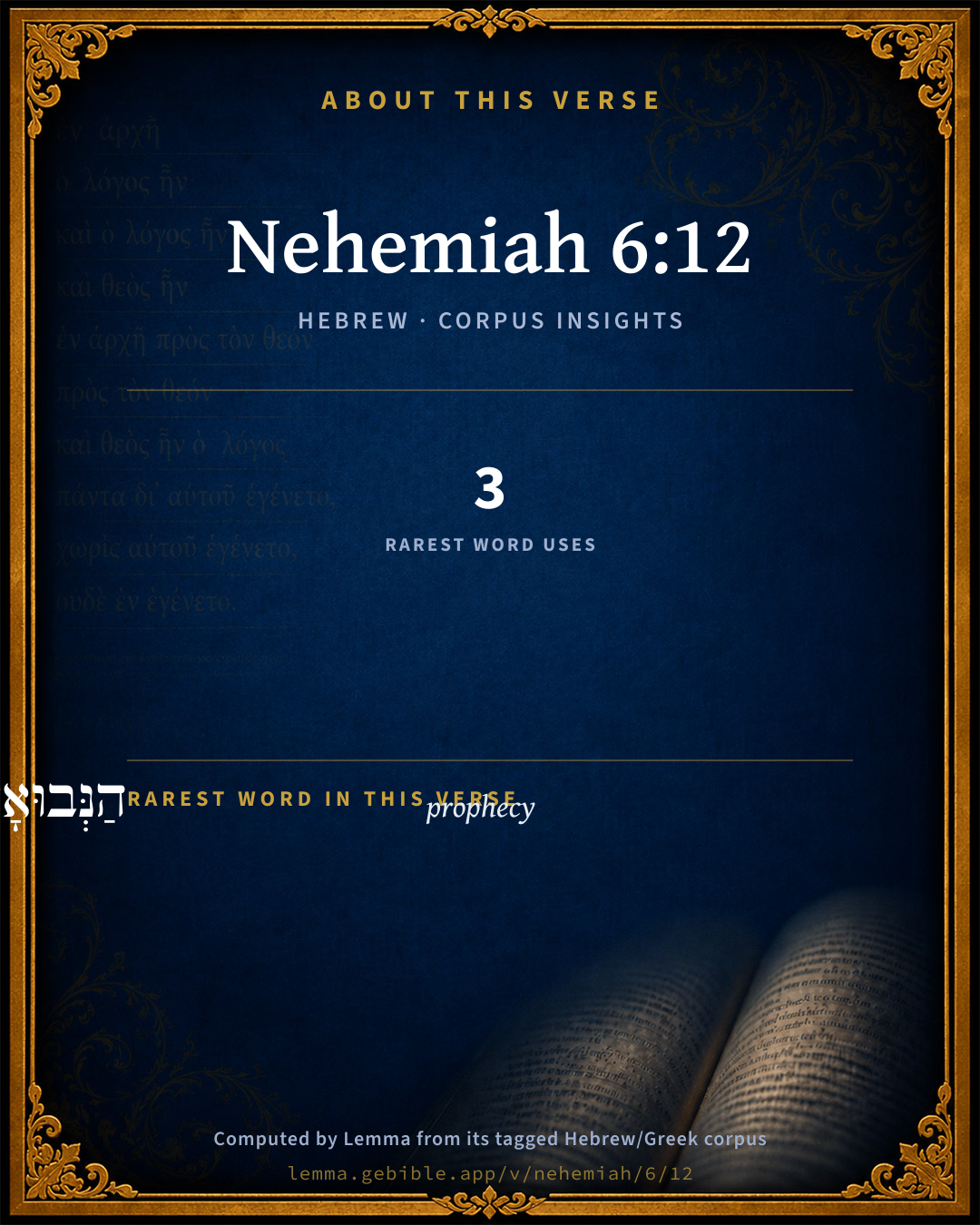
The rarest word here is הַנְּבוּאָה֙ prophecy H5016 — appearing just 3 times in the whole Hebrew Bible.

Shared distinctive vocabulary

הַנְּבוּאָה֙ prophecy H5016 occurs in 3 verses of the Hebrew Bible. Also found in:

Grammatical profile

  • 4 verbs
  • 4 nouns
  • 1 preposition
  • 1 conjunction
  • 2 particles

Verb forms

  • וָאַכִּ֕ירָה Hiphil · Sequential Imperfect
  • שְׁלָח֑וֹ Qal · Perfect
  • דִּבֶּ֣ר Piel · Perfect
  • שְׂכָרֽוֹ Qal · Perfect

Cross-references

18

Topical passages linked to Nehemiah 6:12 in the Treasury of Scripture Knowledge — connected by theme and wording, ordered by reader-vote popularity; previews shown in the World English Bible.

  • Ezekiel 13:22 Because with lies you have grieved the heart of the righteous, whom I have not made sad; and strengthened the hands of the wicked, that he should not return from his wicked way, and be saved alive:
  • Isaiah 56:11 Yes, the dogs are greedy, they can never have enough; and these are shepherds who can't understand: they have all turned to their own way, each one to his gain, from every quarter.
  • Jeremiah 14:14 Then Yahweh said to me, The prophets prophesy lies in my name; I didn't send them, neither have I commanded them, neither spoke I to them: they prophesy to you a lying vision, and divination, and a thing of nothing, and the deceit of their own heart.
  • Jeremiah 23:16 Thus says Yahweh of Hosts, Don't listen to the words of the prophets who prophesy to you: they teach you vanity; they speak a vision of their own heart, and not out of the mouth of Yahweh.
  • Jeremiah 23:25 I have heard what the prophets have said, who prophesy lies in my name, saying, I have dreamed, I have dreamed.
  • Jeremiah 28:15 Then said the prophet Jeremiah to Hananiah the prophet, Hear now, Hananiah: Yahweh has not sent you; but you make this people to trust in a lie.
  • Ezekiel 13:7 Haven't you seen a false vision, and haven't you spoken a lying divination, in that you say, Yahweh says; but I have not spoken?
  • Ezekiel 13:19 You have profaned me among my people for handfuls of barley and for pieces of bread, to kill the souls who should not die, and to save the souls alive who should not live, by your lying to my people who listen to lies.
  • Micah 3:11 Her leaders judge for bribes, And her priests teach for a price, And her prophets of it tell forturnes for money: Yet they lean on Yahweh, and say, Isn't Yahweh in the midst of us? No disaster will come on us.
  • Acts 20:33 I coveted no one's silver, or gold, or clothing.
  • 1 Corinthians 2:15 But he who is spiritual discerns all things, and he himself is judged by no one.
  • 1 Corinthians 12:10 and to another workings of miracles; and to another prophecy; and to another discerning of spirits; to another different kinds of languages; and to another the interpretation of languages.
  • 1 Timothy 3:3 not a drinker, not violent, not greedy for money, but gentle, not quarrelsome, not covetous;
  • Titus 1:7 For the overseer must be blameless, as God's steward; not self-pleasing, not easily angered, not given to wine, not violent, not greedy for dishonest gain;
  • 1 Peter 5:2 Shepherd the flock of God which is among you, exercising the oversight, not under compulsion, but voluntarily, not for dishonest gain, but willingly;
  • 2 Peter 2:3 In covetousness they will exploit you with deceptive words: whose sentence now from of old doesn't linger, and their destruction will not slumber.
  • Revelation 18:13 and cinnamon, incense, perfume, frankincense, wine, olive oil, fine flour, wheat, sheep, horses, chariots, bodies, and people's souls.
  • 1 John 4:1 Beloved, don't believe every spirit, but test the spirits, whether they are of God, because many false prophets have gone out into the world.

Cross-references courtesy of OpenBible.info (CC BY 4.0).

Hebrew and Greek witnesses Masoretic Hebrew ↔ Greek Septuagint

The same verse in the two great witnesses to the Old Testament, shown verse-for-verse.

These are two independent witnesses, not word-aligned to each other, and the Septuagint is shown in lemma (dictionary) form.

Hebrew Nehemiah 6:12 Masoretic · Westminster Leningrad Codex

וָאַכִּ֕ירָה וְהִנֵּ֥ה לֹֽא אֱלֹהִ֖ים שְׁלָח֑וֹ כִּ֤י הַנְּבוּאָה֙ דִּבֶּ֣ר עָלַ֔י וְטוֹבִיָּ֥ה וְסַנְבַלַּ֖ט שְׂכָרֽוֹ

I discerned, and, behold, God had not sent him; but he pronounced this prophecy against me: and Tobiah and Sanballat had hired him.

World English Bible · Public Domain

Greek LXX Structure differs

The Septuagint has no separate book of Nehemiah. Its Greek text is the second half of Esdras B (2 Esdras), chapters 11–23; Ezra is the first half (1–10).

A verse-for-verse comparison isn’t shown here because the chapters and verses don’t line up. Switch to the LXX edition with the MT / LXX toggle above to read the Greek directly.

Hebrew: Westminster Leningrad Codex (CC BY 4.0). Greek: Septuagint (public domain); English from a public-domain English Septuagint. How the Septuagint differs from the Hebrew →

Commentary

Notes on Nehemiah 6:12 from classic Christian and Jewish commentators (each source and its license shown beneath its notes). The classic Christian expositions comment on the surrounding passage and are grouped to its opening verse, so a note may address several verses; the Jewish commentaries on the Tanakh (Rashi and others) are per-verse, so they appear only where the commentator wrote on this verse.

Lemma curates 59 commentaries, every one of them public domain or Creative Commons licensed, each selected and text-cleaned for this edition rather than reprinted as found. About our sources →

Trapp's Complete Commentary

John Trapp

Neh 6:12 And, lo, I perceived that God had not sent him; but that he pronounced this prophecy against me: for Tobiah and Sanballat had hired him.

Ver. 12. And, lo, I perceived that God had not sent him] By my spiritual sagacity I smelt him out; as having my inward senses habitually exercised to discern good and evil, Heb 5:14. Doth not the ear try words, as the mouth tasteth meat? Job 12:11. What though we have not received the spirit of the world (we cannot cog and comply as they can, yet), we have received a better thing, the Spirit of God, the mind of Christ, 1Co 2:12; 1Co 2:16.

But that he pronounced this prophecy against me] To make my righteous soul sad with his lies, Eze 13:22, and to bring me to disgrace and danger. Luther was wont to advise preachers to see that these three dogs did not follow them into the pulpit: pride, covetousness, and envy.

For Tobiah and Sanballat had hired him] A mere mercenary he was then, and had Linguam Venalem; he could call good evil, and evil good, justify the wicked for a reward, and take away the righteousness of the righteous from him, Isa 5:20. Such false prophets were Dr Shaw and friar Pinket in Richard III’s time, who made use of them as his studges to obtrude bastardy on his brother, King Edward IV, and so to disable his children for the crown, that he might settle it upon his own head (Dan. Hist.). What became of Pinker I know not, but Shaw (as ashamed of his sermon at Paul’s Cross) disconsolately departed, and never after that was publicly seen. Like unto these were Bishop Bourn and Cardinal Pole in Queen Mary’s days. The cardinal, hired with the archbishopric of Canterbury, took for his text, Isa 66:8, and applied it to England, as then happily reduced to the pope’s obedience. Bourn, for the bishopric of Bath, preached such stuff at Paul’s Cross, that the people were ready to tear him in pieces. They flung a dagger at him in the pulpit. Phlugius and Sidonius, authors of the Popish book published in Germany by the name of Interim, Chrisma et oleum pontificium defendebant, ut ipsi discederent unctiores, defended chrism and extreme unction, as being liquored in the fists, and promoted to fat bishoprics (Melch. Adam). But a minister, as he should have nothing to lose, so he should have as little to get; he should be above all price or sale. Nec prece, nec pretio, neither request nor reward, should be his motto.

John Trapp, A Commentary or Exposition upon All the Books of the Old and New Testament (1647–1656) — public domain. Text from a community e-Sword module.

Joseph Benson's Commentary

Neh 6:12. I perceived that God had not sent him — Partly by considering the sinful nature and pernicious consequences of this counsel; partly by the suggestion of God’s Spirit, whose direction I sought in this matter; and partly by the event, which manifested that there was no such danger from the approach of the enemy as was pretended.

Joseph Benson's Commentary on the Old and New Testaments (1811–1818) — public domain. Text from a community e-Sword module.

The Cambridge Bible for Schools and Colleges

gen. ed. J. J. S. Perowne

12. And lo, I perceived that] R.V. And I discerned, and, lo. The R.V. gives the verb the requisite sense of ‘recognition’ as in Gen_27:23, ‘he discerned him not.’ Not as some commentators ‘I considered.’ Of a sudden, as it were, Nehemiah distinguishes the man’s object. The interjection ‘and, lo,’ follows after the recognition of Shemaiah’s character and intent.

God had not sent him] The emphasis lies on ‘God,’ i.e. it was not God that sent him, but Sanballat and his party. Cf. Jer_23:21, ‘I sent not these prophets, yet they ran: I spake not unto them, yet they prophesied.’ Nehemiah’s words probably refer to the Deuteronomic law about the false prophet that ‘speaketh rebellion against God’ and seeketh ‘to draw thee away from the Lord thy God’ (Deu_13:5; Deu_13:10).

he pronounced this prophecy against me] i.e. his prophecy was not on behalf of God to declare a divine message, but to oppose Nehemiah.

for (R.V. And) Tobiah and Sanballat] The clause is not a parenthetical explanation, but gives the third point which Nehemiah ‘discerned’ in Shemaiah’s action. He had ‘discerned’ (1) that Shemaiah’s message was not of God, (2) that its purpose was hostile to himself, (3) that it was the result of bribery on the part of Tobiah and Sanballat.

This is the first statement that Tobiah and Sanballat were in communication with a party in Jerusalem itself hostile to Nehemiah, cf. Neh_6:17-19; Neh_13:4; Neh_13:28. ‘Tobiah and Sanballat.’ The usual order of the names is inverted, it has been suggested, because ‘Tobiah was the immediate briber, Sanballat only finding the funds’ (Pulpit Comm.). More probably, however, his name stands first in this passage because in intrigues with the Jews of Jerusalem (Neh_13:4 ff.) he was the more active and dangerous.

hired] Cf. Ezr_4:5.

The Cambridge Bible for Schools and Colleges (gen. ed. J. J. S. Perowne; Cambridge University Press, 1878–1918) — public domain. Text from a community e-Sword module.

John Gill's Exposition

And, lo, I perceived that God had not sent him,.... Because he advised to that which was against the cause of God and true religion:

but that he pronounced the prophecy against me; for by fleeing, as he advised, it would seem that he was guilty of the crimes of rebellion and treason he was charged with; and leaving the people, as they would in course break up, he himself could not be long in safety, no, not in the temple:

for Tobiah and Sanballat had hired him; this he found out afterwards, on purpose to intimidate him, and take such measures as that thereby he would lose his character and his influence.

John Gill's Exposition of the Whole Bible (1746–1763) — public domain (CC PDM 1.0). Text via the HelloAO Bible API.

Albert Barnes' Notes on the Bible

The existence of a party among the Jews who sided with Sanballat and lent themselves to his schemes, is here for the first time indicated. Compare Neh 6:14, Neh 6:17-19; Neh 13:4-5, Neh 13:28.

Albert Barnes' Notes on the Bible (1834–1885) — public domain. Text from a community e-Sword/MySword module.

Haydock's Catholic Bible Commentary

Understood, by the nature of the suggestion, and the manner in which he heard the refusal. Aggeus, or some of the true prophets, might also inform him, (Calmet) or a supernatural light irradiated his mind, unless human sagacity sufficed. (Tirinus) (Menochius)

George Leo Haydock (1774–1849), Haydock's Catholic Family Bible and Commentary, 1859 edition — public domain. Excludes Psalms (Douay-Rheims chapter numbering differs from Protestant) and Deuterocanonical books (Catholic canon only).

Matthew Poole's English Annotations

I perceived; partly, by considering the sinful nature and pernicious consequence of this counsel; partly, by the suggestion of God’s Spirit, whose counsel and help I sought in this matter; and partly, by the event, which discovered that there was no such danger from the approach of the enemy as was pretended.

Matthew Poole's English Annotations on the Holy Bible (1683–1685) — public domain. Text from a community e-Sword/MySword module.

Whedon's Commentary on the Bible

Daniel D. Whedon

12. God had not sent him — Nehemiah soon perceived that Shemaiah was a false and lying prophet.

This prophecy — Any utterance of advice, counsel, or warning, given by a professed man of God, is in Old Testament usage a prophecy.

Had hired him — This fact afterwards came to light, greatly to the honour of Nehemiah and to the shame of Shemaiah and those who bribed him. Here Sanballat was found doing the very thing which he had charged on Nehemiah. See Neh_6:7.

Daniel D. Whedon (gen. ed.), Commentary on the Old and New Testaments (1874–1909) — public domain. Text from a community e-Sword module.

The Pulpit Commentary

And, lo, I perceived, etc. Rather, "And I considered; and lo! God had not sent him." I reflected on the whole matter, and came to the conclusion that, though he might be a prophet, he had not on this occasion exercised his prophetical office he had not declared to me God"s will. (compare the case of the "old prophet," 1Ki_13:11-18) And I was right, "for (in fact) he had pronounced this prophecy against me, because Tobiah and Sanballat had hired him." "Tobiah and Sanballat" here not "Sanballat and Tobiah," as elsewhere, (Neh_2:10, 19 4:7 6:1) because Tobiah was no doubt the immediate briber, Sanballat merely furnishing the funds.

The Pulpit Commentary (1880–1919), ed. H.D.M. Spence-Jones & Joseph S. Exell — public domain. Text from a community e-Sword module.

unfoldingWord translationNotes

Door43 World Missions Community

but that he had prophesied against me

"but that he had prophesied in order to oppose me"

and sin

Using the temple as a place to hide was sinful. It may be helpful to make this explicit. AT: "and sin by misusing the temple"

a bad name

This is an idiom. AT: "so that they could give me a bad reputation" or "so that they could give a bad report about me" (See: Idiom)

Call to mind

This is an idiom. AT: "Remember"

Noadiah

This is the name of a woman. (See: How to Translate Names)

translationWords

God

prophet

fear

sin

name

call

mind

unfoldingWord translationNotes — © Distant Shores Media and the Door43 World Missions Community, licensed CC BY-SA 4.0. Source: git.door43.org/Door43/en_tn.

Rashi

Rabbi Shlomo Yitzchaki (Rashi)

And I discerned I discerned in his words that the Holy One, blessed be He, had not sent him on this mission, but that he wanted me to commit a transgression because of fear of death.

for he spoke prophesy concerning me for he spoke these words concerning me in the name of prophecy.

had hired him Heb. שְּׂכָרוֹ. Each one of them had hired him and given him pay to frighten me and to curtail the building of the wall.

Rashi on the Tanakh — English translations: “The Judaica Press complete Tanach with Rashi, translated by A. J. Rosenberg” (CC BY 4.0); “Pentateuch with Rashi's commentary by M. Rosenbaum and A.M. Silbermann, 1929-1934” (public domain); “The Metsudah Tanach series, Lakewood, N.J” (CC BY 4.0); and “The Book of Joshua, Metsudah Publications, 1997” (CC BY 4.0). Text via Sefaria.

Lesson kit

Teaching starters — assembled from the data on this page, not authored interpretation. Every prompt links to the verse data it draws on. Edit before teaching.

Nehemiah, in the Historical, opens this verse with 12 words (12 distinct Hebrew lemmas). Its most distinctive word is nᵉbûwʼâh (“prophecy”). A historical commentator’s framing appears above. Read the whole chapter for the surrounding context.

Discussion questions

  1. The word nᵉbûwʼâh carries the sense “prophecy.” How does it shape the verse?
  2. 2 Chronicles 9:29 shares the word «prophecy» with this verse. How do the two illuminate each other?
  3. These translations render this verse differently; the difference is in the English rendering, not the original. What questions does that raise?
  4. The verb «וָאַכִּ֕ירָה» is Hiphil Sequential Imperfect. How does its form color the action?
  5. Reading how Trapp's Complete Commentary and Joseph Benson's Commentary read this verse, where do the two commentators agree and where do they part?

Things to notice

Reading settings

Reading text

Shown beneath each verse's original-language words.

Old Testament
Old Testament edition

Read the OT as the Masoretic Hebrew (MT) or the Greek Septuagint (LXX).

English shown for the Greek Septuagint (in the Hebrew ↔ Greek comparison).

Comparing translations? Open the Compare panel on any verse page to stack up to four side by side.