
Judges 9:4

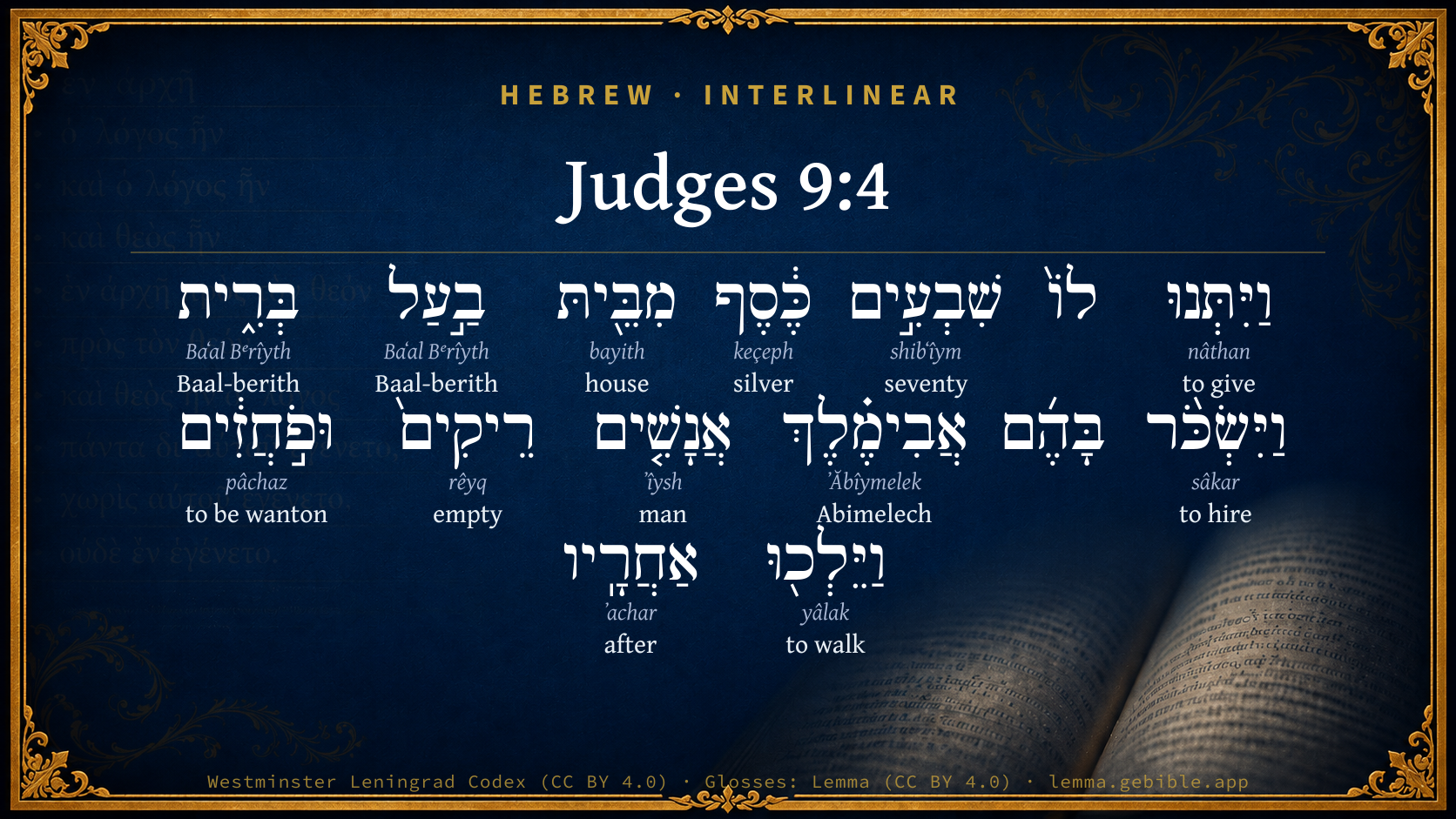
Hebrew (Westminster Leningrad Codex) Judges 9:4 appears in the Hebrew Old Testament. The text above is from the Westminster Leningrad Codex. Each word links to its Strong’s number, a concise gloss, and parsing drawn from the Open Scriptures Hebrew Bible morphology. Click any word for its full Brown-Driver-Briggs (BDB) entry.
Download image
Cite this verse

Judges 9:4 (World English Bible). Public Domain. Lemma interlinear Bible study tool, https://lemma.gebible.app/v/judges/9/4.

Show BibTeX & RIS
BibTeX
RIS
English Translation
They gave him seventy [pieces] of silver out of the house of Baal Berith, with which Abimelech hired vain and light fellows, who followed him.
World English Bible · Public Domain
Highlights
  • 1 first appearance in the Hebrew Bible
Full analysis ↓
Download a study sheet

One document with this verse’s original text, its word-by-word gloss line, the meaning frame, cross-references with their text, attributed commentary, and full source and license credits — printable, and it pastes into notes with its structure intact.

This verse Autodidact and up

Study sheet (.html) Plain text (.txt)

A passage Seminary Student

Up to 50 verses in one chapter. A passage sheet keeps up to 6 commentary sources and 12 cross-references per verse, in the order this page ranks them, and says so on the sheet whenever that leaves anything out. Ask for a single verse and you get the Autodidact verse sheet above.

Everything on this page stays free to read, with no account — the sheet is a download of what is already on screen, not access to it.

Want to remove ads? Support Godless Engineer
Compare translations 3

The same verse in 3 English versions, stacked beneath the original-language interlinear above. Click any original word for its lexicon entry.

Each is an independent rendering of the whole verse — the interlinear is not word-aligned to these translations.

Highlighted words mark where these versions differ — a whole-verse word diff, not a word-by-word alignment.

  • World English Bible Public Domain
    They gave him seventy [pieces] of silver out of the house of Baal Berith, with which Abimelech hired vain and light fellows, who followed him.
  • King James Version Public Domain
    And they gave him threescore and ten pieces of silver out of the house of Baalberith, wherewith Abimelech hired vain and light persons, which followed him.
  • unfoldingWord Literal Text CC BY-SA 4.0
    Then they gave 70 silver to him from the house of Baal-Berith, and with them Abimelech hired worthless and reckless men, and they went after him.

unfoldingWord Literal Text — © unfoldingWord, licensed CC BY-SA 4.0. Word-aligned USFM3 via Door43 (git.door43.org/unfoldingWord/en_ult).

Versions to compare (up to 4)

3 of 4 selected

Show all 18 translations

Every available English version of this verse, each an independent rendering of the whole verse.

  • World English Bible Public Domain
    They gave him seventy [pieces] of silver out of the house of Baal Berith, with which Abimelech hired vain and light fellows, who followed him.
  • Berean Standard Bible Public Domain
    So they gave him seventy shekels of silver from the temple of Baal-berith, with which Abimelech hired some worthless and reckless men to follow him.
  • Majority Standard Bible Public Domain
    So they gave him seventy shekels of silver from the temple of Baal-berith, with which Abimelech hired some worthless and reckless men to follow him.
  • King James Version Public Domain
    And they gave him threescore and ten pieces of silver out of the house of Baalberith, wherewith Abimelech hired vain and light persons, which followed him.
  • American Standard Version (1901) Public Domain
    And they gave him threescore and ten `pieces' of silver out of the house of Baal-berith, wherewith Abimelech hired vain and light fellows, who followed him.
  • Revised Version (1885) Public Domain
    And they gave him threescore and ten pieces of silver out of the house of Baal-berith, wherewith Abimelech hired vain and light fellows, which followed him.
  • Geneva Bible (1599) Public Domain
    And they gaue him seuentie pieces of siluer out of the house of Baal-berith, wherewith Abimelech hired vayne and light fellowes which followed him.
  • Douay-Rheims (1899) Public Domain
    And they gave him seventy weight of silver out of the temple of Baalberith: wherewith he hired to himself men that were needy, and vagabonds, and they followed him.
  • Young's Literal Translation Public Domain
    and they give to him seventy silverings out of the house of Baal-Berith, and Abimelech hireth with them men, vain and unstable, and they go after him;
  • Literal Standard Version CC BY-SA 4.0
    and they give seventy [pieces] of silver out of the house of Ba‘al-Berith to him, and Abimelech hires vain and unstable men with them, and they go after him;
  • Unlocked Literal Bible CC BY-SA 4.0
    They gave him seventy pieces of silver out of the house of Baal-Berith, and Abimelech used it to hire men of lawless and reckless character, who followed him.
  • unfoldingWord Literal Text CC BY-SA 4.0
    Then they gave 70 silver to him from the house of Baal-Berith, and with them Abimelech hired worthless and reckless men, and they went after him.
  • Darby Bible Public Domain
    And they gave him seventy pieces of silver out of the house of Ba'al-be'rith with which Abim'elech hired worthless and reckless fellows, who followed him.
  • World Messianic Bible Public Domain
    They gave him seventy pieces of silver out of the house of Baal Berith, with which Abimelech hired vain and reckless fellows who followed him.
  • Webster's Bible Public Domain
    And they gave him seventy pieces of silver out of the house of Baal-berith, with which Abimelech hired vain and light persons, who followed him.
  • Free Bible Version CC BY-SA 4.0
    They gave him seventy shekels of silver from the temple of Baal-berith. Abimelech used the money to hire some arrogant troublemakers as his gang.
  • Bible in Basic English Public Domain
    And they gave him seventy shekels of silver from the house of Baal-berith, with which Abimelech got the support of a number of uncontrolled and good-for-nothing persons.
  • JPS Tanakh (1917) Public Domain
    And they gave him threescore and ten pieces of silver out of the house of Baal-berith, wherewith Abimelech hired vain and light fellows, who followed him.

Literal Standard Version (2020), Covenant Press — licensed CC BY-SA 4.0. Text via the HelloAO Bible API (eBible.org). Unlocked Literal Bible (unfoldingWord) — licensed CC BY-SA 4.0. Text via the HelloAO Bible API (eBible.org). unfoldingWord Literal Text — © unfoldingWord, licensed CC BY-SA 4.0. Word-aligned USFM3 via Door43 (git.door43.org/unfoldingWord/en_ult). Free Bible Version, Dr. Jonathan Gallagher — licensed CC BY-SA 4.0. Text via the HelloAO Bible API (eBible.org).

Word by word

More ways to search: Search by grammar → Find every occurrence → Compare this word →

Practice this passage: Drill this verse → Learn its vocabulary →

וּפֹ֣חֲזִ֔ים
pâchaz
H6348
“and · being wanton”
Conjunction + Verb, Qal, Participle Active, Masculine, Plural, Absolute
Part of Speech
Conjunction + Verb
Stem
Qal
Form
Participle Active
Gender
Masculine
Number
Plural
State
Absolute
Full BDB Definition

Origin: a primitive root

TWOT: 1758

(Qal) to be wanton, be reckless, be frothy
  1. וַיִּתְּנוּ nâthan H5414 “and · to give” Conjunction + Verb, Qal, Sequential Imperfect, 3rd Person, Masculine, Plural
  2. שִׁבְעִ֣ים shibʻîym H7657 “seventy” Adjective, Cardinal number, Both, Plural, Absolute
  3. כֶּ֔סֶף keçeph H3701 “silver” Noun, Common, Masculine, Singular, Absolute
  4. מִבֵּ֖יתּ bayith H1004 “from · house of” Preposition + Noun, Common, Masculine, Singular, Construct
  5. בַ֣עַל Baʻal Bᵉrîyth H1170 “Baal-berith” Noun, Proper
  6. בְּרִ֑ית Baʻal Bᵉrîyth H1170 “Baal-berith” Noun, Proper
  7. וַיִּשְׂכֹּ֨ר sâkar H7936 “and · to hire” Conjunction + Verb, Qal, Sequential Imperfect, 3rd Person, Masculine, Singular
  8. אֲבִימֶ֗לֶךְ ʼĂbîymelek H40 “Abimelech” Noun, Proper
  9. אֲנָשִׁ֤ים ʼîysh H376 “men” Noun, Common, Masculine, Plural, Absolute
  10. רֵיקִים֙ rêyq H7386 “empty” Adjective, Adjective, Masculine, Plural, Absolute
  11. וַיֵּלְכ֖וּ yâlak H3212 “and · to walk” Conjunction + Verb, Qal, Sequential Imperfect, 3rd Person, Masculine, Plural
  12. אַחֲרָֽיו ʼachar H310 “after · him” Preposition + Suffix, Personal, 3rd Person, Masculine, Singular

About this verse

These counts appear in no published source. They are computed here, from the morphology-tagged text and Lemma’s own curated glosses. What Lemma adds →

15
words
12
distinct lemmas
Historical
section

Notable vocabulary

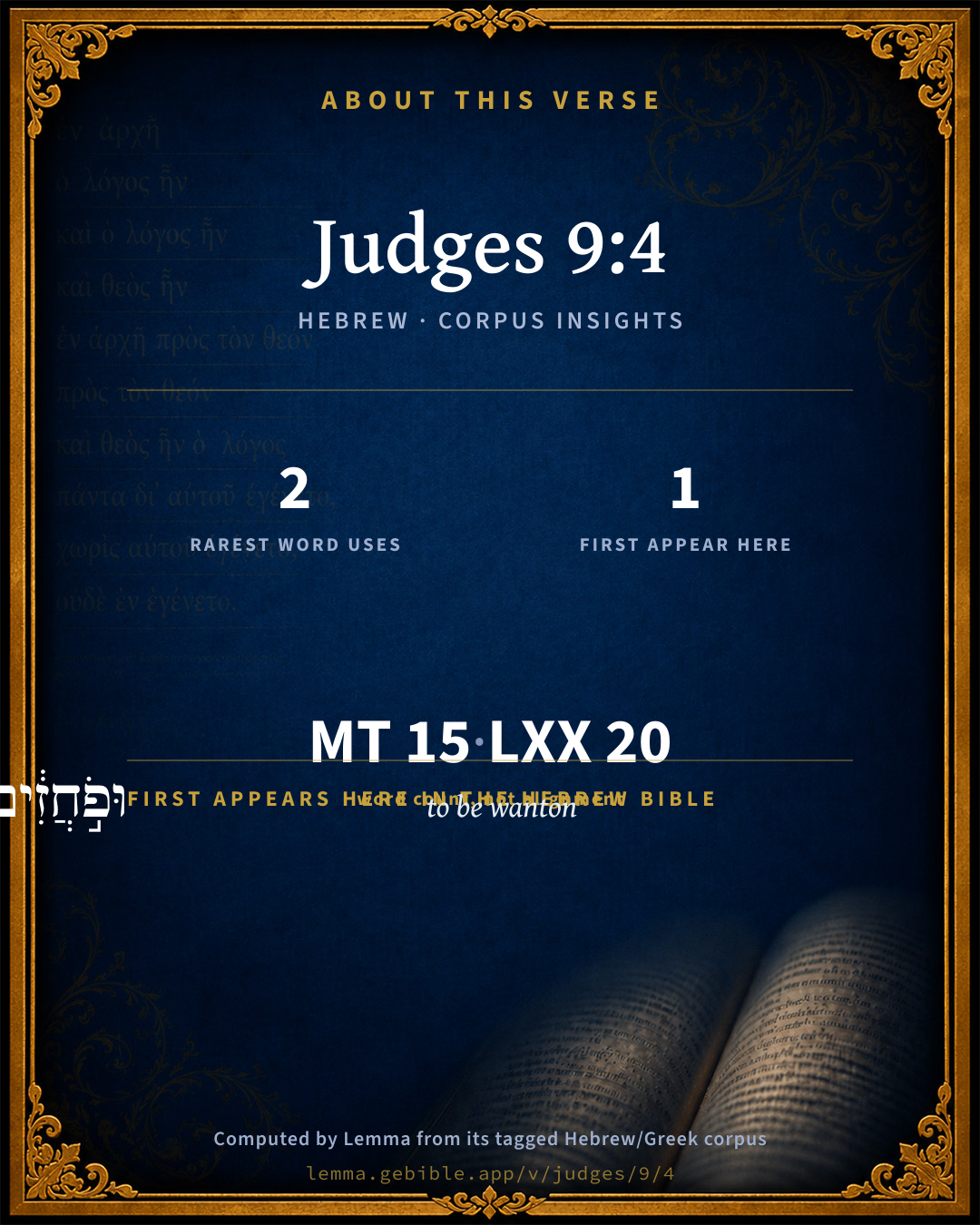
The rarest word here is וּפֹ֣חֲזִ֔ים to be wanton H6348 — appearing just 2 times in the whole Hebrew Bible.

First appearance in Scripture

This word makes its first canonical appearance in the Hebrew Bible here:

  • וּפֹ֣חֲזִ֔ים to be wanton H6348

Shared distinctive vocabulary

וּפֹ֣חֲזִ֔ים to be wanton H6348 occurs in 2 verses of the Hebrew Bible. Also found in:

Grammatical profile

  • 4 verbs
  • 6 nouns
  • 2 adjectives
  • 3 prepositions

Verb forms

  • וַיִּתְּנוּ Qal · Sequential Imperfect
  • וַיִּשְׂכֹּ֨ר Qal · Sequential Imperfect
  • וּפֹ֣חֲזִ֔ים Qal · Participle Active
  • וַיֵּלְכ֖וּ Qal · Sequential Imperfect

Repetition

A word recurs within this verse — often emphatic in Hebrew:

  • בַ֣עַל Baal-berith H1170 ×2

Hebrew & Septuagint length

In English translation the verse runs 25 words from the Hebrew and 28 from the Septuagint (LXX English) — closely comparable.

A rough comparison of the two English renderings, which tokenize alike — not a word-level alignment.

Word counts can differ between the Hebrew and the Greek without any difference in meaning — e.g. the Hebrew direct-object marker אֵת has no separate Greek word, and Greek often adds the article ὁ.

In the original languages it is 15 Hebrew tokens and 20 Greek tokens — but the two are counted differently (Hebrew bundles its prefixes and suffixes into one token; the Greek is in lemma form), so that isn’t a like-for-like length.

Cross-references

8

Topical passages linked to Judges 9:4 in the Treasury of Scripture Knowledge — connected by theme and wording, ordered by reader-vote popularity; previews shown in the World English Bible.

  • Judges 8:33 It happened, as soon as Gideon was dead, that the children of Israel turned again, and played the prostitute after the Baals, and made Baal Berith their god.
  • Judges 11:3 Then Jephthah fled from his brothers, and lived in the land of Tob: and there were gathered vain fellows to Jephthah, and they went out with him.
  • 2 Chronicles 13:7 There were gathered to him worthless men, base fellows, who strengthened themselves against Rehoboam the son of Solomon, when Rehoboam was young and tender-hearted, and could not withstand them.
  • Proverbs 12:11 He who tills his land shall have plenty of bread, But he who chases fantasies is void of understanding.
  • Acts 17:5 But the unpersuaded Jews took along some wicked men from the marketplace, and gathering a crowd, set the city in an uproar. Assaulting the house of Jason, they sought to bring them out to the people.
  • Judges 9:46–49 When all the men of the tower of Shechem heard of it, they entered into the stronghold of the house of Elberith.
  • 1 Samuel 22:2 Everyone who was in distress, and everyone who was in debt, and everyone who was discontented, gathered themselves to him; and he became captain over them: and there were with him about four hundred men.
  • Job 30:8 They are children of fools, yes, children of base men. They were flogged out of the land.

Cross-references courtesy of OpenBible.info (CC BY 4.0).

Hebrew and Greek witnesses Masoretic Hebrew ↔ Greek Septuagint

The same verse in the two great witnesses to the Old Testament, shown verse-for-verse.

These are two independent witnesses, not word-aligned to each other, and the Septuagint is shown in lemma (dictionary) form.

Hebrew Judges 9:4 Masoretic · Westminster Leningrad Codex

וַיִּתְּנוּ לוֹ֙ שִׁבְעִ֣ים כֶּ֔סֶף מִבֵּ֖יתּ בַ֣עַל בְּרִ֑ית וַיִּשְׂכֹּ֨ר בָּהֶ֜ם אֲבִימֶ֗לֶךְ אֲנָשִׁ֤ים רֵיקִים֙ וּפֹ֣חֲזִ֔ים וַיֵּלְכ֖וּ אַחֲרָֽיו

They gave him seventy [pieces] of silver out of the house of Baal Berith, with which Abimelech hired vain and light fellows, who followed him.

World English Bible · Public Domain

Greek LXX Judges 9:4 Septuagint · lemma form

καί δίδωμι αὐτός ἑβδομήκοντα ἀργύριον ἐκ οἶκος βααλβεριθ καί μισθόω ἑαυτοῦ αβιμελεχ ἀνήρ κενός καί δειλός καί πορεύομαι ὀπίσω αὐτός

And they gave him seventy pieces of silver out of the house of Baalberith; and Abimelech hired for himself vain and cowardly men, and they went after him.

LXX2012 (modern English Septuagint) · Public Domain

On this verse, Haydock's Catholic Bible Commentary discusses the Septuagint’s reading. Read the note in Commentary ↓

Hebrew: Westminster Leningrad Codex (CC BY 4.0). Greek: Septuagint (public domain); English from LXX2012 (modern English Septuagint) (Public Domain). How the Septuagint differs from the Hebrew →

Targum (Aramaic paraphrase)

1

The Targum is the ancient Jewish Aramaic paraphrase of the Hebrew Scriptures — an interpretive translation, not the Hebrew text itself. Onkelos (literal) and Pseudo-Jonathan (expansive) render the Torah, and Jonathan the Prophets. Coverage is partial: where no permissively-licensed English translation exists for a verse, only the Aramaic is shown. This is verse-level text, not a word-by-word alignment to the Hebrew.

  1. Targum Jonathan Prophets (Joshua–Malachi)
    וִיהָבוּ לֵיהּ שַׁבְעִין כְּסָף מִבֵּית בָּעֵיל קְיָם וַאֲגַר בְּהוֹן אֲבִימֶלֶךְ גַבְרִין סְרִיקִין וּבְסִירִין וַאֲזַלוּ בַּתְרוֹהִי:

    (no public-domain English translation for this verse)

    Targum Jonathan — Aramaic: “Mikraot Gedolot” (public domain). English: “Sefaria Community Translation” (CC0 1.0 (public-domain dedication)); “London "Chaldee Paraphrase," 1871” (public domain). Text via Sefaria.

Commentary

Notes on Judges 9:4 from classic Christian and Jewish commentators (each source and its license shown beneath its notes). The classic Christian expositions comment on the surrounding passage and are grouped to its opening verse, so a note may address several verses; the Jewish commentaries on the Tanakh (Rashi and others) are per-verse, so they appear only where the commentator wrote on this verse.

Lemma curates 59 commentaries, every one of them public domain or Creative Commons licensed, each selected and text-cleaned for this edition rather than reprinted as found. About our sources →

Trapp's Complete Commentary

John Trapp

Jdg 9:4 And they gave him threescore and ten [pieces] of silver out of the house of Baalberith, wherewith Abimelech hired vain and light persons, which followed him.

Ver. 4. And they gave him threescore and ten pieces.] Pounds, saith the Vulgate: but more likely, shekels: which though it were a small sum, yet we must know that a little money would go a great way in those days; as also that such soldiers might be hired for small wages, &c.

Hired vain and light persons.] Beggarly rascals, fit for his purpose, debauched desperadoes.

John Trapp, A Commentary or Exposition upon All the Books of the Old and New Testament (1647–1656) — public domain. Text from a community e-Sword module.

Joseph Benson's Commentary

Jdg 9:4. They gave him threescore and ten pieces of silver — To bear the charges which he would be put to in making good his pretensions. It is not said what the value of these pieces was: so many shekels would have been but a small present to make a man a prince, and too little to serve his purposes; and so many talents too much for them to give. Therefore the Vulgate translates it so many pounds weight of silver, which learned men approve. Out of the house of Baal-berith — Out of the sacred treasury of that idol-temple, which they had probably built since Gideon’s death, (for he would never have suffered it while he lived,) and endowed it with considerable revenues. Wherewith Abimelech hired vain and light persons — The word ריקים, reekim, which we translate vain, signifies empty; that is, ignorant, inconsiderate, and needy persons. And the other word, פחזים, pochazim, means idle, vagabond fellows, that could settle to no business, but wandered about the country, who, being commonly men of loose and profligate lives, were fittest for his purpose.

Joseph Benson's Commentary on the Old and New Testaments (1811–1818) — public domain. Text from a community e-Sword module.

Geneva Bible (1599)

Geneva Bible translators

Or, idle fellows and vagabonds.

Geneva Bible (1599) marginal notes — public domain. Text via Bolls.life.

Jamieson, Fausset & Brown

Robert Jamieson, A. R. Fausset & David Brown

the house of Baal-berith--either the temple, or the place where this idol was worshipped; Baal-berith, "god of the covenant," by invocation of whom the league of cities was formed.

Abimelech hired vain and light persons, which followed him--idle, worthless vagabonds, the scum of society, who had nothing to lose, but much to gain from the success of a revolutionary movement.

Jamieson, Fausset & Brown — Commentary Critical and Explanatory on the Whole Bible (1871) — public domain (CC PDM 1.0). Text via the HelloAO Bible API.

Adam Clarke's Commentary

Verse 4. Threescore and ten pieces of silver] Probably shekels; and this was the whole of his exchequer. As he was now usurping the government of God, he begins with a contribution from the idol temple. A work begun under the name and influence of the devil is not likely to end to the glory of God, or to the welfare of man.

Hired vain and light persons] אנשים ריקים ופחזים anashim reykim uphochazim, worthless and dissolute men; persons who were living on the public, and had nothing to lose. Such was the foundation of his Babel government. By a cunning management of such rascals most revolutions have been brought about.

Adam Clarke's Commentary on the Bible (1810–1826) — public domain. Text from a community e-Sword/MySword module.

Ellicott's Commentary for English Readers

(4) Pieces.—Rather, shekels, which is the word normally understood in similar phrases (Jdg_8:26). “Neither the citizens of Shechem nor the ignobly-ambitious bastard understood what true monarchy was, and still less what it ought to be in the commonwealth of Jehovah” (Ewald, ii. 389).

Out of the house of Baal-berith.—Like most temples in ancient days (e.g., that of Venus on Mount Eryx, the Parthenon, and that of Jupiter Latiaris), this served at once as a sanctuary, a fortress, and a bank. Similarly the treasures amassed at Delphi enabled the three Phocian brothers, Phayllus, Phalaekus, and Onomarchus, to support the whole burden of the sacred war (Diodor. xvi. 30; comp. Thuc. i. 121, 2:13). (Comp. also 1Ki_15:18.)

Vain and light persons.—These are exactly analogous to the doruphoroi—a body-guard of spear-bearers, which an ambitious Greek always hired as the first step to setting up a tyranny (Diog. Laert. 1:49). We find Jephthah (Jdg_11:3), and David (1Sa_22:2), and Absalom (2Sa_15:1), and Rezon (1Ki_11:24), and Adonijah (1Ki_1:5), and Jeroboam (2Ch_13:7) doing exactly the same thing. Who these “vain” persons were is best defined in 1Sa_22:2. They were like the condottieri, or free-lances. The word vain (rikîm) is from the same root as Raca; it means vauriens. The word for “light persons” (pochazîm) occurs in Gen_49:4 (applied to Reuben) and Zep_3:4. It is from a root which means to boil over.

A Bible Commentary for English Readers, edited by Charles John Ellicott (1878–1897) — public domain. Text from a community e-Sword module.

The Cambridge Bible for Schools and Colleges

gen. ed. J. J. S. Perowne

4. the house of Baal-berith] In Jdg_9:46 El-bĕrîth = God of the covenant; see Jdg_8:33 n. Temples in antiquity had their own treasuries into which offerings and fines were paid; they also served the purpose of banks for public and private money, cf. 2Ma_3:10-12.

vain and light fellows] i.e. disreputable and reckless, cf. Jdg_11:3, 2Ch_13:7.

The Cambridge Bible for Schools and Colleges (gen. ed. J. J. S. Perowne; Cambridge University Press, 1878–1918) — public domain. Text from a community e-Sword module.

John Gill's Exposition

And they gave him seventy pieces of silver out of the house of Baalbirith,.... The temple of their idol; of this name See Gill on Jdg 8:33, out of the money which had been dedicated to his service by freewill offering, or out of a bank which they deposited there for greater safety, and perhaps out of a superstitious notion of its being more prosperous and successful: of what value these pieces were is not certain; by pieces of silver, commonly shekels are meant; but these are thought to be of too little value to be given to a man to raise an army with, or carry on a scheme to advance himself to the throne; and talents are judged to be too large a sum for such a city to contribute out of a temple of theirs, and that but lately built, as it must be since the death of Gideon; they are therefore thought to be pounds, as the Vulgate Latin version renders it; however, in the number of them there seems to be some reference to the number of Gideon's sons, who were to be destroyed by bribing men with this sum, which was the scheme concerted between Abimelech and the men of Shechem:

wherewith Abimelech hired vain and light persons, which followed him; perhaps seventy of them, giving to each a piece or pound of silver; these were a base scoundrel sort of people, that lived in an idle scandalous manner, a sort of freebooters, that lived upon what they could lay hold on in a way of force and rapine; men of light heads and empty brains, and whose pockets were as light and empty as their heads, and fit to engage in any enterprise, though ever so barbarous, for the sake of a little money.

John Gill's Exposition of the Whole Bible (1746–1763) — public domain (CC PDM 1.0). Text via the HelloAO Bible API.

Haydock's Catholic Bible Commentary

Weight. Hebrew, Chaldean, and Septuagint do not express what quantity of silver was given. (Menochius) --- But sicle on such occasions is generally supplied. (Calmet) --- Hence this sum would amount to little more than 8l. sterling. (Haydock) --- As this appears too insignificant a sum to maintain an army, (Calmet) some would supply pounds, each consisting of 24 sicles, or talents, which were equivalent to 3000 sicles. (Menochius) --- But this is without example, and the army of Abimelech was, probably, a company of banditti, or villains, who went with him to Ephra, to murder his brethren, and afterwards kept near his person. When he had got possession of his father’s estate, and of the sovereign power, he found means to supply his wants. (Calmet) --- Baalberith. That is, Baal of the covenant, so called from the covenant they had made with Baal, chap. viii. 33. (Challoner) --- The custom of keeping money in temples was formerly very common. Almost all the cities of Greece sent money to the temple of Apollo, at Delphos, (Marsham, sæc. xvii.) where the people of Rome and of Marseilles had also some. The different cities had likewise holes cut in the rock of Olympia, in Elis, for the same purpose. The public treasury was, almost universally, some temple. That of Rome was the temple of Saturn. --- Vagabonds. Hebrew, "empty and inconstant" (Calmet) people who had nothing to lose, and who would not embrace any proper method of getting a livelihood. (Haydock) --- Chaldean, "seekers." Septuagint, "stupid." Symmachus, "idle and of desperate fortunes, or frantic." (Calmet) --- Such people are generally at the head of every revolution, or, at least, are ready to follow the directions of some powerful and designing man; as but too many instances, both in ancient and modern times evince; which ought to be a caution for all to watch their motions. (Haydock)

George Leo Haydock (1774–1849), Haydock's Catholic Family Bible and Commentary, 1859 edition — public domain. Excludes Psalms (Douay-Rheims chapter numbering differs from Protestant) and Deuterocanonical books (Catholic canon only).

Matthew Poole's English Annotations

Threescore and ten, agreeably to the number of his enemies, Gideon’s seventy sons.

Pieces of silver; not shekels, as some fancy, which were too small a sum for this purpose; but far larger pieces, the exact worth whereof it is neither possible nor needful for us now to know.

Out of the house of Baal-berith; out of his sacred treasury; for even they; who were very parsimonious and base in their expenses about God’s service, were liberal in their contributions to idols; having since Gideon’s death built this temple, (which he would never have suffered whilst he lived,) and endowed it with considerable revenues.

Vain and light persons; unsettled, idle, and necessitous persons, the most proper instruments for tyranny and cruelty.

Matthew Poole's English Annotations on the Holy Bible (1683–1685) — public domain. Text from a community e-Sword/MySword module.

Whedon's Commentary on the Bible

Daniel D. Whedon

4. They gave him — As a tribute to royalty, and to enable him to hire a body-guard and provide himself with the emblems of royalty.

Threescore and ten pieces of silver — Silver shekels are probably meant, and this number would amount to about forty dollars.

House of Baal-berith — The edifice or temple which the Shechemites had built for the worship of this heathen deity. Great treasure was usually laid up in such temples, and not unfrequently applied to political purposes. Compare 1Ki_15:18.

The treasures of Baal were thought to be well appropriated to the use of him who essayed to destroy the sons of Jerubbaal, the Baal-fighter. There was one piece of silver to each of the seventy sons of the Baal-destroyer.

Vain and light persons — Loose and desperate characters, who were alike ready for the lowest meanness and the darkest crimes.

Daniel D. Whedon (gen. ed.), Commentary on the Old and New Testaments (1874–1909) — public domain. Text from a community e-Sword module.

The Pulpit Commentary

Threescore and ten of silver, i.e. shekels, which is always understood. Equal in value to about seven pounds; quite enough with which to hire a band of "vain and light persons," who would afterwards maintain themselves by plunder. Out of the house of Baal-berith. The custom of collecting treasures at the temple, both that of the true God and of idols, whether they were offerings and gifts for the service of the temple, or treasures deposited there for safety, was very general. (see 1Ki_15:18 1Ch_29:8 Dan_1:2, etc.) The treasures belonging to the temple of Apollo at Delphi were very great, and excited the cupidity of Xerxes, who sent an army to plunder the temple, but was foiled in the attempt. The Phocians are related to have seized 10, 000 talents from the treasury of Delphi, nearly two and a half millions sterling. The temple of Diana at Ephesus had considerable treasures in money, as well as other valuable articles. Many other notices of the riches of temple treasures occur in classical writers. Vain and light persons. Of. Jud_1:11:3 1Sa_22:2 2Sa_15:1 2Ch_13:7. Vain, literally, empty; light, literally, boiling over. Applied to the false prophets. (Zep_3:4) In German, sprudel-kopf is a hotheaded, hasty man.

The Pulpit Commentary (1880–1919), ed. H.D.M. Spence-Jones & Joseph S. Exell — public domain. Text from a community e-Sword module.

John Wesley's Explanatory Notes

Pieces of silver - Not shekels, which were too small a sum for this purpose; but far larger pieces, the exact worth whereof it is not possible for us now to know. The house of Baal-berith - Out of his sacred treasury; having since Gideon's death built this temple (which he would never have suffered whilst he lived) and endowed it with considerable revenues. Light persons - Unsettled, idle and necessitous persons, the proper instruments of tyranny and cruelty.

John Wesley, Explanatory Notes Upon the Whole Bible (1754–1765) — public domain. Text via the GEBible commentary corpus.

Rashi

Rabbi Shlomo Yitzchaki (Rashi)

Headstrong. They acted impetuously, thoughtlessly.

Rashi on the Tanakh — English translations: “The Judaica Press complete Tanach with Rashi, translated by A. J. Rosenberg” (CC BY 4.0); “Pentateuch with Rashi's commentary by M. Rosenbaum and A.M. Silbermann, 1929-1934” (public domain); “The Metsudah Tanach series, Lakewood, N.J” (CC BY 4.0); and “The Book of Joshua, Metsudah Publications, 1997” (CC BY 4.0). Text via Sefaria.

Lesson kit

Teaching starters — assembled from the data on this page, not authored interpretation. Every prompt links to the verse data it draws on. Edit before teaching.

Judges, in the Historical, opens this verse with 15 words (12 distinct Hebrew lemmas). Its most distinctive word is pâchaz (“to be wanton”). A historical commentator’s framing appears above. Read the whole chapter for the surrounding context.

Discussion questions

  1. How does “to be wanton” (pâchaz) shape what this verse is saying?
  2. This is the first place “to be wanton” appears in Scripture (first appears here). What does its debut here establish?
  3. How does Zephaniah 3:4, which shares the word «to be wanton», read alongside this verse?
  4. What does the repetition of “Baal-berith” (2× in this one verse) do in this verse?
  5. The translations on this page render this verse differently — a whole-verse word diff, not a word-by-word alignment. What might account for the different wordings?
  6. «וַיִּתְּנוּ» is a Qal Sequential Imperfect verb. How does that grammatical form shape the action described?
  7. Compare how Trapp's Complete Commentary and Joseph Benson's Commentary read this verse. Where do they agree or differ?

Things to notice

Reading settings

Reading text

Shown beneath each verse's original-language words.

Old Testament
Old Testament edition

Read the OT as the Masoretic Hebrew (MT) or the Greek Septuagint (LXX).

English shown for the Greek Septuagint (in the Hebrew ↔ Greek comparison).

Comparing translations? Open the Compare panel on any verse page to stack up to four side by side.