Judges 18:4

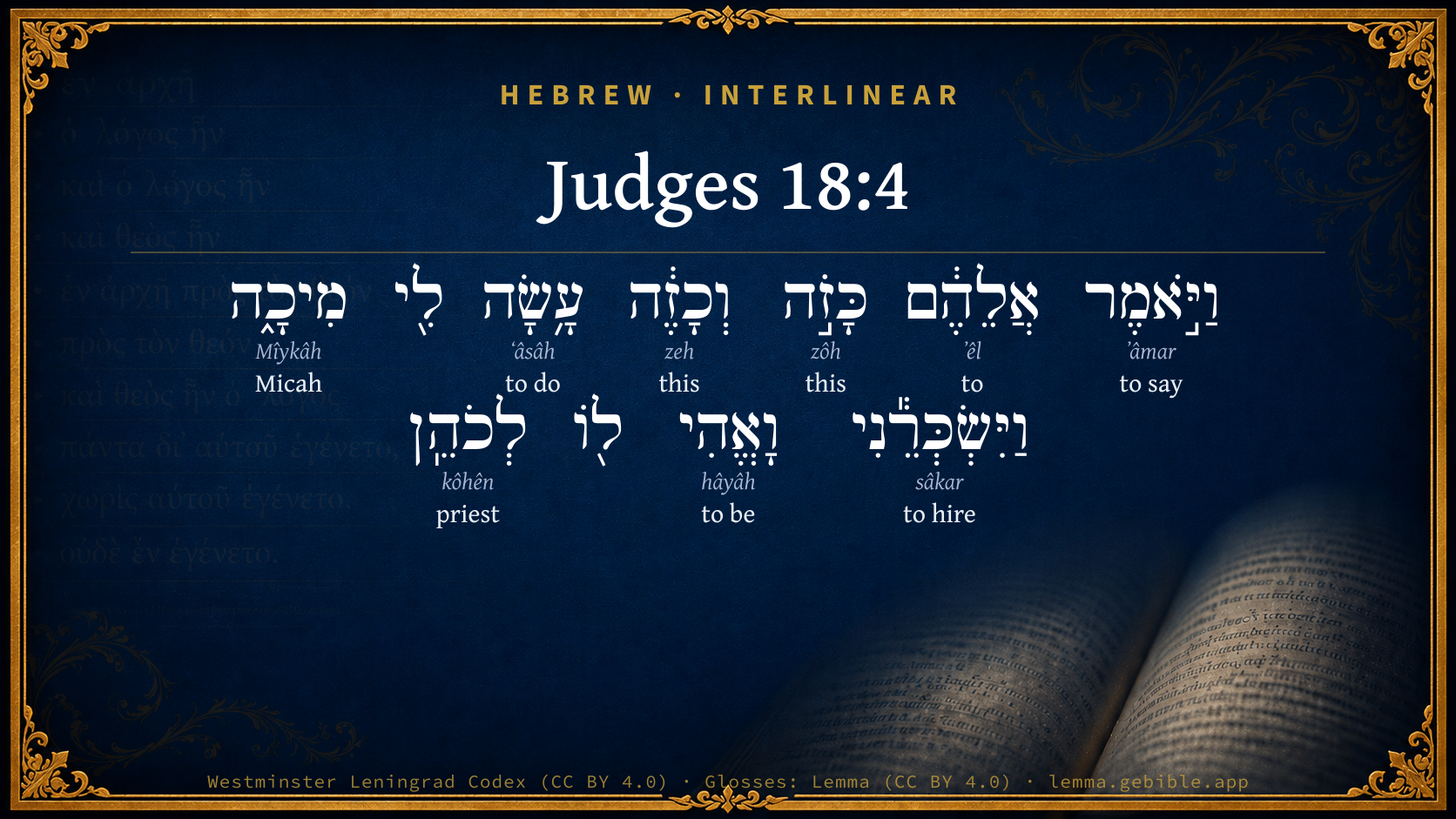
Hebrew (Westminster Leningrad Codex) Judges 18:4 appears in the Hebrew Old Testament. The text above is from the Westminster Leningrad Codex. Each word links to its Strong’s number, a concise gloss, and parsing drawn from the Open Scriptures Hebrew Bible morphology. Click any word for its full Brown-Driver-Briggs (BDB) entry.
Download image
Cite this verse

Judges 18:4 (World English Bible). Public Domain. Lemma interlinear Bible study tool, https://lemma.gebible.app/v/judges/18/4.

Show BibTeX & RIS
BibTeX
RIS
English Translation
He said to them, Thus and thus has Micah dealt with me, and he has hired me, and I am become his priest.
World English Bible · Public Domain
Highlights
  • 1 first appearance in the Hebrew Bible
Full analysis ↓
Download a study sheet

One document with this verse’s original text, its word-by-word gloss line, the meaning frame, cross-references with their text, attributed commentary, and full source and license credits — printable, and it pastes into notes with its structure intact.

This verse Autodidact and up

Study sheet (.html) Plain text (.txt)

A passage Seminary Student

Up to 50 verses in one chapter. A passage sheet keeps up to 6 commentary sources and 12 cross-references per verse, in the order this page ranks them, and says so on the sheet whenever that leaves anything out. Ask for a single verse and you get the Autodidact verse sheet above.

Everything on this page stays free to read, with no account — the sheet is a download of what is already on screen, not access to it.

Want to remove ads? Support Godless Engineer
Compare translations 3

The same verse in 3 English versions, stacked beneath the original-language interlinear above. Click any original word for its lexicon entry.

Each is an independent rendering of the whole verse — the interlinear is not word-aligned to these translations.

Highlighted words mark where these versions differ — a whole-verse word diff, not a word-by-word alignment.

  • World English Bible Public Domain
    He said to them, Thus and thus has Micah dealt with me, and he has hired me, and I am become his priest.
  • King James Version Public Domain
    And he said unto them, Thus and thus dealeth Micah with me, and hath hired me, and I am his priest.
  • unfoldingWord Literal Text CC BY-SA 4.0
    And he said to them, “Like this and like this Micah has done for me: now he has hired me, and I am to him for a priest.”

unfoldingWord Literal Text — © unfoldingWord, licensed CC BY-SA 4.0. Word-aligned USFM3 via Door43 (git.door43.org/unfoldingWord/en_ult).

Versions to compare (up to 4)

3 of 4 selected

Show all 18 translations

Every available English version of this verse, each an independent rendering of the whole verse.

  • World English Bible Public Domain
    He said to them, Thus and thus has Micah dealt with me, and he has hired me, and I am become his priest.
  • Berean Standard Bible Public Domain
    “Micah has done this and that for me,” he replied, “and he has hired me to be his priest.”
  • Majority Standard Bible Public Domain
    “Micah has done this and that for me,” he replied, “and he has hired me to be his priest.”
  • King James Version Public Domain
    And he said unto them, Thus and thus dealeth Micah with me, and hath hired me, and I am his priest.
  • American Standard Version (1901) Public Domain
    And he said unto them, Thus and thus hath Micah dealt with me, and he hath hired me, and I am become his priest.
  • Revised Version (1885) Public Domain
    And he said unto them, Thus and thus hath Micah dealt with me, and he hath hired me, and I am become his priest.
  • Geneva Bible (1599) Public Domain
    And he answered them, Thus and thus dealeth Michah with me, and hath hired me, and I am his Priest.
  • Douay-Rheims (1899) Public Domain
    He answered them: Michas hath done such and such things for me, and hath hired me to be his priest.
  • Young's Literal Translation Public Domain
    And he saith unto them, `Thus and thus hath Micah done to me; and he hireth me, and I am to him for a priest.'
  • Literal Standard Version CC BY-SA 4.0
    And he says to them, “Thus and thus has Micah done to me; and he hires me, and I am for a priest to him.”
  • Unlocked Literal Bible CC BY-SA 4.0
    He said to them, “This is what Micah has done for me: He has hired me to become his priest.”
  • unfoldingWord Literal Text CC BY-SA 4.0
    And he said to them, “Like this and like this Micah has done for me: now he has hired me, and I am to him for a priest.”
  • Darby Bible Public Domain
    And he said to them, "Thus and thus has Micah dealt with me: he has hired me, and I have become his priest."
  • World Messianic Bible Public Domain
    He said to them, “Thus and thus has Micah dealt with me, and he has hired me, and I have become his priest.”
  • Webster's Bible Public Domain
    And he said to them, Thus and thus dealeth Micah with me, and hath hired me, and I am his priest.
  • Free Bible Version CC BY-SA 4.0
    “Micah arranged things for me, and he hired me as his priest,” he told them.
  • Bible in Basic English Public Domain
    And he said to them, This is what Micah did for me, and he gave me payment and I became his priest.
  • JPS Tanakh (1917) Public Domain
    And he said unto them: 'Thus and thus hath Micah dealt with me, and he hath hired me, and I am become his priest.'

Literal Standard Version (2020), Covenant Press — licensed CC BY-SA 4.0. Text via the HelloAO Bible API (eBible.org). Unlocked Literal Bible (unfoldingWord) — licensed CC BY-SA 4.0. Text via the HelloAO Bible API (eBible.org). unfoldingWord Literal Text — © unfoldingWord, licensed CC BY-SA 4.0. Word-aligned USFM3 via Door43 (git.door43.org/unfoldingWord/en_ult). Free Bible Version, Dr. Jonathan Gallagher — licensed CC BY-SA 4.0. Text via the HelloAO Bible API (eBible.org).

Word by word

More ways to search: Search by grammar → Find every occurrence → Compare this word →

Practice this passage: Drill this verse → Learn its vocabulary →

כָּזֹ֣ה
zôh
H2090
“like/as · this”
Preposition + Pronoun, Demonstrative, Feminine, Singular
Part of Speech
Preposition + Pronoun
Type
Demonstrative
Gender
Feminine
Number
Singular
Full BDB Definition

Origin: for H2088

TWOT: None

this
  1. וַיֹּ֣אמֶר ʼâmar H559 “and · to say” Conjunction + Verb, Qal, Sequential Imperfect, 3rd Person, Masculine, Singular
  2. אֲלֵהֶ֔ם ʼêl H413 “to · them” Preposition + Suffix, Personal, 3rd Person, Masculine, Plural
  3. וְכָזֶ֔ה zeh H2088 “and · like/as · this” Conjunction + Preposition + Pronoun, Demonstrative, Masculine, Singular
  4. עָ֥שָׂה ʻâsâh H6213 “to do” Verb, Qal, Perfect, 3rd Person, Masculine, Singular
  5. מִיכָ֑ה Mîykâh H4318 “Micah” Noun, Proper
  6. וַיִּשְׂכְּרֵ֕נִי sâkar H7936 “and · to hire · me” Conjunction + Verb, Qal, Sequential Imperfect, 3rd Person, Masculine, Singular + Suffix, Personal, 1st Person, Common, Singular
  7. וָאֱהִי hâyâh H1961 “and · to be” Conjunction + Verb, Qal, Sequential Imperfect, 1st Person, Common, Singular
  8. לְכֹהֵֽן kôhên H3548 “to/for · priest” Preposition + Noun, Common, Masculine, Singular, Absolute

About this verse

These counts appear in no published source. They are computed here, from the morphology-tagged text and Lemma’s own curated glosses. What Lemma adds →

11
words
9
distinct lemmas
Historical
section

Notable vocabulary

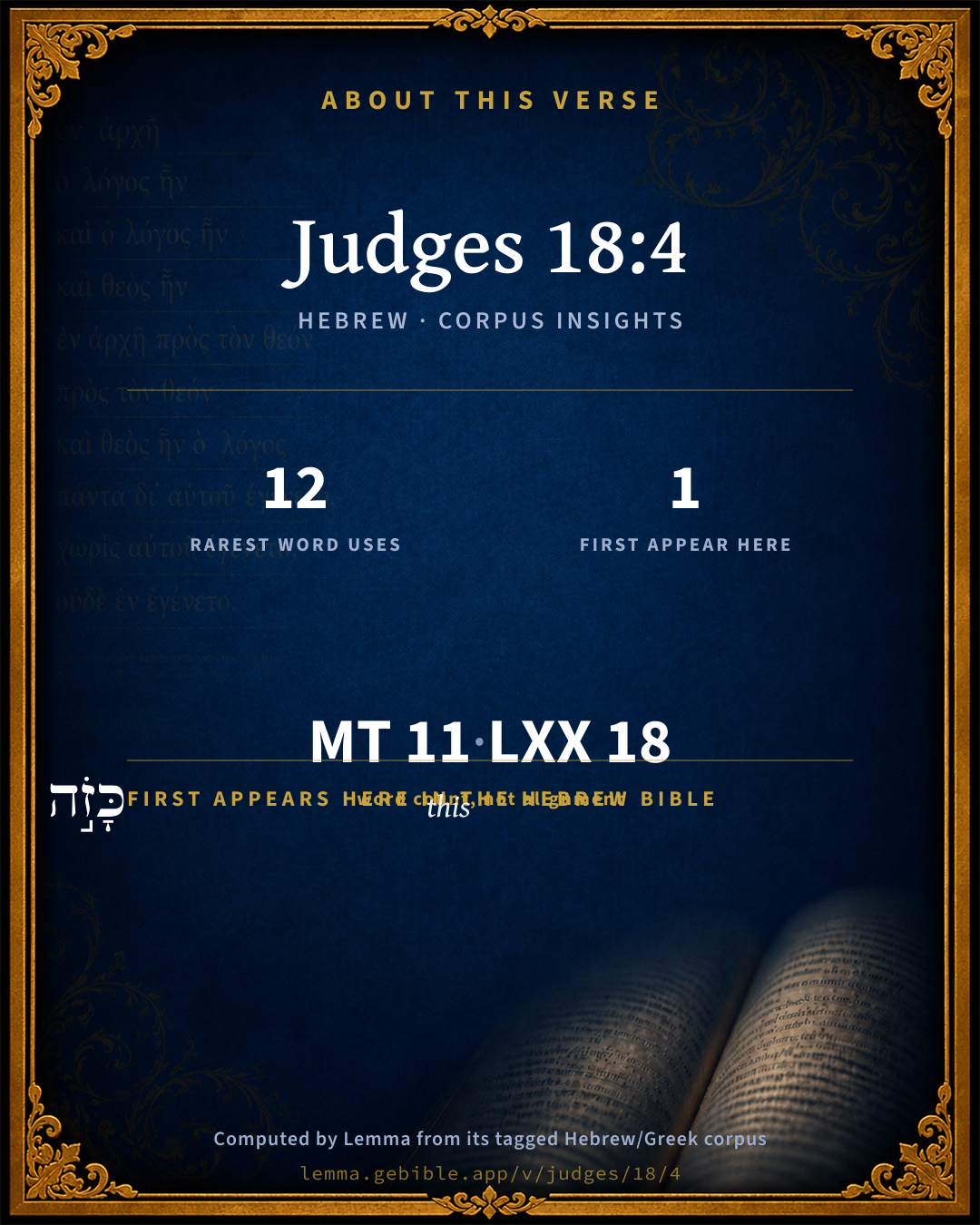
The rarest word here is כָּזֹ֣ה this H2090 — appearing just 12 times in the whole Hebrew Bible.

First appearance in Scripture

This word makes its first canonical appearance in the Hebrew Bible here:

  • כָּזֹ֣ה this H2090

Shared distinctive vocabulary

כָּזֹ֣ה this H2090 occurs in 12 verses of the Hebrew Bible. Also found in:

Grammatical profile

  • 4 verbs
  • 2 nouns
  • 2 pronouns
  • 3 prepositions

Verb forms

  • וַיֹּ֣אמֶר Qal · Sequential Imperfect
  • עָ֥שָׂה Qal · Perfect
  • וַיִּשְׂכְּרֵ֕נִי Qal · Sequential Imperfect
  • וָאֱהִי Qal · Sequential Imperfect

Hebrew & Septuagint length

In English translation the verse runs 23 words from the Hebrew and 21 from the Septuagint (LXX English) — closely comparable.

A rough comparison of the two English renderings, which tokenize alike — not a word-level alignment.

Word counts can differ between the Hebrew and the Greek without any difference in meaning — e.g. the Hebrew direct-object marker אֵת has no separate Greek word, and Greek often adds the article ὁ.

In the original languages it is 11 Hebrew tokens and 18 Greek tokens — but the two are counted differently (Hebrew bundles its prefixes and suffixes into one token; the Greek is in lemma form), so that isn’t a like-for-like length.

Cross-references

14

Topical passages linked to Judges 18:4 in the Treasury of Scripture Knowledge — connected by theme and wording, ordered by reader-vote popularity; previews shown in the World English Bible.

  • Judges 17:10 Micah said to him, Dwell with me, and be to me a father and a priest, and I will give you ten [pieces] of silver by the year, and a suit of clothing, and your food. So the Levite went in.
  • Judges 17:12 Micah consecrated the Levite, and the young man became his priest, and was in the house of Micah.
  • Ezekiel 13:19 You have profaned me among my people for handfuls of barley and for pieces of bread, to kill the souls who should not die, and to save the souls alive who should not live, by your lying to my people who listen to lies.
  • John 10:12–13 He who is a hired hand, and not a shepherd, who doesn't own the sheep, sees the wolf coming, leaves the sheep, and flees. The wolf snatches the sheep, and scatters them.
  • Proverbs 28:21 To show partiality is not good; Yet a man will do wrong for a piece of bread.
  • Isaiah 56:11 Yes, the dogs are greedy, they can never have enough; and these are shepherds who can't understand: they have all turned to their own way, each one to his gain, from every quarter.
  • Hosea 4:8–9 They feed on the sin of my people, And set their heart on their iniquity.
  • Malachi 1:10 "Oh that there were one among you who would shut the doors, that you might not kindle fire on my altar in vain! I have no pleasure in you," says Yahweh of hosts, "neither will I accept an offering at your hand.
  • Acts 8:18–21 Now when Simon saw that the Holy Spirit was given through the laying on of the apostles' hands, he offered them money,
  • Acts 20:33 I coveted no one's silver, or gold, or clothing.
  • 1 Timothy 3:3 not a drinker, not violent, not greedy for money, but gentle, not quarrelsome, not covetous;
  • Titus 1:11 whose mouths must be stopped; men who overthrow whole houses, teaching things which they ought not, for dishonest gain's sake.
  • 2 Peter 2:3 In covetousness they will exploit you with deceptive words: whose sentence now from of old doesn't linger, and their destruction will not slumber.
  • 2 Peter 2:14–15 having eyes full of adultery, and who can't cease from sin; enticing unsettled souls; having a heart trained in greed; children of cursing;

Cross-references courtesy of OpenBible.info (CC BY 4.0).

Hebrew and Greek witnesses Masoretic Hebrew ↔ Greek Septuagint

The same verse in the two great witnesses to the Old Testament, shown verse-for-verse.

These are two independent witnesses, not word-aligned to each other, and the Septuagint is shown in lemma (dictionary) form.

Hebrew Judges 18:4 Masoretic · Westminster Leningrad Codex

וַיֹּ֣אמֶר אֲלֵהֶ֔ם כָּזֹ֣ה וְכָזֶ֔ה עָ֥שָׂה לִ֖י מִיכָ֑ה וַיִּשְׂכְּרֵ֕נִי וָאֱהִי ל֖וֹ לְכֹהֵֽן

He said to them, Thus and thus has Micah dealt with me, and he has hired me, and I am become his priest.

World English Bible · Public Domain

Greek LXX Judges 18:4 Septuagint · lemma form

καί εἶπον πρός αὐτός οὕτως καί οὕτως ποιέω ἐγώ μιχαιας καί μισθόω ἐγώ καί γίγνομαι αὐτός εἰς ἱερεύς

And he said to them, Thus and thus did Michaias to me, and he hired me, and I became his priest.

LXX2012 (modern English Septuagint) · Public Domain

Hebrew: Westminster Leningrad Codex (CC BY 4.0). Greek: Septuagint (public domain); English from LXX2012 (modern English Septuagint) (Public Domain). How the Septuagint differs from the Hebrew →

Targum (Aramaic paraphrase)

1

The Targum is the ancient Jewish Aramaic paraphrase of the Hebrew Scriptures — an interpretive translation, not the Hebrew text itself. Onkelos (literal) and Pseudo-Jonathan (expansive) render the Torah, and Jonathan the Prophets. Coverage is partial: where no permissively-licensed English translation exists for a verse, only the Aramaic is shown. This is verse-level text, not a word-by-word alignment to the Hebrew.

  1. Targum Jonathan Prophets (Joshua–Malachi)
    וַאֲמַר לְהוֹן כְּדֵין וּכְדֵין עֲבַד לִי מִיכָה וְאַגִרַנִי וַהֲוֵית לֵיהּ לְכוּמְרָא:

    (no public-domain English translation for this verse)

    Targum Jonathan — Aramaic: “Mikraot Gedolot” (public domain). English: “Sefaria Community Translation” (CC0 1.0 (public-domain dedication)); “London "Chaldee Paraphrase," 1871” (public domain). Text via Sefaria.

Commentary

Notes on Judges 18:4 from classic Christian and Jewish commentators (each source and its license shown beneath its notes). The classic Christian expositions comment on the surrounding passage and are grouped to its opening verse, so a note may address several verses; the Jewish commentaries on the Tanakh (Rashi and others) are per-verse, so they appear only where the commentator wrote on this verse.

Lemma curates 59 commentaries, every one of them public domain or Creative Commons licensed, each selected and text-cleaned for this edition rather than reprinted as found. About our sources →

Trapp's Complete Commentary

John Trapp

Jdg 18:4 And he said unto them, Thus and thus dealeth Micah with me, and hath hired me, and I am his priest.

Ver. 4. And hath hired me, aud I am his priest.] He should have been ashamed to tell them thus, since it was directly against God’s word that he had done. But sin had added an impudency in his face, &c.

John Trapp, A Commentary or Exposition upon All the Books of the Old and New Testament (1647–1656) — public domain. Text from a community e-Sword module.

Ellicott's Commentary for English Readers

(4) Thus and thus.—Literally, according to this and according to that, as in 2Sa_11:25; 1Ki_14:5.

I am his priest.—See Jdg_17:13. Similarly in the dearth of genuine priests Jeroboam was forced to make even Levites out of the lowest of the people (1Ki_12:31).

A Bible Commentary for English Readers, edited by Charles John Ellicott (1878–1897) — public domain. Text from a community e-Sword module.

The Cambridge Bible for Schools and Colleges

gen. ed. J. J. S. Perowne

4. and he hath hired me] points to Jdg_17:10-11 a; so a continuation of that narrative.

The Cambridge Bible for Schools and Colleges (gen. ed. J. J. S. Perowne; Cambridge University Press, 1878–1918) — public domain. Text from a community e-Sword module.

John Gill's Exposition

And he said unto them, thus and thus dealeth Micah with me,.... Told them the whole story, how he came to the door of Micah's house, how he inquired of him who he was, and from whence he came, and whither he was going, and then invited him into his house to stay with him:

and hath hired me; by the year, for ten shekels of silver, a suit of clothes, and meat and drink, and by this means he got a livelihood, and was supported:

and I am his priest; and that was his business to offer sacrifice for his family, and to consult his oracle for him, and for whomsoever should apply.

John Gill's Exposition of the Whole Bible (1746–1763) — public domain (CC PDM 1.0). Text via the HelloAO Bible API.

Haydock's Catholic Bible Commentary

Voice. His pronunciation was different from that of the Ephraimites, chap. xii. 6.

George Leo Haydock (1774–1849), Haydock's Catholic Family Bible and Commentary, 1859 edition — public domain. Excludes Psalms (Douay-Rheims chapter numbering differs from Protestant) and Deuterocanonical books (Catholic canon only).

The Pulpit Commentary

And I am his priest, or, to be his priest.

The Pulpit Commentary (1880–1919), ed. H.D.M. Spence-Jones & Joseph S. Exell — public domain. Text from a community e-Sword module.

Lesson kit

Teaching starters — assembled from the data on this page, not authored interpretation. Every prompt links to the verse data it draws on. Edit before teaching.

Judges, in the Historical, opens this verse with 11 words (9 distinct Hebrew lemmas). Its most distinctive word is zôh (“this”). A historical commentator’s framing appears above. Read the whole chapter for the surrounding context.

Discussion questions

  1. The word zôh carries the sense “this.” How does it shape the verse?
  2. This is the first place “this” appears in Scripture (first appears here). What does its debut here establish?
  3. How does 2 Samuel 11:25, which shares the word «this», read alongside this verse?
  4. These translations render this verse differently. What is at stake in choosing one wording over another?
  5. «וַיֹּ֣אמֶר» is a Qal Sequential Imperfect verb. How does that grammatical form shape the action described?
  6. Compare how Trapp's Complete Commentary and Ellicott's Commentary for English Readers read this verse. Where do they agree or differ?

Things to notice

Reading settings

Reading text

Shown beneath each verse's original-language words.

Old Testament
Old Testament edition

Read the OT as the Masoretic Hebrew (MT) or the Greek Septuagint (LXX).

English shown for the Greek Septuagint (in the Hebrew ↔ Greek comparison).

Comparing translations? Open the Compare panel on any verse page to stack up to four side by side.