Numbers 32:7

Hebrew (Westminster Leningrad Codex) Numbers 32:7 appears in the Hebrew Old Testament. The text above is from the Westminster Leningrad Codex. Each word links to its Strong’s number, a concise gloss, and parsing drawn from the Open Scriptures Hebrew Bible morphology. Click any word for its full Brown-Driver-Briggs (BDB) entry.
Download image
Cite this verse

Numbers 32:7 (World English Bible). Public Domain. Lemma interlinear Bible study tool, https://lemma.gebible.app/v/numbers/32/7.

Show BibTeX & RIS
BibTeX
RIS
English Translation
Why discourage you the heart of the children of Israel from going over into the land which Yahweh has given them?
World English Bible · Public Domain
Download a study sheet

One document with this verse’s original text, its word-by-word gloss line, the meaning frame, cross-references with their text, attributed commentary, and full source and license credits — printable, and it pastes into notes with its structure intact.

This verse Autodidact and up

Study sheet (.html) Plain text (.txt)

A passage Seminary Student

Up to 50 verses in one chapter. A passage sheet keeps up to 6 commentary sources and 12 cross-references per verse, in the order this page ranks them, and says so on the sheet whenever that leaves anything out. Ask for a single verse and you get the Autodidact verse sheet above.

Everything on this page stays free to read, with no account — the sheet is a download of what is already on screen, not access to it.

Want to remove ads? Support Godless Engineer
Compare translations 3

The same verse in 3 English versions, stacked beneath the original-language interlinear above. Click any original word for its lexicon entry.

Each is an independent rendering of the whole verse — the interlinear is not word-aligned to these translations.

Highlighted words mark where these versions differ — a whole-verse word diff, not a word-by-word alignment.

  • World English Bible Public Domain
    Why discourage you the heart of the children of Israel from going over into the land which Yahweh has given them?
  • King James Version Public Domain
    And wherefore discourage ye the heart of the children of Israel from going over into the land which the LORD hath given them?
  • unfoldingWord Literal Text CC BY-SA 4.0
    And why do you discourage the heart of the sons of Israel from crossing over into the land that Yahweh has given to them?

unfoldingWord Literal Text — © unfoldingWord, licensed CC BY-SA 4.0. Word-aligned USFM3 via Door43 (git.door43.org/unfoldingWord/en_ult).

Versions to compare (up to 4)

3 of 4 selected

Show all 18 translations

Every available English version of this verse, each an independent rendering of the whole verse.

  • World English Bible Public Domain
    Why discourage you the heart of the children of Israel from going over into the land which Yahweh has given them?
  • Berean Standard Bible Public Domain
    Why are you discouraging the Israelites from crossing into the land that the LORD has given them?
  • Majority Standard Bible Public Domain
    Why are you discouraging the Israelites from crossing into the land that the LORD has given them?
  • King James Version Public Domain
    And wherefore discourage ye the heart of the children of Israel from going over into the land which the LORD hath given them?
  • American Standard Version (1901) Public Domain
    And wherefore discourage ye the heart of the children of Israel from going over into the land which Jehovah hath given them?
  • Revised Version (1885) Public Domain
    And wherefore discourage ye the heart of the children of Israel from going over into the land which the LORD hath given them?
  • Geneva Bible (1599) Public Domain
    Wherefore now discourage ye the heart of the children of Israel, to goe ouer into the lande, which the Lord hath giuen them?
  • Douay-Rheims (1899) Public Domain
    Why do ye overturn the minds of the children of Israel, that they may not dare to pass into the place which the Lord hath given them?
  • Young's Literal Translation Public Domain
    and why discourage ye the heart of the sons of Israel from passing over unto the land which Jehovah hath given to them?
  • Literal Standard Version CC BY-SA 4.0
    And why discourage the heart of the sons of Israel from passing over to the land which YHWH has given to them?
  • Unlocked Literal Bible CC BY-SA 4.0
    Why discourage the hearts of the people of Israel from going over into the land that Yahweh has given them?
  • unfoldingWord Literal Text CC BY-SA 4.0
    And why do you discourage the heart of the sons of Israel from crossing over into the land that Yahweh has given to them?
  • Darby Bible Public Domain
    And why do ye discourage the children of Israel from going over into the land that Jehovah has given them?
  • World Messianic Bible Public Domain
    Why do you discourage the heart of the children of Israel from going over into the land which the LORD has given them?
  • Webster's Bible Public Domain
    And why discourage ye the heart of the children of Israel from going over into the land which the LORD hath given them?
  • Free Bible Version CC BY-SA 4.0
    Why discourage the Israelites from crossing into the country that the Lord has given them?
  • Bible in Basic English Public Domain
    Why would you take from the children of Israel the desire to go over into the land which the Lord has given them?
  • JPS Tanakh (1917) Public Domain
    And wherefore will ye turn away the heart of the children of Israel from going over into the land which the LORD hath given them?

Literal Standard Version (2020), Covenant Press — licensed CC BY-SA 4.0. Text via the HelloAO Bible API (eBible.org). Unlocked Literal Bible (unfoldingWord) — licensed CC BY-SA 4.0. Text via the HelloAO Bible API (eBible.org). unfoldingWord Literal Text — © unfoldingWord, licensed CC BY-SA 4.0. Word-aligned USFM3 via Door43 (git.door43.org/unfoldingWord/en_ult). Free Bible Version, Dr. Jonathan Gallagher — licensed CC BY-SA 4.0. Text via the HelloAO Bible API (eBible.org).

Word by word

More ways to search: Search by grammar → Find every occurrence → Compare this word →

Practice this passage: Drill this verse → Learn its vocabulary →

תנואון
nûwʼ
H5106
“to hinder”
Verb, Qal, Imperfect, 2nd Person, Masculine, Plural + Suffix, n
Part of Speech
Verb
Stem
Qal
Form
Imperfect
Person
2nd Person
Gender
Masculine
Number
Plural
Full BDB Definition

Origin: a primitive root

TWOT: 1317

to hinder, hold back, forbid, disallow, restrain, frustrate - (Qal) to hinder, hold back - (Hiphil) - to restrain, forbid, frustrate - to restrain, make averse, discourage
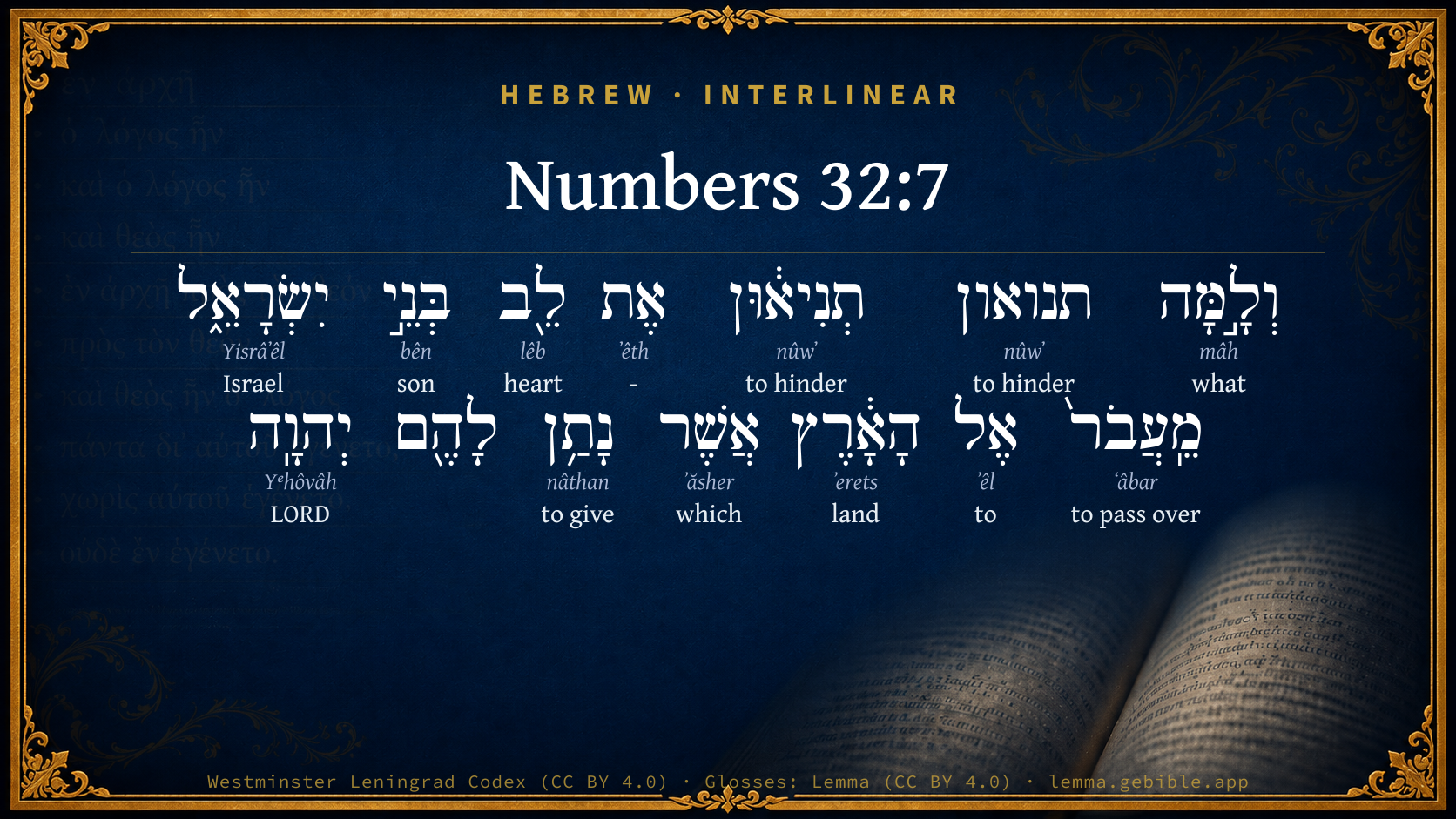
  1. וְלָ֣מָּה mâh H4100 “and · to/for · what” Conjunction + Preposition + Particle, Interrogative
  2. תְנִיא֔וּן nûwʼ H5106 “to hinder” Verb, Hiphil, Imperfect, 2nd Person, Masculine, Plural + Suffix, n
  3. אֶת ʼêth H853 “-” Particle, Direct Object
  4. לֵ֖ב lêb H3820 “heart of” Noun, Common, Masculine, Singular, Construct
  5. בְּנֵ֣י bên H1121 “sons of” Noun, Common, Masculine, Plural, Construct
  6. יִשְׂרָאֵ֑ל Yisrâʼêl H3478 “Israel” Noun, Proper
  7. מֵֽעֲבֹר֙ ʻâbar H5674 “from · to pass over” Preposition + Verb, Qal, Infinitive Construct
  8. אֶל ʼêl H413 “to” Preposition
  9. הָאָ֔רֶץ ʼerets H776 “the · land” Particle, Definite Article + Noun, Common, Both, Singular, Absolute
  10. אֲשֶׁר ʼăsher H834 “which” Particle, Relative
  11. נָתַ֥ן nâthan H5414 “to give” Verb, Qal, Perfect, 3rd Person, Masculine, Singular
  12. יְהוָֽה Yᵉhôvâh H3068 “LORD” Noun, Proper

About this verse

These counts appear in no published source. They are computed here, from the morphology-tagged text and Lemma’s own curated glosses. What Lemma adds →

14
words
12
distinct lemmas
Pentateuch
section

Notable vocabulary

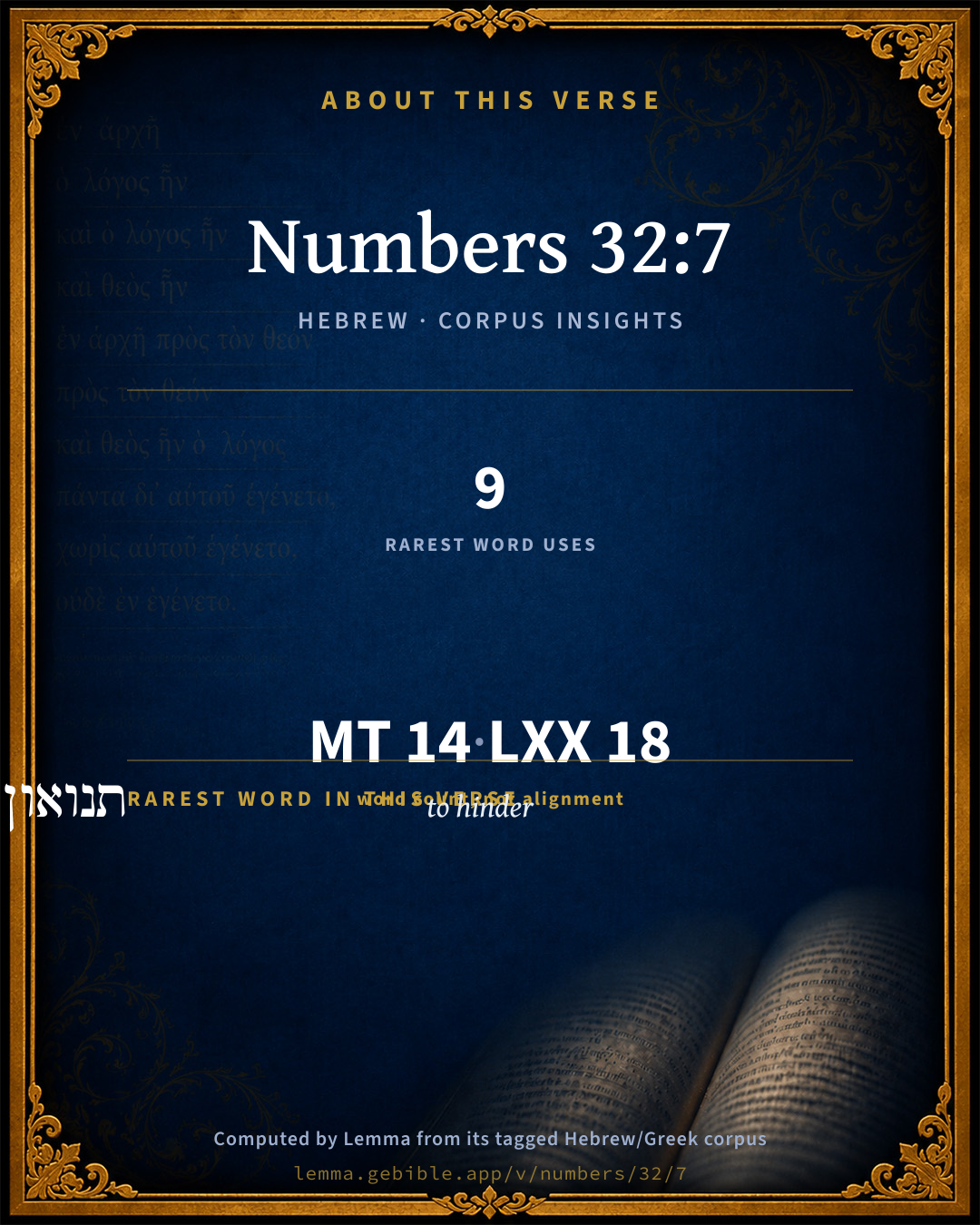
The rarest word here is תנואון to hinder H5106 — appearing just 9 times in the whole Hebrew Bible.

Shared distinctive vocabulary

תנואון to hinder H5106 occurs in 7 verses of the Hebrew Bible. Also found in:

Grammatical profile

  • 4 verbs
  • 5 nouns
  • 2 prepositions
  • 3 particles

Verb forms

  • תנואון Qal · Imperfect
  • תְנִיא֔וּן Hiphil · Imperfect
  • מֵֽעֲבֹר֙ Qal · Infinitive Construct
  • נָתַ֥ן Qal · Perfect

Repetition

A word recurs within this verse — often emphatic in Hebrew:

  • תנואון to hinder H5106 ×2

Hebrew & Septuagint length

In English translation the verse runs 21 words from the Hebrew and 26 from the Septuagint (LXX English) — closely comparable.

A rough comparison of the two English renderings, which tokenize alike — not a word-level alignment.

Word counts can differ between the Hebrew and the Greek without any difference in meaning — e.g. the Hebrew direct-object marker אֵת has no separate Greek word, and Greek often adds the article ὁ.

In the original languages it is 14 Hebrew tokens and 18 Greek tokens — but the two are counted differently (Hebrew bundles its prefixes and suffixes into one token; the Greek is in lemma form), so that isn’t a like-for-like length.

Cross-references

5

Topical passages linked to Numbers 32:7 in the Treasury of Scripture Knowledge — connected by theme and wording, ordered by reader-vote popularity; previews shown in the World English Bible.

  • Numbers 13:27–14:4 They told him, and said, We came to the land where you sent us; and surely it flows with milk and honey; and this is the fruit of it.
  • Numbers 21:4 They traveled from Mount Hor by the way to the Red Sea, to compass the land of Edom: and the soul of the people was much discouraged because of the way.
  • Numbers 32:9 For when they went up to the valley of Eshcol, and saw the land, they discouraged the heart of the children of Israel, that they should not go into the land which Yahweh had given them.
  • Deuteronomy 1:28 Where are we going up? our brothers have made our heart to melt, saying, The people are greater and taller than we; the cities are great and fortified up to the sky; and moreover we have seen the sons of the Anakim there.
  • Acts 21:13 Then Paul answered, "What are you doing, weeping and breaking my heart? For I am ready not only to be bound, but also to die at Jerusalem for the name of the Lord Jesus."

Cross-references courtesy of OpenBible.info (CC BY 4.0).

Hebrew and Greek witnesses Masoretic Hebrew ↔ Greek Septuagint

The same verse in the two great witnesses to the Old Testament, shown verse-for-verse.

These are two independent witnesses, not word-aligned to each other, and the Septuagint is shown in lemma (dictionary) form.

Hebrew Numbers 32:7 Masoretic · Westminster Leningrad Codex

וְלָ֣מָּה תנואון תְנִיא֔וּן אֶת לֵ֖ב בְּנֵ֣י יִשְׂרָאֵ֑ל מֵֽעֲבֹר֙ אֶל הָאָ֔רֶץ אֲשֶׁר נָתַ֥ן לָהֶ֖ם יְהוָֽה

Why discourage you the heart of the children of Israel from going over into the land which Yahweh has given them?

World English Bible · Public Domain

Greek LXX Numbers 32:7 Septuagint · lemma form

καί ἵνα τίς διαστρέφω ὁ διάνοια ὁ υἱός ἰσραήλ μή διαβαίνω εἰς ὁ γῆ ὅς κύριος δίδωμι αὐτός

And why do you⌃ pervert the minds of the children of Israel, that they should not cross over into the land, which the Lord gives them?

LXX2012 (modern English Septuagint) · Public Domain

On this verse, The Pulpit Commentary discusses the Septuagint’s reading. Read the note in Commentary ↓

Hebrew: Westminster Leningrad Codex (CC BY 4.0). Greek: Septuagint (public domain); English from LXX2012 (modern English Septuagint) (Public Domain). How the Septuagint differs from the Hebrew →

Targum (Aramaic paraphrase)

2

The Targum is the ancient Jewish Aramaic paraphrase of the Hebrew Scriptures — an interpretive translation, not the Hebrew text itself. Onkelos (literal) and Pseudo-Jonathan (expansive) render the Torah, and Jonathan the Prophets. Coverage is partial: where no permissively-licensed English translation exists for a verse, only the Aramaic is shown. This is verse-level text, not a word-by-word alignment to the Hebrew.

  1. Targum Onkelos Torah (Genesis–Deuteronomy)
    וּלְמָא תוֹנוּן יָת לִבָּא דִבְנֵי יִשְׂרָאֵל מִלְמֶעֱבַר לְאַרְעָא דִיהַב לְהוֹן יְיָ

    (no public-domain English translation for this verse)

    Targum Onkelos — Aramaic: “Onkelos Genesis” (public domain); “Onkelos Exodus” (public domain); “Onkelos Leviticus” (public domain); “Onkelos Numbers” (public domain); “Onkelos Deuteronomy” (public domain). English: “Sefaria Community Translation” (CC0 1.0 (public-domain dedication)); “J.W. Etheridge. The Targums of Onkelos and Jonathan Ben Uzziel on the Pentateuch. London: Longmans, Green, 1862” (public domain). Text via Sefaria.

  2. Targum Pseudo-Jonathan Torah (Genesis–Deuteronomy)
    וּלְמָא תְבַטְלוּן רַעֲוַת בְּנֵי יִשְרָאֵל מִלְמֵעִיבַּר לְאַרְעָא דִיהַב לְהוֹן יְיָ

    And why should you enfeeble the will of the sons of Israel from going over to the land which the Lord hath given to them?

    Targum Pseudo-Jonathan — Aramaic: “Targum Jonathan on Genesis” (public domain); “Targum Jonathan on Exodus” (public domain); “Targum Jonathan on Leviticus” (public domain); “Targum Jonathan on Numbers” (public domain); “Targum Jonathan on Deuteronomy” (public domain). English: “The Targum of Jonathan ben Uzziel, trans. J. W. Etheridge, London, 1862” (public domain). Text via Sefaria.

Commentary

Notes on Numbers 32:7 from classic Christian and Jewish commentators (each source and its license shown beneath its notes). The classic Christian expositions comment on the surrounding passage and are grouped to its opening verse, so a note may address several verses; the Jewish commentaries on the Tanakh (Rashi and others) are per-verse, so they appear only where the commentator wrote on this verse.

Lemma curates 59 commentaries, every one of them public domain or Creative Commons licensed, each selected and text-cleaned for this edition rather than reprinted as found. About our sources →

Geneva Bible (1599)

Geneva Bible translators

Hebrew, break.

Geneva Bible (1599) marginal notes — public domain. Text via Bolls.life.

Ellicott's Commentary for English Readers

(7) And wherefore discourage ye the heart . . . —The verb which is rendered discourage, and which occurs again in Num_32:9, means rather to “alienate,” or “avert.” The cognate noun occurs in Num. adv. 34, in the same connection in which it is used in Num_32:9. (See Note in loc.)

A Bible Commentary for English Readers, edited by Charles John Ellicott (1878–1897) — public domain. Text from a community e-Sword module.

The Cambridge Bible for Schools and Colleges

gen. ed. J. J. S. Perowne

7. discourage] lit. ‘oppose.’ The word is the same as in Num_30:5 [Hebrews 6].

The Cambridge Bible for Schools and Colleges (gen. ed. J. J. S. Perowne; Cambridge University Press, 1878–1918) — public domain. Text from a community e-Sword module.

John Gill's Exposition

Thus did your fathers,.... Meaning not particularly and only the fathers of these two tribes he was speaking to, but of them and the other tribes also, who acted much such a part; did not choose to go into the good land to possess it, when they were bid to do it, but were for sending spies first, which brought an ill report of it, and discouraged the people from going into it; the history of which Moses here gives:

when I sent them from Kadeshbarnea to see the land; called only Kadesh, Num 13:26 the reason of the name See Gill on Num 32:13.

John Gill's Exposition of the Whole Bible (1746–1763) — public domain (CC PDM 1.0). Text via the HelloAO Bible API.

Haydock's Catholic Bible Commentary

Overturn. Hebrew nua, "to discourage," (Haydock) break, dissolve, &c., ver. 9. (Menochius) --- The same history is mentioned, (Deuteronomy iii. 12, 18,) but without these reproaches. (Calmet)

George Leo Haydock (1774–1849), Haydock's Catholic Family Bible and Commentary, 1859 edition — public domain. Excludes Psalms (Douay-Rheims chapter numbering differs from Protestant) and Deuterocanonical books (Catholic canon only).

Whedon's Commentary on the Bible

Daniel D. Whedon

THE REMONSTRANCE OF MOSES, Num_32:6-15.

7. Discourage… the heart… of Israel — Jehovah had promised Canaan to courageous and confiding Israel. He had declared that he would drive out their enemies, if they would trust in him. But faith in Jehovah has its human conditions. Israel must stand as a unit and present an unbroken front to the foe.

Daniel D. Whedon (gen. ed.), Commentary on the Old and New Testaments (1874–1909) — public domain. Text from a community e-Sword module.

The Pulpit Commentary

Discourage. The verb awOn, translated "discourage" here and in verse 9, is of somewhat doubtful meaning. The Septuagint renders it by diastrefw , and perhaps the sense is, "Why do ye draw away the heart?" i.e., render it averse from going over.

The Pulpit Commentary (1880–1919), ed. H.D.M. Spence-Jones & Joseph S. Exell — public domain. Text from a community e-Sword module.

Rashi

Rabbi Shlomo Yitzchaki (Rashi)

ולמה תניאון means AND WHY WILL YE TURN ASIDE AND WITHHOLD their heart from passing over? — because they will think that you are afraid to pass over on account of the prospect of war and the strength of the cities and the peoples.

Rashi on the Tanakh — English translations: “The Judaica Press complete Tanach with Rashi, translated by A. J. Rosenberg” (CC BY 4.0); “Pentateuch with Rashi's commentary by M. Rosenbaum and A.M. Silbermann, 1929-1934” (public domain); “The Metsudah Tanach series, Lakewood, N.J” (CC BY 4.0); and “The Book of Joshua, Metsudah Publications, 1997” (CC BY 4.0). Text via Sefaria.

Sforno

Rabbi Ovadia Sforno

Why do you dishearten. You know how those who disheartened in the previous generation were severely struck.

Sforno on the Tanakh — English translation: “Yalkut, Sifsei Chachomim Chumash, Metsudah Publications, 2009” (CC BY 4.0). Text via Sefaria.

Lesson kit

Teaching starters — assembled from the data on this page, not authored interpretation. Every prompt links to the verse data it draws on. Edit before teaching.

Numbers, in the Pentateuch, opens this verse with 14 words (12 distinct Hebrew lemmas). Its most distinctive word is nûwʼ (“to hinder”). A historical commentator’s framing appears above. Read the whole chapter for the surrounding context.

Discussion questions

  1. How does “to hinder” (nûwʼ) shape what this verse is saying?
  2. Numbers 30:5 shares the word «to hinder» with this verse. How do the two illuminate each other?
  3. “to hinder” occurs 2× in this one verse. What is the effect of the repetition?
  4. These translations render this verse differently; the difference is in the English rendering, not the original. What questions does that raise?
  5. The verb «תנואון» is Qal Imperfect. How does its form color the action?
  6. Reading how Geneva Bible (1599) and Ellicott's Commentary for English Readers read this verse, where do the two commentators agree and where do they part?

Things to notice

Reading settings

Reading text

Shown beneath each verse's original-language words.

Old Testament
Old Testament edition

Read the OT as the Masoretic Hebrew (MT) or the Greek Septuagint (LXX).

English shown for the Greek Septuagint (in the Hebrew ↔ Greek comparison).

Comparing translations? Open the Compare panel on any verse page to stack up to four side by side.