
Psalms 124:6

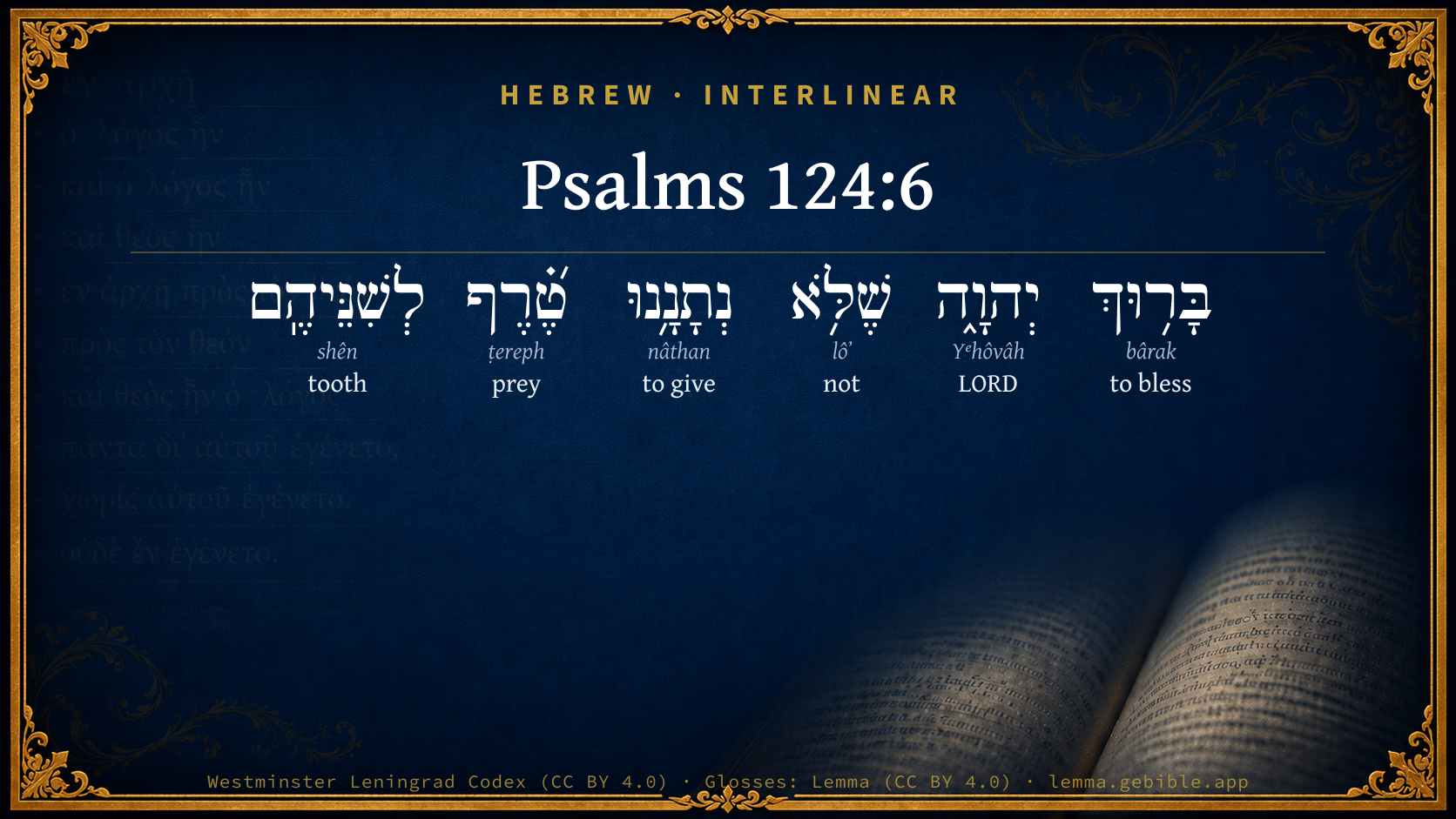
Hebrew (Westminster Leningrad Codex) Psalms 124:6 appears in the Hebrew Old Testament. The text above is from the Westminster Leningrad Codex. Each word links to its Strong’s number, a concise gloss, and parsing drawn from the Open Scriptures Hebrew Bible morphology. Click any word for its full Brown-Driver-Briggs (BDB) entry.
Download image
Cite this verse

Psalms 124:6 (World English Bible). Public Domain. Lemma interlinear Bible study tool, https://lemma.gebible.app/v/psalms/124/6.

Show BibTeX & RIS
BibTeX
RIS
English Translation
Blessed be Yahweh, Who has not given us as a prey to their teeth.
World English Bible · Public Domain
Download a study sheet

One document with this verse’s original text, its word-by-word gloss line, the meaning frame, cross-references with their text, attributed commentary, and full source and license credits — printable, and it pastes into notes with its structure intact.

This verse Autodidact and up

Study sheet (.html) Plain text (.txt)

A passage Seminary Student

Up to 50 verses in one chapter. A passage sheet keeps up to 6 commentary sources and 12 cross-references per verse, in the order this page ranks them, and says so on the sheet whenever that leaves anything out. Ask for a single verse and you get the Autodidact verse sheet above.

Everything on this page stays free to read, with no account — the sheet is a download of what is already on screen, not access to it.

Want to remove ads? Support Godless Engineer
Compare translations 3

The same verse in 3 English versions, stacked beneath the original-language interlinear above. Click any original word for its lexicon entry.

Each is an independent rendering of the whole verse — the interlinear is not word-aligned to these translations.

Highlighted words mark where these versions differ — a whole-verse word diff, not a word-by-word alignment.

  • World English Bible Public Domain
    Blessed be Yahweh, Who has not given us as a prey to their teeth.
  • King James Version Public Domain
    Blessed be the LORD, who hath not given us as a prey to their teeth.
  • unfoldingWord Literal Text CC BY-SA 4.0
    Blessed Yahweh, who did not make us prey for their teeth.

unfoldingWord Literal Text — © unfoldingWord, licensed CC BY-SA 4.0. Word-aligned USFM3 via Door43 (git.door43.org/unfoldingWord/en_ult).

Versions to compare (up to 4)

3 of 4 selected

Show all 17 translations

Every available English version of this verse, each an independent rendering of the whole verse.

  • World English Bible Public Domain
    Blessed be Yahweh, Who has not given us as a prey to their teeth.
  • Berean Standard Bible Public Domain
    Blessed be the LORD, who has not given us as prey to their teeth.
  • Majority Standard Bible Public Domain
    Blessed be the LORD, who has not given us as prey to their teeth.
  • King James Version Public Domain
    Blessed be the LORD, who hath not given us as a prey to their teeth.
  • American Standard Version (1901) Public Domain
    Blessed be Jehovah, Who hath not given us as a prey to their teeth.
  • Revised Version (1885) Public Domain
    Blessed be the LORD, who hath not given us as a prey to their teeth.
  • Geneva Bible (1599) Public Domain
    Praysed be the Lord, which hath not giuen vs as a praye vnto their teeth.
  • Young's Literal Translation Public Domain
    Blessed `is' Jehovah who hath not given us, A prey to their teeth.
  • Literal Standard Version CC BY-SA 4.0
    Blessed [is] YHWH who has not given us, || [As] prey to their teeth.
  • Unlocked Literal Bible CC BY-SA 4.0
    Blessed be Yahweh, who has not allowed us to be torn by their teeth.
  • unfoldingWord Literal Text CC BY-SA 4.0
    Blessed Yahweh, who did not make us prey for their teeth.
  • Darby Bible Public Domain
    Blessed be Jehovah, who gave us not up a prey to their teeth!
  • World Messianic Bible Public Domain
    Blessed be the LORD, who has not given us as a prey to their teeth.
  • Webster's Bible Public Domain
    Blessed be the LORD, who hath not given us as a prey to their teeth.
  • Free Bible Version CC BY-SA 4.0
    Praise the Lord, who didn't hand us over to them as prey to be ripped apart by their teeth.
  • Bible in Basic English Public Domain
    Praise be to the Lord, who has not let us be wounded by their teeth.
  • JPS Tanakh (1917) Public Domain
    Blessed be the LORD, who hath not given us as a prey to their teeth.

Literal Standard Version (2020), Covenant Press — licensed CC BY-SA 4.0. Text via the HelloAO Bible API (eBible.org). Unlocked Literal Bible (unfoldingWord) — licensed CC BY-SA 4.0. Text via the HelloAO Bible API (eBible.org). unfoldingWord Literal Text — © unfoldingWord, licensed CC BY-SA 4.0. Word-aligned USFM3 via Door43 (git.door43.org/unfoldingWord/en_ult). Free Bible Version, Dr. Jonathan Gallagher — licensed CC BY-SA 4.0. Text via the HelloAO Bible API (eBible.org).

Word by word

More ways to search: Search by grammar → Find every occurrence → Compare this word →

Practice this passage: Drill this verse → Learn its vocabulary →

About this verse

These counts appear in no published source. They are computed here, from the morphology-tagged text and Lemma’s own curated glosses. What Lemma adds →

6
words
6
distinct lemmas
Wisdom
section

Notable vocabulary

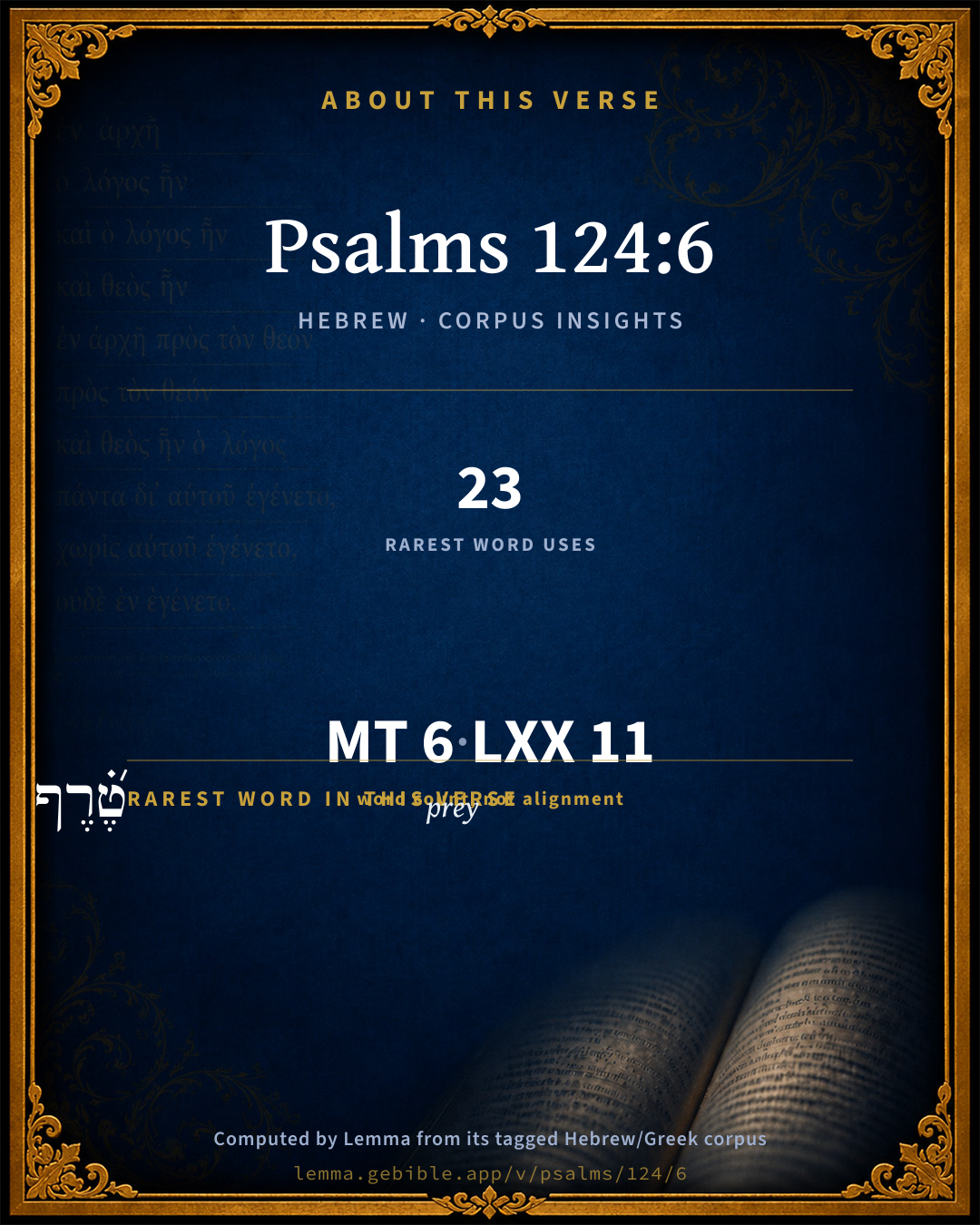
The rarest word here is טֶ֝֗רֶף prey H2964 — appearing just 23 times in the whole Hebrew Bible.

Shared distinctive vocabulary

טֶ֝֗רֶף prey H2964 occurs in 23 verses of the Hebrew Bible. Also found in:

Grammatical profile

  • 2 verbs
  • 3 nouns
  • 1 particle

Verb forms

  • בָּר֥וּךְ Qal · Participle Passive
  • נְתָנָ֥נוּ Qal · Perfect

Hebrew & Septuagint length

In English translation the verse runs 14 words from the Hebrew and 15 from the Septuagint (LXX English) — closely comparable.

A rough comparison of the two English renderings, which tokenize alike — not a word-level alignment.

Word counts can differ between the Hebrew and the Greek without any difference in meaning — e.g. the Hebrew direct-object marker אֵת has no separate Greek word, and Greek often adds the article ὁ.

In the original languages it is 6 Hebrew tokens and 11 Greek tokens — but the two are counted differently (Hebrew bundles its prefixes and suffixes into one token; the Greek is in lemma form), so that isn’t a like-for-like length.

Cross-references

7

Topical passages linked to Psalms 124:6 in the Treasury of Scripture Knowledge — connected by theme and wording, ordered by reader-vote popularity; previews shown in the World English Bible.

  • Psalms 118:13 You pushed me back hard, to make me fall, But Yahweh helped me.
  • Exodus 15:9–10 The enemy said, 'I will pursue, I will overtake, I will divide the spoil. My desire shall be satisfied on them. I will draw my sword, my hand shall destroy them.'
  • Psalms 145:5–6 Of the glorious majesty of your honor, Of your wondrous works, I will meditate.
  • Isaiah 10:14–19 and my hand has found as a nest the riches of the peoples; and as one gathers eggs that are forsaken, have I gathered all the earth: and there was none that moved the wing, or that opened the mouth, or chirped.
  • Psalms 17:9 From the wicked who oppress me, My deadly enemies, who surround me.
  • 1 Samuel 26:20 Now therefore, don't let my blood fall to the earth away from the presence of Yahweh: for the king of Israel is come out to seek a flea, as when one does hunt a partridge in the mountains.
  • Judges 5:30–31 Have they not found, have they not divided the spoil? A lady, two ladies to every man; To Sisera a spoil of dyed garments, A spoil of dyed garments embroidered, Of dyed garments embroidered on both sides, on the necks of the spoil?

Cross-references courtesy of OpenBible.info (CC BY 4.0).

Hebrew and Greek witnesses Masoretic Hebrew ↔ Greek Septuagint

The same verse in the two great witnesses to the Old Testament, shown verse-for-verse.

You’re reading Greek Psalm 123 (Hebrew Psalm 124). The Septuagint counts the superscription, so verse numbers can differ from the Hebrew — chapter-level alignment, not verse-by-verse. Numbering follows Rahlfs.

These are two independent witnesses, not word-aligned to each other, and the Septuagint is shown in lemma (dictionary) form.

Hebrew Psalms 124:6 Masoretic · Westminster Leningrad Codex

בָּר֥וּךְ יְהוָ֑ה שֶׁלֹּ֥א נְתָנָ֥נוּ טֶ֝֗רֶף לְשִׁנֵּיהֶֽם

Blessed be Yahweh, Who has not given us as a prey to their teeth.

World English Bible · Public Domain

Greek LXX Greek Psalm 123:6 Septuagint · lemma form

εὐλογητός κύριος ὅς οὐ δίδωμι ἐγώ εἰς θήρα ὁ ὀδούς αὐτός

Blessed be the Lord, who has not given us for a prey to their teeth.

LXX2012 (modern English Septuagint) · Public Domain

Hebrew: Westminster Leningrad Codex (CC BY 4.0). Greek: Septuagint (public domain); English from LXX2012 (modern English Septuagint) (Public Domain). How the Septuagint differs from the Hebrew →

Commentary

Notes on Psalms 124:6 from classic Christian and Jewish commentators (each source and its license shown beneath its notes). The classic Christian expositions comment on the surrounding passage and are grouped to its opening verse, so a note may address several verses; the Jewish commentaries on the Tanakh (Rashi and others) are per-verse, so they appear only where the commentator wrote on this verse.

Lemma curates 59 commentaries, every one of them public domain or Creative Commons licensed, each selected and text-cleaned for this edition rather than reprinted as found. About our sources →

Matthew Henry's Commentary

Here the psalmist further magnifies the great deliverance God had lately wrought for them.

I. That their hearts might be the more enlarged in thankfulness to him (Psa 124:6): Blessed be the Lord. God is the author of all our deliverances, and therefore he must have the glory of them. We rob him of his due if we do not return thanks to him. And we are the more obliged to praise him because we had such a narrow escape. We were delivered, 1. Like a lamb out of the very jaws of a beast of prey: God has not given us as a prey to their teeth, intimating that they had no power over God's people but what was given them from above. They could not be a prey to their teeth unless God gave them up, and therefore they were rescued, because God would not suffer them to be ruined. 2. Like a bird, a little bird (the word signifies a sparrow), out of the snare of the fowler. The enemies are very subtle and spiteful; they lay snares for God's people, to bring them into sin and trouble, and to hold them there. Sometimes they seem to have prevailed so far as to gain their point. God's people are taken in the snare, and are as unable to help themselves out as any weak and silly bird is; and then is God's time to appear for their relief, when all other friends fail; then God breaks the snare, and turns the counsel of the enemies into foolishness: The snare is broken and so we are delivered. Isaac was saved when he lay ready to be sacrificed. Jehovah-jireh - in the mount of the Lord it shall be seen.

II. That their hearts, and the hearts of others, might be the more encouraged to trust in God in the like dangers (Psa 124:8): Our help is in the name of the Lord. David had directed us (Psa 121:2) to depend upon God for help as to our personal concerns - My help is in the name of the Lord; here as to the concerns of the public - Our help is so. It is a comfort to all that lay the interests of God's Israel near their hearts that Israel's God is the same that made the world, and therefore will have a church in the world, and can secure that church in times of the greatest danger and distress. In him therefore let the church's friends put their confidence, and they shall not be put to confusion.

Matthew Henry's Commentary on the Whole Bible (1708–1710) — public domain (CC PDM 1.0). Text via the HelloAO Bible API.

Trapp's Complete Commentary

John Trapp

Psa 124:6 Blessed [be] the LORD, who hath not given us [as] a prey to their teeth.

Ver. 6. Blessed be the Lord, &c.] Deo gratias, thanks be to God was much in Austin’s mouth, and should be so in ours, but especially upon some signal deliverance. How was God blessed at Berachah? 2Ch 20:26

As a prey to their teeth] Who meant to have made but a breakfast of us, and had already devoured us in their hopes, but God defeated them.

John Trapp, A Commentary or Exposition upon All the Books of the Old and New Testament (1647–1656) — public domain. Text from a community e-Sword module.

The Biblical Illustrator

Joseph S. Exell

Psa_124:6-8

Blessed be the Lord, who hath not given us as a prey to their teeth.

Thanksgiving for deliverance

1. It is our duty after delivery from dangers to acknowledge not only Gods power for us, but His goodness also towards us, and to acknowledge Him the fountain of all blessedness upon that occasion (verse 6).

2. As the Churchs enemies are superior to her in worldly strength, so also in policy, craftiness, and worldly wit, as the fowler is craftier than the bird.

3. According as the danger is fearful, so is the delivery sweet and joyful (verse 7).

4. It is as easy for God to deliver His people out of their enemies hands, even when they have the godly in their power, as to break a net made of thread or yarn, wherewith birds are taken.

5. The fairest fruits of our by-past experience is to glorify God by confidence in Him for time to come.

6. Then is our confidence in God to be delivered from evil well bottomed, when we consider the Lords omnipotency manifested in the creation of the world, and held out by His Word unto us: for so much doth the psalmist teach, when he maketh mention of the name of the Lord, and the work of the Lord, in professing of his confidence. (D. Dickson.)

The Biblical Illustrator, edited by Joseph S. Exell (c. 1880s–1900s) — public domain. Text from a community e-Sword module.

Keil & Delitzsch

C. F. Keil & F. Delitzsch

After the fact of the divine succour has been expressed, in Psa 124:6 follows the thanksgiving for it, and in Psa 124:7 the joyful shout of the rescued one. In Psa 124:6 the enemies are conceived of as beasts of prey on account of their bloodthirstiness, just as the worldly empires are in the Book of Daniel; in Psa 124:7 as "fowlers" on account of their cunning. According to the punctuation it is not to be rendered: Our soul is like a bird that is escaped, in which case it would have been accented בפשׁנו כצפור, but: our soul (subject with Rebia magnum) is as a bird (כּצפור as in Hos 11:11; Pro 23:32; Job 14:2, instead of the syntactically more usual כּצּפור) escaped out of the snare of him who lays snares (יוקשׁ, elsewhere יקושׁ, יקוּשׁ, a fowler, Psa 91:3). נשׁבר (with ā beside Rebia) is 3rd praet.: the snare was burst, and we - we became free. In Psa 124:8 (cf. Psa 121:2; Psa 134:3) the universal, and here pertinent thought, viz., the help of Israel is in the name of Jahve, the Creator of the world, i.e., in Him who is manifest as such and is continually verifying Himself, forms the epiphonematic close. Whether the power of the world seeks to make the church of Jahve like to itself or to annihilate it, it is not a disavowal of its God, but a faithful confession, stedfast even to death, that leads to its deliverance.

Keil & Delitzsch — Biblical Commentary on the Old Testament (1861–1891) — public domain (CC PDM 1.0). Text via the HelloAO Bible API. (Old Testament only.)

J. A. Alexander on Psalms

Joseph Addison Alexander

6. (Psa 124:6) Blessed (be) Jehovah, who did not give us (as) prey to their teeth. By one of those rhetorical transitions which are constantly occurring in the figurative diction of the psalms, the enemies and dangers, which had just been represented as an overwhelming flood or torrent, are suddenly transformed into devouring beasts. See above, on Psa 3:7; Psa 58:6. With the benediction or doxology, blessed (be) Jehovah, compare Psa 28:6; Psa 31:21.

Joseph Addison Alexander, The Psalms Translated and Explained (1850) — public domain. Text from a community e-Sword module.

Tyndale Open Study Notes

Tyndale Open Resources

124:6-8 The enemies of God’s people, like lions or bears who tear their prey with their teeth (see 57:4; Prov 28:15), had their mouths shut by the Lord (Dan 6:22).

Tyndale Open Study Notes — © Tyndale Open Resources, licensed CC BY-SA 4.0. Text via the HelloAO Bible API.

John Calvin's Commentaries

6. Blessed be Jehovah! The Psalmist now exhorts the godly to a grateful acknowledgment of the divine goodness, and as it were puts words into their mouth. Here also he shows by another similitude, that it would have been all over with them had not God succoured them; affirming that they were delivered not otherwise than if some one had plucked the prey from the teeth of a wild and cruel beast. Of the same import is the third similitude, That they were on all sides entrapped and entangled in the snares of their enemies, even as little birds caught in the net he stretched under the hand of the fowler; and that when they were delivered, it was just as if one should set at liberty birds which had been taken. The amount is, that the people of God, feeble, without counsel, and destitute of aid, had not only to deal with blood-thirsty and furious beasts, but were also ensnared by bird-nets and stratagems, so that being greatly inferior to their enemies as well in policy as in open force, they were besieged by many deaths. From this it may be easily gathered that they were miraculously preserved.

John Calvin's Commentaries (1540-1563) — public domain. Text from the Calvin Translation Society English edition (1840s-50s) via the Christian Classics Ethereal Library (ccel.org). Calvin's coverage is partial (roughly two-thirds of the Bible); uncommented books and verses are honest gaps, never fabricated. The 19th-century editor's footnotes and remarks are omitted so the notes are faithfully Calvin's own voice.

The Cambridge Bible for Schools and Colleges

gen. ed. J. J. S. Perowne

6. a prey to their teeth] For the figure cp. Psa_7:2.

6–8. Thanksgiving and confidence for the future.

The Cambridge Bible for Schools and Colleges (gen. ed. J. J. S. Perowne; Cambridge University Press, 1878–1918) — public domain. Text from a community e-Sword module.

John Gill's Exposition

Our soul is escaped as a bird out of the snare of the fowlers,.... The people of God are like little birds, being harmless and innocent, singing forth the praises of God for his goodness to them; as also because weak and unable to resist their foes; and worthless in themselves, like sparrows, as the word (i) here used signifies; and are fearful and timorous, and flee at the least apprehension of danger, Psa 102:7. Satan, and wicked men under his influence, are like fowlers who lay snares for them, to draw them into sin, into immorality and error, in order to bring them to ruin and destruction; hence we read of the snare of the devil and of wicked men, Ti1 3:7, Ti2 2:26; and who form plans and lay schemes to oppress and destroy them; but through the wisdom given them to discern these devices and stratagems, and through the power of divine grace, accompanying them, they escape what was intended for their hurt, and particularly in the following manner:

the snare is broken, and we are escaped; measures concerted by wicked men are broken, their schemes are confounded, their devices are disappointed, so that they cannot perform their enterprise; and by this means the saints escape the evils designed against them, the afflictions of the world, and the temptations of Satan.

(i) , Sept. "sicut passer", V. L.

John Gill's Exposition of the Whole Bible (1746–1763) — public domain (CC PDM 1.0). Text via the HelloAO Bible API.

Albert Barnes' Notes on the Bible

Blessed be the Lord - The Lord be praised; or, We have reason to praise the Lord because we have been delivered from these calamities.

Who hath not given us as a prey to their teeth - The figure is here changed, though the same idea is retained. The imago is now that of destruction by wild beasts - a form of destruction not less fearful than that which comes from overflowing waters. Such changes of imagery constantly occur in the Book of Psalms, and in impassioned poetry everywhere. The mind is full of a subject; numerous illustrations occur in the rapidity of thought; and the mind seizes upon one and then upon another as best suited to express the emotions of the soul. The next verse furnishes another instance of this sudden transition.

Albert Barnes' Notes on the Bible (1834–1885) — public domain. Text from a community e-Sword/MySword module.

Matthew Poole's English Annotations

A metaphor from wild beasts, which tear and devour their prey with their teeth.

Matthew Poole's English Annotations on the Holy Bible (1683–1685) — public domain. Text from a community e-Sword/MySword module.

The Treasury of David

Charles H. Spurgeon

Ver. 6. Blessed be the Lord, who hath not given us as a prey to their teeth. Leaving the metaphor of a boiling flood, he compares the adversaries of Israel to wild beasts who desired to make the godly their prey. Their teeth are prepared to tear, and they regard the godly as their victims. The Lord is heartily praised for not permitting his servants to be devoured when they were between the jaws of the raging ones. It implies that none can harm us till the Lord permits: we cannot be their prey unless the Lord gives us up to them, and that our loving Lord will never do. Hitherto he has refused permission to any foe to destroy us, blessed be his name. The more imminent the danger the more eminent the mercy which would not permit the soul to perish in it. God be blessed for ever for keeping us from the curse. Jehovah be praised for checking the fury of the foe, and saving his own. The verse reads like a merely negative blessing, but no boon can be more positively precious. He has given us to his Son Jesus, and he will never give us to our enemies.

Ver. 6,7. Two figures are again employed, in order to show how imminent was the destruction, had there been no divine interposition. The first is that of a savage beast which was formerly used. But an addition is made, to describe the urgency of the danger. The wild beast was not only lying in wait for them; he was not merely ready to spring upon his prey; he had already leaped upon it: he had actually seized it: it was even now between his teeth. What a graphic description! A moment's delay, and all help would have been in vain. But Jehovah appears on the ground. He goes up to the ferocious beast, and takes out the trembling prey from between his bloody jaws. The danger is imminent; but nothing is too hard for the Lord. "My soul is among lions." "What time I am afraid I will trust in thee." "He shall send from heaven, and save me from the reproach of him that would swallow me up." The second figure is that of a fowler. The fowler has prepared his snare in a skilful manner. The bird enters it, unconscious of danger: the net is thrown over it; and in an instant its liberty is lost. There it lies, the poor bird, its little heart throbbing wildly, and its little wings beating vainly against the net. It is completely at the mercy of the fowler, and escape is impossible. But again the Lord appears, and his presence is safety He goes up to the net, lifts it from the ground; the bird flies out, lights on a neighbouring tree, and sings among the branches. "Surely he shall deliver thee from the snare of the fowler." God rescues his people from the craft and subtlety of their enemies, as he does from their open violence. N. McMichael.

Ver. 6,7. We were delivered,

1. Like a lamb out of the very jaws of a beast of prey: God "hath not given us as a prey to their teeth"; intimating that they had no power against God's people, but what was given them from above. They could not be a prey to their teeth unless God gave them up, and therefore they were rescued, because God would not suffer them to be ruined.

2. Like "a bird, "a little bird, the word signifies a sparrow, "out of the snare of the fowler." The enemies are very subtle and spiteful, they lay snares for God's people, to bring them into sin and trouble, and to hold them there. Sometimes they seem to have prevailed so far as to gain their point, the children of God are taken in the snare, and are as unable to help themselves out as any weak and silly bird is; and then is God's time to appear for their relief; when all other friends fail, then God breaks the snare, and turns the counsel of the enemies into foolishness: "The snare is broken, and so we are delivered." Matthew Henry.

Ver. 6.

1. The Lamb.

2. The Lion.

3. The Lord.

Ver. 6.

1. They would gladly devour us.

2. They cannot devour unless the Lord will.

3. God is to be praised since he does not permit them to injure us.

Ver. 6.

1. The ill will of men against the righteous.

(a) For their spoliation.

(b) For their destruction: "As a prey to their teeth."

2. The goodwill of God. "Blessed be the Lord, "etc.

(a) What it supposesthat good men, in a measure and

for a time, may be given into the hands of the

wicked.

(b) What it affirmsthat they are not given entirely

into their hands:

G.R.

Psalms 124:7*

Charles H. Spurgeon's The Treasury of David (1869–1885) — public domain. Psalms only. Text from a community e-Sword/MySword module.

The Pulpit Commentary

Blessed be the Lord, who hath not given us as a prey to their teeth. We are not devoured we are not "swallowed up thanks to the interposition of the merciful and gracious Lord, to whom therefore praise and blessing are due.

Vers. 6, 7. God"s delivering ways.

"Our soul is escaped as a bird out of the snare of the fowler." The enmity of Sanballat and his party found expression in secret schemes, which may well be likened to the "snare of the fowler." The account of the peril is given in Nehemiah 6. The violence of the wild beast is illustrated by the threatenings of Nehemiah 4.; the scheming of the hunter by Nehemiah 6. Speaking of Tobiah, Stanley says, "He it was who had constant intrigues with the disaffected party within the walls." Possibly Sanballat may represent the more open and violent ways of the wild beast, and Tobiah the more secretly scheming ways of the hunter. The "bird" here is a "little bird," such as a sparrow. McMichael vividly presents this figure. "The fowler has prepared his net in a skilful manner. The bird enters it, unconscious of danger; the net is thrown over it, and in an instant its liberty is lost. There it lies, the poor bird, its little heart throbbing wildly, and its little wings beating vainly against the net. It is completely at the mercy of the fowler, and escape is impossible. But again the Lord appears, and his presence is safety. He goes up to the net, lifts it from the ground; the bird flies out, lights on a neighboring tree, and sings among the branches. "Surely he shall deliver thee from the snare of the fowler." God rescues his people from the craft and subtlety of their enemies, as he does from their open violence." The point which is set forth prominently by the figure of the snare is, that God often delivers his people by removing obstacles out of their way, and giving them the opportunity of delivering themselves.

I GOD DELIVERING BY PROVIDING OPPORTUNITIES. The figure does not show s hand taking the bird from under the net, but breaking the net, making a hole in it, of which the bird can take advantage. The rescue from Egypt is the type of God"s deliverances. God removed the obstacle of the sea; but Israel had to take advantage of this, and show promptitude and energy in crossing. It may sometimes be best for God to do the whole redemptive work, but usually he does so much only as sets us free to do. In our deliverances we have to be "co-workers together with God." God saves man without humiliating or enfeebling him.

II OUR WORK IS RESPONDING TO THE OPPORTUNITIES PROVIDED. As the ensnared bird does. The great deliverance from sin is no rescue without our wills. It is the lifting off us our bonds, and so leaving us free to live the life of righteousness. We must respond to the freedom that we have in Christ Jesus. R.T.

The Pulpit Commentary (1880–1919), ed. H.D.M. Spence-Jones & Joseph S. Exell — public domain. Text from a community e-Sword module.

unfoldingWord translationNotes

Door43 World Missions Community

torn by their teeth

The enemies are spoken of as if they were wild animals that would destroy the Israelites by eating them. AT: "destroyed as if we were eaten by wild animals" (See: Metaphor)

escaped like a bird out of the snare of the fowlers

The writer describes his escape from the enemies as if he was a bird that had escaped from the snare of the hunters. AT: "escaped from our enemies as a bird escapes from the trap that hunters have set" (See: Metaphor)

snare

a small trap of string or wire made for catching small animals or birds

the snare has been broken

The plot of the enemies to catch the writer failed as if it was a snare that had broken. (See: Metaphor)

translationWords

bless

unfoldingWord translationNotes — © Distant Shores Media and the Door43 World Missions Community, licensed CC BY-SA 4.0. Source: git.door43.org/Door43/en_tn.

Lesson kit

Teaching starters — assembled from the data on this page, not authored interpretation. Every prompt links to the verse data it draws on. Edit before teaching.

Psalms, in the Wisdom, opens this verse with 6 words (6 distinct Hebrew lemmas). Its most distinctive word is ṭereph (“prey”). A historical commentator’s framing appears above. Read the whole chapter for the surrounding context.

Discussion questions

  1. What does “prey” (ṭereph) contribute to the verse as a whole?
  2. How does Genesis 49:9, which shares the word «prey», read alongside this verse?
  3. These translations render this verse differently. What is at stake in choosing one wording over another?
  4. «בָּר֥וּךְ» is a Qal Participle Passive verb. How does that grammatical form shape the action described?
  5. Compare how Matthew Henry's Commentary and Trapp's Complete Commentary read this verse. Where do they agree or differ?

Things to notice

Reading settings

Reading text

Shown beneath each verse's original-language words.

Old Testament
Old Testament edition

Read the OT as the Masoretic Hebrew (MT) or the Greek Septuagint (LXX).

English shown for the Greek Septuagint (in the Hebrew ↔ Greek comparison).

Comparing translations? Open the Compare panel on any verse page to stack up to four side by side.