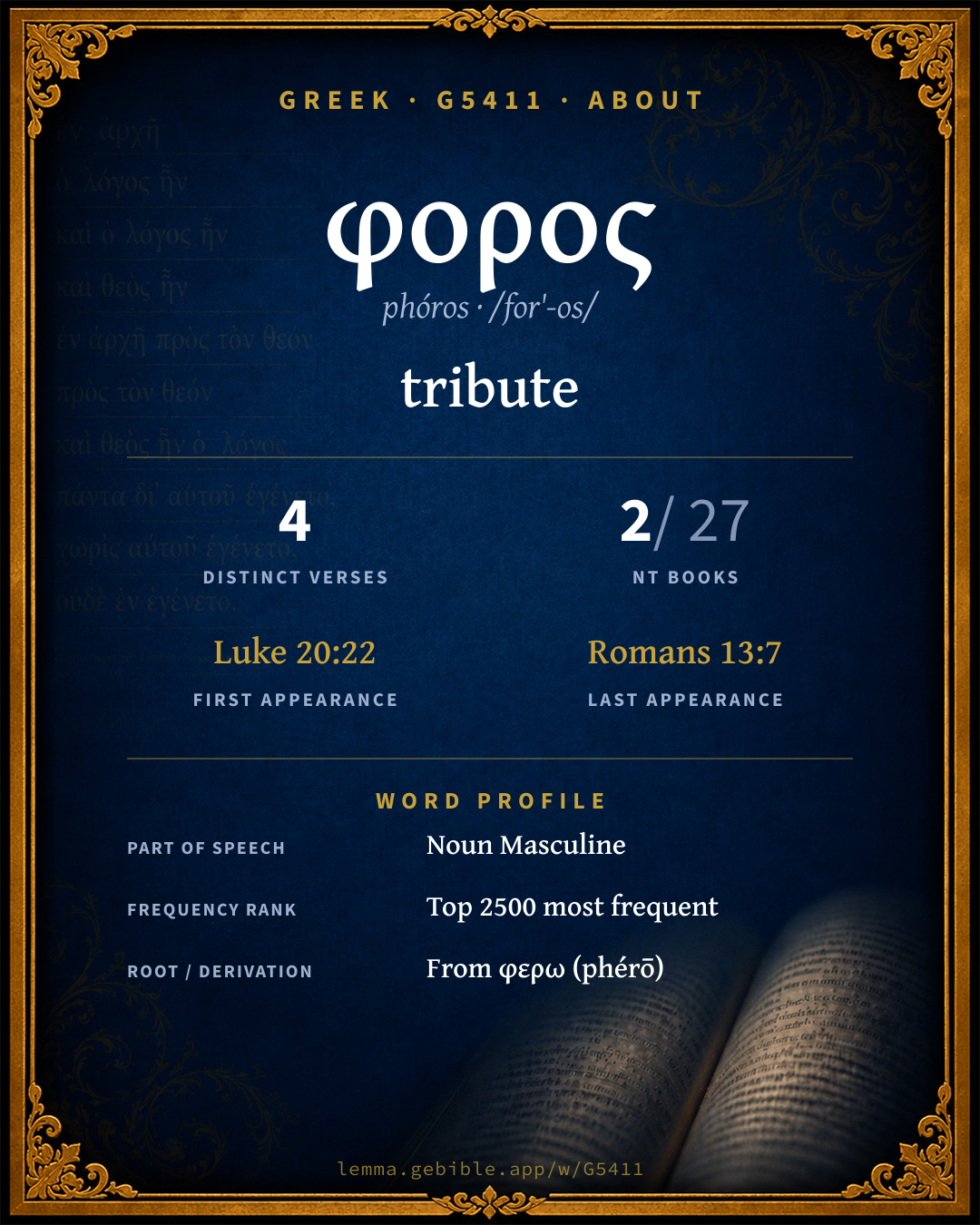
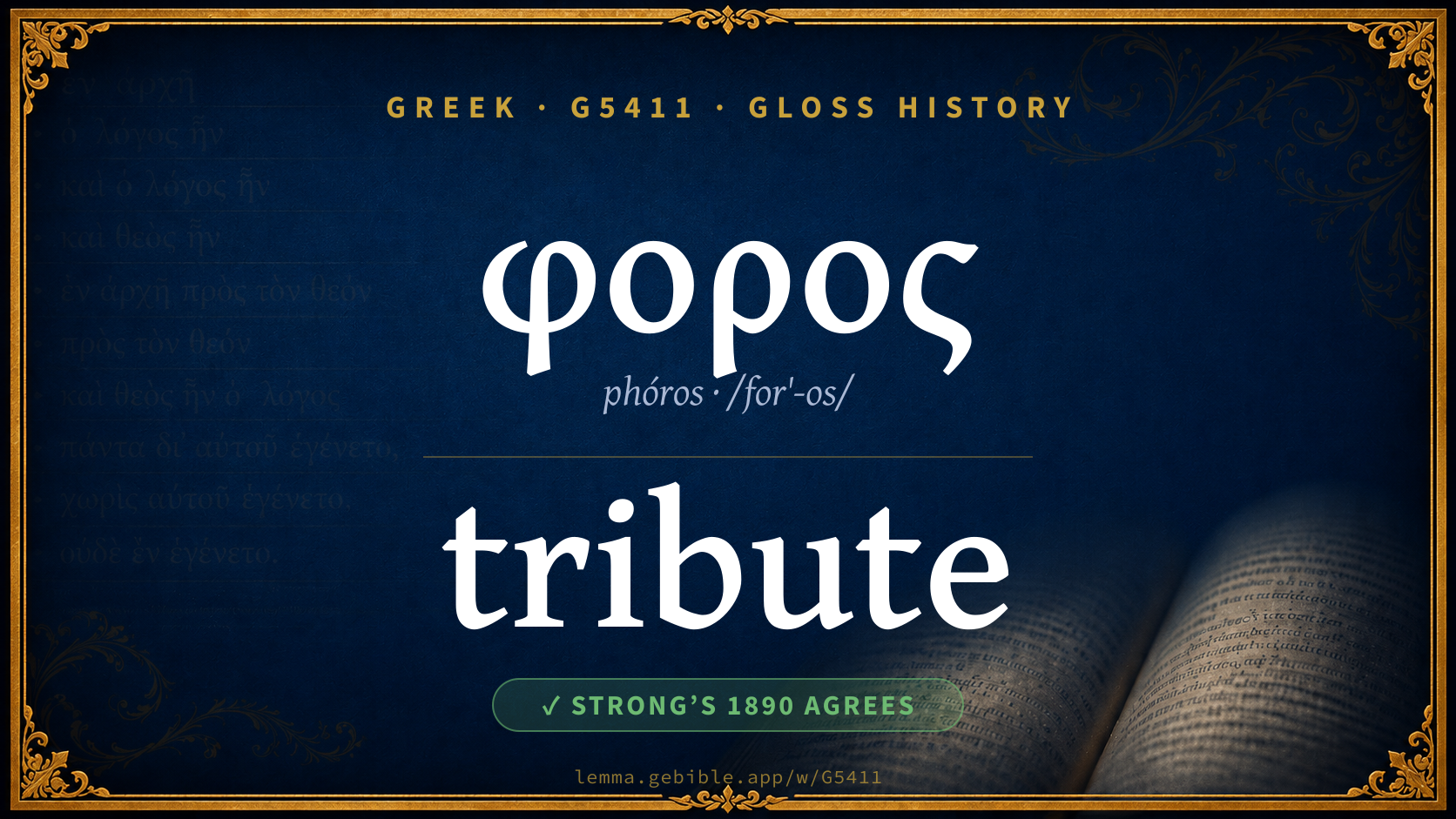
φόρος
tribute
Full lexicon entry — Thayer's Greek Lexicon
From Thayer's Greek Lexicon
Where this word appears
Grammar key — what these labels mean
Part of speech
- Noun
- A naming word — a person, place, thing, or idea.
Case
- Accusative
- The case of the direct object and of extent.
Gender
- Masculine
- Grammatically masculine.
Number
- Singular
- One.
- Plural
- More than one.
Grammatical forms
- Noun, Accusative, Singular, Masculine 3 times (60%)
- Noun, Accusative, Plural, Masculine 2 times (40%)
Parsed forms decoded from the imported morphology (Robinson–Tischendorf, public domain), counted across 5 parsed occurrences — not distinct verses.
Every verse where G5411 appears — 4 distinct verses across 2 books. Click any verse to open its interlinear word-by-word view. Verse text shown in the World English Bible for context — . Each verse’s Greek form is shown with its reference; the English is not keyword-highlighted, since the data carries no word-level English alignment. Use “Compare translations” on any verse to read it across multiple English versions. This concordance covers the Greek New Testament; Septuagint (Greek Old Testament) occurrences of this word are not indexed here.
Luke 2 verses
Romans 2 verses
- Romans 13:6 φόρους n acc pl masc For this reason you also pay taxes, for they are ministers of God's service, attending continually on this very thing.
- Romans 13:7 φόρον φόρον n acc sg masc n acc sg masc Give therefore to everyone what you owe: taxes to whom taxes are due; customs to whom customs; respect to whom respect; honor to whom honor.
About this entry
At a glance — auto-summarized from this page’s data, not written by a person. Every figure links to its source below. This summary describes the numbers; it doesn’t interpret them.
φορος — transliterated phóros — is a Greek noun carrying the sense “tribute.” A scarce word — 4 verses in all of the Greek New Testament. More than half of its appearances fall in Luke. Debuting at Luke 20:22, it then recurs through the corpus. Related forms include φερω, ταλαντον and φορτος. The sections below give every sense, occurrence, and version rendering.
Gloss history
Strong's 1890 vs modern scholarship
About this word
Strong's G5411 catalogs a Greek word from the Greek New Testament.
These counts are not copied from any lexicon or concordance. They are computed here, from the morphology-tagged Greek New Testament. What Lemma adds →
- 4
- distinct verses
- The word appears in 4 distinct verses.
- 2 / 27
- NT books
- The word appears in 2 of 27 New Testament books.
- #1,648
- by frequency
- Top 2500 most frequent Greek words (rank 1,648 of 5,347 Greek words by occurrence).
View all 4 occurrences in the concordance →
By traditional corpus
Conventional, traditional groupings — biblical authorship is debated, so this is a traditional corpus grouping, not an authorship claim. Some books belong to more than one corpus (Luke is in both the Gospels and the Lukan corpus, and so on), so these shares overlap and need not total 100%. Each figure is a share of the word’s 4 distinct verses.
- Gospels 2 verses · 50%
- Lukan (Luke–Acts) 2 verses · 50%
- Pauline corpus 2 verses · 50%
How translations render this word
Counts come from each version’s own published word-to-Strong’s tagging or interlinear alignment — an approximate guide to how each version renders this word, not a word-level alignment the data otherwise carries. Because each total is that version’s own tagged count, the per-version totals vary from one another and need not match the appearance or distinct-verse counts above. These counts may also differ from a printed concordance because Lemma counts each distinctly tagged rendering and does not collapse phrase taggings into a single head-word total. This is a fixed set of word-tagged versions (KJV, ASV, BSB, ULT) and does not change with the reading translation you choose elsewhere. Each version’s license is shown beside its name below (and on Sources).
- King James Version: Tribute 5×
- American Standard Version: Tribute 4×
- Berean Standard Bible: Taxes 4×
- unfoldingWord Literal Text: Tax 2×, Tribute 2×
King James Version Public Domain
Renders G5411 across 5 tagged occurrences — most commonly:
American Standard Version Public Domain
Renders G5411 across 5 tagged occurrences — most commonly:
Plus 1 rendering that appears only once — usually multi-word phrases or single function words the recovered tagging swept in, not distinct renderings.
Berean Standard Bible Public Domain
Renders G5411 across 5 tagged occurrences — most commonly:
Plus 1 rendering that appears only once — usually multi-word phrases or single function words the recovered tagging swept in, not distinct renderings.
unfoldingWord Literal Text CC BY-SA 4.0
Renders G5411 across 5 tagged occurrences — most commonly:
Plus 1 rendering that appears only once — usually multi-word phrases or single function words the recovered tagging swept in, not distinct renderings.
Senses in Thayer's
The 1 sense Thayer's distinguishes for this word, in lexicon order (not ranked by frequency or importance). The full entry — with sub-senses — is in the Lexicon Entry tab.
- tribute, esp. the annual tax levied upon houses, lands, and persons
Word origin
Derived from φερω (phérō) (G5342) — to carry.
Forms in the corpus
The 2 distinct written forms G5411 takes in the Greek New Testament, most frequent first — each parse links to that case’s occurrences in the concordance.
| Form | Parsing | Example | Uses |
|---|---|---|---|
| φόρον phóron | Noun, Accusative, Singular, Masculine | Luke 20:22 | 3 |
| φόρους phórous | Noun, Accusative, Plural, Masculine | Luke 23:2 | 2 |
Same root — word family
Other Thayer's entries built from the same root as G5411, grouped by Strong’s listed origin. These share a root / origin per the lexicon — not necessarily a shared meaning. Each links to that word’s own entry.
Derives from
Shares the same root
Derived from this word
Proper names from this root
People and places named from this root — a name, not an additional meaning of the word.
Compare all same-root words → Showing 4 of 7 — not the complete family. 1 of the same-root words is a proper name (a person or place). They share a root, not necessarily a meaning.
Septuagint usage
The same Greek word φορος appears 30 times in the Greek Old Testament (Septuagint), across 29 verses in 7 books.
- 30
- LXX occurrences
- Tagged occurrences of this Greek word in the Septuagint.
- 29
- verses
- Distinct Septuagint verses containing this word.
- 7 / 39
- OT books
- The word appears in 7 of the 39 Old Testament books.
Sample Septuagint occurrences
- Joshua 19:48 φόρος
- Judges 1:28 φόρος
- 2 Samuel 20:24 φόρος
- 1 Kings 4:6 φόρος
- 2 Chronicles 8:8 φόρος
- Ezra 2:3 φορος
- Lamentations 1:1 φόρος
Septuagint occurrences (same lexeme)
Every verse where the same Strong’s number (G5411) appears in the Greek Septuagint. Verse text shown in the World English Bible for context; the Greek form is the matched word — the English is not keyword-highlighted.
- Joshua 19:48 φόρος This is the inheritance of the tribe of the children of Dan according to their families, these cities with their villages.
- Judges 1:28 φόρος It happened, when Israel had grown strong, that they put the Canaanites to forced labor, and did not utterly drive them out.
- Judges 1:29 φόρος Ephraim didn't drive out the Canaanites who lived in Gezer; but the Canaanites lived in Gezer among them.
- Judges 1:30 φόρος Zebulun didn't drive out the inhabitants of Kitron, nor the inhabitants of Nahalol; but the Canaanites lived among them, and became subject to forced labor.
- Judges 1:31 φόρος Asher didn't drive out the inhabitants of Acco, nor the inhabitants of Sidon, nor of Ahlab, nor of Achzib, nor of Helbah, nor of Aphik, nor of Rehob;
- Judges 1:33 φόρος Naphtali didn't drive out the inhabitants of Beth-shemesh, nor the inhabitants of Beth Anath; but he lived among the Canaanites, the inhabitants of the land: nevertheless the inhabitants of Beth-shemesh and of Beth Anath became subject to forced labor.
- Judges 1:35 φόρος but the Amorites would dwell in Mount Heres, in Aijalon, and in Shaalbim: yet the hand of the house of Joseph prevailed, so that they became subject to forced labor.
- 2 Samuel 20:24 φόρος and Adoram was over the men subject to forced labor; and Jehoshaphat the son of Ahilud was the recorder;
- 1 Kings 4:6 φόρος and Ahishar was over the household; and Adoniram the son of Abda was over the men subject to forced labor.
- 1 Kings 5:27 φόρος
- 1 Kings 5:28 φόρος
- 1 Kings 10:15 φόρος besides [that which] the traders [brought], and the traffic of the merchants, and of all the kings of the mixed people, and of the governors of the country.
- 1 Kings 10:22 φόρος For the king had at sea a navy of Tarshish with the navy of Hiram: once every three years came the navy of Tarshish, bringing gold, and silver, ivory, and apes, and peacocks.
- 1 Kings 12:18 φόρος Then king Rehoboam sent Adoram, who was over the men subject to forced labor; and all Israel stoned him to death with stones. King Rehoboam made speed to get him up to his chariot, to flee to Jerusalem.
- 2 Chronicles 8:8 φόρος of their children who were left after them in the land, whom the children of Israel didn't consume, of them did Solomon raise a levy [of bondservants] to this day.
- 2 Chronicles 10:18 φόρος Then king Rehoboam sent Hadoram, who was over the men subject to forced labor; and the children of Israel stoned him to death with stones. King Rehoboam made speed to get him up to his chariot, to flee to Jerusalem.
- 2 Chronicles 36:3 φόρος The king of Egypt deposed him at Jerusalem, and fined the land one hundred talents of silver and a talent of gold.
- Ezra 2:3 φορος The children of Parosh, two thousand one hundred seventy-two.
- Ezra 4:13 φόρος Be it known now to the king that if this city is built, and the walls finished, they will not pay tribute, custom, or toll, and in the end it will be hurtful to the kings.
- Ezra 4:20 φόρος There have been mighty kings also over Jerusalem, who have ruled over all [the country] beyond the River; and tribute, custom, and toll, was paid to them.
- Ezra 6:8 φόρος Moreover I make a decree what you shall do to these elders of the Jews for the building of this house of God: that of the king's goods, even of the tribute beyond the River, expenses be given with all diligence to these men, that they be not hindered.
- Ezra 7:24 φόρος Also we inform you, that touching any of the priests and Levites, the singers, porters, Nethinim, or servants of this house of God, it shall not be lawful to impose tribute, custom, or toll, on them.
- Ezra 8:3 φορος Of the sons of Shecaniah, of the sons of Parosh, Zechariah; and with him were reckoned by genealogy of the males one hundred fifty.
- Ezra 10:25 φορος Of Israel: Of the sons of Parosh: Ramiah, and Izziah, and Malchijah, and Mijamin, and Eleazar, and Malchijah, and Benaiah.
- Ezra 13:25 φορος
- Ezra 15:4 φόρος
- Ezra 17:8 φορος
- Ezra 20:15 φορος
- Lamentations 1:1 φόρος How does the city sit solitary, that was full of people! She has become as a widow, who was great among the nations! She who was a princess among the provinces is become tributary!
These are occurrences of the same Greek lexeme (G5411) in the Septuagint — not a translation of any one Hebrew word. The store carries no word-level Hebrew↔Greek alignment, so no Hebrew original is asserted here. Counts come from the recovered LXX Strong's tagging — high-frequency vocabulary is well covered, while rare or late forms may be untagged — so they reflect tagged occurrences and may slightly undercount.