Judges 18:31

Hebrew (Westminster Leningrad Codex) Judges 18:31 appears in the Hebrew Old Testament. The text above is from the Westminster Leningrad Codex. Each word links to its Strong’s number, a concise gloss, and parsing drawn from the Open Scriptures Hebrew Bible morphology. Click any word for its full Brown-Driver-Briggs (BDB) entry.
Download image
Cite this verse

Judges 18:31 (World English Bible). Public Domain. Lemma interlinear Bible study tool, https://lemma.gebible.app/v/judges/18/31.

Show BibTeX & RIS
BibTeX
RIS
English Translation
So they set them up Micah's engraved image which he made, all the time that the house of God was in Shiloh.
World English Bible · Public Domain
Download a study sheet

One document with this verse’s original text, its word-by-word gloss line, the meaning frame, cross-references with their text, attributed commentary, and full source and license credits — printable, and it pastes into notes with its structure intact.

This verse Autodidact and up

Study sheet (.html) Plain text (.txt)

A passage Seminary Student

Up to 50 verses in one chapter. A passage sheet keeps up to 6 commentary sources and 12 cross-references per verse, in the order this page ranks them, and says so on the sheet whenever that leaves anything out. Ask for a single verse and you get the Autodidact verse sheet above.

Everything on this page stays free to read, with no account — the sheet is a download of what is already on screen, not access to it.

Want to remove ads? Support Godless Engineer
Compare translations 3

The same verse in 3 English versions, stacked beneath the original-language interlinear above. Click any original word for its lexicon entry.

Each is an independent rendering of the whole verse — the interlinear is not word-aligned to these translations.

Highlighted words mark where these versions differ — a whole-verse word diff, not a word-by-word alignment.

  • World English Bible Public Domain
    So they set them up Micah's engraved image which he made, all the time that the house of God was in Shiloh.
  • King James Version Public Domain
    And they set them up Micah's graven image, which he made, all the time that the house of God was in Shiloh.
  • unfoldingWord Literal Text CC BY-SA 4.0
    So they set up for themselves the idol of Micah that he had made, all of the days of the being of the house of God at Shiloh.

unfoldingWord Literal Text — © unfoldingWord, licensed CC BY-SA 4.0. Word-aligned USFM3 via Door43 (git.door43.org/unfoldingWord/en_ult).

Versions to compare (up to 4)

3 of 4 selected

Show all 18 translations

Every available English version of this verse, each an independent rendering of the whole verse.

  • World English Bible Public Domain
    So they set them up Micah's engraved image which he made, all the time that the house of God was in Shiloh.
  • Berean Standard Bible Public Domain
    So they set up for themselves Micah’s graven image, and it was there the whole time the house of God was in Shiloh.
  • Majority Standard Bible Public Domain
    So they set up for themselves Micah’s graven image, and it was there the whole time the house of God was in Shiloh.
  • King James Version Public Domain
    And they set them up Micah's graven image, which he made, all the time that the house of God was in Shiloh.
  • American Standard Version (1901) Public Domain
    So they set them up Micah's graven image which he made, all the time that the house of God was in Shiloh.
  • Revised Version (1885) Public Domain
    So they set them up Micah’s graven image which he made, all the time that the house of God was in Shiloh.
  • Geneva Bible (1599) Public Domain
    So they set them vp the grauen image, which Michah had made, all the while the house of God was in Shiloh.
  • Douay-Rheims (1899) Public Domain
    And the idol of Michas remained with them all the time that the house of God was in Silo. In those days there was no king in Israel.
  • Young's Literal Translation Public Domain
    And they appoint for them the graven image of Micah, which he had made, all the days of the house of God being in Shiloh.
  • Literal Standard Version CC BY-SA 4.0
    And they appoint for themselves the carved image of Micah, which he had made, all the days of the house of God being in Shiloh.
  • Unlocked Literal Bible CC BY-SA 4.0
    So they worshiped Micah's carved figure that he made as long as the house of God was at Shiloh.
  • unfoldingWord Literal Text CC BY-SA 4.0
    So they set up for themselves the idol of Micah that he had made, all of the days of the being of the house of God at Shiloh.
  • Darby Bible Public Domain
    So they set up Micah's graven image which he made, as long as the house of God was at Shiloh.
  • World Messianic Bible Public Domain
    So they set up for themselves Micah’s engraved image which he made, and it remained all the time that God’s house was in Shiloh.
  • Webster's Bible Public Domain
    And they set up for themselves Micah's graven image which he made, all the time that the house of God was in Shiloh.
  • Free Bible Version CC BY-SA 4.0
    They worshiped the carved idol that Micah had made the whole time God's Temple was at Shiloh.
  • Bible in Basic English Public Domain
    And they put up for themselves the image which Micah had made, and it was there all the time that the house of God was in Shiloh.
  • JPS Tanakh (1917) Public Domain
    So they set them up Micah's graven image which he made, all the time that the house of God was in Shiloh.

Literal Standard Version (2020), Covenant Press — licensed CC BY-SA 4.0. Text via the HelloAO Bible API (eBible.org). Unlocked Literal Bible (unfoldingWord) — licensed CC BY-SA 4.0. Text via the HelloAO Bible API (eBible.org). unfoldingWord Literal Text — © unfoldingWord, licensed CC BY-SA 4.0. Word-aligned USFM3 via Door43 (git.door43.org/unfoldingWord/en_ult). Free Bible Version, Dr. Jonathan Gallagher — licensed CC BY-SA 4.0. Text via the HelloAO Bible API (eBible.org).

Word by word

More ways to search: Search by grammar → Find every occurrence → Compare this word →

Practice this passage: Drill this verse → Learn its vocabulary →

פֶּ֥סֶל
peçel
H6459
“idol of”
Noun, Common, Masculine, Singular, Construct
Part of Speech
Noun
Type
Common
Gender
Masculine
Number
Singular
State
Construct
Full BDB Definition

Origin: from H6458

TWOT: 1788a

idol, image
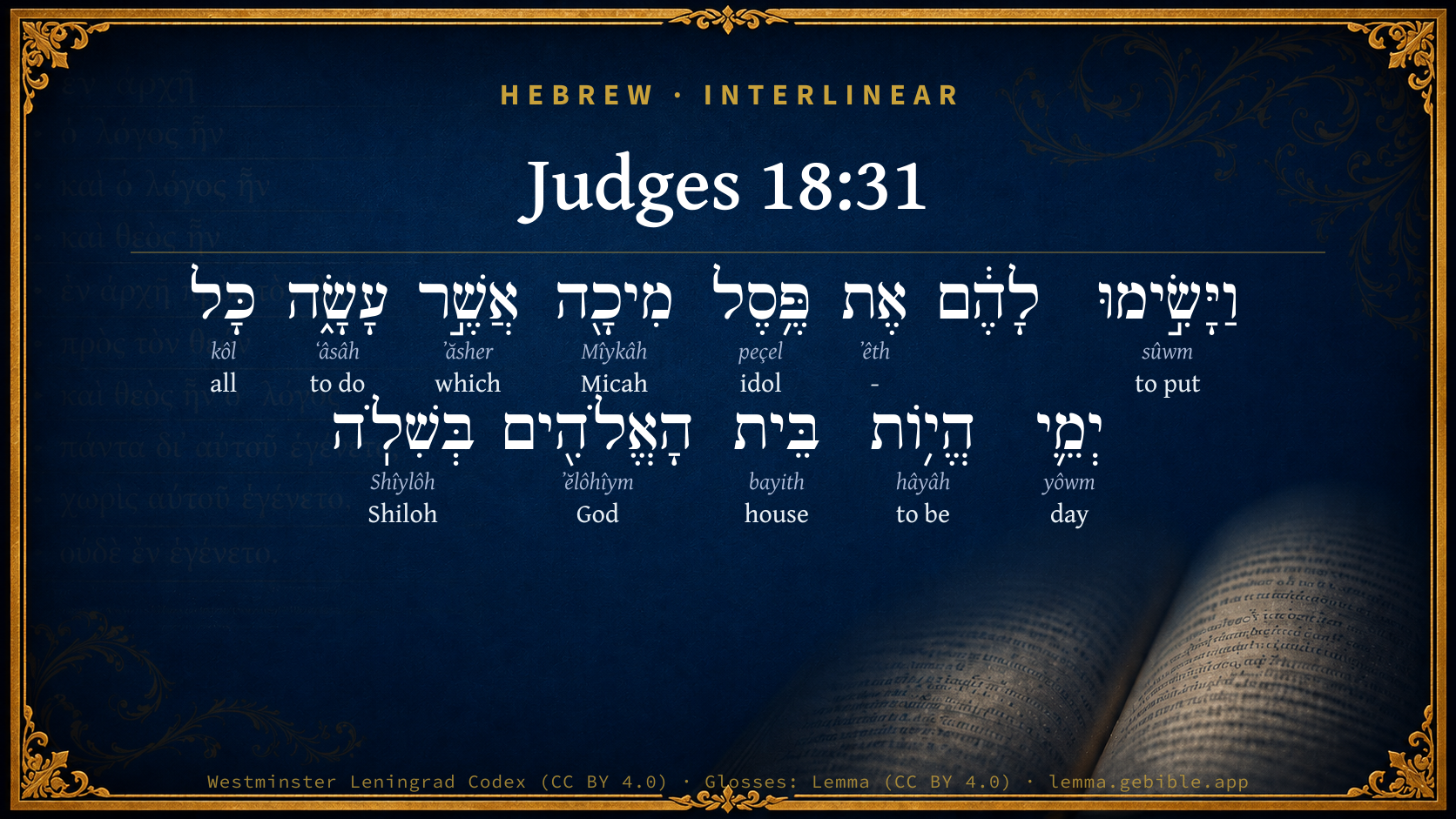
  1. וַיָּשִׂ֣ימוּ sûwm H7760 “and · to put” Conjunction + Verb, Qal, Sequential Imperfect, 3rd Person, Masculine, Plural
  2. אֶת ʼêth H853 “-” Particle, Direct Object
  3. מִיכָ֖ה Mîykâh H4318 “Micah” Noun, Proper
  4. אֲשֶׁ֣ר ʼăsher H834 “which” Particle, Relative
  5. עָשָׂ֑ה ʻâsâh H6213 “to do” Verb, Qal, Perfect, 3rd Person, Masculine, Singular
  6. כָּל kôl H3605 “all of” Noun, Common, Masculine, Singular, Construct
  7. יְמֵ֛י yôwm H3117 “days of” Noun, Common, Masculine, Plural, Construct
  8. הֱי֥וֹת hâyâh H1961 “to be” Verb, Qal, Infinitive Construct
  9. בֵּית bayith H1004 “house of” Noun, Common, Masculine, Singular, Construct
  10. הָאֱלֹהִ֖ים ʼĕlôhîym H430 “the · God(s)” Particle, Definite Article + Noun, Common, Masculine, Plural, Absolute
  11. בְּשִׁלֹֽה Shîylôh H7887 “in/at · Shiloh” Preposition + Noun, Proper

About this verse

These counts appear in no published source. They are computed here, from the morphology-tagged text and Lemma’s own curated glosses. What Lemma adds →

13
words
12
distinct lemmas
Historical
section

Shared distinctive vocabulary

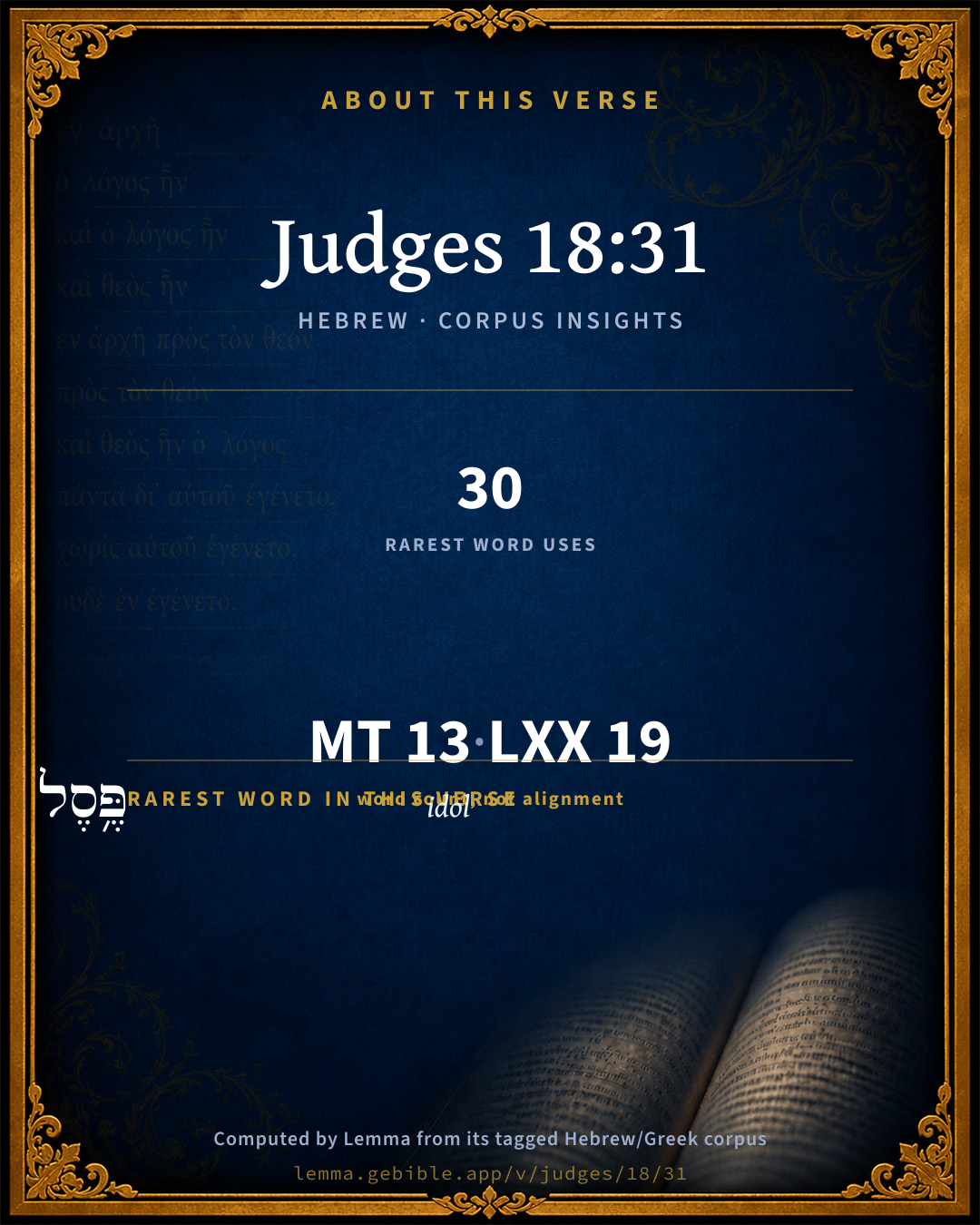
פֶּ֥סֶל idol H6459 occurs in 30 verses of the Hebrew Bible. Also found in:

Grammatical profile

  • 3 verbs
  • 7 nouns
  • 1 preposition
  • 2 particles

Verb forms

  • וַיָּשִׂ֣ימוּ Qal · Sequential Imperfect
  • עָשָׂ֑ה Qal · Perfect
  • הֱי֥וֹת Qal · Infinitive Construct

Hebrew & Septuagint length

In English translation the verse runs 22 words from the Hebrew and 37 from the Septuagint (LXX English) — the Septuagint runs noticeably longer here. See the side-by-side →

A rough comparison of the two English renderings, which tokenize alike — not a word-level alignment.

Word counts can differ between the Hebrew and the Greek without any difference in meaning — e.g. the Hebrew direct-object marker אֵת has no separate Greek word, and Greek often adds the article ὁ.

In the original languages it is 13 Hebrew tokens and 19 Greek tokens — but the two are counted differently (Hebrew bundles its prefixes and suffixes into one token; the Greek is in lemma form), so that isn’t a like-for-like length.

Cross-references

6

Topical passages linked to Judges 18:31 in the Treasury of Scripture Knowledge — connected by theme and wording, ordered by reader-vote popularity; previews shown in the World English Bible.

  • Joshua 18:1 The whole congregation of the children of Israel assembled themselves together at Shiloh, and set up the tent of meeting there: and the land was subdued before them.
  • Judges 19:18 He said to him, We are passing from Bethlehem Judah to the farther side of the hill-country of Ephraim; from there am I, and I went to Bethlehem Judah: and I am [now] going to the house of Yahweh; and there is no man who takes me into his house.
  • 1 Samuel 1:3 This man went up out of his city from year to year to worship and to sacrifice to Yahweh of Hosts in Shiloh. The two sons of Eli, Hophni and Phinehas, priests to Yahweh, were there.
  • Judges 21:21 and see, and, behold, if the daughters of Shiloh come out to dance in the dances, then come you out of the vineyards, and catch you every man his wife of the daughters of Shiloh, and go to the land of Benjamin.
  • 1 Samuel 4:4 So the people sent to Shiloh; and they brought from there the ark of the covenant of Yahweh of Hosts, who sits [above] the cherubim: and the two sons of Eli, Hophni and Phinehas, were there with the ark of the covenant of God.
  • Jeremiah 7:12 But go you now to my place which was in Shiloh, where I caused my name to dwell at the first, and see what I did to it for the wickedness of my people Israel.

Cross-references courtesy of OpenBible.info (CC BY 4.0).

Hebrew and Greek witnesses Masoretic Hebrew ↔ Greek Septuagint

The same verse in the two great witnesses to the Old Testament, shown verse-for-verse.

Here the Septuagint runs noticeably longer than the Hebrew — LXX2012 (modern English Septuagint) 37 words vs World English Bible 22. A rough length comparison of the two English translations, not a word-level alignment — read both below.

These are two independent witnesses, not word-aligned to each other, and the Septuagint is shown in lemma (dictionary) form.

Hebrew Judges 18:31 Masoretic · Westminster Leningrad Codex

וַיָּשִׂ֣ימוּ לָהֶ֔ם אֶת פֶּ֥סֶל מִיכָ֖ה אֲשֶׁ֣ר עָשָׂ֑ה כָּל יְמֵ֛י הֱי֥וֹת בֵּית הָאֱלֹהִ֖ים בְּשִׁלֹֽה

So they set them up Micah's engraved image which he made, all the time that the house of God was in Shiloh.

World English Bible · Public Domain

Greek LXX Judges 18:31 Septuagint · lemma form

καί τίθημι αὐτός ὁ γλυπτός ὅς ποιέω μιχαιας πᾶς ὁ ἡμέρα ὅς εἰμί ὁ οἶκος ὁ θεός ἐν σηλωμ

And they set up for themselves the graven image which Michaias made, all the days that the house of God was in Selom; and it was so in those days that there was no king in Israel.

LXX2012 (modern English Septuagint) · Public Domain

On this verse, Ellicott's Commentary for English Readers discusses the Septuagint’s reading. Read the note in Commentary ↓

Hebrew: Westminster Leningrad Codex (CC BY 4.0). Greek: Septuagint (public domain); English from LXX2012 (modern English Septuagint) (Public Domain). How the Septuagint differs from the Hebrew →

Targum (Aramaic paraphrase)

1

The Targum is the ancient Jewish Aramaic paraphrase of the Hebrew Scriptures — an interpretive translation, not the Hebrew text itself. Onkelos (literal) and Pseudo-Jonathan (expansive) render the Torah, and Jonathan the Prophets. Coverage is partial: where no permissively-licensed English translation exists for a verse, only the Aramaic is shown. This is verse-level text, not a word-by-word alignment to the Hebrew.

  1. Targum Jonathan Prophets (Joshua–Malachi)
    וְשַׁוִיאוּ לְהוֹן יַת צְלָם מִיכָה דִי עֲבַד כָּל יוֹמַיָא דַהֲוָה קַיָם בֵּית מַקְדְשָׁא דַייָ בְּשִׁלֹה:

    (no public-domain English translation for this verse)

    Targum Jonathan — Aramaic: “Mikraot Gedolot” (public domain). English: “Sefaria Community Translation” (CC0 1.0 (public-domain dedication)); “London "Chaldee Paraphrase," 1871” (public domain). Text via Sefaria.

Commentary

Notes on Judges 18:31 from classic Christian and Jewish commentators (each source and its license shown beneath its notes). The classic Christian expositions comment on the surrounding passage and are grouped to its opening verse, so a note may address several verses; the Jewish commentaries on the Tanakh (Rashi and others) are per-verse, so they appear only where the commentator wrote on this verse.

Lemma curates 59 commentaries, every one of them public domain or Creative Commons licensed, each selected and text-cleaned for this edition rather than reprinted as found. About our sources →

Trapp's Complete Commentary

John Trapp

Jdg 18:31 And they set them up Micah’s graven image, which he made, all the time that the house of God was in Shiloh.

Ver. 31. All the time, &c,] Till Samuel threw down this and other idols. {1Sa 7:3}

John Trapp, A Commentary or Exposition upon All the Books of the Old and New Testament (1647–1656) — public domain. Text from a community e-Sword module.

Ellicott's Commentary for English Readers

(31) And they set them up Micah’s graven image.—Rather, entrusted to them, i.e., to Jonathan’s descendants. The phrase “set them up” can only have been used by inadvertence by our translators in this verse, since the verb used, yasîmo (LXX., etaxan heautois; but Vulg., mansitque apud eos, i.e., there remained with them the descendants of Jonathan), is wholly different from the verb yakîmû, rendered “set up” (LXX., anestésan) in Jdg_18:30.

All the time that the house of God was in Shiloh—i.e., till Samuel’s early manhood, when the Philistines sacked Shiloh, to which place the Ark and Tabernacle never returned (1Sa_4:3, 1Sa_6:21, 1Sa_7:1). This verse may probably have been added by a later hand to prevent any mistake in the interpretation of the former. It may have been written in Saul’s reign, when the Tabernacle and ephod had been removed to Nob for greater safety. The last mention of the town of Dan is in 2Ch_16:4

A Bible Commentary for English Readers, edited by Charles John Ellicott (1878–1897) — public domain. Text from a community e-Sword module.

The Cambridge Bible for Schools and Colleges

gen. ed. J. J. S. Perowne

31. This verse is clearly not by the same hand as the foregoing.

the house of God … in Shiloh] Not a tabernacle, or moveable tent, but a temple; see 1Sa_1:7; 1Sa_1:24; 1Sa_3:15. We are not told when the temple in Shiloh came to an end; was it when the ark fell into the hands of the Philistines, 1 Samuel 4? In the time of Saul the descendants of Eli are found not at Shiloh, but at Nob, ib. Jdg_21:2 ff. Or was it during the Assyrian wars? The allusions in Jer_7:12; Jer_7:14; Jer_26:6; Jer_26:9 suggest a comparatively recent and well-remembered disaster. At any rate the writer does not say that the Danite shrine disappeared when the temple in Shiloh came to an end; what he means is that the local cult existed side by side with the national sanctuary. Cf. further 1Ki_12:29 f., Amo_8:14.

The Cambridge Bible for Schools and Colleges (gen. ed. J. J. S. Perowne; Cambridge University Press, 1878–1918) — public domain. Text from a community e-Sword module.

John Gill's Exposition

And they set them up Micah's graven image, which he made,.... Which is repeated for the sake of the time of its continuance next expressed:

all the time the house of God was in Shiloh; which, according to some Jewish writers (g), was three hundred and sixty years; that is, so long as the tabernacle was there, which was afterwards removed to Nob.

(g) Maimon. in Misn. Zebachim, c. 14. sect. 6. & Bartenora in ib. sect. 7.

Next: Judges Chapter 19

John Gill's Exposition of the Whole Bible (1746–1763) — public domain (CC PDM 1.0). Text via the HelloAO Bible API.

Haydock's Catholic Bible Commentary

In Silo. The ark was taken by the Philistines, (1 Kings iv.) after remaining at Silo 349 years, and 217 from the idolatry of Michas and of Dan. (Salien) (Haydock) --- In those. The Hebrew here commences the following chapter, which contains an account of another instance of licentiousness, which probably took place after the two former. Phinees was high priest; but there was no civil head. (Calmet)

George Leo Haydock (1774–1849), Haydock's Catholic Family Bible and Commentary, 1859 edition — public domain. Excludes Psalms (Douay-Rheims chapter numbering differs from Protestant) and Deuterocanonical books (Catholic canon only).

Whedon's Commentary on the Bible

Daniel D. Whedon

31. All the time that the house of God was in Shiloh — This statement confirms our view in the last note, that the captivity of the land was that which followed the capture of the ark, and the consequent desolation of Shiloh. About the same time, it would seem, the Danite sanctuary in which the sons of Jonathan the Levite ministered was also made desolate. It had probably stood more than a hundred years.

Daniel D. Whedon (gen. ed.), Commentary on the Old and New Testaments (1874–1909) — public domain. Text from a community e-Sword module.

Lesson kit

Teaching starters — assembled from the data on this page, not authored interpretation. Every prompt links to the verse data it draws on. Edit before teaching.

Judges, in the Historical, opens this verse with 13 words (12 distinct Hebrew lemmas). Its most distinctive word is peçel (“idol”). The Greek Septuagint runs longer here. A historical commentator’s framing appears above. Read the whole chapter for the surrounding context.

Discussion questions

  1. How does “idol” (peçel) shape what this verse is saying?
  2. How does Exodus 20:4, which shares the word «idol», read alongside this verse?
  3. The Septuagint runs longer here than the Hebrew. What might account for the difference?
  4. These translations render this verse differently; the difference is in the English rendering, not the original. What questions does that raise?
  5. «וַיָּשִׂ֣ימוּ» is a Qal Sequential Imperfect verb. How does that grammatical form shape the action described?
  6. Compare how Trapp's Complete Commentary and Ellicott's Commentary for English Readers read this verse. Where do they agree or differ?

Things to notice

Reading settings

Reading text

Shown beneath each verse's original-language words.

Old Testament
Old Testament edition

Read the OT as the Masoretic Hebrew (MT) or the Greek Septuagint (LXX).

English shown for the Greek Septuagint (in the Hebrew ↔ Greek comparison).

Comparing translations? Open the Compare panel on any verse page to stack up to four side by side.