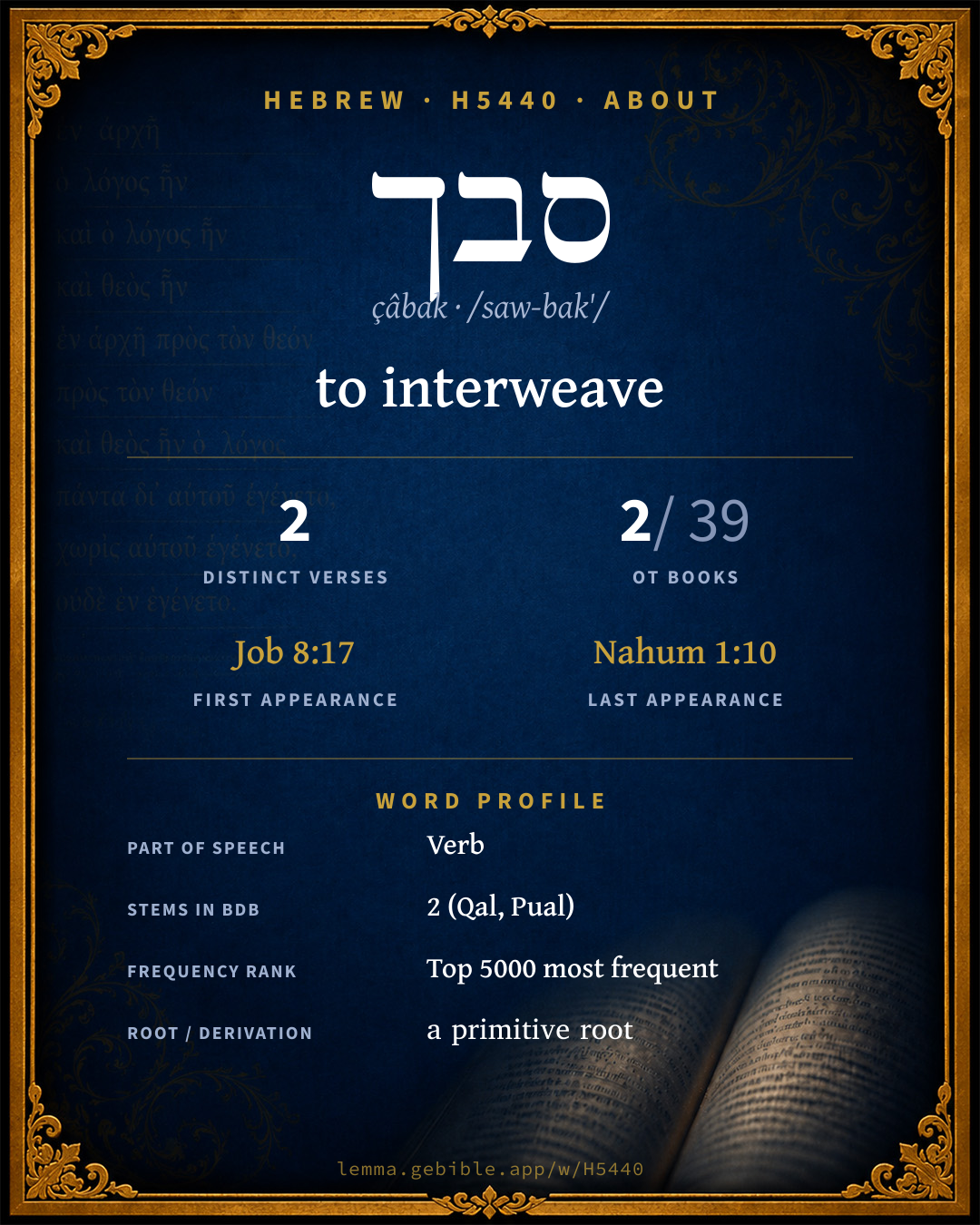
סָבַךְ
to interweave
‘to interweave’ is one of 2 main senses fuller range ↓
Full lexicon entry — Brown-Driver-Briggs (BDB)
From Brown-Driver-Briggs (BDB)
Where this word appears
See every Pual verb in the Hebrew Bible →
Grammar key — what these labels mean
Part of speech
- Verb
- An action or state-of-being word.
Stem
- Pual
- The passive counterpart of the Piel.
- Qal
- The basic, simple active stem — the plain form of the verb (“he wrote”). Here: ‘interwoven’
Form
- Imperfect
- An incomplete, ongoing, or future action (“he will / would write”).
- Participle Passive
- A verbal adjective expressing action received (“written”).
State
- Absolute
- The independent form of a noun, not bound to a following word.
Person
- 3rd Person
- The one spoken about (“he / she / it / they”).
Gender
- Masculine
- Grammatically masculine.
Number
- Plural
- More than one (in Hebrew, generally three or more).
Grammatical forms
- Verb, Pual, Imperfect, 3rd Person, Masculine, Plural 1 time (50%)
- Verb, Qal, Participle Passive, Masculine, Plural, Absolute 1 time (50%)
Parsed forms decoded from the imported morphology (morphhb / Westminster Leningrad Codex — WLC text public domain, morphhb tagging CC BY 4.0), counted across 2 parsed occurrences — not distinct verses.
Every verse where H5440 appears — 2 distinct verses across 2 books. Click any verse to open its interlinear word-by-word view. Verse text shown in the World English Bible for context — . Each verse’s Hebrew form is shown with its reference; the English is not keyword-highlighted, since the data carries no word-level English alignment. Use “Compare translations” on any verse to read it across multiple English versions. This concordance covers the Hebrew Bible; Septuagint (Greek Old Testament) occurrences are not indexed here.
Job 1 verse
Nahum 1 verse
About this entry
At a glance — auto-summarized from this page’s data, not written by a person. Every figure links to its source below. This summary describes the numbers; it doesn’t interpret them.
The Hebrew verb סבך centers on the idea of “to interweave.” The Hebrew Bible uses it only 2 verses. The word gravitates to Job (50%), then Nahum. Debuting at Job 8:17, it then recurs through the corpus. Across 2 stems, its meaning turns on the binyan (Qal, Pual). Dig into 2-verse concordance and the renderings breakdown below.
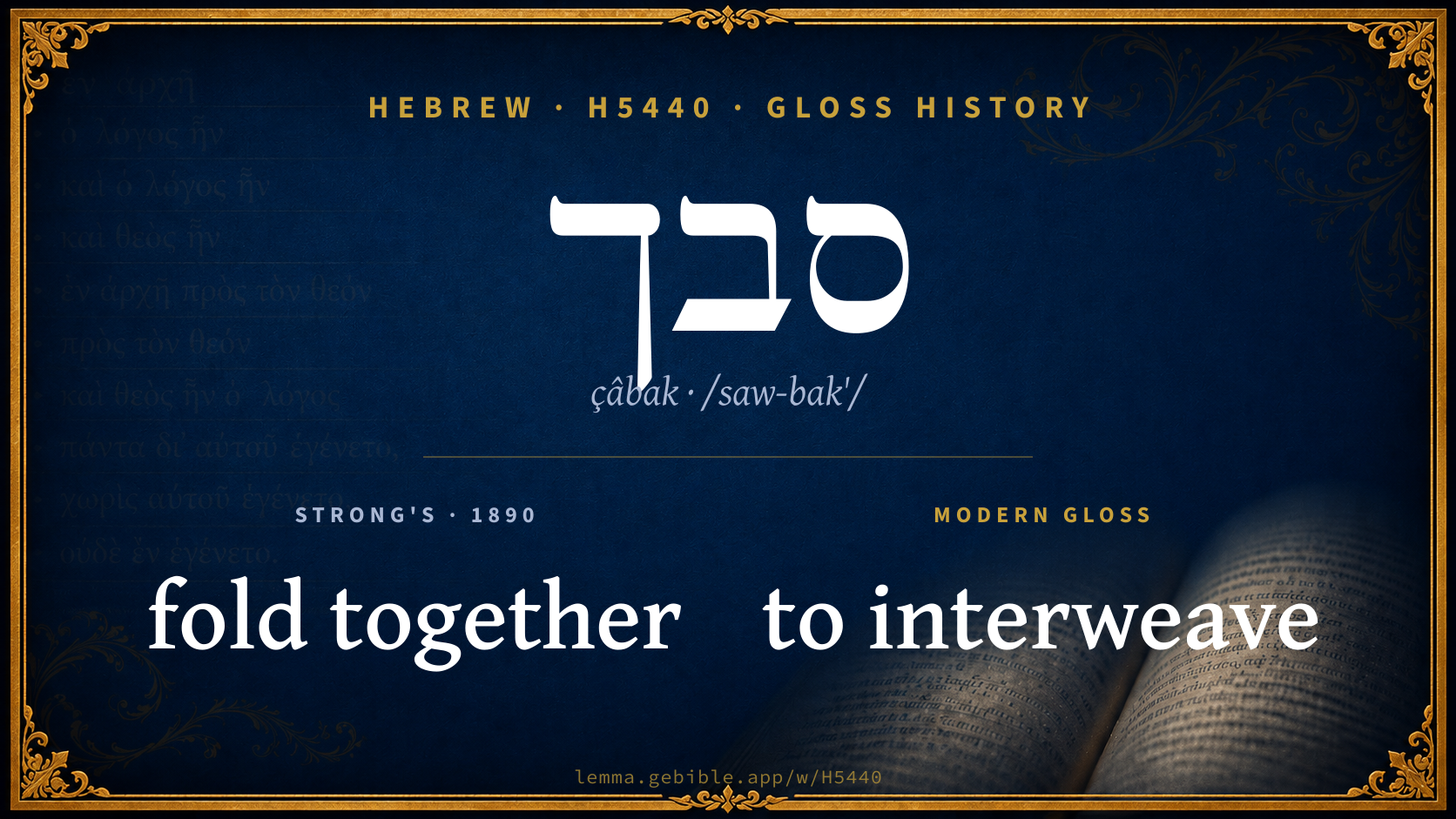
Gloss history
Strong's 1890 vs modern scholarship
About this word
Strong's H5440 catalogs a Hebrew word from the Hebrew Old Testament.
These counts are not copied from any lexicon or concordance. They are computed here, from the morphology-tagged Hebrew Old Testament. What Lemma adds →
- 2
- distinct verses
- The word appears in 2 distinct verses.
- 2 / 39
- OT books
- The word appears in 2 of 39 Old Testament books.
- #4,807
- by frequency
- Top 5000 most frequent Hebrew words (rank 4,807 of 8,640 Hebrew words by occurrence).
View all 2 occurrences in the concordance →
By traditional corpus
Conventional, traditional groupings — biblical authorship is debated, so this is a traditional corpus grouping, not an authorship claim. Each share is this word’s portion of its verses in that division of the Hebrew canon. Each figure is a share of the word’s 2 distinct verses.
- Prophets (Nevi'im) 1 verse · 50%
- Writings (Ketuvim) 1 verse · 50%
How translations render this word
Counts come from each version’s own published word-to-Strong’s tagging or interlinear alignment — an approximate guide to how each version renders this word, not a word-level alignment the data otherwise carries. Because each total is that version’s own tagged count, the per-version totals vary from one another and need not match the appearance or distinct-verse counts above. These counts may also differ from a printed concordance because Lemma counts each distinctly tagged rendering and does not collapse phrase taggings into a single head-word total. This is a fixed set of word-tagged versions (KJV, ASV, BSB, ULT) and does not change with the reading translation you choose elsewhere. Each version’s license is shown beside its name below (and on Sources).
- King James Version: Are wrapped about 1×, They be folden together 1×
- American Standard Version: Are wrapped about 1×, Entangled 1×
- Berean Standard Bible: They will be entangled 1×, Wrap 1×
- unfoldingWord Literal Text: Are wrapped 1×, Tangled 1×
King James Version Public Domain
Renders H5440 across 2 tagged occurrences — most commonly:
American Standard Version Public Domain
Renders H5440 across 2 tagged occurrences — most commonly:
Berean Standard Bible Public Domain
Renders H5440 across 2 tagged occurrences — most commonly:
unfoldingWord Literal Text CC BY-SA 4.0
Renders H5440 across 2 tagged occurrences — most commonly:
Senses in the full BDB
Hebrew verbs can shift meaning by stem (binyan): Qal is the basic action, Niphal is often passive or reflexive, Piel often intensifies or makes it factitive, and Hiphil is typically causative. The senses below are grouped under the stem BDB assigns to each. This entry also uses Pual (the passive of Piel).
What do BDB’s symbols mean?
BDB uses these scholarly abbreviations:
| Symbol | Meaning |
|---|---|
| 𝔊 | the Septuagint (the ancient Greek translation, LXX) |
| 𝔙 | the Vulgate (the Latin translation) |
| 𝔖 | the Syriac version (the Peshitta) |
| 𝔗 | the Targum (the Aramaic translation) |
| ψ | the Psalms |
| √ | root (the underlying root or stem) |
| ‖ | parallel passage (a synonymous or contrasted parallel) |
| † | the dagger: every passage where the word occurs is cited |
The 2 senses and sub-senses the full Brown-Driver-Briggs lexicon distinguishes for this word, in lexicon order (not ranked by frequency), with BDB’s own verbatim wording and sub-sense lettering. Shown in Hebrew script with BDB’s own scholarly abbreviations. The condensed entry is in the Lexicon Entry tab. See also the Forms in the corpus table below.
Qal
- interwoven (entangled) thorns
Pual
- . are interwoven
Senses from the full Brown-Driver-Briggs lexicon (Brown, Driver, Briggs; Oxford 1906 — public domain), digitized via Sefaria, supplemented by the OpenScriptures HebrewLexicon (CC BY 4.0). Full attribution on Sources.
Word origin
Origin: a primitive root
Jastrow Dictionary
A second Hebrew/Aramaic lexicon for comparison, covering Aramaic and post-biblical (Talmudic, Targumic, Midrashic) usage that the biblical-Hebrew BDB does not. Matched by lemma rather than by Strong’s number, so a lemma may carry more than one Jastrow headword (shown separately below), and the entries cover usage well beyond the Bible.
סָבַךְ
- (b. h.) to interweave, interlace, esp. to make a hedge or dam with twigs, stones &c. Shebi. III, 8 לא יִסְבּוֹךְ בעפר Ms. M. a. R. S. a. l. (ed. יסמוך) he must not cover the dam with earth, opp. עושה חייץ, v. חַיִיץ.
- to be caught, entangled. Lev. R. s. 29, a. e., v. נָטַשׁ II. Yalk. Num. 782, v. infra; a. e.
- same. Gen. R. s. 56 מִסְתַּבְּכִין בצרות entangled in troubles. Ib. [read:] עתידין בניך להִסְתַּבֵּךְ במלכיות ונמשכין ממלכות למלכות thy children will be entangled (come in conflict) with successive empires, and be drawn from empire to empire; Yalk. Num. 782 נִסְבָּכִין. Gen. R. s. 65 ונ׳ בשערו and the chaff stuck in his hair. Y. Sabb. VII, 10ᵃ bot. נִסְתַּבְּכוּ בגדיו וכ׳ if his garments were caught in thorns; a. e.
- same. Peah VII, 3 [read:] עקץ … ה׳ בעלים ונפל לארץ וכ׳ if he cut a cluster off by its stalk, and it was intercepted by the foliage, and in falling to the ground single berries fell off.
- to entangle. [Y. Kil. II, end, 28ᵇ מסבכין, some ed., v. סָכַךְ.]—Part. pass. מְסוּבָּךְ. Ḥull. 30ᵇ תחת צמר מס׳ if he put the slaughtering knife under the entangled wool (on the animal’s neck). M. Kat. 6ᵃ top במְסוּבָּכִין when the trees in the field are irregularly scattered (not planted in rows). Sot. 48ᵃ; Yalk. Is. 292 (ref. to ארזה, Zeph. II, 14) בית המסובך בארזים a house which lies in a thicket of cedars. e.g. Zephaniah 2:14
סְבַךְ
- Part. pass. סָבִיךְ. Ḥull. 48ᵃ והוא דס׳ בבסרא provided the perforated lung is intergrown with the fleshy part of the ribs.
- to weave a net. Targ. Prov. XXX, 28 דמְסַבְּכָא ed. Lag. (Var. דמְסַכְּכָה).
סֶבֶךְ
- (preced.) net-work, web. Tosef. Kel. B. Bath. VII, 1 אם יש להן ס׳ (ed. Zuck. a. oth. סכך) if the fringes form a web. Ib. ס׳ עולה וכ׳ a web of fringes is partly subject and partly not subject to the standard measure of &c.
*סַבָּךְ
- (preced.) net-weaver. Erub. 72ᵇ top ר׳ יהודה הס׳ R. Ḥan. a. Alfasi (ed. הסבר, v. Rabb. D. S. a. l. note 20).
A Dictionary of the Targumim, the Talmud Babli and Yerushalmi, and the Midrashic Literature (Marcus Jastrow; London, Luzac, 1903) — Public Domain. Digitized via Sefaria. Digitized via Sefaria. Full attribution on Sources.
Forms in the corpus
The 2 distinct written forms H5440 takes in the Hebrew Bible, most frequent first — each parse links to that stem’s occurrences in the concordance. Hebrew forms include their vowel points and cantillation, so a single lemma takes many written forms.
| Form | Parsing | Example | Uses |
|---|---|---|---|
| יְסֻבָּ֑כוּ | Verb, Pual, Imperfect, 3rd Person, Masculine, Plural | Job 8:17 | 1 |
| סְבֻכִ֔ים | Verb, Qal, Participle Passive, Masculine, Plural, Absolute | Nahum 1:10 | 1 |
Same root — word family
Other BDB entries built from the same root as H5440, grouped by Strong’s listed origin. These share a root / origin per the lexicon — not necessarily a shared meaning. Each links to that word’s own entry.
Derived from this word
Proper names from this root
People and places named from this root — a name, not an additional meaning of the word.
Compare all same-root words → Showing 4 of 5 — not the complete family. 1 of the same-root words is a proper name (a person or place). They share a root, not necessarily a meaning.
Septuagint verse parallels
This word appears in 2 verses that also exist in the Greek Old Testament (Septuagint), out of the 2 Hebrew verses it occurs in. You can read those verses in Greek by switching the Old Testament edition to the Septuagint.
Read these verses in the Septuagint
This is a verse-level parallel only — the same verses exist in both the Hebrew and Greek Old Testaments. No word-level Hebrew↔Greek correspondence is claimed: the data carries no such alignment, so no Greek word is shown as this Hebrew word’s translation. Coverage is not total — the Septuagint omits the deuterocanon and renumbers the Psalms, so some Hebrew verses have no direct Greek parallel.