
Numbers 26:9

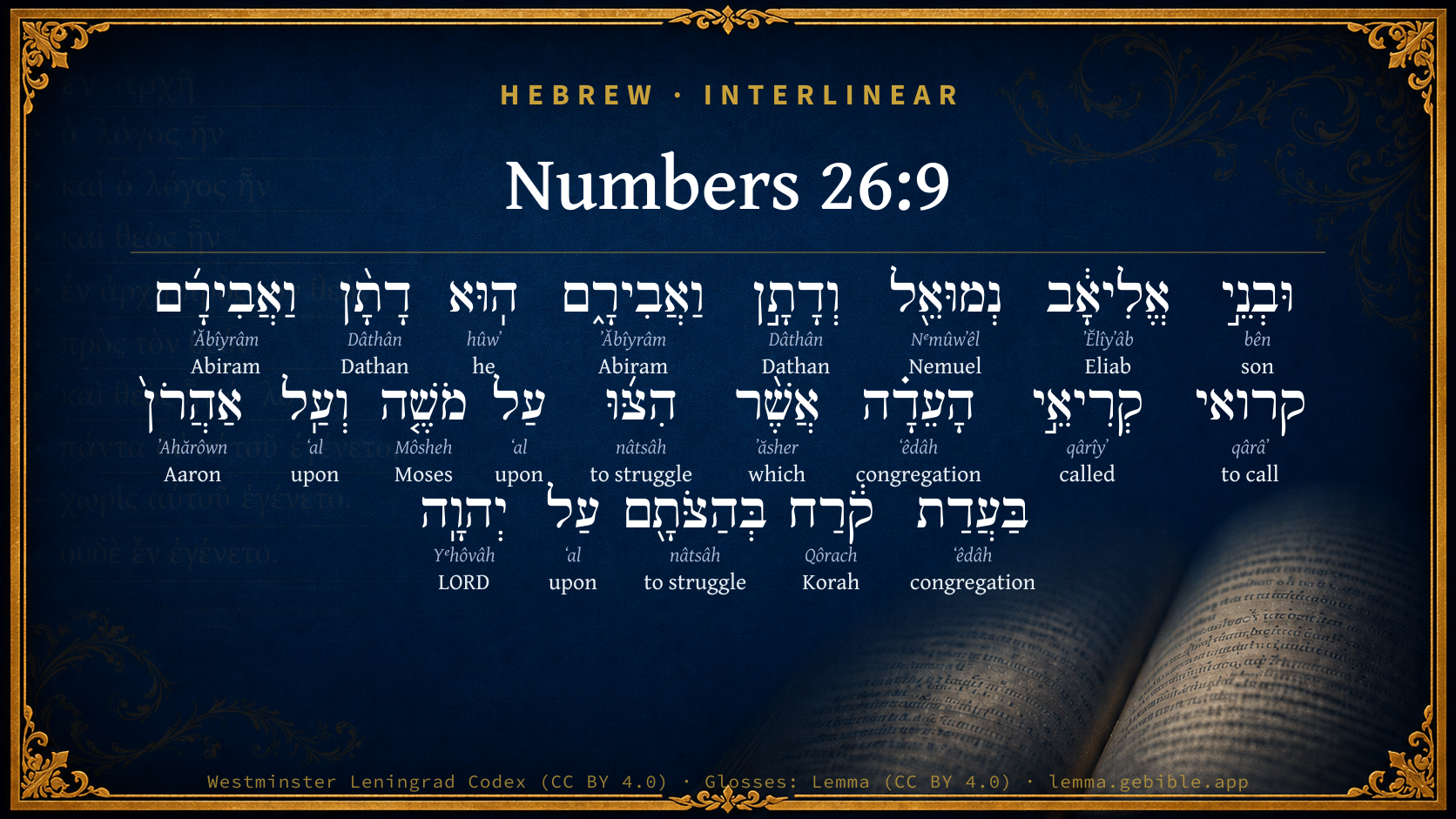
Hebrew (Westminster Leningrad Codex) Numbers 26:9 appears in the Hebrew Old Testament. The text above is from the Westminster Leningrad Codex. Each word links to its Strong’s number, a concise gloss, and parsing drawn from the Open Scriptures Hebrew Bible morphology. Click any word for its full Brown-Driver-Briggs (BDB) entry.
Download image
Cite this verse

Numbers 26:9 (World English Bible). Public Domain. Lemma interlinear Bible study tool, https://lemma.gebible.app/v/numbers/26/9.

Show BibTeX & RIS
BibTeX
RIS
English Translation
The sons of Eliab: Nemuel, and Dathan, and Abiram. These are that Dathan and Abiram, who were called of the congregation, who strove against Moses and against Aaron in the company of Korah, when they strove against Yahweh,
World English Bible · Public Domain
Highlights
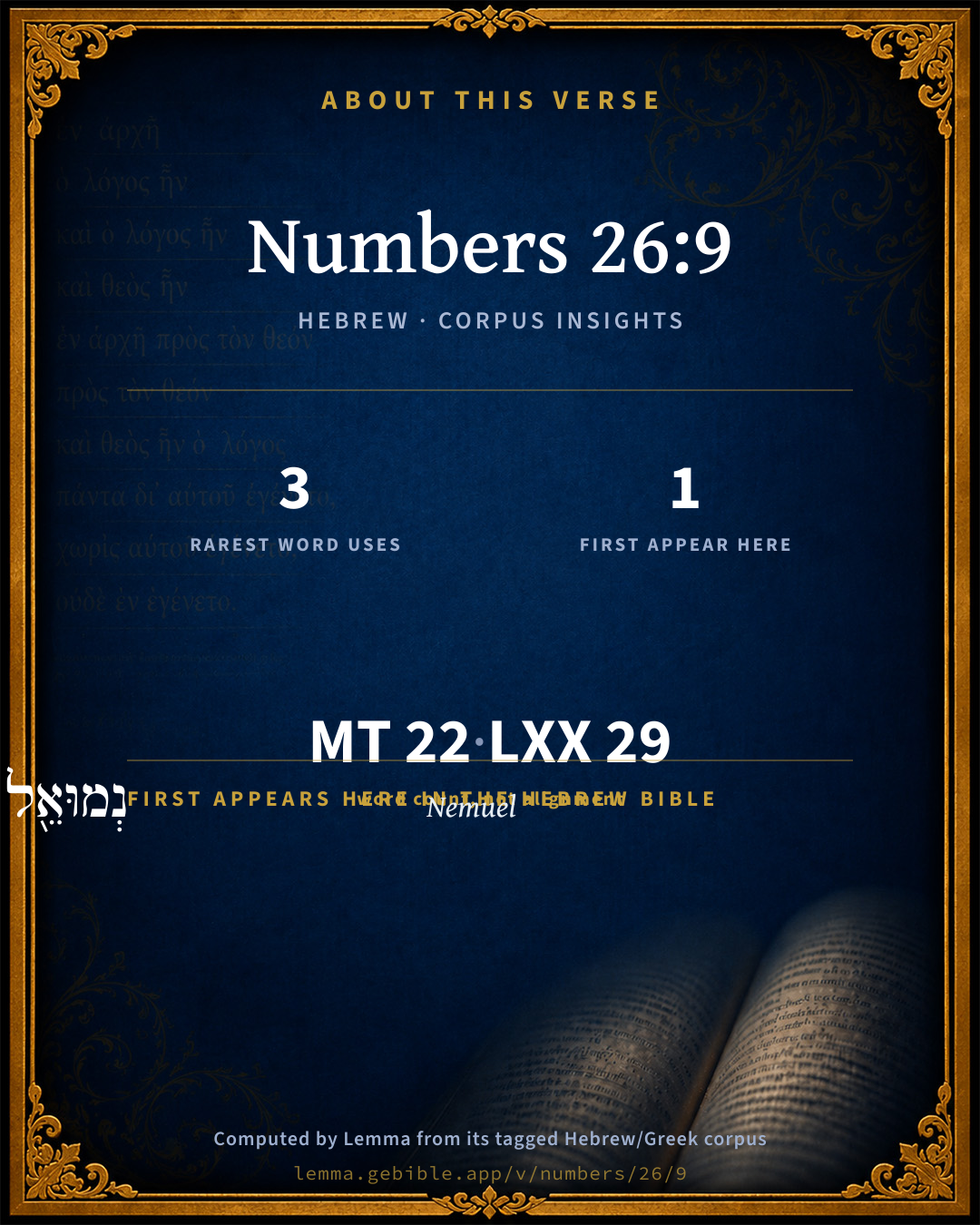
  • 1 first appearance in the Hebrew Bible
Full analysis ↓
Download a study sheet

One document with this verse’s original text, its word-by-word gloss line, the meaning frame, cross-references with their text, attributed commentary, and full source and license credits — printable, and it pastes into notes with its structure intact.

This verse Autodidact and up

Study sheet (.html) Plain text (.txt)

A passage Seminary Student

Up to 50 verses in one chapter. A passage sheet keeps up to 6 commentary sources and 12 cross-references per verse, in the order this page ranks them, and says so on the sheet whenever that leaves anything out. Ask for a single verse and you get the Autodidact verse sheet above.

Everything on this page stays free to read, with no account — the sheet is a download of what is already on screen, not access to it.

Want to remove ads? Support Godless Engineer
Compare translations 3

The same verse in 3 English versions, stacked beneath the original-language interlinear above. Click any original word for its lexicon entry.

Each is an independent rendering of the whole verse — the interlinear is not word-aligned to these translations.

Highlighted words mark where these versions differ — a whole-verse word diff, not a word-by-word alignment.

  • World English Bible Public Domain
    The sons of Eliab: Nemuel, and Dathan, and Abiram. These are that Dathan and Abiram, who were called of the congregation, who strove against Moses and against Aaron in the company of Korah, when they strove against Yahweh,
  • King James Version Public Domain
    And the sons of Eliab; Nemuel, and Dathan, and Abiram. This is that Dathan and Abiram, which were famous in the congregation, who strove against Moses and against Aaron in the company of Korah, when they strove against the LORD:
  • unfoldingWord Literal Text CC BY-SA 4.0
    And the sons of Eliab were Nemuel and Dathan and Abiram. This is Dathan and Abiram, the called ones of the congregation, who rebelled against Moses and against Aaron with the congregation of Korah when they rebelled against Yahweh.

unfoldingWord Literal Text — © unfoldingWord, licensed CC BY-SA 4.0. Word-aligned USFM3 via Door43 (git.door43.org/unfoldingWord/en_ult).

Versions to compare (up to 4)

3 of 4 selected

Show all 18 translations

Every available English version of this verse, each an independent rendering of the whole verse.

  • World English Bible Public Domain
    The sons of Eliab: Nemuel, and Dathan, and Abiram. These are that Dathan and Abiram, who were called of the congregation, who strove against Moses and against Aaron in the company of Korah, when they strove against Yahweh,
  • Berean Standard Bible Public Domain
    and the sons of Eliab were Nemuel, Dathan, and Abiram. It was Dathan and Abiram, chosen by the congregation, who fought against Moses and Aaron with the followers of Korah who rebelled against the LORD.
  • Majority Standard Bible Public Domain
    and the sons of Eliab were Nemuel, Dathan, and Abiram. It was Dathan and Abiram, chosen by the congregation, who rebelled against Moses and Aaron with the followers of Korah who rebelled against the LORD.
  • King James Version Public Domain
    And the sons of Eliab; Nemuel, and Dathan, and Abiram. This is that Dathan and Abiram, which were famous in the congregation, who strove against Moses and against Aaron in the company of Korah, when they strove against the LORD:
  • American Standard Version (1901) Public Domain
    And the sons of Eliab: Nemuel, and Dathan, and Abiram. These are that Dathan and Abiram, who were called of the congregation, who strove against Moses and against Aaron in the company of Korah, when they strove against Jehovah,
  • Revised Version (1885) Public Domain
    And the sons of Eliab; Nemuel, and Dathan, and Abiram. These are that Dathan and Abiram, which were called of the congregation, who strove against Moses and against Aaron in the company of Korah, when they strove against the LORD:
  • Geneva Bible (1599) Public Domain
    And the sonnes of Eliab, Nemuel, and Dathan, and Abiram: this Dathan and Abiram were famous in the Congregation, and stroue against Moses and against Aaron in the assemblie of Korah, when they stroue against the Lord.
  • Douay-Rheims (1899) Public Domain
    His sons, were Namuel and Dathan and Abiron. These are Dathan and Abiron the princes of the people, that rose against Moses and Aaron in the sedition of Core, when they rebelled against the Lord:
  • Young's Literal Translation Public Domain
    and the sons of Eliab `are' Nemuel and Dathan and Abiram; this `is that' Dathan and Abiram, called ones of the company, who have striven against Moses and against Aaron in the company of Korah, in their striving against Jehovah,
  • Literal Standard Version CC BY-SA 4.0
    and the sons of Eliab [are] Nemuel, and Dathan, and Abiram; this [is that] Dathan and Abiram, called ones of the congregation, who have striven against Moses and against Aaron in the congregation of Korah, in their striving against YHWH,
  • Unlocked Literal Bible CC BY-SA 4.0
    Eliab's sons were Nemuel, Dathan, and Abiram. These were the same Dathan and Abiram who followed Korah when they challenged Moses and Aaron and rebelled against Yahweh.
  • unfoldingWord Literal Text CC BY-SA 4.0
    And the sons of Eliab were Nemuel and Dathan and Abiram. This is Dathan and Abiram, the called ones of the congregation, who rebelled against Moses and against Aaron with the congregation of Korah when they rebelled against Yahweh.
  • Darby Bible Public Domain
    and the sons of Eliab were Nemuel, and Dathan, and Abiram. This is that Dathan and Abiram, summoned of the assembly, who contended against Moses and against Aaron in the band of Korah, when they contended against Jehovah.
  • World Messianic Bible Public Domain
    The sons of Eliab: Nemuel, Dathan, and Abiram. These are that Dathan and Abiram who were called by the congregation, who rebelled against Moses and against Aaron in the company of Korah when they rebelled against the LORD;
  • Webster's Bible Public Domain
    And the sons of Eliab; Nemuel, and Dathan, and Abiram. This is that Dathan and Abiram, who were famous in the congregation, who strove against Moses and against Aaron in the company of Korah, when they strove against the LORD:
  • Free Bible Version CC BY-SA 4.0
    and Eliab's sons were Nemuel, Dathan, and Abiram. (It was Dathan and Abiram, leaders chosen by the Israelites, who joined the rebellion against Moses and Aaron with the followers of Korah when they rebelled against the Lord.
  • Bible in Basic English Public Domain
    And the sons of Eliab: Nemuel and Dathan and Abiram. These are the same Dathan and Abiram who had a place in the meeting of the people, who together with Korah made an outcry against Moses and Aaron and against the Lord:
  • JPS Tanakh (1917) Public Domain
    And the sons of Eliab: Nemuel, and Dathan, and Abiram. These are that Dathan and Abiram, the elect of the congregation, who strove against Moses and against Aaron in the company of Korah, when they strove against the LORD;

Literal Standard Version (2020), Covenant Press — licensed CC BY-SA 4.0. Text via the HelloAO Bible API (eBible.org). Unlocked Literal Bible (unfoldingWord) — licensed CC BY-SA 4.0. Text via the HelloAO Bible API (eBible.org). unfoldingWord Literal Text — © unfoldingWord, licensed CC BY-SA 4.0. Word-aligned USFM3 via Door43 (git.door43.org/unfoldingWord/en_ult). Free Bible Version, Dr. Jonathan Gallagher — licensed CC BY-SA 4.0. Text via the HelloAO Bible API (eBible.org).

Word by word

More ways to search: Search by grammar → Find every occurrence → Compare this word →

Practice this passage: Drill this verse → Learn its vocabulary →

נְמוּאֵ֖ל
Nᵉmûwʼêl
H5241
“Nemuel”
Noun, Proper
Part of Speech
Noun
Type
Proper
Full BDB Definition

Origin: apparently for H3223

TWOT: None

Nemuel = "day of God" - the eldest son of Simeon - a Reubenite, son of Eliab and brother of Dathan and Abiram in the time of the exodus
  1. וּבְנֵ֣י bên H1121 “and · sons of” Conjunction + Noun, Common, Masculine, Plural, Construct
  2. אֱלִיאָ֔ב ʼĔlîyʼâb H446 “Eliab” Noun, Proper
  3. וְדָתָ֣ן Dâthân H1885 “and · Dathan” Conjunction + Noun, Proper
  4. וַאֲבִירָ֑ם ʼĂbîyrâm H48 “and · Abiram” Conjunction + Noun, Proper
  5. הֽוּא hûwʼ H1931 “he” Pronoun, Personal, 3rd Person, Masculine, Singular
  6. דָתָ֨ן Dâthân H1885 “Dathan” Noun, Proper
  7. וַאֲבִירָ֜ם ʼĂbîyrâm H48 “and · Abiram” Conjunction + Noun, Proper
  8. קרואי qârâʼ H7121 “called” Verb, Qal, Participle Passive, Masculine, Plural, Construct
  9. קְרִיאֵ֣י qârîyʼ H7148 “called of” Adjective, Adjective, Masculine, Plural, Construct
  10. הָעֵדָ֗ה ʻêdâh H5712 “the · congregation” Particle, Definite Article + Noun, Common, Feminine, Singular, Absolute
  11. אֲשֶׁ֨ר ʼăsher H834 “which” Particle, Relative
  12. הִצּ֜וּ nâtsâh H5327 “to struggle” Verb, Hiphil, Perfect, 3rd Person, Common, Plural
  13. עַל ʻal H5921 “upon” Preposition
  14. מֹשֶׁ֤ה Môsheh H4872 “Moses” Noun, Proper
  15. וְעַֽל ʻal H5921 “and · upon” Conjunction + Preposition
  16. אַהֲרֹן֙ ʼAhărôwn H175 “Aaron” Noun, Proper
  17. בַּעֲדַת ʻêdâh H5712 “in/at · congregation of” Preposition + Noun, Common, Feminine, Singular, Construct
  18. קֹ֔רַח Qôrach H7141 “Korah” Noun, Proper
  19. בְּהַצֹּתָ֖ם nâtsâh H5327 “in/at · to struggle · them” Preposition + Verb, Hiphil, Infinitive Construct + Suffix, Personal, 3rd Person, Masculine, Plural
  20. עַל ʻal H5921 “upon” Preposition
  21. יְהוָֽה Yᵉhôvâh H3068 “LORD” Noun, Proper

About this verse

These counts appear in no published source. They are computed here, from the morphology-tagged text and Lemma’s own curated glosses. What Lemma adds →

22
words
16
distinct lemmas
Pentateuch
section

Notable vocabulary

The rarest word here is נְמוּאֵ֖ל Nemuel H5241 — appearing just 3 times in the whole Hebrew Bible.

First appearance in Scripture

This word makes its first canonical appearance in the Hebrew Bible here:

  • נְמוּאֵ֖ל Nemuel H5241

Shared distinctive vocabulary

נְמוּאֵ֖ל Nemuel H5241 occurs in 3 verses of the Hebrew Bible. Also found in:

Grammatical profile

  • 3 verbs
  • 13 nouns
  • 1 adjective
  • 1 pronoun
  • 3 prepositions
  • 1 particle

Verb forms

  • קרואי Qal · Participle Passive
  • הִצּ֜וּ Hiphil · Perfect
  • בְּהַצֹּתָ֖ם Hiphil · Infinitive Construct

Repetition

Words recur within this verse — often emphatic in Hebrew:

  • עַל upon H5921 ×3
  • וְדָתָ֣ן Dathan H1885 ×2
  • וַאֲבִירָ֑ם Abiram H48 ×2
  • הָעֵדָ֗ה congregation H5712 ×2
  • הִצּ֜וּ to struggle H5327 ×2

Hebrew & Septuagint length

In English translation the verse runs 38 words from the Hebrew and 38 from the Septuagint (LXX English) — the same length.

A rough comparison of the two English renderings, which tokenize alike — not a word-level alignment.

Word counts can differ between the Hebrew and the Greek without any difference in meaning — e.g. the Hebrew direct-object marker אֵת has no separate Greek word, and Greek often adds the article ὁ.

In the original languages it is 22 Hebrew tokens and 29 Greek tokens — but the two are counted differently (Hebrew bundles its prefixes and suffixes into one token; the Greek is in lemma form), so that isn’t a like-for-like length.

Cross-references

4

Topical passages linked to Numbers 26:9 in the Treasury of Scripture Knowledge — connected by theme and wording, ordered by reader-vote popularity; previews shown in the World English Bible.

  • Numbers 1:16 These are those who were called of the congregation, the princes of the tribes of their fathers; they were the heads of the thousands of Israel.
  • Numbers 16:1–35 Now Korah, the son of Izhar, the son of Kohath, the son of Levi, with Dathan and Abiram, the sons of Eliab, and On, the son of Peleth, sons of Reuben, took [men]:
  • Psalms 106:17 The earth opened and swallowed up Dathan, And covered the company of Abiram.
  • Jude 1:11 Woe to them! For they went in the way of Cain, and ran riotously in the error of Balaam for hire, and perished in Korah's rebellion.

Cross-references courtesy of OpenBible.info (CC BY 4.0).

Hebrew and Greek witnesses Masoretic Hebrew ↔ Greek Septuagint

The same verse in the two great witnesses to the Old Testament, shown verse-for-verse.

These are two independent witnesses, not word-aligned to each other, and the Septuagint is shown in lemma (dictionary) form.

Hebrew Numbers 26:9 Masoretic · Westminster Leningrad Codex

וּבְנֵ֣י אֱלִיאָ֔ב נְמוּאֵ֖ל וְדָתָ֣ן וַאֲבִירָ֑ם הֽוּא דָתָ֨ן וַאֲבִירָ֜ם קרואי קְרִיאֵ֣י הָעֵדָ֗ה אֲשֶׁ֨ר הִצּ֜וּ עַל מֹשֶׁ֤ה וְעַֽל אַהֲרֹן֙ בַּעֲדַת קֹ֔רַח בְּהַצֹּתָ֖ם עַל יְהוָֽה

The sons of Eliab: Nemuel, and Dathan, and Abiram. These are that Dathan and Abiram, who were called of the congregation, who strove against Moses and against Aaron in the company of Korah, when they strove against Yahweh,

World English Bible · Public Domain

Greek LXX Numbers 26:9 Septuagint · lemma form

καί υἱός ελιαβ ναμουηλ καί δαθαν καί αβιρων οὗτος ἐπίκλητος ὁ συναγωγή οὗτος εἰμί ὁ ἐπι συνἵστημι ἐπί μωυσῆς καί ἀαρών ἐν ὁ συναγωγή κορε ἐν ὁ ἐπισύστασις κύριος

and the sons of Eliab, Namuel, and Dathan, and Abiron: these are renowned men of the congregation; these are they that rose up against Moses and Aaron in the gathering of Core, in the rebellion against the Lord.

LXX2012 (modern English Septuagint) · Public Domain

Hebrew: Westminster Leningrad Codex (CC BY 4.0). Greek: Septuagint (public domain); English from LXX2012 (modern English Septuagint) (Public Domain). How the Septuagint differs from the Hebrew →

Targum (Aramaic paraphrase)

2

The Targum is the ancient Jewish Aramaic paraphrase of the Hebrew Scriptures — an interpretive translation, not the Hebrew text itself. Onkelos (literal) and Pseudo-Jonathan (expansive) render the Torah, and Jonathan the Prophets. Coverage is partial: where no permissively-licensed English translation exists for a verse, only the Aramaic is shown. This is verse-level text, not a word-by-word alignment to the Hebrew.

  1. Targum Onkelos Torah (Genesis–Deuteronomy)
    וּבְנֵי אֱלִיאָב נְמוּאֵל וְדָתָן וַאֲבִירָם הוּא דָתָן וַאֲבִירָם מְעַרְעֵי כְּנִשְׁתָּא דְאִתְכְּנָשׁוּ עַל משֶׁה וְעַל אַהֲרֹן בִּכְנִשְׁתָּא דְקֹרַח בְּאִתְכַּנוֹשֵׁיהוֹן עַל יְיָ

    (no public-domain English translation for this verse)

    Targum Onkelos — Aramaic: “Onkelos Genesis” (public domain); “Onkelos Exodus” (public domain); “Onkelos Leviticus” (public domain); “Onkelos Numbers” (public domain); “Onkelos Deuteronomy” (public domain). English: “Sefaria Community Translation” (CC0 1.0 (public-domain dedication)); “J.W. Etheridge. The Targums of Onkelos and Jonathan Ben Uzziel on the Pentateuch. London: Longmans, Green, 1862” (public domain). Text via Sefaria.

  2. Targum Pseudo-Jonathan Torah (Genesis–Deuteronomy)
    וּבְנוֹי דֶאֱלִיאָב נְמוּאֵל וְדָתָן וַאֲבִירָם הוּא דָתָן וַאֲבִירָם מְעַרְעֵי כְנִשְׁתָּא דְאִתְכַּנָשׁוּ וּפְלִיגוּ עַל משֶׁה וְעַל אַהֲרן בִּכְנִישְׁתָּא דְקרַח בִּזְמַן דְאִתְכַּנָשׁוּ וּפְלִיגוּ עַל יְיָ

    the sons of Eliab, Nemuel, and Dathan, and Abiram. The same were Dathan and Abiram who brought together the congregation that gathered and made the division against Mosheh and Aharon in the congregation of Korach, when they gathered together and made division against the Lord,

    Targum Pseudo-Jonathan — Aramaic: “Targum Jonathan on Genesis” (public domain); “Targum Jonathan on Exodus” (public domain); “Targum Jonathan on Leviticus” (public domain); “Targum Jonathan on Numbers” (public domain); “Targum Jonathan on Deuteronomy” (public domain). English: “The Targum of Jonathan ben Uzziel, trans. J. W. Etheridge, London, 1862” (public domain). Text via Sefaria.

Commentary

Notes on Numbers 26:9 from classic Christian and Jewish commentators (each source and its license shown beneath its notes). The classic Christian expositions comment on the surrounding passage and are grouped to its opening verse, so a note may address several verses; the Jewish commentaries on the Tanakh (Rashi and others) are per-verse, so they appear only where the commentator wrote on this verse.

Lemma curates 59 commentaries, every one of them public domain or Creative Commons licensed, each selected and text-cleaned for this edition rather than reprinted as found. About our sources →

Trapp's Complete Commentary

John Trapp

Num 26:9 And the sons of Eliab; Nemuel, and Dathan, and Abiram. This [is that] Dathan and Abiram, [which were] famous in the congregation, who strove against Moses and against Aaron in the company of Korah, when they strove against the LORD:

Ver. 9. Which were famous.] But for no goodness. Tubulus, who was the Roman praetor a little afore Cicero’s time, was homo tam proiecte improbus, ut eius nomen non hominis sed vitii esse videretur, so wicked a wretch, that he seemed to be wickedness itself. {a} Portius Latro calleth Catiline, sacrarium libidinum, portentum scelerum, gurgitem et sentinam flagitiorum, &c., a sink of sinfulness. And Josephus saith of Antipater, that his life was no better than a mystery of iniquity. These men were famous, or rather infamous, for their flagitious practices; notoriously naught; signally sinful.

{a} Lips., Antiq. Lection.

John Trapp, A Commentary or Exposition upon All the Books of the Old and New Testament (1647–1656) — public domain. Text from a community e-Sword module.

The Biblical Illustrator

Joseph S. Exell

Num_26:9-11

The earth opened her mouth, and swallowed them up.

Solemn monitors against sin

Sin and infamy cling to families long after the actors have passed away. Parents ought to strive above all to leave to their children the heritage of a good name. Sin and infamy are long lived; as in the verse of our text, many years after the descendants are reminded of their ancestors crime. Their sin was to oppose Moses and God--using their influence as men of note to create a rebellion. God visited them for their sin--And they became a sign (see chap. 16.). They became symbols, beacons. God made use of them to teach great lessons. Visitations like that have tongues; they speak to us from God.

I. The insidious character of sin. Sin grows upon us; never trifle with it; safety in the opposing it. As the moth, dazzled with the light, &c., ends in being scorched or burnt, so it ever is with those who trifle with sin and parley with temptation.

II. They warn us of the terrible evil and danger of sin. Sin becomes our greatest curse; we have, indeed, nothing else to fear.

III. They show us what a curse bad men are to their families and others. If there is any manhood left in one, this thought must arrest his attention.

IV. They show us Gods desire to benefit man. (David Lloyd.)

The victims of sin a warning to others

I. A warning against the commission of sin.

II. A warning against association with sinners.

III. A warning against tempting others. (Lay Preacher.)

Notwithstanding the children of Korah died not.--

Children that live

Notwithstanding, the children of Korah died not. May we not read it--that though the sire dies the progeny lives? There is a continuity of evil in the world. We only cut off the tops of iniquities, their deep roots we do not get at; we pass the machine over the sward, and cut off the green tops of things that are offensive to us; but the juicy root is struck many inches down into the earth, and our backs will hardly be turned, and the click of the iron have ceased, before those roots are asserting themselves in new and obvious growths. Iniquity is not to be shaved off the earth--ironed and mowed away like an obnoxious weed--it must be uprooted, torn right up by every thinnest, frailest fibre of its bad self, and then, having been torn out, left for the fire of the sun to deal with--the fire of mid-day is against it and will consume it. And thus only can growths of evil be eradicated and destroyed. It is an awful thing to live! You cannot tell where influence begins, how it operates, or how it ends. The boy sitting next you is partly yourself, and he cannot help it, You cannot turn round and say, You must look after yourself as I had to do. That is a fools speech. You can never shake off the responsibility of having helped in known and unknown ways and degrees to make that boy what he is. Life is not a surface matter, a loose pebble lying on the road that men can take up and lay down again without any particular harm being done. When the boy drinks himself into madness, he may be but expressing the influences wrought within him by three generations. When the young man tells a lie, he may be surprised at his own audacity, and feel as if he were rather a tool and a victim than a person and a responsible agent--as if generations of liars were blackening his young lips with their falsehoods. When this youth is restive and will not go to the usual church, do not blame the modern spirit of scepticism and restlessness, but go sharply into the innermost places of your own heart, and see how far you have bolted the church doors against your son, or made a place which he would be ashamed to be seen in. Then there is a bright side to all this view. I can, now that I have got my rough reading done, turn this notwithstanding into a symbol of hope, a light of history; I can make high and inspiring uses of it. I will blot out the word, Korah, and fill in other names, and then the moral lesson of the text will expand itself into gracious meanings, rise above us like a firmament crowded with innumerable and brilliant lights. In days long ago they killed the martyrs--notwithstanding, the children of the martyrs died not. There the light begins to come; there I hear music lifting up sweetest voice of testimony and hope. So, in all the ages, one generation passeth away and another generation cometh, and still Christs following enlarges; on the whole, he sums up into higher figures year by year. Not that I care for census-religion, not that I would number people for the purpose of ascertaining Christs position in the world. The kingdom of heaven cometh not with observation; is not a matter of census-reckoning or statistic-returns; it is a matter of spiritual quality, inner manhood, meaning and attitude of the soul; and amid all sin, struggle, doubt, difficulty, darkness, the kingdom moves. (J. Parker, D. D.)

The children of Korah

These sons of Korah were afterwards in their prosperity eminently serviceable to the Church, being employed by David as singers in the house of the Lord; hence many psalms are said to be for the sons of Korah; and perhaps they were made to bear his name so long after, rather than the name of any other of their ancestors, for warning to themselves, and as an instance of the power of God, which brought those choice fruits even out of that bitter root. The children of families that have been stigmatised, should endeavour by their eminent virtues to bear away the reproach of their fathers. (Matthew Henry, D. D.)

The Biblical Illustrator, edited by Joseph S. Exell (c. 1880s–1900s) — public domain. Text from a community e-Sword module.

Geneva Bible (1599)

Geneva Bible translators

In that rebellion whereof Korah was head.

Geneva Bible (1599) marginal notes — public domain. Text via Bolls.life.

The Cambridge Bible for Schools and Colleges

gen. ed. J. J. S. Perowne

9–11. The mention of Dathan and Abiram leads the writer, or a later editor, to add a note recalling the incidents of ch. 16. He combines the story of Dathan and Abiram with that of Korah in such a way that the events are inextricably confused.

The Cambridge Bible for Schools and Colleges (gen. ed. J. J. S. Perowne; Cambridge University Press, 1878–1918) — public domain. Text from a community e-Sword module.

John Gill's Exposition

And the earth opened her mouth, and swallowed them up,.... Not only Dathan and Abiram, but their wives and children, their houses and tents, and all their goods, see Num 16:32 together with Korah; the words being thus rendered, and standing in such close connection with the preceding, some have concluded from hence that Korah was swallowed up with them in the earth; whereas he seems rather to have been at that time with the two hundred and fifty men that had censers at the door of the tabernacle, and was consumed by fire with them, see Num 16:16 and, indeed, it is suggested here, for the phrase may be rendered, "and the things of Korah" (m); what appertained unto him, his men, tents, goods, and substance, which agrees with Num 16:32 or, "and as for Korah" (n); with respect to him: "when that company died": he was at the head of, he died also, the same death they died, by fire, as follows:

what time the fire devoured two hundred and fifty men; which was the number his company consisted of, who took censers, and offered incense, and were consumed by fire, Num 16:2, and with whom, in all probability, he perished:

and they became a sign, were made an example of, to deter others from the like practices, and particularly usurping any part of the priest's office: some connect the words with the following, and take the sense to be, that this was the sign or miracle, that when they perished, Korah's sons died not, but were preserved; which sense is countenanced by the Vulgate Latin, but the other sense is best.

(m) "et quae erant, Korachi", Junius & Tremellius. (n) So Pool, Patrick; "deinde et Corah (qui periit) in morte congregationis", Tigurine version.

John Gill's Exposition of the Whole Bible (1746–1763) — public domain (CC PDM 1.0). Text via the HelloAO Bible API.

Haydock's Catholic Bible Commentary

Princes. Hebrew, "men of name in the congregation," senators. (Vatable) (Chap. xvi. 2.)

George Leo Haydock (1774–1849), Haydock's Catholic Family Bible and Commentary, 1859 edition — public domain. Excludes Psalms (Douay-Rheims chapter numbering differs from Protestant) and Deuterocanonical books (Catholic canon only).

Rashi

Rabbi Shlomo Yitzchaki (Rashi)

אשר הצו WHO INCITED — i.e., who incited Israel, על משה AGAINST MOSES,

בהצתם WHEN THEY INCITED the people AGAINST THE LORD.

הצו means they persuaded Israel to strive against Moses — it is a grammatical form denoting “they caused someone to do something".

Rashi on the Tanakh — English translations: “The Judaica Press complete Tanach with Rashi, translated by A. J. Rosenberg” (CC BY 4.0); “Pentateuch with Rashi's commentary by M. Rosenbaum and A.M. Silbermann, 1929-1934” (public domain); “The Metsudah Tanach series, Lakewood, N.J” (CC BY 4.0); and “The Book of Joshua, Metsudah Publications, 1997” (CC BY 4.0). Text via Sefaria.

Ramban (Nachmanides)

Rabbi Moshe ben Nachman (Ramban / Nachmanides)

AND THE SONS OF ELIAB: NEMUEL, AND DATHAN, AND ABIRAM. THESE ARE DATHAN AND ABIRAM WHO [QUARRELLED AGAINST MOSES] etc. Scripture mentions this [episode leading to the death of Dathan and Abiram] in order to indicate that the whole inheritance of the Palluite family remained for Nemuel alone, because Dathan and Abiram [the other sons of Eliab] and all their belongings were swallowed up [in the earth, and hence Nemuel was the only surviving son of Eliab, who was in turn the only son of Pallu]. Or it may be, as our Rabbis have said, that [Dathan and Abiram’s death is mentioned here] to allude [to the fact] that they lost their share in the Land even though they were amongst those who came out of Egypt, and were therefore eligible to [receive] an inheritance.

Ramban (Nachmanides) on the Tanakh — English translation: “Commentary on the Torah by Ramban (Nachmanides). Translated and annotated by Charles B. Chavel. New York, Shilo Pub. House, 1971-1976” (CC BY 4.0). Text via Sefaria.

Lesson kit

Teaching starters — assembled from the data on this page, not authored interpretation. Every prompt links to the verse data it draws on. Edit before teaching.

Numbers, in the Pentateuch, opens this verse with 22 words (16 distinct Hebrew lemmas). Its most distinctive word is Nᵉmûwʼêl (“Nemuel”). A historical commentator’s framing appears above. Read the whole chapter for the surrounding context.

Discussion questions

  1. How does “Nemuel” (Nᵉmûwʼêl) shape what this verse is saying?
  2. This is the first place “Nemuel” appears in Scripture (first appears here). What does its debut here establish?
  3. How does Numbers 26:12, which shares the word «Nemuel», read alongside this verse?
  4. What does the repetition of “upon” (3× in this one verse) do in this verse?
  5. These translations render this verse differently; the difference is in the English rendering, not the original. What questions does that raise?
  6. «קרואי» is a Qal Participle Passive verb. How does that grammatical form shape the action described?
  7. Compare how Trapp's Complete Commentary and The Biblical Illustrator read this verse. Where do they agree or differ?

Things to notice

Reading settings

Reading text

Shown beneath each verse's original-language words.

Old Testament
Old Testament edition

Read the OT as the Masoretic Hebrew (MT) or the Greek Septuagint (LXX).

English shown for the Greek Septuagint (in the Hebrew ↔ Greek comparison).

Comparing translations? Open the Compare panel on any verse page to stack up to four side by side.