
Proverbs 18:13

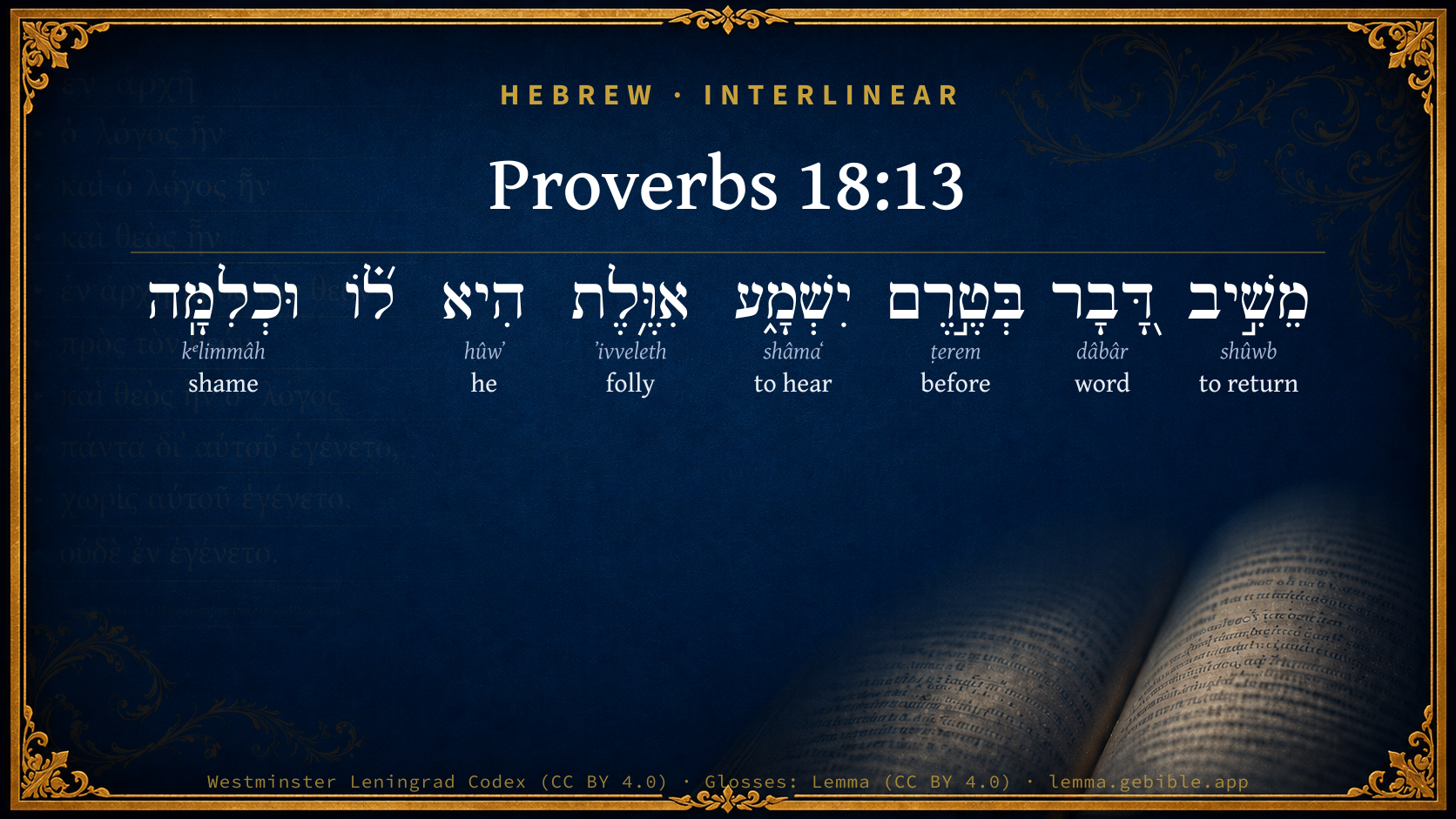
Hebrew (Westminster Leningrad Codex) Proverbs 18:13 appears in the Hebrew Old Testament. The text above is from the Westminster Leningrad Codex. Each word links to its Strong’s number, a concise gloss, and parsing drawn from the Open Scriptures Hebrew Bible morphology. Click any word for its full Brown-Driver-Briggs (BDB) entry.
Download image
Cite this verse

Proverbs 18:13 (World English Bible). Public Domain. Lemma interlinear Bible study tool, https://lemma.gebible.app/v/proverbs/18/13.

Show BibTeX & RIS
BibTeX
RIS
English Translation
He who gives answer before he hears, That is folly and shame to him.
World English Bible · Public Domain
Download a study sheet

One document with this verse’s original text, its word-by-word gloss line, the meaning frame, cross-references with their text, attributed commentary, and full source and license credits — printable, and it pastes into notes with its structure intact.

This verse Autodidact and up

Study sheet (.html) Plain text (.txt)

A passage Seminary Student

Up to 50 verses in one chapter. A passage sheet keeps up to 6 commentary sources and 12 cross-references per verse, in the order this page ranks them, and says so on the sheet whenever that leaves anything out. Ask for a single verse and you get the Autodidact verse sheet above.

Everything on this page stays free to read, with no account — the sheet is a download of what is already on screen, not access to it.

Want to remove ads? Support Godless Engineer
Compare translations 3

The same verse in 3 English versions, stacked beneath the original-language interlinear above. Click any original word for its lexicon entry.

Each is an independent rendering of the whole verse — the interlinear is not word-aligned to these translations.

Highlighted words mark where these versions differ — a whole-verse word diff, not a word-by-word alignment.

  • World English Bible Public Domain
    He who gives answer before he hears, That is folly and shame to him.
  • King James Version Public Domain
    He that answereth a matter before he heareth it, it is folly and shame unto him.
  • unfoldingWord Literal Text CC BY-SA 4.0
    One who returns a word before he listens, it folly to him and shame.

unfoldingWord Literal Text — © unfoldingWord, licensed CC BY-SA 4.0. Word-aligned USFM3 via Door43 (git.door43.org/unfoldingWord/en_ult).

Versions to compare (up to 4)

3 of 4 selected

Show all 18 translations

Every available English version of this verse, each an independent rendering of the whole verse.

  • World English Bible Public Domain
    He who gives answer before he hears, That is folly and shame to him.
  • Berean Standard Bible Public Domain
    He who answers a matter before he hears it—this is folly and disgrace to him.
  • Majority Standard Bible Public Domain
    He who answers a matter before he hears it—this is folly and disgrace to him.
  • King James Version Public Domain
    He that answereth a matter before he heareth it, it is folly and shame unto him.
  • American Standard Version (1901) Public Domain
    He that giveth answer before he heareth, It is folly and shame unto him.
  • Revised Version (1885) Public Domain
    He that giveth answer before he heareth, it is folly and shame unto him.
  • Geneva Bible (1599) Public Domain
    He that answereth a matter before hee heare it, it is folly and shame vnto him.
  • Douay-Rheims (1899) Public Domain
    He that answereth before he heareth sheweth himself to be a fool, and worthy of confusion.
  • Young's Literal Translation Public Domain
    Whoso is answering a matter before he heareth, Folly it is to him and shame.
  • Literal Standard Version CC BY-SA 4.0
    Whoever is answering a matter before he hears, || It is folly to him—and shame.
  • Unlocked Literal Bible CC BY-SA 4.0
    One who answers before listening— it is his folly and shame.
  • unfoldingWord Literal Text CC BY-SA 4.0
    One who returns a word before he listens, it folly to him and shame.
  • Darby Bible Public Domain
    He that giveth answer before he heareth, it is folly and shame unto him.
  • World Messianic Bible Public Domain
    He who answers before he hears, that is folly and shame to him.
  • Webster's Bible Public Domain
    He that answereth a matter before he heareth it, it is folly and shame to him.
  • Free Bible Version CC BY-SA 4.0
    Replying before hearing is stupidity and shame.
  • Bible in Basic English Public Domain
    To give an answer before hearing is a foolish thing and a cause of shame.
  • JPS Tanakh (1917) Public Domain
    He that giveth answer before he heareth, it is folly and confusion unto him.

Literal Standard Version (2020), Covenant Press — licensed CC BY-SA 4.0. Text via the HelloAO Bible API (eBible.org). Unlocked Literal Bible (unfoldingWord) — licensed CC BY-SA 4.0. Text via the HelloAO Bible API (eBible.org). unfoldingWord Literal Text — © unfoldingWord, licensed CC BY-SA 4.0. Word-aligned USFM3 via Door43 (git.door43.org/unfoldingWord/en_ult). Free Bible Version, Dr. Jonathan Gallagher — licensed CC BY-SA 4.0. Text via the HelloAO Bible API (eBible.org).

Word by word

More ways to search: Search by grammar → Find every occurrence → Compare this word →

Practice this passage: Drill this verse → Learn its vocabulary →

About this verse

These counts appear in no published source. They are computed here, from the morphology-tagged text and Lemma’s own curated glosses. What Lemma adds →

8
words
7
distinct lemmas
Wisdom
section

Notable vocabulary

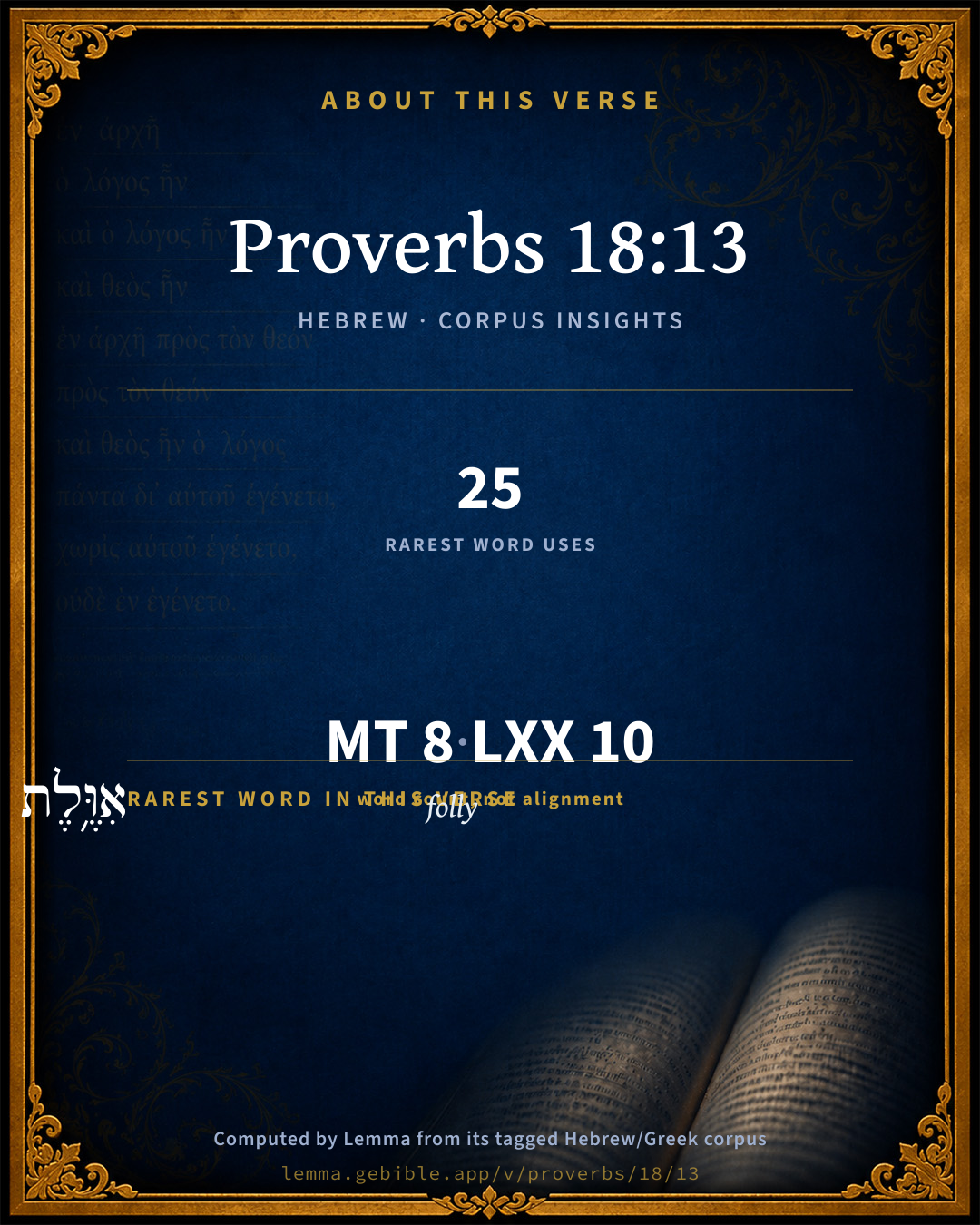
The rarest word here is אִוֶּ֥לֶת folly H200 — appearing just 25 times in the whole Hebrew Bible.

Shared distinctive vocabulary

אִוֶּ֥לֶת folly H200 occurs in 24 verses of the Hebrew Bible. Also found in:

Grammatical profile

  • 2 verbs
  • 3 nouns
  • 1 pronoun
  • 1 preposition
  • 1 adverb

Verb forms

  • מֵשִׁ֣יב Hiphil · Participle Active
  • יִשְׁמָ֑ע Qal · Imperfect

Hebrew & Septuagint length

In English translation the verse runs 14 words from the Hebrew and 16 from the Septuagint (LXX English) — closely comparable.

A rough comparison of the two English renderings, which tokenize alike — not a word-level alignment.

Word counts can differ between the Hebrew and the Greek without any difference in meaning — e.g. the Hebrew direct-object marker אֵת has no separate Greek word, and Greek often adds the article ὁ.

In the original languages it is 8 Hebrew tokens and 10 Greek tokens — but the two are counted differently (Hebrew bundles its prefixes and suffixes into one token; the Greek is in lemma form), so that isn’t a like-for-like length.

Cross-references

4

Topical passages linked to Proverbs 18:13 in the Treasury of Scripture Knowledge — connected by theme and wording, ordered by reader-vote popularity; previews shown in the World English Bible.

  • John 7:51 "Does our law judge a man, unless it first hears from him personally and knows what he does?"
  • Deuteronomy 13:14 then shall you inquire, and make search, and ask diligently; and, behold, if it be truth, and the thing certain, that such abomination is done in the midst of you,
  • Proverbs 20:25 It is a snare to a man to make a rash dedication, Then later to consider his vows.
  • Job 29:16 I was a father to the needy. The cause of him who I didn't know, I searched out.

Cross-references courtesy of OpenBible.info (CC BY 4.0).

Hebrew and Greek witnesses Masoretic Hebrew ↔ Greek Septuagint

The same verse in the two great witnesses to the Old Testament, shown verse-for-verse.

These are two independent witnesses, not word-aligned to each other, and the Septuagint is shown in lemma (dictionary) form.

Hebrew Proverbs 18:13 Masoretic · Westminster Leningrad Codex

מֵשִׁ֣יב דָּ֭בָר בְּטֶ֣רֶם יִשְׁמָ֑ע אִוֶּ֥לֶת הִיא ל֝֗וֹ וּכְלִמָּֽה

He who gives answer before he hears, That is folly and shame to him.

World English Bible · Public Domain

Greek LXX Proverbs 18:13 Septuagint · lemma form

ὅς ἀποκρίνω λόγος πρίν ἀκούω ἀφροσύνη αὐτός εἰμί καί ὄνειδος

Whoso answers a word before he hears a cause, it is folly and reproach to him.

LXX2012 (modern English Septuagint) · Public Domain

Hebrew: Westminster Leningrad Codex (CC BY 4.0). Greek: Septuagint (public domain); English from LXX2012 (modern English Septuagint) (Public Domain). How the Septuagint differs from the Hebrew →

Commentary

Notes on Proverbs 18:13 from classic Christian and Jewish commentators (each source and its license shown beneath its notes). The classic Christian expositions comment on the surrounding passage and are grouped to its opening verse, so a note may address several verses; the Jewish commentaries on the Tanakh (Rashi and others) are per-verse, so they appear only where the commentator wrote on this verse.

Lemma curates 59 commentaries, every one of them public domain or Creative Commons licensed, each selected and text-cleaned for this edition rather than reprinted as found. About our sources →

Trapp's Complete Commentary

John Trapp

Pro 18:13 He that answereth a matter before he heareth [it], it [is] folly and shame unto him.

Ver. 13. He that answereth a matter before he heareth it.] Solomon had said before, that "even a fool, when he holdeth his peace, is counted wise," {Pro 17:28} and in many passages of this blessed book he sets forth that a great part of man’s wisdom is shown in his words. To be too forward to answer, before the question be fully propounded or expounded is rash, if not proud boldness, and reflects shame upon them that do it. Likewise to be "slow to hear, swift to speak," - hath not God given us two ears, and one tongue, to teach us better? - to precipitate a censure, or pass sentence before both parties be heard, to speak evil of the things that a man knows not, or weakly and insufficiently to defend that which is good against a subtle adversary; Augustine professeth this was it that hardened him; and made him to triumph in his former manicheeism, that he met with feeble opponents, and such as his nimble wit was easily able to overturn. Oecolampadius said of Carolostadius, that he had a good cause, but wanted shoulders to support it.

John Trapp, A Commentary or Exposition upon All the Books of the Old and New Testament (1647–1656) — public domain. Text from a community e-Sword module.

Joseph Benson's Commentary

Pro 18:13. He that answereth a matter before he beareth it — Before he hath fully heard and considered what another is speaking about it; it is folly and shame unto him — It is a shameful folly, though he seek the reputation of a wise man by it; as if he could readily and thoroughly understand all that another can say before he has uttered it.

Joseph Benson's Commentary on the Old and New Testaments (1811–1818) — public domain. Text from a community e-Sword module.

The Preacher's Complete Homiletical Commentary

Joseph S. Exell (gen. ed.)

MAIN HOMILETICS OF Pro_18:13

ANSWERING BEFORE HEARING

I. A man who gives judgment in a matter before he has heard all the facts of the case wrongs himself. If he were to give his opinion upon a building as soon as the builders had dug out the foundation, or were to criticise a picture when the artist had only sketched its outline upon his canvas, he would be deemed a fool, and what he said would have no weight whatever. Men would justly say that the house or the picture had as yet no existence, and therefore could not be judged. And a man who has only heard a part of “a matter” is in no better position to judge in it, and commits as great a folly if he attempts to do so. He does violence to his own understanding—to those mental faculties which enable him to place things side by side and to compare them, and to sift and weigh evidence before he arrives at a conclusion. Unless he does this, the opinion that he forms to-day will be altered to-morrow, and his mind will never be firmly made up on any subject. As a necessary consequence, nobody will give much heed to his judgment—no thoughtful person will attach much weight to his words—and he will thus deprive himself of that consideration and respect which he might otherwise have enjoyed.

II. Such a man often deeply wrongs others. A half-told story often makes the state of matters appear so different from the truth that it is a gross injustice to condemn or justify any person when that is all that is known. A man who does it proclaims that he values very lightly the reputation of those concerned, and is often a robber of what is more to a man than his purse, viz. his good name.

OUTLINES AND SUGGESTIVE COMMENTS

Secularly, this is beyond a doubt; judicially, here is a great outrage; socially, a something very impolite; but religiously, a thing altogether a “shame.” Men born yesterday might certainly afford to listen. Life is a wide thing; and might, at least, be acted through, before in the darker points we insist upon a judgment … Folly, and therefore, mischief; shame, and therefore, ill desert. These elements often appear together.—Miller.

According to Mr. Stuart Mill, it might be plausibly maintained that in almost every one of the leading controversies, past or present, in social philosophy, both sides were right in what they affirmed, though wrong in what they denied; and that if either could have been made to take the other’s views in addition to his own, little more would have been needed to make its doctrine correct.… Nicodemus did well to start the seasonable query, “Doth our law judge any man before it hear him, and know what he doth?” Festus did well to protest that it was not the manner of the Romans to deliver any man to die before that he which was accused had the accusers face to face, and had licence to answer for himself concerning the charge laid against him. And in the same spirit and by the same rule, otherwise applied, had Felix done well to defer hearing Paul’s defence until Paul’s accusers were present.… Aristides, they tell us, would lend but one ear to anyone who accused an absent “party,” and used to hold his hand on the other, intimating that he reserved one ear for the absentee accused.… Cicero, “the greatest orator, save one, of antiquity,” has left it on record, as we are pertinently reminded on the Essays on Liberty, that he always studied his adversaries’ case with as great intensity as his own, if not still greater. And what Cicero practised as the means of forensic success, requires, as the essayist urges, to be imitated by all who study any subject in order to arrive at the truth. For he who knows only his own side of the case is convicted of knowing little of that; his reasons may be good and no one may have been able to refute them, but if he is equally unable to refute the reasons on the opposite side, if he does not so much as know what they are, what rational ground has he for preferring either opinion?—Jacox.

We ought to be the more cautious in forming and pronouncing opinions, because we are so little disposed to admit conviction if we fall into mistakes, or to retract them upon conviction. It is commonly supposed that ministers cannot repent, although they do not claim, like the Pope, the gift of infallibility; and there is too much reason for the supposition, provided it be not restricted to that order of men; for the same pride that makes one set of men stubborn in their wrong opinions is to be found in other men, although it is not perhaps so much strengthened by particular circumstances, nor so visible in their conduct, because they meet not with the same temptations to discover it. How many do we find who will not change their sentiments about religion, or about persons and things, upon the clearest evidence, and give way to anger upon the least contradiction to their favourite notions, as if their dearest interests were attacked! Saints themselves are not entirely delivered from this selfish disposition, as we see in the behaviour of David to Mephibosheth, after he had pronounced a rash sentence in his case.—Lawson.

The sources of the evil are various. There is—

1. Natural or acquired eagerness of spirit, and impatience of protracted inquiry. Such minds cannot bear anything that requires close and long-sustained attention. They become uneasy, fretted, and fidgetty; and are ever anxious to catch at any occasion for cutting the matter short and being done with it.

2. The sympathy of passion with one or other of the parties. One of them happens to be their friend; and whether it be he or his adversary that makes the statement, partiality for him stirs their resentment at the injury done to him; the blood warms, and, passion thus striking in, they hastily interrupt the narration—will hear no more of it—and at once proceed to load the enemy of their friend with abuse and imprecation. They know their friend, and to them it is enough that he has been a sufferer; they take it for granted that he must be in the right.

3. Indolence—indisposition to be troubled. This is a temper the very opposite of the first, but producing a similar effect. The former jumped to a conclusion from over-eagerness; this comes soon to a close from sheer sluggishness of mind. It is to a man of this stagnant and lazy temperament an exertion quite unbearable to keep his mind so long on the stretch as to listen even to a statement, and still more to an argument or pleading, that cannot be finished in a breath and done with. His attention soon flags; he gets sick of it; he seems as if he were listening when he is not, and with a yawn of exhaustion and misery he pronounces his verdict, and at times with great decision, for no other purpose than to get quit of the trouble. He can stand it no longer.

4. Self-conceit—the affectation of extraordinary acuteness. This would be an amusing character, were it not, at the same time, so provoking. The self-conceited man assumes a very sagacious and penetrating look—sits down with apparent determination to hear out the cause on both sides, and to “judge righteous judgment.” But it is hardly well begun, when the self-conceited man sees to the end of it.… It is surprising with what agility this spirit of self-conceit gets over difficulties. It sees none—no, never.

“Where others toil with philosophic force,

Its nimble nonsense takes a shorter course;

Flings at your head conviction in the lump,

And gains remote conclusions at a jump.”—

Wardlaw.

The Preacher's Complete Homiletical Commentary (gen. ed. Joseph S. Exell; Funk & Wagnalls, c. 1892) — public domain (pre-1929). A full-Bible homiletical/sermon-outline anthology covering 65 of 66 books (2 John is absent from the source module). Text from a community e-Sword module.

Matthew Henry's Commentary

See here how men often expose themselves by that very thing by which they hope to gain applause. 1. Some take a pride in being quick. They answer a matter before they hear it, hear it out, nay, as soon as they but hear of it. They think it is their honour to take up a cause suddenly; and, when they have heard one side, they think the matter so plain that they need not trouble themselves to hear the other; they are already apprized of it, and masters of all the merits of the cause. Whereas, though a ready wit is an agreeable thing to play with, it is solid judgment and sound wisdom that do business. 2. Those that take a pride in being quick commonly fall under the just reproach of being impertinent. It is folly for a man to go about to speak to a thing which he does not understand, or to pass sentence upon a matter which he is not truly and fully informed of, and has not patience to make a strict enquiry into; and, if it be folly, it is and will be shame.

Matthew Henry's Commentary on the Whole Bible (1708–1710) — public domain (CC PDM 1.0). Text via the HelloAO Bible API.

Jamieson, Fausset & Brown

Robert Jamieson, A. R. Fausset & David Brown

Hasty speech evinces self-conceit, and ensures shame (Pro 26:12).

Jamieson, Fausset & Brown — Commentary Critical and Explanatory on the Whole Bible (1871) — public domain (CC PDM 1.0). Text via the HelloAO Bible API.

Adam Clarke's Commentary

Verse 13. He that answereth a matter] This is a common case; before a man can tell out his story, another will begin his. Before a man has made his response, the other wishes to confute piecemeal, though he has had his own speech already. This is foolishness to them. They are ill-bred. There are many also that give judgment before they hear the whole of the cause, and express an opinion before they hear the state of the case. How absurd, stupid, and foolish!

Adam Clarke's Commentary on the Bible (1810–1826) — public domain. Text from a community e-Sword/MySword module.

Ellicott's Commentary for English Readers

(13) He that answereth a matter before he heareth it . . .—Comp. Sir_11:8.

A Bible Commentary for English Readers, edited by Charles John Ellicott (1878–1897) — public domain. Text from a community e-Sword module.

The Cambridge Bible for Schools and Colleges

gen. ed. J. J. S. Perowne

13. answereth a matter] Rather, giveth answer, R.V. “Heb. returneth a word,” A.V. marg. Compare:

“Answer not before thou hast heard;

And interrupt not in the midst of speech.”—Sir_11:8.

The Cambridge Bible for Schools and Colleges (gen. ed. J. J. S. Perowne; Cambridge University Press, 1878–1918) — public domain. Text from a community e-Sword module.

John Gill's Exposition

He that answereth a matter before he heareth it,.... Who is impatient, and cannot wait to hear it out, but breaks in upon the speaker before he has finished what he has to say; or is rash and precipitate, and returns an answer at once, without weighing and considering, and thoroughly understanding, what is said:

it is folly and shame unto him; his answer must be a foolish one, and bring shame and confusion upon him; men should be "swift to hear", and "slow to speak", Jam 1:9.

John Gill's Exposition of the Whole Bible (1746–1763) — public domain (CC PDM 1.0). Text via the HelloAO Bible API.

Haydock's Catholic Bible Commentary

Heareth the end of the question, chap. i. 5.

George Leo Haydock (1774–1849), Haydock's Catholic Family Bible and Commentary, 1859 edition — public domain. Excludes Psalms (Douay-Rheims chapter numbering differs from Protestant) and Deuterocanonical books (Catholic canon only).

Matthew Poole's English Annotations

Before he heareth it; before he hath fully heard and considered what another is speaking about it.

It is folly and shame; it is a shameful folly, though he seek the reputation of a wise man by it, as if he could readily and thoroughly understand all that another cart say before he hath uttered it.

Matthew Poole's English Annotations on the Holy Bible (1683–1685) — public domain. Text from a community e-Sword/MySword module.

Whedon's Commentary on the Bible

Daniel D. Whedon

13. Answereth… before he heareth — This proverb condemns the bad manners of those who catch words out of a person’s mouth; the bad policy of those who express an opinion before they hear the state of the case; and the bad morals of those who give judgment before they hear the whole of a cause.

Daniel D. Whedon (gen. ed.), Commentary on the Old and New Testaments (1874–1909) — public domain. Text from a community e-Sword module.

The Pulpit Commentary

He that answereth a matter, etc. Thus Ecc_11:8, "Answer not before thou hast heard the, cause; neither interrupt men in the midst of their talk." A reminiscence of the passage occurs in the Talmud ("Aboth." 5. 10), "I weighed all things in the balance, and found nothing lighter than meal; lighter than meal is the betrothed man who dwells in the house of his intended father-in-law; lighter than he is a guest who introduces a friend; and lighter than he is the man who answers before he has heard the other"s speech" (Dukes, p. 72, So Menander OO prokatagignwskwn de priv esti pisteusav kakwv ..

Seneca, "Medea," 199Qui statuit aliquid, parte inaudita altera, Aequum licet statuerit, haud aequus erit.

The folly of hasty judgment.

We may observe some of the cases in which this folly of answering a matter before it is heard is commonly practised.

I THE SOCIAL RELATIONS. Men are often too quick in forming their opinions of other people. A superficial glance is considered enough for an irrevocable verdict. The sentence is pronounced and the neighbour is characterized before he has had a fair chance of revealing his true nature.

1. This is ungenerous. We ought to give a man every opportunity of showing the good that is in him, and to be ready to believe that there may be an unseen goodness that is slow to come to the surface.

2. It is untruthful. The verdict should never go beyond the evidence.

3. It is hurtful. Much harm has been done by the hasty circulation of raw tales of idle calumny. It would be well to take warning, pause, and inquire before encouraging such mischievous gossip.

4. It is foolish. Surely we ought to know that a human character is not to be thus rapidly read off. If we are wise we shall be slow in forming a judgment on our neighbours.

II IN RELIGIOUS BELIEF. Men are only too hasty in forming their opinions in religion. A minimum of evidence and a maximum of prejudice contribute to form the faith of many people. The same is equally true in regard to unbelief. It does not require much knowledge to show that prejudice is rife in the camp of those who venture to call themselves "free thinkers." Bigotry is always blind. No men are so perverse as the dogmatic. Just in proportion to their assurance is the weakness of the grounds on which they base their assertions. On the other hand, the fear of forming a false judgment should not drive us into a perpetual suspension of inquiry. We can hear the matter of Divine revelation. Our duty is neither to rush to a hasty conclusion nor to retreat into paralyzing doubt, but to "search the Scriptures," "try the prophets," and "hear" the teaching on which we can found our convictions. To fail of this is foolishness that must end in shame, because in the end truth must conquer, and then all the votaries of prejudice will be confounded.

III IN OUR CONDUCT TOWARDS GOD. This is more personal and practical than the question of religious belief, although the two things are very closely connected. We are tempted to misjudge providence, rebel against the action of God, and try to answer him who is unanswerable. Yet we have not the materials for judging God if the very thought of so doing were not presumptuous. We cannot understand his ways, which are other than ours higher, wider, wiser, better. Perhaps we shall hear the matter at some future time. It may be that when we have reached the other side of the grave we may be able to look back upon the course of life with the light of heaven upon it, and so to solve some of the enigmas of earth. Meanwhile we have no alternative but to walk by faith. Any attempt at a higher flight will but reveal our folly and issue in our shame.

The Pulpit Commentary (1880–1919), ed. H.D.M. Spence-Jones & Joseph S. Exell — public domain. Text from a community e-Sword module.

Bridges on Proverbs

Charles Bridges

Too often is this Proverb verified in common life. Men will scarcely hear out what is unacceptable to them. They will break in upon a speaker, before they have fully heard him, and therefore answer a matter, which they have little weighed, and but imperfectly understood. The eager disputant prides himself on his acute judgment. He interrupts his opponent, and confutes arguments, or contradicts statements, before he has fairly heard them.†1 Job’s friends seem to have erred here.†2 Elihu, on the other hand, considerately restrained himself, till he had thoroughly heard the matter.†3 Job himself prudently "searched out the cause that he knew not."†4 This impatient spirit tells little for candor or humility, and only stamps a man’s character with folly and shame. It is fraught with injustice in the court of law. (Joh 7:45-52 .) Here at least the judge must carefully hear and weigh both sides for a satisfactory verdict. The wise man thoroughly heard his difficult case, before he gave judgment.†5 Job was scrupulously exact in thus "contending with his servant."†6 "The rich man, when his steward was accused to him, that he had wasted his goods," did not turn him away upon the mere report, but he examined his accounts.†7 On the other hand, Potiphar, from the want of this upright considerateness, was guilty of the most flagrant wrong.†8 The Eastern autocrats seldom cared to sift accusations. Even "the man after God’s heart" grievously sinned in this matter. But their hasty decisions brought shame upon them, being either covered over, or virtually retracted.†9 Our Lord’s matter, was answered before it was heard.†10 The Apostle met with similar treatment,†11 though at other times he found a more impartial judgment.†12

This folly was directly forbidden by God’s law.†13 It was no less contrary to his own procedure. He examined Adam, before he pronounced judgment.†14 He came down to see Babel and Sodom, previous to their destruction, for the more clear demonstration of his justice.†15 While on earth, patient investigation marked his decisions.†16 "All his ways are judgment; a God of truth, and without iniquity, just and right is he."†17

Footnotes:

†1 See the wise rules, Sir 11:7-8 .

†2 Job 20:1-3; Job 21:1-6 .

†3 Job 32:4, Job 32:10-11 .

†4 Job 29:16.

†5 1Ki 3:16-28 . Compare Pro 25:2 .

†6 Job 31:13.

†7 Luk 16:1-2.

†8 Gen 39:17-20.

†9 Est 3:8-11; Est 8:5-13 . Dan 6:9, Dan 6:14, Dan 6:24 . 2Sa 16:1-4 ; 2Sa 19:26-30 .

†10 Luk 22:66-71.

†11 Act 22:21-22; Act 23:2 .

†12 Act 23:30-35; Act 24:1-22 ; Act 25:1-5, Act 25:24-27 ; Act 26:30-32 .

†13 Deu 13:12-14; Joh 7:24 .

†14 Gen 3:9-19.

†15 Gen 11:5; Gen 18:20-21 .

†16 Mat 22:15-33, with Isa 11:3 .

†17 Deu 32:4. Compare 1Sa 2:3 .

Charles Bridges, An Exposition of the Book of Proverbs (1846) — public domain. Text from a community e-Sword module.

Kretzmann's Popular Commentary

Paul E. Kretzmann

v. 13. He that answereth a matter before he heareth it, before a careful hearing of both sides enables him to reach a right and just conclusion, it is folly and shame unto him, for an opinion not based upon sound investigation is worse than worthless, Ecc 11:8.

Paul E. Kretzmann, Popular Commentary of the Bible (1921–1924) — public domain. Text from a community e-Sword module.

unfoldingWord translationNotes

Door43 World Missions Community

it is his folly and shame

The abstract nouns "folly" and "shame" may be expressed as adjectives. AT: "it is foolish of him, and he should be ashamed" (See: Abstract Nouns)

A person's spirit will survive sickness

Here a person is referred to by his spirit to emphasize his attitude. AT: "A person who is hopeful will survive sickness" or "If a person is full of hope in his inner being, he will survive being sick" (See: Synecdoche)

but a broken spirit who can bear it?

This is a rhetorical question, expecting the answer that few can bear it. This can be written as a statement. AT: "but it is very hard to bear a broken spirit." (See: Rhetorical Question)

a broken spirit

This refers to being depressed. AT: "being depressed" (See: Idiom)

translationWords

fool

shame

unfoldingWord translationNotes — © Distant Shores Media and the Door43 World Missions Community, licensed CC BY-SA 4.0. Source: git.door43.org/Door43/en_tn.

Lesson kit

Teaching starters — assembled from the data on this page, not authored interpretation. Every prompt links to the verse data it draws on. Edit before teaching.

Proverbs, in the Wisdom, opens this verse with 8 words (7 distinct Hebrew lemmas). Its most distinctive word is ʼivveleth (“folly”). A historical commentator’s framing appears above. Read the whole chapter for the surrounding context.

Discussion questions

  1. What does “folly” (ʼivveleth) contribute to the verse as a whole?
  2. Psalms 38:5 shares the word «folly» with this verse. How do the two illuminate each other?
  3. These translations render this verse differently; the difference is in the English rendering, not the original. What questions does that raise?
  4. The verb «מֵשִׁ֣יב» is Hiphil Participle Active. How does its form color the action?
  5. Reading how Trapp's Complete Commentary and Joseph Benson's Commentary read this verse, where do the two commentators agree and where do they part?

Things to notice

Reading settings

Reading text

Shown beneath each verse's original-language words.

Old Testament
Old Testament edition

Read the OT as the Masoretic Hebrew (MT) or the Greek Septuagint (LXX).

English shown for the Greek Septuagint (in the Hebrew ↔ Greek comparison).

Comparing translations? Open the Compare panel on any verse page to stack up to four side by side.