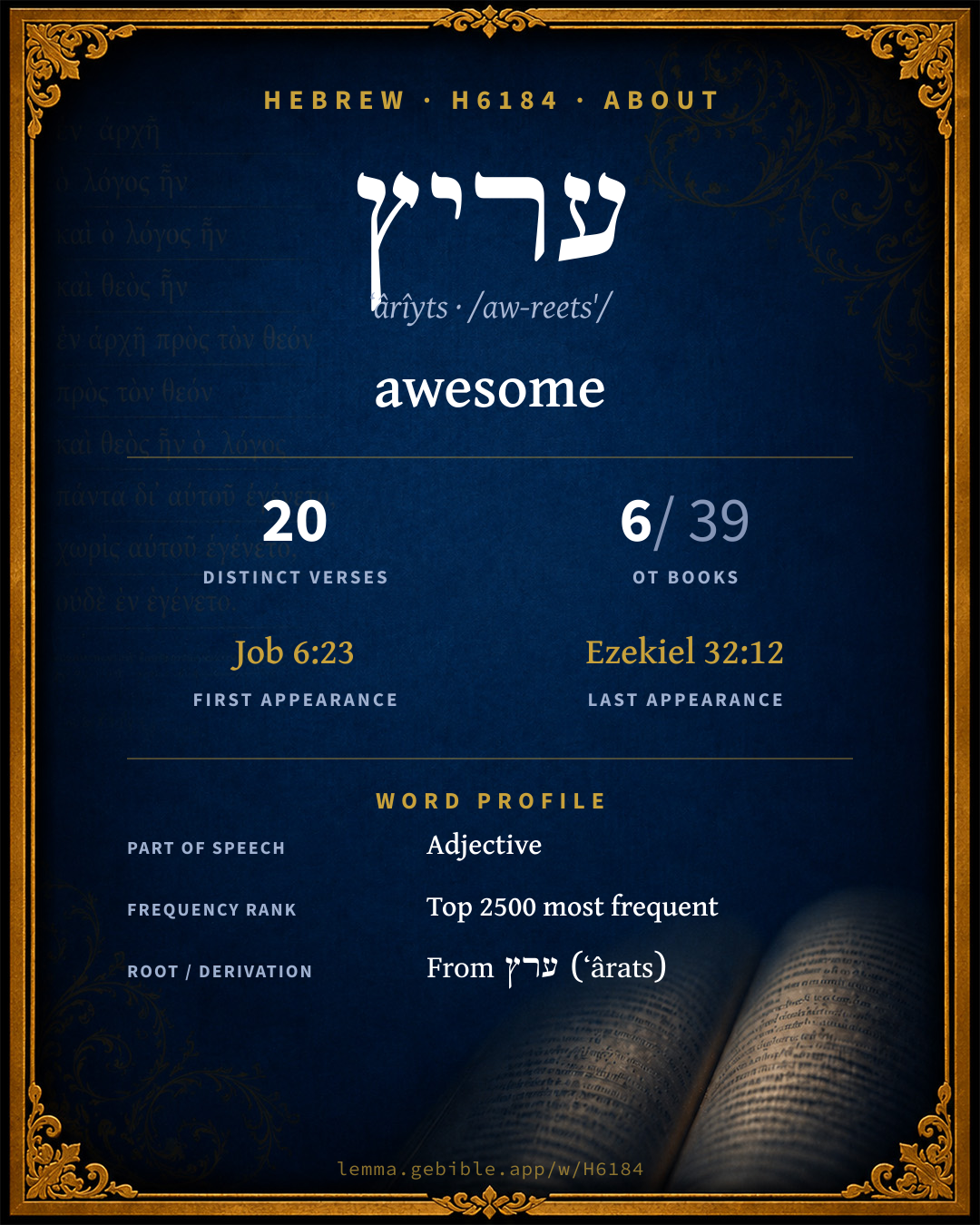
עָרִיץ
awesome
Full lexicon entry — Brown-Driver-Briggs (BDB)
From Brown-Driver-Briggs (BDB)
Where this word appears
See every Absolute-state word in the Hebrew Bible →
Grammar key — what these labels mean
Part of speech
- Adjective
- A word that describes or qualifies a noun.
State
- Absolute
- The independent form of a noun, not bound to a following word.
- Construct
- A noun bound to a following noun in a possessive / “of” relationship (the construct chain).
Gender
- Masculine
- Grammatically masculine.
- Feminine
- Grammatically feminine.
Number
- Plural
- More than one (in Hebrew, generally three or more).
- Singular
- One.
Grammatical forms
- Adjective, Adjective, Masculine, Plural, Absolute 11 times (55%)
- Adjective, Adjective, Masculine, Plural, Construct 4 times (20%)
- Adjective, Adjective, Masculine, Singular, Absolute 4 times (20%)
- Adjective, Adjective, Feminine, Singular, Absolute 1 time (5%)
Parsed forms decoded from the imported morphology (morphhb / Westminster Leningrad Codex — WLC text public domain, morphhb tagging CC BY 4.0), counted across 20 parsed occurrences — not distinct verses.
Every verse where H6184 appears — 20 distinct verses across 6 books. Click any verse to open its interlinear word-by-word view. Verse text shown in the World English Bible for context — . Each verse’s Hebrew form is shown with its reference; the English is not keyword-highlighted, since the data carries no word-level English alignment. Use “Compare translations” on any verse to read it across multiple English versions. This concordance covers the Hebrew Bible; Septuagint (Greek Old Testament) occurrences are not indexed here.
Job 3 verses
- Job 6:23 עָרִיצִ֣ים adj Adjective mp Or, 'Deliver me from the adversary's hand?' Or, 'Redeem me from the hand of the oppressors?'
- Job 15:20 לֶ/עָרִֽיץ prep det + Adjective Adjective fs The wicked man travails with pain all his days, Even the number of years that are laid up for the oppressor.
- Job 27:13 עָ֝רִיצִ֗ים adj Adjective mp "This is the portion of a wicked man with God, The heritage of oppressors, which they receive from the Almighty.
Psalms 3 verses
- Psalms 37:35 עָרִ֑יץ adj Adjective ms I have seen the wicked in great power, Spreading himself like a green tree in its native soil.
- Psalms 54:3 וְֽ֭/עָרִיצִים conj + Adjective Adjective mp For strangers have risen up against me. Violent men have sought after my soul. They haven't set God before them. Selah.
- Psalms 86:14 עָ֭רִיצִים adj Adjective mp God, the proud have risen up against me. A company of violent men have sought after my soul, And they don't hold regard for you before them.
Proverbs 1 verse
Isaiah 7 verses
- Isaiah 13:11 עָרִיצִ֖ים adj Adjective mp I will punish the world for [their] evil, and the wicked for their iniquity: and I will cause the arrogance of the proud to cease, and will lay low the haughtiness of the terrible.
- Isaiah 25:3 עָרִיצִ֖ים adj Adjective mp Therefore shall a strong people glorify you; a city of awesome nations shall fear you.
- Isaiah 25:4 עָרִיצִ֖ים adj Adjective mp For you have been a stronghold to the poor, a stronghold to the needy in his distress, a refuge from the storm, a shade from the heat, when the blast of the awesome ones is as a storm against the wall.
- Isaiah 25:5 עָֽרִיצִ֖ים adj Adjective mp As the heat in a dry place will you bring down the noise of strangers; as the heat by the shade of a cloud, the song of the awesome ones shall be brought low.
- Isaiah 29:5 עָֽרִיצִ֔ים adj Adjective mp But the multitude of your foes shall be like small dust, and the multitude of the awesome ones as chaff that passes away: yes, it shall be in an instant suddenly.
- Isaiah 29:20 עָרִ֖יץ adj Adjective ms For the terrible one is brought to nothing, and the scoffer ceases, and all those who watch for iniquity are cut off;
- Isaiah 49:25 עָרִ֖יץ adj Adjective ms But thus says Yahweh, Even the captives of the mighty shall be taken away, and the prey of the terrible shall be delivered; for I will contend with him who contends with you, and I will save your children.
Jeremiah 2 verses
- Jeremiah 15:21 עָרִצִֽים adj Adjective mp I will deliver you out of the hand of the wicked, and I will redeem you out of the hand of the terrible.
- Jeremiah 20:11 עָרִ֔יץ adj Adjective ms But Yahweh is with me as an awesome mighty one: therefore my persecutors shall stumble, and they shall not prevail; they shall be utterly disappointed, because they have not dealt wisely, even with an everlasting dishonor which shall never be forgotten.
Ezekiel 4 verses
- Ezekiel 28:7 עָרִיצֵ֖י adj Adjective mp cs therefore, behold, I will bring strangers on you, the terrible of the nations; and they shall draw their swords against the beauty of your wisdom, and they shall defile your brightness.
- Ezekiel 30:11 עָרִיצֵ֣י adj Adjective mp cs He and his people with him, the terrible of the nations, shall be brought in to destroy the land; and they shall draw their swords against Egypt, and fill the land with the slain.
- Ezekiel 31:12 עָרִיצֵ֥י adj Adjective mp cs Strangers, the terrible of the nations, have cut him off, and have left him: on the mountains and in all the valleys his branches are fallen, and his boughs are broken by all the watercourses of the land; and all the peoples of the earth are gone down from his shadow, and have left him.
- Ezekiel 32:12 עָרִיצֵ֥י adj Adjective mp cs By the swords of the mighty will I cause your multitude to fall; the terrible of the nations are they all: and they shall bring to nothing the pride of Egypt, and all the multitude of it shall be destroyed.
About this entry
At a glance — auto-summarized from this page’s data, not written by a person. Every figure links to its source below. This summary describes the numbers; it doesn’t interpret them.
At its core, עריץ (ʻârîyts) means “awesome.” Translators differ — “terrible” in the King James Version, then “ruthless” (Berean Standard Bible), as the renderings breakdown shows. With 20 verses in 6 books, it is an uncommon word in the Hebrew Bible. Its uses concentrate in Isaiah (35% of all occurrences). First canonically at Job 6:23, it enters the text early. Dig into 20-verse concordance and the renderings breakdown below.
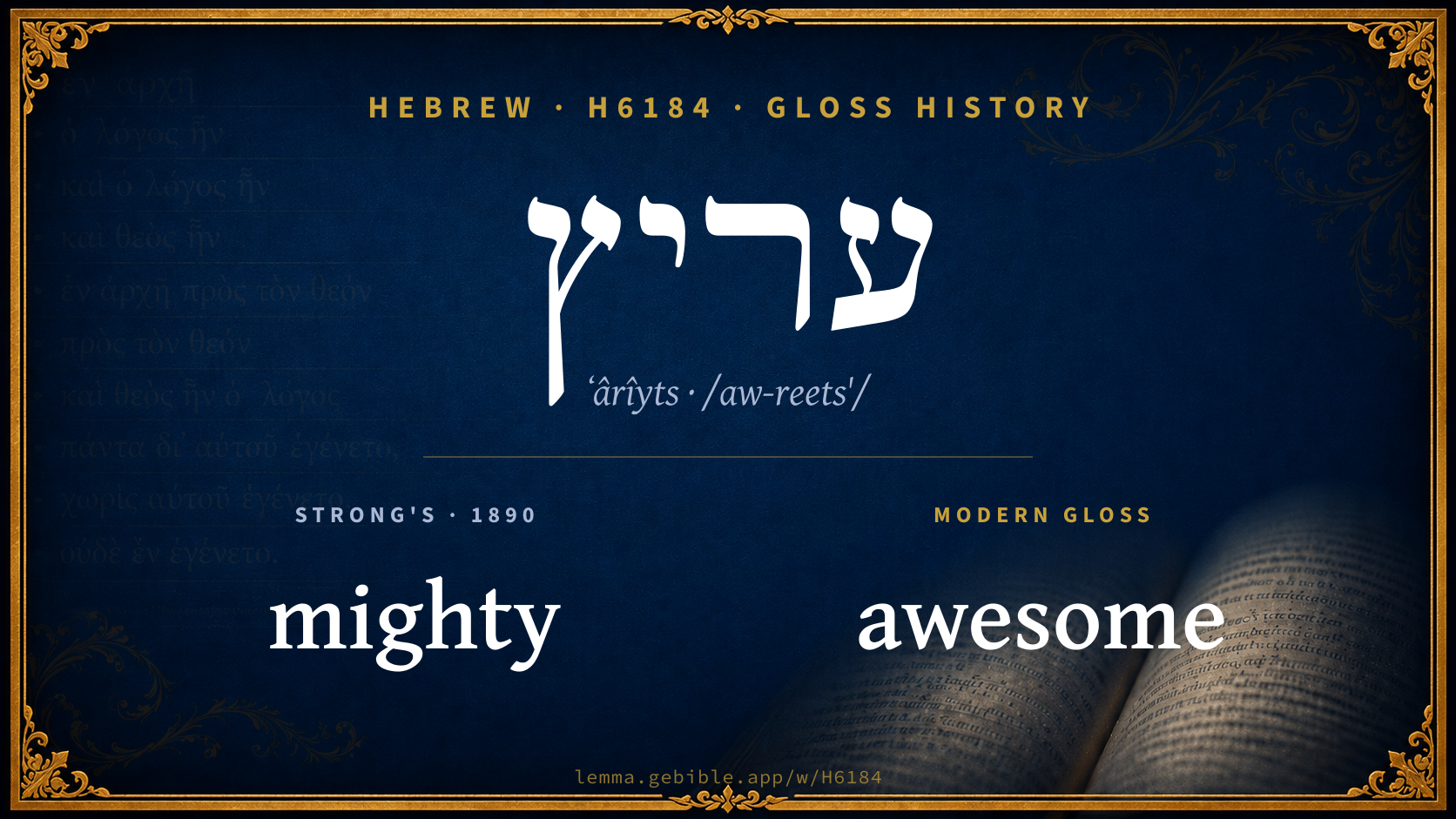
Gloss history
Strong's 1890 vs modern scholarship
About this word
Strong's H6184 catalogs a Hebrew word from the Hebrew Old Testament.
These counts are not copied from any lexicon or concordance. They are computed here, from the morphology-tagged Hebrew Old Testament. What Lemma adds →
- 20
- distinct verses
- The word appears in 20 distinct verses.
- 6 / 39
- OT books
- The word appears in 6 of 39 Old Testament books.
- #1,513
- by frequency
- Top 2500 most frequent Hebrew words (rank 1,513 of 8,640 Hebrew words by occurrence).
View all 20 occurrences in the concordance →
By section of the Old Testament
By traditional corpus
Conventional, traditional groupings — biblical authorship is debated, so this is a traditional corpus grouping, not an authorship claim. Each share is this word’s portion of its verses in that division of the Hebrew canon. Each figure is a share of the word’s 20 distinct verses.
- Prophets (Nevi'im) 13 verses · 65%
- Writings (Ketuvim) 7 verses · 35%
How translations render this word
Counts come from each version’s own published word-to-Strong’s tagging or interlinear alignment — an approximate guide to how each version renders this word, not a word-level alignment the data otherwise carries. Because each total is that version’s own tagged count, the per-version totals vary from one another and need not match the appearance or distinct-verse counts above. These counts may also differ from a printed concordance because Lemma counts each distinctly tagged rendering and does not collapse phrase taggings into a single head-word total. This is a fixed set of word-tagged versions (KJV, ASV, BSB, ULT) and does not change with the reading translation you choose elsewhere. Each version’s license is shown beside its name below (and on Sources).
- King James Version: Terrible 7×, Terrible ones 3×, Terrible one 2×
- American Standard Version: Terrible 5×, Terrible ones 3×, Oppressors 2×
- Berean Standard Bible: Ruthless 12×, Most ruthless 4×
- unfoldingWord Literal Text: Terrible 6×, Ruthless 3×, Violent 3×
King James Version Public Domain
Renders H6184 across 20 tagged occurrences — most commonly:
Plus 8 renderings that appear only once — usually multi-word phrases or single function words the recovered tagging swept in, not distinct renderings.
American Standard Version Public Domain
Renders H6184 across 20 tagged occurrences — most commonly:
Plus 10 renderings that appear only once — usually multi-word phrases or single function words the recovered tagging swept in, not distinct renderings.
Berean Standard Bible Public Domain
Renders H6184 across 20 tagged occurrences — most commonly:
Plus 4 renderings that appear only once — usually multi-word phrases or single function words the recovered tagging swept in, not distinct renderings.
unfoldingWord Literal Text CC BY-SA 4.0
Renders H6184 across 22 tagged occurrences — most commonly:
Plus 8 renderings that appear only once — usually multi-word phrases or single function words the recovered tagging swept in, not distinct renderings.
Senses in BDB
The 1 sense BDB distinguishes for this word, in lexicon order (not ranked by frequency or importance). The full entry — with sub-senses — is in the Lexicon Entry tab.
- awe-inspiring, terror-striking, awesome, terrifying, ruthless, mighty
Word origin
adj. awe-inspiring, terror-striking;—ע׳ of י׳, כְּגִבּוֹר עָרִיץ Je 20:11; pl. as subst. עָרִיצִים, in bad sense of formidable adversaries, personal, Je 15:21 (‖ רָעִים), Jb 6:23 (‖ צָר), and national, ψ 54:5 (‖ זָרִים), = עֲדַת ע׳ 86:14 (‖ זֵדִים), הֲמוֹן ע׳ Is 29:5 (‖ זָרָ֑יִךְ); especially of Chaldeans Is 13:11, cstr. עָרִיצֵי גוֹיִם most terrifying of the nations Ez 28:7 (‖ זָרִים) 30:11; 31:12 (‖ זָרִים), 32:12; so (prob.) sg. עָרִיץ Is 49:25 (read ע׳ also for צַדִּיק v 24, so Lo Ew Che Gr al.); without specif. ref. גּוֹרִם עָרִיצִים Is 25:3 awe-inspiring nations (Du Che take ע׳ as subst.), רוּחַ ע׳ v 4 (del. as gloss Di al.), זְמִיר ע׳ v 5 (del. verse as gloss Du Che); late, of wicked in gen., as ruthless רָאִיתִי רָשָׁע ע׳ ψ 37:35 I have seen a wicked man ruthless; as subst., Is 29:20 (‖ לֵץ), Jb 15:20 (‖ רשׁע), pl. 27:13 (‖ id.), Pr 11:16; read also עָרִיץִ(ים) Is 11:4 (for MT אֶרֶץ), so Che BrMP Du Gr al. (‖ רָשָׁע).
— Brown-Driver-Briggs (Oxford 1906, public domain), digitized via Sefaria, supplemented by the OpenScriptures HebrewLexicon (CC BY 4.0). See Sources.
Derived from ערץ (ʻârats) (H6206) — to tremble.
Jastrow Dictionary
A second Hebrew/Aramaic lexicon for comparison, covering Aramaic and post-biblical (Talmudic, Targumic, Midrashic) usage that the biblical-Hebrew BDB does not. Matched by lemma rather than by Strong’s number, so a lemma may carry more than one Jastrow headword (shown separately below), and the entries cover usage well beyond the Bible.
עָרִיץ
- עָרַץ to frighten) powerful, violent man.—Pl. עָרִיצִים. Y. Ber. IV, 8ᵃ, v. רָמַס. Y. Meg. IV, 74ᵈ bot. הגואלך והמושיעך מכף עָרִיצַיִךְ who redeems thee and saves thee from the hand of thy oppressors; Treat. Sof’rim XIV, 5.
A Dictionary of the Targumim, the Talmud Babli and Yerushalmi, and the Midrashic Literature (Marcus Jastrow; London, Luzac, 1903) — Public Domain. Digitized via Sefaria. Digitized via Sefaria. Full attribution on Sources.
Forms in the corpus
The 16 distinct written forms H6184 takes in the Hebrew Bible, most frequent first — each parse links to that state’s occurrences in the concordance. Hebrew forms include their vowel points and cantillation, so a single lemma takes many written forms.
Same root — word family
Other BDB entries built from the same root as H6184, grouped by Strong’s listed origin. These share a root / origin per the lexicon — not necessarily a shared meaning. Each links to that word’s own entry.
Derives from
Shares the same root
Compare all same-root words → They share a root, not necessarily a meaning.
Septuagint verse parallels
This word appears in 18 verses that also exist in the Greek Old Testament (Septuagint), out of the 20 Hebrew verses it occurs in. You can read those verses in Greek by switching the Old Testament edition to the Septuagint.
Read these verses in the Septuagint
This is a verse-level parallel only — the same verses exist in both the Hebrew and Greek Old Testaments. No word-level Hebrew↔Greek correspondence is claimed: the data carries no such alignment, so no Greek word is shown as this Hebrew word’s translation. Coverage is not total — the Septuagint omits the deuterocanon and renumbers the Psalms, so some Hebrew verses have no direct Greek parallel.