
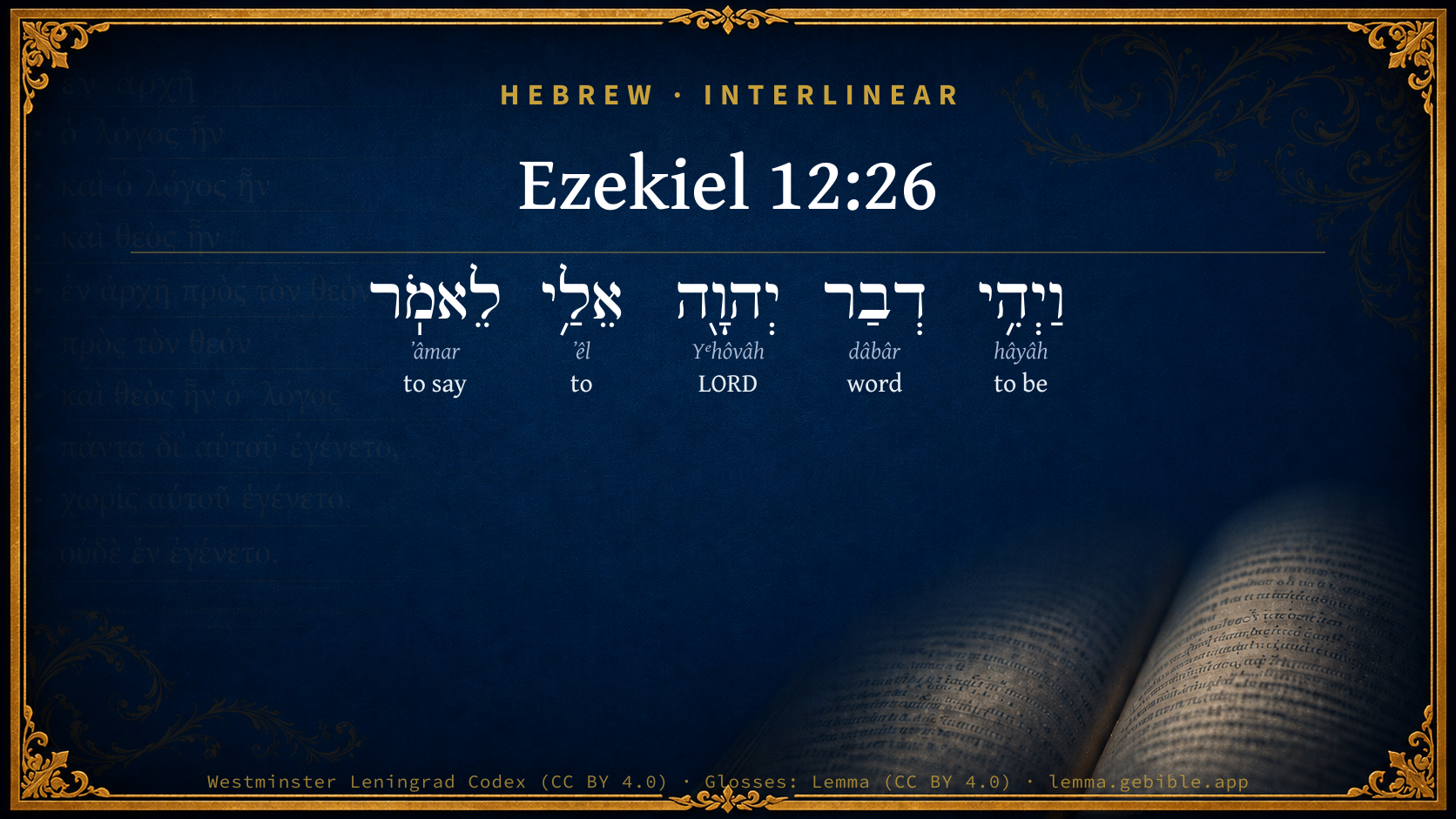
Ezekiel 12:26

Hebrew (Westminster Leningrad Codex) Ezekiel 12:26 appears in the Hebrew Old Testament. The text above is from the Westminster Leningrad Codex. Each word links to its Strong’s number, a concise gloss, and parsing drawn from the Open Scriptures Hebrew Bible morphology. Click any word for its full Brown-Driver-Briggs (BDB) entry.
Download image
Cite this verse

Ezekiel 12:26 (World English Bible). Public Domain. Lemma interlinear Bible study tool, https://lemma.gebible.app/v/ezekiel/12/26.

Show BibTeX & RIS
BibTeX
RIS
English Translation
Again the word of Yahweh came to me, saying,
World English Bible · Public Domain
Download a study sheet

One document with this verse’s original text, its word-by-word gloss line, the meaning frame, cross-references with their text, attributed commentary, and full source and license credits — printable, and it pastes into notes with its structure intact.

This verse Autodidact and up

Study sheet (.html) Plain text (.txt)

A passage Seminary Student

Up to 50 verses in one chapter. A passage sheet keeps up to 6 commentary sources and 12 cross-references per verse, in the order this page ranks them, and says so on the sheet whenever that leaves anything out. Ask for a single verse and you get the Autodidact verse sheet above.

Everything on this page stays free to read, with no account — the sheet is a download of what is already on screen, not access to it.

Want to remove ads? Support Godless Engineer
Compare translations 3

The same verse in 3 English versions, stacked beneath the original-language interlinear above. Click any original word for its lexicon entry.

Each is an independent rendering of the whole verse — the interlinear is not word-aligned to these translations.

Highlighted words mark where these versions differ — a whole-verse word diff, not a word-by-word alignment.

  • World English Bible Public Domain
    Again the word of Yahweh came to me, saying,
  • King James Version Public Domain
    Again the word of the LORD came to me, saying.
  • unfoldingWord Literal Text CC BY-SA 4.0
    Again the word of Yahweh came to me, saying,

unfoldingWord Literal Text — © unfoldingWord, licensed CC BY-SA 4.0. Word-aligned USFM3 via Door43 (git.door43.org/unfoldingWord/en_ult).

Versions to compare (up to 4)

3 of 4 selected

Show all 18 translations

Every available English version of this verse, each an independent rendering of the whole verse.

  • World English Bible Public Domain
    Again the word of Yahweh came to me, saying,
  • Berean Standard Bible Public Domain
    Furthermore, the word of the LORD came to me, saying,
  • Majority Standard Bible Public Domain
    Furthermore, the word of the LORD came to me, saying,
  • King James Version Public Domain
    Again the word of the LORD came to me, saying.
  • American Standard Version (1901) Public Domain
    Again the word of Jehovah came to me, saying,
  • Revised Version (1885) Public Domain
    Again the word of the LORD came to me, saying,
  • Geneva Bible (1599) Public Domain
    Againe the word of the Lord came vnto me, saying,
  • Douay-Rheims (1899) Public Domain
    And the word of the Lord came to me, saying:
  • Young's Literal Translation Public Domain
    And there is a word of Jehovah unto me, saying:
  • Literal Standard Version CC BY-SA 4.0
    And there is a word of YHWH to me, saying,
  • Unlocked Literal Bible CC BY-SA 4.0
    Again the word of Yahweh came to me, saying,
  • unfoldingWord Literal Text CC BY-SA 4.0
    Again the word of Yahweh came to me, saying,
  • Darby Bible Public Domain
    And the word of Jehovah came unto me, saying,
  • World Messianic Bible Public Domain
    Again the LORD’s word came to me, saying,
  • Webster's Bible Public Domain
    Again the word of the LORD came to me, saying,
  • Free Bible Version CC BY-SA 4.0
    An additional message from the Lord came to me, saying,
  • Bible in Basic English Public Domain
    Again the word of the Lord came to me, saying,
  • JPS Tanakh (1917) Public Domain
    Again the word of the LORD came to me, saying:

Literal Standard Version (2020), Covenant Press — licensed CC BY-SA 4.0. Text via the HelloAO Bible API (eBible.org). Unlocked Literal Bible (unfoldingWord) — licensed CC BY-SA 4.0. Text via the HelloAO Bible API (eBible.org). unfoldingWord Literal Text — © unfoldingWord, licensed CC BY-SA 4.0. Word-aligned USFM3 via Door43 (git.door43.org/unfoldingWord/en_ult). Free Bible Version, Dr. Jonathan Gallagher — licensed CC BY-SA 4.0. Text via the HelloAO Bible API (eBible.org).

Word by word

More ways to search: Search by grammar → Find every occurrence → Compare this word →

Practice this passage: Drill this verse → Learn its vocabulary →

About this verse

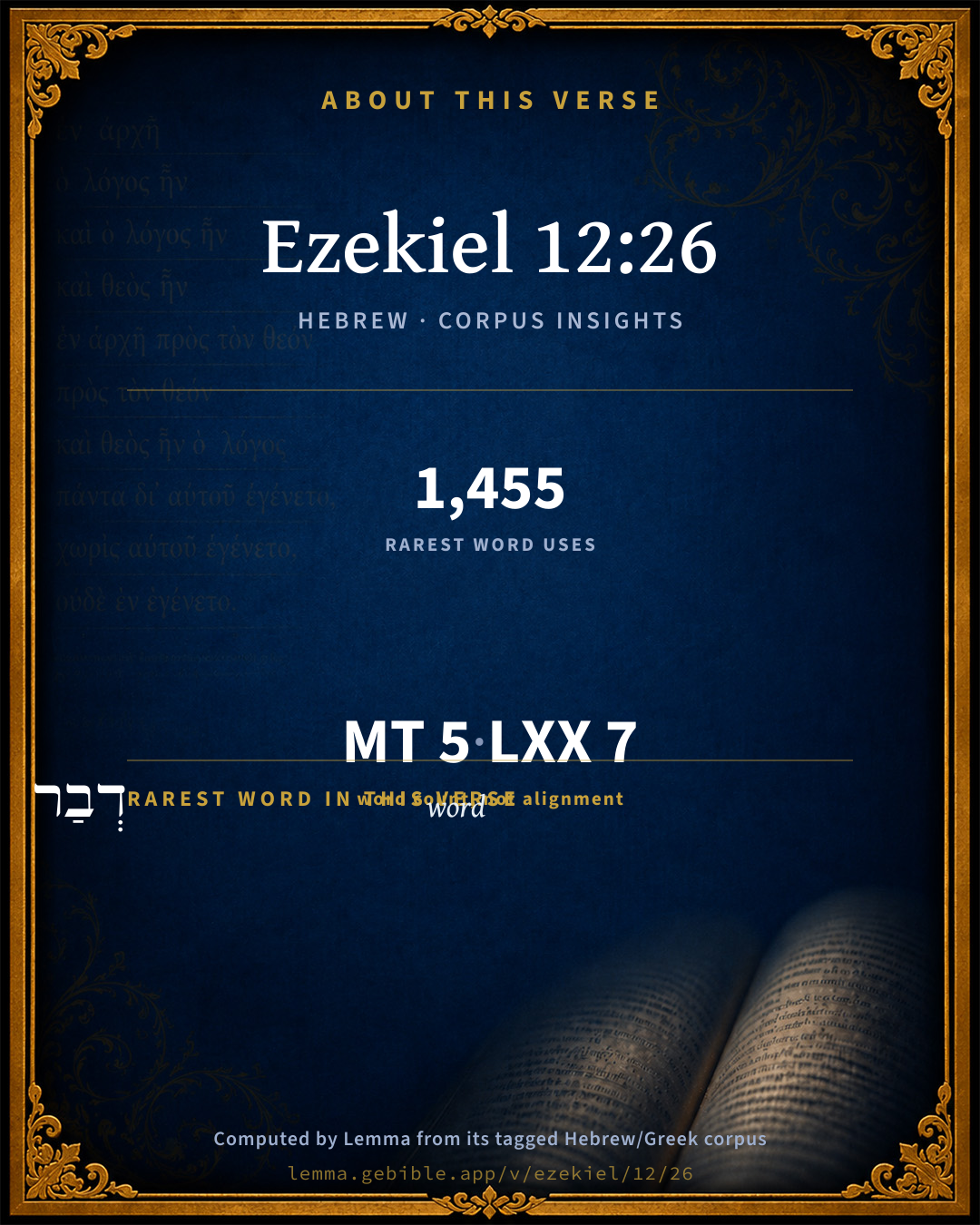
These counts appear in no published source. They are computed here, from the morphology-tagged text and Lemma’s own curated glosses. What Lemma adds →

5
words
5
distinct lemmas
Prophets
section

Grammatical profile

  • 2 verbs
  • 2 nouns
  • 1 preposition

Verb forms

  • וַיְהִ֥י Qal · Sequential Imperfect
  • לֵאמֹֽר Qal · Infinitive Construct

Hebrew & Septuagint length

In English translation the verse runs 9 words from the Hebrew and 10 from the Septuagint (LXX English) — closely comparable.

A rough comparison of the two English renderings, which tokenize alike — not a word-level alignment.

Word counts can differ between the Hebrew and the Greek without any difference in meaning — e.g. the Hebrew direct-object marker אֵת has no separate Greek word, and Greek often adds the article ὁ.

In the original languages it is 5 Hebrew tokens and 7 Greek tokens — but the two are counted differently (Hebrew bundles its prefixes and suffixes into one token; the Greek is in lemma form), so that isn’t a like-for-like length.

Hebrew and Greek witnesses Masoretic Hebrew ↔ Greek Septuagint

The same verse in the two great witnesses to the Old Testament, shown verse-for-verse.

These are two independent witnesses, not word-aligned to each other, and the Septuagint is shown in lemma (dictionary) form.

Hebrew Ezekiel 12:26 Masoretic · Westminster Leningrad Codex

וַיְהִ֥י דְבַר יְהוָ֖ה אֵלַ֥י לֵאמֹֽר

Again the word of Yahweh came to me, saying,

World English Bible · Public Domain

Greek LXX Ezekiel 12:26 Septuagint · lemma form

καί γίγνομαι λόγος κύριος πρός ἐγώ λέγω

Moreover the word of the Lord came to me, saying,

LXX2012 (modern English Septuagint) · Public Domain

Hebrew: Westminster Leningrad Codex (CC BY 4.0). Greek: Septuagint (public domain); English from LXX2012 (modern English Septuagint) (Public Domain). How the Septuagint differs from the Hebrew →

Targum (Aramaic paraphrase)

1

The Targum is the ancient Jewish Aramaic paraphrase of the Hebrew Scriptures — an interpretive translation, not the Hebrew text itself. Onkelos (literal) and Pseudo-Jonathan (expansive) render the Torah, and Jonathan the Prophets. Coverage is partial: where no permissively-licensed English translation exists for a verse, only the Aramaic is shown. This is verse-level text, not a word-by-word alignment to the Hebrew.

  1. Targum Jonathan Prophets (Joshua–Malachi)
    וַהֲוָה פִּתְגַם נְבוּאָה מִן קֳדָם יְיָ עִמִי לְמֵימָר:

    (no public-domain English translation for this verse)

    Targum Jonathan — Aramaic: “Mikraot Gedolot” (public domain). English: “Sefaria Community Translation” (CC0 1.0 (public-domain dedication)); “London "Chaldee Paraphrase," 1871” (public domain). Text via Sefaria.

Commentary

Notes on Ezekiel 12:26 from classic Christian and Jewish commentators (each source and its license shown beneath its notes). The classic Christian expositions comment on the surrounding passage and are grouped to its opening verse, so a note may address several verses; the Jewish commentaries on the Tanakh (Rashi and others) are per-verse, so they appear only where the commentator wrote on this verse.

Lemma curates 59 commentaries, every one of them public domain or Creative Commons licensed, each selected and text-cleaned for this edition rather than reprinted as found. About our sources →

Trapp's Complete Commentary

John Trapp

Eze 12:26 Again the word of the LORD came to me, saying,

Ver. 26. Again the word.] See on Eze 12:1.

John Trapp, A Commentary or Exposition upon All the Books of the Old and New Testament (1647–1656) — public domain. Text from a community e-Sword module.

Tyndale Open Study Notes

Tyndale Open Resources

12:26-28 The people responded with a second proverb, and again the Lord refuted them. What the Lord had threatened, he would do.

Tyndale Open Study Notes — © Tyndale Open Resources, licensed CC BY-SA 4.0. Text via the HelloAO Bible API.

John Calvin's Commentaries

Here indeed such detestable blasphemy as we lately heard is not condemned in the Jews: but oblique ridicule, the tendency of which was first of all to weaken all confidence in Prophecy, and then to get rid of all heavenly doctrine. Those who are now condemned by the Prophet did not dare to bluster against God with swollen cheeks, but when others concluded the Prophecies to be vain and frivolous, because the time was put off, they said — it may happen that God will accomplish what he has denounced against us by his servant: meanwhile let us feast securely as we shall be dead before these things can happen. We see, therefore, that there were two classes of men: some who utterly rejected God’s Prophets, and wantonly derided their threats: this gross impiety has been already exposed. But others neither openly nor distinctly pronounced God to be a liar, but put far away from them the performance of the prophetic announcement. We see that the former were so abandoned, that they all but openly derided God, so as to turn away all fear from their own feelings since God prorogued the time. For Jeremiah had spent his strength in vain for many years in daily summoning them by a loud trumpet to God’s tribunal, and in setting the Chaldeans before their eyes. Since he effected nothing, Ezekiel is chosen, and after he has inveighed against a fouler impudence in despising God, he now attacks the hypocrite who had not yet proceeded so far as to vilify God by the use of words. But as I have just remarked, the gliding down from this security to open contempt of God is easy. Those then who feign themselves quiet and without danger, since God patiently delays his judgments, at length determine him to be content with his own ease, and not to regard human affairs. Let us then be on our guard against the snares of Satan; and not only abhor the foul blasphemy of which the Prophet speaks, but as soon as God threatens us, let us prevent his judgment, and not promise ourselves a long period of escape, which may render us so stupid as to deprive us of all fear.

The house of Israel then said, he prophesies for many days. They did not openly assert that Ezekiel was speaking rashly and arrogating to himself the prophetic name, but they said that he prophesied for many days and a long period. Now he adds, thou shalt say unto them, it shall not be any lower put off Some thus interpret these words — all my discourses shall not be put off. They prefer a change of number, and resolve it thus — each of my words shall not be put. off. But the other view seems to suit the context better: it shall not be put off any lower, for the words which I utter I will execute Here again he confirms what we formerly saw: that God would not speak in vain, since he is not divided in opinion. It belongs to men to lie, and to utter vainly what they cannot perform, and to change their; nothing of the kind ought to be imagined of God, for his hand is always in union with his speech.

John Calvin's Commentaries (1540-1563) — public domain. Text from the Calvin Translation Society English edition (1840s-50s) via the Christian Classics Ethereal Library (ccel.org). Calvin's coverage is partial (roughly two-thirds of the Bible); uncommented books and verses are honest gaps, never fabricated. The 19th-century editor's footnotes and remarks are omitted so the notes are faithfully Calvin's own voice.

The Cambridge Bible for Schools and Colleges

gen. ed. J. J. S. Perowne

26–28. If others did not go so far as to disregard prophecy altogether, they concluded that the prophecies bore reference to the future, and that the judgments threatened would not come in their day (Isa_39:8). This also was an inference not unnatural. The prophecies of the true prophets were moral and designed even when threatening to turn men away from their sins, and thus in a manner to frustrate their own fulfilment. They were not absolute predictions, but conditional threats, which might be averted on repentance and amendment (Jonah; Jeremiah 18; Joe_2:14). And in point of fact the most terrible threatenings of judgment were connected with the “day of the Lord,” which might be supposed not very near (Isa_5:18-19). Cf. on Eze_12:22; Hab_2:3.

The Cambridge Bible for Schools and Colleges (gen. ed. J. J. S. Perowne; Cambridge University Press, 1878–1918) — public domain. Text from a community e-Sword module.

Matthew Poole's English Annotations

Again; for instructing some that were seduced by those scoffers forementioned.

Matthew Poole's English Annotations on the Holy Bible (1683–1685) — public domain. Text from a community e-Sword/MySword module.

Whedon's Commentary on the Bible

Daniel D. Whedon

26-28. Some who still retained their faith in prophecy, and were even inclined to accept Jeremiah and Ezekiel as true prophets, yet comforted themselves in their disobedience by saying that the times of trouble and judgment of which the prophet spoke were far in the future (Isa_39:8). Perhaps, as in other cases, the people would repent and the prophecy be averted (Jonah; Jer_18:8; Joe_2:14). But against this Ezekiel replies that Jehovah has explicitly declared that the fulfillment of his threatening shall not be postponed longer, “but the word which I shall speak [Eze_12:25] shall be done, saith Jehovah Elohim.”

Daniel D. Whedon (gen. ed.), Commentary on the Old and New Testaments (1874–1909) — public domain. Text from a community e-Sword module.

The Pulpit Commentary

Vers. 26, 27. The words imply another interval of silence, meditation, and then a fresh utterance to the same effect as before. In this case (ver. 27) we trace a slight modification in the language of the gainsayers. They recognize Ezekiel both as a seer and a prophet. They do not say that his vision "faileth." They content themselves with throwing the fulfilment into the distant future. Their thought is that of the proverb which has been ascribed to more than one king or statesman, Apres moi le deluge. To these his answer is nearly in the same terms as before. Still harping on the offensive word, he tells them that nothing that he has spoken shall be "prolonged." The destruction of the temple and the holy city, the departure of the Divine Presence from the sanctuary, these were already within measurable distance.

The Pulpit Commentary (1880–1919), ed. H.D.M. Spence-Jones & Joseph S. Exell — public domain. Text from a community e-Sword module.

unfoldingWord translationNotes

Door43 World Missions Community

the word of Yahweh came

This is an idiom that is used to introduce something that God told his prophets or his people. See how you translated this in Ezekiel 3:16. AT: "Yahweh spoke this message" or "Yahweh spoke these words" (See: Idiom)

Behold

The word "Behold" here alerts us to pay attention to the surprising information that follows.

house of Israel

The word "house" is a metonym for the family that lives in the house, in this case the Israelites, the descendants of Jacob over many years. See how you translated this in Ezekiel 3:1. AT: "the Israelite people group" (See: Metonymy)

The vision that he sees is for many days from now, and he prophesies of far off times

These phrases are both ways the people of Israel are saying Ezekiel's warnings will not happen in their lifetime but will happen far in the future. (See: Parallelism)

My words will not be delayed any longer, but the word that I have spoken will be done

These phrases are both ways God is telling the people of Israel that the things he has warned about will happen soon. (See: Parallelism)

My words will not be delayed any longer

This can be stated in active form. AT: "I will no longer delay the word I have spoken" or "I will no longer delay doing what I said I would do" (See: Active or Passive)

the word that I have spoken will be done

This can be stated in active form. AT: "I will accomplish the word that I have spoken" or "I will do what I have spoken" (See: Active or Passive)

translationWords

word of God

Son of Man

house

Israel

vision

prophet

Lord Yahweh

word

declare

unfoldingWord translationNotes — © Distant Shores Media and the Door43 World Missions Community, licensed CC BY-SA 4.0. Source: git.door43.org/Door43/en_tn.

Lesson kit

Teaching starters — assembled from the data on this page, not authored interpretation. Every prompt links to the verse data it draws on. Edit before teaching.

Ezekiel, in the Prophets, opens this verse with 5 words (5 distinct Hebrew lemmas). Its most distinctive word is dâbâr (“word”). A historical commentator’s framing appears above. Read the whole chapter for the surrounding context.

Discussion questions

  1. How does “word” (dâbâr) shape what this verse is saying?
  2. These translations render this verse differently. What is at stake in choosing one wording over another?
  3. The verb «וַיְהִ֥י» is Qal Sequential Imperfect. How does its form color the action?
  4. Reading how Trapp's Complete Commentary and Tyndale Open Study Notes read this verse, where do the two commentators agree and where do they part?

Things to notice

Reading settings

Reading text

Shown beneath each verse's original-language words.

Old Testament
Old Testament edition

Read the OT as the Masoretic Hebrew (MT) or the Greek Septuagint (LXX).

English shown for the Greek Septuagint (in the Hebrew ↔ Greek comparison).

Comparing translations? Open the Compare panel on any verse page to stack up to four side by side.