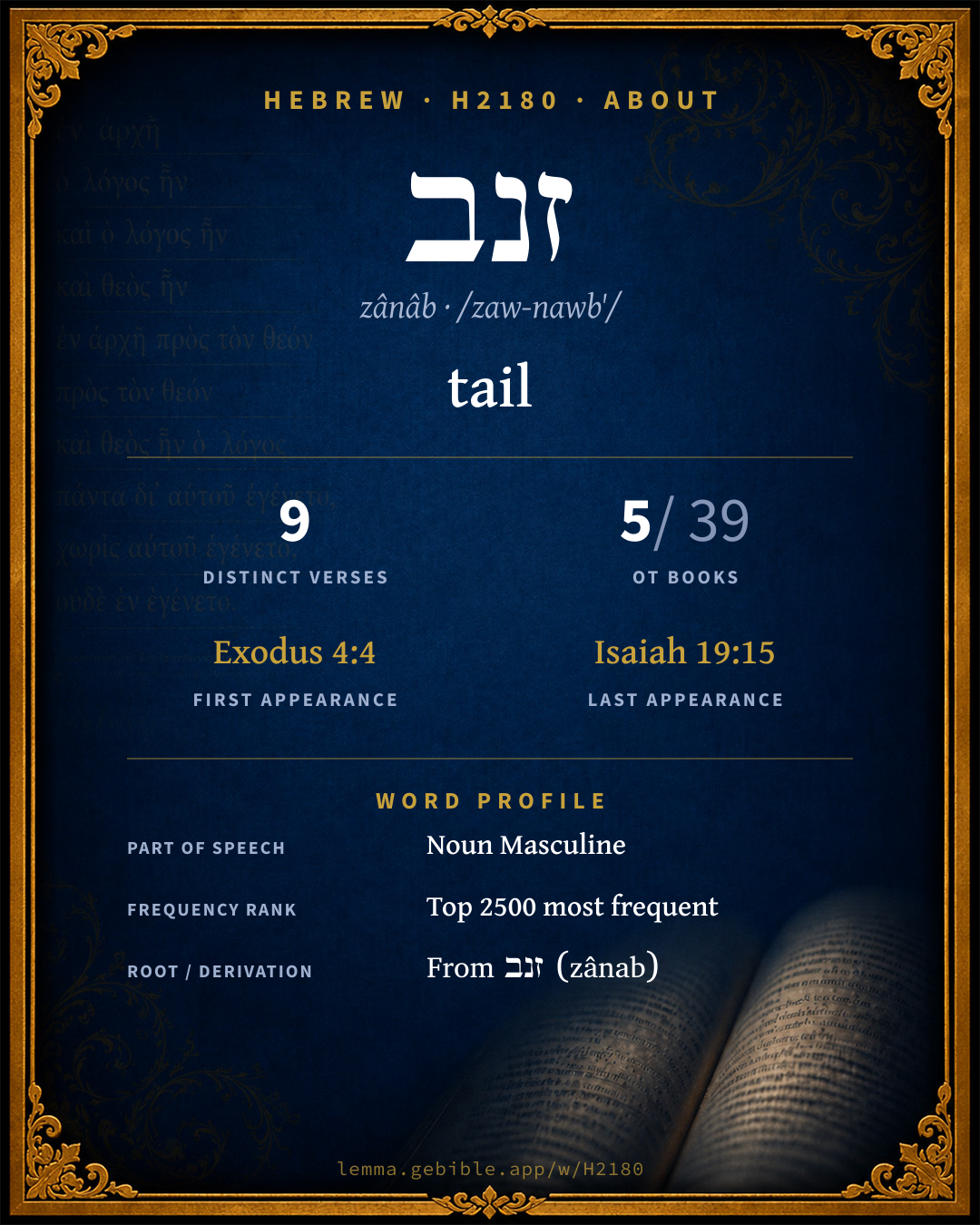
זָנָב
tail
Full lexicon entry — Brown-Driver-Briggs (BDB)
From Brown-Driver-Briggs (BDB)
Where this word appears
See every Absolute-state word in the Hebrew Bible →
Grammar key — what these labels mean
Part of speech
- Noun
- A naming word — a person, place, thing, or idea.
Noun type
- Common
- A common noun — a general class of person, place, or thing (“king,” “city,” “water”), not a specific name.
State
- Absolute
- The independent form of a noun, not bound to a following word.
- Construct
- A noun bound to a following noun in a possessive / “of” relationship (the construct chain).
Gender
- Masculine
- Grammatically masculine.
Number
- Singular
- One.
- Plural
- More than one (in Hebrew, generally three or more).
Grammatical forms
- Noun, Common, Masculine, Singular, Absolute 7 times (64%)
- Noun, Common, Masculine, Singular, Construct 2 times (18%)
- Noun, Common, Masculine, Plural, Construct 1 time (9%)
- Noun, Common, Masculine, Plural, Absolute 1 time (9%)
Parsed forms decoded from the imported morphology (morphhb / Westminster Leningrad Codex — WLC text public domain, morphhb tagging CC BY 4.0), counted across 11 parsed occurrences — not distinct verses.
Every verse where H2180 appears — 9 distinct verses across 5 books. Click any verse to open its interlinear word-by-word view. Verse text shown in the World English Bible for context — . Each verse’s Hebrew form is shown with its reference; the English is not keyword-highlighted, since the data carries no word-level English alignment. Use “Compare translations” on any verse to read it across multiple English versions. This concordance covers the Hebrew Bible; Septuagint (Greek Old Testament) occurrences are not indexed here.
Exodus 1 verse
Deuteronomy 2 verses
- Deuteronomy 28:13 לְ/זָנָ֔ב prep + n c ms Yahweh will make you the head, and not the tail; and you shall be above only, and you shall not be beneath; if you shall listen to the commandments of Yahweh your God, which I command you this day, to observe and to do [them],
- Deuteronomy 28:44 לְ/זָנָֽב prep + n c ms He shall lend to you, and you shall not lend to him: he shall be the head, and you shall be the tail.
Judges 1 verse
Job 1 verse
Isaiah 4 verses
- Isaiah 7:4 זַנְב֧וֹת n c mp cs Tell him, 'Be careful, and keep calm. Don't be afraid, neither let your heart be faint because of these two tails of smoking firebrands, for the fierce anger of Rezin and Syria, and of the son of Remaliah.
- Isaiah 9:14 וְ/זָנָ֛ב conj + n c ms Therefore Yahweh will cut off from Israel head and tail, palm-branch and rush, in one day.
- Isaiah 9:15 הַ/זָּנָֽב ptcl def.art + n c ms The elder and the honorable man, he is the head; and the prophet who teaches lies, he is the tail.
- Isaiah 19:15 וְ/זָנָ֖ב conj + n c ms Neither shall there be for Egypt any work, which head or tail, palm-branch or rush, may do.
About this entry
At a glance — auto-summarized from this page’s data, not written by a person. Every figure links to its source below. This summary describes the numbers; it doesn’t interpret them.
The Hebrew noun זנב centers on the idea of “tail.” Debuting at Exodus 4:4, it then recurs through the corpus. It appears 9 verses across 5 books of the Hebrew Bible, among its uncommon vocabulary. The word gravitates to Isaiah (44%), then Deuteronomy and Exodus. It shares a root with זנב. Dig into 9-verse concordance and the renderings breakdown below.
Gloss history
Strong's 1890 vs modern scholarship
About this word
Strong's H2180 catalogs a Hebrew word from the Hebrew Old Testament.
These counts are not copied from any lexicon or concordance. They are computed here, from the morphology-tagged Hebrew Old Testament. What Lemma adds →
- 9
- distinct verses
- The word appears in 9 distinct verses.
- 5 / 39
- OT books
- The word appears in 5 of 39 Old Testament books.
- #2,210
- by frequency
- Top 2500 most frequent Hebrew words (rank 2,210 of 8,640 Hebrew words by occurrence).
View all 9 occurrences in the concordance →
Most concentrated in
- Isaiah 4 verses 44%
- Deuteronomy 2 verses 22%
- Exodus 1 verse 11%
By section of the Old Testament
By traditional corpus
Conventional, traditional groupings — biblical authorship is debated, so this is a traditional corpus grouping, not an authorship claim. Each share is this word’s portion of its verses in that division of the Hebrew canon. Each figure is a share of the word’s 9 distinct verses.
- Prophets (Nevi'im) 5 verses · 56%
- Torah (Pentateuch) 3 verses · 33%
- Writings (Ketuvim) 1 verse · 11%
How translations render this word
Counts come from each version’s own published word-to-Strong’s tagging or interlinear alignment — an approximate guide to how each version renders this word, not a word-level alignment the data otherwise carries. Because each total is that version’s own tagged count, the per-version totals vary from one another and need not match the appearance or distinct-verse counts above. These counts may also differ from a printed concordance because Lemma counts each distinctly tagged rendering and does not collapse phrase taggings into a single head-word total. This is a fixed set of word-tagged versions (KJV, ASV, BSB, ULT) and does not change with the reading translation you choose elsewhere. Each version’s license is shown beside its name below (and on Sources).
- King James Version: Tail 6×, Tails 2×
- American Standard Version: Tail 5×, Tails 2×
- Berean Standard Bible: Tail 6×
- unfoldingWord Literal Text: Tail 7×
King James Version Public Domain
Renders H2180 across 11 tagged occurrences — most commonly:
Plus 3 renderings that appear only once — usually multi-word phrases or single function words the recovered tagging swept in, not distinct renderings.
American Standard Version Public Domain
Renders H2180 across 10 tagged occurrences — most commonly:
Plus 3 renderings that appear only once — usually multi-word phrases or single function words the recovered tagging swept in, not distinct renderings.
Berean Standard Bible Public Domain
Renders H2180 across 10 tagged occurrences — most commonly:
Plus 4 renderings that appear only once — usually multi-word phrases or single function words the recovered tagging swept in, not distinct renderings. Not rendered by a distinct English word in 1 further occurrence.
unfoldingWord Literal Text CC BY-SA 4.0
Renders H2180 across 11 tagged occurrences — most commonly:
Plus 4 renderings that appear only once — usually multi-word phrases or single function words the recovered tagging swept in, not distinct renderings.
Senses in the full BDB
What do BDB’s symbols mean?
BDB uses these scholarly abbreviations:
| Symbol | Meaning |
|---|---|
| 𝔊 | the Septuagint (the ancient Greek translation, LXX) |
| 𝔙 | the Vulgate (the Latin translation) |
| 𝔖 | the Syriac version (the Peshitta) |
| 𝔗 | the Targum (the Aramaic translation) |
| ψ | the Psalms |
| √ | root (the underlying root or stem) |
| ‖ | parallel passage (a synonymous or contrasted parallel) |
| † | the dagger: every passage where the word occurs is cited |
The 3 senses and sub-senses the full Brown-Driver-Briggs lexicon distinguishes for this word, in lexicon order (not ranked by frequency), with BDB’s own verbatim wording and sub-sense lettering. Shown in Hebrew script with BDB’s own scholarly abbreviations. The condensed entry is in the Lexicon Entry tab. See also the Forms in the corpus table below.
- 1.
- a. tail of fox Ju 15:4(×3), of serpent Ex 4:4 (J), of hippopot. Jb 40:17; e.g. Judges 15:4
- b. fig. of common people, opp. to rulers Is 9:13; 19:15 (in both, רֹאשׁ וְזָנָב, ‖ כִּפָּה וְאַגְמוֹן; Is 9:14 is incorrect gloss); of subject-people (opp. רֹאשׁ) Dt 28:13, 44. e.g. Isaiah 9:13
- 2. end, stump (of firebrand, אוּד) in metaph. Is 7:4. e.g. Isaiah 7:4
Senses from the full Brown-Driver-Briggs lexicon (Brown, Driver, Briggs; Oxford 1906 — public domain), digitized via Sefaria, supplemented by the OpenScriptures HebrewLexicon (CC BY 4.0). Full attribution on Sources.
Word origin
n.m. Ju 15:4 tail, also (fig.) end, stump (NH id., Assyrian zibbatu HomNS 368, Ethiopic ዘነብ Arabic ذَنَبٌ, Aramaic ܕܽܘܢܒܳܐ, דּוּנְבָּא, דַּנְבָּא)—ז׳ abs. Ju 15:4(×2) + 5 times; sf. זְנָבוֹ Jb 40:17; pl. זְנָבוֹת Ju 15:4; cstr. זַנְבוֹת Is 7:4;—
— Brown-Driver-Briggs (Oxford 1906, public domain), digitized via Sefaria, supplemented by the OpenScriptures HebrewLexicon (CC BY 4.0). See Sources.
Derived from זנב (zânab) (H2179) — to cut off.
Jastrow Dictionary
A second Hebrew/Aramaic lexicon for comparison, covering Aramaic and post-biblical (Talmudic, Targumic, Midrashic) usage that the biblical-Hebrew BDB does not. Matched by lemma rather than by Strong’s number, so a lemma may carry more than one Jastrow headword (shown separately below), and the entries cover usage well beyond the Bible.
זָנָב
- (b. h.) attachment, tail. Bekh. VI, 9 זְנַב הגדי the tail of a kid; a. fr.—Yoma 41ᵇ זְ׳ לשון the tail-end (fringes) of the band. Erub. 18ᵃ (ref. to צלע, Gen. II, 22) ז׳ it means the tail (with which Adam was originally created). Kil. IV, 6 ואחת יוצאה ז׳ and one vine projects like a tail. Ukts. I, 3 ז׳ של אשכול the skeleton of the cluster of grapes (the thin branches), opp. to יד, the stem; a. fr.—Trnsf. the last, least. Ab. IV, 15, v. אֲרִי.—Euphem. membrum virile. Tanḥ. Ki Thetsé 10 (expl. ויזנב, Deut. XXV, 18) הכה אותן מכת ז׳ Amalek mutilated them by cutting off &c.; Pesik. Zakh., p. 27ᵃ; Pesik. R. s. 12; Num. R. s. 13; v. זְמוֹרָה.—Denom. e.g. Genesis 2:22
זִנֵּב
- Pi. (b. h.)
- 1. (v. Ukts. I, 3 quot. in preced. w.) to cut off the extreme branches of the vine, to trim. Shebi. IV, 6 המְזַנֵּב בגפנים he who trims grape-vines.—Trnsf. ז׳ באשכולות [to thin the clusters,] to diminish the scholars by persecution (v. אֶשְׁכּוֹל). Gen. R. s. 42; Lev. R. s. 11; a. e.
- 2. to attack, force a passage. Gen. R. s. 74 בקש לזַנְּבָן Joab wanted to force his passage through their territory; Yalk. Sam. 147.
A Dictionary of the Targumim, the Talmud Babli and Yerushalmi, and the Midrashic Literature (Marcus Jastrow; London, Luzac, 1903) — Public Domain. Digitized via Sefaria. Digitized via Sefaria. Full attribution on Sources.
Forms in the corpus
The 11 distinct written forms H2180 takes in the Hebrew Bible, most frequent first — each parse links to that state’s occurrences in the concordance. Hebrew forms include their vowel points and cantillation, so a single lemma takes many written forms.
| Form | Parsing | Example | Uses |
|---|---|---|---|
| בִּ/זְנָב֑/וֹ | Noun, Common, Masculine, Singular, Construct | Exodus 4:4 | 1 |
| הַ/זְּנָב֖וֹת | Noun, Common, Masculine, Plural, Absolute | Judges 15:4 | 1 |
| הַ/זָּנָֽב | Noun, Common, Masculine, Singular, Absolute | Isaiah 9:15 | 1 |
| וְ/זָנָ֖ב | Noun, Common, Masculine, Singular, Absolute | Isaiah 19:15 | 1 |
| וְ/זָנָ֛ב | Noun, Common, Masculine, Singular, Absolute | Isaiah 9:14 | 1 |
| זְנָב֣/וֹ | Noun, Common, Masculine, Singular, Construct | Job 40:17 | 1 |
| זַנְב֧וֹת | Noun, Common, Masculine, Plural, Construct | Isaiah 7:4 | 1 |
| זָנָ֔ב | Noun, Common, Masculine, Singular, Absolute | Judges 15:4 | 1 |
| זָנָב֙ | Noun, Common, Masculine, Singular, Absolute | Judges 15:4 | 1 |
| לְ/זָנָ֔ב | Noun, Common, Masculine, Singular, Absolute | Deuteronomy 28:13 | 1 |
| לְ/זָנָֽב | Noun, Common, Masculine, Singular, Absolute | Deuteronomy 28:44 | 1 |
Same root — word family
Other BDB entries built from the same root as H2180, grouped by Strong’s listed origin. These share a root / origin per the lexicon — not necessarily a shared meaning. Each links to that word’s own entry.
Derives from
Derived from this word
Compare all same-root words → They share a root, not necessarily a meaning.
Septuagint verse parallels
This word appears in 9 verses that also exist in the Greek Old Testament (Septuagint), out of the 9 Hebrew verses it occurs in. You can read those verses in Greek by switching the Old Testament edition to the Septuagint.
Read these verses in the Septuagint
This is a verse-level parallel only — the same verses exist in both the Hebrew and Greek Old Testaments. No word-level Hebrew↔Greek correspondence is claimed: the data carries no such alignment, so no Greek word is shown as this Hebrew word’s translation. Coverage is not total — the Septuagint omits the deuterocanon and renumbers the Psalms, so some Hebrew verses have no direct Greek parallel.