
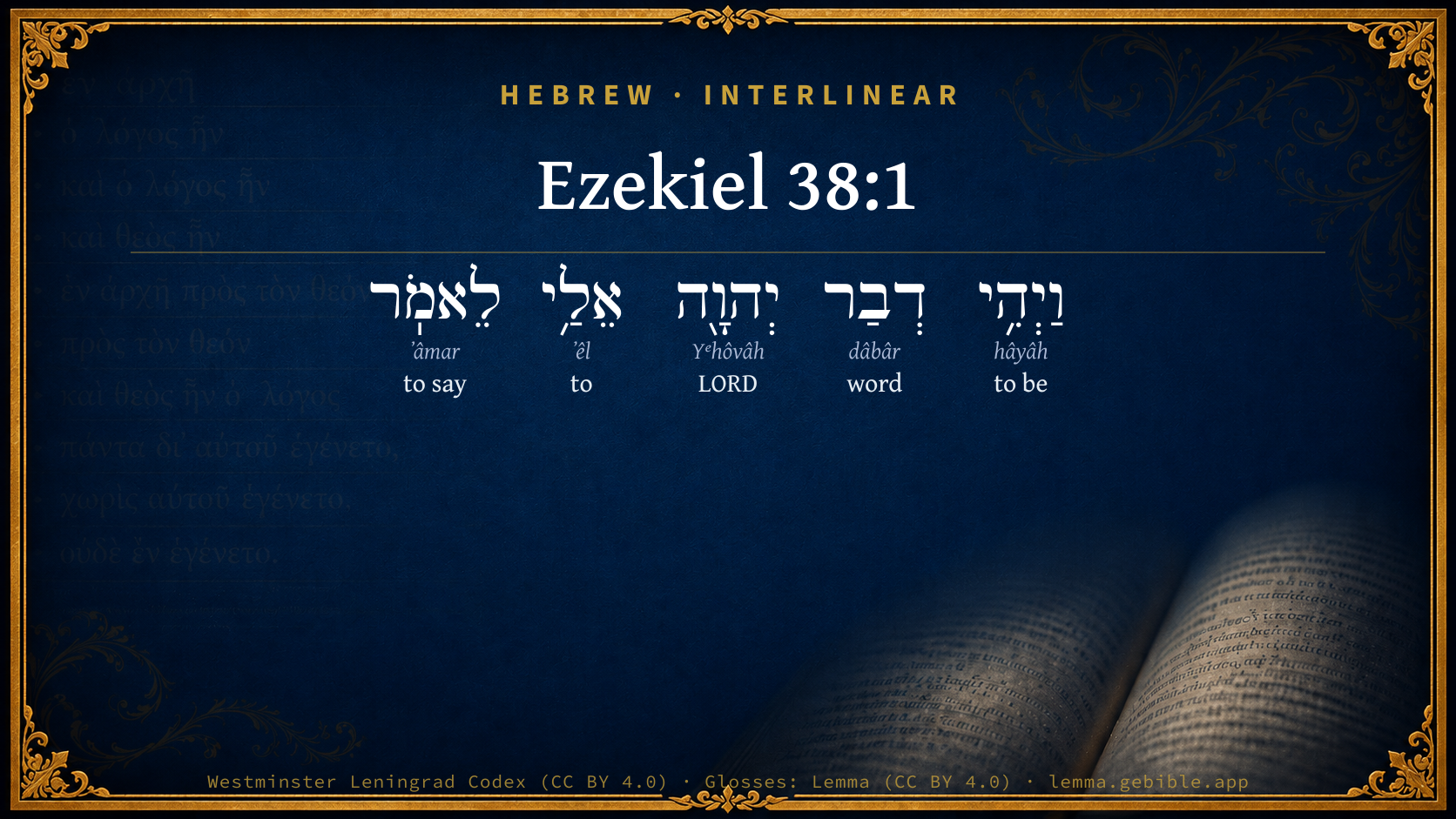
Ezekiel 38:1

Hebrew (Westminster Leningrad Codex) Ezekiel 38:1 appears in the Hebrew Old Testament. The text above is from the Westminster Leningrad Codex. Each word links to its Strong’s number, a concise gloss, and parsing drawn from the Open Scriptures Hebrew Bible morphology. Click any word for its full Brown-Driver-Briggs (BDB) entry.
Download image
Cite this verse

Ezekiel 38:1 (World English Bible). Public Domain. Lemma interlinear Bible study tool, https://lemma.gebible.app/v/ezekiel/38/1.

Show BibTeX & RIS
BibTeX
RIS
English Translation
The word of Yahweh came to me, saying,
World English Bible · Public Domain
Download a study sheet

One document with this verse’s original text, its word-by-word gloss line, the meaning frame, cross-references with their text, attributed commentary, and full source and license credits — printable, and it pastes into notes with its structure intact.

This verse Autodidact and up

Study sheet (.html) Plain text (.txt)

A passage Seminary Student

Up to 50 verses in one chapter. A passage sheet keeps up to 6 commentary sources and 12 cross-references per verse, in the order this page ranks them, and says so on the sheet whenever that leaves anything out. Ask for a single verse and you get the Autodidact verse sheet above.

Everything on this page stays free to read, with no account — the sheet is a download of what is already on screen, not access to it.

Want to remove ads? Support Godless Engineer
Compare translations 3

The same verse in 3 English versions, stacked beneath the original-language interlinear above. Click any original word for its lexicon entry.

Each is an independent rendering of the whole verse — the interlinear is not word-aligned to these translations.

Highlighted words mark where these versions differ — a whole-verse word diff, not a word-by-word alignment.

  • World English Bible Public Domain
    The word of Yahweh came to me, saying,
  • King James Version Public Domain
    And the word of the LORD came unto me, saying,
  • unfoldingWord Literal Text CC BY-SA 4.0
    The word of Yahweh came to me, saying,

unfoldingWord Literal Text — © unfoldingWord, licensed CC BY-SA 4.0. Word-aligned USFM3 via Door43 (git.door43.org/unfoldingWord/en_ult).

Versions to compare (up to 4)

3 of 4 selected

Show all 18 translations

Every available English version of this verse, each an independent rendering of the whole verse.

  • World English Bible Public Domain
    The word of Yahweh came to me, saying,
  • Berean Standard Bible Public Domain
    And the word of the LORD came to me, saying,
  • Majority Standard Bible Public Domain
    And the word of the LORD came to me, saying,
  • King James Version Public Domain
    And the word of the LORD came unto me, saying,
  • American Standard Version (1901) Public Domain
    And the word of Jehovah came unto me, saying,
  • Revised Version (1885) Public Domain
    And the word of the LORD came unto me, saying,
  • Geneva Bible (1599) Public Domain
    And the worde of the Lord came vnto mee, saying,
  • Douay-Rheims (1899) Public Domain
    And the word of the Lord came to me, saying:
  • Young's Literal Translation Public Domain
    And there is a word of Jehovah unto me, saying:
  • Literal Standard Version CC BY-SA 4.0
    And there is a word of YHWH to me, saying,
  • Unlocked Literal Bible CC BY-SA 4.0
    The word of Yahweh came to me, saying,
  • unfoldingWord Literal Text CC BY-SA 4.0
    The word of Yahweh came to me, saying,
  • Darby Bible Public Domain
    And the word of Jehovah came unto me, saying,
  • World Messianic Bible Public Domain
    The LORD’s word came to me, saying,
  • Webster's Bible Public Domain
    And the word of the LORD came to me, saying,
  • Free Bible Version CC BY-SA 4.0
    A message from the Lord came to me, saying,
  • Bible in Basic English Public Domain
    And the word of the Lord came to me, saying,
  • JPS Tanakh (1917) Public Domain
    And the word of the LORD came unto me, saying:

Literal Standard Version (2020), Covenant Press — licensed CC BY-SA 4.0. Text via the HelloAO Bible API (eBible.org). Unlocked Literal Bible (unfoldingWord) — licensed CC BY-SA 4.0. Text via the HelloAO Bible API (eBible.org). unfoldingWord Literal Text — © unfoldingWord, licensed CC BY-SA 4.0. Word-aligned USFM3 via Door43 (git.door43.org/unfoldingWord/en_ult). Free Bible Version, Dr. Jonathan Gallagher — licensed CC BY-SA 4.0. Text via the HelloAO Bible API (eBible.org).

Word by word

More ways to search: Search by grammar → Find every occurrence → Compare this word →

Practice this passage: Drill this verse → Learn its vocabulary →

About this verse

These counts appear in no published source. They are computed here, from the morphology-tagged text and Lemma’s own curated glosses. What Lemma adds →

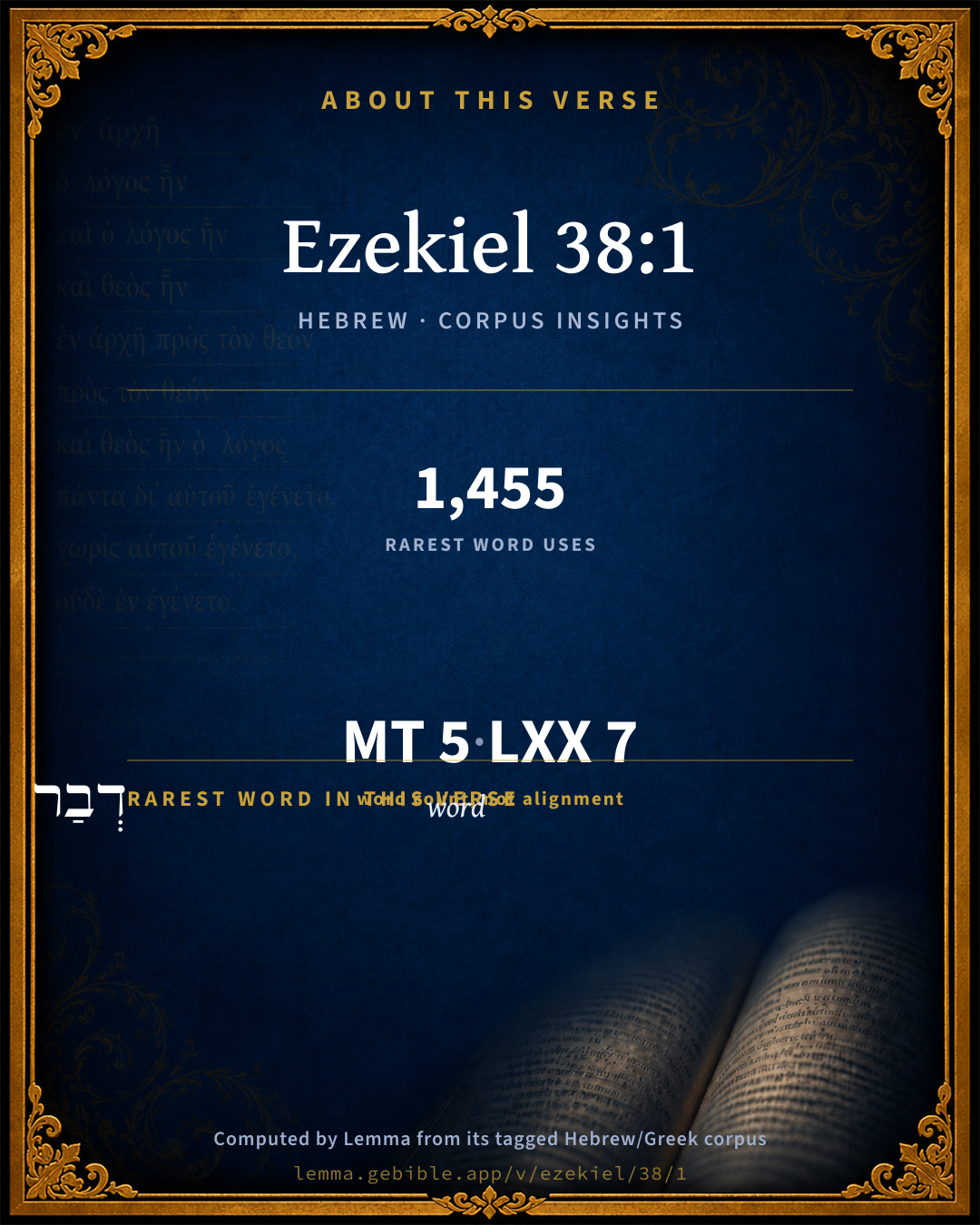
5
words
5
distinct lemmas
Prophets
section

Grammatical profile

  • 2 verbs
  • 2 nouns
  • 1 preposition

Verb forms

  • וַיְהִ֥י Qal · Sequential Imperfect
  • לֵאמֹֽר Qal · Infinitive Construct

Hebrew & Septuagint length

In English translation the verse runs 8 words from the Hebrew and 10 from the Septuagint (LXX English) — closely comparable.

A rough comparison of the two English renderings, which tokenize alike — not a word-level alignment.

Word counts can differ between the Hebrew and the Greek without any difference in meaning — e.g. the Hebrew direct-object marker אֵת has no separate Greek word, and Greek often adds the article ὁ.

In the original languages it is 5 Hebrew tokens and 7 Greek tokens — but the two are counted differently (Hebrew bundles its prefixes and suffixes into one token; the Greek is in lemma form), so that isn’t a like-for-like length.

Hebrew and Greek witnesses Masoretic Hebrew ↔ Greek Septuagint

The same verse in the two great witnesses to the Old Testament, shown verse-for-verse.

These are two independent witnesses, not word-aligned to each other, and the Septuagint is shown in lemma (dictionary) form.

Hebrew Ezekiel 38:1 Masoretic · Westminster Leningrad Codex

וַיְהִ֥י דְבַר יְהוָ֖ה אֵלַ֥י לֵאמֹֽר

The word of Yahweh came to me, saying,

World English Bible · Public Domain

Greek LXX Ezekiel 38:1 Septuagint · lemma form

καί γίγνομαι λόγος κύριος πρός ἐγώ λέγω

And the word of the Lord came to me, saying,

LXX2012 (modern English Septuagint) · Public Domain

On this verse, Dummelow's Commentary on the Holy Bible discusses the Septuagint’s reading. Read the note in Commentary ↓

Hebrew: Westminster Leningrad Codex (CC BY 4.0). Greek: Septuagint (public domain); English from LXX2012 (modern English Septuagint) (Public Domain). How the Septuagint differs from the Hebrew →

Targum (Aramaic paraphrase)

1

The Targum is the ancient Jewish Aramaic paraphrase of the Hebrew Scriptures — an interpretive translation, not the Hebrew text itself. Onkelos (literal) and Pseudo-Jonathan (expansive) render the Torah, and Jonathan the Prophets. Coverage is partial: where no permissively-licensed English translation exists for a verse, only the Aramaic is shown. This is verse-level text, not a word-by-word alignment to the Hebrew.

  1. Targum Jonathan Prophets (Joshua–Malachi)
    וַהֲוָה פִּתְגַם נְבוּאָה מִן קֳדָם יְיָ עִמִי לְמֵימַר:

    (no public-domain English translation for this verse)

    Targum Jonathan — Aramaic: “Mikraot Gedolot” (public domain). English: “Sefaria Community Translation” (CC0 1.0 (public-domain dedication)); “London "Chaldee Paraphrase," 1871” (public domain). Text via Sefaria.

Commentary

Notes on Ezekiel 38:1 from classic Christian and Jewish commentators (each source and its license shown beneath its notes). The classic Christian expositions comment on the surrounding passage and are grouped to its opening verse, so a note may address several verses; the Jewish commentaries on the Tanakh (Rashi and others) are per-verse, so they appear only where the commentator wrote on this verse.

Lemma curates 59 commentaries, every one of them public domain or Creative Commons licensed, each selected and text-cleaned for this edition rather than reprinted as found. About our sources →

Trapp's Complete Commentary

John Trapp

Eze 38:1 And the word of the LORD came unto me, saying,

Ver. 1. And the word.] This particle and showeth the dependence of this discourse upon the former. God’s people shall be brought to their own country. The Lord Christ also shall sit upon the throne of his father David. But between these two great benefits the Church shall suffer much, and her enemies a great deal more, when once God takes them to do.

John Trapp, A Commentary or Exposition upon All the Books of the Old and New Testament (1647–1656) — public domain. Text from a community e-Sword module.

Albert Barnes' Notes on the Bible

The last conflict of the world with God, and the complete overthrow of the former. This section Eze. 38–39 refers to times subsequent to the restoration of Israel. As the Church (the true Israel) waxes stronger and stronger, more distant nations will come into collision and must be overthrown before the triumph is complete. Some have thought that this prophecy is directed against the Scythians who had possession of Asia twenty-three years, and in the course of this time had overrun Syria, and had probably made their appearance in the holy land. But in this prophecy there is little distinctive of one nation. It is a gathering together of the enemies of Yahweh to make their last effort, and to be overthrown. The seer passes to the final struggle between Good and Evil, and the triumphant establishment of the divine rule. It is the same struggle which is depicted in the Book of Revelation Eze 20:7-10, where John adopts words and phrases of Ezekiel.

There are four main divisions of this prophecy:

(1) Eze 38:1-13, describing Gog’s march;

(2) Eze 38:14-23, describing his punishment;

(3) Ezek. 39:1-16, describing his ruin;

(4) Eze 39:17-29, the issue of Gog’s ruin in Israel’s redemption and sanctification.

Each division is broken up like a poem into stanzas.

Albert Barnes' Notes on the Bible (1834–1885) — public domain. Text from a community e-Sword/MySword module.

Dummelow's Commentary on the Holy Bible

J. R. Dummelow

God's Final Victory over the Heathen

Ezekiel's earlier group of prophecies against the nations (Ezekiel 25-32) was concerned with Israel's nearer neighbours, which had interfered more or less in former times with her prosperity; and their humiliation was regarded as a necessary condition of Israel's peaceful and happy future. Ezekiel, however, contemplated a wider extension of God's glory than these prophecies involved. This is described under the form of an invasion of the restored Israel by hordes of the remotest heathen, who will be destroyed by God without any fighting on Israel's part. His glory will thus be manifested to the very ends of the earth. Ezekiel is alone among the Old Testament prophets in expecting another crisis to arise after the restoration has been accomplished. His conception is reproduced in the New Testament in the book of Revelation (Rev_20:7-10), and the underlying idea in both cases is that what seems the triumph of God's kingdom may be followed by a fresh assault of the forces of evil, which, however, are destined to be overthrown at last. The picture of Gog may have been suggested partly by the memory of the great Scythian invasion (see Intro.), and partly by the ravages of Nebuchadrezzar's armies.

Ezekiel 38 describes Gog's allies (Eze_38:1-7), his nefarious plans (Eze_38:8-13), his great invasion (Eze_38:14-17), and God's turning of the forces of nature against him (Eze_38:18-23). Ezekiel 39 foretells that God will lead him on to destruction (Eze_39:1-7); his weapons will provide Israel with fuel for seven years (Eze_39:8-10); seven months will be required to bury the corpses of his host, which will fill a whole valley on the E. of the Dead Sea (Eze_39:11-13); when the seven months are over special officers will still be required to search out and bury the dead bodies that remain (Eze_39:14-16); birds and beasts of prey will enjoy an enormous banquet (Eze_39:17-20); all the earth will recognise the power and glory of the true God, the heathen will understand at last the real meaning of Israel's exile, and Israel will learn the lessons of all God's dealings with them in judgment and in mercy (Eze_39:21-29).

2. Gog, the land of Magog] RV 'Gog, of the land of Magog.' The exact reference of the names is unknown. Magog is the land ruled over by Gog. The conjecture that 'Magog' (Mgg = Ggm = Bbl) is a cryptogram for 'Babel' (Babylon) has no probability. Gog in any case is the representative of remote heathendorn, and is located in the far N. (Eze_38:6, Eze_38:15; Eze_39:2), while he has allies in the distant S. (Eze_38:5).

Chief prince of Meshech, etc.] RV 'Prince of Rosh, Meshech,' etc., and so in Eze_38:3, Eze_39:1. The land meant by 'Rosh' is unknown, but there can be no allusion to Russia. On Meshech and Tubal see on Eze_27:13.

4. Turn thee back] RV 'turn thee about.' Perhaps we should read, 'lead thee,' and so in Eze_39:2. God directs the movements even of the enemies of His kingdom.

5. Persia] a doubtful rendering. Ethiopia, and Libya] RV 'Cush and Put': see on Eze_27:10; Eze_30:5.

6. Gomer] (Gen_10:2), a people in the N. of Asia Minor, usually identified with the Cimmerians.

Togarmah] Armenia: see on Eze_27:14; The north quarters] RV 'the uttermost parts of the north.' Bands] RV 'hordes,' and so throughout. People] RV 'peoples,' and so throughout, except in Eze_38:12, and Eze_39:13.

7. Be thou a guard unto them] LXX reads, 'hold thyself in reserve for me.'

8. The latter years] The invasion of Gog is in the distant future. The land that is.. gathered, etc.] The sense requires 'the nation' to be supplied before 'that is gathered': see Eze_38:12.

11. The peaceful state of the restored Israel is here described.

12. Midst of the land] RV 'middle of the earth,' the supposed geographical position of Palestine.

13. Sheba.. Dedan.. Tarshish] see on Eze_22:23, Eze_22:25; Eze_27:15, Eze_27:20.

Young lions] does not give a clear sense. Other suggested readings are, 'Canaanites,' 'Cyprians,' or 'traffickers.' The nations mentioned were spectators of Gog's invasion, and inquired what commercial advantage they might reap from the disposal of the spoil.

15. North parts] RV 'uttermost parts of the north.'

17. Certain older prophecies were understood by Ezekiel to refer, though not by name, tö the coming invasion of Gog. Perhaps he had in view Zep_1:14.; Zep_3:8; Jeremiah 3-6.

18. At the same time] RV 'in that day.' In my face] RV 'into my nostrils.'

19. Shaking] or, 'earthquake.'

J. R. Dummelow, A Commentary on the Holy Bible (Macmillan, 1909) — public domain. Text from a community e-Sword module.

The Pulpit Commentary

The present and the following chapters, comprising the next oracle, or "word of God," delivered by the prophet, relate to the expedition, (Eze_38:1-13) overthrow (vers. 14-23), and destruction of Gog, (Eze_39:1-20) with the results of the same to the heathen world and to Israel (vers. 21-29). Attempts to identify Gog and his armies with particular nations, as e.g. with the Chaldeans (Ewald), the Scythians (Kuobel, Hitzig), the Greeks under Antiochus Epiphanes (Grotius), and even the Turks (Luther), have not been and are not likely to be successful. Either the highly idealized picture the prophet sketches was designed, as Hengstenberg thinks, to sum up and present in one great battle-piece all the conflicts which, throughout subsequent centuries, the restored and united Israel should have to maintain against the heathen world; or it was intended, as Havernick, Keil, and others believe, to point to one closing struggle, in which the world"s hostility to the Church of God should culminate, and in which it should be utterly and finally broken. In favor of this latter view stand the facts that by the prophet the uprising of Gog is located in "the latter days," and by the author of the Apocalypse, who seems to allude to the same event, the last battle between the powers of evil and the Church of God is placed immediately before the final judgment and the emergence of the new heavens and the new earth. (Rev_20:8)

Vers. 1-13. The announcement of Cog"s expedition against Israel.

The word of the Lord came unto me. Although this oracle is unaccompanied by any note of time, it was obviously delivered before the twenty-fifth year of the Captivity, (Eze_40:1) and most likely in immediate succession to the preceding prophecy, with which also it has a close relation in respect of purport, being designed to show that against restored and united Israel, i.e. against the Church of God of the future, the strongest combinations of hostile force would not prevail, but would fall back defeated and self-destroyed.

HOMILETICS.

Vers. 1-4. Gog and Magog.

If we take these names as representing the Scythians and their king, we have a description of God"s judgment of the most wild and remote heathen tribes and of their relation to Israel.

I THE BIBLE IS FOR ALL NATIONS. It contains a message even for Gog and Magog it is intended to reach the Scythians. It has to do with all people in the world. The Hebrew prophet was not permitted to narrow his thoughts to the parochial mind; His vision was world-wide. A Jew of the Jews, he was nevertheless a preacher to mankind. Much more is the Christian apostle a preacher to all men. Here is a great motive for circulating the Scriptures among all nations.

II GOD HAS DEALINGS WITH ALL PEOPLE. His influence extends to Gog and Magog. God"s hook will be put in the jaws of the distant prince. The heathen are under God"s notice and affected by his supreme authority. To be far from the Church of God is not to be far from the power of God. The ends of the earth feel his great energy. The arms of God are long. This is a reason for our seeking to enlighten the most remote and heathenish people; for they all belong by right to God.

III GOD TAKES ACCOUNT OF SAVAGES. The Scythians of ancient times were about the wildest known people; they were to the Easterns of the past what the cannibals of Central Africa are to modem Europeans. It was difficult to make civilized nations feel that they belonged to the same species with such wild men of the Northern forests. Yet God knew these people. God does not ignore the most degraded savages. They, too, are naturally made in the image of God. Judged according to their poor, obtuse, perverted consciences, even they will have to give account to the God of all. They are not responsible for the ignorance and degradation in which they are born, and surely God will deal very leniently with these unhappy races. Yet for their acknowledged evil even they must be punished. But if there is a judgment of Gog, much. more must there be a judgment of Israel; if the savages of Africa must give an account of the deeds done in the body, much more must the Christians of Europe appear before the judgment-seat of God.

IV CHRISTIANITY BRINGS A GOSPEL OF SALVATION AND UNION FOR ALL NATIONS.

It even includes Gog and Magog in its gracious outlook; for St. Paul taught that the Scythians were to share in the common brotherhood of the Christian Church. (Col_3:11)

1. The gospel is suited to the lowest heathen. This fact is proved by its effects. While the dreamer at home pronounces the Christianizing of savages to be an impossibility, the worker in the missionary field answers effectually by quietly accomplishing the so-called impossible feat. Charles Darwin was so struck with the good work of missionaries in civilizing the inhabitants of Tierra del Fuego, whom he regarded as about the most degraded savages on the face of the earth, that he subscribed to the society from which the missionaries had gone forth.

2. The gospel should be spread among the lowest heathen. We have no excuse to despair of any. The very dedication of heathendom is a call to Christians for help. Rousseau"s fancy of the innocence and happiness of the simple savage is not justified by experience. Oppressed with cruelty and superstition, degraded in uncleanness, the savage greatly needs the liberty and salvation of Christ.

HOMILIES BY J.R. THOMSON

Vers. 1-13. The invasion of those who dwell secure.

The occurrence in this place of this and the following chapters is somewhat perplexing. The events here prophetically described take place after the restoration of the Israelites from their Eastern captivity. Yet they are altogether too stupendous to be applicable to anything which happened in the time or soon after the time of Ezekiel. Thus many interpreters of prophecy refer them to a period still in the future, when a final struggle may take place between the Church of Christ and the powers of this world. The general moral and religious lessons of the passage are, however, independent of any special prophetical interpretation.

I THE MANIFESTATION OF GOD"S FAVOR DOES NOT INVOLVE PERFECT TRANQUILITY. Israel had been restored from the East to the land of inheritance and promise. The hand of Divine retribution had been removed, and the hidden countenance of God had shone upon his people. But their troubles were not over; their land was not to remain in their undisturbed possession; Jerusalem was not to be the city of peace. This indicates a general principle of the Divine government. The Church of Christ is a ransomed Church, a chosen and beloved possession. But upon earth it is the Church militant; there is a warfare to be waged; this is not our rest. Even in the latest period of this dispensation repose may be disturbed, enemies may arise, a conflict may be passed through. All this would be consistent with the favor and loving-kindness of the God of salvation.

II SINFUL RAPACITY IS NOT DETERRED BY THE SIGNS OF DIVINE PROTECTION. Not a few of the enemies of Israel had been defeated and put to shame, whilst Israel had been spared, favored, and exalted. He who questioned the power and kindness of Jehovah might well be pointed to the history of the Hebrew people. Yet, as a matter of fact, there were enemies of Israel and of God who, notwithstanding these apparent lessons, renewed their assaults upon the objects of Divine protection. Similarly, the Church of Christ is exposed to assaults open and insidious, physical and moral. The enemies of religion, if they have studied history, must be aware that Christ has built his Church upon a rock, and that the gates of Hades do not prevail against it. Yet they are not found to desist from their endeavors or to abate their hostility. Nor need the people of God expect to be exempt from "rude assaults of raging foes.

III THE ENEMIES OF GOD"S PEOPLE, CONSCIOUS OF THEIR NUMBER AND THEIR POWER, REGARD THE APPARENTLY DEFENSELESS AS AN EASY PREY. The foe is described in these verses in a manner which depicts his formidable character. Cog and his auxiliaries and allies are represented as preparing for the attack, as mustering to make war upon those who are without the protection of walls, bars, or gates. The unwalled villages seem to invite the marauder, and he counts the cattle and goods, the silver and gold, as already a prey. In like manner, the foes of the Church, confident in their resources, relying upon the force of their arms, encourage one another in their hostile designs against the Church, by observing how defenseless she appears, and how open to the hostile attack and the crafty strategy of her foes. The weapons of her warfare are not carnal, and weapons of any other kind are beyond the comprehension of the foe.

IV THE AGGRESSOR SHOULD REMEMBER THAT THE LORD OF ALL CAN CHECK AND DEFEAT THE ABLEST AND THE MIGHTIEST. If the Omnipotent do but say, "I am against thee," it matters not how formidable and vast are the hostile resources of the enemy. One word from his lips, one glance from his eye, is enough to put to confusion all the boasted power of the foe.

V THE DEFENSELESS SHOULD REMEMBER THAT GOD IS ABLE IN ALL CIRCUMSTANCES TO DEFEND AND TO DELIVER HIS OWN. The true security of Israel was in God"s care; Jehovah was the Shield, the Stronghold of his people, and when they trusted in him they were safe. The Israel of God has a sure defense. "Fear not," says Jehovah; "I am with thee." The protection of the Church is not in the favor of kings or in the arm of the warrior; it is the eternal God who is our Refuge, and underneath us are the everlasting arms. T.

HOMILIES BY J.D. DAVIES

Vers. 1-13. The stability of God"s kingdom.

The lengthened subjection of the Hebrews had sapped their courage and their hope. The promises of a return to Canaan fell upon hearts full of apathy and self-diffidence. A latent fear was growing up that, even should they regain their old possession, they would soon be exposed to fresh invasion from some grasping monarch. They felt their lack of organization, their lack of military prowess, and men devoid of energy felt that it was better to remain in exile than to be more completely crushed alter a temporary restoration. Hence Ezekiel was commissioned to deal with this form of indifference before it grew into active opposition. A vision respecting a great confederacy against Israel is granted to the prophet. God anticipates the gravest evil. He reveals to his people that this criminal conspiracy will end in complete disaster to its originators, and that Israel"s triumph will be complete and perpetual. Ezekiel"s face was set firmly against Gog, because God"s face was against him.

I GOD"S KINGDOM IS SECURE AGAINST THE GREATEST WORLDLY CONFEDERACY. The theory that is propounded in this prophetic picture is that possibly all peoples adverse to righteousness will combine against the righteous nation. The empires of the extreme North will, sooner or later, coalesce with the great empires of Asia and Africa in a common greed for the territory and possessions of Israel. The world-power is provoked into active opposition by the presence of a righteous and spiritual kingdom. As darkness is the foe of light, water the foe of fire, death the foe of life, so selfish wickedness is the foe of goodness. Sooner or later, these two great forces shall meet for final and mortal combat on the earth. But the mightiest forces are not those which are visible. Victory will not finally sit on the banners of largest battalions. These numbers count for nothing with God. Minor rivalries are often forgotten by reason of a mightier passion, viz. a common hatred of truth and God.

II GOD"S KINGDOM IS SECURE AGAINST THE CLEVEREST MILITARY TACTICS. Men have enormous faith in swords and shields, in rifles, cannons, and dynamite. Against the empire of righteousness the most complete and prudent preparations will be made. No precaution foreseen by human sagacity will be omitted. Each nation will fight with such weapons as they can most skillfully wield. The most clever inventions in offensive artillery will be pressed into service. The hostility will be pressed on with all the arts and machinations possible to the human mind. Yet there is a force enlisted upon the side of the righteous kingdom that shall baffle all human combination, and make all human energy to appear as an embodiment of weakness. Man"s strength and skill are only borrowed instruments.

III GOD"S KINGDOM IS SECURE AMID UNFRIENDLY NEUTRALS. "Sheba, and Dedan, and the merchants of Tarshish shall say to thee, Art thou come to take a spoil?" These peoples were neighbors to Israel, unwilling to join openly the ranks of Israel"s foes, yet secretly desiring to see Israel humbled. They were heartless enough to cheer on the aggressive leaders of the foe, moved by a selfish hope that they might avoid the toil and the peril of war, and yet gain some advantage out of Israel"s defeat. Neutrality at such a time and in such a manner was a crime scarcely minor to the crime of invasion, and such neutrality will be covered with disgrace. The most hidden motive of man, Israel"s Ruler will detect, and in proportion to wrongdoing will be the award. Neutrals are usually despised by both sides. Nor can we forget how deeply God felt a selfish neutrality upon a former occasion, when the voice of the angel said, "Curse ye Meroz; curse ye bitterly the inhabitants of Meroz, because they came not to the help of the Lord against the mighty!

IV GOD"S KINGDOM IS SECURE BECAUSE EVERY FOE IS UNDER THE RESTRAINT OF JEHOVAH. Every selfish passion of man is under the control of God. A world of meaning is in that phrase, "I will put hooks into thy jaws." At any point in the development of the hostile project, God could have defeated it. He could have bridled the malicious impulse of Gog, the originator. He could have deprived him of reason or of life. He could have smitten with blindness all the leaders of the expedition. But God sees it to be best to allow large liberty to wicked men. The inner nature of wickedness is seen when it bears its full and proper fruit. Some plants look well in the shoot and in the leaf, but the fruit thereof is deadly. Men are seldom conscious of the action of God upon them. He "girded Cyrus" with strength and courage for his work, although Cyrus knew him not. And Gog would pursue his brilliant march, proud of himself and of his forces, least of all imagining that his Royal Foe had put already a hook in his jaw, and was simply leading him on to destruction. Utterly insane is the man who dares fight against God. The issue may be early foreseen. D.

HOMILIES BY W. CLARKSON Vers. 1, 2The supreme contest.

What is the real significance of this prophecy? Is it to receive a literal or a symbolical interpretation? If not fairly open to the one, in what direction shall we look for the other? Agreeing with the views advocated by Fairbairn, we give his exposition, reproducing his arguments as given in his work on this prophet. And thus guided, we look at

I THE REASONS FOR REJECTING A LITERAL INTERPRETATION.

1. The name given to the hostile leader points to an "ideal delineation;" while the name of the country is that of a "very indefinite territory," impossible to define.

2. The extraordinary character of the combination of forces, including those most remote and dissociated from one another, is "the reverse of the natural one," and points to "the clothing of an idea rather than to a literal reality.

3. The immensity of the numbers of the allied host makes it impossible that they would actually come up against Israel for plunder; they must necessarily lose rather than gain, even if they succeeded to the full extent of their expectations.

4. The details respecting the wood of the enemy"s weapons (Eze_39:9, Eze_39:10) and the burial of the dead (Eze_39:11, Eze_39:12) are not such as would become historical

5. The particulars, especially as to the exact locality, do not correspond with those given in other prophecies. (see Isa 34 Joe 3 Zec 14)

6. The undoubted Messianic element in the prophecy demands a non-literal interpretation; for the kingdom of Christ was not to be established or secured by carnal, but by spiritual means.

II THE TRUE SPIRITUAL INTERPRETATION. The prophet has already, in previous visions, brought us on to a period when Israel (the Church of Christ) has entered on a time of rest and triumph. The second David, the Divine Shepherd of Israel, presides over his people who dwell in security. But that is not the end; much has still to be done and to be experienced. For:

1. The peace and the prospects of the Christian Church stir up the enmity of the world, and "enlarge the field of conflict;" and "as the whole earth is Christ"s heritage," there must be conflict until the victory is complete.

2. The war is to be on a gigantic scale, for the question now is "whether God"s truth or man"s sin is to have possession of the field;" in comparison with this great final conflict all previous contests seem small, and the largest numbers are applicable.

3. Great and preponderating as are the odds against the Church, reckoned by material resources, the presence of Divine power and grace on the side of Israel makes her completely victorious, and issues in the defeat of" the adversary.

4. The kingdom over all the earth becomes the Lord"s. It becomes clear that it was his zeal on behalf of righteousness which led to previous chastisements, and that same zeal now causes them to triumph. Before the Church there stretches a "prospect of eternal peace and blessedness." The delineation may, or it may not, nave to do with some particular crisis or decisive moment when the "spiritual controversy rises to a gigantic magnitude, and ranges on either side all that is good and all that is evil in the world.

PRACTICAL SUGGESTIONS.

1. We need not be discouraged because a great and threatening battle has still to be fought out. We have intimations in Scripture that the Church will be called to face overwhelming hosts.

2. We may, by doing our best in the sphere in which we are placed, contribute something to the final triumph of the good.

3. We ought to have some better assurance than the presence of vast and apparently invincible numbers that we are on the winning side. The one decisive question is this Is God with us or against us? C.

The Pulpit Commentary (1880–1919), ed. H.D.M. Spence-Jones & Joseph S. Exell — public domain. Text from a community e-Sword module.

The Preacher's Complete Homiletical Commentary

Joseph S. Exell (gen. ed.)

THE WARLIKE ASSAULT OF GOG, AND ITS REPULSE. (Chap. 38)

EXEGETICAL NOTES.—Eze_38:2. “Gog.” “An ideal name; it is simply the root of Magog, the only related name known to history. The whole prophecy demands a non-literal interpretation. The prophetical delineations of the Divine principles of government are thrown into the familiar forms of Old Testament relations. The final triumph of Messiah’s truth over the most distant and barbarous nations is represented as a literal conflict on a gigantic scale, Israel being the battlefield, ending in the complete triumph of Israel’s anointed King, the Saviour of the world. It is a prophetical parable, in which every trait in the delineation is full of important meaning, only couched in the language of a symbolical representation. While the vision respecting Gog and Magog in the Apocalypse (chap. 20.) may be regarded in substance a reannouncement of the prophecy before us, it does not follow that the prophecy in the Apocalypse has exactly the same compass as in Ezekiel. In each case alike the vision is appropriated to describe the final workings of the world’s evil, and its results in connection with the kingdom of God; only, the starting-point is placed farther in advance in the one case than in the other. Therefore, as found in Ezekiel, it can throw no light on the chronological arrangement of the Apocalypse.”—Fairbairn. “Chief prince of Meshech and Tubal.” “Rosh,” translated chief, is taken as a proper name by some, and probably refers to the Russi, a people from whom the modern Russians derive their name. Schrader accepts Magog as equivalent to Scythians. Tubal = Tabal, according to him, bordered on Cilicia, and seems to have been what was afterwards Cappadocia. It was famous for great horses. Meshech he regards as having lain north-east of Cappadocia in Lower Armenia. Magog was Gog’s original kingdom, though he acquired the mastery over Meshech and Tubal, and so might be called their chief prince.

Eze_38:3. “I am against thee, O Gog, the chief prince of Meshech and Tubal.” His high-sounding titles are repeated, to imply the haughty self-confidence of the invader as invincible.

Eze_38:4. “I will turn thee back”—“as a refractory wild beast which thinks to take its own way, but is bent by a superior power to turn on a course which must end in its destruction. Satan shall be by overruling Providence permitted to deceive them to their ruin (Rev_20:7-8).”—Fausset. “It is significant that the irruption of Gog is here and in what follows referred to Jehovah. He means to march against Jehovah, but the latter has him in tow—he must march whither He will to his own destruction, as in former times Pharaoh did not thwart the God of Israel when he refused to let His people go, but acted so because Jehovah Himself had hardened his heart to plunge him into destruction.”—Hengstenberg. “And put hooks into thy jaws”—rings in thy jaws; the rings which are put in the most tender parts of intractable animals on which to fasten the bridle or reins (chaps. Eze_19:4, Eze_29:4; 2Ki_19:28). “Horses and horsemen”—a decidedly Scythian trait, for the richness in horses of these hordes, most equestrian tribes, was already known to Herodotus. “Clothed with all sorts of armour”—“clothed with splendour, an Assyrian element introduced: thus the figure of Gog is enlarged.”—Lange.

Eze_38:5. “Persia, Ethiopia, and Libya,” or Phut. “These are in the farthest south from Babylon, where Ezekiel lived. The Asiatic Cush or Ethiopia lay in Central and Northern Babylon. Phut was the name, according to Ebers, of some wandering tribes of Arabia. Sayce thinks Phut was the Somali country in Eastern Africa.”—Geikie.

Eze_38:6. “Gomer”—the Celtic Cimmerians of Crim-Tartary. “Togarmah”—“the Armenians of the Caucasus, south of Iberia. A pictorial and manifestly symbolical grouping of nations. There is no impossibility in the connection of nations so distant from one another. The anti-Chaldaic coalition, which the prophet himself had witnessed, actually extended from Ethiopia to Persia. The impossible lies rather in this, that all these nations are to co-operate at a definite time against the petty Palestine.”—Hengstenberg, &c.

Eze_38:7. “Be thou prepared.” “Irony. Prepare thee and all thine with all needful accoutrements for war, that ye may perish together!”—Fausset.

Eze_38:8. “After many days thou shalt be visited” (Isa_24:22; Isa_29:6). Gog meant to visit the people of God, but in reality he is himself visited. It was God who led him in order to prepare him for his downfall. It is very consolatory to the Church that God not merely conquers its enemies, that even their hostile undertaking is under His guidance, that they move not hand nor foot but at His command. “In the latter years”—“at the end of the years. This indicates that the catastrophe belongs to a quite new order of things—the Messianic epoch.”—Hengstenberg.

Eze_38:9. “Thou shalt ascend and come like a storm—like a cloud to cover the land.” “The cavalry of the Tanjou frequently consisted of two or three hundred thousand men, formidable by the matchless dexterity with which they managed their bows and their horses, by their hardy patience in supporting the inclemency of the weather; unchecked by torrents or by precipices, by the deepest rivers or by the most lofty mountains, they spread themselves over the face of the country and overthrew all who opposed them.”—Gibbon.

Eze_38:10. “Thou shalt think an evil thought”—conceive a mischievous purpose, as to attacking God’s people in their defenceless state.

Eze_38:11. “I will go up to the land of unwalled villages, to them that dwell safely.” The towns lie open, in fancied security, the prize of a sudden attack.

Eze_38:12. “That dwell in the midst of the land”—“the navel of the land, not physically but morally; a central position for being a blessing to the world. The literal sense, ‘navel,’ seems to point to the fact of its being the moral centre of the world, not to its moral eminence (chap. Eze_5:5).”—Fausset.

Eze_38:13. “Sheba and Dedan and the merchants of Tarshish”—“the Arabian nations Sheba and Dedan as representatives of the land-trade, and Tarshish of the sea-trade. Representatives of that portion of the world who, though they are not disposed to take any active part against the cause of God, are well pleased to see others do it. This worldly feeling makes them disrelish the truth, and they are ready to cheer on those who would make a spoil of its defenders.”—Fairbairn.

Eze_38:15. “All of them riding upon horses.” It is related of the Scythians that they eat, drink, and sleep in the saddle.

Eze_38:16. “When I shall be sanctified in thee, O Gog”—when God displays His incomparable glory in his punishment.

Eze_38:17. “Art thou he of whom I have spoken in old time by My servants the prophets of Israel?” “Gog and Magog are here identified with the enemies spoken of in other prophecies (Num_24:17-24; Isa_27:1; Isa_26:20-21; Jer_30:23-24; Joe_3:2; Mic_5:5-6; Isa_14:12-14; Isa_59:19). God is represented as addressing Gog at the time of his assault; therefore the old time is the time long prior when Ezekiel uttered these prophecies; so he also, as well as Daniel

(11) and Zechariah

(14), are included among the prophets of Israel here.”—Fausset.

Eze_38:18. “My fury shall come up in My face”—literally, into My nose; in Hebrew the idiomatic expression for anger, as men in anger breathe strongly through the nostrils.

Eze_38:20. “All shall shake at My presence.” “An earthquake, the figure of a great annihilating catastrophe in the human world, in which all has the feeling as if the earth were dissolving. The catastrophe affects only the enemies of God’s people; but it is so dreadful that the whole world seems to come to an end—that all that lives on earth is felt to be affected by it; every high thing is cast to the ground without discriminating whether it belongs to the enemy or not. All terrible particular judgments in their operations come upon the sense like a universal judgment.”—Hengstenberg.

Eze_38:21. “Every man’s sword shall be against his brother.” One great means by which God sweeps away the enemies of the king is the internal discord, for which He presents the natural occasions. The community of hatred can scarcely offer successful resistance to these (see historical example, 2 Chronicles 20).

Eze_38:22. “With pestilence, blood, hail, fire, and brimstone.” The colours of the picture are partly taken from the Egyptian plagues, and from the destruction of Sodom and Gomorrah.

Eze_38:23. “Thus will I magnify Myself.” The destruction is effected by an intervention of Jehovah, His fighting for His people, who are small compared to the greatness of Gog (Eze_38:15).

HOMILETICS

THE FIERCE ONSLAUGHT OF THE ENEMIES OF THE TRUTH

(Eze_38:1-23.)

The beautiful picture of tranquil prosperity depicted in the close of the last chapter would be difficult for the captive Jews to realise, unless there was the assurance of protection from hostile attacks like those which had brought them to their present deplorable condition. What avails it, they cry, even if we are restored? The heathen power still predominates, and we shall be crushed back again into irretrievable ruin. The wild, savage races of Scythia had spread terror over all Western Asia in the days of Josiah, and were still remembered with dread. Against such desponding thoughts the prophet here offers comfort. The heathen nations as a whole, in their opposition to the kingdom of God, are represented under the figure of a great invasion of the Holy Land by the Scythian forces. All the battles which restored Israel has to wage are united in one great battle. He who would lead his people out of captivity would be their omnipotent defender, the foe would be triumphantly vanquished, and Israel, the kingdom of the Messiah, finally delivered from all fear, would enter on a period of temporal and spiritual prosperity. The descriptions of the chapter illustrate the fierce onslaught of the enemies of the Truth. Observe—

I. That the enemies of the Truth are rallied and commanded by a leader of conspicuous ability (Eze_38:2-7). Gog, the chief prince of Meshech and Tubal—an ideal character, one possessing great military genius, faculty for organisation, power to manœuvre vast armies, revelling in destruction, and animated by a mighty hatred to the good. Gog’s forces are composed of diverse nationalities, extending over a wide area (Eze_38:5-6), and present an imposing and threatening aspect (Eze_38:4; Eze_38:7). The invasion and overthrow of the Chaldeans, the conflict of the Maccabees with Antiochus Epiphanes, the temporary successes and defeat of the Turks—to each of which historical events some interpreters would limit the application of the prophecy—were but feeble prototypes of a coming struggle with a powerful embodied Antichrist. Sin is fruitful in breeding formidable confederacies, and never lacks a leader. The people of God have often to complain with the Psalmist—“How are they increased that trouble me? Many are they that rise up against me” (Psa_3:1).

II. That the enemies of the Truth are fertile in plots to work mischief (Eze_38:10-12). “Thou shalt think an evil thought” (Eze_38:10). Here is a land defenceless, “dwelling without walls, and having neither bars nor gates,” its people inoffensive, quietly pursuing their avocations in fancied security; their “cattle and goods” are increasing, and they have no means of offering resistance. Let us pick a quarrel with them, and “take a spoil” (Eze_38:12). It is true they have done us no harm, nor are likely to do; but what of that? It is enough that they love the truth that we hate, and will become an easy prey to our superior force. If we yield to the suggestions of an evil heart, we trample down the laws of justice and equity, and can readily concert a plan of wholesale robbery and crime. The boldest highwayman or cattle-riever will not go more directly to his mark than we.

III. That there is a class of persons ever ready to make gain out of the havoc created by the enemies of the Truth (Eze_38:13). The eager merchants of Tarshish are referred to as young lions because of their well-known ferocity. There is little room for gentleness and pity in the breast of the unscrupulous trader. Where the carrion lies, there the vultures gather: where there is spoil, the traders. Gain is often made out of the misfortunes and sufferings of others. Many who would shrink from bringing about the ruin of others do not hesitate to make all possible profit out of the ruin. Looters, “the snappers-up of unconsidered trifles,” hang about the skirts of every victorious army.

IV. That the onslaught of the enemies of the Truth is fierce and terrible (Eze_38:8-9; Eze_38:14-17). The army of Gog was to burst upon Israel like a storm-cloud, enveloping and desolating the land. In all ages the forces of unbelief have made violent attacks upon the citadel of Divine Truth; and there have been times when it seemed as if the foundations had been shaken and the fabric must fall into hopeless ruin. But when the shock has spent itself, the stronghold has stood forth more prominent and stable than before. The great world-crisis is yet future. A time is coming that will test the faith of the most stalwart. Baffled and defeated in all previous attempts, the enemies of the Truth will gather up and concentrate all their powers, and all that wily diplomacy, vindictive hatred, and intensified rage can do will be combined in one grand, united, final effort. What will be the result? Mark—

V. That the most formidable onset of the enemies of the Truth will be Divinely opposed (Eze_38:17-23).

1. The Divine anger will be roused (Eze_38:17-19). “My fury shall come up in My face”—in My nostrils, as men are accustomed to show anger by a flushed countenance and dilated nostrils. An anthropomorphic representation: God stooping to the use of human methods of thought and expression. Injustice and cruelty provoke the Divine wrath; He is not an indifferent spectator of the oppressions inflicted upon His people. “When the great day of His wrath is come, who shall be able to stand?” (Rev_6:17).

2. The Divine power will employ against the enemies of the Truth the most destructive forces—earthquakes, wars, pestilence, storms (Eze_38:19-22). The resources of the universe are in the hands of God, and He can use them on the side of righteousness and in the punishment of tyranny and wrong. Heaven and earth are armed against every evil work, and will effectually prevent its triumph.

3. The Divine character will be vindicated in taking vengeance on the enemies of the Truth (Eze_38:23). God will be known and His honour magnified in judgment us well as in showing mercy. The mightiest army is impotent before His avenging sword. The defence and rescue of His people will demonstrate His power, His faithfulness, and His justice.

LESSONS.—

1. Hatred of the Truth manifests itself in violent opposition.

2. A time comes in the life of every man when he must take sides for or against the Truth.

3. Evil is doomed to suffer terrible defeat.

4. The resources of Omnipotence are at work in defence of the Truth.

GERM NOTES ON THE VERSES

Chaps. 28, 29. “The last conflict of the world with God, and the complete overthrow of the former. The place occupied by this section shows that it refers to times subsequent to the restoration of Israel. Hitherto the prophecies have been directed against the more immediate neighbours of God’s people. Their fall is to make room for Israel’s triumph. But as the Church—the true Israel—waxes stronger and stronger, more distant nations will come into collision and must be overthrown before the triumph is complete. Hence the present prophecy is directed against peoples dwelling in the remote regions of the North. From this quarter had come the terrible invasion of the Scythians, who had possession of Asia twenty-three years, and in the course of this time they had certainly overrun Syria, and had probably made their appearance in the Holy Land. Some have thought that this prophecy is directed against these Scythians, foretelling their fall, like that of the other invaders of the land of Israel. But in this prophecy there is little distinctive of one nation. It is a gathering together of the enemies of Jehovah to make their last effort, and to be overthrown. The seer passes now to the final struggle between good and evil, and the triumphant establishment of the Divine rule. It is the same struggle which is depicted in the Book of Revelation (Eze_20:7-10), where St. John adopts words and phrases of Ezekiel, indicating thereby that he is predicting the same event which Ezekiel had foretold.”—Speaker’s Commentary.

Eze_38:1-23. “In many passages of Scripture God forewarns the Church of a great conspiracy, headed by one person, about to be made against God and His Christ, as also against both the literal and the spiritual Israel in the last days. As Antiochus fearfully desolated Judea and blasphemously desecrated the Temple of God, towards the close of Old Testament times, so Antichrist, here described under the ideal name Gog, and his godless hosts under the name Magog, shall terribly oppress Israel and the Church of Christ, and arrogate to himself divine honours, towards the close of the times of the Gentiles in the New Testament dispensation. Haughty and blasphemous self-confidence shall be his prominent characteristic. His immense hordes of formidable warriors in his train, seduced by Satan to their destruction, shall add to his innate presumption.”—Fausset.

Eze_38:1-13. The Audacity of Evil.—

1. Often embodied in a champion of distinguished genius (Eze_38:2-3).

2. Succeeds in organising a formidable confederacy (Eze_38:4-6).

3. Is blind to the superiority of the power with which it has to wrestle, and is deaf to all warnings (Eze_38:7-8).

4. Apparently overwhelming in its attack (Eze_38:9).

5. Stimulated by its own wicked devices (Eze_38:10).

6. Wantonly assaults the inoffensive and defenceless (Eze_38:11-12).

7. Is applauded by those who hope to share in the wreckage it creates (Eze_38:13).

Eze_38:1-7. The Sufferings of God’s People. “

1. After prophecies of grace and mercy come tidings of afflictions and judgments (Eze_38:2).

2. The great princes of the earth, being no friends to the Church of God, have God for their enemy (Eze_38:3).

3. The Lord at His pleasure can bring enemies and armies upon His own people (Eze_38:4).

4. The Lord can easily bring men to do His work and service, whatever the difficulty or danger be (Eze_38:4).

5. From all quarters of the world there are enemies ready to combine and act with Gog and Antichrist against the Church, the Truth, and Christ Himself (Eze_38:5-6).

6. The enemies of the Church make great preparations against the same (Eze_38:7).

7. Princes, notwithstanding all their preparations, cannot secure themselves, nor those under their command (Eze_38:7).”—Greenhill.

Eze_38:2. “This cannot be one single person, or one only prince, though like enough it points out some one by whom the troubles foretold were begun; yet the successors of this one, whoever he was, are included and designed by this Gog; nor is he to be limited to one certain nation that he was king of, nor yet confined to one age, or to two or three. Others think that all the enemies of Israel, in all quarters, both open and secret enemies, are here intended, and that the anti-Christian forces and combinations are what the prophet foretells.”—Pool.

Eze_38:4. “I will turn thee back, and put My hook into thy jaws”—“I will disappoint all thy designs, and turn thee about as easily as a fisherman masters a great fish, when he has once fastened the hook into its jaws.”—Benson.

—“I will place rings in thy jaws.” “Gog is represented as an unmanageable beast which is compelled to follow its leader, and the thought is thereby expressed that Gog is compelled to obey the power of God against his will.”—Keil.

Eze_38:7. “God, the prophet, and the Church deride this mighty preparation, as once the daughter of Zion laughed Sennacherib, that proud Assyrian, to scorn, and the scoff is doubled. Such a mighty army will need great magazines and granaries, and good watches and guards, for their marching in safety; therefore, awaken thy diligence, let nothing be wanting, for, O Gog, thou wilt find I am against thee, saith the Lord.”—Pool.

Eze_38:8. God Slow to Punish. “

1. God bears with the worst of men a long time. ‘After many days.’

2. Though wicked men be spared long, yet at last they shall suffer. ‘Thou shalt be visited.’ ”—Greenhill.

—“They shall dwell safely.” “This began to be fulfilled when, for three hundred and eighty years after their return, Israel lived tolerably quiet: afterwards Antiochus vexed them and did much damage. What remains of longer and fuller quiet and prosperity after the slaying of Gog, time will discover to the people of God; whose lot it will be to stand up in those days.”—Pool.

Eze_38:9. “This storm is violent, with confused, tumultuous noises and with devastation, as the word implies; and come as a storm—that is, as dark, as large, as inevitable, and which continueth the violent waving storm.”—Pool.

—The Adversities of the Church. “

1. The Church and people of God are subject to calamities. The Church is oft afflicted and tossed with tempest: but here is some comfort—storms, tempests, and clouds last not long; they cease after a little time, and the sun shines again.

2. The goodness of God in foretelling the Church what shall come upon it: storm, clouds, perplexity—not to discourage His people, but to awaken them to prayer, holiness of life, and living by faith.”—Greenhill.

—“In the world we have anguish to the end; before we expect it, a storm arises and heaven and earth seem hid from our eyes. Our security is peace with God: Christians wish indeed peace with all men, but the world keeps no peace with them. Such is its turbulence, that it has no rest; such its darkness, that it would like to shut out all light, even God Himself from being our lamp.—If great armies resemble clouds, how soon can a wind disperse them! (2Ki_19:35).”—Lange.

Eze_38:10-13. God’s Knowledge of the Tactics of the Wicked. “

1. God foreknows and determines things to come, even those things that seem most free and contingent, as the thoughts of men’s hearts (Eze_38:10).

2. God doth not only foreknow but prediscovers the purposes, counsels, and plots of His Church’s enemies, to evidence His care thereof (Eze_38:10-11).

3. The enemies of the Church do watch and take advantage against the Church: they wait for and seek occasions to ruin the same (Eze_38:11-12).

4. Wicked ones will undertake great matters and venture their lives to satisfy their lusts (Eze_38:12).

5. The wicked confederate and combine together to mischief the Church of God (Eze_38:13). Wicked men are thorns, and they cleave together to scratch and vex the righteous.”—Greenhill.

Eze_38:10. A Wicked Brain.

1. A willing ally of a wicked heart.

2. Fertile in plotting mischief.

3. Its only conception of justice is how it may most cleverly circumvent it.

4. Is indifferent to the sufferings its schemings may occasion others.

5. Is often deluded by its own smartness.

—“Thus God is a heart-searcher; He knows the evil purpose in the man himself.”—Starck.

Eze_38:12-13. “A covetous desire for the possessions of the people of God and envy at their exalted position in the centre of the world are the motives by which Gog is impelled to enter upon his predatory expedition against the people living in the depth of peace. This covetousness is so great, that even the rich trading populations of Sabea, Dedan, and Tarshish perceive it, and declare that it is this alone which has determined Gog to undertake his expedition. Their words give prominence to the obvious thirst for booty which characterises the multitude led by Gog.”—Keil.

Eze_38:12. “How good it is to possess the goods which cannot be stolen—the joy which no one shall take from us!—To the end the world seeks only the temporal, the earthly.”—Lange.

Eze_38:13. “The merchants of Tarshish—the inhabitants of the sea-coast westward, and Magog north. Robbers by land on three sides, pirates by sea on the fourth, in a confederacy to spoil the Church of God.”—Pool.

—“It is the tendency of a gain-seeking spirit to look to no other considerations but its own selfish and worldly interests. Gain is the godliness of the carnal mind. Whatever promotes directly or indirectly the acquisition of silver, gold, cattle, and goods is the uppermost thought; and whilst, perhaps, the more quietly disposed of the worldly shrink from an active participation in unjust and ungodly invasions, yet they are well pleased at such wars when seeming to be conducive to their own gains, and will not scruple to traffic in the unhallowed spoils, at the sacrifice of conscience and the will of God.”—Fausset.

Eze_38:14-23. The Power of Evil—

1. Is imposing in its battle-march (Eze_38:14-16).

2. Is allured and limited by the power it opposes (Eze_38:16-17).

3. Excites the Divine wrath (Eze_38:18-19).

4. The forces of heaven and earth combine in its defeat (Eze_38:20-22).

5. Its defeat a signal vindication of the Divine character (Eze_38:23).

Eze_38:14-16. The Divine Protection. “

1. When God’s people are in Canaan they have safety (Eze_38:14).

2. Those who design and attempt mischief against the people of God shall experimentally know that God is their Protector and the Revenger of their wrongs (Eze_38:14).

3. The secret plots and deep designs of men at length break out into action (Eze_38:15).

4. The great enemies of the Church have many helpers and adherents fitted to further their wicked designs (Eze_38:15).

5. Though all people and lands in the world be the Lord’s, yet some people and lands are His in a more peculiar manner (Eze_38:16).

6. God takes occasion, from the attempts of the wicked, to execute His just judgments upon them, and so to get glory to His name even from heathens (Eze_38:16).”—Greenhill.

Eze_38:14. “ ‘Prophesy and say unto Gog.’ Say it over again, that it may be the better considered for the strengthening of the hands and hearts of My people.”—Trapp.

Eze_38:16. “Gog gathers all from all quarters to be with him to take the spoil; God brings them together to do that among them which may make the heathen see and own His hand. They do it in proud contempt of God and His people; but God doth it to glorify His own name and to vindicate His people.”—Pool.

Eze_38:17. “ ‘By My servants the prophets of Israel.’ Not by prognosticators or soothsayers, but by true prophets. Now, though they had not foretold this when Ezekiel did, yet when the question shall be asked by the Church, it will be so many hundreds of years past, it may well refer to these prophets. Besides, Daniel 11; Zechariah 14; Isa_26:20-21; Isa_27:1; Jer_30:23-24; Joe_3:1; Joe_3:15-16; Mic_5:5-6, are prophets cited as those who spake of this mighty enemy and his coming, and from which an understanding reader may soon collect that this foe was intended as well as others in those places.”—Pool.

—The Credibility of Prophecy. “

1. The Lord doth infallibly know things to come.

2. The prophets delivered many things which were not recorded.

3. Those whom God sends to make known His mind to men, He owns, honours, and protects.

4. It is not an accidental or casual thing that enemies do come against the Church.”—Greenhill.

—Everything has been told before: they who hold to the Word have to fear no surprises.

Eze_38:18-22. God’s Proceedings against His Enemies. “

1. When wicked men are plotting and attempting the ruin of the Church, God’s wrath is kindled against them (Eze_38:18).

2. When mischief is intended against God’s people, His love and indignation are manifested: His love to His people, His indignation towards their enemies (Eze_38:18-19).

3. The judgments of God are dreadful; they affect all creatures—the fishes of the sea, the fowls of heaven, the beasts of the field, all that creeps upon the earth: all men on the face of the earth shall shake; mountains, rocks, walls, shall fall (Eze_38:20).

4. God can easily raise forces against His and the Church’s enemies; He can do it without any trouble (Eze_38:21-22).

5. As God can easily gather armies for the good of His Church, so He can as easily ruin armies which are against His Church: He can mingle a perverse spirit among them, so divide them that they shall execute one another (Eze_38:21).

6. God hath a variety of means and ways whereby to destroy armies and punish enemies (Eze_38:22).

7. Those who join with great ones in wicked enterprises must look to suffer grievous things with them.”—Greenhill.

Eze_38:18. “Fury is the glow which bursts forth in the breathing of wrath. The wrath of God is the holy jealousy with which He, for the protection of His kingdom—the kingdom of peace—dashes down the wicked; and this wrath of eternal protecting love is fearful.”—Schmieder.

Eze_38:19-23. “The visible creation takes part in this great catastrophe. A dreadful scene of confusion ensues, and ruin bursts forth from every side upon the head of sinners. In fierce bewilderment they draw their swords one upon another. All conceivable plagues work together for their destruction, and so Jehovah is manifested as the holy God.”—Hävernick.

Eze_38:20. “Here is a lofty strain indeed, giving us the description of the tokens of God’s presence against His enemies; the effects of His displeasure against them are seen in all the creatures, sensible that their Maker is angry, though they know not with whom or for what. If to be interpreted literally, we shall find some Scripture parallels (Psa_77:16; Psa_77:19; Psa_29:5-6). But men, apprehensive of God’s displeasure and shaken with their own guilt, shall much more shake. But I think it is a very elegant allusive description of those strange troubles and consternation of men’s minds at that day, and so metaphorically to be understood.”—Pool.

Eze_38:23. “Thus undeniably prove that I am the mighty, just, faithful, wise, holy, and merciful God toward My people; and that I am the great, just, and terrible One against Mine and My Church’s enemies.”—Pool.

—“This end God proposeth to Himself in all His works; and well He may, since He hath none higher than Himself to whom to have respect. And let all this that hath been said comfort us against the rage and good success, if any such yet be, of the anti-Christian rout, since these are but—as was once said of decaying Carthage—the last sprunts and bites of dying wild beasts.”—Trapp.

—“The conclusion is, that the result of everything is to magnify and sanctify God. We ought, therefore, to begin all our affairs with God.”—Lange.

The Preacher's Complete Homiletical Commentary (gen. ed. Joseph S. Exell; Funk & Wagnalls, c. 1892) — public domain (pre-1929). A full-Bible homiletical/sermon-outline anthology covering 65 of 66 books (2 John is absent from the source module). Text from a community e-Sword module.

Keil & Delitzsch

C. F. Keil & F. Delitzsch

Introduction

Preparation of Gog and his army for the invasion of the restored land of Israel. - Eze 38:1. And the word of Jehovah came to me, saying, Eze 38:2. Son of man, set thy face toward Gog in the land of Magog, the prince of Rosh, Meshech, and Tubal, and prophesy against him, Eze 38:3. And say, Thus saith the Lord Jehovah, Behold, I will deal with thee, Gog, thou prince of Rosh, Meshech, and Tubal, Eze 38:4. And will mislead thee, and will put rings in thy jaws, and lead thee out, and all thine army, horses, and riders, all clothed in perfect beauty, a great assembly, with buckler and shield, all wielding swords; Eze 38:5. Persian, Ethiopian, and Libyan with them, all of them with shield and helmet; Eze 38:6. Gomer and all his hosts, the house of Togarmah in the uttermost north with all his hosts; many peoples with thee. Eze 38:7. Be prepared and make ready, thou and all thine assembly, who have assembled together to thee, and be thou their guard. Eze 38:8. After many days shalt thou be visited, at the end of the years shalt thou come into the land, which is brought back from the sword, gathered out of many peoples, upon the mountains of Israel, which were constantly laid waste, but now it is brought out of the nations, and they dwell together in safety; Eze 38:9. And thou shalt come up, come like a storm, like a cloud to cover the land, thou and all thy hosts and many peoples with thee. - Eze 38:1 and Eze 38:2. Command to prophesy against God. גּוג, Gog, the name of the prince against whom the prophecy is directed, is probably a name which Ezekiel has arbitrarily formed from the name of the country, Magog; although Gog does occur in Ch1 5:4 as the name of a Reubenite, of whom nothing further is known. The construction גּוג ארץ מגוג, Gog of the land of Magog, is an abbreviated expression for "Gog from the land of Magog;" and 'ארץ מג is not to be taken in connection with שׂים פּניך, as the local object ("toward Gog, to the land of Magog"), as Ewald and Hvernick would render it; since it would be very difficult in that case to explain the fact that גּוג is afterwards resumed in the apposition 'נשׂיא וגו.

מגוג, Magog, is the name of a people mentioned in Gen 10:2 as descended from Japhet, according to the early Jewish and traditional explanation, the great Scythian people; and here also it is the name of a people, and is written with the article (המגוג), to mark the people as one well known from the time of Genesis, and therefore properly the land of the Magog (-people). Gog is still further described as the prince of Rosh, Meshech, and Tubal. It is true that Ewald follows Aquila, the Targum, and Jerome, and connects ראשׁ with נשׂיא as an appellative in the sense of princeps capitis, chief prince. But the argument used in support of this explanation, namely, that there is no people of the name of Rosh mentioned either in the Old Testament or by Josephus, is a very weak one; whilst, on the other hand, the appellative rendering, though possible, no doubt, after the analogy of הכּהן ראשׁ in Ch1 27:5, is by no means probable, for the simple reason that the נשׂיא occurs again in Eze 38:3 and Eze 39:1, and in such repetitions circumstantial titles are generally abbreviated. The Byzantine and Arabic writers frequently mention a people called ̔Ρῶς, Arab. Ru=s, dwelling in the country of the Taurus, and reckoned among the Scythian tribes (for the passages, see Ges. Thesaurus, p. 1253), so that there is no reason to question the existence of a people known by the name of Rosh; even though the attempt of Bochart to find a trace of such a people in the ̔Ρωξαλᾶνοι (Ptol. iii. 5) and Roxalani (Plin. h. n. iv. 12), by explaining this name as formed from a combination of Rhos (Rhox) and Alani, is just as doubtful as the conjecture, founded upon the investigations of Frhn (Ibn Foszlan, u. a. Araber Berichte ber die Russen lterer Zeit, St. Petersburg 1823), that the name of the Russians is connected with this ̔Ρῶς, Arab. ru=s, and our ראשׁ. Meshech and Tubal (as in Eze 27:13 and Eze 32:26), the Moschi and Tibareni of classical writers (see the comm. on Gen 10:2), dwelt, according to the passage before us, in the neighbourhood of Magog. There were also found in the army of Gog, according to Eze 38:5, Pharas (Persians), Cush, and Phut (Ethiopians and Libyans, see the comm. on Eze 30:5 and Eze 27:10), and, according to Eze 38:6, Gomer and the house of Togarmah. From a comparison of this list with Gen 10:2, Kliefoth draws the conclusion that Ezekiel omits all the peoples mentioned in Gen 10:2 as belonging to the family of Japhet, who had come into historical notice in his time, or have done so since, namely, the Medes, Greeks, and Thracians; whilst, on the other hand, he mentions all the peoples enumerated, who have never yet appeared upon the stage of history. But this remark is out of place, for the simple reason that Ezekiel also omits the Japhetic tribes of Ashkenaz and Riphath (Gen 10:3), and still more from the fact that he notices not only the פּרס, or Persians, who were probably related to the מדי, but also the Hamitic peoples Cush and Phut, two African families. Consequently the army of Gog consisted not only of wild Japhetic tribes, who had not yet attained historical importance, but of Hamitic tribes also, that is to say, of peoples living at the extreme north (ירכּתי צפון, Eze 38:6) and east (Persians) and south (Ethiopians), i.e., on the borders of the then known world. These are all summoned by Gog, and gathered together for an attack upon the people of God. This points to a time when their former foes, Ammon, Moab, Edom, Philistines, and Syrians, and the old imperial powers, Egypt, Asshur, Babel, Javan, will all have passed away from the stage of history, and the people of God will stand in the centre of the historical life of the world, and will have spread so widely over the earth, that its foes will only be found on the borders of the civilised world (compare Rev 20:8).

Eze 38:3-9 contain in general terms the determinate counsel of God concerning Gog. - Eze 38:3-6. Jehovah is about to mislead Gog to a crusade against His people Israel, and summons him to prepare for the invasion of the restored land of Israel. The announcement of the purpose for which Jehovah will make use of Gog and his army, and the summons addressed to him to make ready, form two strophes, which are clearly marked by the similarity of the conclusion in Eze 38:6 and Eze 38:9. - Eze 38:3. God will deal with Gog, to sanctify Himself upon him by means of judgment (cf. Eze 38:10). He therefore misleads him to an attack upon the people of Israel. שׁובב, an intensive form from שׁוּב, may signify, as vox media, to cause to return (Eze 39:27), and to cause to turn away, to lead away from the right road or goal, to lead astray (Isa 47:10). Here and in Eze 39:2 it means to lead or bring away from his previous attitude, i.e., to mislead or seduce, in the sense of enticing to a dangerous enterprise; according to which the Chaldee has rendered it correctly, so far as the actual sense is concerned, אשׁדלנּך, alliciam te. In the words, "I place rings in thy jaws" (cf. Eze 29:4), Gog is represented as an unmanageable beast, which is compelled to follow its leader (cf. Isa 37:29); and the thought is thereby expressed, that Gog is compelled to obey the power of God against his will. הוציא, to lead him away from his land, or natural soil. The passage in Rev 20:8, "to deceive the nations (πλανῆσαι τὰ ἔθνη), Gog and Magog, to gather them together to battle," corresponds to these words so far as the material sense is concerned; with this exception, that Satan is mentioned as the seducer of the nations in the Apocalypse, whereas Ezekiel gives prominence to the leading of God, which controls the manifestations even of evil, "so that these two passages stand in the same relation to one another as Sa2 24:1 and Ch1 21:1" (Hv.). In Eze 38:4-6 the army is depicted as one splendidly equipped and very numerous. For לבשׁי מכלול, see the comm. on Eze 23:12, where the Assyrian satraps are so described. קהל , as in Eze 17:17. The words buckler and shield are loosely appended in the heat of the discourse, without any logical subordination to what precedes. Besides the defensive arms, the greater and smaller shield, they carried swords as weapons of offence. In the case of the nations in Eze 38:5, only the shield and helmet are mentioned as their equipment, for the sake of variation, as in Eze 27:10; and in Eze 38:6 two other nations of the extreme north with their hosts are added. Gomer: the Cimmerians; and the house of Togarmah: the Armenians (see the comm. on Eze 27:14). For אגפּים, see the comm. on Eze 12:14. The description is finally rounded off with עמּים רבּים . In Eze 38:7, the infin. abs. Niphal הכּון, which occurs nowhere else except in Amo 4:12, is used emphatically in the place of the imperative. The repetition of the same verb, though in the imperative Hiphil, equip, i.e., make ready, sc. everything necessary (cf. Eze 7:14), also serves to strengthen the thought. Be thou to them למשׁמר, for heed, or watch, i.e., as abstr. pro concr., one who gives heed to them, keeps watch over them (cf. Job 7:12 and Neh 4:3, Neh 4:16), in actual fact their leader.

Eze 38:8 and Eze 38:9 indicate for what Gog was to hold himself ready. The first clause reminds so strongly of מרוב ימים in Isa 24:22, that the play upon this passage cannot possibly be mistaken; so that Ezekiel uses the words in the same sense as Isaiah, though Hvernick is wrong in supposing that הפּקד is used in the sense of being missed or wanting, i.e., of perishing. The word never has the latter meaning; and to be missed does not suit the context either here or in Isaiah, where יפּקד means to be visited, i.e., brought to punishment. And here also this meaning, visitari (Vulg.), is to be retained, and that in the sense of a penal visitation. The objection raised, namely, that there is no reference to punishment here, but that this is first mentioned in Eze 38:16 or 18, loses all its force if we bear in mind that visiting is a more general idea than punishing; and the visitation consisted in the fact of God's leading Gog to invade the land of Israel, that He might sanctify Himself upon him by judgment. This might very fittingly be here announced, and it also applies to the parallel clause which follows: thou wilt come into the land, etc., with which the explanation commences of the way in which God would visit him. The only other meaning which could also answer to the parallelism of the clauses, viz., to be commanded, to receive command (Hitzig and Kliefoth), is neither sustained by the usage of the language, nor in accordance with the context. In the passages quoted in support of this, viz., Neh 7:1 and Neh 12:44, נפקד merely signifies to be charged with the oversight of a thing; and it never means only to receive command to do anything. Moreover, Gog has already been appointed leader of the army in v.7, and therefore is not "to be placed in the supreme command" for the first time after many days. מיּמים רבּים, after many days, i.e., after a long time (cf. Jos 23:1), is not indeed equivalent in itself to בּאחרית השּׁנים, but signifies merely the lapse of a lengthened period; yet this is defined here as occurring in the אחרית השּׁנים. - אחרית השּׁנים, equivalent to אחרית היּמים (Eze 38:16), is the end of days, the last time, not the future generally, but the final future, the Messianic time of the completing of the kingdom of God (see the comm. on Gen 49:1). This meaning is also applicable here. For Gog is to come up to the mountains of Israel, which have been laid waste תּמיד, continually, i.e., for a long time, but are now inhabited again. Although, for example, תּמיד signifies a period of time relatively long, it evidently indicates a longer period than the seventy or fifty years' desolation of the land during the Babylonian captivity; more especially if we take it in connection with the preceding ad following statements, to the effect that Gog will come into the land, which has been brought back from the sword and gathered out of many peoples. These predicates show that in ארץ the idea of the population of the land is the predominant one; for this alone could be gathered out of many nations, and also brought back from the sword, i.e., not from the consequences of the calamity of war, viz., exile (Rosenmller), but restored from being slain and exiled by the sword of the enemy. משׁובבת, passive participle of the Pilel שׁובב, to restore (cf. Isa 58:12); not turned away from the sword, i.e., in no expectation of war (Hitzig), which does not answer to the parallel clause, and cannot be sustained by Mic 2:8. מעמּים , gathered out of many peoples, points also beyond the Babylonian captivity to the dispersion of Israel in all the world, which did not take place till the second destruction of Jerusalem, and shows that תּמיד denotes a much longer devastation of the land than the Chaldean devastation was. והיא introduces a circumstantial clause; and היא points back to ארץ, i.e., to the inhabitants of the land. These are now brought out of the nations, i.e., at the time when Gog invades the land, and are dwelling in their own land upon the mountains of Israel in untroubled security. עלה signifies the advance of an enemy, as in Isa 7:1, etc. שׁואה, a tempest, as in Pro 1:27, from שׁאה, to roar. The comparison to a cloud is limited to the covering; but this does not alter the signification of the cloud as a figurative representation of severe calamity.

Keil & Delitzsch — Biblical Commentary on the Old Testament (1861–1891) — public domain (CC PDM 1.0). Text via the HelloAO Bible API. (Old Testament only.)

Lange's Commentary on the Holy Scriptures

4. Against Gog and Magog for the Glorification of Jehovah in the World (Ch. 38 and 39)

Chap. 38 1. And the word of Jehovah came to me, saying, 2Son of man, set thy face towards [against] Gog, of the land of Magog, the prince of Rosh, Meshech, and Tubal, and prophesy concerning him. 3And say, Thus saith the Lord Jehovah, Behold, I am against thee, Gog, prince of Rosh, Meshech, and Tubal. 4And I lead thee back, and give rings in thy jaws, and bring thee forth, and thy whole army, horses and riders, all of them perfectly clothed, a numerous assemblage, 5with long shield and short shield, all handling swords: Persia, Cush, and 6Phut with them, all of them with shield and helmet: Gomer and all his squadrons; the house of Togarmah, the farthest north, and all his squadrons; many 7nations with thee. Be prepared and hold prepared for thyself, thou and all thy assemblages which assemble around thee, and be a guard unto them. 8After many days thou art visited; at the end of the years thou shalt come to a land recovered from the sword, gathered from many nations, upon the mountains of Israel, which were perpetually for devastation; and it was brought forth out 9of the nations, and all of them dwell securely. And thou ascendest, as a tempest shalt thou come, like a cloud to cover the land shalt thou be, thou and all thy squadrons, and many nations with thee. 10Thus saith the Lord Jehovah: And it comes to pass on that day, words shall ascend upon thy heart, and 11thou devisest an evil device; And sayest, I will go up to a plain country, I will come upon those who are at rest [quiet], who dwell securely, all of them dwelling 12where there is no wall, and they have no bars and gates, To take spoil and to seize prey, to draw back thy hand over (re-) inhabited ruins, and to a people gathered from the heathen, who acquire cattle and goods, dwelling upon 13the navel of the earth. Sheba and Dedan, and the merchants of Tarshish, and all his [her] young lions, will say to thee, Comest thou to take spoil ? hast thou assembled thy assemblages to seize prey ? to lift silver and gold ? to take cattle 14and goods ? to take great spoil ?—Therefore prophesy, son of man, and say to Gog: Thus saith the Lord Jehovah, In that day when My people Israel dwell 15securely, shalt thou not know [experience] it? And [yet] thou comest out of thy place, from the farthest north, thou and many nations with thee, all of them 16riding upon horses, a great assemblage [community], and a numerous army; And goest up upon My people Israel, like a cloud to cover the land; in the end of the days it shall be, and [yet] I make thee come upon My land, that the heathen may know Me when I sanctify Myself on thee before their eyes, O Gog. 17Thus saith the Lord Jehovah: Art thou he of whom I spoke in former days by the hand of My servants, the prophets of Israel, who in those days 18prophesied for years that I would bring thee upon them? And it comes to pass on that day, on the day of the coming of Gog upon the land of Israel—19sentence of the Lord Jehovah—My fury shall come up in My nose. And in My jealousy, in the fire of My wrath, do I speak, if there shall not be on that 20day a great shaking over the land of Israel! And the fishes of the sea, and the fowl of heaven, and the beast of the field, and every creeping thing that creepeth upon the ground, and every man that is on the face of the earth shall tremble before My face; and the mountains are thrown down, and the cliffs 21fall, and every wall shall fall to the earth. And I call the sword upon him at all My mountains—sentence of the Lord Jehovah—the sword of every one 22shall be against his brother. And I carry on My plea with him in pestilence and in blood; and overflowing [gushing] rain and hailstones, fire and brimstone, will I rain upon him and upon his squadrons, and upon the many nations that 23are with him. And I show Myself great, and sanctify Myself, and make Myself known before the eyes of many heathen nations, and they know that I am Jehovah.

Eze_38:2. Sept.: ... κ. την γην τ.. M. Vulg.: terram M., principem capitis … de eo. (Another read.:על ג׳.)

Eze_38:3. ... Ὶωγ και ἀρχοντα.

Eze_38:4. Κ. περιστρεψω σε … κ. συναξω σε … ἐνδεδυμενους θωρακας παντας πελται χ. περιχεφαλαιαι χ. μαχαιραι. Vulg.: Et circumagam te—

Eze_38:6. Another read.: תורגמה.

Eze_38:7. Sept.: ... κ. ἐση μοι εἰς προφυλαχην. Vulg.: … eis in præceptum.

Eze_38:8. ἑτοιμασθησεται … ἐπι τ. γην τ. Ἰσρ.

Eze_38:11. Sept.: ... ἐπι γην ἀπεριμμενην—

Eze_38:12. ... του ἐπιστρεψαι την χειραν μου … πεποιηχοτας χτησεις,—

Eze_38:13. ... κ. οἱ μποροι Καρχηδονιοι κ. πασαι αἱ χωμαι αὐτων—

Eze_38:14. ... ἐξεγερθηση—

Eze_38:16. ... παντα τ. ἐθνη—גוג is omitted, or they transfer it to following verse.

Eze_38:19. ... σεισμος—Vulg.: … commotio—

Eze_38:20. ... κ. ῥαγησονται τ. ὀρη κ. πεσουνται αἱ φαραγγες—Vulg.: … et cadent sepes et.

Eze_38:21. ... ἐπ’ αὐτο παν φαβον μαχαιρας—

Eze_38:22. Κ. χρινω αὐτον—

Ezekiel 38:24. Sept. ... κ. ἐνδοξασθηασομαι—

EXEGETICAL REMARKS

Eze_38:2. See Eze_6:2 Magog is known from Gen_10:2 (1Ch_1:5); he is one of the Japhetites. The article pointing to what is known, הַמָּגוֹנ, shows that he, or rather the people denoted by him, is meant. Already Josephus, and doubtless in accordance with generally received tradition, recognises in them the Scythians. Comp. Häv. p. 599 sq., and also Gesen. Lex. When אֶרֶץ is expressly added, it is not necessary, with Hitzig, to seek in the syllable Ma from the Coptic and the Sanscrit the idea of land. Even if the translation is not to be “Gog, prince of the land of Magog,” yet it does not need to be translated, with Hävernick and Ewald, as dependent on שִׂים פָּנֶיךָ: “against Gog, towards the land of Magog;” but אֶרֶץ הַמָּגוֹג is a brief expression for: in or of the land of Magog. As he is immediately entitled נְשִׂיא, it lies on the surface to see in נּוֹג the king of the land of the people of Magog. A Reubenite “Gog” is named in 1Ch_5:4.—It appears that we have before us rather an official than a personal name. A comparison of the word (in full יְגוֹג, like the Arab, “yagug”) with נָּג, “roof,” the “top” of the altar, would countenance this, if the latter is to be derived from גֵּאֶה, גֵּא, “to be high;” hence: the high, sublime, supreme. The Tartaric and Turkish “kak,” “chakan,” “khan,” has been thought of (a traveller calls a Tartaric chief of the 13th century “Gog Khan”). [Cocc.: “Gog denotes him who sets himself like the roof in the midst between heaven and earth, between God and men” (Eze_28:14; Eze_28:16).] The very probable formation of the name from “Magog” would confirm the interpretation and derivation which it implies, since the national character (for this people is to be conceived of as on the Caucasus, which Herodotus calls the greatest mountain range of the earth), and thus their nature and residence in the high north, might be very suitably outlined in the official name of their leader and representative. In form it would be as if we said, instead of the Chinese Emperor: the Chin of China. Rev_20:8 takes “Gog and Magog” from Ezekiel as title for “the nations which are in the four corners of the earth.” That Gog represents Magog is the less surprising, because Magog on its side represents a whole complex of nations: Rosh, Meshech, and Tubal. For the two latter see on Eze_27:13; Eze_32:26; the former between the sources of the Phasis and Cyrus, below Colchis, the latter on the coast of the Euxine, west of Trapezus. It is not exactly said that “they dwelt in the neighbourhood of Magog” (Keil), but that they are in a state of subjection, as vassals, to Gog; and this Hengstenberg, like Ewald, and ancient translators and expositors before them, find expressed by נְשִׂיא רֹאשׁ, which they render: “chief prince” (king of kings)—a combination which would be allowable (מלך ראש on coins) if it were meant to be the translation of גּוֹג, whence also it might be repeated unabbreviated in Eze_38:3; Eze_39:1. (It cannot be translated appositionally: “the prince, the head of Meshech and Tubal.”) But some who are of this opinion appeal more to the non-occurrence elsewhere (in Scripture or in Josephus) of a people Rosh; while on the other side, reference has been made to the Byzantines of the tenth century, who mention οἱ Ῥῶς, a barbarous people about the north of Taurus. An Arabian writer of the same age knew of the heathen nation “Rus,” on the Wolga itself. (Whether the inhabitants of “Rass,” Koran 25:50, are to be cited, is very questionable.) Gesenius observes that it can scarcely be doubtful that the first trace of the Russians is here given. Comp. Hävernick, p. 604. It is curious that Hengstenberg cannot bear to see the “poor Russians” ranged among the enemies of the kingdom of God. Hitzig points out that also in Genesis 10. there is subjoined to Meshech and Tubal a third nation, Tiras, which von Hammer brings into connection with Rosh, conjecturing their original abode to have been on the Araxes. The name (Ross, horse) seems to indicate an equestrian people, like the Scythians, under which name the Greeks very early comprehended all the nations of the north; especially as living from mare’s milk, they are described (Iliad, xiii. 5, 6) as “mare-milkers.” In the name Roxolani (Rhoxalani), whom Bochart combines, “ala” means the same as horse (Hitzig).

Eze_38:3. Comp. 26:3, 28:22, 29:3, 10.

Eze_38:4. Hitzig translates the Pilel שׁוֹבֵב, “allure,” just as the Targ.: “decoy.” [Keil: in the sense of: to a dangerous undertaking. Hävern.: with force, as a will-less beast out of his land, away from his former path, and on to the way of destruction.] Hitzig: “The Scythian is in the outset thought of as a wild beast, which rushes aside from the path, and must first be brought back.” But שׁוֹבֵב means properly: to cause one to return (a repeating and strengthening form), a meaning which Hengstenberg justly retains as the simplest and most natural. He interprets thus: in Gog, the earlier enemies of God’s people, namely, the Chaldeans, reappear. For the signification of the word adopted by him he appeals to Eze_38:8 and Eze_39:27, and compares also Eze_38:12, remarking at the same time, that in the appearance of Gog, Eze_38:17 and Eze_39:8, the fulfilment of earlier prophecies is recognised in which Gog is not expressly contemplated. The giving of special prominence to the Chaldeans is not in accordance with Ezekiel’s manner (see Introd. to Ezekiel 25:32, and on Eze_21:28 sq.). It is at all events more obvious, and permits us to retain exactly the proper signification of שׁוֹבֵב, to assume a reference to the inroad of the Scythians (b.c. 633) related by Herodotus (I. 103–6), the news of which induced Cyaxares to raise the siege of Nineveh. This effect, and still more the fact that the Scythians were a powerful army (as Herodotus says), which under the command of their king Madyas defeated the Medes, who thereby lost the dominion over Asia, of which the Scythians took entire possession, fitted these latter to be a serviceable form for our prophecy. It was a kind of collision of nations, like the later barbarian migrations. The polemic of Delitzsch (comp. Strauss on Zephaniah) against the “Scythian hypothesis,” which Winer also calls most uncertain, is well founded as regards Zephaniah, Jeremiah, and Habakkuk. But if the Scythians, whose equestrian hordes, marching south through Syria in b.c. 626, overran Judea, neither plundered nor laid waste Palestine, etc. (Delitzsch, Habakkuk, p. 18.), but “quietly went up again along the coast of the Mediterranean as they had come down as far as Philistia” (?), at any rate left behind them pre-eminently the impression of a quite sudden (that is the Apocalyptic feature, comp. Luk_17:24) and unexpected irruption, and not that of a definite judgment of God on Israel, like the Assyrians and Babylonians,—then the silence of the sacred record regarding this inroad of the Scythians, who (according to Herodotus) let themselves be turned away from Egypt by Psammetichus through means of presents and entreaties, is comprehensible, the question of Eze_38:17 made intelligible, and the compulsory bringing back in our verse explained. As they disappeared after they had shown themselves, to people’s great surprise, so would they also have remained out of sight; but Jehovah will bring them back, according to His purpose and by His power, otherwise than they came the first time, and in a still different manner of appearing. For Kliefoth’s observation regarding nations hitherto unhistoric, more properly nations not yet come into consideration for the kingdom of God, is applicable to the matter in hand. The prophecy points, as we shall see, far beyond the immediate historic present and its nations; and a complex of nations coming thus from the far north, such as the generic name “Scythians” (for: uncultivated barbarians) suggested, after the above-mentioned inroad into Media, etc., was excellently adapted for that purpose. Moreover, what is here said in order to give due prominence to the divine direction, and above all to the higher intention and guidance: And give, etc., and bring thee forth, is accounted for in Eze_38:10 sq. from the natural will of the people in these respects. Their wild ungovernableness is evident from the figurative expression: give rings in thy jaws (for which comp. Eze_29:4), coming between שׁוֹבַבְתִּיךָ and הוֹצֵאתִי, and explaining both; even to the shambles (Ewald). The force which makes Gog return takes him from his own land.—םוּםִים וּפָרשִׁים, comp. Eze_27:14. Here, at all events, horses and riders is a decidedly Scythian trait, for the richness in horses of these hordes, mostly equestrian tribes, was already known to Herodotus; while with the expression: all of them perfectly clothed (see Eze_23:12), an Assyrian element is introduced, thus the figure of Gog is enlarged.—קָהָל רָב (Eze_17:17) resumes כָּל־חֵילֶךָ, in order by the description of the armour (comp. Eze_23:24) to suggest doubtless the Chaldeans. Hitzig rightly considers the large shield as respecting only an army of cavalry. We may suppose infantry, but it is better to suppose a description embracing all and sundry kinds (handling swords, etc.), for the Scythians are only the nucleus (צִנָּה וּמָגֵן, loosely combined). To such a description correspond also

Eze_38:5—Persia (Eze_27:10), representing the far East, Cush (Eze_30:4 sq.), the remote south, and Phut (Eze_30:5; Eze_27:10), the south-west; thus, especially as the farthest north is expressely added in Eze_38:6, altogether (like Rev_20:8) τα ἐθνη τα ἐν ταις τεσσαρσι γωνιαις της γης.—(Shield and helmet, as in Eze_27:10.)—Gomer, Gen_10:2 (1Ch_1:5), the Cimmerians, already mentioned by Homer (Odyss. 11:14 sq.), dwelling at the end of the earth and Okeanos, where the entrance to the lower world is,—wretched men, enveloped in cloud, darkness, and night, and never shone upon by Helios; afterwards placed on the west coast of Lower Italy, near Cumæ, and still later supposed to be on the northern shores of the Euxine, so that the entrance into the Palus Mæotis was called the Cimmerian Bosporus; after this they were removed to the Rhipæan Mountains, into the neighbourhood of the Hyperboreans, and finally became identified with the German Cimbri and the Celtic Cymry. “The old sound of their name is still retained in the mouth of the inhabitants of Wales, who call themselves Cumri or Cymry, and their land Cymru” (Delitzsch), May not the name be derived from χειμεριοι, corresponding to the cloudy, wintry nature of their territory? (Hesychius interprets χεμμερος ἀχλυς ὁμιχλη.) See Duncker, Gesch. d. Alterth. 1. p. 739 sq.—On וְכָל־אֲגַפֶּיהָ, comp. on Eze_12:14.—The house of Togarmah (Eze_27:14), as Knobel thinks, including the Phrygians; just as the Armenians still to this day call themselves “house of Torgom” (Torkomatsi)—on Assyrian monuments “Tarkheler,” from “Tagoma.”—A pictorial and manifestly symbolical grouping of nations.

Eze_38:7 announces from the decree concerning Gog the demand made upon him. הִכֹּן, inf. abs. Niph. pro imperativo, very energetic, and the more so as imperat. Hiph. וְהָכֵן (Eze_7:14) follows: he himself is to be ready, and to make everything ready for leading out; or, the former referring to אַתָּה and the latter to וְכָל־קְהָלֶיךָ׳, recapitulated and combined by וְהָיִיתָ לָהֶם לִמִשְׁמָר, abstract for concrete, that is, he who takes care of them. [Hengst.: Thou art authority to them = they are obedient to thee. Hävern.: And thou art a law to them, as leader and commander-in-chief. Ewald: And thou servest as ensign to them. Hitzig (Sept.): And thou shalt be to Me a reserve, which I hold in readiness for the coming day (Eze_38:8), etc., or: and stand thou at My order.] Half ironical, for it will be seen immediately how the matter turns out.

Eze_38:8. The time when and the direction in which this preparation and equipment shall take place. מַיָּמִים רַבִּים׳, comp. Isa_24:22, according to which parallel, תִּפָּקֵד seems to signify: to “visit,” and that in wrath, as the word (according to Delitzsch) does not occur in the sense of gracious visitation. Hitzig replies that it is not yet time to speak in the connection here of the infliction of punishment, and denies that פָּקַד with accus. of the person signifies to visit in a bad sense. But the ambiguous expression only says even here that the judgment upon Gog will begin to be prepared, hence it is not immediate infliction of punishment; the sallying forth from his land, to which he will be moved, is his visitation referred to in the connection—תִּפָּקֵד equivalent to שׁוֹבַבְתִּיךָ׳, Eze_38:4. The radical signification of the word in the Hebrew is: to seek = to examine, to inspect, to survey, from which “to visit” easily follows; hardly, however, as Hitzig: “thou shalt receive command,” or as Hävern.: “thou art missed,” that is, considered as a nation that has disappeared and perished; “then, however, thou burstest forth unexpectedly with so much the more formidable forces into the land of promise.” Hävern. according to this takes בְּאַחֲרִית הַשָּׁנִים as antithetical to מִיָמִים רַבִּים, whereas the expiration of a long time is expressly supposed to be in the last time, which is the consummation not only of the kingdom of God, but of the world generally. Days and years interchange harmoniously; that which appears in the single event as many days is, for the Apocalyptic eye, which ranges over the whole, the summation for that which is still outstanding, that is, still in arrears, in years or time generally. Of the future in general, and hence of an indefinite time, nothing is accordingly said. Hengst.: the catastrophe belongs to a quite new order of things; both phrases denote the Messianic epoch. (But as to its final terminus), Rev_20:7 sq.—That now the land comes to view is for the purpose of joining on to Ezekiel 37, as the mountains of Israel point to Ezekiel 36. What is said of the land, מְשׁוֹבֶבֶת׳ (part. p. Pil., comp. שׁוֹבַבְתִּיךָ, Eze_38:4), “made to return from the sword,” that is, after war had raged over it (Eze_6:5), applies in substance to the people of the land, as also מְקֻבֶּצֶת׳ (Pu. pass.)—comp. Eze_11:17; Eze_20:34; Eze_20:41; Eze_36:24; Eze_37:21—shows, and still more clearly וְיָשְׁבוּ׳, as conclusion. [Hitzig: the turned away from the sword, not in the sense of: which has desisted from war, but: which expects no war, in careless security.] Keil connects עַל הָרִי׳ with חָּבוֹא Comp. Eze_37:22. The closer designation of them as perpetually, that is, continuing a long time for devastation (Eze_5:14), rather connects the mountains of Israel with the people assembled upon them, who possess and inhabit them. The time referred to during which they were laid waste is to be considered as previous to what was prophesied in Eze_36:37; moreover, the phrase: from many nations, does not necessarily point beyond the Babylonian exile, although the spiritual sense: that “the Son of God gathers, protects, and upholds for Himself an elect church, etc., out of the whole human race,” readily results from it. Comp. on לָבֶטַח, Eze_28:26; Eze_34:25; Eze_34:27.

Eze_38:9. וְעָלִיתָ, not a mere vox militaris (Isa_7:1; comp. Rev_20:9), but coloured by בַּשּׁוֹאָה, which signifies “subversion,” destruction, as well the state (waste, desolation), as the cause which produces it; storm, as it may also denote the moment of devastation, the crash (שָׁאָה,שׁוֹא, “to come smashing down”). The continuation of the comparison by כֶּעָנָן (Eze_30:18) makes the translation given too obvious for its needing to be interpreted, with Hengstenberg, “like ruin.” (“Gog is, as it were, desolation incarnate.”) [“The cavalry of the Tanjou frequently consisted of two or three hundred thousand men, formidable by the matchless dexterity with which they managed their bows and their horses, by their hardy patience in supporting the inclemency of the weather: unchecked by torrents or by precipices, by the deepest rivers or by the most lofty mountains, they spread themselves over the face of the country, and overthrew all who opposed them.”—Gibbon.]—But that, notwithstanding this, only the “covering” is held up to view, limits essentially the evil significance of this expedition; it is in the first instance merely threatening.

Eze_38:10 completes, through means of subjective morality, the representation given theocratically in principle from the divine purpose in Eze_38:4. For although a host not only so numerous, but also so tumultuous, wild, and disorderly, is a temptation, yet Gog too is put in the position with respect to the people and land of peace on the mountains of Israel, to settle down in this peace with his nations and participate in it, as the salvation from the Jews is announced to all the world, even to its remotest corners and ends. If, therefore, Gog’s impetuosity and urgency to depart from his abodes is not thence explained, then behind the thoughts of his heart we will have to assume in addition (Rev_20:7 sq.) ὁ σατανας and his πλανησαι τα ἐθνη, and to conceive of the relation to Eze_38:4 as of that of 1Ch_21:1 to 2Sa_24:1, and generally to direct our view to the world of nations, which has remained unreceptive, notwithstanding that the gospel has been preached in the whole world πασῃ τῃ κτισει. On the expression: on that day, comp. Eze_29:21.——יַעֲלוּ illustrates וְעָלִיתָ in Eze_38:9.—דְבָרִים are not: “things,” but (as and sayest, Eze_38:11, immediately proves) in the first instance: words, which ascend upon the heart, after they were thoughts in the heart (and so proceed out of the heart, Mar_7:21), חָשַׁב, to settle something inwardly, to conceive in thought, to devise, especially in a bad sense, denotes the inward process which precedes and accompanies.

Eze_38:11. The evil purpose is well characterized by the contrast to אֶרֶץ פְּרָזוֹת, a plain country, which has no mountain fortresses, no walled cities; whereby is intended, not so much: which lies open on all sides (Hitzig), as: which offers no incentive for conquest; comp. Est_9:19; Zec_2:4. In accordance with this, בְּצוּרוֹת, in Eze_36:35, is to be understood of a high secure position. The whole description, and particularly what follows, is an idyl, which, rather than matter for dogmatism, has a symbolic character, and is especially designed to bring out the guilt of Gog through his device against such peace of God. Comp. in addition, Jdg_18:7; Jer_49:31; Mic_5:10 sq.

Eze_38:12. As such an attack is an evil device, so also is the intention of plundering. [Hengst. makes “the community of God to be depicted in its want of earthly defence or help, in this its disadvantage against the world, while God has reserved to Himself to be its defence.” It is not, however, “the perception of this defenceless state which presents the occasion for the undertaking of the enemy;” this proceeds rather from the wanton self-sufficiency of carnal power and might.] לְהָשִׁיב יָדְךָ, a fresh instance of what the heathen had done before, connects itself with the “and sayest” in Eze_38:11. In מִקְנֶה (see Ges. Lex.) here, while in other passages the sense of the word is otherwise defined (Gen_31:18; Gen_36:6; Gen_34:23), the possession of flocks by the patriarchs is referred to, and the synonym קּנְיָן is to be defined in accordance therewith; comp. on Eze_38:13. “Very beautifully does the Archaic expression delineate the revival of the patriarchal state, the resemblance which the future bears to the past” (Hävern.). [Hitzig: “attending to productive labour and commerce.” Ewald: “who possess land and goods.” Both translations obliterate the idyllic character of the description.] As טַבּוּר can be said of any height, curved elevation (Mount Tabor!), so it here signifies the same as το πλατος της γης (Rev_20:9), the symbolical elevated plateau of the earth, in contradistinction to the four corners of the earth,—a position thus of prominent centrality (see Hitzig)—“the highlands of the Spirit,” as Lange expresses it. Comp. on Eze_5:5. “The designation applies so much the more closely, because the land itself lies high, and, sloping both to the east and the west, exposes a navel to view” (Hitzig). Israel’s peacefulness and significance—the Israel of the fulfilment in Christ—are meant to be counter-types to the restless and the essentially mean, to the rapacious, materialistic disposition of the Christless heathen world. שָׁלָל and בַּז show what alone Gog wants with the Lord’s people. Hävernick rightly remarks that “the inward significance” of the conflict is meant to be portrayed. “The heathen power has assembled its forces, as if about to fight with one of the greatest world-kingdoms. According to mere human opinion, and in view of such disparity of outward power, the evil appears here to march to certain victory.” Ought we not also to be able to infer from the representation given, that the community of God has at the time ceased to appear in “dominant churches,” and has also dispensed with the support of the temporal arm in the way of state churches? It looks here quite like το μικρον ποιμνιον, Luk_12:32, which possesses nothing except the εὐδοκησεν of the Father and the δουναι την βασιλειαν. Hävernick mentions in this connection the “true destination of the theocracy, as it is already set before us in the law,” and then adds: “Israel was not intended to stand out among other nations as a politically great people in the outward sense; its weapons and honour were, in direct contrast to the powers of this world, to belong to an incomparably higher sphere.” He nevertheless makes “the theocracy be an object of allurement for covetousness and plunder,” in that he makes “the new nation rich in flocks and possessions,” as already the Chaldee Paraphrast does,—an idea, however, which the text does not express, and which is not contained in עשֶֹׁה׳. In that case one could not but choose to hear in Eze_38:13 the “similar interest of avarice,” the “participation in joy over such a robbing expedition;” against which Hitzig “but why are traders named, and not rather arch-enemies, like Edom and Moab?” Sheba; see Eze_27:22-23. Dedan; Eze_27:15; Eze_27:20. The merchants of Tarshish; Eze_27:21; Eze_27:36; Eze_27:12; Eze_27:25. First of all, traffic which crosses sea and land presents a contrast to the settled system and peaceful procedure, Eze_38:11-12. Then further, those named by means of the clause: וְכָל־כְּפִירֶיהָ (Hitzig: “its,” the land of Tarshish’s, “authorities;” Keil: “the rapacious rulers of these commercial nations;” Grotius: “sea pirates”),—comp. Eze_19:2-3 (Eze_32:2),—are placed alongside of the greedy and rapacious Gog. (“The magnates of Tarshish are designated as fierce lions on account of the heartless cruelty which goes hand in hand with the spirit of trade,” Hengst.) The meaning, however, is not: “where there is spoil the traders gather,” so that “the question, in the case of affirmation, implies a prospect of joyful participation” (Hengst.), for finally they figure as connoisseurs, as men skilled in robbery and plunder; and this not merely “for bringing out the evident desire of Gog’s hordes” (Keil)—for if it is “evident,” what need is there of the “bringing out”?—but rather to place an almost ironical point of interrogation after the greed and rapacity of Gog in respect to the patriarchal possessions and goods mentioned in Eze_38:12; somewhat thus: what wilt thou get then? as if even for them who delight to rob and plunder for their living, the greatness of the attack bore no proportion to the smallness of the object! Moreover, what is put into their mouth is in keeping with this. In the first place, they simply take up Gog’s intention (Eze_38:12), asking in his own words, Comest thou with this intention? are thine assemblages for this? Then, however, very characteristically, the merchants, the connoisseurs, immediately speak of “silver and gold” as that above all which should reward such an expedition as Gog’s. This, however, is not mentioned in the description in Eze_38:12, so that the naming again of the מִקְנֶה וְקִנְיָן looks antithetical, and this the more as the questioners conclude: to take great spoil. To take cattle and goods of that kind must recommend itself poorly to hordes which have come from such a distance.

After those skilled in pillage have given their dictum by their question, Jehovah now says, Eze_38:14, that Gog will find it just as those of kindred spirit to him have already said.—Therefore, because in fact it is as those say, the prophet also shall, on God’s part, confirm it (הִנָּבֵא). The interrogatory: And say to Gog, Thus saith the Lord Jehovah, In that day … shalt thou not know it? is parallel to the interrogating speakers in Eze_38:13 (יֹאמְרוּ לְךָ). It is so, and therefore will also be so when Gog shall be in a position to know it. [תֵּדעָ has been most commonly, as already by the Chaldee Paraphrast, understood of knowing through punishment. Hävernick regards at least “the whole foregoing leading forth” as that “of the truth” of which “Gog shall have living experience.” Ewald and Hitzig read תֵּעֹר (Sept.): “wilt thou set thyself in motion?”]—On that day, Eze_38:10.

Eze_38:11.

Eze_38:15. Although thou comest to this knowledge, nevertheless thou comest, etc., because (Eze_38:16) I make thee come according to My intention.—Comp. Eze_38:8; Eze_38:6; Eze_38:9.—Riding horses, etc., comp. Eze_23:6. It is related of the Scythians that they eat, drink, and sleep in the saddle. Duncker remarks on Herodotus’ expedition of the Scythians: “Only on the west shore of the Caspian Sea, only through the pass of Denbend was it possible that the numerous bands of cavalry (he supposes the Sarmatian tribes, which pressed forward towards the Caucasus, and that neighbouring hordes of the Scolots, from the Tanais (Don) to the Tyras (Dniester), joined in this movement) could take and open up for themselves the way to the south. It led into the heart of the Median territory.”—Eze_26:7.

Eze_38:16. Comp. Eze_38:9.—בְּאַחֲרִית הַיָּמִים combining the two designations of Eze_38:8.—לְמַעַן׳, the divine purpose at Eze_38:4, in distinction to Gog’s purposes, Eze_38:12. That which was meant to end in a plundering expedition issues in the knowledge of Jehovah; while by the expression: when I sanctify Myself on thee, Gog is exhibited as a parallel and at the same time an antithesis to Israel,—a parallel as Jehovah has sanctified Himself in judgment, an antithesis as He has sanctified Himself in mercy in His people. [“Known as the Holy One, whose honour and estate no one is permitted to touch, even in His weak protegées,” Schmieder.] Comp. Eze_20:41; Eze_28:22; Eze_36:23.

The vocative גּוֹג, Eze_38:16, prepares for הַאַתָּה־הוּא, Eze_38:17. The interrogative form is not so much intended to make a stronger affirmation, as to call special attention to the former prophetic announcement. The affirmation to the question also does not lie in the last clause of the verse (Keil), for this clause rather expresses the immediate contents of the earlier prophecy referred to,—what will come upon the community of God as end and consummation. That the prophets of Israel had already named Gog is directly excluded by the interrogation. If they mentioned names, these were rather other national forms, but behind all these there remained a point of interrogation; and for this reason, that especially accompanying all the prospects of grace for Israel, there remained in prospect a final judgment over his and God’s enemies, over the world that withstands the kingdom of God (over the heathen world). This interrogative realizes itself here in Ezekiel by this Gog. Hence it is not only difficult to point out distinct sayings of the older prophets (Ewald: Isa_10:6; Isa_17:14; Hengst.: Joe_3:3 [Joe_2:30] sq.; Isaiah 24-27, 34; Deuteronomy 32; Keil: Joe_3:2; Joe_3:11 sq.: Isa_25:5; Isa_25:10 sq., Isa_26:21; Isa_30:23; Isa_30:25), but also superfluous to do so, and above all to imagine “lost” passages (Ewald). The judgment of the world shall, according to the word of the prophets of Israel, be the transforming of the Church militant into the Church triumphant. [“The predictions of the earlier prophets are in so far alluded to as the victory of the kingdom of God over the heathen world, and the judgment of the Lord on it, are announced in them. It is only thus that the reference to the prophecies accords with the other contents of the section. The special announcements regarding the invasion and overthrow of Assyria and Babylon may also be included,” Hengst.]—קַדְמֹנִים,קַדְמֹנִי, what in relation to the speaker, or some one else referred to, belongs to ancient times.—בְּיַד׳, Dan_9:10.—בַּיָמִים הָהֵם reproduces בְּיָמִים קַדְמוֹנִים, in order to designate by the accusative of duration, שָׁנִים, “during years,” the prophecy as one “going through the whole course of the times” (Hengst.). [Others, e.g. Hävernick, take it as an asyndeton. Ewald: “who prophesied in those days of years.”]

Eze_38:18 is, according to Hitzig, a quotation from the former prophecy, of which we do not see the necessity. Our verse brings to actual fulfilment what was prophesied by: that I would bring thee upon them (Eze_38:17).—On that day, more definitely: on the day of the coming of Gog, etc., upon the land of Israel, explains upon them (Eze_38:17).—Comp. moreover, Psa_18:9; Psa_18:16 (8, 15). בְּאַפִּי, not: “in my wrath,” but the short breathing of the nose, anthropopathically as the gesture indicative of an angry man, or poetically, as in general also of the horse, lion, crocodile, etc. (אף, from אָנַף, i.e. to breathe through the nose, to puff, correl. נָפַשׁ,נָשַׁף, through the mouth). Comp. Eze_24:8.

Eze_38:19. (Eze_5:13; Eze_36:6.) Comp. Eze_21:31; Eze_22:21.—דִּבַּרְתִּי, prophetic perfect, not, as Hitzig, = דִּבַּרְתִּי in Eze_38:17, as repetition before introducing the expression left out in Eze_38:18, so that Eze_38:18 continues itself with Eze_38:19 b. Forced and artificial.—By דִּבַּרְתִּי,אִם־לֹא becomes an oath: surely. The “shaking” is not merely a shaking of the earth, because the land of Israel is immediately mentioned. For this reference is made obvious by the locality of the judgment, and besides, רַעַשׁ takes place over (עַל) the ground and soil of Israel, just as Hupf. on Psalms 18 directs attention to the shaking of the earth by thunder, and the violence of Eastern tempests. What is meant by רַעַשׁ is explained in Eze_38:20; and at the same time the “greatness” of the shaking: וְרָעֲשׁוּ מִפָּנַי׳. That the mountains, etc., are thrown down (Eze_30:4), is only one element in the whole, which, as a whole, is described as a cosmic catastrophe, sympathized in by every κτισις (comp. Zep_1:3; Jer_4:25; Gen_7:21), like a world’s overthrow. הַמַּדְרֵגוֹת, according to Gesenius, particularly: “stair-like rocks” (like κλιμαξ), from דָּרַג, from which Miter deduces the signification: rift, fissure. Proceeding from the Arabic, מַדְרֵגָה might denote something to be ascended, a height.—Every wall that is to fall includes natural walls, as well as those made by man.

Eze_38:21. עָלָיו, because the judgment of the fury and jealousy of Jehovah is aimed at Gog and his bands.—The sword, thus his own weapon (Eze_38:4 לְכָל, etc., Hitzig distributive: on all, sq.; Keil: towards all, sq., indicating the direction. This, which is certainly not “forced into the connection” (Hitzig), is explained from Eze_38:9 (16) from the cloud covering the land. Gog’s bands are in all directions, therefore also the sword is in all directions (Eze_39:4).—My mountains, the Lord says, casting a glance at His people there (Eze_38:8). [Hitzig grounds it on Zec_14:4 sq. (?).] For what purpose the sword is called for is indeed self-evident; but here one assails the other therewith in discord (contrast to the assembling at first, Eze_38:7), probably as usual at the dividing of the booty made. Comp. Zec_14:13. Previous types, Jdg_7:22; 2Ch_20:23. In the first instance Jehovah merely “calls.”

Eze_38:22. He grasps it still more personally as a judge: נִשְׁפַּטְתִּי, Eze_17:20. The colouring for the farther description reminds us of the plagues of Egypt, whence Hengstenberg makes them be “partly taken, and from the destruction of Sodom and Gomorrah,” Gen_19:24. Comp. also Eze_28:23, and on Eze_13:11; Eze_13:13 (Jos_10:11). Eze_38:23 proves that it is an intervention of Jehovah Himself, His fighting for His people, who are small compared with the greatness of Gog (Eze_38:15).—הִתְגִּדִּלְתִּי is to be understood from the contrast to the greatness of Gog. Comp. on Eze_36:23. On הִתְקַדִּשְׁתִּי, comp. on Eze_38:16.—נוֹדעַתּי, comp. Eze_35:11 (Eze_39:7; Eze_20:5; Eze_20:9).—The many heathen nations, corresponding antithetically to the repeatedly-mentioned “many nations” (according to Eze_38:22).—Comp. Eze_38:16.

Additional Note on Ezekiel 38, 39

[Ezekiel’s object in the chapters before us was, “through the Spirit, to present a picture of what might be expected in the last scenes of the world’s history; and according to the native bent and constitution of his mind, the picture must be lifelike. Not only must it be formed of the materials of existing relations, but it must be formed into a perspective with manifold and intricate details; yet so constructed and arranged, that while nothing but the most superficial eye could look for a literal realization, the great truths and prospects embodied in it should be patent to the view of all. What, then, are these? Let it be remembered at what point it is in Ezekiel’s prospective exhibitions that this prophecy is brought in. He has already represented the covenant-people as recovered from all their existing troubles, and made victorious over all their surrounding enemies. The best in the past has again revived in their experience, freed even from its former imperfections, and secured against its ever-recurring evils. For the new David, the all-perfect and continually-abiding Shepherd, presides over them, and at once prevents the out-breaking of internal disorders, and shields them from the attacks of hostile neighbours. All around, therefore, is peace and quietness; the old enemies vanish from the field; Israel dwells securely in his habitation. But let it not be supposed that the conflict is over, and that the victory is finally won. It is a world-wide dominion which this David is destined to wield, and the kingdom of righteousness and peace established at the centre must expand and grow till it embrace the entire circumference of the globe. But will Satan yield his empire without a struggle? Will he not rather, when he sees the kingdom of God taking firmer root and rising to a higher elevation, seek to effect its dismemberment or its downfall, by stirring up in hostile array against it the multitudinous and gigantic forces that lie scattered in the extremities of the earth? Assuredly he will do so; and God also will direct events into this channel, in order to break effectually the power of the adversary, and secure the diffusion of Jehovah’s truth and the glory of His name to the remotest regions. A conflict, therefore, must ensue between the embattled forces of heathenism, gathered out of their far-distant territories, and the nation that holds the truth of God. But the issue is certain. For God’s people being now holiness to Him, He cannot but fight with them and give success to their endeavours. So that the arm of heathenism shall be completely broken. Its mightiest efforts only end in the more signal display of its own weakness, as compared with the truth and cause of God; and the name of God as the Holy One of Israel is magnified and feared to the utmost bounds of the earth.

“Such is the general course and issue of things as marked out in this prophecy, under the form and aspect of what belonged to the Old Covenant, and its relation to the world as then existing. But stripping the vision of this merely temporary and imperfect exterior, since now the higher objects and relations of the New Covenant have come, we find in the prophecy the following series of important and salutary truths. 1. In the first place, while the appearance of the new David to take the rule and presidency over God’s heritage would have the effect of setting His people free from the old troubles and dangers which had hitherto assailed them, and laying sure and broad the foundations of their peace, it should be very far from securing them against all future conflicts with evil. It would rather tend to call up other adversaries, and enlarge the field of conflict, so as to make it embrace the most distant and barbarous regions of the earth. For the whole earth is Christ’s heritage, and sooner or later it must come to an issue between the adherents of His cause and the children of error and corruption. Though the latter might have no thought of interfering with the affairs of Christ’s kingdom, and would rather wish to pursue their own courses undisturbed (see on Eze_38:4), yet the Lord will not permit them to do so. He must bring the light of heaven into contact with their darkness; so as to necessitate a trial of strength between the powers of evil working in them, and the truth and grace of God as displayed in the kingdom of Christ. 2. From the very nature of the case, this trial would fall to be made on a very large scale, and with most gigantic resources; for the battlefield now is the world to its farthest extremities, and the question to be practically determined is, whether God’s truth or man’s sin is to have possession of the field. So that all preceding contests should appear small, and vanish out of sight, in comparison of this last great struggle, in which the world’s destiny was to be decided for good or evil. Hence it seemed, in the distance, as if not thousands, as formerly, but myriads upon myriads, numbers without number, were to stand here in battle array. 3. Though the odds in this conflict could not but appear beforehand very great against the people and cause of Christ, yet the result should be entirely on their side; and simply because with them is the truth and the might of Jehovah. Had it been only carnal resources that were to be brought into play on either side, victory must inevitably have been with those whose numbers were so overwhelmingly great. But these being only flesh, and not spirit; they must fall before the omnipotent energy of the living God, who can make His people more than conquerors over all that is against them. And so in this mighty conflict, in which all that the powers of darkness could muster from the world was to stand, as it were, front to front with the people of God, there were to be found remaining only, on the part of the adversaries, the signs of defeat and ruin. 4. Lastly, as all originated in the claim of Messiah and His truth to the entire possession of the world, so the whole is represented as ending in the complete establishment of the claim. The kingdom through every region of the earth becomes the Lord’s. He is now universally known and sanctified as the God of truth and holiness. It is understood at last, that it was His zeal for the interests of righteousness which led Him to chastise in former times His own professing people; and that the same now has induced Him to render them triumphant over every form and agency of evil. And now, all counter rule and authority being put down, all disturbing elements finally hushed to rest, the prospect stretches out before the Church of eternal peace and blessedness, in what have at length become the new heavens and the new earth, wherein dwelleth righteousness.

“It may still, perhaps, seem strange to some, if this be the real meaning and import of the vision, that the prophet should have presented it under the aspect of a single individual gathering immense forces from particular regions, and at the head of these fighting in single conflict, and falling on the land of Israel. They may feel it difficult to believe that a form so concrete and fully developed should have been adopted, if nothing more local and specific had been intended. But let such persons look back to other portions of this book, especially to what is written of the king of Tyre in Ezekiel 28. (which in form, perhaps, most nearly resembles the prophecy before us), and judge from the shape and aspect there given to the past, whether it is not in perfect accordance with the ascertained characteristics of Ezekiel’s style to find him giving here such a detailed and fleshly appearance to the future. There Tyre is not only viewed as personified in her political head, but that head is represented as passing through all the experiences of the best and highest of humanity. It is, as we showed, a historical parable, in which every feature is admirably chosen, and pregnant with meaning, but all of an ideal and not a literal or prosaic kind. And what is the present vision, as now explained, but a prophetical parable, in which, again, every trait in the delineation is full of important meaning, only couched in the language of a symbolical representation? Surely we must concede to the prophet, what we would never think of withholding from a mere literary author, that he has a right to employ his own method; and that the surest way of ascertaining this is to compare one part of his writings with another, so as to make the better known reflect light upon the less known—the delineations of the past upon the visions of the future.

“At the same time, let us not be understood as declaring for certain that the delineation in this prophecy must have nothing to do with any particular crisis or decisive moment in the Church’s history. It is perfectly possible that in this case, as in most others, there may be a culminating point, at which the spiritual controversy is to rise to a gigantic magnitude, and virtually range on either side all that is good and all that is evil in the world. It may be so; I see nothing against such a supposition in the nature of the prophecy; but I must add, I see nothing conclusively for it. For when we look back to the other prophecy just referred to, we find the work of judgment represented as taking effect upon Tyre, precisely as if it were one individual that was concerned, and one brief period of his history; while still we know blow after blow was required, and even age after age, to carry forward and consummate the process. Perfectly similar, too, was the case of Babylon, as described in the thirteenth and fourteenth chapters of Isaiah; it seems as if almost one act were to do the whole, yet how many instruments had a hand in it, and over how many centuries was the work of destruction spread! We see no necessity in the form of the representation, or in the nature of things, why it should be otherwise here; none, at least, why a different mode of reaching the result should be expected as certain. We believe that as the judgment of Tyre began when the first breach was made in the walls by Nebuchadnezzar, and as the judgment of Babylon began when the Medes and Persians entered her two-leaved gates, so the controversy with Gog and his heathenish forces has been proceeding since Christ, the new David, came to lay the everlasting foundations of His kingdom, and asserted His claim to the dominion of the earth as His purchased possession. Every stroke that has been dealt since against the idolatry and corruption of the world is a part of that great conflict which the prophet in vision saw collected as into a single locality, and accomplished in a moment of time. He would thus more clearly assure us of the certainty of the result. And though, from the vast extent of the field, and the many imperfections that still cleave to the Church, there may be much delay and many partial reverses experienced in the process; though there may, too, at particular times, be more desperate struggles than usual between the powers of evil in the world and the confessors of the truth, when the controversy assumes a gigantic aspect, yet the prophecy is at all times proceeding onwards in its accomplishment. Let the Church therefore do her part, and be faithful to her calling. Let her grasp with a firm hand the banner of truth, and in all lands display it in the name of her risen Lord. And whichever way He may choose to finish and consummate the process,—whether by giving fresh impulses to the hearts of His people, and more signally blessing the work of their hands, or by shining forth in visible manifestations of His power and glory, such as may at once and for ever shame into confusion the adversaries of His cause and kingdom,—leaving this to Himself, to whom it properly belongs, let the blessed hope of a triumphant issue animate every Christian bosom, and nerve every Christian arm to maintain the conflict, and do all that zeal and love can accomplish to hasten forward the final result.”—Fairbairn’s Ezekiel, pp. 425–430.—W. F.]

DOCTRINAL REFLECTIONS

1. With our two chapters the prophecy of Ezekiel passes over to the apocalyptic (comp. Introd. pp. 19, 20. Comp. in general what is said by Lange in the introduction to the Revelation of St. John, p. 2 sq.). Characteristic apocalyptic features as to form and contents are perceptible, just as the very circumstance that the New Testament Apocalypse begins with the transition of Ezekiel 37 to Ezekiel 38, to borrow important (eschatological) elements for its closing visions, must suggest something apocalyptic. The prophetic element, the element of doctrine and of application, still pervades Ezekiel 38, 39, but this element will subside, Ezekiel 40 sq.; and our chapters, too, present to us and delineate a tableau of unity,—the impressive picture of a national expedition, a migration of nations, a battle of nations, and still more of God. Although contained in the word of prophecy (“Thus saith the Lord”), yet the description of the march of the army (Ezekiel 38.), and of its fearful over-throw in Israel (Ezekiel 39), assumes, as elsewhere, the appearance of a vision. Scene succeeds scene. The style is typical to such a degree, that what of historical from the past or present may here form the basis, assumes at once the form of pure symbols, whose idea stretches far beyond the Old Testament theocracy, and on to the end of time. The consummation of Israel shows itself as the consummation of the world. The contrast of the world to Israel is in our chapters not so much the traditional one of the heathen as opposed to the people of God, as coarse callousness, resembling insensibility, in relation to the peace in which the royal priesthood, the people of the possession of an eternal covenant of Jehovah (Eze_37:26), delight themselves. Compare the impressions and utterances of Balaam in Num_23:9-10, so very different from Eze_38:11 sq.! On the other hand, the impelling force to the savage irruption into the quietness of such a people in the land is appropriately conceived, viz. on the one part, as divine compulsion of the Judge overruling to the end in view, it is high as heaven (but comp. Eze_38:4 with Eze_38:10 sq.); on the other part, as demoniac selfishness and worldly-mindedness, it is deep as hell. Considering the apocalyptic character of our two chapters, with which the remainder of the book of Ezekiel announces itself, the suddenness of Gog’s appearance on the scene and also of his overthrow is worthy of observation, reminding us of the ἐν ταχει (Luk_18:8), and of the oft-repeated ταχυ of the Revelation of St. John, and also of the final completeness of the judgment and its execution.

2. Hengstenberg has very justly observed: “We have here a good preparation for the exposition of the vision of the new temple.” But what he pronounces a specialty of Ezekiel,—how “wide a space” is given by him to “painting,” how “attentive” he is “to fill the imagination with holy figures,”—depends rather on the apocalyptic character of the prophecy regarding Gog. Moreover, to confront the imagination of timidity with the imagination of faith, to pour forth light and comfort in opposition to thoughts despairing of the future, is precisely a mark of all apocalypse proper. Lange says beautifully and strikingly of apocalypses in this respect: “As they have proceeded from the divine quieting and comforting of a longing of the hearts of elect prophets, which flamed aloft in times of great oppression of the kingdom of God, so they are also designed to direct and guide, to comfort and calm, in the first place, the servants of God, and through them the Church, in times of similar and fresh oppression in the future—nay, even to change for them all tokens of terror into tokens of hope and promise.”

3. In Hengstenberg’s interpretation, at all events, not only does the “so-called biblical realism” entirely disappear, to which, as he says, it so often happens to take the garb for the man, but, as the exposition has already incidentally indicated, the nations named in Ezekiel 38 although in themselves historical, appear in the connection here as elements of an idea which is summed up in the symbolic Gog of the land of Magog, namely, as the last outbreak of enmity against the kingdom of God. This symbolized idea is at all events also historical—nay, even world-historical in the highest sense, or pertaining to the universal judgment. The world’s history is theocratically determined by it, determined by the kingdom of God finally developing itself into the consummation of humanity and the world. But Magog, Gomer, Meshech, Tubal, Sheba, Dedan, and Phut are as such no longer historically to be found. Of Cush Hengstenberg asserts: that it is “a Christian people, and such a one as, according to recent experience, will scarcely again attain to world-wide influence.”

4. As Grotius and others, e.g. Jahn (Introd. 2), interpret of the days of the Maccabees and Antiochus Epiphanes, so Luther found in our chapters the Turk, who, even in the hymns and prayers of the Church, was for a long time firmly held to be, together with the Pope, the chief enemy of German Christianity. While individual Jewish expositors apply what is said sometimes to Rome, and sometimes interpret it of the Crusades, yet we find also in Shabb. 118:1; Berach. Eze_7:2; the Jerusalem Targum on Num_11:25; Deu_34:2, Gog shifted into the times previous to the Messiah, and the battle, in which the Messiah annihilates Gog, discoursed of. Likewise, in reference to the Messianic kingdom, the Sibylline books speak of Gog and Magog, placing him in the farthest south of Egypt (see Hävernick, p. 602). In the notices which the Koran makes of Dzu-Ikarnayn, i.e. Alexander the Great and his adventurous warlike expeditions (Sur. 18 and 21), Yagug and Magug are designated as mischief-makers on earth, and enclosed by an iron wall; which, however, will be at last turned to dust, whereupon Gog and Magog break forth, and the universal judgment ensues. (Sprenger: Das Leben und die Lehre des Mohammad, ii. p. 474 sq.) “The fear of these northern nations,” says W. Menzel, “is very ancient, and has been justified by the Scythian, and afterwards by the Hunnish-Mongolian warlike expeditions, which have already often overrun both Europe and Asia; and this Oriental popular tradition coincides (?) with the widespread German tradition of the armies of Charlemagne or Barbarossa sleeping in the mountain, which will burst forth at the end of the world, and conquer a new golden age.”

5. Hävernick adduces the following reasons for the interpretation of the time as the time of the completion of the kingdom of God. (1) The names, which do not so much indicate single nations then existing, as that we have to do with a “view of future new relations only starting from the present.” “Whatever far remote, more or less known, national names can be named, the prophet collects here; and specially important is the free formation of the name Gog.” (2) The connection with Ezekiel 36, 37 represents the way prepared for the glorification and completion of the theocracy; the judgment over Edom (Ezekiel 35) is regarded as having taken place, in which old hereditary enemy, the enemies hitherto of the covenant-people appear judged in their immediate neighbourhood. It still remains, however, “to marshal the entire (?) world-power in its sinful insurrection against God (?), and thus to perfect the salvation,” just as this idea lies at the foundation of the fourth, the Roman empire, prophesied by Daniel, the contemporary of Ezekiel (Euseb. Demonstr. Ev. Eze_9:3). (3) The prophetic denunciation of heathen nations always regards them as representatives and supporters of definite ideas,—in Edom the hitherto antitheocratic tendency, in our prophecy the idea of future enmity as experienced by Israel in the completion of its salvation. (4) The fulfilment is, in Eze_38:8; Eze_38:16, expressly placed in the latter days. (5) The announcements of former prophets, referred to in Eze_38:17, point to the judgment of the last day, just as also the prophet’s picture is made to conform with those models. (6) Lastly, the resumption of the subject in Revelation 20.—It tells particularly for the apocalyptic character of the representation given by Gog, that it is pervaded not only by reminiscences of Assyrians and Chaldeans—of Edom only locally, indeed (“on the mountains of Israel,” comp. on this point Ezekiel 35. with Ezekiel 36.)—but also by presentiments of much later heathen powers. For it is quite in the apocalyptic way and manner always to present to us types stamped anew from history as it gravitates towards the end of the world.

6. In the Introduction, p. 19, the importance of Ezekiel’s position in the midst of the Babylonian world, and with that his acquaintance with foreign nations and their relations, have been adverted to. In Babylon, if anywhere, there was a standing-place for surveying the rolling waves of the sea of nations. The prediction regarding Gog, peculiar to our prophet, will have to be conceived of as to its human side from his peculiar abode on such a watch-tower in the midst of the heathen-. Philippson justly observes: “We must remember that Ezekiel was placed in the midst of the inner-Asiatic world, and hence had opportunity of observing the great movements therein. Here, in the bosom of the national movements of Asia, it must have been clear to the prophet that these movements were far from having reached their end, that the dynasties would still change often, and that these concussions could not fail to affect also the countries on the Mediterranean.” At all events, although our prophecy is not the result of the incidental observations, the far-sighted political reflections, etc., of a gifted man, yet, as the magnificent architecture of Nebuchadnezzar might furnish Ezekiel with views for Ezekiel 40. sq., so the fluctuating sea of nations, which he saw and heard of in Babylonia, may perhaps have furnished him with the colours in which he paints the figure of Gog and his bands.

7. Our prophecy has been explained from the very natural question after Ezekiel 37.—will this peace of Israel continue always undisturbed? will the relations of the rest of the world take such a shape that Israel can remain in peace? So Philippson. “The dogmatic idea of the prophecy,” says Hengstenberg, “is very simple: the community of God, renewed by His grace, will victoriously resist all the assaults of the world. This idea the prophet has here clothed with flesh and blood,” etc. The prophecy, then, is more or less a parable. We come back to this. “The starting-point,” continues Hengstenberg, “is the fear which penetrates the sick heart. What avails it, is the question that met the prophet, even if we recover, according to thy announcement, from the present catastrophe? The predominance of the heathen still remains. Soon shall we sink under another attack into permanent ruin. Against such desponding thoughts the prophet here offers comfort. He unites all the battles which the restored community has in future still to endure into one great battle, and makes this be decided by one glorious victory of the Lord and His people.” The latter is as arbitrary as what has been said regarding the idea of the prophecy is general and superficial. Hävernick, connecting with Ezekiel 37, says: “How powerful that protection is which the Lord accords to the new glorified theocracy, is shown by its new relation to the heathen world and its power. The holy people are truly an unassailable, inviolable possession of their God. As such, Israel in its glory is the grandest, the most thorough victory over the heathen world. Hence the future of Israel stands in the most striking contrast to its present. While heathendom is now an instrument in the hand of Jehovah for the chastisement and purification of Israel, then comes the time when Israel’s destiny is fulfilled, namely, to execute the final judgment on heathendom. In it is then revealed the completion of the victory of the kingdom of God over the heathen world-power.” However much of what has been said is right and proper, yet the reason assigned by Hävernick for “this fundamental idea” is not quite satisfactory as he puts it, namely, that “God Himself occasions the battle (the last rallying of the power of heathendom to annihilate the king of God), that His judgment may in it be revealed.” God, however, will judge only that which, whether in self-righteousness (Pharisaism), or in worldliness (Sadducism), has, by the rejection of His counsel of salvation in Christ, shown itself ripe for judgment. In. connection with this subjective ripeness for judgment, we are reminded of the deceiving by Satan, Revelation 20. World, or heathendom without further qualification, is not the idea of this so individual prophecy regarding Gog. Lange is entirely in the right when he doubts (Pos. Dogm. p. 1280) whether Gog and Magog represent generally all the future enemies of the kingdom of God; and he gives the hint to the understanding of the chapters before us when he declares: “We must, however, think chiefly of the obscure residue of nations which has not come under the full operation of the kingdom of Christ, of barbarous and haughty tribes.”

[On the whole of this 7th section, compare the above Additional Note at the close of the Exegetical Remarks.—W. F.]

8. For the explanation of the prophecy before us we have not to search after questions of this or that kind put by Israel, which the prophet was bound to answer, as, indeed, nothing like this is intimated in the text (comp. in opposition on Ezekiel 37); but Jehovah, in Ezekiel 38, 39, simply sets the end clearly and truly before His people, at that time in Israel, and in this sense we have here ἀποκαλυψις before us. If we want an inscription on the double picture in Ezekiel, Ezekiel 38, 39, there is no more appropriate one than the saying of Christ in Mat_16:18 : και πυλαι ἁδου οὐ κατισχυσουσιν αὐτης—a saying not understood in its apocalyptic significance. If we have to understand Ezekiel 37 in Christ, how much more free from doubt will the proper understanding be when the subject is again referred to in such a manner at the end of Ezekiel 39 And so Gog, etc. cannot mean heathenism, or heathenism in the last effects which it may produce, but must mean the obdurate world as opposed to Christianity, the world which has remained farthest away from the spirit and frame of Christianity as we find it described in Ezekiel; the most remote north as opposed to the central in this world (Eze_38:6; Eze_38:15; comp. on Eze_39:12). That which has been maintained regarding the final stiffening down of our planet into ice, has its apocalyptic truth rather in respect of the definitive position of the human heart to Christianity, as possibly our Lord also intimates when He says, Mat_24:12 : δια το πληθυνθηναι την ἀνομιαν ψυγησεται ἡ ἀγαπη των πολλων. To a finally developed egoism and worldliness, to a materialism ripe for judgment which can no longer think of anything except plunder and robbery, the μαμωνας της ἀδιχιας, as opposed to the ideal powers which go to make up Christianity (righteousness, peace, and joy in the Holy Ghost, Rom_14:17), the community of God, the Lord’s people, appear—and this Ezekiel plainly pictures out (comp. Eze_38:12 with Eze_39:11)—in its meaning and essence a high-flown ideal, which men, after having at least ceased to persecute it, partly because they purely ignore it, and partly because they expect with scientific certitude its collapse, its death, after the manner of the old heathen religions (the πυλαι ἁδου), will have to take down from its height and simply crush with force. This, according to Ezekiel 38, is the position of the world in the time of Gog. If the “millennial kingdom” is to approximate to the picture with which Ezekiel 37. closes, the conception of it will necessarily be very different from what the imagination of many apocalypticists, still adhering to the old Jewish sensuous tradition, dreams it to be. But even in the locus classicus of the millennium, Revelation 20, the putting of Satan in chains is mentioned as the main point for the symbolical thousand years. The binding of him is the necessary preliminary of the millennial kingdom. If he is not to deceive the nations during this time, but after this does so again, then it is clear, even from that to which he afterwards deceives them, that his confinement is above all the cessation of war with violence, of violent combating of the community of God, just as also the immediately following vision of the witnesses unto blood (Rev_20:4) seems particularly to point in the same direction. Regarding the “fair reality of the kingdom in its glorious manifestation,” the ἐζησαν, certainly distinct from the ἀνεζησαν (Eze_39:5), only tells us forcibly thus much in relation to a certain number, that they, given over, indeed, to death by the world, are in reality alive (comp. also Joh_11:25 sq. with Rev_20:6); the “thrones,” however, and the “judgment,” already express virtually the “reigning as kings,” which is only more exactly defined by the expression: “with Christ,” and that as a reigning in heaven without any express reference to earth, to which the only reference mentioned is the binding of Satan. But this heavenly vision (Eze_39:4 sq.) is assuredly meant for comfort, as is the certainty of final victory (comp. moreover, μικρον χρονον, Eze_39:3), when Gog and Magog (Rev_20:8) march to battle upon the centre of the earth (Eze_39:9).

9. The misconceptions of the traditional exegesis in respect of the chapters before us, and the corresponding passages in the Revelation of John, thus relate on the one hand to the appearance of Gog, and on the other to the position and state of the true Israel, the Church of Christ, in the last days. With respect to the latter, we have remarked on the idyllic picture in Ezekiel 38.; comp. also the exposition. Rev_20:9, by means of το πλατος της γης (Eze_38:12) belonging here, points with παρεμβολη των ἁγιων and πολις ἡ ἠγαπημενη rather to Ezekiel 40-48 (at least more to them than to Zec_12:7-8), if these two Old Testament theocratic designations of Israel are not meant simply to denote the Church, the people of God, without any special reference. Yet, considering the reciprocal action between the unseen world and the seen, especially in the last days, when the transformation of the world is at hand and everything is prepared for it, any reflex whatever of the Church triumphant in heaven will unquestionably affect its earthly compeer, the Church on earth, during the thousand years. If it holds true for this time also that ἡμων γαρ το πολιτευμα ἐν οὐρανοις ὑπαρχει, ἐζ οὑ sq., according to Php_3:20 sq., then something corresponding in the Church on earth of the last days must run parallel to the life, the enthronement, the reigning with Christ of them who have overcome,—a “time of great peace and festivity,” as Lange expresses it, an ideality of life, shining so much the more brightly as the rest of mankind are under the sway of materialism, have become the slaves of enjoyment, and serve Mammon; and if the judgment on the world will be realized in presence of the latter-day community, yet on the other hand a time of final, and perhaps “most successful activity” previous to that may be reckoned upon; comp. in our prophet Eze_37:28; Eze_36:36. As the Chaldean world-power of Ezekiel’s time, with its “many nations” (עַמִּים), out of which, in the first place, Israel is gathered, Ezekiel 38-39 (Eze_39:12, גּוֹיִם), is reproduced as Βαβυλων (Rev_14:8; Rev_17:5; Rev_18:2), so also, as in Ezekiel from the passages cited, not only will “many nations” (Eze_38:16; Eze_38:23) besides Gog and Magog have to be supposed in the Revelation of John, but the binding also of Satan, “that he should deceive the nations no more” (Rev_20:3), suggests the operation of the community of God upon them to bring them to the knowledge of Him. Nay, since Gog, brought up by Jehovah, like Balaam formerly, is in a position to view the people of peace assembled and encamped upon their hills—this view, which can scarcely entice a nation supposed to be rude and barbarous but still simple, may symbolize to us a virtual mission, the latest missionary activity which the community of God on earth, as such, puts forth; so that, alongside of the temptation which leads to being deceived by Satan through the besetting sin of Gog (Eze_38:10 sq.), who is perfectly conscious of what his heart purposes and expresses in Eze_39:11-12, we not only hear the ironical incitements of Eze_39:13, but above all the aspect of the community of God, virtually giving testimony everywhere of salvation and peace upon this earth, as it lives securely solely by faith in its King, without worldly protection or power, is to be looked upon as a last dispensation and expression of God’s long-suffering and grace in relation to Gog, which he in his ripeness for judgment despises (comp. the exposition). That Gog’s purpose and expedition are to be aimed directly against God is a feature at least foreign to Gog as drawn by Ezekiel, and has to be inferred even in Rev_20:9; for the final attack is rather directly against the people of the Lord, and only indirectly against Himself, who, however, manifests Himself from heaven in behalf of His people.

10. Although the Reformation regained the knowledge of the truth, both as respects the supreme authority, the word of God, and the foundation laid, namely, Christ, yet church life as church life was not reformed, but only the Cæsar Pope succeeded to the Pope Pope. The episcopal power was given over to the hands of the State, and thereby the Church only sank into a new servitude, which was a purely secular one. This may well be called the “Babylonish captivity” of the community of God. Pietism, however much it emphasized life in opposition to creed, furnished the theory for this, since its method is solely to influence and form the individual. Thus the Reformation made no breach with Byzantinism—it may be said that that was not the antithesis of the Reformers; but they left it possible for the State also to become evangelical. As since the Reformation—i.e., the attempt of ecclesiastical reconstruction upon the foundation of the apostles and prophets, in which Christ is the corner-stone—the modern sovereign-powers have come forward politically, as Ranke says, so since then, under the title of the gospel, a State-churchism has been more and more developed, which, when compared with the fundamental declaration of Christ regarding His kingdom (Joh_18:36), is no less a caricature of the holy than is the Church-state. If the whore become wife (Revelation 17.), who formerly rode upon the beast, is finally to be destroyed by the beast, perhaps we are near to this point of time. The complete apocalyptic history of Antichristianism, however (Revelation 13.), sets also in prospect the case that the spirit of a fallen Christianity, the false prophet, can be active, in the service of the political world-power, to bring about something of the form of a universal world-church, with legally social exclusiveness. The judgment of Antichristianism, as of pseudo-Christianity (Rev_19:17 sq.), appears in relation to their adherents as a spiritual, moral destruction, namely, by the sword of Him who sits upon the white horse, and which goes out from His mouth; so that the Antichristian world, slain as with a sword by the word of Christ, which should have rescued them to life, now affords room for the enjoyment of peace and dominion to the quiet community of the latter days. If the description of the closing battle against Christ in the Apocalypse of John, borrowed from Ezekiel 39. sq., consciously conforms itself to the description given there, that will intimate that it has an affinity with Gog’s final war against the Christian Church, that what begins with the Head has to be completed with the members, but that the victory of the King with His army contains in it the assurance of victory for His people to the end. But does not the very fact that rude force like that of Gog and his bands will bring about the conclusion of the development of Christian salvation for this world, also imply the corresponding recompense for the being sunk in materialism, in the common mock-reality of earthly things? And how, then, accordingly do the first heavens and the first earth pass away? It may farther be worth observing, for the social form of the world during the time previous to Gog’s making his appearance, that after the judgment in Rev_19:17 sq. no “kings of the earth” figure any more, that the Revelation of John significantly renews “Gog and Magog” solely as national titles. The “social democracy” threatened for the future discuss only materialistic themes, just as the science destitute of philosophy labours in a similar sphere. But the victory of Christianity, the absolutely religious truth, will always be on this earth only a spiritual victory. The victory that overcame the world is our faith, 1Jn_5:4. Comp. besides, Joh_18:36, which is called, in 1Ti_6:13, the χαλη ὁμολογια της πιστεως (Eze_39:12). The idea of a preliminary transformation of the world, even when put into a more real shape, as a mediating transition-period, conformable to the laws of life and to the development of life, remains, however, affected with a certain show, a mere display, the necessity of which is so much the more difficult to see, as Gog, notwithstanding, again comes up over it; and it would be much more in accordance with the moralo-theocratic law of the ripening of mankind for final judgment, that this ripening for judgment should fill up its measure on the quiet community of God, which presents in opposition to the materialistic world and its spirit of the times nothing but its unique ideality in Christ and with Christ—this indeed in a purity and sanctity unsullied by any secularity and worldliness. Comp. Eze_36:38; Eze_37:28, and the burying of Gog’s dead recorded afterwards, Ezekiel 39, in a way that tells for such a character. The church-idyl of Ezekiel in the chapters before us may be compared with the apostolic church of primitive Christianity. The first period and the last, when thus laid together, form a circle.

11. “Neither as to letter or spirit was this prophecy fulfilled under the Old Covenant, and, moreover, many single passages of it are incapable of being understood in the literal sense. For example, when at the end of Ezekiel 39. the Israelites are to be brought back from the lands of their enemies without a single one of them remaining behind, and that God poured out His Spirit on the house of Israel. As the kingdom promised in Ezekiel 36. is in this world, indeed, but not of this world, so the resurrection of the dead in Ezekiel 37. places itself under the saying of Christ, Joh_5:25,” etc. (Cocceius).

12. “The enemies of the Old Covenant were curbed; and those of the New, who will once more rise up against the kingdom of the Messiah, are, to the terror of the world, overthrown on the day of judgment, and the New Covenant solemnizes its final victory” (Umbreit).

13. The appearance of Gog shall be liable to no contingency, and its necessity for the consummation of things is apparent, Eze_38:4; Eze_38:8; Eze_38:16, etc. That even evil intent only serves the cause of God’s kingdom is a fundamental view of Holy Scripture.

14. From the symbolical style and character which pervades the chapters before us, a geographical inquiry respecting the burial-place of Gog (Ezekiel 39.) will be of little use. All the more, however, may such thoughts suggest themselves as the contrast generally of the low ground, where Gog’s lofty purpose makes a grave for himself, with his going up on the mountains of Israel, and then also the contrast of these heights with their security and his grave, which secures against him, confines him. Gog’s grave in Israel, lying east of the sea, makes significant allusion to the sea, the apocalyptic term for the birthplace and cradle of the heathen nations; who, moreover, ought not to have found downfall and destruction in Israel, but, on the contrary, sunrise, to which they are described as coming virtually out of darkness and the shadow of death, from the farthest north. That Gog finds his grave in Israel is so much the more striking as Israel himself comes out of his grave in Ezekiel 37.

15. But still more significant is the closing verse of Ezekiel 39, which refers back to Ezekiel 37, 36. What Israel is to be or to signify according to his idea, he becomes only through divine sanctification in the Spirit, whose final and full impartation, in contradistinction to all occasional and partial givings, is made plain, as pouring out upon the house of Israel. “As the outpouring of the Spirit, according to the earlier announcements of the prophet himself and his predecessors, bears an essentially Messianic character, and is connected with the coming of the Good Shepherd of David’s line, on whom (Isa_11:1) the whole fulness of the Spirit rests” (Hengst.), so the predictions of the chapters before us point to the course in the world of the Christian Church, which was founded by the outpouring of the Divine Spirit, and may live in the certainty that not one soul destined to be gathered into it shall remain behind in the world, as its faith, its confession, is to rely with confidence on a grace which is eternal.

HOMILETIC HINTS

On Ch. 38

Eze_38:1 sq. “The prophet evidently speaks of the last times. A good part of his sayings are riddles, which the fulfilment alone must solve and explain” (Berl. Bib.).—“The enemies of the Church are great, strong, and many; but however great their strength may be, it can effect nothing against the community of the Lord, for the Lord is its protection, 2Ch_32:7-8” (Tüb. Bib.).—“The Christian Church never remains unmolested, but is always persecuted by internal and external enemies, or otherwise plagued with crosses, tribulations, and adversities of all kinds, 2Ti_3:12; 1Co_11:19” (W.).—“The adversity which befalls the Church of God does not befall her accidentally, but according to the divine counsel and will, Rev_2:9-10” (Starke).—“Gog is so briefly mentioned in Revelation 20. according to the economy of Holy Scripture, because here so fully” (Richter).—Gog is not the Antichrist (the beast), nor yet the pseudo-Christ (the false prophet), but the anti-Israel of the latter days. The last attack on the community of God, in contempt of its mission of peace and salvation, from self-confidence and worldliness.

Eze_38:3. “He will, however, be of kindred disposition with Antichrist, a circumstance which is to be observed, and which at the same time explains why the Lord is so angry at him” (Berl. Bib.).

Eze_38:4. “He means to march against Jehovah, but in reality Jehovah has him in tow: he must march whither He wills to his own destruction, as Pharaoh of old did not set aside the purposes of the God of Israel when he refused to let His people go, but acted so because Jehovah Himself had hardened his heart in order to hurl him to destruction” (Hengst.).

Eze_38:5 sq. “It is, however, of little moment to know whether the present nations and which of them are to be understood under those designations; for those ancient nations no longer exist separately, and the Holy Spirit intended to designate under this name generally only such peoples and nations as in the latter days lie outside of the sphere of the civilisation of the Church of Christ” (Heim-Hoffmann).

Eze_38:7. The equipment even of His enemies is subject to God’s word.—“The ungodly are bound with and to one another by the cord of malice” (Starck).

Eze_38:8. A glance into the latter days of the Church of God and of the world.—“Gog meant to visit the people of God, but in reality he is himself visited. It is very consolatory to the Church, that God not merely conquers her enemies, but that even their hostile undertaking is under His guidance, that they move neither hand nor foot except at His command” (Hengst.).—“Thus God visits in grace and also in wrath” (Starck).—“The Church is thus described: from her persecutions, according to her calling, as the fulfilment of Israel, from her devastation by Antichrist, because of her separation from the world, according to her rest in God” (Cocc).

Ver 9. In the world we have anguish to the end; before we expect it, a tempest arises, and heaven and earth appear to be hid from our eyes. Our security is peace with God: Christians wish, indeed, peace with all men, but the world keeps no peace with them. Such is its turbulence that it has no rest, such its darkness that it would like to shut out all light; even God is not to be our lamp.—“If great armies resemble clouds, how soon can a wind disperse them! 2Ki_19:35” (Starke).

Eze_38:10. “Thus God is a heart-searcher, He knows the evil purpose in the man himself”—(Starck).

Eze_38:11. What a confession from the mouth of an enemy! for the Church and against himself.

Eze_38:12. How good it is to possess the goods which cannot be stolen,—the joy, for example, which no one shall take from us!—To the end the world seeks only the temporal, the earthly.

Eze_38:14. It is bad when we observe only when it is too late.

Eze_38:15 sq. That is already the victory when God says, It is My people that ye seek to injure.—“Yea, all things revolve around the community of God on earth; hell must assail it, and yet suffer shipwreck on the faith of the true confessors. Therefore we ought simply to keep God’s word pure, and not to care about the great multitude” (Diedrich).

Eze_38:17. Everything has been told before; they who hold to the word have to fear no surprises.

Eze_38:18 sq. “Fury is the glow which bursts forth in the breathing of wrath. The wrath of God is the holy jealousy with which He, for the protection of His kingdom, the kingdom of peace, dashes down the wicked; and this wrath of eternal protecting love is fearful” (Schmieder).

Quantus tremor est futurus,

Quando Judex est venturus,

Cuncta stricte discussurus.

“Even the saints will tremble, but with adoration and hope. Comp. Psalms 46.” (Schmieder).

Eze_38:21. Even the sword is the Lord’s servant, which He needs only to call for and it comes at His word.—How one may become the sword of another!—“When God determines to inflict His judgments, the best friends must become the worst enemies, that one may receive from the other the merited reward, Jdg_7:22” (Starke).

Eze_38:23. The conclusion is, that the result of everything is to magnify and sanctify God. We ought, therefore, to begin all our affairs with God.

Lange's Commentary on the Holy Scriptures (Critical, Doctrinal, and Homiletical), ed. John Peter Lange, English translation edited by Philip Schaff (1864–1880) — public domain. Text from a community e-Sword module.

Fairbairn on Ezekiel, Jonah & the Pastoral Epistles

Patrick Fairbairn

CHAPTERS 38, 39.

THE ASSAULT OF GOG, AND HIS DESTRUCTION.

THE last portion of the prophecy, which began at Ezekiel 37, stretches through these two next chapters, which properly form but one piece. It is one of the most remarkable predictions in the book of Ezekiel; and before offering any remarks on its general purport and design, we shall present an exact translation of the whole, with such explanatory notes as may be needed to elucidate the meaning, that the subject in its entire compass may be distinctly in view.

Eze 38:1. And the word of Jehovah came to me, saying,

Eze 38:2. Son of man, set thy face against Gog, of the land of Magog, (The name Magog occurs only once elsewhere in the Old Testament, at Gen 10:2, among the sons of Japheth; and according to the principles on which the genealogical tables are there constructed, it must be regarded as the name of a land and people, belonging to a branch of Japheth’s posterity. The syllable Ma, which in Coptic bears the meaning of place (in the Sanscrit, also, Mahâ signifies earth or land), was probably regarded as having respect to the territory; so that Gog would naturally denote the people, or the head who represented both land and people. Gog is clearly a name formed by the prophet from Magog—a representative name, intended to designate the political head of the region. With a like freedom, Gog and Magog are in Revelation 20 used as the names of two separate people.) prince of Kosh (or Rhos), (The two words נְשִׂיא רֹאשׂ are, with various ancient and some modern authorities, connected together in our common version, and rendered chief prince. Ewald adheres to this view, on the ground that no people are known in the Bible by the name of Rosh; so also does Hengstenberg on Rev 20:7—he regards Gog as having Magog for his original kingdom, though he had also acquired the mastery over Meshech and Tubal, and so might be called their “chief prince.” It is certainly possible. But Hitzig justly objects, on the other side, that an epithet formed by the junction of these two words is nowhere else known in the Bible; and that the full title, if it were simply a compound title, should be so formally repeated three several times (Eze 38:2-3; Eze 39:1) is rather improbable. Besides, traces have been found of a northern people anciently bearing such a name. The passage especially of Tzetzes, in Gallæus ad Orac. Sibyl, p. 391, quoted by Hävernick, in which the Tauri are expressly called Rôs (ἐδήλωσα Ταύρους τοῦς Ρῶς καλεῖσθαι), is a strong proof. Bochart, also (Paleg. iii. 13), has shown that the Araxes had the name of Rhos, rendering it probable that the people in the neighbourhood were called by the same name. There is hence great probability in the opinion, that the people referred to were the Russi, from whom the modern Russians derive their name. The other two names connected with them, Meshech and Tubal, are the Moschi and Tibareni, inhabitants of the regions about Caucasus. The Moschi seem to have formed the chief population in Cappadocia down to classical times, and gave it much of its well-known rough and semi-barbarous character. The Tibareni were their neighbours, and in profane history also are often joined with them; but their territory is not well ascertained (see Rawlinson’s Herod. iv. p. 222-24). So that the people mentioned are northern tribes; and Jerome gives it as the opinion of the Jews in his day, that Magog was a general name for the numberless Scythian tribes.) Meshech, and Tubal; and prophesy upon him;

Eze 38:3. And say, Thus saith the Lord Jehovah, Behold, I am against thee, Gog, prince of Bosh, Meshech, and Tubal:

Eze 38:4. And I make thee turn back, (The usual meaning of the verb suits well enough here, if only it is understood that the aspect under which Gog is contemplated by the prophet is that of an untamed, fractious wild beast, which thought only of taking its own .way and pursuing its lawless career at pleasure, while God was going to direct events into such a channel as would draw it where destruction was sure to overtake it. He would turn it back, bend its lawless and ferocious energies into this one course, in which it must inevitably perish. In the parallel passage (Revelation 20) the directing impulse is ascribed to the deceptive power of Satan, but to him, of course, as the mere instrumental agent: precisely as in 1Ch 21:1, where the temptation is ascribed to Satan, which in 2Sa 24:1 is represented as coming from God in the exercise of his just displeasure.) and put hooks into thy jaws, and lead thee forth, and all thy host, horses and horsemen, clothed in complete armour all of them, a great multitude, with buckler and shield, all of them handling swords:

Eze 38:5. Persia, Ethiopia, and Phut, with them—all with shield and helmet:

Eze 38:6. Gomer, and all his hordes; the house of Togarmah in the extreme north, and all his hordes; many nations with thee. (We must note respecting the nations that are mentioned as in league with Gog, and under his influence, their great distance from each other, as well as from Canaan. Not only have we the Scythian hordes, but the Persians also; the Ethiopians and Libyans of Africa; Gomer, or the Cimmerians of Crim Tartary; Togarmah, or the Armenians, and the multitudes beyond them that peopled the regions of the far north.)

Eze 38:7. Be prepared and hold thyself ready, thou and all thy multitude that are gathered around thee, and be thou a guard (or commander) to them.

Eze 38:8. After many days thou gettest the command; at the end of the years thou dost come to a laud withdrawn from the sword (a people), gathered out of many nations, upon the mountains of Israel which were perpetually desolate; and they were brought forth from the heathen, and dwelt all securely. (The first clause in this verse has been very differently understood; most commonly, as in our version, made to express the destiny of Gog to punishment: thou art visited or chastised. But to make this sense the preposition עַל, with the person, would have been necessary: to visit upon one, to punish. Hävernick supposes a reference to Isa 24:22, and renders: for a long time thou art missed; that is, regarded as a lost people, not heard of—a very unnatural idea, and founded on a very unusual sense. I greatly prefer the rendering of De Wette, Rosen., Hitzig: after a long time thou art made leader, or gettest the command. The verb certainly has this sense in Jer 15:3, Neh 7:1; Neh 12:44. It was not to be immediately; a long period was to elapse before the assault, headed by Gog, was to take place; but when the time came, he should have the leadership, and everything would seem favourable—the land against which they came apparently an easy prey to their combined and numerous forces, unfortified, and its people dwelling in outward security, without any thought of the sword. The eye of flesh looked only to the want of visible defences, and perceived not the grand security—the invisible shield of Jehovah.)

Eze 38:9. And thou dost go up, as a tempest wilt thou come, as a cloud to cover the land shalt thou be, thou and all thy hordes, and many people with thee.

Eze 38:10. Thus saith the Lord Jehovah, And it shall come to pass in that day, that words come up into thy heart, and thou dost imagine an evil device:

Eze 38:11. And thou shalt say,” I will go up into the land of villages; I will come upon the people at rest, who are dwelling securely, who dwell without walls, and have neither bars nor gates.”

Eze 38:12. To make booty, and to carry off prey, to turn thine hand upon the now inhabited ruins, and on a people gathered from the nations, that have gotten cattle and goods, who dwell in the heart (literally, navel) of the earth. (The peculiar expression, “the navel of the earth,” is very much the same in meaning as that used in Eze 5:5, where Israel was said to have been set in the midst of the nations. It does not denote, as was shown there, that Jerusalem, or Judea generally, was placed physically in the centre of the world; but that it occupied morally a central position, and one also in every respect advantageously situated for exerting a happy influence on the world. The expression here may include the two points—of a prominent position, and of great fulness of blessing; on both accounts fitted to awaken the envy of others. It is the same idea, though differently expressed, in Rev 20:9, where the combined forces are said to “compass the camp of the saints about, and the beloved city”—the city which was the object of special favour, and held the pre-eminent place.)

Eze 38:13. Sheba, and Dedan, and the merchants of Tarshish, and all her young lions, shall say to thee, “Art thou come to take spoil? to carry off booty hast thou gathered thy multitude? to bear away silver and gold? to take cattle and goods? to seize great spoil?” (The people here represented as speaking thus to Gog and his company, were on his side rather than with the covenant-people. They are representatives of that portion of the world who, though they are not disposed to take any active part against the cause of God, are well pleased to see others do it. Their worldly feeling makes them disrelish the truth; and they are ready to cheer on those who would make a spoil of its defenders.)

Eze 38:14. Therefore prophesy, son of man, and say to Gog, Thus saith the Lord Jehovah, Shalt thou not know in that day when my people Israel dwell securely?

Eze 38:15. And thou comest out of thy place from the extreme north, thou and many nations with thee, all of them riding upon horses, a great assemblage, and a mighty force:

Eze 38:16. And thou comest up upon my people Israel like a cloud to cover the land: in the latter days shall it be; and I bring thee upon my land, that the nations may know me, when I sanctify myself on thee, Gog, before their eyes.

Eze 38:17. Thus saith the Lord Jehovah, Art thou he of whom I have spoken in the days of old, by the hand of my servants the prophets of Israel, that prophesied in those days years, to bring thee upon them? (Gog and his warlike force are here identified with the enemies of whom former prophets have spoken, when they spake of the conflicts and troubles of the last days. Thinking of those prophecies—prophecies uttered long ago, and spread over many years—such, for example, as those recorded in Num 24:17-24, Isa 14:28-32; Isa 14:18, etc., Joel 3, Dan 2:44-45, etc.,—and seeing now in vision this last grand gathering of the powers of evil under Gog, the prophet asks whether it was not the same that had already so often been announced. It appeared now only in a new form, but the thing itself had been many times described by God’s servants.)

Eze 38:18. And it shall come to pass in that day, in the day that Gog comes upon the land of Israel, saith the Lord Jehovah, mine anger shall rise up in my nose;

Eze 38:19. And in my zeal, in the tire of my wrath I will speak. Surely in that day there shall be a great earthquake over the land of Israel. (We find mention made of the earthquake also, though more briefly, m the parallel prophecy of Joe 3:16; also Isa 29:6. In Rev 20:9, the external form differs; there is no earthquake, but fire is said to come down from heaven to consume the adversaries, as here also in Eze 38:22.)

Eze 38:20. So that before me the fishes of the sea quake, and the fowl of heaven, and the beasts of the field, and every creeping thing that creepeth on the ground, and all men that are upon the face of the ground; and the mountains are thrown down, and the craggy rocks fall, and every wall tumbles to the ground.

Eze 38:21. And I call for a sword against him to all my mountains, saith the Lord Jehovah; one sword shall be against another. (There can be no doubt that this is the proper rendering of the original in this clause; and the translation in the Authorized Version—every man’s sword shall be against his brother—suggests a wrong idea, as if the enemies were to turn and fight against each other. The meaning simply is, that God would meet sword with sword; for the sword of the adversary he would provide a brother sword, a fellow, in the hand of his people.)

Eze 38:22. And I will judge him through pestilence and blood; and a torrent of rain, and hailstones, fire, and brimstone, will I pour down on him and on his hordes, and on the many peoples that are with him.

Eze 38:23. And I will magnify myself, and sanctify myself, and make myself to be known before many nations; and they shall know that I am Jehovah.

Eze 39:1. And thou, son of man, prophesy against Gog, and say, Thus saith the Lord Jehovah, Behold, I am against thee, Gog, prince of Rosh, Meshech, and Tubal:

Eze 39:2. And I turn thee back, and guide thee, (In this rendering of שִׁשֵׁאתִיךָ, we have the substantial agreement of the ancient translators, who concur in ascribing to it the sense of leading or guiding in some respect; occasionally of leading wrong, decoying. The connection plainly requires some such meaning, and though there is no direct confirmation, there are not wanting analogies to support it, as Hävernick has shown. The rendering, “I will leave but the sixth part of thee,” and some others of a like nature, are justly exploded.) and lead thee up from the extreme north, and bring thee upon the mountains of Israel:

Eze 39:3. And I will dash thy bow out of thy left hand, and make thine arrows fall from thy right hand.

Eze 39:4. Upon the mountains of Israel shalt thou fall, thou and all thy hordes, and the nations that are with thee; to birds of prey of every kind, and beasts of the field I give thee for food.

Eze 39:5. Upon the open field shalt thou fall, for I have spoken, saith the Lord Jehovah.

Eze 39:6. And I send fire upon Magog, and upon the inhabitants of the sea-coasts in their security; and they shall know that I am Jehovah. (From the mention of Magog here, we are not to identify it with Gog; it refers, as before, to the Scythian territory, including the people who occupy it. The anger of God first flames out against the Scythian host, who came against the covenant-people; but it does not stop there, it goes forth in judgment against all belonging to them, and consumes the adversaries out of the earth, wherever they may be found: the Scythians at home, and all of like mind and temper with them.)

Eze 39:7. And my holy name I will manifest in the midst of my people Israel, and will not profane my holy name any more; and the heathen shall know that I Jehovah am the holy one in Israel.

Eze 39:8. Behold, it comes and is done, saith the Lord Jehovah; this is the day of which I have spoken.

Eze 39:9. And the inhabitants of the cities of Israel shall go forth and kindle a flame, and make a fire with the armour, both the shields and the bucklers, bows and arrows, handstaves and spears, and keep a fire burning with them seven years. (The burning of the armour here mentioned has nothing to do with any ancient custom, but was evidently introduced for the purpose of conveying the idea that no remnant should be left of the great conflict to pollute the land; the very weapons of the enemy should be utterly consumed. The seven years points to the sacredness and completeness of the number seven. It was a great work getting the land thoroughly cleansed from all the implements of heathenism, and the people would not rest till the whole was accomplished. How different from the ancient Israelites, who, because they were themselves so imperfectly purified, were content to let, not the implements merely, but the persons of the heathen remain among them! The action here, therefore, is a sign of the people’s zeal for purity.)

Eze 39:10. And they shall take no wood from the field, nor cut it in the forests; for with armour they will make the fire burn, and spoil their spoilers, and plunder their plunderers, saith the Lord Jehovah.

Eze 39:11. And it shall come to pass in that day, that I will give to Gog a place there for a grave in Israel,—the valley of the passers-through eastward of the sea, (The idea of Hitzig respecting this valley scarcely deserves being mentioned, except as a specimen of the ridiculous. He thinks it should be understood to be the valley of the opposite heights, and supposes it to refer to the valley in Zec 14:4, formed by the cleaving asunder of Mount Olivet, for which Ezekiel, thinking there must be some use, fell on the happy idea of a burying-ground for Gog’s army! That the prophet thought of a valley for such a purpose, arose, we should fancy, from the vast numbers it was to receive; nothing but a deep valley would be sufficient to contain such a mass of dead bodies. He lays it to the east of the sea, by which we naturally understand the Dead Sea, the memorial of one of God’s earliest and greatest judgments; so that the final resting-place of those last sinners would be close beside that of their ancient prototypes, the guilty inhabitants of Sodom and Gomorrah. And he calls it first, more generally, the valley of the passers-through, ironically, because the persons buried in it had only intended to pass through the land and return again after they had made all their own, though here they found an effectual stop put to their proceedings; and then, more definitely, the valley of Hamon-gog. The stopping is to be taken in reference, not to the noses, but to the persons of the enemies. So Cocceius, in his Lex.: Et ea (detinet) frænat transeuntes; habenam injicit transeuntibus.)—and it shall stop the passers-through; and they shall bury there Gog and all his multitude, and they shall call it the Valley of Hamon-gog (Gog’s multitude).

Eze 39:12. And the house of Israel will be burying them seven months, that the land may be purified.

Eze 39:13. And all the people of the land shall bury, and it shall be to them for a renown, at the time I glorify myself, saith the Lord Jehovah.

Eze 39:14. And they shall choose out set men, journeyers through the land, who may bury the passers-through, those that were left upon the face of the land, to purify it; at the end of seven weeks they shall make search.

Eze 39:15. When the journeyers through the land pass on, and see a man’s skeleton, then one shall set up a mark beside it, until the buriers bury it in the valley of Hamon-gog. (The process described in Eze 39:12-15, is the following:—The whole people of the land are engaged burying the corpses in the grave-valley for seven months (the seven, as before, the symbol of sacredness and completeness); then, at the end of the seven months, persons are selected to the special and regular work (for such is the force of אַנְשֵׁי תָמִיד) of going through the land to search everywhere for the skeletons of those who might still have been left—the stragglers of the great host. And when they found any such skeletons, they were to set up a mark, that the buriers might go and fetch them to the proper burying-ground. The whole denotes the minute care and business-like alacrity with which the work of purification should be gone about, that every remnant of heathenish impurity might be extirpated.)

Eze 39:16. And also there shall be the name of a city, Hamonah, (The thought here is, that an additional memorial of the transaction was to be found in the erection of a city near, called Hamonah (multitude). Pointing שָׁם, and so rendering: “And also there is a city Hamonah,” makes fully a better sentence, but leaves the meaning essentially the same.) and they shall purify the land.

Eze 39:17. And thou, son of man, thus saith the Lord Jehovah, Say to birds of every kind, and to all the beasts of the field, Assemble yourselves and come, gather yourselves from every side for my sacrifice, which I sacrifice for you, a great sacrifice upon the mountains of Israel; and ye shall eat flesh and drink blood.

Eze 39:18. The flesh of heroes shall ye eat, and the blood of princes of the earth ye shall drink, of rams, lambs, and he-goats, bullocks, all of them failings of Bashan.

Eze 39:19. And ye shall eat fat to the full, and drink blood till ye are drunken of my sacrifice which I sacrifice to you. (The representation of a great sacrifice of slain victims lying exposed on the face of the earth, and ready to afford a repast for the beasts of the field and birds of prey, is found also elsewhere: in Isa 18:6 (in Eze 34:6, there is the representation of a great sacrifice in Idumea, though nothing is said of an invitation to the wild beasts and birds of prey), Zep 1:7, Rev 19:17-18. Here it occupies only a secondary place, and hence it is mentioned last, though in point of order it rather belonged to the immediate results of the battle.)

Eze 39:20. And ye shall be filled at my table with horses and riders, (The ordinary sense of רֶכֶב will manifestly not suit here, as chariots are entirely out of place in a feast. But the word is used in the sense of horsemen, or cavalry, in Isa 21:7, also in 2Ki 9:17, though the Masorites have there used a different pointing. Ewald accordingly translates: riders; as did also the Sept., Vulgate, Syriac, Capellus, etc.) with heroes and all men of war, saith the Lord Jehovah.

Eze 39:21. And I will set my glory among the heathen, and all the heathen shall see my judgment which I execute, and my hand which I lay on them.

Eze 39:22. And the house of Israel shall know that I am Jehovah their God from that day and henceforth.

Eze 39:23. And the heathen shall know that the house of Israel were carried captive for their iniquities, because they transgressed against me, and I hid my face from them, and gave them up into the hand of their enemies, and they all fell by the sword.

Eze 39:24. According to their impurities and their transgressions I did to them, and hid my face from them.

Eze 39:25. Therefore, thus saith the Lord Jehovah, Now will I turn again the captivity of Jacob, and have mercy on the whole house of Israel, and am zealous for my holy name.

Eze 39:26. And they shall forget their shame, (נָשׂוּ אֶת־כְּלִמָּתָם, but pointing נָשׁוּ, so as to obtain the sense of forgetting. The expression of bearing one’s iniquity is always used (as was shown on Ezekiel 4), of suffering the punishment due to it. But that is quite out of place here, where the people are expressly said to have escaped from all the consequences of their sins. Nor will it do, with Ewald and Hävernick, to point to such passages as Eze 20:43; Eze 36:31, where, after their conversion, the people are said to remember their iniquities. These passages refer to the nearer results of their conversion; this here to the more remote. They would at first be deeply conscious of their sins, and bear the shame of them; but this could with no propriety be said after they were fully settled in the Divine favour and blessing.) and all their transgressions wherein they transgressed against me, when they dwell upon their land securely, and there is none to make them afraid.

Eze 39:27. When I bring them back from the peoples, and gather them from the lands of their enemies, and am sanctified in them before many nations.

Eze 39:28. And they shall know that I am Jehovah their God, in that I banished them to the heathen, and gather them to their own land, and no longer desert them there.

Eze 39:29. And I shall not hide my face any more from them, I who have poured out my Spirit upon the house of Israel, saith the Lord Jehovah.

Now, with this remarkable prophecy fully before us, let us ask how it is as a whole to be explained and understood. Are we to regard it as simply an anticipated history of transactions that were to take place precisely in the form and manner here described; or rather as an ideal delineation of what, as to the substance, might certainly be expected to happen, though possibly under aspects and relations widely different from those to be found in the prophet’s description? For a satisfactory answer to this question we must look especially to the leading features of the description itself.

1. And the first thing that strikes us there is the name given to the leader of the hostile party—Gog. From the very mode of its formation this discovers itself at once as an ideal name; it is simply the root of Magog, the only related name known to history. And this Magog is itself the name of a very indefinite territory and people, as appears not only from the want of any express landmarks connected with them here or elsewhere, but also from the parties most closely associated with Gog, as his natural and proper subjects. Of the land of Magog, he is also the prince of Rosh, Meshech and Tubal—tribes that seem to have been contiguous in territory, as they were probably also related in their origin, but which were never, that we know of, actually united into one kingdom, and have long since disappeared as distinct races. When, therefore, we find the prophet giving to the head of the great movement an ideal name, derived from a sort of indefinite, obscurely known territory, it is scarcely possible to avoid the impression at the outset, that the description is intended to possess an ideal, not a real character. 2. Another thing that presently comes into consideration is the singular combination of the party which this Gog is represented as heading. The nations mentioned are all selected from the distance—remote, in the first instance, from the land of Israel, in the extremities of the earth, and also many of them far apart from one another, and consequently the most unlike naturally to act in concert for any particular purpose. Beside the Scythian tribes, with whom the head of the movement was more immediately connected, there are the Persians, Armenians, the other inhabitants of the far north in Asia and Europe; and then, passing to the opposite extreme, and overleaping all the intermediate regions, he names the Ethiopians and Libyans of Africa,—the people, in short, occupying the most distant and remote territories of the then known world. The principle of assortment and union is evidently the very reverse of the natural one—not nearness, but remoteness of position, as well to the land of Israel as to the associated parties themselves. But this entire omission of the near, and conjunction only of the remote and distant, is so very peculiar a characteristic, and so contrary to all real combinations, that it is impossible to avoid thinking that here also we have but the clothing of an idea—not a literal reality, but the pictorial delineation of one. 3. Then the huge numbers of this combined party are to be taken into account, in connection with the object for which it was avowedly formed. According to the description, it was to be a marauding host, breaking in like a mighty inundation upon the land of Israel, and again departing after it had enriched itself with the spoil and booty there obtained (chap. Eze 38:12-13). That is, myriads of people were to be gathered from the most distant regions of the earth, combining and acting together against all the known principles of human nature: and for what? To spoil and plunder a land which could not, had they got all it contained, have been a handful to a tithe of their number—could not have served to maintain the invaders for a single day! One would think it is impossible in such a case for the most aerial fancy to dream of literality; and when the prophet is spoken of as furnishing here a plain historical description, one is tempted to ask whether he is supposed to have written for the amusement of children or for the belief and instruction of persons of mature understanding? 4. This impression is still further increased when we look to the fruits of the victory. The wood of the adversaries weapons was to serve for fuel to all Israel for seven years! and all Israel were to be employed for seven months in burying the dead! It would be but a very moderate allowance, on the literal supposition, to say that a million of men would thus be engaged, and that on an average each would consign two corpses to the tomb in one day; which, for the 180 working days of the seven months, would make an aggregate of 360,000,000 of corpses! Then the putrefaction, the pestilential vapours arising from such masses of slain victims before they were all buried! Who could live at such a time? It bids defiance to all the laws of nature, as well as the known principles of human action; and to insist on such a description being understood according to the letter, is to make it take rank with the most extravagant tales of romance, or the most absurd legends of Popery. 5. Further, on the ground of a literal description, there is the collateral consideration of its becoming utterly impossible to make out a prophetical harmony; the prophets in that case do not mutually confirm, but, on the contrary, oppose and contradict each other. Here the great controversy, which finally adjudges the cause of heathendom, is represented as taking issue on the mountains of Israel, and covering the whole land with the slain. In Isaiah 34 we have, to all appearance, the same controversy—the controversy of the Lord’s judgment upon Zion’s adversaries, when his indignation was to be “upon all nations, and his fury upon all their armies”—determined upon the mountains of Edom. In Joel, again, it takes place in the valley of Jehoshaphat, or the valley of decision (Joe 3:12, Joe 3:14); and in Zechariah (Zechariah 14.) in the immediate neighbourhood of Jerusalem, as also in the Apocalypse (Revelation 20) around the camp of the saints and the beloved city. Thus we have three or four distinct localities, each represented as the scene of a last conflict, ending in a final triumph to the cause of God over the leagued hostility of the world. If held to be literal descriptions, they of course mutually destroy one another; for the localities being different (as also many of the accompanying circumstances), they must either be ideal delineations under various aspects of what was to happen, or they are literal and contradictory descriptions. 6. Finally, pointing, as all these prophetical descriptions do, and the one before us in particular, to the latter ages of the world—to the times of the Messiah—the gross carnality of the representation in respect to God’s dealing with the adversaries demands a non-literal interpretation. Under the old covenant, when the Church was still in its childhood, it was necessary to employ to a large extent the outward and material; carnal elements had a prominent place in the immediate service of God, and they could not fail to be much resorted to in the administration of the kingdom, so long as it had a political existence in the world. His people had then often to defend themselves with a carnal sword, and often in the successful exercise of this did God’s power and goodness appear to his people. But the revelation of God in the person and work of Christ introduced an entire change in this respect. The spiritual element in the Divine character came thereby into fuller manifestation, and, as a necessary consequence, everything carnal fell into the background. Not that the Lord’s people must therefore cease to operate upon the outward and material things around them, but that in doing so they must bring more into exercise the higher elements of power, and no longer lean upon the more gross and imperfect instruments of working. The carnal sword, in particular, must henceforth be sheathed, and weapons of violence for ever put aside. The glorious Head of the Church showed himself strong only in the truth of God, and conquered by suffering in its behalf. It was thus that he gained unspeakably the noblest victory recorded in the annals of time. And never would he permit his followers to entertain the thought of winning any triumphs over the ignorance and malice of the world, otherwise than by their standing like him in the truth of God, and holding it fast, even unto death. How, then, would such conflicts and victories as those described here, if literally understood, comport with this new and more elevated posture of affairs? Precisely as the imperfections of childhood with the higher developments of mature age. They would exhibit a Church again in bondage to the elements of the world, wielding the artillery of brute force instead of the nobler weapons of her spiritual armour, and so losing infinitely more than she would gain by such a method of achieving her conquests. The spirit of prophecy never could intend by such delineations of the far-distant future to indicate so humiliating a result, or give birth to anticipations so directly opposed to the teaching of Christ; the less so, as it was Christ’s Spirit that guided the prophets of the Old Testament in their prospective delineations (1Pe 1:11). And therefore, in addition to all the other impossibilities standing in the way of the literal interpretation of this vision, there is that which arises from the false and degrading position in which it would put the Church, sending her back, after she has attained to the spiritual light and privileges of the Gospel, to her old fleshly weapons and worldly entanglements.

Persons who in the face of all these considerations can still cling to the literal view of this prophecy, must be left to themselves; they must have principles of interpretation or grounds of conviction with which it is impossible to deal in the way of argument. Their views, also, respecting the position and calling of the Old Testament prophets, as to the revelation of the future, must be altogether erroneous. They must suppose that the object of these was to delineate beforehand, with historical exactness, the coming events of Providence; whereas it often consisted much more in disclosing how the great truths and principles of the Divine government should appear in the administration of the affairs of men. In doing this it was necessary for them to throw their delineations, even when referring to the last periods of time, into the form of existing relations and known circumstances—for such alone it was competent to them to use; but they could, and they did, sometimes use these in such strange assortments and grotesque combinations, as might in a sense compel thoughtful minds to look beyond the surface, and feel that in the things written they had but the form and drapery of what should be; that the reality itself lay deeper, and could meanwhile be but dimly apprehended. Such, certainly, is the manner in which the description of the prophet here ought from the first to have been understood. He was going, through the Spirit, to present a picture of what might be expected in the last scenes of the world’s history; and according to the native bent and constitution of his mind, the picture must be lifelike. Not only must it be formed of the materials of existing relations, but it must also be formed into a perspective with manifold and intricate details; yet so constructed and arranged, that while nothing but the most superficial eye could look for a literal realization, the great truths and prospects embodied in it should be patent to the view of all. What, then, are these? Let it be remembered at what point it is in Ezekiel’s prospective exhibitions that this prophecy is brought in. He has already represented the covenant-people as recovered from all their existing troubles, and made victorious over all their surrounding enemies. The best in the past has again revived in their experience, freed even from its former imperfections, and secured against its ever-recurring evils. For the new David, the all-perfect and continually-abiding Shepherd, presides over them, and at once prevents the outbreaking of internal disorders, and shields them from the attacks of hostile neighbours. All around, therefore, is peace and quietness; the old enemies vanish from the field; Israel dwells securely in his habitation. But let it not be supposed that the conflict is over, and that the victory is finally won; it is a world-wide dominion which this David is destined to wield, and the kingdom of righteousness and peace established at the centre must expand and grow till it embrace the entire circumference of the globe. But will Satan yield his empire without a struggle? Will he not rather, when he sees the kingdom of God taking firmer root and rising to a higher elevation, seek to effect its dismemberment or its downfall, by stirring up in hostile array against it the multitudinous and gigantic forces that lie scattered in the extremities of the earth? Assuredly he will do so; and God also will direct events into this channel, in order to break effectually the power of the adversary, and secure the diffusion of Jehovah’s truth and the glory of his name to the remotest regions. A conflict, therefore, must ensue between the embattled forces of heathenism, gathered out of their far-distant territories, and the nation that holds the truth of God. But the issue is certain. For God’s people being now holiness to him, he cannot but fight with them and give success to their endeavours. So that the arm of heathen ism shall be completely broken. Its mightiest efforts only end in the more signal display of its own weakness, as compared with the truth and cause of God; and the name of God as the Holy One of Israel is magnified and feared to the utmost bounds of the earth.

Such is the general course and issue of things as marked out in this prophecy, under the form and aspect of what belonged to the old covenant, and its relation to the world as then existing. But, stripping the vision of this merely temporary and imperfect exterior, since now the higher objects and relations of the new covenant have come, we find in the prophecy the following series of important and salutary truths. 1. In the first place, while the appearance of the new David to take the rule and presidency over God’s heritage would have the effect of setting his people free from the old troubles and dangers which had hitherto assailed them, and laying sure and broad the foundations of their peace, it should be very far from securing them against all future conflicts with evil; it would rather tend to call up other adversaries, and enlarge the field of conflict, so as to make it embrace the most distant and barbarous regions of the earth. For the whole earth is Christ’s heritage, and sooner or later it must come to an issue between the adherents of his cause and the children of error and corruption. Though the latter might have no thought of interfering with the affairs of Christ’s kingdom, and would rather wish to pursue their own courses undisturbed (see on Eze 38:4), yet the Lord will not permit them to do so. He must bring the light of heaven into contact with their darkness; so as to necessitate a trial of strength between the powers of evil working in them, and the truth and grace of God as displayed in the kingdom of Christ. 2. From the very nature of the case, this trial would fall to be made on a very large scale, and with most gigantic resources; for the battlefield now is the world to its farthest extremities; and the question to be practically determined is, whether God’s truth or man’s sin is to have possession of the field? So that all preceding contests should appear small, and vanish out of sight, in comparison of this last great struggle, in which the world’s destiny was to be decided for good or evil. Hence it seemed in the distance as if not thousands, as formerly, but myriads upon myriads, numbers without number, were to stand here in battle array. 3. Though the odds in this conflict could not but appear beforehand very great against the people and cause of Christ, yet the result should be entirely on their side; and simply because with them is the truth and the might of Jehovah. Had it been only carnal. resources that were to be brought into play on either side, victory must inevitably have been with those whose numbers were so overwhelmingly great. But these being only flesh, and not spirit, they must fall before the omnipotent energy of the living God, who can make his people more than conquerors over all that is against them. And so in this mighty conflict, in which all that the powers of darkness could muster from the world was to stand, as it were, front to front with the people of God, there were to be found remaining only, on the part of the adversaries, the signs of defeat and ruin. 4. Lastly, as all originated in the claim of Messiah and his truth to the entire possession of the world, so the whole is represented as ending in the complete establishment of the claim. The kingdom through every region of the earth becomes the Lord’s. He is now universally known and sanctified as the God of truth and holiness. It is understood at last that it was his zeal for the interests of righteousness which led him to chastise in former times his own professing people; and that the same now has induced him to render them triumphant over every form and agency of evil. And now, all counter rule and authority being put down, all disturbing elements finally hushed to rest, the prospect stretches out before the Church of eternal peace and blessedness, in what have at length become the new heavens and the new earth, wherein dwelleth righteousness.

It may still, perhaps, seem strange to some, if this be the real meaning and import of the vision, that the prophet should have presented it under the aspect of a single individual, gathering immense forces from particular regions, and at the head of these fighting in single conflict, and falling on the land of Israel. They may feel it difficult to believe that a form so concrete and fully developed should have been adopted, if nothing more local and specific had been intended. But let such persons look back to other portions of this Book, especially to what is written of the king of Tyre in Ezekiel 28 (which in form, perhaps, most nearly resembles the prophecy before us), and judge from the shape and aspect there given to the past, whether it is not in perfect accordance with the ascertained characteristics of Ezekiel’s style, to find him giving here such a detailed and fleshly appearance to the future. There Tyre is not only viewed as personified in her political head, but that head is represented as passing through all the experiences of the best and highest of humanity. It is, as we showed, a historical parable, in which every feature is admirably chosen and pregnant with meaning, but all of an ideal and not a literal or prosaic kind. And what is the present vision, as now explained, but a prophetical parable, in which, again, every trait in the delineation is full of important meaning, only couched in the language of a symbolical representation? Surely we must concede to the prophet what we would never think of withholding from a mere literary author, that he has a right to employ his own method; and that the surest way of ascertaining this is to compare one part of his writings with another, so as to make the better known reflect light upon the less known—the delineations of the past upon the visions of the future.

At the same time let us not be understood as declaring for certain, that the delineation in this prophecy must have nothing to do with any particular crisis, or decisive moment, in the Church’s history. It is perfectly possible that in this case, as in most others, there may be a culminating point, at which the spiritual controversy is to rise to a gigantic magnitude, and virtually range on either side all that is good and all that is evil in the world. It may be so; I see nothing against such a supposition in the nature of the prophecy, but, I must add, I see nothing conclusively for it. For when we look back to the other prophecy just referred to, we find the work of judgment represented as taking effect upon Tyre, precisely as if it were one individual that was concerned, and one brief period of his history; while still we know blow after blow was required, and even age after age, to carry forward and consummate the process. Perfectly similar, too, was the case of Babylon, as described in the 13th and 14th chapters of Isaiah; it seems as if almost one act were to do the whole, yet how many instruments had a hand in it! and over how many centuries was the work of destruction spread! We see no necessity in the form of the representation, or in the nature of things, why it should be otherwise here; none at least why a different mode of reaching the result should be expected as certain. We believe that as the judgment of Tyre began when the first breach was made in the walls by Nebuchadnezzar, and as the judgment of Babylon began when the Medes and Persians entered her two-leaved gates, so the controversy with Gog and his heathenish forces has been proceeding since Christ, the new David, came to lay the everlasting foundations of his kingdom, and asserted his claim to the dominion of the earth as his purchased possession. Every stroke that has been dealt since against the idolatry and corruption of the world, is a part of that great conflict which the prophet in vision saw collected as into a single locality and accomplished in a moment of time. He would thus more clearly assure us of the certainty of the result. And though, from the vast extent of the field and the many imperfections that still cleave to the Church, there may be much delay and many partial reverses experienced in the process, though there may, too, at particular times be more desperate struggles than usual between the powers of evil in the world and the confessors of the truth, when the controversy assumes a gigantic aspect,—yet the prophecy is at all times proceeding onwards in its accomplishment. Let the Church, therefore, do her part, and be faithful to her calling; let her grasp with a firm hand the banner of truth, and in all lands display it in the name of her risen Lord. And whichever way he may choose to finish and consummate the process,—whether by giving fresh impulses to the hearts of his people, and more signally blessing the work of their hands, or by shining forth in visible manifestations of his power and glory, such as may at once and for ever shame into confusion the adversaries of his cause and kingdom, leaving this to himself, to whom it properly belongs, let the blessed hope of a triumphant issue animate every Christian bosom and nerve every Christian arm to maintain the conflict, and do all that zeal and love can accomplish to hasten forward the final result.

In the preceding remarks we have deemed it unnecessary to take any special notice of such interpretations as seek the accomplishment of the prophecy in particular and partial occurrences of the past: for example, the conflicts of the Maccabees with Antiochus (Grotius, Dathe, Jahn), the invasion and overthrow of the Chaldeans (Ewald), the temporary successes and destined overthrow of the Turks (Luther). All such interpretations rare obviously unsatisfactory and inadequate. And we simply add, further, in case of misapprehension, that while we have no hesitation in regarding the vision respecting Gog and Magog in the Apocalypse to be in substance a re-announcement of the prophecy before us, it does not therefore follow that the prophecy in the Apocalypse has exactly the same compass as in Ezekiel. It plainly, indeed, has not. Ezekiel contemplates the great conflict in a more general light, as what was certainly to be connected with the times of Messiah, and should come then to its last decisive issues. John, on the other hand, writing from the commencement of the Messiah’s times, breaks up these into distinct portions (how far successive or contemporaneous, we pretend not to say), and giving the vision respecting Gog and his forces the same relative place that it had in the visions of Ezekiel, he describes under it the last strangles and victories of the cause of Christ. In each case alike the vision is appropriated to describe the final workings of the world’s evil, and its results in connection with the kingdom of God: only, the starting-point is placed farther in advance in the one case than in the other. Therefore, as found in Ezekiel, it can throw no light on the chronological arrangement of the Apocalypse.

Patrick Fairbairn — An Exposition of Ezekiel (1851), Jonah (1849), and The Pastoral Epistles (1874) — public domain. Text from a community e-Sword module.

The Annotated Bible

Arno C. Gaebelein

Eze 38:1-23; Eze 39:1-29. There will be at that time of restoration a great and final invasion of the land of Israel. Gog and Magog will invade the land “that is brought back from the sword, and is gathered out of many people.” The invaders come “against the mountains of Israel which have always been waste; but it is brought forth out of the nations, and they shall dwell safely, all of them.” In Eze 38:11, the evil purpose of the invader is made known. From all this we learn that the invasion takes place at the time when the Lord has brought back His people and resumed His relationship with the remnant of Israel.

The invasion will happen some time after the beastly empire with its beast head, the revived Roman empire, in its final ten kingdom form and the clay, with the little horn as leader Dan 7:1-28; Rev 13:1-18 and the false prophet, the personal Antichrist Rev 13:11, etc. have been dealt with in judgment Rev 19:19-21. The stone out of heaven has then fallen upon the feet of the great dream image of Nebuchadnezzar; and as far as the western confederated world power is concerned, it is now ended. But other nations gather now for an assault. It is a northern confederacy which sweeps southward to invade the land, as Antiochus Epiphanes did in the past, as well as the Assyrian in the days of Isaiah. These final invading hosts, under the leadership of a powerful king, come like a storm, and like a cloud to cover the land.

But who are they?

The leader is the prince of Rosh (not as the Authorized Version has it “the chief prince”) of Meshech and Tubal. This prince is the head of the confederacy and with him allied are Persia, Cush, Phut, Gomer and Togormah. They come out of the north, or, as it is in Hebrew, “out of the uttermost north” (Eze 38:15). Inasmuch as the Prince of Rosh is addressed in Eze 38:3 as Gog, we take it that Gog is the name given to this prince and leader of these nations. His dwelling place is in the land of Magog. We know from Gen 10:2, that Magog was the second son of Japheth. Gomer, Tubal and Meshech were also sons of Japheth; Togormah was a grandson of Japheth, being the third son of Gomer. Magog’s land was located in what is called today the Caucasus and the adjoining steppes. And the three, Rosh, Meshech, and Tubal were called by the ancients Scythians. They roamed as nomads in the country around and north of the Black and the Caspian Seas, and were known as the wildest barbarians. We learn from this that the invading forces, which fall into Israel’s land in the future, when Israel has been regathered, come from a territory north of Palestine which today is in the hands of Russia. And here we call attention to the prince, this northern leader, or king, who is the head of all these nations. He is the prince of Rosh. Careful research has established the fact that the progenitor of Rosh was Tiraz Gen 10:22, and that Rosh is Russia. All students of prophecy are agreed that this is the correct meaning of Rosh. The prince of Rosh, means, therefore, the prince or king of the Russian empire. But he also is in control of Meshech and Tubal, which are reproduced in the modern Moscow and Tobolsk. Russia, we may well conclude from this, will furnish the man who will lead this confederacy of nations. We write this at a time when Russia is passing through horrors upon horrors. A revolution changed the autocratic government into a democracy, and that gave way to anarchy, produced by satanic powers. From what is written in this chapter, we learn that Russia will ultimately return to the old regime, and will once more become a monarchy to fulfill her final destiny as made known in this sublime prophecy. Well known it is that Russia has been in the past the most pronounced and bitterest enemy of the Jewish people. What she passes through today is but a fulfillment of what the Lord has spoken: “I will curse them that curse thee.” Today, the Jews in Russia may have bright hopes of getting their rights and complete emancipation at last. For a time this may come to pass, but ultimately Russia will turn against them; and, as Pharaoh did, when Israel had left his domain, so this coming king of the north, the prince of Rosh, when Israel is back in the land, will turn against them.

With him come the other nations. Persia, which is even now in part occupied by Russia, will finally be a vassal to this prince of Rosh. Ethiopia and Phut are also in this confederacy. There also is Gomer and all its bands. Gomer, says Delitzsch, “is most probably the tribe of the Cimmerians, who dwell, according to Herodotus, on the Maeotis, in the Taurian Chersonesus, and from whom are descended the Curmi or Cymry in Wales and Britain, whose relation to the Germanic Cimbri is still in obscurity.” Valuable information is given in the Talmud; Gomer is there stated to be the Germani, the Germans. That the descendants of the Gomer moved northward and established themselves in parts of Germany seems to be an established fact. All this is of much interest. Germany did not belong to the Roman empire, at least the greater part of Germany was never conquered by Rome. She will therefore not participate in the Western confederacy. Will she then become united to Russia and march under the prince of Rosh into the land of Israel? We cannot be sure about all these things. This, however, we know, that a powerful confederacy of nations, under the leadership of the prince of Rosh, Meshech and Tubal, will come up against Immanuel’s land, when Israel has been restored and dwells safely.

The judgment and destruction of the invading hosts are vividly pictured in the thirty-fourth to thirty-ninth chapters as well as their burial. Compare Eze 39:17-20 with Rev 19:17-18; though the great supper in Revelation and Jehovah’s sacrifice here in Ezekiel are not identical, yet both are judgments. The final paragraphs of this chapter (Eze 39:21-29) give the promise of glory.

The last verse contains an important statement. The Lord says that He hides His face no more from them. This in itself shows that all this is not yet here; for still He hides His face from them. The hiding of His face from them will be no more when His Spirit is poured upon them. “I have poured out My Spirit upon the house of Israel, saith the Lord GOD.” There comes then a time when the house of Israel, the literal descendants of Abraham, will receive an outpouring of the Spirit of God. Such is also the message of Joel, in which restoration and spiritual blessing, through the outpouring of the Spirit are blended together Joe 2:1-32). We call attention to another passage which should be linked with the statement in this chapter.Isa 32:13-20 is a very striking prophecy. There is an announcement made first of all concerning the judgment which is to fall upon Israel’s land. “Upon the land of My people shall come up thorns and briers; yea, upon all the houses of joy in the joyous city,” etc. But this is not to last forever. An “until” follows. “Until the Spirit be poured upon us from on high.” This is the same future outpouring of the Spirit of God. Up to now it has not been. The Holy Spirit on the day of Pentecost came to form the body of Christ; but this outpouring in connection with Israel has another significance.

Arno C. Gaebelein, The Annotated Bible (1913–1922) — public domain. Text from a community e-Sword module.

F. W. Grant's Numerical Bible

Section 1 (Eze 38:1-7).

The leaders in this final conflict.

{Verse 5: Cush was the son of Ham, and the father of Nimrod. Cush, or Ethiopia, has reference in general to a powerful kingdom to the south of Egypt, while the connection with Nimrod associates the family with the first kingdom in Babylonia. -(J. Bloore).

The A. V. gives Libya, the Greek name for the region along the Mediterranean, west of Egypt. The Hebrew name is Phut. -(J. Bloore)

Verse 6, Gomer was the eldest son of Japheth, and father of Ashkenaz, Riphath, and Togarmah. He is the supposed progenitor of certain branches of the Celtic family. His descendants settled to the north of the Black Sea, spreading to the South and West of Europe. -(J. Bloore)

Verse 7 ’Guard,’ "Or, "chief," "commander."

Verse 8 ’end of years’: This expression would seem to have the same meaning as another of very distinct prophetic connection, i.e., "the last," or "latter (end of, New Trans.) days," which occurs just 14 times (Gen 49:1; Num 24:14; Deu 4:30; Deu 31:29; Isa 2:2; Jer 23:20; Jer 30:24; Jer 48:47; Jer 49:39; Eze 38:16; Dan 2:28; Dan 10:14; Hos 3:5; Mic 4:1), in all of which the reference is clearly to the closing scenes of Jacob’s time of trouble and the establishment of the Millennial kingdom, as a study of the context of these passages will show. -(J. Bloore)}

1. The leaders in the conflict soon to ensue are first set before us. It is the Lord Jehovah as against Gog, prince of Rosh, Meshech, and Tubal. For faith this must at once settle the issue. "Who may stand in Thy sight when once Thou art angry?" Who? -for it is the hour when the earth must fear and be still, God having arisen in judgment "to save all the meek of the earth" (Psa 76:1-12).

Gog is evidently a ruler of great power and influence, for he is able to gather under his leadership a complex group of nations, on behalf of whom Jehovah commands him to prepare in view of the coming conflict, and to whom he is to be a "guard" or "commander." This marks him as a military organizer and leader. Here we have simply the statement of his great assemblage. The time at which it takes place and the object, are given later in the chapter.

These nations do not fill a large place in prophecy. Persia alone has any measure of prominence. They are not immediately adjacent to the land, nor do they belong to the western confederacy. They are the Gentile nations external to the groups mentioned in Daniel and Revelation, and largely descendants of Japheth, from whom come the inhabitants of "the isles of the sea" (Gen 10:5). In a general way these peoples have been located near to and north of the Black Sea, Rosh pointing to Russia. It seems clear that we have in this assemblage a great northern confederacy which becomes the last instrument in Satan’s hand by which he will seek the destruction of the chosen people then restored to the land under Messiah.

We must also distinguish this company and this invasion (which takes place early in the Millennium) from that which comes after the 1000 years of Messiah’s reign, though Gog and Magog are again introduced (see notes on Rev 20:7-9) .

F. W. Grant, The Numerical Bible (4th ed., 1903) — public domain. Text from a community e-Sword module.

The Expositor's Bible

JEHOVAHS FINAL VICTORY

Ezekiel 38, Ezekiel 39

THESE chapters give the impression of having been intended to stand at the close of the book of Ezekiel. Their present position is best explained on the supposition that the original collection of Ezekiels prophecies actually ended here, and that the remaining chapters (40-48) form an appendix, added at a later period without disturbing the plan on which the book had been arranged. In chronological order, at all events, the oracle on Gog comes after the vision of the last nine chapters. It marks the utmost limit of Ezekiels vision of the future of the kingdom of God. It represents the denouement of the great drama of Jehovahs self-manifestation to the nations of the world. It describes an event which is to take place in the far-distant future, long after the Messianic age has begun and after Israel has long been settled peacefully in its own land. Certain considerations, which we shall notice at the end of this lecture, brought home to the prophets mind the conviction that the lessons of Israels restoration did not afford a sufficient illustration of Jehovahs glory or of the meaning of His past dealings with His people. The conclusive demonstration of this is therefore to be furnished by the destruction of Gog and his myrmidons when in the latter days they make an onslaught on the Holy Land.

The idea of a great world-catastrophe, following after a long interval the establishment of the kingdom of God, is peculiar to Ezekiel amongst the prophets of the Old Testament. According to other prophets the judgment of the nations takes place in a "day of Jehovah" which is the crisis of history; and the Messianic era which follows is a period of undisturbed tranquillity in which the knowledge of the true God penetrates to the remotest regions of the earth. In Ezekiel, on the other hand, the judgment of the world is divided into two acts. The nearer nations which have played a part in the history of Israel in the past form a group by themselves; their punishment is a preliminary to the restoration of Israel, and the impression produced by that restoration is for them a signal, though not perhaps a complete, {Cf. Eze_39:23} vindication of the Godhead of Jehovah. But the outlying barbarians, who hover on the outskirts of civilisation, are not touched by this revelation of the divine power and goodness; they seem to be represented as utterly ignorant of the marvellous course of events by which Israel has been brought to dwell securely in the midst of the nations. {Eze_38:1-12} These, accordingly, are reserved for a final reckoning, in which the power of Jehovah will be displayed with the terrible physical convulsions which mark the great day of the Lord. {Eze_38:19-23} Only then will the full meaning of Israels history be disclosed to the world; in particular it will be seen that it was for their sin that they had fallen under the power of the heathen, and not because of Jehovahs inability to protect them. {Eze_39:23}

These are some general features of the prophecy which at once attract attention. We shall now examine the details of the picture, and then proceed to consider its significance in relation to other elements of Ezekiels teaching.

I.

The thirty-eighth chapter may be divided into three sections of seven verses each.

1. Eze_38:3-9.-The prophet having been commanded to direct his face towards Gog in the land of Magog, is commissioned to announce the fate that is in store for him and his hosts in the latter days. The name of this mysterious and formidable personage was evidently familiar to the Jewish world of Ezekiels time, although to us its origin is altogether obscure. The most plausible suggestion, on the whole, is perhaps that which identifies it with the name of the Lydian monarch Gyges, which appears on the Assyrian monuments in the form of Gugu, corresponding as closely as is possible to the Hebrew Gog. But in the mind of Ezekiel Gog is hardly a historical figure. He is but the impersonation of the dreaded power of the northern barbarians, already recognised as a serious danger to the peace of the world. His designation as prince of Rosh, Meshech, and Tubal points to the region east of the Black Sea as the seat of his power. He is the captain of a vast multitude of horsemen, gorgeously arrayed, and armed with shield, helmet, and sword. But although Gog himself belongs to the "uttermost north," he gathers under his banner all the most distant nations both of the north and the south. Not only northern peoples like the Cimmerians and Armenians, but Persians and Africans, all of them with shield and helmet, swell the ranks of his motley army. The name of Gog is thus on the way to become a symbol of the implacable enmity of this world to the kingdom of God; as in the book of the Revelation it appears as the designation of the ungodly world-power which perishes in conflict with the saints of God. {Rev_20:7 ff.}

Gog therefore is summoned to hold himself in readiness, as Jehovahs reserve, against the last days, when the purpose for which he has been raised up will be made manifest. After many days he shall receive his marching orders; Jehovah Himself will lead forth his squadrons and the innumerable hosts of nations that follow in his train, and bring them up against the mountains of Israel, now reclaimed from desolation, and against a nation gathered from among many peoples, dwelling in peace and security. The advance of these destructive hordes is likened to a tempest, and their innumerable multitude is pictured as a cloud covering all the land (Eze_38:9).

2. Eze_38:10-16.-But like the Assyrian in the time of Isaiah, Gog "meaneth not so"; he is not aware that he is Jehovahs instrument, his purpose being to "destroy and cut off nations not a few." {Isa_10:7} Hence the prophet proceeds to a new description of the enterprise of Gog, laying stress on the "evil thought" that will arise in his heart and lure him to his doom. What urges him on is the lust of plunder. The report of the people of Israel as a people that has amassed wealth and substance, and is at the same time de-fenceless, dwelling in a land without walls or bolts or gates, will have reached him. These two verses (Eze_38:11-12) are interesting as giving a picture of Ezekiels conception of the final state of the people of God. They dwell in the "navel of the world"; they are rich and prosperous, so that the fame of them has gone forth through all lands; they are destitute of military resources, yet are unmolested in the enjoyment of their favoured lot because of the moral effect of Jehovahs name on all nations that know their history: To Gog, however, who knows nothing of Jehovah, they will seem an easy conquest, and he will come up confident of victory to seize spoil and take booty and lay his hand on waste places reinhabited and a people gathered out of the heathen. The news of the great expedition and the certainty of its success will rouse the cupidity of the trading communities from all the ends of the earth, and they will attach themselves as camp-followers to the army of Gog. In historic times this role would naturally have fallen to the Phoenicians, who had a keen eye for business of this description. But Ezekiel is thinking of a time when Tyre shall be no more; and its place is taken by the mercantile tribes of Arabia and the ancient Phoenician colony of Tarshish. The whole world will then resound with the fame of Gogs expedition, and the most distant nations will await its issue with eager expectation. This then is the meaning of Gogs destiny. In the time when Israel dwells peacefully he will be restless and eager for spoil; his multitudes will be set in motion, and throw themselves on the land, covering it like a cloud. But this is Jehovahs doing, and the purpose of it is that the nations may know Him and that He may be sanctified in Gog before their eyes.

3. Eze_38:17-23.-These verses are in the main a description of the annihilation of Gogs host by the fierce wrath of Jehovah; but this is introduced by a reference to unfulfilled prophecies which are to receive their accomplishment in this great catastrophe. It is difficult to say what particular prophecies are meant. Those which most readily suggest themselves are perhaps the fourth chapter of Joel and the twelfth and fourteenth of Zechariah; but these probably belong to a later date than Ezekiel. The prophecies of Zephaniah and Jeremiah, called forth by the Scythian invasion, {Zepaniah 1- Zep_3:8; Jeremiah 4-6} have also been thought of, although the point of view there is different from that of Ezekiel. In Jeremiah and Zephaniah the Scythians are the scourge of God, appointed for the chastisement of the sinful nation; whereas Gog is brought up against a holy people, and for the express purpose of having judgment executed on himself. On the supposition that Ezekiels vision was coloured by his recollection of the Scythians, this view has no doubt the greatest likelihood. It is possible, however, that the allusion is not to any particular group of prophecies, but to a general idea which pervades prophecy-the expectation of a great conflict in which the power of the world shall be arrayed against Jehovah and Israel, and the issue of which shall exhibit the sole sovereignty of the true God to all mankind. It is of course unnecessary to suppose that any prophet had mentioned Gog by name in a prediction of the future. All that is meant is that Gog is the person in whom the substance of previous oracles is to be accomplished.

The question of Eze_38:17 leads thus to the announcement of the outpouring of Jehovahs indignation on the violators of His territory. As soon as Gog sets foot on the soil of Israel, Jehovahs wrath is kindled against him. A mighty earthquake shall shatter the mountains and level every wall to the ground and strike terror into the hearts of all creatures. The host of Gog shall be panic-stricken, each man turning his sword against his fellow; while Jehovah completes the slaughter by pestilence and blood, rain and hailstones, fire and brimstone. The deliverance of Israel is effected without the help of any human arm; it is the doing of Jehovah, who thus magnifies and sanctifies Himself and makes Himself known before the eyes of many peoples, so that they may know Him to be Jehovah.

4. Eze_39:1-8.-Commencing afresh with a new apostrophe to Gog, Ezekiel here recapitulates the substance of the previous chapter-the bringing up of Gog from the farthest north, his destruction on the mountains of Israel, and the effect of this on the surrounding nations. Mention is expressly made of the bow and arrows which were the distinctive weapons of the Scythian horsemen. These are struck from the grasp of Gog, and the mighty host falls on the open field to be devoured by wild beasts and by ravenous birds of every feather. But the judgment is universal in its extent; it reaches to Magog, the distant abode of Gog, and all the remote lands whence his auxiliaries were drawn. This is the day whereof Jehovah has spoken by His servants the prophets of Israel, the day which finally manifests His glory to all the ends of the earth.

5. Eze_39:9-16.-Here the prophet falls into a more prosaic strain, as he proceeds to describe with characteristic fulness of detail the sequel of the great invasion. As the English story of the Invincible Armada would be incomplete without a reference to the treasures cast ashore from the wrecked galleons on the Orkneys and the Hebrides, so the fate of Gogs ill-starred enterprise is vividly set forth by the minute description of the traces it left behind in the peaceful life of Israel. The irony of the situation is unmistakable, and perhaps a touch of conscious exaggeration is permissible in such a picture. In the first place the weapons of the slain warriors furnish wood enough to serve for fuel to the Israelites for the space of seven years. Then follows a picture of the process of cleansing the land from the corpses of the fallen enemy. A burying-place is assigned to them in the valley of Abarim on the eastern side of the Dead Sea, outside of the sacred territory. The whole people of Israel will be engaged for seven months in the operation of burying them; after this the mouth of the valley will be sealed, and it will be known ever afterwards as the Valley of the Host of Gog. But even after the seven months have expired the scrupulous care of the people for the purity of their land will be shown by the precautions they take against its continued defilement by any fragment of a skeleton that may have been overlooked. They will appoint permanent officials, whose business wilt be to search for and remove relics of the dead bodies, that the land may be restored to its purity. Whenever any passer-by lights on a bone he will set up a mark beside it to attract the attention of the buriers. "Thus" (in course of time) "they shall cleanse the land."

6. Eze_39:17-24.-The overwhelming magnitude of the catastrophe is once more set forth under the image of a sacrificial feast, to which Jehovah summons all the birds of the air and every beast of the field (Eze_39:17-20). The feast is represented as a sacrifice not in any religious sense, but simply in accordance with ancient usage, in which the slaughtering of animals was invariably a sacrificial act. The only idea expressed by the figure is that Jehovah has decreed this slaughter of Gog and his host, and that it will be so great that all ravenous beasts and birds will eat flesh to the full and drink the blood of princes of the earth to intoxication. But we turn with relief from these images of carnage and death to the moral purpose which they conceal (Eze_39:21-24). This is stated more distinctly here than in earlier passages of this prophecy. It will teach Israel that Jehovah is indeed their God; the lingering sense of insecurity caused by the remembrance of their former rejection will be finally taken away by this signal deliverance. And through Israel it will teach a lesson to the heathen. They will learn something of the principles on which Jehovah has dealt with His people when they contrast this great salvation with His former desertion of them. It will then fully appear that it was for their sins that they went into captivity; and so the knowledge of Gods holiness and His displeasure against sin will be extended to the nations of the world.

7. Eze_39:25-29.-The closing verses do not strictly belong to the oracle on Gog. The prophet returns to the standpoint of the present, and predicts once more the restoration of Israel, which has heretofore been assumed as an accomplished fact. The connection with what precedes is, however, very close. The divine attributes, whose final manifestation to the world is reserved for the far-off day of Gogs defeat, are already about to be revealed to Israel. Jehovahs compassion for His people and His jealousy for His own name will speedily be shown in "turning the fortunes" of Israel, bringing them back from the peoples, and gathering them from the land of their enemies. The consequences of this upon the nation itself are described in more gracious terms than in any other passage. They shall forget their shame and all their trespasses when they dwell securely in their own land, none making them afraid. The saving knowledge of Jehovah as their God, who led them into captivity and brought them back again, will as far as Israel is concerned be complete; and the gracious relation thus established shall no more be interrupted, because of the divine Spirit which has been poured out on the house of Israel.

II.

It will be seen from this summary of the contents of the prophecy that, while it presents many features peculiar to itself, it also contains much in common with the general drift of the prophets thinking. We must now try to form an estimate of its significance as an episode in the great drama of Providence which unfolded itself before his inspired imagination.

The ideas peculiar to the passage are for the most part such as might have been suggested to the mind of Ezekiel by the remembrance of the great Scythian invasion in the reign of Josiah. Although it is not likely that he had himself lived through that time of terror, he must have grown up whilst it was still fresh in the public recollection, and the rumour of it had apparently left upon him impressions never afterwards effaced. Several circumstances, none of them perhaps decisive by itself, conspire to show that at least in its imagery the oracle on Gog is based on the conception of an irruption of Scythian barbarians. The name of Gog may be too obscure to serve as an indication; but his location in the extreme north, the description of his army as composed mainly of cavalry armed with bows and arrows, their innumerable multitude, and the love of pillage and destruction by which they are animated, all point to the Scythians as the originals from whom the picture of Gogs host is drawn. Besides the light which it casts on the genesis of the prophecy, this fact has a certain biographical interest for the reader of Ezekiel. That the prophets furthest vista into the future should be a reflection of his earliest memory reminds us of a common human experience. "The thoughts of youth are long, long thoughts," reaching far into manhood and old age; and the mind as it turns back upon them may often discover in them that which carries it furthest in reading the divine mysteries of life and destiny.

"Thus while the Sun sinks down to rest

Far in the regions of the west,

Though to the vale no parting beam

Be given, not one memorial gleam,

A lingering light he fondly throws

On the dear halls where first he rose."

For it is not merely the imagery of the prophecy that reveals the influence of these early associations; the thoughts which it embodies are themselves partly the result of the prophets meditation on questions suggested by the invasion. His youthful impressions of the descent of the northern hordes were afterwards illuminated, as we see from his own words, by the study of contemporary prophecies of Jeremiah and Zephaniah called forth by the event. From these and other predictions he learned that Jehovah had a purpose with regard to the remotest nations of the earth which yet awaited its accomplishment. That purpose, in accordance with his general conception of the ends of the divine government, could be nothing else than the manifestation of Jehovahs glory before the eyes of the world. That this involved an act of judgment was only too certain from the universal hostility of the heathen to the kingdom of God. Hence the prophets reflections would lead directly to the expectation of a final onslaught of the powers of this world on the people of Israel, which would give occasion for a display of Jehovahs might on a grander scale than had yet been seen. And this presentiment of an impending conflict between Jehovah and the pagan world headed by the Scythian barbarians forms the kernel of the oracle against Gog. But we must further observe that this idea, from Ezekiels point of view, necessarily presupposes the restoration of Israel to its own land. The peoples assembled under the standard of Gog are those which have never as yet come in contact with the true God, and consequently have had no opportunity of manifesting their disposition towards Him. They have not sinned as Edom and Tyre, as Egypt and Assyria have sinned, by injuries done to Jehovah through His people. Even the Scythians themselves, although they had approached the confines of the sacred territory, do not seem to have invaded it. Nor could the opportunity present itself so long as Israel was in Exile. While Jehovah was without an earthly sanctuary or a visible emblem of His government, there was no possibility of such an infringement of His holiness on the part of the heathen as would arrest the attention of the world. The judgment of Gog, therefore, could not be conceived as a preliminary to the restoration of Israel, like that on Egypt and the nations immediately surrounding Palestine. It could only take place under a state of things in which Israel was once more "holiness to the Lord, and the firstfruits of His increase," so that "all that devoured him were counted guilty". {Jer_2:3} This enables us partly to understand what appears to us the most singular feature of the prophecy, the projection of the final manifestation of Jehovah into the remote future, when Israel is already in possession of all the blessings of the Messianic dispensation. It is a consequence of the extension of the prophetic horizon, so as to embrace the distant peoples that had hitherto been beyond the pale of civilisation.

There are other aspects of Ezekiels teaching on which light is thrown by this anticipation of a world-judgment as the final scene of history. The prophet was evidently conscious of a certain inconclusiveness and want of finality in the prospect of the restoration as a justification of the ways of God to men. Although all the forces of the worlds salvation were wrapped up in it, its effects were still limited and measurable, both as to their range of influence and their inherent significance. Not only did it fail to impress the more distant nations, but its own lessons were incompletely taught. He felt that it had not been made clear to the dull perceptions of the heathen why the God of Israel had ever suffered His land to be desecrated and His people to be led into captivity. Even Israel itself will not fully know all that is meant by having Jehovah for its God until the history of revelation is finished. Only in the summing up of the ages, and in the light of the last judgment, will men truly realise all that is implied in the terms God and sin and redemption. The end is needed to interpret the process; and all religious conceptions await their fulfilment in the light of eternity which is yet to break on the issues of human history.

William Robertson Nicoll, ed., The Expositor's Bible (London: Hodder & Stoughton, 1887–1910) — public domain. 65 of 66 books (1 Corinthians is not separately keyed, as that volume carries no machine-parseable verse references); section-level commentary keyed to the opening verse. Introductory and overview sections not keyed to a specific passage are excluded.

Tyndale Open Study Notes

Tyndale Open Resources

38:1–39:29 The idyllic scene in ch 37 of the reunited nation living at peace in its own land gives way to gathering storm clouds in chs 38–39, a two-panel depiction of the assault, defeat, and disposal of the last enemy, Gog. Readers have long sought to identify Gog, who has sometimes been identified with Gyges, king of Lydia (about 680~644 BC). The biblical Gog, however, transcends historical categories; the text is less concerned with Gog’s identity than with the universal threat caused by the nations of the world. Yet even such an overwhelming force would be no serious threat to the restored people of God, for God was now dwelling in their midst. The symbolism of these chapters has much in common with psalms of Zion’s security (see, e.g., Pss 2, 46). If even a fearsome foe such as Gog could not separate God’s people from his protection, then surely nothing in all creation could do so. • Ezekiel’s account of Gog contains some of the characteristics of apocalyptic literature (see “Apocalyptic Literature” Theme Note).

38:1-6 Gog would lead a coalition of seven nations from the four corners of the world. The numbers seven and four both symbolize completeness; here, they indicate an invincible alliance coming from far and near in all directions, from which there would be no escape. Magog, Meshech and Tubal, Gomer, and Beth-togarmah were located in the north, in Anatolia and the region beyond the Black Sea. Persia was to the east, Ethiopia to the south, and Libya to the west.

Tyndale Open Study Notes — © Tyndale Open Resources, licensed CC BY-SA 4.0. Text via the HelloAO Bible API.

Matthew Henry's Commentary

The critical expositors have enough to do here to enquire out Gog and Magog. We cannot pretend either to add to their observations or to determine their controversies. Gog seems to be the king and Magog the kingdom; so that Gog and Magog are like Pharaoh and the Egyptians. Some think they find them afar off, in Scythia, Tartary, and Russia. Others think they find them nearer the land of Israel, in Syria, and Asia the Less. Ezekiel is appointed to prophesy against Gog, and to tell him that God is against him, Eze 38:2, Eze 38:3. Note, God does not only see those that are now the enemies of his church and set himself against them, but he foresees those that will be so and lets them know by his word that he is against them too, and yet is pleased to make use of them to serve his own purposes, for the glory of his own name; surely their wrath shall praise him, and the remainder thereof he will restrain, Psa 76:10. Let us observe here,

I. The confusion which God designed to put this enemy to. It is remarkable that this is put first in the prophecy; before it is foretold that God will bring him forth against Israel it is foretold that God will put hooks into his jaws and turn him back (Eze 38:4), that they might have assurance of their deliverance before they had the prospect given them of their danger. Thus tender is God of the comfort of his people, thus careful that they may not be frightened; even before the trouble begins he tells them it will end well.

II. The undertaking which he designed to engage him in, in order to this defeat and disappointment. 1. The nations that shall be confederate in this enterprise against Israel are many, and great, and mighty (Eze 38:5, Eze 38:6), Persia, Ethiopia, etc. Antiochus had an army made up of all the nations here named, and many others. These people had been at variance with one another, and yet in combination against Israel. How are those increased that trouble God's people! 2. They are well furnished with arms and ammunition, and bring a good train of artillery into the field - horses and horsemen (Eze 38:4) bravely equipped with all sorts of armour, bucklers and shields for defence, and all handling swords for offence. Orders are given to make all imaginable preparation for this expedition (Eze 38:7): "Be thou prepared, and do thou prepare. See what warlike preparations thou hast already in store, and, lest that should not suffice, make further preparation, thou and all thy company," Let Gog himself be a guard to the rest of the confederates. As commander-in-chief, let him engage to take care of them and their safety; let him pass his word for their security, and take them under his particular protection. The leaders of an army, instead of exposing their soldiers needlessly and presumptuously, and throwing away their lives upon desperate undertakings, should study to be a guard to them, and, whenever they send them forth in danger, should contrive to support and cover them. This call to prepare seems to be ironical - Do thy worst, but I will turn thee back; like that Isa 8:9. Gird yourselves, and you shall be broken in pieces. 3. Their design is against the mountains of Israel (Eze 38:8), against the land that is brought back from the sword. It is not long since it was harassed with the sword of war, and it has been always wasted, more or less, with one judgment or other; it is but newly gathered out of many people, and brought forth out of the nations; it has enjoyed comparatively but a short breathing-time, has scarcely recovered any strength since it was brought down by war and captivity; and therefore its neighbours need not fear its being too great, nay, and therefore it is very barbarous to pick a quarrel with it so soon. It is a people that dwell safely, all of them, in unwalled villages, very secure, and having neither bars nor gates, Eze 38:11. It is a certain sign that they intend no mischief to their neighbours, for they fear no mischief from them. It cannot be thought that those will offend others who do not take care to defend themselves; and this aggravates the sin of these invaders. It is base and barbarous to devise evil against thy neighbour while he dwells securely by thee, and has no distrust of thee, Pro 3:29. But see here how the clouds return after the rain in this world, and what little reason we have ever to be secure till we come to heaven. It is not long since Israel was brought back from the sword of one enemy, and behold the sword of another is drawn against it. Former troubles will not excuse us from further troubles; but when we think we have put off the harness, at least for some time, by a fresh and sudden alarm we may be called to gird it on again; and therefore we must never boast nor be off our guard. 4. That which the enemy has in view, in forming this project, is to enrich himself and to make himself master, not of the country, but of the wealth of it, to spoil and plunder it, and make a prey of it: At the same time that God intends to bring this matter about things shall come into the mind of this enemy, and he shall think an evil thought, Eze 38:10. Note, All the mischief men do, and particularly the mischief they do to the church of God, arises from evil thoughts that come into their mind, ambitious thoughts, covetous thoughts, spiteful thoughts against those that are good, for the sake of their goodness. It came into Antiochus's mind what a singular people these religious Jews were, and how their worship witnessed against and condemned the idolatries of their neighbours, and therefore, in enmity to their religion, he would plague them. It came into his mind what a wealthy people they were, that they had gotten cattle and goods in the midst of the land (Eze 38:12), and withal how weak they were, how unable to make any resistance, how easy it would be to carry off what they had, and how much glory this rapine would add to his victorious sword; these things coming into his mind, and one evil thought drawing on another, he came at last to this resolve (Eze 38:11, Eze 38:12): "I will go up to the land of unwalled villages; yea, that I will; it will cost me nothing to make them all my own. I will go and disturb those that are at rest, without giving them any notice, not to crush their growing greatness, or chastise their insolence, or make reprisals upon them for any wrong they have done us (they had none of these pretences to make war upon them), but purely to take a spoil and to take a prey" (Eze 38:12), in open defiance to all the laws of justice and equity, as much as the highwayman's killing the traveller that he may take his money. These were the thoughts that came into the mind of this wicked prince, and God knew them; nay, he knew them before they came into his mind, for he understands our thoughts afar off, Psa 139:2. 5. According to the project thus formed he pours in all his forces upon the land of Israel, and finds those that are ready to come in to his assistance with the same prospects (Eze 38:9): "Thou shalt ascent and come like a storm, with all the force, and fury, and fierceness imaginable, and thou shalt be like a cloud to cover the land, to darken it, and to threaten it, thou and not only all thy bands, all the force thou canst bring into the field, but many people with thee" (such as are spoken of Eze 38:13), "Sheba and Dedan, the Arabians and the Edomites, and the merchants of Tarshish, of Tyre and Sidon and other maritime cities, they and their young lions that are greedy of spoil and live upon it, shall say, Hast thou come to take the spoil of this land?" Yes he has; and therefore they wish him success. Or perhaps they envy him, or grudge it to him. "Hast thou come for riches who art thyself so rich already?" Or, knowing that God was on Israel's side, they thus ridicule his attempts, foreseeing that they would be baffled and that he would be disappointed of the prey he promised himself. Or, if he come to take the prey, they will come and join with him, and add to his forces. When Lysias, who was general of Antiochus's army, came against the Jews, the neighbouring nations joined with him (1 Macc. 3:41), to share in the guilt, in hopes to share in the prey. When thou sawest a thief then thou consentedst with him.

Matthew Henry's Commentary on the Whole Bible (1708–1710) — public domain (CC PDM 1.0). Text via the HelloAO Bible API.

Adam Clarke's Commentary

CHAPTER XXXVIII

The sublime prophecy contained in this and the following

chapter relates to Israel's victory over Gog, and is very

obscure. It begins with representing a prodigious armarnent of

many nations combined together under the conduct of Gog, with

the intention of overwhelming the Jews, after having been for

some time resettled in their land subsequent to their return

from the Babylonish captivity, 1-9.

These enemies are farther represented as making themselves sure

of the spoil, 10-13.

But in this critical conjuncture when Israel, to all human

appearance, was about to be swallowed up by her enemies, God

most graciously appears, to execute by terrible judgments the

vengeance threatened against these formidable adversaries of

his people, 14-16.

The prophet, in terms borrowed from human passions, describes,

with awful emphasis, the fury of Jehovah as coming up to his

face; and the effects of it so dreadful, as to make all the

animate and inanimate creation tremble, and even to convulse

with terror the whole frame of nature, 17-23.

NOTES ON CHAP. XXXVIII

Adam Clarke's Commentary on the Bible (1810–1826) — public domain. Text from a community e-Sword/MySword module.

The Cambridge Bible for Schools and Colleges

gen. ed. J. J. S. Perowne

1–6. The great array of Gog which Jehovah shall lead forth

2. set thy face against Gog] Cf. Eze_35:2-3. The meaning of the word Gog is obscure. Schrader (KAT. on the passage) refers to the name of the Lydian king Gyges, given as Gu-gu in the Assyr. inscriptions, on the one hand, and on the other to Gagi, name of the ruler of a country in the east, the situation of which is uncertain. This land apparently lay north of Assyria (Frd. Del. Par. p. 246–7).

Gog, the land of Magog] i.e. in sense: Gog in (of) the land of Magog. Gog is the prince and Magog his country (Eze_39:6). (In construction Magog is acc. of direction or in loose apposition to Gog, hardly gen. after the proper name).

the chief prince] More probably: the prince of Rosh, Meshech &c., although a people or country Rosh may be impossible to identify. Of course any connexion between the name and Russian is to be rejected. Frd. Del. (Par. p. 322) refers to the land of Râsh (mât Ra-a-shi) of the inscriptions, situated on the borders of Elam on the Tigris. The geography of the prophet is no doubt vague and general, but this position as well as that of Gagi referred to above appears to lie too far east. The rendering “chief prince” would imply an unusual construction (chief-priest is different), and it is difficult to guess what chief prince or over-lord could mean. On Meshech, Tubal, cf. Eze_27:13, Eze_32:26.

The Cambridge Bible for Schools and Colleges (gen. ed. J. J. S. Perowne; Cambridge University Press, 1878–1918) — public domain. Text from a community e-Sword module.

John Gill's Exposition

And the word of the Lord came unto me,.... At the same time as the preceding prophecy did, as the copulative and shows; which predicts the restoration and conversion of the Jews; the union of their tribes under the King Messiah; and their settlement in their own land: and this respects some disturbance they should meet with upon it, for a short time, by a powerful enemy hereafter described:

saying; as follows:

John Gill's Exposition of the Whole Bible (1746–1763) — public domain (CC PDM 1.0). Text via the HelloAO Bible API.

John Wesley's Explanatory Notes

The attempt of Gog and Magog on the land of Israel, ver. 1-13. The terror occasioned thereby, ver. 14-20. Their defeat by the immediate hand of God, ver. 21-23.

Saying - God now forewarns the Jews, what enemies and troubles would interpose, before he would fully deliver them.

John Wesley, Explanatory Notes Upon the Whole Bible (1754–1765) — public domain. Text via the GEBible commentary corpus.

Kretzmann's Popular Commentary

Paul E. Kretzmann

Gog Prepares for WarfaRe

v. 1. And the word of the Lord came unto me, saying,

v. 2. Son of man, set thy face against Gag, the land of Magog, names which originally designated the hosts of heathen tribes toward the north, in Scythia and the neighboring countries, but applying, in general, to all enemies of the Church of God, the chief prince of Meshech and Tubal, literally, "the ruler of Rosh, Meshech, and Tubal," countries in Asia Minor, south of the Black Sea, with fierce and warlike tribes, greatly feared by the inhabitants of Syria and Palestine, and prophesy against him

v. 3. and say, Thus saith the Lord God, Behold, I am against thee, O Gog, the chief prince of Meshech and Tubal, rather, "the prince of Rosh, Meshech, and Tubal,"

v. 4. and I will turn thee back, causing him to return from the expedition whose magnitude is set forth in the entire paragraph, and put hooks into thy jaws, as men put wild beasts into chains and force them to follow their guidance, and I will bring thee forth and all thine army, horses, and horsemen, for these tribes were known for their cavalry, all of them clothed with all sorts of armor, perfectly equipped for every form of warfare, even a great company with bucklers and shields, as weapons of defense, all of them handling swords, as weapons of offense:

v. 5. Persia, representing the far East, Ethiopia, representing the remote South, and Libya with them, standing for the enemies of the Southwest, along the northern coast of Africa, all of them with shield and helmet, fitted out for warfare against the Lord’s people,

v. 6. Gomer, the Celtic Cimmerians of the North, and all his bands, the house of Togarmah of the north quarters, the Armenians of the Caucasus, and all his bands, and many people with thee. We have here a pictorial, symbolical grouping of nations as representatives of the heathen world, assembled against the Church of God.

v. 7. Be thou prepared, so the Lord shouts in holy irony, in a challenge to the forces of darkness, and prepare for thyself, thou and all thy company that are assembled unto thee, and be thou a guard unto them, their ensign, their leader and guide. Cf Isa 8:9-10.

v. 8. After many days thou shalt be visited, sought out by the Lord for carrying out His judgment; in the latter years thou shalt come into the land that is brought back from the sword, delivered from warfare and destruction, and is gathered out of many people, brought back out of exile, against the mountains of Israel, which have been always waste, which were for a perpetual devastation; but it is brought forth out of the nations, and they shall dwell safely, all of them. This statement clearly points forward beyond the Babylonian exile and even beyond the destruction of Jerusalem by the Romans: the gathering of Israel is that of the Lord’s spiritual children, and the hosts assembled against them are the enemies of the Church’s latter days on earth, in whose very midst the believers will be safe and secure.

v. 9. Thou shalt ascend and come like a storm, in an effort to wreck the ship of the Church; thou shalt be like a cloud to cover the land, with the multitude of hostile forces summoned together, thou and all thy bands, and many people with thee. It is truly a formidable army that is assembled with the avowed intention of destroying the Church of God, and it would be foolish for the believers to deceive themselves by a false security and by trusting in their own powers.

Paul E. Kretzmann, Popular Commentary of the Bible (1921–1924) — public domain. Text from a community e-Sword module.

unfoldingWord translationNotes

Door43 World Missions Community

The word of Yahweh came

This is an idiom that is used to introduce something that God told his prophets or his people. See how you translated this in Ezekiel 3:16. AT: "Yahweh spoke this message" or "Yahweh spoke these words" (See: Idiom)

set your face toward Gog, the land of Magog, the chief prince ... Tubal

This is a command to stare at Gog and Magog as a symbol of punishing the people there. See how you translated a similar phrase in Ezekiel 4:3. AT: "Stare at the land of Magog and at Gog, the chief prince ... Tubal" or "Stare at Gog, the chief prince ... Tubal, and at the land of Magog so that they will be harmed" (See: Symbolic Action)

set your face

Here "face" is a metonym for attention or gaze, and "set your face" represents staring. AT: "stare" (See: Metonymy)

Gog, the land of Magog

It is implied that Magog is the land over which Gog rules. AT: "Gog who rules over the land of Magog" (See: Assumed Knowledge and Implicit Information)

Gog

This is the name of a leader or king who ruled in the land of Magog. (See: How to Translate Names)

Magog

This is the name of an ancient nation that was probably located in the land that is now Turkey. Magog might be the ancient nation of Lydia.

the chief prince of Meshech and Tubal

This expression occurs twice in these verses. Some modern versions, however, interpret the Hebrew expression as "the chief of Rosh, Meshech, and Tubal." This is another title for Gog. AT: "who is the chief prince of Meshech and Tubal" (See: Assumed Knowledge and Implicit Information)

Meshech ... Tubal

See how you translated these names in Ezekiel 32:26.

Behold!

This emphasizes the importance of the statement that follows. It can be translated as "Look!" or "Listen!" or "Pay attention to what I am about to tell you!"

I am against you

This idiom means "I am your enemy." (See: Idiom)

translationWords

word of God

Son of Man

face

Meshech

Tubal

prophet

Lord Yahweh

unfoldingWord translationNotes — © Distant Shores Media and the Door43 World Missions Community, licensed CC BY-SA 4.0. Source: git.door43.org/Door43/en_tn.

Lesson kit

Teaching starters — assembled from the data on this page, not authored interpretation. Every prompt links to the verse data it draws on. Edit before teaching.

Ezekiel, in the Prophets, opens this verse with 5 words (5 distinct Hebrew lemmas). Its most distinctive word is dâbâr (“word”). A historical commentator’s framing appears above. Read the whole chapter for the surrounding context.

Discussion questions

  1. What does “word” (dâbâr) contribute to the verse as a whole?
  2. These translations render this verse differently; the difference is in the English rendering, not the original. What questions does that raise?
  3. «וַיְהִ֥י» is a Qal Sequential Imperfect verb. How does that grammatical form shape the action described?
  4. Compare how Trapp's Complete Commentary and Albert Barnes' Notes on the Bible read this verse. Where do they agree or differ?

Things to notice

Reading settings

Reading text

Shown beneath each verse's original-language words.

Old Testament
Old Testament edition

Read the OT as the Masoretic Hebrew (MT) or the Greek Septuagint (LXX).

English shown for the Greek Septuagint (in the Hebrew ↔ Greek comparison).

Comparing translations? Open the Compare panel on any verse page to stack up to four side by side.