
Isaiah 8:13

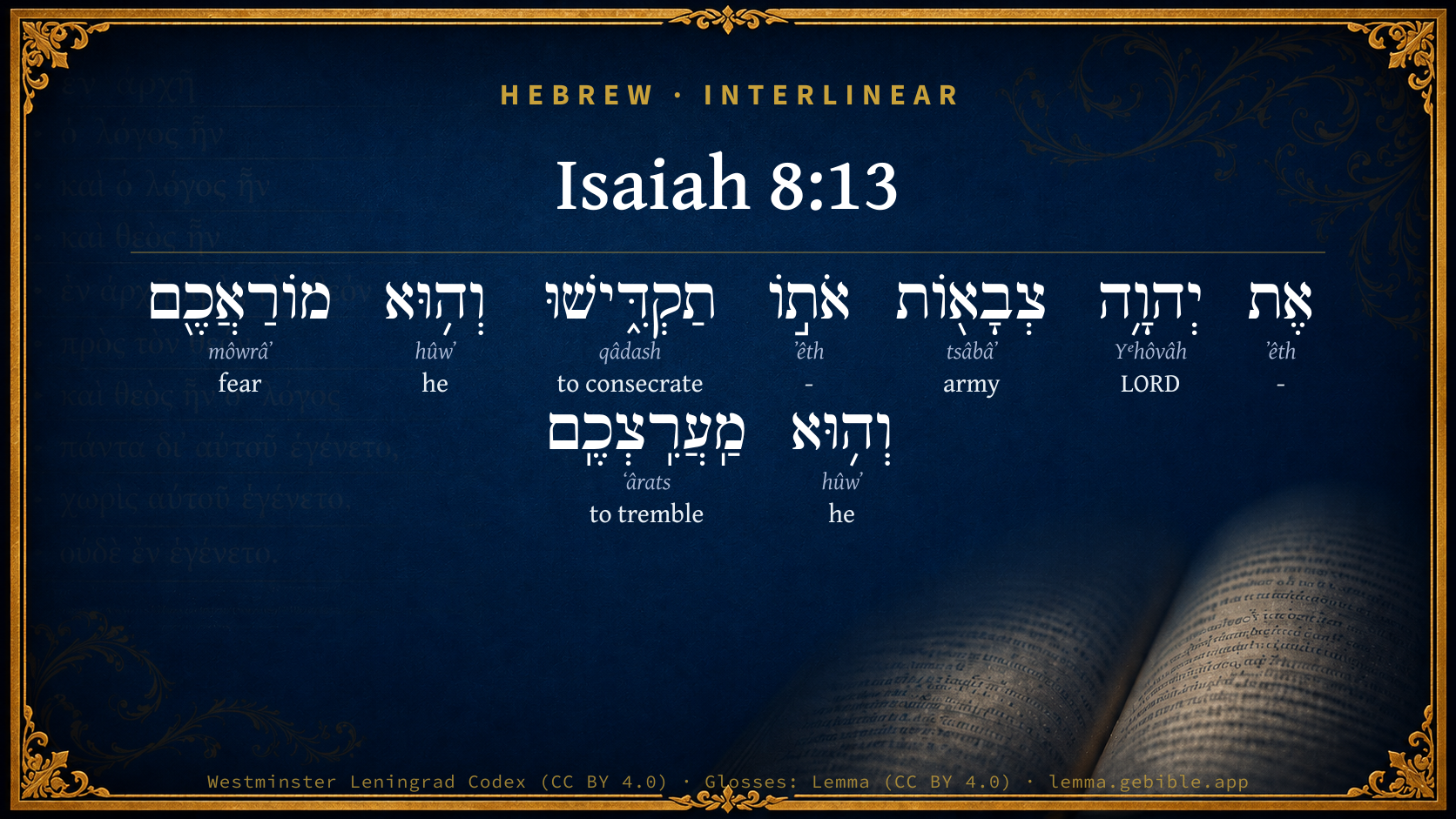
Hebrew (Westminster Leningrad Codex) Isaiah 8:13 appears in the Hebrew Old Testament. The text above is from the Westminster Leningrad Codex. Each word links to its Strong’s number, a concise gloss, and parsing drawn from the Open Scriptures Hebrew Bible morphology. Click any word for its full Brown-Driver-Briggs (BDB) entry.
Download image
Cite this verse

Isaiah 8:13 (World English Bible). Public Domain. Lemma interlinear Bible study tool, https://lemma.gebible.app/v/isaiah/8/13.

Show BibTeX & RIS
BibTeX
RIS
English Translation
Yahweh of hosts, him shall you sanctify; and let him be your fear, and let him be your dread.
World English Bible · Public Domain
Download a study sheet

One document with this verse’s original text, its word-by-word gloss line, the meaning frame, cross-references with their text, attributed commentary, and full source and license credits — printable, and it pastes into notes with its structure intact.

This verse Autodidact and up

Study sheet (.html) Plain text (.txt)

A passage Seminary Student

Up to 50 verses in one chapter. A passage sheet keeps up to 6 commentary sources and 12 cross-references per verse, in the order this page ranks them, and says so on the sheet whenever that leaves anything out. Ask for a single verse and you get the Autodidact verse sheet above.

Everything on this page stays free to read, with no account — the sheet is a download of what is already on screen, not access to it.

Want to remove ads? Support Godless Engineer
Compare translations 3

The same verse in 3 English versions, stacked beneath the original-language interlinear above. Click any original word for its lexicon entry.

Each is an independent rendering of the whole verse — the interlinear is not word-aligned to these translations.

Highlighted words mark where these versions differ — a whole-verse word diff, not a word-by-word alignment.

  • World English Bible Public Domain
    Yahweh of hosts, him shall you sanctify; and let him be your fear, and let him be your dread.
  • King James Version Public Domain
    Sanctify the LORD of hosts himself; and let him be your fear, and let him be your dread.
  • unfoldingWord Literal Text CC BY-SA 4.0
    Yahweh of armies, him you shall sanctify, and he your fear, and he your dread.

unfoldingWord Literal Text — © unfoldingWord, licensed CC BY-SA 4.0. Word-aligned USFM3 via Door43 (git.door43.org/unfoldingWord/en_ult).

Versions to compare (up to 4)

3 of 4 selected

Show all 18 translations

Every available English version of this verse, each an independent rendering of the whole verse.

  • World English Bible Public Domain
    Yahweh of hosts, him shall you sanctify; and let him be your fear, and let him be your dread.
  • Berean Standard Bible Public Domain
    The LORD of Hosts is the One you shall regard as holy. Only He should be feared; only He should be dreaded.
  • Majority Standard Bible Public Domain
    The LORD of Hosts is the One you shall regard as holy. Only He should be feared; only He should be dreaded.
  • King James Version Public Domain
    Sanctify the LORD of hosts himself; and let him be your fear, and let him be your dread.
  • American Standard Version (1901) Public Domain
    Jehovah of hosts, him shall ye sanctify; and let him be your fear, and let him be your dread.
  • Revised Version (1885) Public Domain
    The LORD of hosts, him shall ye sanctify; and let him be your fear, and let him be your dread.
  • Geneva Bible (1599) Public Domain
    Sanctifie the Lord of hostes, and let him be your feare, and let him be your dread,
  • Douay-Rheims (1899) Public Domain
    Sanctify the Lord of hosts himself: and let him be your fear, and let him be your dread.
  • Young's Literal Translation Public Domain
    Jehovah of Hosts -- Him ye do sanctify, And He `is' your Fear, and He your Dread,
  • Literal Standard Version CC BY-SA 4.0
    YHWH of Hosts—Him you sanctify, || And He [is] your Fear, and He your Dread,
  • Unlocked Literal Bible CC BY-SA 4.0
    It is Yahweh of hosts whom you will honor as holy; he is the one you must fear, and he is the one you must dread.
  • unfoldingWord Literal Text CC BY-SA 4.0
    Yahweh of armies, him you shall sanctify, and he your fear, and he your dread.
  • Darby Bible Public Domain
    Jehovah of hosts, him shall ye sanctify; and let him be your fear, and let him be your dread.
  • World Messianic Bible Public Domain
    The LORD of Hosts is who you must respect as holy. He is the one you must fear. He is the one you must dread.
  • Webster's Bible Public Domain
    Sanctify the LORD of hosts himself; and let him be your fear, and let him be your dread.
  • Free Bible Version CC BY-SA 4.0
    The Lord Almighty is the one you should see as holy. He is the one you should fear, he is the one you should be in awe of.
  • Bible in Basic English Public Domain
    But let the Lord of armies be holy to you, and go in fear of him, giving honour to him.
  • JPS Tanakh (1917) Public Domain
    The LORD of hosts, Him shall ye sanctify; and let Him be your fear, and let Him be your dread.

Literal Standard Version (2020), Covenant Press — licensed CC BY-SA 4.0. Text via the HelloAO Bible API (eBible.org). Unlocked Literal Bible (unfoldingWord) — licensed CC BY-SA 4.0. Text via the HelloAO Bible API (eBible.org). unfoldingWord Literal Text — © unfoldingWord, licensed CC BY-SA 4.0. Word-aligned USFM3 via Door43 (git.door43.org/unfoldingWord/en_ult). Free Bible Version, Dr. Jonathan Gallagher — licensed CC BY-SA 4.0. Text via the HelloAO Bible API (eBible.org).

Word by word

More ways to search: Search by grammar → Find every occurrence → Compare this word →

Practice this passage: Drill this verse → Learn its vocabulary →

מוֹרַאֲכֶ֖ם
môwrâʼ
H4172
“fear · your”
Noun, Common, Masculine, Singular, Construct + Suffix, Personal, 2nd Person, Masculine, Plural
Part of Speech
Noun
Type
Common
Gender
Masculine
Number
Singular
State
Construct
Full BDB Definition

Origin: from H3372

TWOT: 907c , 907d

fear, reverence, terror - fear, terror - reverence - object of reverence - awe-inspiring spectacle or deed
  1. אֶת ʼêth H853 “-” Particle, Direct Object
  2. יְהוָ֥ה Yᵉhôvâh H3068 “LORD” Noun, Proper
  3. צְבָא֖וֹת tsâbâʼ H6635 “armies” Noun, Common, Both, Plural, Absolute
  4. אֹת֣וֹ ʼêth H853 “- · him” Particle, Direct Object + Suffix, Personal, 3rd Person, Masculine, Singular
  5. תַקְדִּ֑ישׁוּ qâdash H6942 “to consecrate” Verb, Hiphil, Imperfect, 2nd Person, Masculine, Plural
  6. וְה֥וּא hûwʼ H1931 “and · he” Conjunction + Pronoun, Personal, 3rd Person, Masculine, Singular
  7. וְה֥וּא hûwʼ H1931 “and · he” Conjunction + Pronoun, Personal, 3rd Person, Masculine, Singular
  8. מַֽעֲרִֽצְכֶֽם ʻârats H6206 “trembling · you” Verb, Hiphil, Participle Active, Masculine, Singular, Construct + Suffix, Personal, 2nd Person, Masculine, Plural

About this verse

These counts appear in no published source. They are computed here, from the morphology-tagged text and Lemma’s own curated glosses. What Lemma adds →

9
words
7
distinct lemmas
Prophets
section

Notable vocabulary

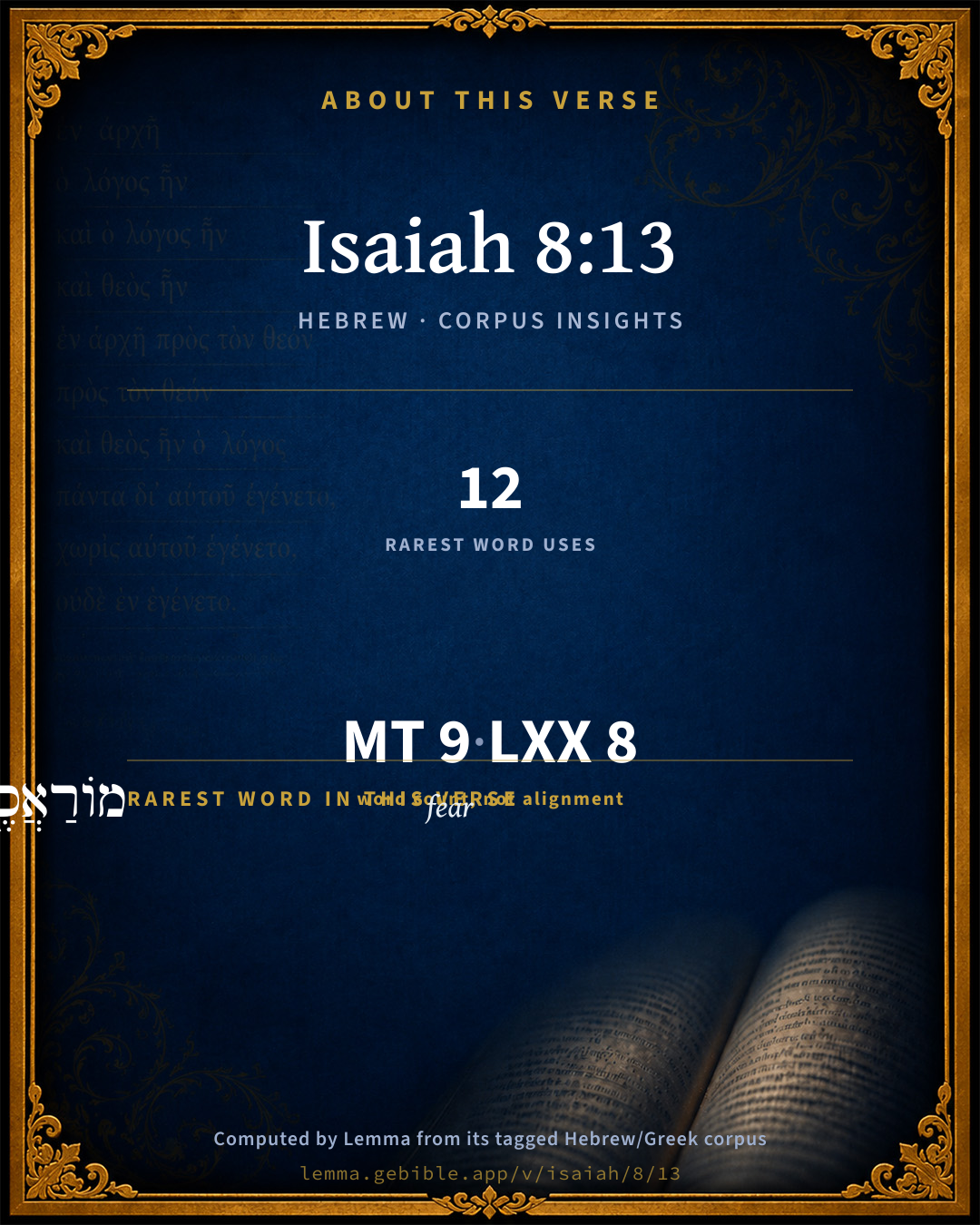
The rarest word here is מוֹרַאֲכֶ֖ם fear H4172 — appearing just 12 times in the whole Hebrew Bible.

Shared distinctive vocabulary

מוֹרַאֲכֶ֖ם fear H4172 occurs in 12 verses of the Hebrew Bible. Also found in:

Grammatical profile

  • 2 verbs
  • 3 nouns
  • 2 pronouns
  • 2 particles

Verb forms

  • תַקְדִּ֑ישׁוּ Hiphil · Imperfect
  • מַֽעֲרִֽצְכֶֽם Hiphil · Participle Active

Repetition

A word recurs within this verse — often emphatic in Hebrew:

  • וְה֥וּא he H1931 ×2

Hebrew & Septuagint length

In English translation the verse runs 19 words from the Hebrew and 11 from the Septuagint (LXX English) — the Septuagint runs noticeably shorter here. See the side-by-side →

A rough comparison of the two English renderings, which tokenize alike — not a word-level alignment.

Word counts can differ between the Hebrew and the Greek without any difference in meaning — e.g. the Hebrew direct-object marker אֵת has no separate Greek word, and Greek often adds the article ὁ.

In the original languages it is 9 Hebrew tokens and 8 Greek tokens — but the two are counted differently (Hebrew bundles its prefixes and suffixes into one token; the Greek is in lemma form), so that isn’t a like-for-like length.

Cross-references

12

Topical passages linked to Isaiah 8:13 in the Treasury of Scripture Knowledge — connected by theme and wording, ordered by reader-vote popularity; previews shown in the World English Bible.

  • Luke 12:5 But I will warn you whom you should fear. Fear him, who after he has killed, has power to cast into Gehenna. Yes, I tell you, fear him.
  • Isaiah 26:3–4 You will keep [him] in perfect peace, [whose] mind [is] stayed [on you]; because he trusts in you.
  • Revelation 15:4 Who wouldn't fear you, Lord, And glorify your name? For you only are holy. For all the nations will come and worship before you. For your righteous acts have been revealed."
  • Matthew 10:28 Don't be afraid of those who kill the body, but are not able to kill the soul. Rather, fear him who is able to destroy both soul and body in Gehenna.
  • Psalms 76:7 You, even you, are to be feared. Who can stand in your sight when you are angry?
  • Malachi 2:5 "My covenant was with him of life and peace; and I gave them to him who he might be reverent toward me; and he was reverent toward me, and stood in awe of my name.
  • Numbers 20:12–13 Yahweh said to Moses and Aaron, Because you didn't believe in me, to sanctify me in the eyes of the children of Israel, therefore you shall not bring this assembly into the land which I have given them.
  • Genesis 31:53 The God of Abraham, and the God of Nahor, the God of their father, judge between us." Then Jacob swore by the fear of his father, Isaac.
  • Isaiah 29:23 But when he sees his children, the work of my hands, in the midst of him, they shall sanctify my name; yes, they shall sanctify the Holy One of Jacob, and shall stand in awe of the God of Israel.
  • Numbers 27:14 because you rebelled against my word in the wilderness of Zin, in the strife of the congregation, to sanctify me at the waters before their eyes. (These are the waters of Meribah of Kadesh in the wilderness of Zin.)
  • Romans 4:20 Yet, looking to the promise of God, he didn't waver through unbelief, but grew strong through faith, giving glory to God,
  • Leviticus 10:3 Then Moses said to Aaron, "This is what Yahweh spoke of, saying, "'I will show myself holy to those who come near me, And before all the people I will be glorified.'" Aaron held his peace.

Cross-references courtesy of OpenBible.info (CC BY 4.0).

Hebrew and Greek witnesses Masoretic Hebrew ↔ Greek Septuagint

The same verse in the two great witnesses to the Old Testament, shown verse-for-verse.

Here the Septuagint runs noticeably shorter than the Hebrew — LXX2012 (modern English Septuagint) 11 words vs World English Bible 19. A rough length comparison of the two English translations, not a word-level alignment — read both below.

These are two independent witnesses, not word-aligned to each other, and the Septuagint is shown in lemma (dictionary) form.

Hebrew Isaiah 8:13 Masoretic · Westminster Leningrad Codex

אֶת יְהוָ֥ה צְבָא֖וֹת אֹת֣וֹ תַקְדִּ֑ישׁוּ וְה֥וּא מוֹרַאֲכֶ֖ם וְה֥וּא מַֽעֲרִֽצְכֶֽם

Yahweh of hosts, him shall you sanctify; and let him be your fear, and let him be your dread.

World English Bible · Public Domain

Greek LXX Isaiah 8:13 Septuagint · lemma form

κύριος αὐτός ἁγιάζω καί αὐτός εἰμί σύ φόβος

Sanctify you⌃ the Lord himself; and he shall be your fear.

LXX2012 (modern English Septuagint) · Public Domain

Hebrew: Westminster Leningrad Codex (CC BY 4.0). Greek: Septuagint (public domain); English from LXX2012 (modern English Septuagint) (Public Domain). How the Septuagint differs from the Hebrew →

Targum (Aramaic paraphrase)

1

The Targum is the ancient Jewish Aramaic paraphrase of the Hebrew Scriptures — an interpretive translation, not the Hebrew text itself. Onkelos (literal) and Pseudo-Jonathan (expansive) render the Torah, and Jonathan the Prophets. Coverage is partial: where no permissively-licensed English translation exists for a verse, only the Aramaic is shown. This is verse-level text, not a word-by-word alignment to the Hebrew.

  1. Targum Jonathan Prophets (Joshua–Malachi)
    יַת יְיָ צְבָאוֹת יָתֵיהּ תֵּימְרוּן קַדִישׁ וְהוּא דְחַלְתְּכוֹן וְהוּא תוּקְפֵכוֹן:

    The Lord of hosts Him shall ye call holy; and let Him be your fear, and let Him be your strength.

    Targum Jonathan — Aramaic: “Mikraot Gedolot” (public domain). English: “Sefaria Community Translation” (CC0 1.0 (public-domain dedication)); “London "Chaldee Paraphrase," 1871” (public domain). Text via Sefaria.

Commentary

Notes on Isaiah 8:13 from classic Christian and Jewish commentators (each source and its license shown beneath its notes). The classic Christian expositions comment on the surrounding passage and are grouped to its opening verse, so a note may address several verses; the Jewish commentaries on the Tanakh (Rashi and others) are per-verse, so they appear only where the commentator wrote on this verse.

Lemma curates 59 commentaries, every one of them public domain or Creative Commons licensed, each selected and text-cleaned for this edition rather than reprinted as found. About our sources →

Trapp's Complete Commentary

John Trapp

Isa 8:13 Sanctify the LORD of hosts himself; and [let] him [be] your fear, and [let] him [be] your dread.

Ver. 13. Sanctify the Lord of hosts himself.] Even your sweetest Immanuel; non sanctificatur autem nisi in eam credatar; sanctify him, I say, by believing in your hearts and confessing with your mouths, {Rom 10:9} and walking "as becometh the gospel, … in nothing terrified by your adversaries." {Php 1:27-28}

And let him be your fear.] That is, the object of your fear, {as Gen 31:53 Psa 76:11} where God is called "Fear" by an appellative proper. So the Chaldee paraphrase frequently calleth God Dechilah. The Greeks call him Yεος, of Dεος, fear. Bernard saith well, God is to be feared as a Lord, honoured as a Father, loved as a spouse. This fear of God is a sovereign remedy against the fear of the creature, and is therefore here and elsewhere opposed to it. Surely, as one fire driveth out another, and as Moses’ serpent swallowed up the sorcerers’ serpents, so here.

John Trapp, A Commentary or Exposition upon All the Books of the Old and New Testament (1647–1656) — public domain. Text from a community e-Sword module.

Joseph Benson's Commentary

Isa 8:13-15. Sanctify the Lord of hosts — Give him the glory of his power, and goodness, and faithfulness, by trusting in his promises for deliverance; and let him be your fear — Let God, and not the kings of Syria and Israel, be the chief object of your fear. And he shall be for a sanctuary — A sure refuge to all that truly fear him, and rely upon him; but for a stone of stumbling — An occasion of sin and ruin, at whom they will take offence, and stumble, so as to fall and be broken, as it is expressed Isa 8:15; to both the houses of Israel — To the two kingdoms, that of the ten tribes, and that of the two tribes. And for a gin, &c., to the inhabitants of Jerusalem — This is distinctly mentioned as a wonderful thing, because Jerusalem was the seat of the temple, and of God’s solemn worship; where all the means of knowledge and grace were in the greatest plenty; where the thrones of civil and ecclesiastical judicature were established; where the most wise and learned doctors had their constant abode. And that such a place and people should reject Immanuel, when he should appear, was so strange an occurrence, that the prediction of it was highly necessary, lest otherwise, when it came to pass, it should shake the faith of all who did believe on him; whereas, now the accomplishment hereof was a notable confirmation of their faith. And many among them — Not all; for there shall be a remnant, as was foretold, Isa 4:2; Isa 6:13; shall stumble — At that stone or rock, mentioned Isa 8:14. The writers of the New Testament, who have so frequently quoted this passage, prove, beyond all controversy, that the subject of it is, God manifest in the flesh; the Messiah, who performed for his people all those benefits of grace which this promise implies, being a sanctuary, or place of refuge to them; and who, at the same time, became to the hypocrites and unbelievers in Judea, a stone of stumbling, and a rock of offence, to the destruction of the far greater part of that people. See the margin.

Joseph Benson's Commentary on the Old and New Testaments (1811–1818) — public domain. Text from a community e-Sword module.

The Preacher's Complete Homiletical Commentary

Joseph S. Exell (gen. ed.)

“HALLOWED BE THY NAME!”

Isa_8:13. Sanctify the Lord of hosts Himself; and let Him be your fear, &c.

I. What is it to “sanctify the Lord of hosts Himself”? It is,

1. To fill our minds with right thoughts concerning Him [854]

2. To fill our hearts with right feelings towards Him (P. D. 1492–1526).

[854] See note (α) to preceding outline: BIBLICAL POLITICIANS.

II. How is this to be done? By frequent, devout, prayerful, intense meditation on the revelations of Himself which He has been pleased to give (H. E. I. 3507–3514).

III. What will be the effect of doing it?

1. All other fear and dread will vanish from our minds (1Sa_14:6; 1Sa_17:37; Jer_32:17; 1Pe_3:14-15).

2. Thus we shall unconsciously and inevitably attain to that heroism of which some of us dream (Psa_16:8; Dan_3:16-18; Act_4:19-20).

3. Thus we shall be qualified for the noblest service of God and man (Heb_11:24-27; 1Co_4:3-4).

4. Thus a divine peace and joy will fill our whole being, as a mighty tide fills every nook and cranny of a wide-stretching bay (Psa_104:34). We shall rejoice in God as a soldier rejoices in a mighty fortress in which he feels secure from all assaults (2Sa_22:2-3).

The Preacher's Complete Homiletical Commentary (gen. ed. Joseph S. Exell; Funk & Wagnalls, c. 1892) — public domain (pre-1929). A full-Bible homiletical/sermon-outline anthology covering 65 of 66 books (2 John is absent from the source module). Text from a community e-Sword module.

Keil & Delitzsch

C. F. Keil & F. Delitzsch

The object of their fear was a very different one. "Jehovah of hosts, sanctify Him; and let Him be your fear, and let Him be your terror. So will He become a sanctuary, but a stone of stumbling and a rock of offence (vexation) to both the houses of Israel, a snare and trap to the inhabitants of Jerusalem. And many among them shall stumble, and shall fall; and be dashed to pieces, and be snared and taken." The logical apodosis to Isa 8:13 commences with v'hâhâh (so shall He be). If ye actually acknowledge Jehovah the Holy One as the Holy One (hikdı̄sh, as in Isa 29:23), and if it is He whom ye fear, and who fills you with dread (ma‛arı̄tz, used for the object of dread, as mōrah is for the object of fear; hence "that which terrifies" in a causative sense), He will become a mikdâsh. The word mikdâsh may indeed denote the object sanctified, and so Knobel understands it here according to Num 18:29; but if we adhere to the strict notion of the word, this gives an unmeaning apodosis. Mikdâsh generally means the sanctified place or sanctuary, with which the idea of an asylum would easily associate itself, since even among the Israelites the temple was regarded and respected as an asylum (Kg1 1:50; Kg1 2:28). This is the explanation which most of the commentators have adopted here; and the punctuators also took it in the same sense, when they divided the two halves of Isa 8:14 by athnach as antithetical. And mikdâsh is really to be taken in this sense, although it cannot be exactly rendered "asylum," since this would improperly limit the meaning of the word. The temple was not only a place of shelter, but also of grace, blessing, and peace. All who sanctified the Lord of lords He surrounded like temple walls; hid them in Himself, whilst death and tribulation reigned without, and comforted, fed, and blessed them in His own gracious fellowship. This is the true explanation of v'hâyâh l'mikdâs, according to such passages as Isa 4:5-6; Psa 27:5; Psa 31:21. To the two houses of Israel, on the contrary, i.e., to the great mass of the people of both kingdoms who neither sanctified nor feared Jehovah, He would be a rock and snare. The synonyms are intentionally heaped together (cf., Isa 28:13), to produce the fearful impression of death occurring in many forms, but all inevitable. The first three verbs of Isa 8:15 refer to the "stone" ('eben) and "rock" (tzūr); the last two to the "snare" (pach), and "trap" or springe (mōkēsh).

(Note: Malbim observes quite correctly, that "the pach catches, but does not hurt; the mokesh catches and hurts (e.g., by seizing the legs or nose, Job 40:24): the former is a simple snare (or net), the latter a springe, or snare which catches by means of a spring" (Amo 3:5).)

All who did not give glory to Jehovah would be dashed to pieces upon His work as upon a stone, and caught therein as in a trap. This was the burden of the divine warning, which the prophet heard for himself and for those that believed.

Keil & Delitzsch — Biblical Commentary on the Old Testament (1861–1891) — public domain (CC PDM 1.0). Text via the HelloAO Bible API. (Old Testament only.)

Tyndale Open Study Notes

Tyndale Open Resources

8:13 To make the Lord . . . holy meant giving him first place in life and acknowledging that nothing is greater than he is. • Fear of God means reverencing him as God (Prov 1:7). The people of Judah were not to fear Israel and Syria or the Assyrians (Isa 7:9; 10:24).

Tyndale Open Study Notes — © Tyndale Open Resources, licensed CC BY-SA 4.0. Text via the HelloAO Bible API.

Geneva Bible (1599)

Geneva Bible translators

In putting your trust only in him, in calling upon him in adversity, patiently looking for his help, and fearing to do anything contrary to his will.

Geneva Bible (1599) marginal notes — public domain. Text via Bolls.life.

Jamieson, Fausset & Brown

Robert Jamieson, A. R. Fausset & David Brown

Sanctify--Honor His holy name by regarding Him as your only hope of safety (Isa 29:23; Num 20:12).

him . . . fear--"fear" lest you provoke His wrath by your fear of man and distrust of Him.

Jamieson, Fausset & Brown — Commentary Critical and Explanatory on the Whole Bible (1871) — public domain (CC PDM 1.0). Text via the HelloAO Bible API.

Ellicott's Commentary for English Readers

(13) Sanctify the Lord of hosts himself . . .—The words contain an implicit appeal to the revelation of the Divine Name in Isa_6:3. Had the prophet’s disciples entered into the meaning of that “Holy, holy, holy, is the Lord of hosts?” Had they learnt to sanctify Jehovah Sabaoth, to recognise the power of that infinite holiness?

A Bible Commentary for English Readers, edited by Charles John Ellicott (1878–1897) — public domain. Text from a community e-Sword module.

The Cambridge Bible for Schools and Colleges

gen. ed. J. J. S. Perowne

13. Render: Jehovah of Hosts, Him shall ye count holy, and let Him be (the object of) your fear and (of) your terror. “Count holy” (Isa_29:23); recognise as the Holy One, especially by absolute trust in His providential disposition of events; fearing only what would offend Him.

The Cambridge Bible for Schools and Colleges (gen. ed. J. J. S. Perowne; Cambridge University Press, 1878–1918) — public domain. Text from a community e-Sword module.

John Gill's Exposition

Sanctify the Lord of hosts himself,.... Christ, Immanuel, God with us, the Lord of the armies above and below, of angels and of men, God over all, the true Jehovah, who is sanctified by his people, when they declare him to be so; as the Targum paraphrases it,

"the Lord of hosts, him shall ye say is holy;''

for they cannot make him so, nor can he receive any holiness from them, nor does he need any; but they celebrate the perfection of his holiness, and ascribe it to him; yea, they sanctify him, by ascribing their holiness to him; by looking to him as their sanctification, and by deriving and expecting every degree and measure of holiness from him, to complete theirs; by exercising faith upon him, and showing a regard to his commands and ordinances:

and let him be your fear, and let him be your dread; that is, the object of fear and dread; not of a servile fear and dread, but of a holy reverence and godly fear; such a fear as is the grace of the covenant, which flows from the goodness of God, and has that for its object, and is influenced by it; see Hos 3:5 where the same Lord, Messiah, David the king, is meant, as here. See Pe1 3:15.

John Gill's Exposition of the Whole Bible (1746–1763) — public domain (CC PDM 1.0). Text via the HelloAO Bible API.

Albert Barnes' Notes on the Bible

Sanctify ... - Regard Yahweh as holy; that is, worship and honor him with pious fear and reverence. Regard him as the source of safety, and the true defense. Ahaz and his people sought for aid from Assyria against the armies of Syria and Samaria. The direction here is rather to seek aid from God.

Let him be your fear - Do not be alarmed at what man can do Isa 8:12, but fear and honor God. Be afraid to provoke his wrath by looking to other sources of help when his aid only should be sought.

Albert Barnes' Notes on the Bible (1834–1885) — public domain. Text from a community e-Sword/MySword module.

Matthew Poole's English Annotations

Sanctify the Lord of hosts; give him the glory of his power, and goodness, and faithfulness, by trusting to his promises for your deliverance.

Let him be your fear; let God, and not the kings of Syria and Israel, be the chief object of your fear.

Matthew Poole's English Annotations on the Holy Bible (1683–1685) — public domain. Text from a community e-Sword/MySword module.

Whedon's Commentary on the Bible

Daniel D. Whedon

13. Sanctify, etc. — Regard Jehovah as immutably true.

Let him be your fear — Literally, He is your fear and your dread; one whom alone you have true occasion to fear as your sovereign, and love as your protector.

Daniel D. Whedon (gen. ed.), Commentary on the Old and New Testaments (1874–1909) — public domain. Text from a community e-Sword module.

The Pulpit Commentary

Sanctify the Lord of hosts. God was sanctified by being believed in. (Num_20:12) They who feared Rezin and Pekah, despite of God"s assurances that their design should fail, did not believe in him, and so did not "sanctify" him.

The Pulpit Commentary (1880–1919), ed. H.D.M. Spence-Jones & Joseph S. Exell — public domain. Text from a community e-Sword module.

John Wesley's Explanatory Notes

Sanctify - Give him the glory of his power, and goodness, and faithfulness, by trusting to his promises. Let him - Let God, and not the kings of Syria and Israel be the object of your fear.

John Wesley, Explanatory Notes Upon the Whole Bible (1754–1765) — public domain. Text via the GEBible commentary corpus.

J. A. Alexander on Isaiah

Joseph Addison Alexander

“Jehovah of Hosts, Him shall ye sanctify (i.e., regard and treat as a Holy God, and as the Holy One of Israel), and He shall be your fear, and He your dread,” (i.e., the object of these feelings). If they felt as they ought towards God, as supreme and almighty, and as their own peculiar God, with whom they were united in a national covenant; they could not so distrust Him as to be alarmed at the approach of any earthly danger. The collocation of the words makes the sentence more emphatic. ‘Him shall ye fear’ is substantially equivalent to ‘Him alone shall ye fear’. Thus explained, the passage is at once a condemnation of the terror inspired by the approach of the two kings, and of the application, which it had occasioned, to Assyria for aid against them.

Joseph Addison Alexander, The Prophecies of Isaiah (1846–1847; New York: Scribner, 1870–1878) — public domain. Text from a community e-Sword module.

Rashi

Rabbi Shlomo Yitzchaki (Rashi)

He gives you strength Heb. (מַעֲרִיצְכֶם).

Rashi on the Tanakh — English translations: “The Judaica Press complete Tanach with Rashi, translated by A. J. Rosenberg” (CC BY 4.0); “Pentateuch with Rashi's commentary by M. Rosenbaum and A.M. Silbermann, 1929-1934” (public domain); “The Metsudah Tanach series, Lakewood, N.J” (CC BY 4.0); and “The Book of Joshua, Metsudah Publications, 1997” (CC BY 4.0). Text via Sefaria.

Ibn Ezra

Rabbi Abraham ibn Ezra

אתו Him is added, although את is before the noun, as in many instances; or it means Him alone. You shall sanctify. That which is holy is usually revered by men; comp. for he is a man of God, he is holy (2 Kings 4:9).

מעריצכם is either an adjective, Your dreadful one, or participle, who in truth makes you fear.

Ibn Ezra on the Tanakh — English translations: “Sefaria Community Translation” (CC0 1.0 (public-domain dedication)); “Yalkut, Sifsei Chachomim Chumash, Metsudah Publications, 2009” (CC BY 4.0); and “Commentary of Ibn Ezra on Isaiah - trans. by M. Friedlander, 1873” (public domain). Text via Sefaria.

Lesson kit

Teaching starters — assembled from the data on this page, not authored interpretation. Every prompt links to the verse data it draws on. Edit before teaching.

Isaiah, in the Prophets, opens this verse with 9 words (7 distinct Hebrew lemmas). Its most distinctive word is môwrâʼ (“fear”). The Greek Septuagint runs shorter here. A historical commentator’s framing appears above. Read the whole chapter for the surrounding context.

Discussion questions

  1. How does “fear” (môwrâʼ) shape what this verse is saying?
  2. How does Genesis 9:2, which shares the word «fear», read alongside this verse?
  3. What does the repetition of “he” (2× in this one verse) do in this verse?
  4. The Septuagint runs shorter here than the Hebrew. What might account for the difference?
  5. The translations on this page render this verse differently — a whole-verse word diff, not a word-by-word alignment. What might account for the different wordings?
  6. «תַקְדִּ֑ישׁוּ» is a Hiphil Imperfect verb. How does that grammatical form shape the action described?
  7. Compare how Trapp's Complete Commentary and Joseph Benson's Commentary read this verse. Where do they agree or differ?

Things to notice

Reading settings

Reading text

Shown beneath each verse's original-language words.

Old Testament
Old Testament edition

Read the OT as the Masoretic Hebrew (MT) or the Greek Septuagint (LXX).

English shown for the Greek Septuagint (in the Hebrew ↔ Greek comparison).

Comparing translations? Open the Compare panel on any verse page to stack up to four side by side.