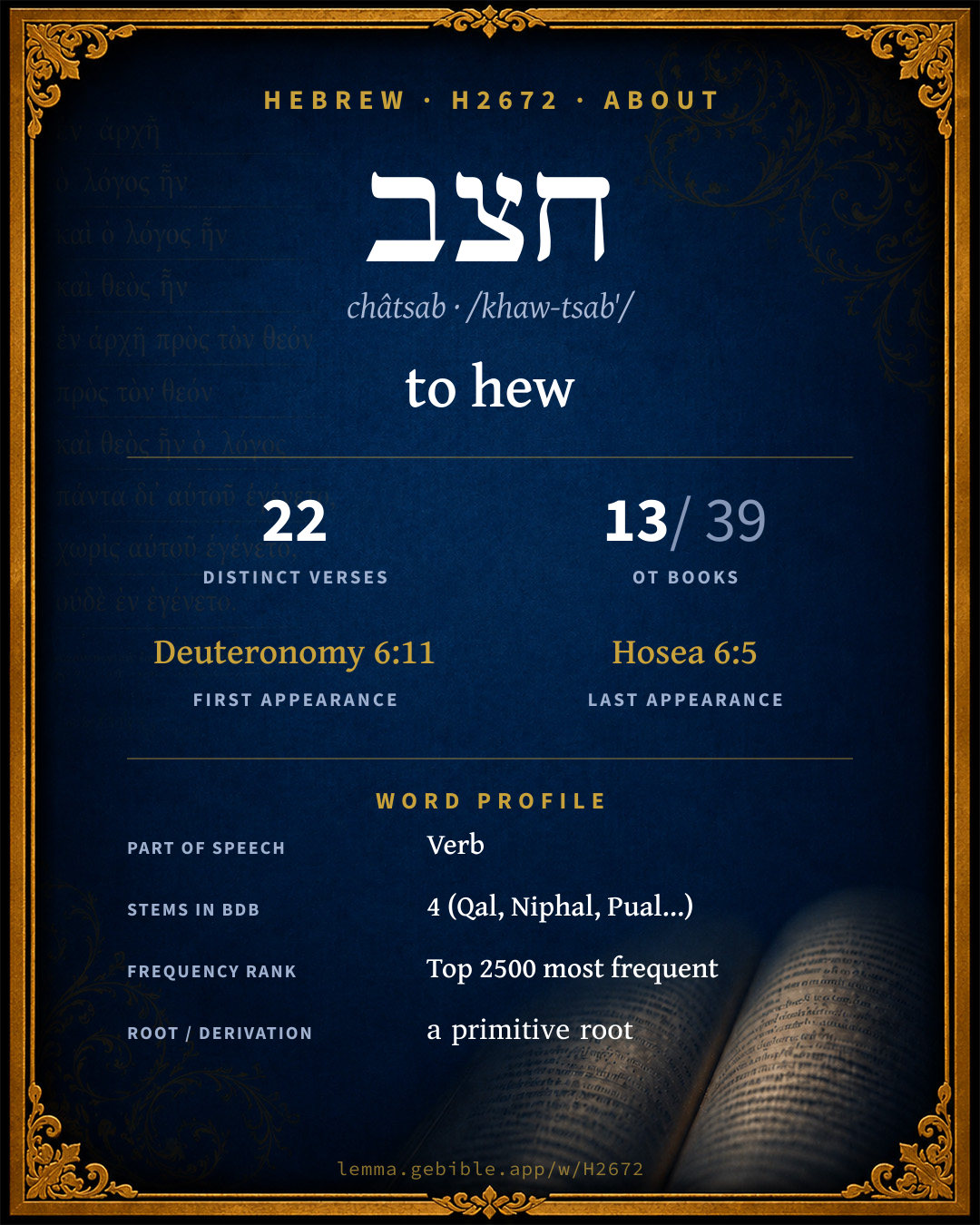
חָצַב
to hew
‘to hew’ is one of 4 main senses fuller range ↓
Full lexicon entry — Brown-Driver-Briggs (BDB)
From Brown-Driver-Briggs (BDB)
Where this word appears
See every Qal verb in the Hebrew Bible →
Grammar key — what these labels mean
Part of speech
- Verb
- An action or state-of-being word.
Stem
- Qal
- The basic, simple active stem — the plain form of the verb (“he wrote”). Here: ‘hew out’
- Hiphil
- The causative active stem (“he caused / brought about”).
- Niphal
- Usually the simple passive or reflexive of the Qal (“he was written”).
- Pual
- The passive counterpart of the Piel.
Form
- Participle Active
- A verbal adjective expressing ongoing or characteristic action (“writing / one who writes”).
- Infinitive Construct
- A bound verbal noun, frequently with prepositions (“to write / in writing”).
- Perfect
- A completed action or state — Hebrew marks aspect (completeness) more than strict tense (“he wrote”).
- Participle Passive
- A verbal adjective expressing action received (“written”).
- Sequential Imperfect
- An imperfect with prefixed waw — the standard past-narrative form (waw-consecutive imperfect).
- Imperfect
- An incomplete, ongoing, or future action (“he will / would write”).
State
- Absolute
- The independent form of a noun, not bound to a following word.
- Construct
- A noun bound to a following noun in a possessive / “of” relationship (the construct chain).
Person
- 2nd Person
- The one addressed (“you”).
- 3rd Person
- The one spoken about (“he / she / it / they”).
- 1st Person
- The speaker (“I / we”).
Gender
- Masculine
- Grammatically masculine.
- Feminine
- Grammatically feminine.
- Common
- Either gender — not distinguished for this form.
Number
- Singular
- One.
- Plural
- More than one (in Hebrew, generally three or more).
Grammatical forms 15 distinct
- Verb, Qal, Participle Active, Masculine, Singular, Absolute 5 times (20%)
- Verb, Qal, Participle Active, Masculine, Plural, Absolute 4 times (16%)
- Verb, Qal, Infinitive Construct 2 times (8%)
- Verb, Qal, Perfect, 2nd Person, Masculine, Singular 2 times (8%)
- Verb, Qal, Participle Passive, Masculine, Plural, Absolute 2 times (8%)
- Verb, Qal, Participle Active, Masculine, Plural, Construct 1 time (4%)
- Verb, Qal, Sequential Imperfect, 3rd Person, Masculine, Singular 1 time (4%)
- Verb, Hiphil, Participle Active, Feminine, Singular, Absolute 1 time (4%)
+7 more forms (7 occurrences)
Parsed forms decoded from the imported morphology (morphhb / Westminster Leningrad Codex — WLC text public domain, morphhb tagging CC BY 4.0), counted across 25 parsed occurrences — not distinct verses.
Every verse where H2672 appears — 22 distinct verses across 13 books. Click any verse to open its interlinear word-by-word view. Verse text shown in the World English Bible for context — . Each verse’s Hebrew form is shown with its reference; the English is not keyword-highlighted, since the data carries no word-level English alignment. Use “Compare translations” on any verse to read it across multiple English versions. This concordance covers the Hebrew Bible; Septuagint (Greek Old Testament) occurrences are not indexed here.
Deuteronomy 2 verses
- Deuteronomy 6:11 חֲצוּבִים֙ חָצַ֔בְתָּ Qal ptcp.pass mp Qal pf 2ms and houses full of all good things, which you didn't fill, and cisterns dug out, which you didn't dig, vineyards and olive trees, which you didn't plant, and you shall eat and be full;
- Deuteronomy 8:9 תַּחְצֹ֥ב Qal impf 2ms a land in which you shall eat bread without scarceness, you shall not lack anything in it; a land whose stones are iron, and out of whose hills you may dig copper.
1 Kings 1 verse
2 Kings 1 verse
1 Chronicles 2 verses
- 1 Chronicles 22:2 חֹֽצְבִ֗ים לַ/חְצוֹב֙ Qal ptcp.act mp prep + Qal inf.cs David commanded to gather together the foreigners who were in the land of Israel; and he set masons to hew worked stones to build the house of God.
- 1 Chronicles 22:15 חֹצְבִ֕ים Qal ptcp.act mp There are also workmen with you in abundance, cutters and workers of stone and timber, and all kinds of men who are skillful in every kind of work:
2 Chronicles 4 verses
- 2 Chronicles 2:2 חֹצֵ֣ב Qal ptcp.act ms Solomon counted out seventy thousand men to bear burdens, and eighty thousand men who were stone cutters in the mountains, and three thousand and six hundred to oversee them.
- 2 Chronicles 2:18 חֹצֵ֣ב Qal ptcp.act ms He set seventy thousand of them to bear burdens, and eighty thousand who were stone cutters in the mountains, and three thousand six hundred overseers to set the people at work.
- 2 Chronicles 24:12 חֹצְבִ֣ים Qal ptcp.act mp The king and Jehoiada gave it to such as did the work of the service of the house of Yahweh; and they hired masons and carpenters to restore the house of Yahweh, and also such as worked iron and brass to repair the house of Yahweh.
- 2 Chronicles 26:10 וַ/יַּחְצֹב֙ conj + Qal wimpf 3ms He built towers in the wilderness, and hewed out many cisterns, for he had much cattle; in the lowland also, and in the plain: [and he had] farmers and vineyard keepers in the mountains and in the fruitful fields; for he loved farming.
Ezra 1 verse
Nehemiah 1 verse
Job 1 verse
Psalms 1 verse
Proverbs 1 verse
Isaiah 5 verses
- Isaiah 5:2 חָצֵ֣ב Qal pf 3ms He dug it up, Gathered out its stones, Planted it with the choicest vine, Built a tower in its midst, And also cut out a winepress therein. He looked for it to yield grapes, But it yielded wild grapes.
- Isaiah 10:15 הַ/חֹצֵ֣ב ptcl def.art + Qal ptcp.act ms Shall the axe boast itself against him who hews therewith? Shall the saw magnify itself against him who wields it? as if a rod should wield those who lift it up, [or] as if a staff should lift up [him who is] not wood.
- Isaiah 22:16 חָצַ֧בְתָּ חֹצְבִ֤י Qal pf 2ms Qal ptcp.act ms cs "What are you doing here? and who has you here, that you have hewed out a tomb here? Cutting him out a tomb on high, chiseling a habitation for himself in the rock!"
- Isaiah 51:1 חֻצַּבְתֶּ֔ם Pual pf 2mp Listen to me, you who follow after righteousness, you who seek Yahweh: look to the rock whence you were hewn, and to the hold of the pit whence you were dug.
- Isaiah 51:9 הַ/מַּחְצֶ֥בֶת ptcl def.art + Hiphil ptcp.act fs Awake, awake, put on strength, arm of Yahweh; awake, as in the days of old, the generations of ancient times. Isn't it you who did cut Rahab in pieces, who pierced the monster?
Jeremiah 1 verse
Hosea 1 verse
About this entry
At a glance — auto-summarized from this page’s data, not written by a person. Every figure links to its source below. This summary describes the numbers; it doesn’t interpret them.
The Hebrew verb חצב centers on the idea of “to hew.” The verb spans 4 stems, from Qal to Niphal. It appears 22 verses across 13 books of the Hebrew Bible, among its uncommon vocabulary. Debuting at Deuteronomy 6:11, it then recurs through the corpus. It shares a root with מחצב. Dig into 22-verse concordance and the renderings breakdown below.
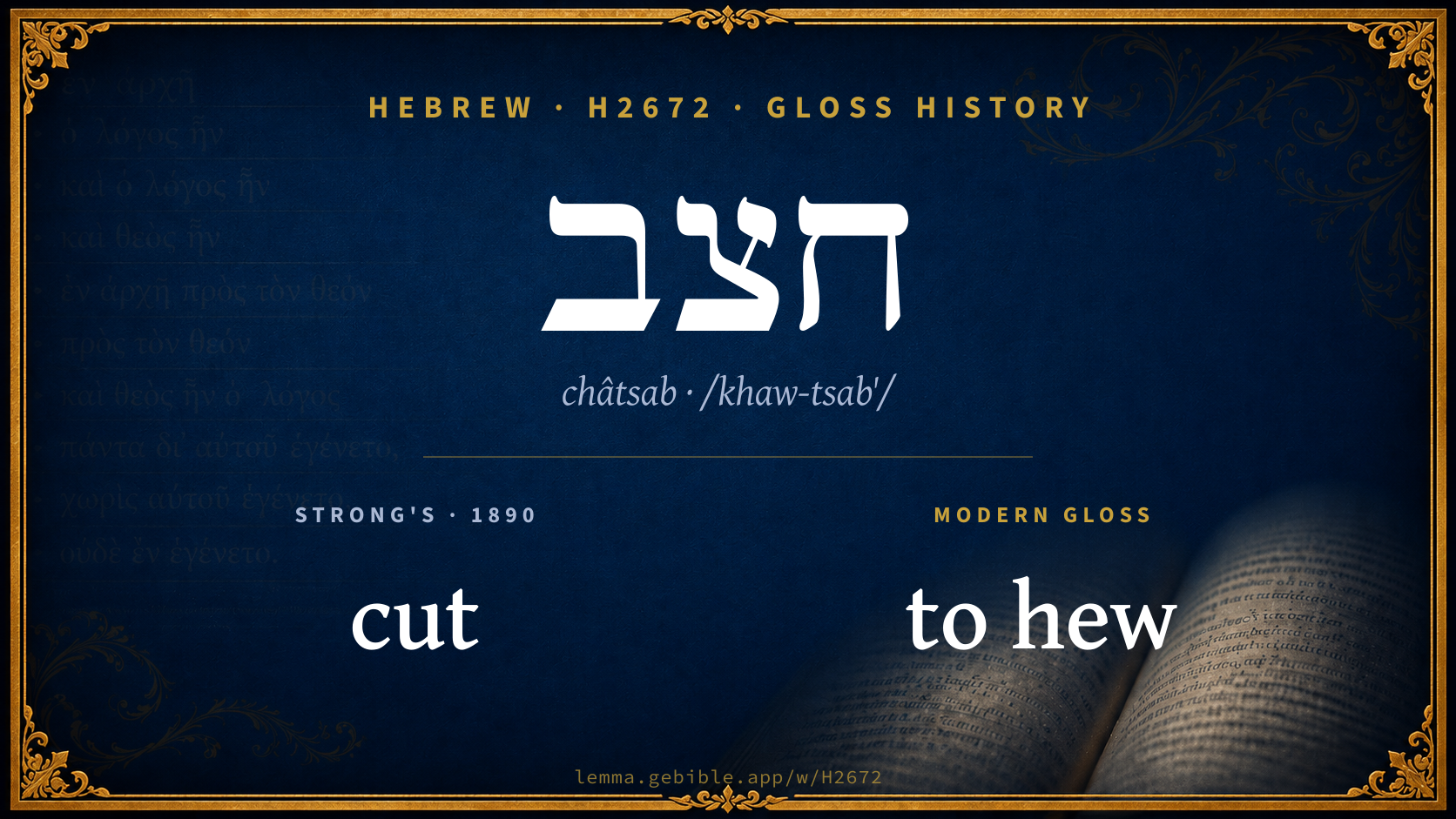
Gloss history
Strong's 1890 vs modern scholarship
About this word
Strong's H2672 catalogs a Hebrew word from the Hebrew Old Testament.
These counts are not copied from any lexicon or concordance. They are computed here, from the morphology-tagged Hebrew Old Testament. What Lemma adds →
- 22
- distinct verses
- The word appears in 22 distinct verses.
- 13 / 39
- OT books
- The word appears in 13 of 39 Old Testament books.
- #1,282
- by frequency
- Top 2500 most frequent Hebrew words (rank 1,282 of 8,640 Hebrew words by occurrence).
View all 22 occurrences in the concordance →
Most concentrated in
- Isaiah 5 verses 23%
- 2 Chronicles 4 verses 18%
- Deuteronomy 2 verses 9%
By section of the Old Testament
By traditional corpus
Conventional, traditional groupings — biblical authorship is debated, so this is a traditional corpus grouping, not an authorship claim. Each share is this word’s portion of its verses in that division of the Hebrew canon. Each figure is a share of the word’s 22 distinct verses.
- Writings (Ketuvim) 11 verses · 50%
- Prophets (Nevi'im) 9 verses · 41%
- Torah (Pentateuch) 2 verses · 9%
How translations render this word
Counts come from each version’s own published word-to-Strong’s tagging or interlinear alignment — an approximate guide to how each version renders this word, not a word-level alignment the data otherwise carries. Because each total is that version’s own tagged count, the per-version totals vary from one another and need not match the appearance or distinct-verse counts above. These counts may also differ from a printed concordance because Lemma counts each distinctly tagged rendering and does not collapse phrase taggings into a single head-word total. This is a fixed set of word-tagged versions (KJV, ASV, BSB, ULT) and does not change with the reading translation you choose elsewhere. Each version’s license is shown beside its name below (and on Sources).
- King James Version: Digged 3×, Hewers 3×, Masons 3×
- American Standard Version: Masons 3×, Hewers 2×, Were hewers 2×
- Berean Standard Bible: Stonecutters 7×, Dug 2×
- unfoldingWord Literal Text: Stonemasons 3×, Cutters 2×, Hewn 2×
King James Version Public Domain
Renders H2672 across 25 tagged occurrences — most commonly:
Plus 14 renderings that appear only once — usually multi-word phrases or single function words the recovered tagging swept in, not distinct renderings.
American Standard Version Public Domain
Renders H2672 across 25 tagged occurrences — most commonly:
Plus 18 renderings that appear only once — usually multi-word phrases or single function words the recovered tagging swept in, not distinct renderings.
Berean Standard Bible Public Domain
Renders H2672 across 24 tagged occurrences — most commonly:
Plus 15 renderings that appear only once — usually multi-word phrases or single function words the recovered tagging swept in, not distinct renderings. Not rendered by a distinct English word in 1 further occurrence.
unfoldingWord Literal Text CC BY-SA 4.0
Renders H2672 across 29 tagged occurrences — most commonly:
Plus 22 renderings that appear only once — usually multi-word phrases or single function words the recovered tagging swept in, not distinct renderings.
8 senses and sub-senses in the full BDB
Hebrew verbs can shift meaning by stem (binyan): Qal is the basic action, Niphal is often passive or reflexive, Piel often intensifies or makes it factitive, and Hiphil is typically causative. The senses below are grouped under the stem BDB assigns to each. This entry also uses Pual (the passive of Piel).
What do BDB’s symbols mean?
BDB uses these scholarly abbreviations:
| Symbol | Meaning |
|---|---|
| 𝔊 | the Septuagint (the ancient Greek translation, LXX) |
| 𝔙 | the Vulgate (the Latin translation) |
| 𝔖 | the Syriac version (the Peshitta) |
| 𝔗 | the Targum (the Aramaic translation) |
| ψ | the Psalms |
| √ | root (the underlying root or stem) |
| ‖ | parallel passage (a synonymous or contrasted parallel) |
| † | the dagger: every passage where the word occurs is cited |
The 8 senses and sub-senses the full Brown-Driver-Briggs lexicon distinguishes for this word, in lexicon order (not ranked by frequency), with BDB’s own verbatim wording and sub-sense lettering. Shown in Hebrew script with BDB’s own scholarly abbreviations. The condensed entry is in the Lexicon Entry tab. See also the Forms in the corpus table below.
Qal
- Pf. חָצֵב Is 5:2; חָֽצְבָה Pr 9:1; חָצַבְתִּי Ho 6:5, etc.; Impf. וַיַּחְצֹב 2 Ch 26:10; 2 ms. תַּחְצֹב Dt 8:9; Inf. cstr. לַחְצֹב Je 2:13; לַחְצוֹב 1 Ch 22:2; Pt. act. חֹצֵב Is 10:15 + 4 times; cstr. חֹצְבִי Is 22:16; חֹצְבִים 1 Ch 22:2 + 3 times; חֹצְבֵי 2 K 12:13; pass. חֲצוּבִים Dt 6:11 Ne 9:25;— e.g. Isaiah 5:2
- 1. hew out, (dig), wine-vat יֶקֶב Is 5:2; sepulchre (קֶבֶר) Is 22:16(×2); cisterns בֹּרוֹת Dt 6:11(×2) 2 Ch 26:10; Ne 9:25, cf. Je 2:13; of mining מהרריה תַּח׳ נחשׁת Dt 8:9 out of its mountains thou mayst hew out copper. e.g. Isaiah 5:2
- 2.
- a. hew stone 1 Ch 22:2; metaph. of pillars Pr 9:1 (subj. wisdom); elsewhere pt., hewer of stone 2 K 12:13; 1 Ch 22:2, 15 (v. SI4.6 supr.); prob. 1 K 5:29; 2 Ch 2:1, 17 (ח׳ בָּהָר v. Be), cf. 24:12; Ezr 3:7. e.g. 1 Chronicles 22:2
- b. appar. hew wood Is 10:15 ח׳ בוֹ (i.e. בְּגַרְזֶן). e.g. Isaiah 10:15
- 3. metaph. hew in pieces Ho 6:5 fig. of י׳ attacking people by agency of prophets (‖ הֲרַגְתִּים); divide, cleave subj. י׳’s voice ψ 29:7 obj. להבות אשׁ, i.e. the thunder of his voice sends forked lightnings (but on text cf. Che and crit. n.) e.g. Hosea 6:5
Niphal
- Impf. יֵחָצְבוּן be cut, hewn, graven (words on rock) Jb 19:24. e.g. Job 19:24
Pual
- Pf. חֻצַּבְתֶּם Is 51:1 fig., hewn out of rock (of Isr.’s origin; ‖ נֻקַּר). e.g. Isaiah 51:1
Hiphil
- Pt. מַחֲצֶ֫בֶת Is 51:9 hew in pieces = Qal 3, fig. of destroying רהב = Egypt (cf. ψ 89:11). e.g. Isaiah 51:9
Senses from the full Brown-Driver-Briggs lexicon (Brown, Driver, Briggs; Oxford 1906 — public domain), digitized via Sefaria, supplemented by the OpenScriptures HebrewLexicon (CC BY 4.0). Full attribution on Sources.
Word origin
vb. hew, hew out, cleave (NH id., Aramaic חֲצַב; SI4.6 pt. pl. החצבם; cf. Ph. מחצב = Heb. id.)—
— Brown-Driver-Briggs (Oxford 1906, public domain), digitized via Sefaria, supplemented by the OpenScriptures HebrewLexicon (CC BY 4.0). See Sources.
Origin: a primitive root
Jastrow Dictionary
A second Hebrew/Aramaic lexicon for comparison, covering Aramaic and post-biblical (Talmudic, Targumic, Midrashic) usage that the biblical-Hebrew BDB does not. Matched by lemma rather than by Strong’s number, so a lemma may carry more than one Jastrow headword (shown separately below), and the entries cover usage well beyond the Bible.
חָצַב
- to cut, chisel, hew, shape. Tosef. Yoma I, 6 כשהוא חוֹצֵב engaged in stone-breaking; Sifra Emor ch. I, Par. 2; Tanḥ. Emor 4 ח׳ אבנים; Lev. R. s. 26 ח׳ באבנים. Y. M. Kat. I, 80ᵈ לא יַחְצוֹב one must not cut stones &c. Yalk. Deut. 854 אתה חֲצוֹב וכ׳ chisel thou the tablets &c.; a. fr.—Part. pass. חָצוּב, f. חֲצוּבָה; pl. חֲצוּבִים, חֲצוּבוֹת. Y. M. Kat. l. c. Y. Shek. VI, 49ᵈ bot.; a. e.
- to be hewn, chiselled. Y. Yoma III, 40ᶜ bot. בקודש יֵחָצֵבוּ on sacred ground they must be chiselled.—Trnsf. (cmp. גזר) to be decided, decreed. Lev. R. s. 5 (ref. to Is. XXII, 16) ממרום נ׳ עליו from on high it has been decreed over him; Yalk. Is. 291 נֶחְצְבָה עליו גזירה. e.g. Isaiah 22:16
חֲצַב
- 1. same.; interch. with חֲצַד q. v.—Part. pass. חֲצִיב, v. חֲצִיבָא.—
- *2. (used of the Cistus) to cut through the ground, to grow. Pes. 111ᵇ, v. חֲצוּבָא II.—[Lev. R. s. 25 ח׳ חצובן, v. חֲצַד I.]
- to be hewn. Targ. Is. LI, 1.
חַצָּב
- (preced. wds.) stone-cutter in the quarry. B. Mets. 118ᵇ הח׳ … לסתת after the stone-cutter has surrendered (the stone) to the polisher; Y. ib. X, 12ᶜ bot. החוֹצֵב לגַמָּל.—Pl. חוֹצְבִין. Y. Shek. VI, 48ᵃ top.
חָצָב
- (preced. wds.) stone pitcher, earthen jug.—Pl. חֲצָבִים, חֲצָבִין. Men. VIII, 7. Kel. II, 2; Tosef. Kel. B. Kam. II, 2.
חֲצָב I
- a species or variety of dates (v. Löw Pfl., p. 109, sq.). Ab. Zar. I, 5 (Y. ed. חצר, with ר). Ib. 14ᵇ, expl. קשבא. Y. ib. I, 39ᵈ bot. חצד, v. חֲצָדָא II. [Maim.: sugar cane, v. Löw l. c.]
חֲצָב II
- (חצב) [cutter,] a shrubby plant, with deep and straight roots, used for hedges to mark boundaries, prob. cistus. B. Bath. 55ᵃ המצר והח׳ וכ׳ a landmark (stone &c.) and the ḥazab form a legal boundary &c. Ib. 56ᵃ, v. חֲצוּבָא I. Tosef. Sabb. XIV (XV), 8; Y. ib. XVIII, 16ᶜ bot; Bab. ib. 128ᵃ מטלטלין את הח׳ וכ׳ you may (on the Sabbath) handle the (cut) ḥ., because it is food for gazelles. Kil. I, 8 חצוב (Ar. חצב).—Pl., v. חֲצוּבָה I.
A Dictionary of the Targumim, the Talmud Babli and Yerushalmi, and the Midrashic Literature (Marcus Jastrow; London, Luzac, 1903) — Public Domain. Digitized via Sefaria. Digitized via Sefaria. Full attribution on Sources.
Forms in the corpus
The 24 distinct written forms H2672 takes in the Hebrew Bible, most frequent first — each parse links to that stem’s occurrences in the concordance. Hebrew forms include their vowel points and cantillation, so a single lemma takes many written forms.
Same root — word family
Other BDB entries built from the same root as H2672, grouped by Strong’s listed origin. These share a root / origin per the lexicon — not necessarily a shared meaning. Each links to that word’s own entry.
Derived from this word
Compare all same-root words → They share a root, not necessarily a meaning.
Septuagint verse parallels
This word appears in 20 verses that also exist in the Greek Old Testament (Septuagint), out of the 22 Hebrew verses it occurs in. You can read those verses in Greek by switching the Old Testament edition to the Septuagint.
Read these verses in the Septuagint
- Deuteronomy 6:11
- 1 Kings 5:15
- 2 Kings 12:12
- 1 Chronicles 22:2
- 2 Chronicles 2:2
- Ezra 3:7
- Job 19:24
- Psalms 29:7
- Proverbs 9:1
- Isaiah 5:2
- Jeremiah 2:13
- Hosea 6:5
This is a verse-level parallel only — the same verses exist in both the Hebrew and Greek Old Testaments. No word-level Hebrew↔Greek correspondence is claimed: the data carries no such alignment, so no Greek word is shown as this Hebrew word’s translation. Coverage is not total — the Septuagint omits the deuterocanon and renumbers the Psalms, so some Hebrew verses have no direct Greek parallel.