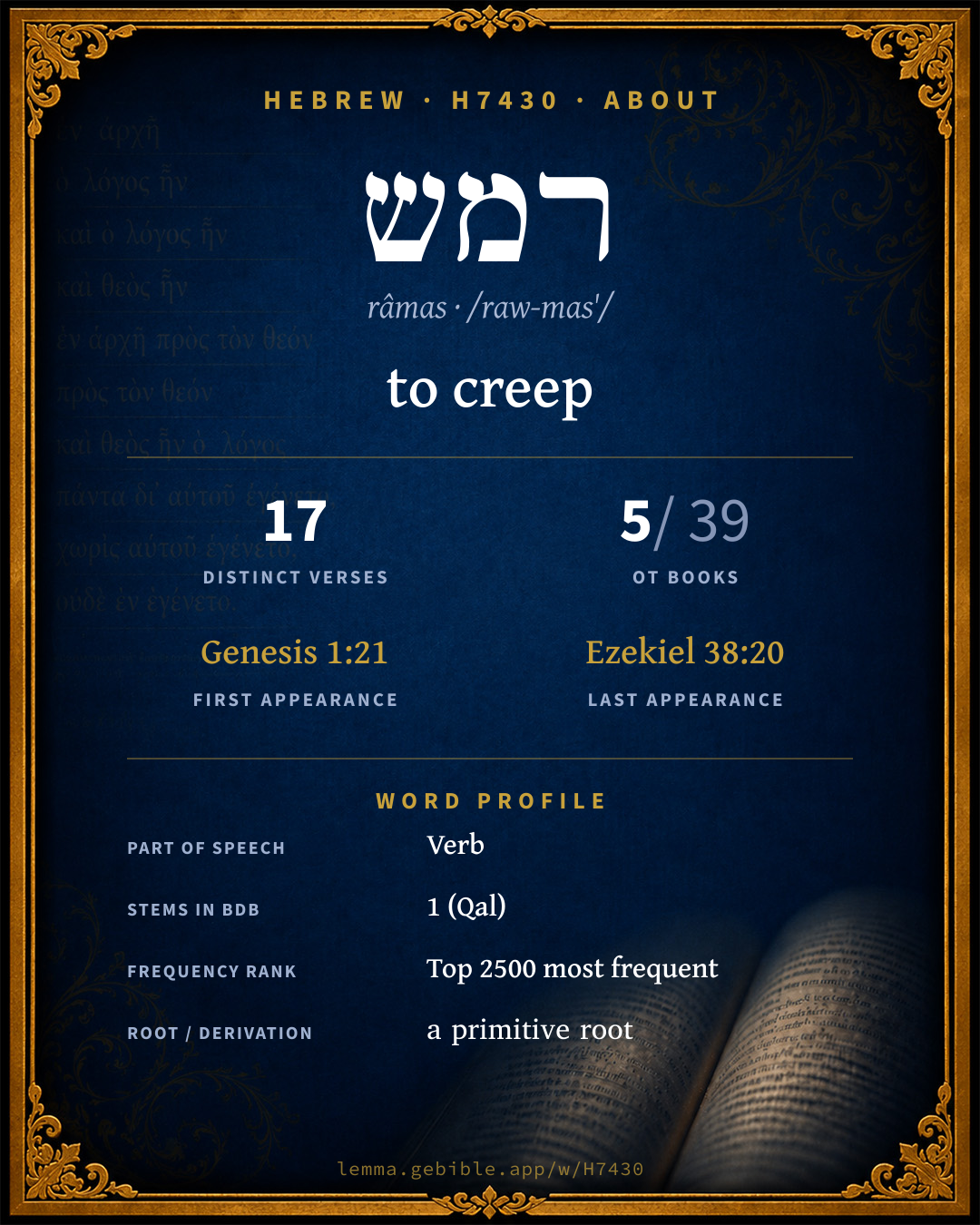
רָמַשׂ
to creep
also: move lightly, move about fuller range ↓
Full lexicon entry — Brown-Driver-Briggs (BDB)
From Brown-Driver-Briggs (BDB)
Where this word appears
Grammar key — what these labels mean
Part of speech
- Verb
- An action or state-of-being word.
Stem
- Qal
- The basic, simple active stem — the plain form of the verb (“he wrote”). Here: ‘subj. ground’
Form
- Participle Active
- A verbal adjective expressing ongoing or characteristic action (“writing / one who writes”).
- Imperfect
- An incomplete, ongoing, or future action (“he will / would write”).
State
- Absolute
- The independent form of a noun, not bound to a following word.
Person
- 3rd Person
- The one spoken about (“he / she / it / they”).
Gender
- Masculine
- Grammatically masculine.
- Feminine
- Grammatically feminine.
Number
- Singular
- One.
Grammatical forms
- Verb, Qal, Participle Active, Masculine, Singular, Absolute 11 times (65%)
- Verb, Qal, Participle Active, Feminine, Singular, Absolute 3 times (18%)
- Verb, Qal, Imperfect, 3rd Person, Feminine, Singular 3 times (18%)
Parsed forms decoded from the imported morphology (morphhb / Westminster Leningrad Codex — WLC text public domain, morphhb tagging CC BY 4.0), counted across 17 parsed occurrences — not distinct verses.
Every verse where H7430 appears — 17 distinct verses across 5 books. Click any verse to open its interlinear word-by-word view. Verse text shown in the World English Bible for context — . Each verse’s Hebrew form is shown with its reference; the English is not keyword-highlighted, since the data carries no word-level English alignment. Use “Compare translations” on any verse to read it across multiple English versions. This concordance covers the Hebrew Bible; Septuagint (Greek Old Testament) occurrences are not indexed here.
Genesis 10 verses
- Genesis 1:21 הָֽ/רֹמֶ֡שֶׂת ptcl def.art + Qal ptcp.act fs God created the large sea creatures, and every living creature that moves, with which the waters swarmed, after their kind, and every winged bird after its kind. God saw that it was good.
- Genesis 1:26 הָֽ/רֹמֵ֥שׂ ptcl def.art + Qal ptcp.act ms God said, "Let us make man in our image, after our likeness: and let them have dominion over the fish of the sea, and over the birds of the sky, and over the cattle, and over all the earth, and over every creeping thing that creeps on the earth."
- Genesis 1:28 הָֽ/רֹמֶ֥שֶׂת ptcl def.art + Qal ptcp.act fs God blessed them. God said to them, "Be fruitful, multiply, fill the earth, and subdue it. Have dominion over the fish of the sea, over the birds of the sky, and over every living thing that moves on the earth."
- Genesis 1:30 רוֹמֵ֣שׂ Qal ptcp.act ms To every animal of the earth, and to every bird of the sky, and to everything that creeps on the earth, in which there is life, I have given every green herb for food." And it was so.
- Genesis 7:8 רֹמֵ֖שׂ Qal ptcp.act ms Clean animals, animals that are not clean, birds, and everything that creeps on the ground
- Genesis 7:14 הָ/רֹמֵ֥שׂ ptcl def.art + Qal ptcp.act ms they, and every animal after its kind, all the cattle after their kind, every creeping thing that creeps on the earth after its kind, and every bird after its kind, every bird of every sort.
- Genesis 7:21 הָ/רֹמֵ֣שׂ ptcl def.art + Qal ptcp.act ms All flesh died that moved on the earth, including birds, cattle, animals, every creeping thing that creeps on the earth, and every man.
- Genesis 8:17 הָ/רֹמֵ֥שׂ ptcl def.art + Qal ptcp.act ms Bring forth with you every living thing that is with you of all flesh, including birds, cattle, and every creeping thing that creeps on the earth; that they may breed abundantly in the earth, and be fruitful, and multiply on the earth."
- Genesis 8:19 רוֹמֵ֣שׂ Qal ptcp.act ms Every animal, every creeping thing, and every bird, whatever moves on the earth, after their families, went forth out of the ark.
- Genesis 9:2 תִּרְמֹ֧שׂ Qal impf 3fs The fear of you and the dread of you will be on every animal of the earth, and on every bird of the sky. Everything that the ground teems with, and all the fish of the sea are delivered into your hand.
Leviticus 3 verses
- Leviticus 11:44 הָ/רֹמֵ֥שׂ ptcl def.art + Qal ptcp.act ms For I am Yahweh your God. Sanctify yourselves therefore, and be holy; for I am holy: neither shall you defile yourselves with any kind of creeping thing that moves on the earth.
- Leviticus 11:46 הָ/רֹמֶ֖שֶׂת ptcl def.art + Qal ptcp.act fs "'This is the law of the animal, and of the bird, and of every living creature that moves in the waters, and of every creature that creeps on the earth,
- Leviticus 20:25 תִּרְמֹ֣שׂ Qal impf 3fs "'You shall therefore make a distinction between the clean animal and the unclean, and between the unclean fowl and the clean: and you shall not make yourselves abominable by animal, or by bird, or by anything with which the ground teems, which I have separated from you as unclean for you.
Deuteronomy 1 verse
Psalms 2 verses
Ezekiel 1 verse
About this entry
At a glance — auto-summarized from this page’s data, not written by a person. Every figure links to its source below. This summary describes the numbers; it doesn’t interpret them.
“to creep” is the headline sense of the Hebrew verb רמש (râmas). More than half of its appearances fall in Genesis. It appears 17 verses across 5 books of the Hebrew Bible, among its uncommon vocabulary. Not a single-sense word: its full sense range also takes in “move lightly” and “move about”. Older and newer Bibles part ways — “creepeth” in the King James Version, “crawls” (Berean Standard Bible) and “moving” (unfoldingWord Literal Text) in modern versions. See the renderings breakdown. See the sense tree, 17-verse concordance, and the renderings breakdown below.
Gloss history
Strong's 1890 vs modern scholarship
About this word
Strong's H7430 catalogs a Hebrew word from the Hebrew Old Testament.
These counts are not copied from any lexicon or concordance. They are computed here, from the morphology-tagged Hebrew Old Testament. What Lemma adds →
- 17
- distinct verses
- The word appears in 17 distinct verses.
- 5 / 39
- OT books
- The word appears in 5 of 39 Old Testament books.
- #1,671
- by frequency
- Top 2500 most frequent Hebrew words (rank 1,671 of 8,640 Hebrew words by occurrence).
View all 17 occurrences in the concordance →
By section of the Old Testament
By traditional corpus
Conventional, traditional groupings — biblical authorship is debated, so this is a traditional corpus grouping, not an authorship claim. Each share is this word’s portion of its verses in that division of the Hebrew canon. Each figure is a share of the word’s 17 distinct verses.
- Torah (Pentateuch) 14 verses · 82%
- Writings (Ketuvim) 2 verses · 12%
- Prophets (Nevi'im) 1 verse · 6%
How translations render this word
Counts come from each version’s own published word-to-Strong’s tagging or interlinear alignment — an approximate guide to how each version renders this word, not a word-level alignment the data otherwise carries. Because each total is that version’s own tagged count, the per-version totals vary from one another and need not match the appearance or distinct-verse counts above. These counts may also differ from a printed concordance because Lemma counts each distinctly tagged rendering and does not collapse phrase taggings into a single head-word total. This is a fixed set of word-tagged versions (KJV, ASV, BSB, ULT) and does not change with the reading translation you choose elsewhere. Each version’s license is shown beside its name below (and on Sources).
- King James Version: Creepeth 5×, Moveth 3×, Every thing that creepeth 2×
- American Standard Version: Moveth 4×, Creepeth 3×, Everything that creepeth 2×
- Berean Standard Bible: Crawls 8×, Moves 3×, Creature that crawls 2×
- unfoldingWord Literal Text: Moving 5×, Moves 4×
King James Version Public Domain
Renders H7430 across 17 tagged occurrences — most commonly:
Plus 7 renderings that appear only once — usually multi-word phrases or single function words the recovered tagging swept in, not distinct renderings.
American Standard Version Public Domain
Renders H7430 across 16 tagged occurrences — most commonly:
Plus 7 renderings that appear only once — usually multi-word phrases or single function words the recovered tagging swept in, not distinct renderings.
Berean Standard Bible Public Domain
Renders H7430 across 16 tagged occurrences — most commonly:
Plus 3 renderings that appear only once — usually multi-word phrases or single function words the recovered tagging swept in, not distinct renderings. Not rendered by a distinct English word in 1 further occurrence.
unfoldingWord Literal Text CC BY-SA 4.0
Renders H7430 across 17 tagged occurrences — most commonly:
Plus 8 renderings that appear only once — usually multi-word phrases or single function words the recovered tagging swept in, not distinct renderings.
Senses in the full BDB
What do BDB’s symbols mean?
BDB uses these scholarly abbreviations:
| Symbol | Meaning |
|---|---|
| 𝔊 | the Septuagint (the ancient Greek translation, LXX) |
| 𝔙 | the Vulgate (the Latin translation) |
| 𝔖 | the Syriac version (the Peshitta) |
| 𝔗 | the Targum (the Aramaic translation) |
| ψ | the Psalms |
| √ | root (the underlying root or stem) |
| ‖ | parallel passage (a synonymous or contrasted parallel) |
| † | the dagger: every passage where the word occurs is cited |
The 6 senses and sub-senses the full Brown-Driver-Briggs lexicon distinguishes for this word, in lexicon order (not ranked by frequency), with BDB’s own verbatim wording and sub-sense lettering. Shown in Hebrew script with BDB’s own scholarly abbreviations. The condensed entry is in the Lexicon Entry tab. See also the Forms in the corpus table below.
Qal
- Impf. 3 fs. תִּרְמֹשׂ Gn 9:2 + 2 times; Pt. רֹמֵשׂ 1:26 +; fs. רֹמֶ֫שֶׂת Lv 11:46 + 2 times;— e.g. Genesis 9:2
- 1. subj. ground, כֹּל אֲשֶׁר ת׳ הָאֲדָמָה all with which the ground creeps (teems), i.e. all creeping things, Lv 20:25 (H), Gn 9:2 (P). e.g. Leviticus 20:25
- 2. elsewhere subj. animal:
- a. creep, עַל־הָאֲדָמָה Dt 4:18; Gn 7:8 (P), עַל־הָאָרֶץ Lv 11:44 (H), Gn 1:30 (P); הָרֶמֶשׂ הָרֹמֵשׂ עַל־הָאֲדָמָה Ez 38:20, עַל־הָאָרֶין Gn 1:26; 7:14; 8:17 (all P). e.g. Deuteronomy 4:18
- b. move lightly, glide about, of water animals, כָּל־נֶפֶשׁ (בַּמַּיִם) הַחַיָּה הָרֹמֶשֶׂת Lv 11:46 (H), Gn 1:21 (P), cf. ψ 69:35. e.g. Leviticus 11:46
- c. in gen. move about, of all land-animals, עַל־הָאָרֶין Gn 1:28; 7:21; 8:19 (all P); specif. of wild beasts prowling at night ψ 104:20. e.g. Genesis 1:28
Senses from the full Brown-Driver-Briggs lexicon (Brown, Driver, Briggs; Oxford 1906 — public domain), digitized via Sefaria, supplemented by the OpenScriptures HebrewLexicon (CC BY 4.0). Full attribution on Sources.
Word origin
vb. creep, move lightly, move about (chiefly P) (Arabic رَمَشَ touch gently (Kam Frey); NH רְמָשִׂים creeping things (rare));—
— Brown-Driver-Briggs (Oxford 1906, public domain), digitized via Sefaria, supplemented by the OpenScriptures HebrewLexicon (CC BY 4.0). See Sources.
Origin: a primitive root
Jastrow Dictionary
A second Hebrew/Aramaic lexicon for comparison, covering Aramaic and post-biblical (Talmudic, Targumic, Midrashic) usage that the biblical-Hebrew BDB does not. Matched by lemma rather than by Strong’s number, so a lemma may carry more than one Jastrow headword (shown separately below), and the entries cover usage well beyond the Bible.
רֶמֶשׂ
- רמש to move, creep) creeping thing, worm, snake &c.—Pl. רְמָשִׂים. Nidd. III, 2; Snh. VIII, 2, v. שֶׁקֶץ. Yalk. Ex. 182 רְמָסִים; a. fr.
רְמַשׁ
- evening. Targ. Gen. I, 5. Targ. Ps. LXV, 9. Targ. Is. XXI, 13 (h. text עֲרָב!); a. fr.—Y. Ber. II, 5ᶜ bot. ברו׳ נחית וכ׳ in the evening he went down to the house of assembly. Ib. IV, 7ᶜ bot. יצלי דר׳ וכ׳ one may say the evening prayer (on the Sabbath), while it is still day-time; a. fr.
A Dictionary of the Targumim, the Talmud Babli and Yerushalmi, and the Midrashic Literature (Marcus Jastrow; London, Luzac, 1903) — Public Domain. Digitized via Sefaria. Digitized via Sefaria. Full attribution on Sources.
Forms in the corpus
The 12 distinct written forms H7430 takes in the Hebrew Bible, most frequent first — each parse links to that stem’s occurrences in the concordance. Hebrew forms include their vowel points and cantillation, so a single lemma takes many written forms.
| Form | Parsing | Example | Uses |
|---|---|---|---|
| הָ/רֹמֵ֥שׂ | Verb, Qal, Participle Active, Masculine, Singular, Absolute | Genesis 7:14 | 3 |
| הָ/רֹמֵ֣שׂ | Verb, Qal, Participle Active, Masculine, Singular, Absolute | Ezekiel 38:20 | 2 |
| רֹמֵ֖שׂ | Verb, Qal, Participle Active, Masculine, Singular, Absolute | Deuteronomy 4:18 | 2 |
| רוֹמֵ֣שׂ | Verb, Qal, Participle Active, Masculine, Singular, Absolute | Genesis 1:30 | 2 |
| הָ/רֹמֶ֖שֶׂת | Verb, Qal, Participle Active, Feminine, Singular, Absolute | Leviticus 11:46 | 1 |
| הָֽ/רֹמֶ֡שֶׂת | Verb, Qal, Participle Active, Feminine, Singular, Absolute | Genesis 1:21 | 1 |
| הָֽ/רֹמֵ֥שׂ | Verb, Qal, Participle Active, Masculine, Singular, Absolute | Genesis 1:26 | 1 |
| הָֽ/רֹמֶ֥שֶׂת | Verb, Qal, Participle Active, Feminine, Singular, Absolute | Genesis 1:28 | 1 |
| רֹמֵ֥שׂ | Verb, Qal, Participle Active, Masculine, Singular, Absolute | Psalms 69:34 | 1 |
| תִ֝רְמֹ֗שׂ | Verb, Qal, Imperfect, 3rd Person, Feminine, Singular | Psalms 104:20 | 1 |
| תִּרְמֹ֣שׂ | Verb, Qal, Imperfect, 3rd Person, Feminine, Singular | Leviticus 20:25 | 1 |
| תִּרְמֹ֧שׂ | Verb, Qal, Imperfect, 3rd Person, Feminine, Singular | Genesis 9:2 | 1 |
Same root — word family
Other BDB entries built from the same root as H7430, grouped by Strong’s listed origin. These share a root / origin per the lexicon — not necessarily a shared meaning. Each links to that word’s own entry.
Derived from this word
Compare all same-root words → They share a root, not necessarily a meaning.
Septuagint verse parallels
This word appears in 16 verses that also exist in the Greek Old Testament (Septuagint), out of the 17 Hebrew verses it occurs in. You can read those verses in Greek by switching the Old Testament edition to the Septuagint.
Read these verses in the Septuagint
This is a verse-level parallel only — the same verses exist in both the Hebrew and Greek Old Testaments. No word-level Hebrew↔Greek correspondence is claimed: the data carries no such alignment, so no Greek word is shown as this Hebrew word’s translation. Coverage is not total — the Septuagint omits the deuterocanon and renumbers the Psalms, so some Hebrew verses have no direct Greek parallel.